[press release]
Indigenous leaders honoured as Australia Post Australian Legends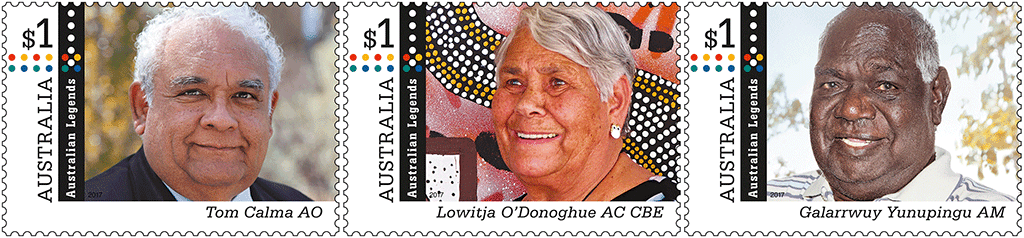 [These stamps were issued May 29th]
Three of Australia’s distinguished Indigenous leaders are being honoured as the 2017 Australia Post Australian Legends, with recipients appearing on commemorative stamps.T hree of Australia’s distinguished Indigenous leaders are being honoured as the 2017 Australia Post Australian Legends, with recipients appearing on commemorative stamps.
Honouring the work of Prof. Thomas Edwin Calma, Dr Lowitja O’Donoghue and Dr Galarrwuy Yunupingu, the award recognises the lifelong advocacy and leadership the Legends have achieved for their communities.
Professor Thomas Edwin “Tom” Calma AO
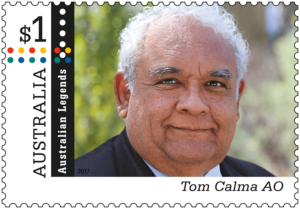 An Aboriginal elder of the Kungarakan people and member of the Iwaidja tribal group, Tom is the first Indigenous man to hold the position of Chancellor of any Australian university – a title he took in 2014 when appointed the sixth Chancellor at the University of Canberra. From 2004 to 2010, Tom was the Aboriginal and Torres Strait Islander Social Justice Commissioner at the Australian Human Rights Commission, and also served as Race Discrimination Commissioner for most of that time. Tom is co-chair of Reconciliation Australia and a director of the Australian Indigenous Leadership Centre. In 2013, he was named ACT Australian of the Year, and in 2012 made an Officer of the Order of Australia in recognition of his work as an inspirational advocate for human rights, social justice and distinguished service to the Indigenous community.
Dr Lowitja O’Donoghue AC CBE
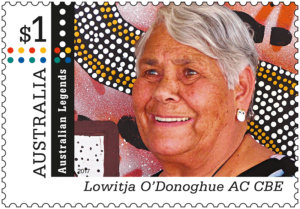 Of Irish and Yankunytjatjara descent, Lowitja is a member of the Stolen Generation. After years of petitioning, Lowitja became the first Aboriginal woman to be accepted into nursing training in South Australia, and finally graduated in 1954. Lowitja continued her active involvement with Indigenous issues by joining the Aboriginal Advancement League to agitate for the rights of Aboriginal people to enter professions and take up apprenticeships. She joined the federal Department of Aboriginal Affairs following the 1967 referendum and for seven years she was the most senior Aboriginal person in public office. Lowitja’s contribution to her community has been recognised with an Order of Australia (1976), Commander of the Order of the British Empire (1983), Australian of the Year award (1985), and a Companion of the Order of Australia (1999). Lowitja is the first and only Aboriginal Australian to address the UN General Assembly.
Dr Galarrwuy Yunupingu AM
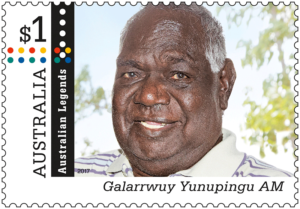 A leader and land rights activist, Galarrwuy first came to prominence in 1970 when he acted as an interpreter for the first litigation on traditional land rights in Australia. The case was instrumental to the passing of the Aboriginal Land Rights (NT) Act in 1976. Galarrwuy’s work has focused on advocacy for traditional land owners to set terms for the mining of Aboriginal land in a way that allows the communities to achieve self-determination and economic independence. In 1978, Galarrwuy was named Australian of the Year, and in 1985 was made a Member of the Order of Australia. In 1997, the National Trust named Galarrwuy an “Australian Living National Treasure”.
Since 1997, the Australia Post Australian Legends Awards has commemorated exceptional people who have made lifetime contributions to the nation’s identity and character.
In years past, Australia Post has awarded Australians who have contributed significantly to their area of expertise, including cricketer Sir Donald Bradman; artist Arthur Boyd; haematologist Donald Metcalf; actress Cate Blanchett; chef Maggie Beer; Victoria Cross recipient Ben Roberts-Smith; and tennis player Patrick Rafter.
Ahmed Fahour, Managing Director & Group CEO, Australia Post, said this year’s award recognises the leadership and advocacy the three recipients have demonstrated over the course of their lives to improve conditions for Indigenous Australians and to bring opportunities to their communities.
“We are pleased to recognise the hard work and unfailing effort our recipients have demonstrated for the betterment of their communities. Our recipients have overcome immense challenges as they have strived for equal representation and agency to ensure a better future for generations to come.
“Australia Post aligns itself as an equal opportunity employer, offering support and genuine pathways into meaningful employment through school-based and adult traineeships and internships for our Aboriginal and Torres Strait Islander community members.
“Australia Post also recognises that 2017 marks the 50th year since the 1967 referendum, when Australians voted overwhelmingly to amend the constitution and provide rights to our First Peoples, so it is fitting that we can honour this occasion with our Australian Legends philatelic issue,” Mr Fahour said.
The Legends Award criteria honours inspirational living Australians who exemplify tenacity, imagination, perseverance, devotion, integrity and compassion.
The 2017 Legends will each feature on a $1 stamp. The products accompanying the stamp issue are a maxicard set, a stamp pack, a booklet of 20 x $1 stamps and a first day cover.
Prof. Thomas Edwin Calma said about receiving the award:
“Advocates like myself never seek the spotlight for the work we do, and while I am acknowledged in the stamp, many who have walked with me share this honour. I am proud, humbled and appreciate that my lifetime work and the achievements of Indigenous advocates and our colleagues are celebrated in such a meaningful way. I hope that occasions like this highlight what is achievable in a lifetime and will encourage greater advocacy for equality. Together we can affect change.” 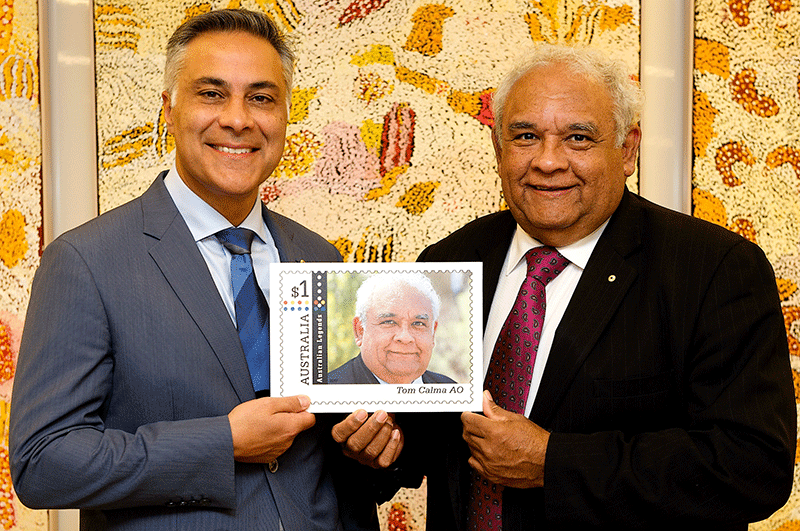
Australia Post’s Ahmed Fahour and Prof. Calma, photo courtesy of Janusz Molinski.
Dr Lowitja O’Donoghue said about receiving the award: “Our work towards equality never stops, and I appreciate that our wider community recognises the changes we have instigated and continue to strive for even today, 50 years from the 1967 Australian Referendum.”
Dr Galarrwuy Yunupingu said about receiving the award: “Advocacy has never been more important for our Indigenous communities, and I’m grateful that our work to address inequality is being recognised and celebrated across the country.”
The stamps and associated products are available at participating Australia Post retail outlets, via mail order on 1800 331 794 and online at www.auspost.com.au/stamps from 29 May 2017 while stocks last.

 On Sunday, May 28th, Israel Post issued a My Own Stamp souvenir sheet commemorating U.S. President Donald Trump’s visit to Israel. It consists of 9 Israeli flag postage stamps with the USA flag and official photos of the visit.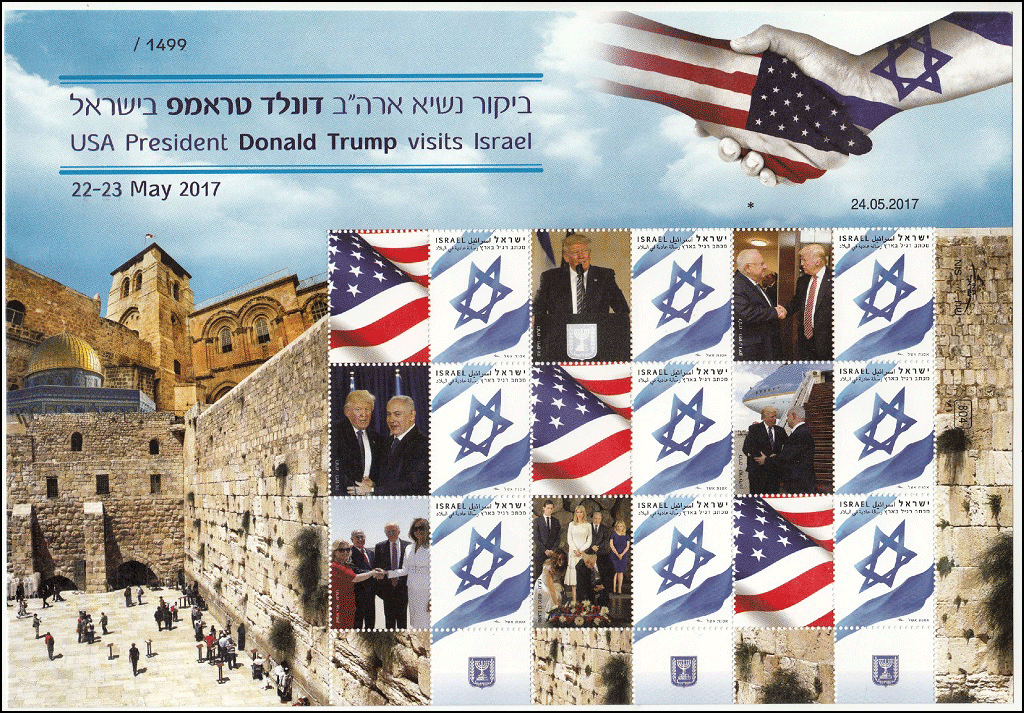
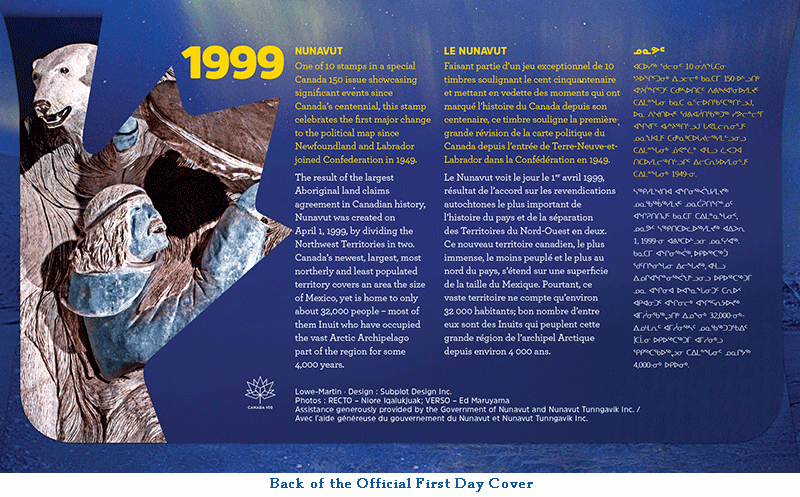
 IQALUIT, NUNAVUT – Nunavut’s Premier, its Commissioner and the Speaker of the legislative assembly unveiled a stamp May 30th that commemorates the creation of the territory of Nunavut in 1999 and celebrates the people who call it home.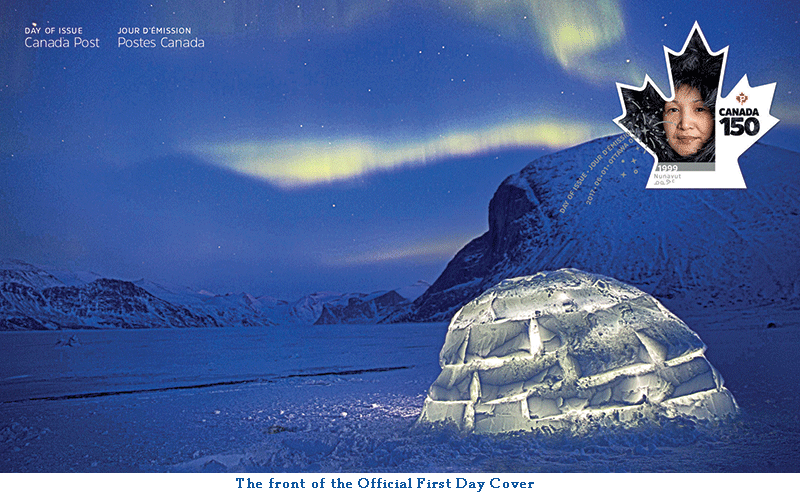
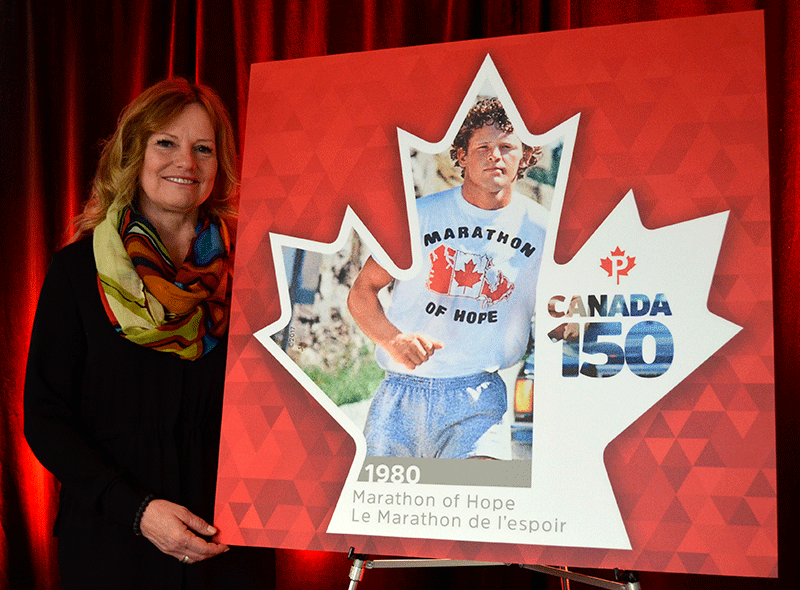
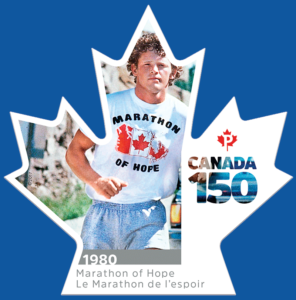 ST. JOHN’S, N.L. – Terry Fox’s sister Judith Fox unveiled a stamp today honouring her brother’s remarkable Marathon of Hope in 1980, which inspired Canadians, captivated a country, and launched a lasting legacy across Canada and around the world.
 OTTAWA – Canada Post May 23 issued an Eid stamp that recognizes Eid al-Fitr and Eid al-Adha, two of the most important festivals celebrated by Muslims in Canada and worldwide.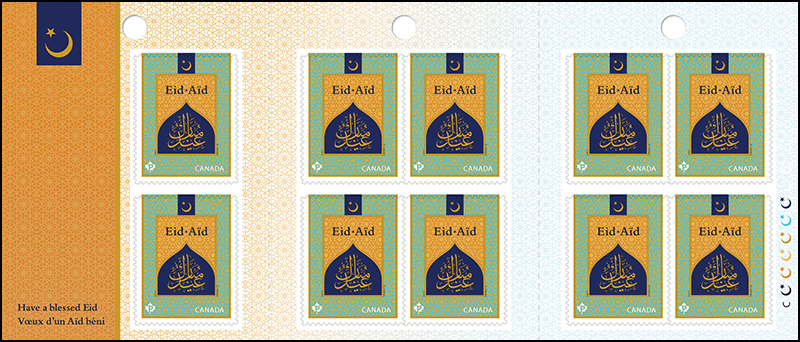
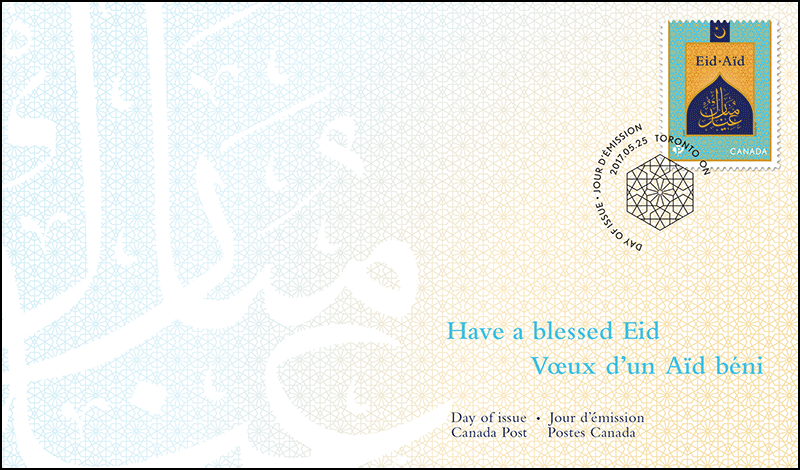
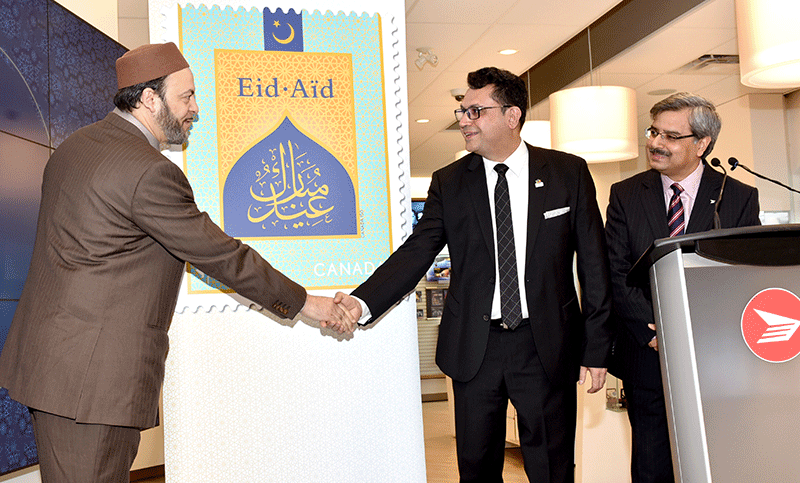 Photo above, the Richmond Hill (Toronto) unveiling, left to right, Dr. Hamid Slimi, Imam, Resident Scholar and Founder of Sayeda Khadija Centre; Majid Jowhari, Member of Parliament for Richmond Hill; Deepak Chopra, President and Chief Executive Officer, Canada Post. Photo Denis Drever/Canada Post
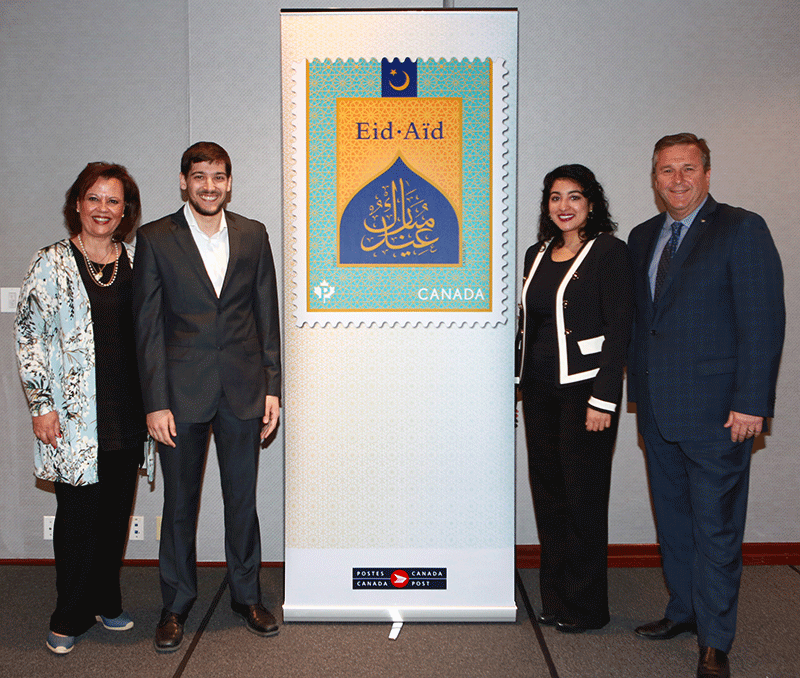 Photo above, the Montreal unveiling, left to right, Alexandra Mendès, Member of Parliament for Brossard-Saint-Lambert; Cheikh Mahdi Tirkawi, Imam of the Al Rawdah mosque and the Laurentian Community Centre; Anju Dhillon, Member of Parliament for Dorval-Lachine-LaSalle; Serge Pitre, Vice-President, Sales, Canada Post. Photo Canada Post
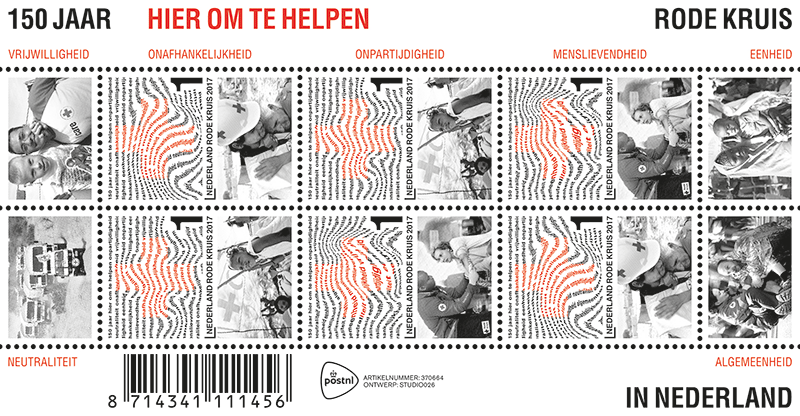 The Hague, 22 May 2017 – PostNL is issuing a new stamp sheetlet commemorating 150 years of the Red Cross. The various stamps refer to the aid organisation’s seven fundamental principles. The black and white photographs show situations in which the Red Cross provides emergency aid and show what the fundamental principles stand for.
 Love is in the air with our June issue…romantic songs and, as it has been known to happen, romantic meetings between Jewish athletes at the Maccabiah!
 The
The 

 When the opening whistle was sounded on March 28th 1932, no one could have anticipated that the 20th Maccabiah would take place in the State of Israel 85 years later, with 10,000 participating athletes from 80 countries, competing in 40 different sports categories, and accompanied by over 20,000 delegates and family members.
 This year, the 20th Maccabiah will mark 50 years of the unification of Jerusalem, the beating heart of Israel. The opening ceremony, which will take place in the Teddy stadium in Jerusalem, will salute the greatest symbols of Jewish identity through the ages.