Updated July 7, 2017: The Scott Catalogue numbers for this issue are
5213 (49¢) Disney Villains – The Queen from Snow White and the Seven Dwarfs
5214 (49¢) Disney Villains – Honest John from Pinocchio
5215 (49¢) Disney Villains – Lady Tremaine from Cinderella
5216 (49¢) Disney Villains – Queen of Hearts from Alice in Wonderland
5217 (49¢) Disney Villains – Captain Hook from Peter Pan
5218 (49¢) Disney Villains – Maleficent from Sleeping Beauty
5219 (49¢) Disney Villains – Cruella De Vil from One Hundred and One Dalmatians
5220 (49¢) Disney Villains – Ursula from The Little Mermaid
5221 (49¢) Disney Villains – Gaston from Beauty and the Beast
5222 (49¢) Disney Villains – Scar from The Lion King
a. Block of 10, #5213-5222
Updated July 7, 2017:
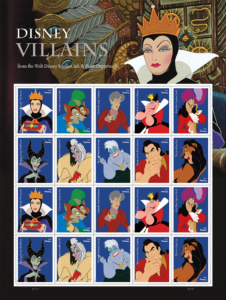 On July 15, 2017, in Anaheim, CA, the U.S. Postal Service® will issue the Disney Villains stamps (Forever® priced at 49 cents), in ten designs, in a pressure-sensitive adhesive (PSA) pane of 20 stamps (Item 475400). The Disney Villains $9.80 pane of 20 stamps may not be split, and the stamps may not be sold individually. The stamps will go on sale nationwide July 15, 2017.
This issuance celebrates the rich legacy of the Walt Disney Studios Ink & Paint Department with a pane of 20 stamps showcasing 10 classic Disney villains: Maleficent (Sleeping Beauty), Honest John (Pinocchio), Cruella De Vil (One Hundred and One Dalmatians), Captain Hook (Peter Pan), the Queen of Hearts (Alice in Wonderland), Lady Tremaine (Cinderella), Ursula (The Little Mermaid), the Queen (Snow White and the Seven Dwarfs), Gaston (Beauty and the Beast), and Scar (The Lion King). The selvage area features the Queen from Snow White standing in front of an ornate background. The reverse side of the pane includes drawings of the 10 characters and a quote by each one. Art Director Derry Noyes of Washington, DC, working closely with Disney Creative Director David Pacheco and the team at the Walt Disney Studios Ink & Paint Department, designed these stamps using new art created for the issuance.
Stamp Fulfillment Services has completed an automatic push distribution to Post Offices of a quantity to cover approximately 30 days of sales. 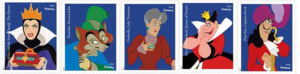 How to Order the First-Day-of-Issue Postmark:
Customers have 60 days to obtain the first-day-of-issue postmark by mail. They may 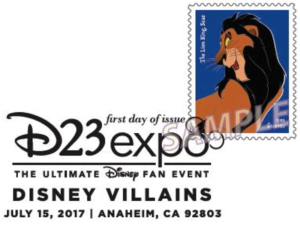 purchase new stamps at their local Post Office, at The Postal Store® website at usps.com/shop, or by calling 800-782-6724. They must affix the stamps to envelopes of their choice, address the envelopes (to themselves or others), and place them in a larger envelope addressed to:
FDOI – Disney Villains Stamps
USPS Stamp Fulfillment Services
8300 NE Underground Drive, Suite 300
Kansas City, MO 64144-9900
After applying the first-day-of-issue postmark, the Postal Service will return the envelopes through the mail. There is no charge for the postmark up to a quantity of 50. There is a 5-cent charge for each additional postmark over 50. All orders must be postmarked by September 15, 2017. 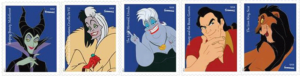 Philatelic products for this stamp issue are as follows:
- 475406, Press Sheet with Die-cut, $58.80
- 475410 Digital Color Postmark Keepsake (random cover), $11.95
- 475416 First-Day Cover (set of 10), $9.30
- 475421 Digital Color Postmark (set of 10), $16.40
- 475430 Ceremony Program, $6.95
- 475433 Panel, $17.95
- 475466 Notecards (set of 20), $15.95
Technical Specifications:
Issue: Disney Villains Stamps
Item Number: 475400
Denomination & Type of Issue: First-Class Mail®, Forever
Format: Pane of 20 (10 designs)
Series: N/A
Issue Date & City: July 15, 2017, Anaheim, CA 92803
Art Director: Derry Noyes, Washington, DC
Designer: Derry Noyes, Washington, DC
Typographer: Derry Noyes, Washington, DC
Artist: Walt Disney Studios Ink & Paint Department
Modeler: Joseph Sheeran
Manufacturing Process: Offset
Printer: Ashton Potter (USA) Ltd. (APU)
Printed at: Williamsville, NY
Press Type: Muller A76
Stamps per Pane: 20
Print Quantity: 60,000,000 stamps
Paper Type: Nonphosphored Type III, Gloss Block Tag
Adhesive Type: Pressure-sensitive
Processed at: Ashton Potter (USA) Ltd. (APU)
Colors: Black, Cyan, Magenta, Yellow, PMS 7687C Purple
Stamp Orientation: Vertical
Image Area (w x h): 1.085 x 1.420 in/27.56 x 36.07 mm
Overall Size (w x h): 1.225 x 1.56 in/31.12 x 39.62 mm
Full Pane Size (w x h): 7.12 x 9.45 in/180.85 x 240.03 mm
Press Sheet Size (w x h): 22.235 x 19.025/564.77 x 483.24 mm
Plate Size: 120 stamps per revolution
Plate Numbers: “P” followed by five (5) digits
Marginal Markings:
Front: Header: DISNEY VILLAINS – from the Walt Disney Studios Ink & Paint Department
Back: ©2017 USPS • USPS Logo • Barcode (475400) • Plate Position Diagram • Promotional Text • Line Drawing and quote for each character • Disney Logo • Disney proprietary information
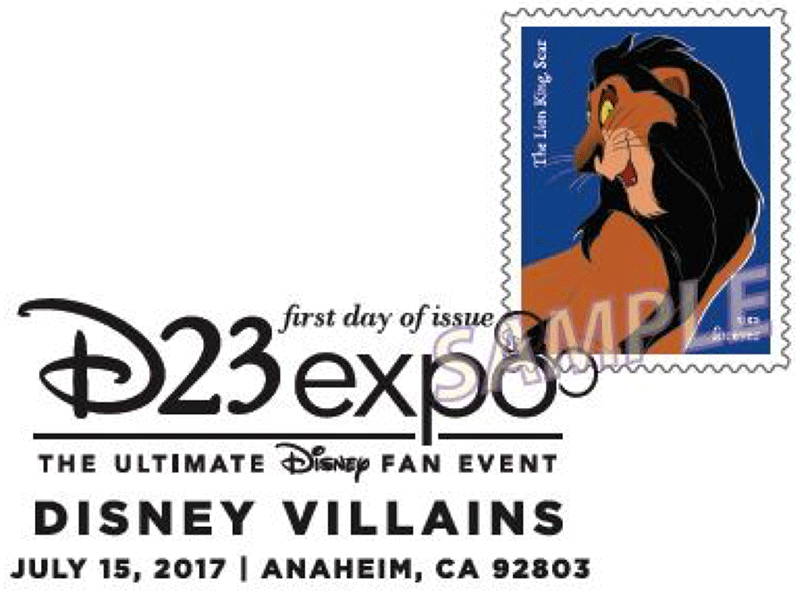
Updated July 6, 2017: There are 10 Digital Color Postmarks for this issue, one for each stamp, but any of the DCPs may be used for any of the stamps! There is also a B&W hand cancel and a “special” postmark that local post offices may use. Here are the designs: 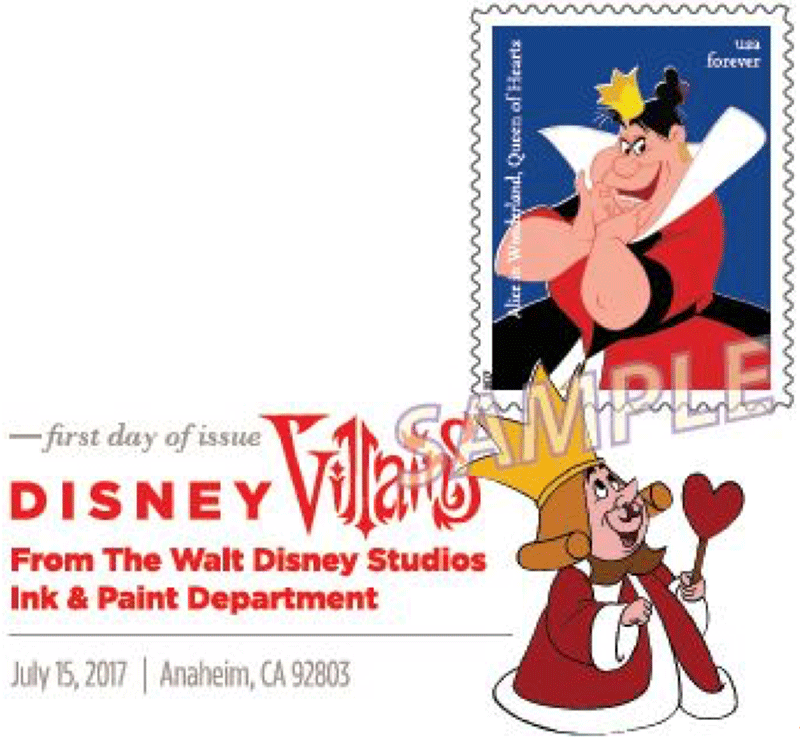 “Alice in Wonderland” measures 2.87″ x 1.47″.
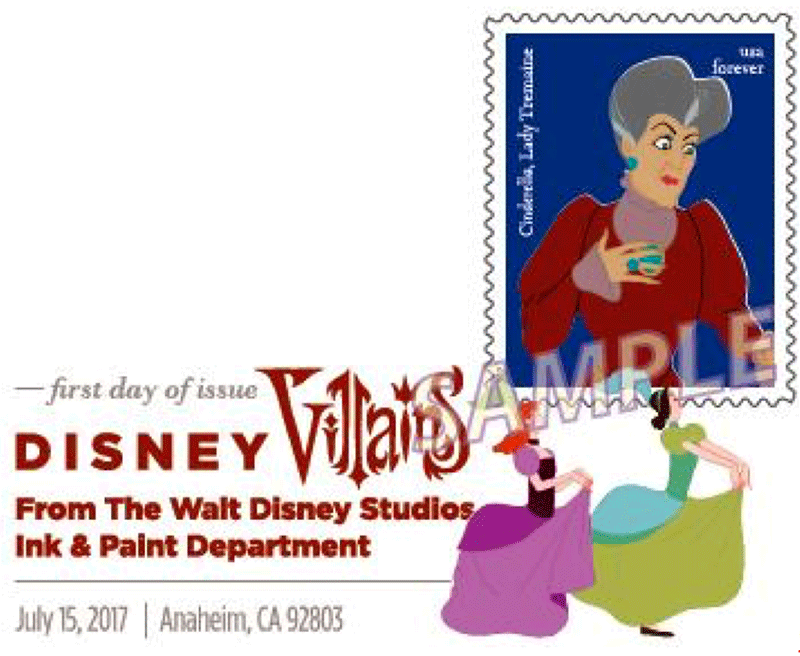 “Cinderella” measures 2.99″ x 1.10″.
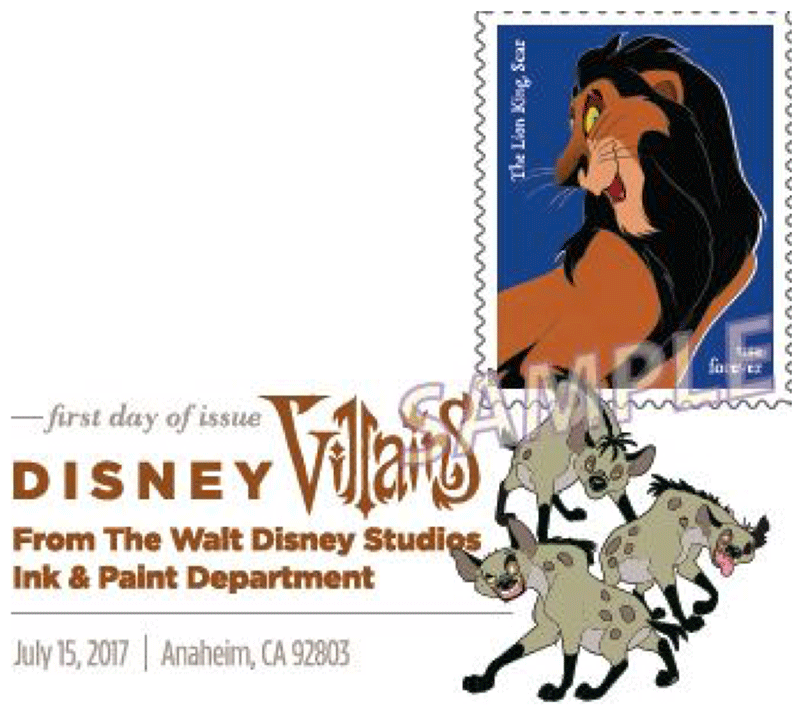 “Lion King” measures 2.97″ x 1.32″.
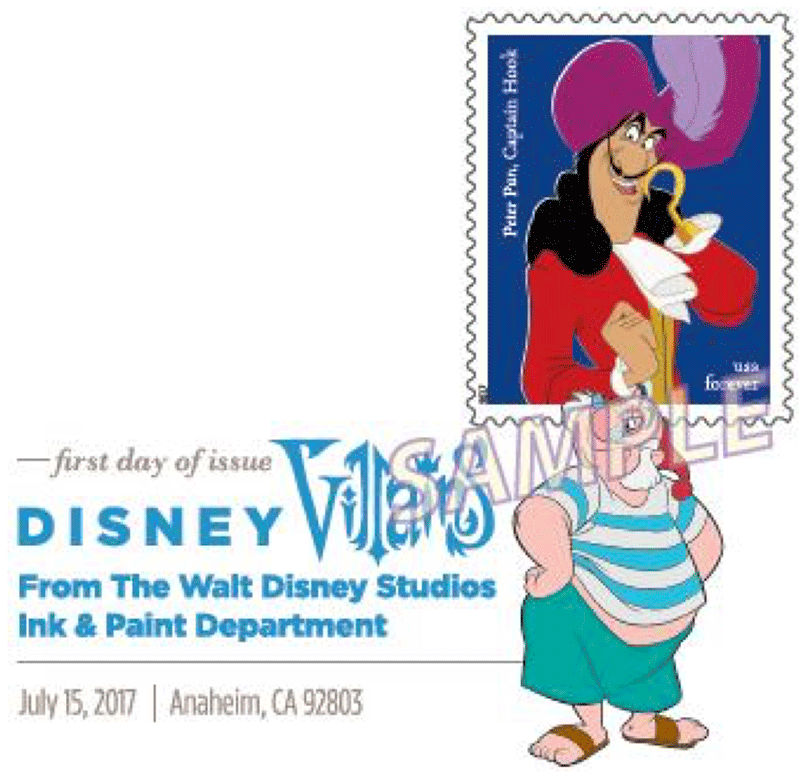 “Peter Pan” measures 2.73″ x 1.48″.
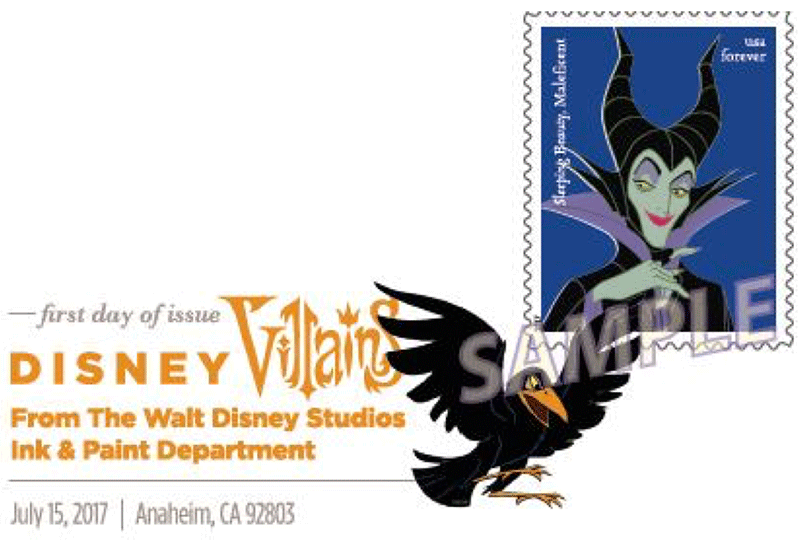 “Sleeping Beauty” measures 2.99″ x 1.15″.
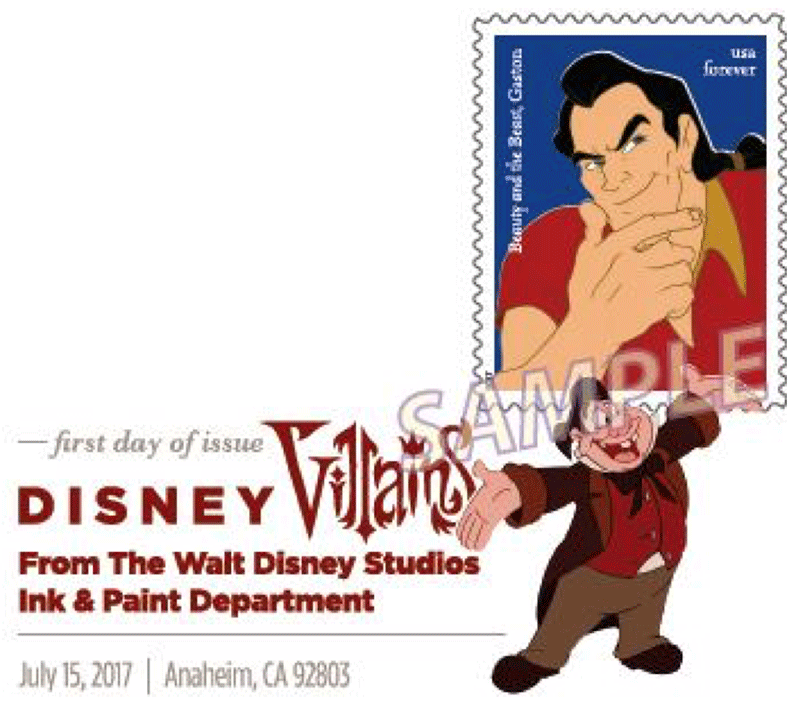 “Beauty and the Beast” measures 2.99″ x 1.32″.
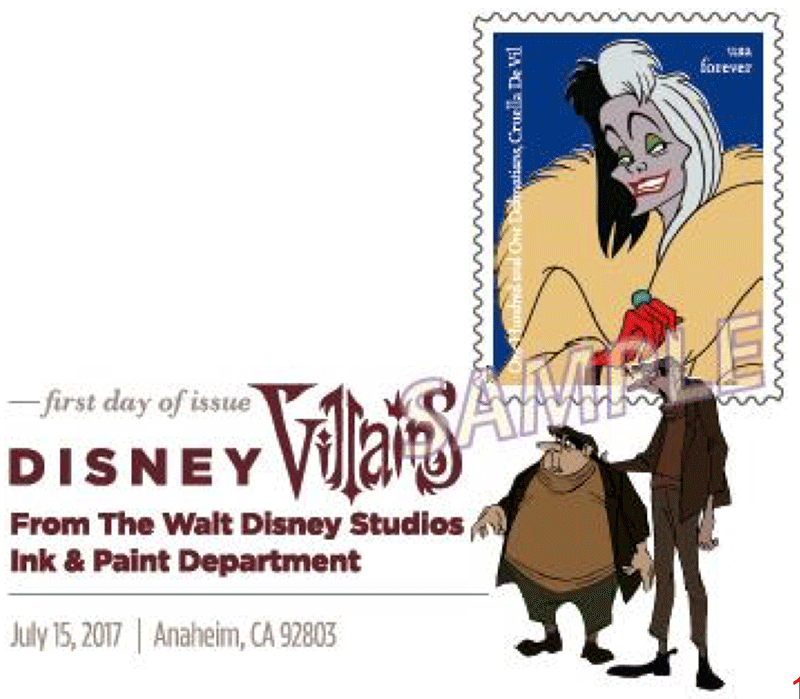 “101 Dalmatians” measures 2.94″ x 1.37″.
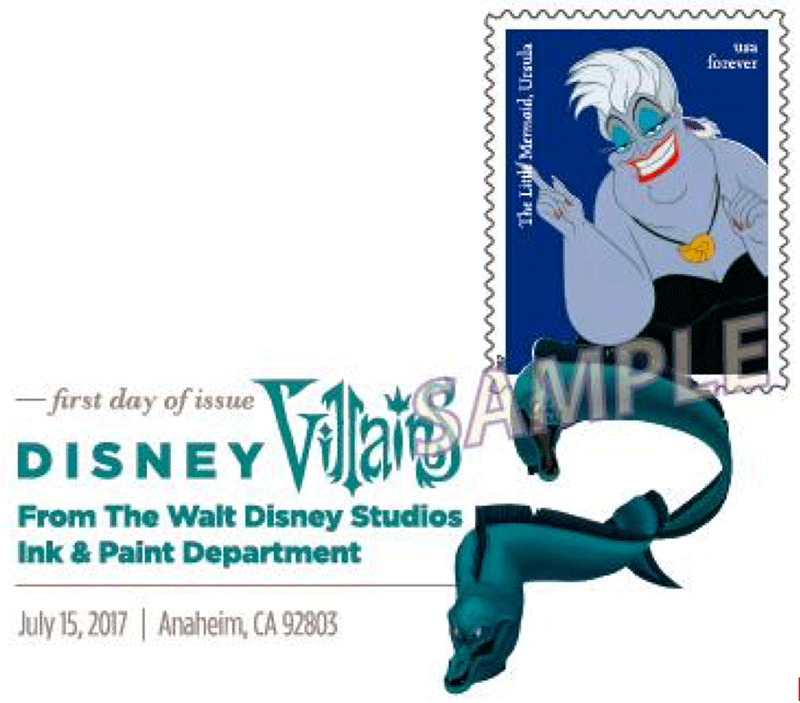 “Little Mermaid” measures 2.98″ x 1.47″.
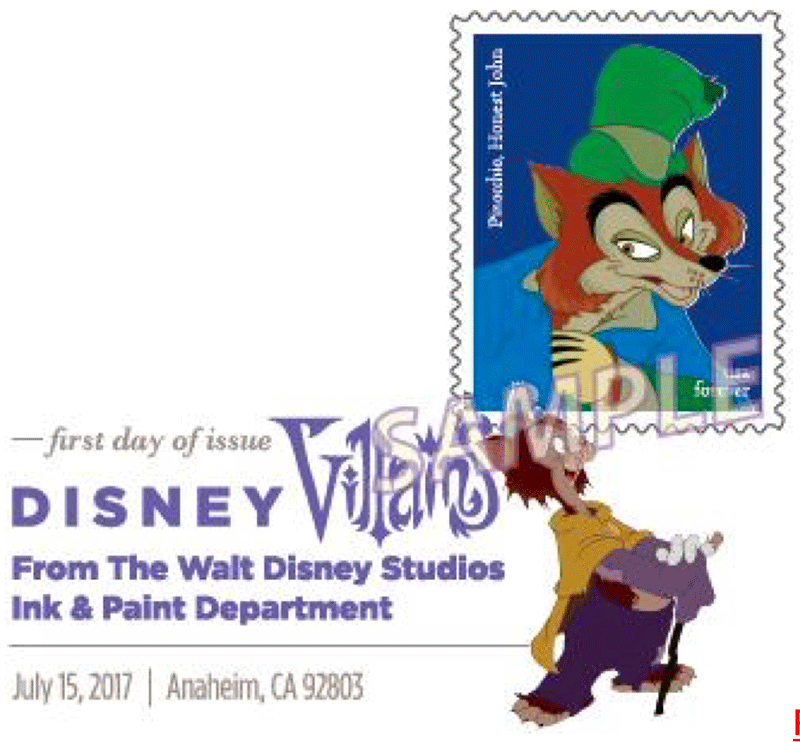 “Pinocchio” measures 2.69″ x 1.32″.
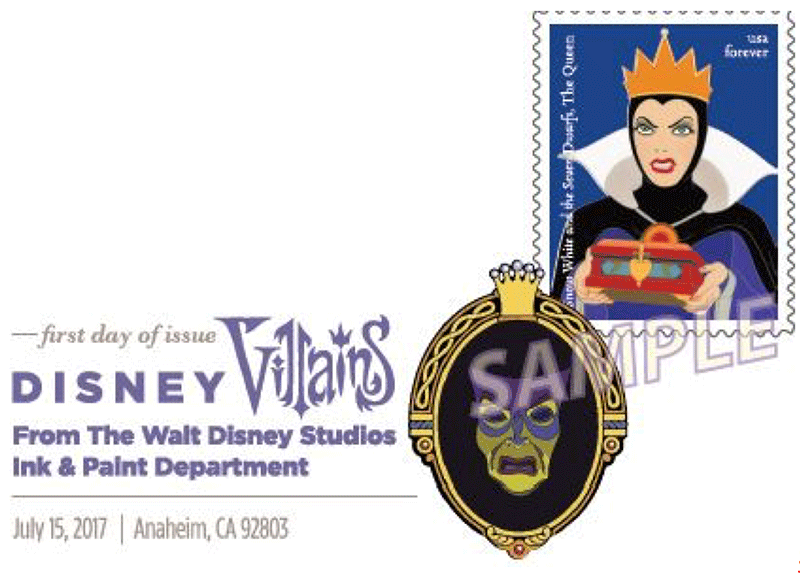 “Snow White” measures 2.97″ x 1.44″.
 The B&W postmark measures 2.57″ x 1.23.”.
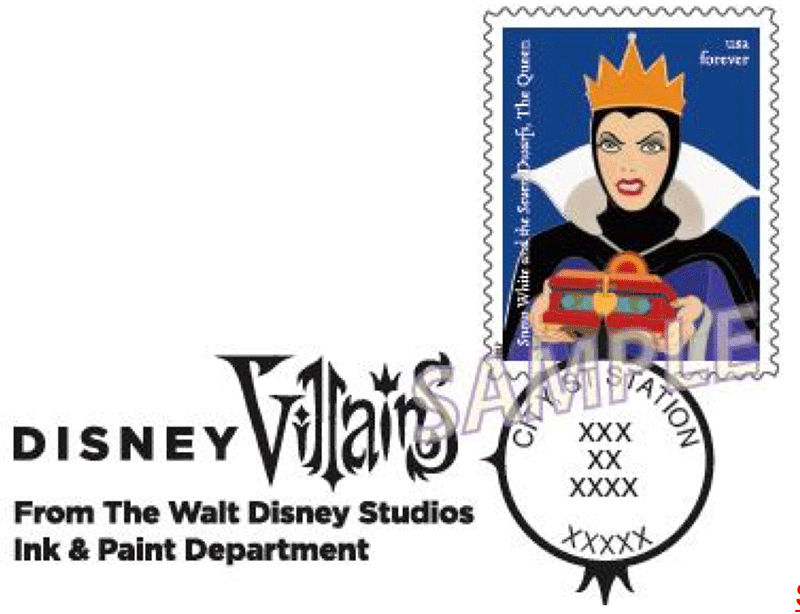 The “special” postmark measures 3.00″ x 1.27″.
Updated July 5, 2017:
According to the USPS web-store listing for this item, “the selvage area features the Queen from Snow White standing in front of an ornate background. The reverse side of the sheet includes drawings of the 10 characters and a quote by each one.”
Maleficent: “You poor simple fools! Thinking you could defeat me, me, the Mistress of All Evil!”
Honest John: “If we play our cards right, we’ll be on easy street, or my name isn’t Honest John!”
Cruella De Vil: “So, they thought they could outwit Cruella.”
Captain Hook: “Blast that Peter Pan!”
Queen of Hearts: “Off with their heads!”
We’re not told if there are quotes for the remaining three characters, Scar, Gaston and Snow White‘s Queen.
Thanks to Richard Wierzbowski for the tip.
[USPS press release]
Disney Studios Ink & Paint Department to be Celebrated on Forever Stamps Featuring Disney Villains
WASHINGTON — The U.S. Postal Service celebrates the rich legacy of the Walt Disney Studios Ink & Paint Department by dedicating a sheet of 20 Forever stamps featuring 10 classic Disney villains.
The Disney Villains Forever stamps will be dedicated at 1:30 p.m. PDT July 15, during D23 Expo 2017, Disney’s ultimate fan event at the Anaheim Convention Center, Center Stage. The public is encouraged to share the news on social media using the hashtag #DisneyVillainsStamps. Beginning June 22, the stamps may be pre-ordered at usps.com/shop for delivery shortly after the July 15 issuance.
Admission is limited to the ceremony that is standing room only. You may RSVP at www.usps.com/disney; however, this does not guarantee admission. Additional instructions will be provided. D23 Expo 2017 ticket holders do not need to RSVP. 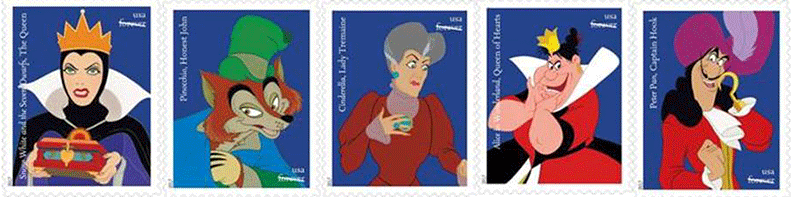 Each stamp showcases one of 10 classic Disney villains against a blue background: the Queen (Snow White and the Seven Dwarfs), Honest John (Pinocchio), Lady Tremaine (Cinderella), the Queen of Hearts (Alice in Wonderland), Captain Hook (Peter Pan); and
 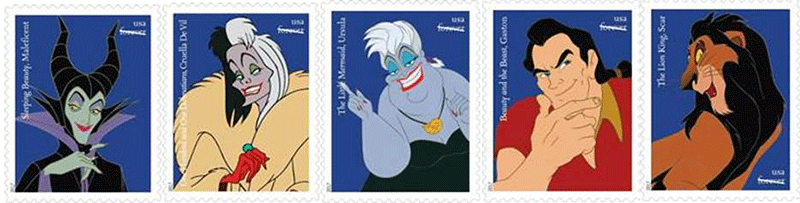 Maleficent (Sleeping Beauty), Cruella De Vil (One Hundred and One Dalmatians), Ursula (The Little Mermaid), Gaston (Beauty and the Beast) and Scar (The Lion King).
The words “USA” and “Forever” appear in the top right corner or bottom right corner of each stamp and the name of the classic villain and the movie in which the character appears runs along the left edge.
The Art of Animation
Beginning in 1923, Disney’s Ink & Paint Department helped create classic animated films. Its artists brought life to countless memorable characters, including many iconic Disney villains.
One of the first groups of its kind, Disney’s Ink & Paint Department was yet another stop on the road to creating an animated film. After the animators’ pencil drawings were finished, they went to Ink and Paint. There, highly specialized artists meticulously recreated each pencil line in ink, capturing every nuanced movement and expression. At first, artists used black and white, and later shades of gray to “color” each celluloid or cel. In the early 1930s, the artists began using rich colors on the animation cels.
The last full-length animated Disney film to use the hand-painted cel process was The Little Mermaid (1989). Beauty and the Beast (1991) and The Lion King (1994) were hand drawn. The original pencil drawings for those films were then scanned and painted digitally. For these stamps, the characters Gaston (Beauty and the Beast) and Scar (The Lion King) have been recreated using traditional ink and paint techniques.
Art director Derry Noyes of Washington, DC, designed the issuance.
The Disney Villains from the Walt Disney Studios Ink & Paint Department stamps are being issued as Forever stamps that are always equal in value to the current First-Class Mail service one-ounce price.

 Elliot Gruber, the chief development and external affairs officer for the Jewish Social Service Agency, has been named director of the National Postal Museum, effective Sept. 5.
 5201 3¢ Strawberries coil
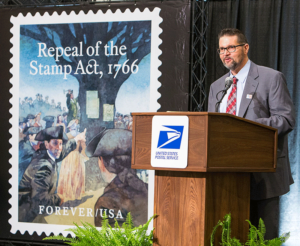 At a “town hall” meeting at the NAPEX show in suburban Washington, D.C., June 9, 2017, American Philatelic Society executive director Scott English talked about the diminishing membership, not only in the APS, but in stamp collecting organizations in general.
 English told the collectors at the NAPEX session the APS may get involved in the Regency-Superior bankruptcy case. That was a large philatelic auction house and retail stamp seller with headquarters in Saint Louis. A major creditor has seized the assets of the firm, and those who consigned stamps and covers to Regency-Superior for sale may not be paid.
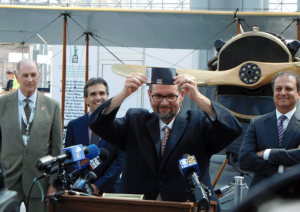 English gives “all credit” to Robert A. Siegel Auctions for getting the most possible for the American Philatelic Research Library for the recently-recovered inverted Jenny airmail stamp. “That stamp should have sold for about $180,000,” English said. “It’s probably the most expensive reperfed stamp ever!”
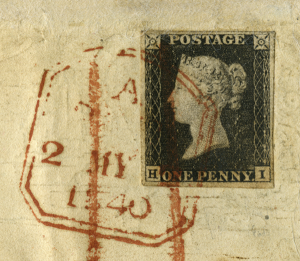 The world’s oldest stamp dealership, Stanley Gibbons, has put itself up for sale, according to a report by the
 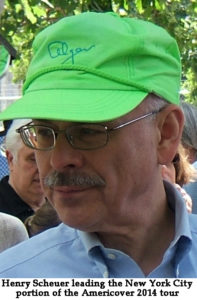 Henry B. Scheuer’s article titled “Kansas-Nebraska Overprint Stamps: Why, Where, and When They Were Initially Sold” was selected as the 2016 winner of the United States Stamp Society/Barbara R. Mueller Award for the best article published in a single year of The American Philatelist. The award will be presented at the APS StampShow Celebration Banquet 2017 on August 5 in Richmond, Virginia.
 The American Philatelic Society is recognizing Ed Andrews, Jack Congrove, Dawn Hamman, Ed & Judy Jarvis, and David McNamee for National Service to Philately, and Ed Laveroni, Sharon Newby, Gerald Nylander, Guy Purington, Roger Rhoads, Charles Shoemaker, Norm Shufrin, Roger Skinner, Tim Wait, and Ann Wood for Local Service.
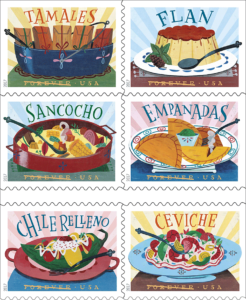 5192 (49¢) Delicioso booklet stamp – Tamales
 RICHMOND, B.C. – Canadian Paralympic and Olympic greats unveiled the final two Canada 150 stamps June 1 at a special ceremony honouring Canada’s athletes and the country’s success in hosting the Paralympic and Olympic Games.
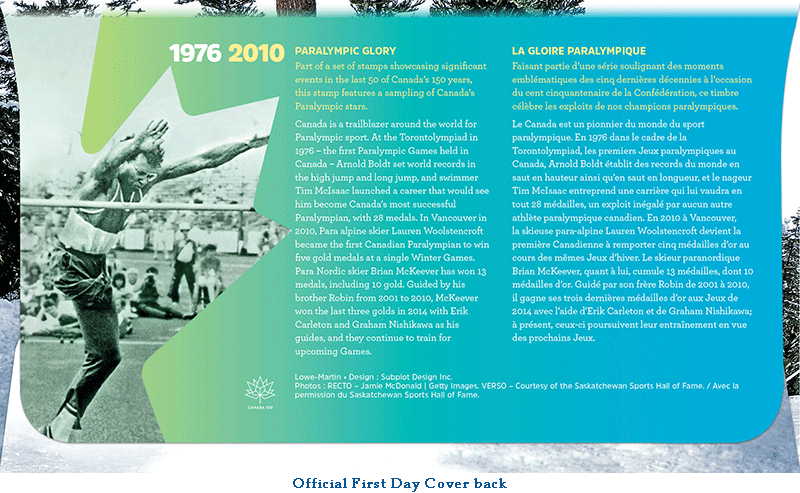
 Canadian Paralympic legends Arnold Boldt and Lauren Woolstencroft unveiled a stamp celebrating Canada’s achievements in the Paralympic movement and our country’s role as host of two Paralympic Games – in Toronto in 1976 and Vancouver in 2010. Boldt is a six-time Paralympian who won eight medals in high jump and long jump, including seven gold. Woolstencroft, a former para-alpine skier and the first Canadian winter Paralympian to win five gold medals at a single Games, is featured on the Paralympic stamp.
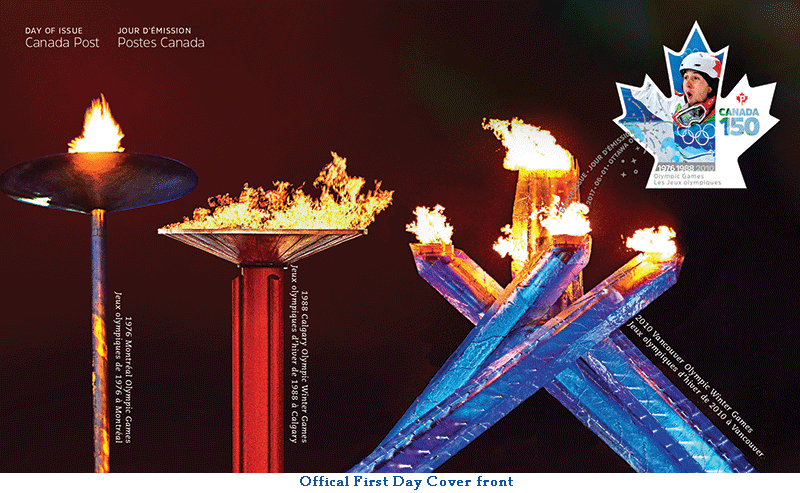
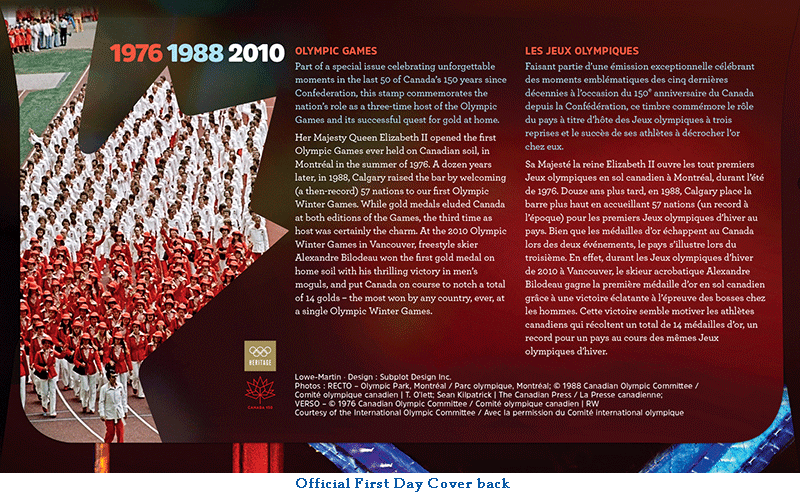
 Canadian high-jump legend and Olympic silver medallist Greg Joy, along with Joannie Rochette, Olympic bronze medallist in figure skating, unveiled a separate stamp commemorating Canada’s success as a three-time host of the Olympic Games: the 1976 Summer Olympics in Montréal, the 1988 Winter Olympics in Calgary and the 2010 Winter Olympics in Vancouver. The Olympic stamp features a triumphant Alexandre Bilodeau after winning the men’s moguls event in Vancouver and capturing Canada’s first Olympic gold medal on Canadian soil.
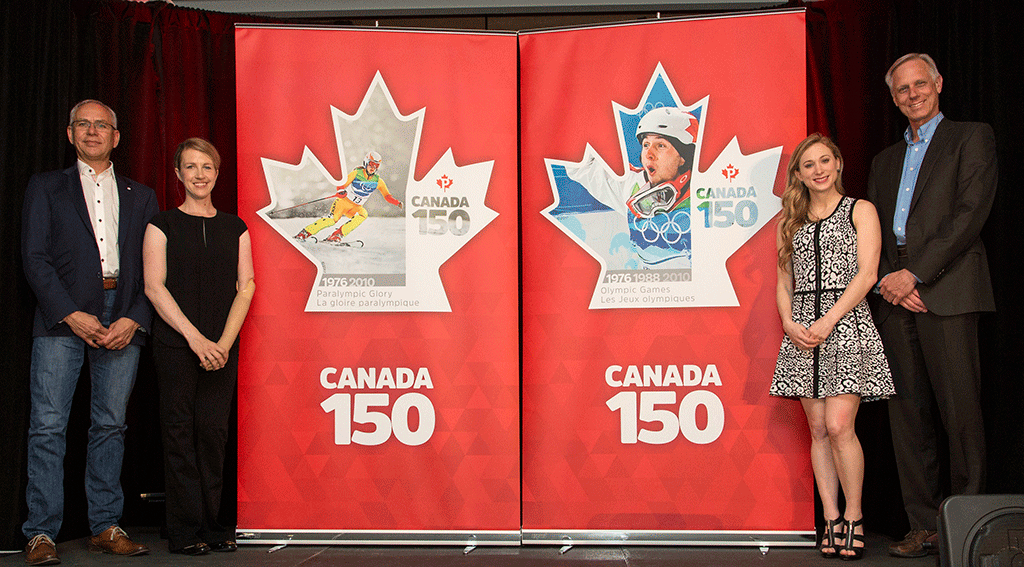 Left to right, Canadian Paralympic legends Arnold Boldt and Lauren Woolstencroft unveiled a stamp celebrating Canada’s achievements in the Paralympic movement and Joannie Rochette, Olympic bronze medallist in figure skating, and Canadian high-jump legend and Olympic silver medallist Greg Joy unveiled a separate stamp commemorating Canada’s success as a three-time host of the Olympic Games. Photo by Flora Gordon/Canada Post.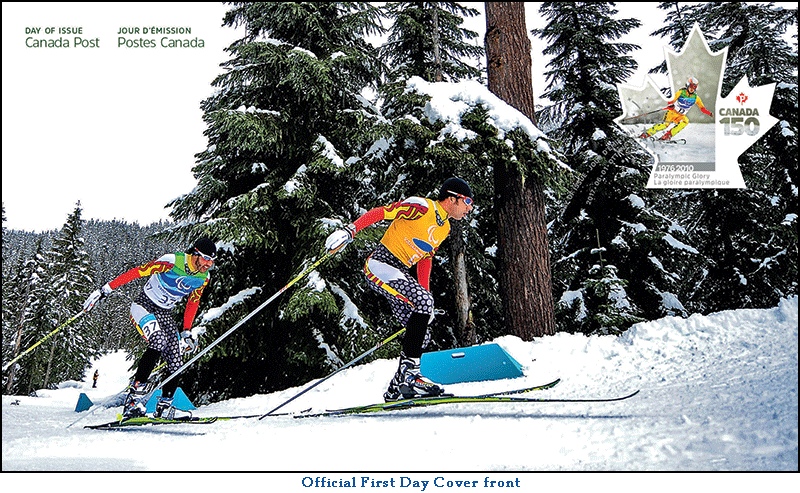
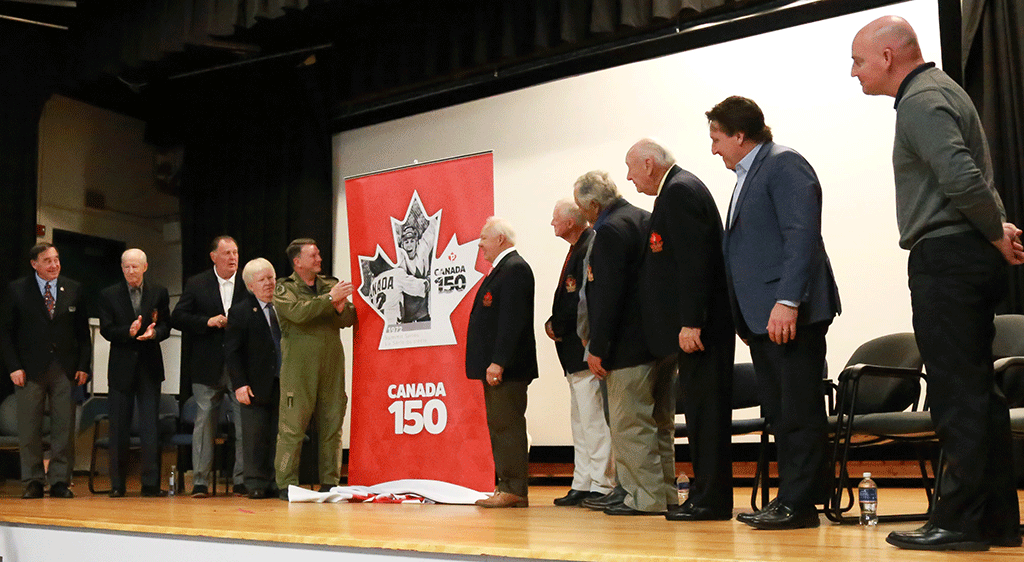
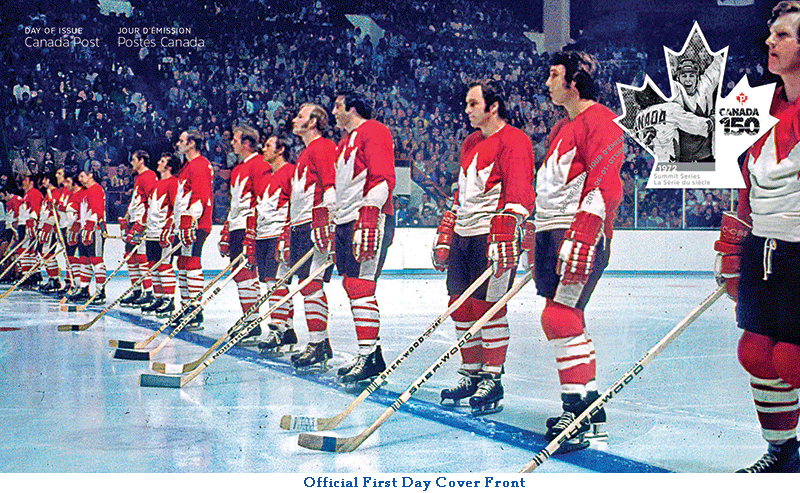
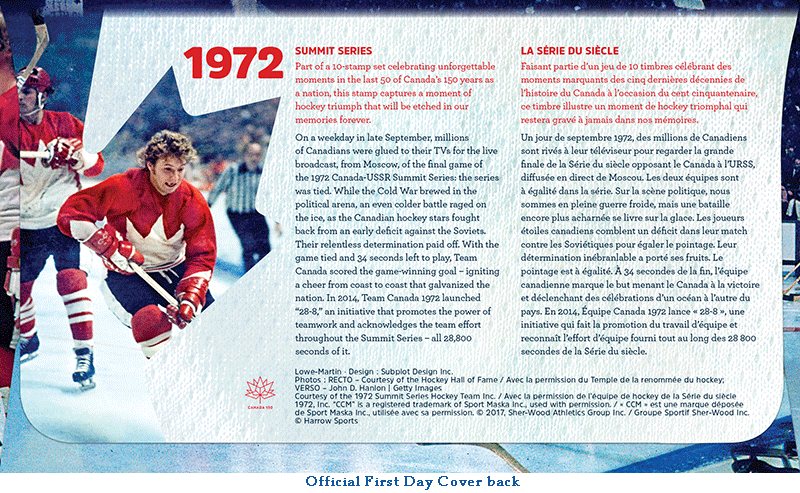
 CFB WINNIPEG – Canada Post May 31st unveiled its latest Canada 150 stamp by uniting legendary players who wore this country’s flag as members of Team Canada 1972 with proud Canadians who take the Maple Leaf to the skies as members of the Royal Canadian Air Force.