
Dealing With Self-Sticks
By John M. Hotchner
 Hardly any stamp collector is happy with the Postal Service’s practice, begun in earnest in 2007, of producing increasing numbers of self-stick issues that when used, can’t be floated free of the envelope paper.
The reason given was that they were saving on the cost of the stamp paper. But this developed later. Initially there was no announcement. Collectors made the discovery through trying to wash new issues so as to have a nice clean example to put in the album.
Actually about a quarter of what is issued these days can be soaked off — even today. But the remainder either have to be specially treated, stamp by stamp, to be removed. Or, they have to be left on neatly clipped (hope- fully thin) paper and put in the album.
The latter will not bother some people, but as most of us are creatures of habit, the change from the old way is annoying. It makes the presentation of a used collection on album pages a bit disorderly with different thicknesses and colors of envelope paper. Even mint self-stick stamps have to be left on their backing paper when displayed in albums. Thus, fewer stamps will t on a page, and albums get thicker faster. Not a few collectors have reacted to this new era by combining this problem with ever higher face values of stamps, and using these excuses to stop collecting U.S. stamps issued after 2000, or to leave the hobby altogether.
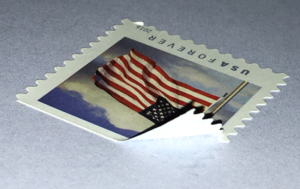 But are the changes really fatal, or do they simply force changes in collecting with which we are unhappy? Are we over-reacting to what we see as high handedness on the part of the USPS? Personally, I feel it, and there can be little doubt that there is some of this in the reaction of collectors. As confirmation, we saw it in letters to the editor in the philatelic press as the USPS went to unwashable self-sticks, and then decreed that all issues would be self-sticks.
The latter decision was popular with the public, but it was anything but for collectors. It is still my belief that this could be “fixed” by leaving mail-use stamps self-stick, and issuing commemoratives as lick-and-stick since their purpose is to be sold to collectors. And I would like to see the Postal Service return to the days of washable self-sticks. This would seem to be only rational given that reporting in the philatelic press indicated that the stamps issued without that feature actually cost more than washable stamps.
But I’m dreaming. Back to reality.
The basic question is this: Will you let the changes wrought by the USPS drive you out of the hobby? Or will you find a way to adapt? I can’t picture life without stamp collecting! So adapting is the way I have gone, and the way I recommend.
For those who think that they will teach the Postal Service a thing or two by dropping out with a blast in the Letters to the Editor column, forget it. They have set their course, and are “driving hard to the basket”, to mix a metaphor.
The only power you have is the power of the purse. If you do not spend money on their products, that has an impact. But the USPS is busily about the task of recruiting new collectors who take as a given the new reality. Apparently, they are having success sufficient to offset losses of old-line collectors who are dropping out.
So, the first way to adapt, is not dropping out alto- gether but limiting U.S. stamp collecting to those issues that are pleasing; say ending with the issues of 2000 or 2005. You save on supplements as well as stamps. And this allows you to spend available money on lling in older spaces with those beautifully engraved stamps of yesteryear.
But if, like me, you maintain your interest in the cur- rent issues of the USPS, then there are several avenues you can take:
1. In choosing stamps-on-paper for your album, consider the color and thickness of stamps to be part of condition. Thin white paper is the goal, and just as you would replace a heavily cancelled stamp with one that is lightly cancelled, replace thick red paper when you can.
2. Choose the margin size you will use for consistency, and trim the excess paper so that your album page looks nice.
3. Obtain and learn to use the Scott U.S. Specialized Catalogue, which has a feature identifying those modern stamps that can and cannot be washed. Then wash what you can. I am hopeful that Scott will eventually add this feature to the U.S. listings in Volume I of the Standard Catalogue. (Note: Keep in mind that I have found several stamps that Scott indicates can be washed are at best very difficult, and at worst, actually won’t wash. Best to try one or two before trying to wash quantities.)
[Note: For three years, The Virtual Stamp Club kept track of which U.S. self-adhesives 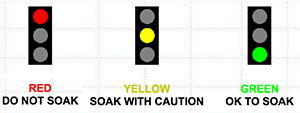 were soakable, through the hard work of volunteer John Cropper. Then he had to move on, and no one else was able to undertake this task. But the “Soaking Stoplight” information is still online here for 2008, 2009 and 2010. — VSC]
4. Consider removing the envelope paper from stamps destined for your album using one of the spray or chemical products that have been discussed in Linn’s [Stamp News] and The American Philatelist (mostly in letters to the editor). Although it takes more time than the old float-free method, and for that reason is not suitable for large quantities, it works well on individual stamps. I use non-aerosol “Pure Citrus” Orange Air Freshener which is available at Home Depot and other locations. It is effective and non-toxic.
I will close with an offer. I will provide a write-up on how I use “Pure Citrus”, and/or a write-up of how to separate some of the more difficult soakable stamps from paper to any reader who requests one or both. If you want these, please write to me, specifying which, and enclose 10¢ in mint postage to cover photocopying, and a stamped addressed envelope. Send to me at PO Box 1125, Falls Church, VA 22041-0125.
Should you wish to comment on this column, or have questions or ideas you would like to have explored in a future column, please write to John Hotchner, VSC Contributor, P.O. Box 1125, Falls Church, VA 22041-0125, or email, putting “VSC” in the subject line.
Or comment right here.
 The Hague, 24 April 2017 – PostNL is issuing a special stamp sheetlet honouring King Willem-Alexander’s fiftieth birthday. The ten pictures show the various periods in the life of the king. The images are featured on six stamps and on four tabs to the left and right of the stamps.
 The Hague, 25 April 2017 – PostNL is issuing a new stamp sheetlet to mark the occasion of the Year of the Botanical Gardens in 2017. The stamps feature ten special plants and trees. These crown jewels are all from botanical gardens in the Netherlands.

 MINT STAMPS IN DETAIL
 Stamp Format: Square
 The First Day Covers (above) Feature All 10 Mint Stamps and a special First Day of Issue postmark.


 OTTAWA, April 28, 2017 /CNW/ – Canada Post today issued a set of seven Star Trek stamps that celebrate each of Starfleet’s finest leaders, dramatically depicting them with the most cunning of the adversaries they confronted on their voyages.
 Admiral James T. Kirk with Khan Noonien Singh (Star Trek II: The Wrath of Khan™, 1982)
 shuttlecraft stamp, measuring 24 mm by 20 mm, is available as a coil of 50 stamps. All seven stamps, including the uniquely-shaped Borg cube, which measures 67 mm by 62 mm and is enhanced with holographic foil and embossing, are available ready-to-mail in a prestige booklet. The Official First Day Covers – all cancelled in Vulcan, Alberta, except Kirk’s, which is cancelled in Montréal, Quebec – are available only as a set of seven.
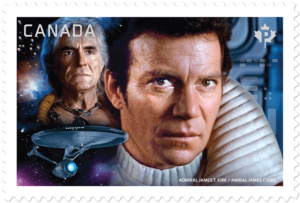 After completing his original five-year mission and earning a promotion, Admiral James T. Kirk set an unassailable standard for every Starfleet captain. But being stuck behind a desk at Starfleet Command made the aging admiral restless. Kirk rejoined the U.S.S. Enterprise, the first step toward a final show- down with his most cunning and deadly adversary: Khan. Set on revenge, the genetically enhanced superhuman cost Kirk the life of his closest companion.
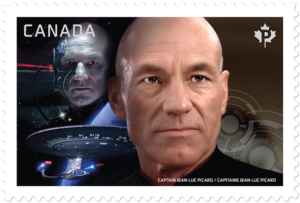 More “by the book” than Kirk, Captain Jean-Luc Picard led his crew with stern professionalism. When Borg drones invaded the U.S.S. Enterprise-D, they captured and assimilated Picard into the Borg Collective. Renamed Locutus and forced to be the Borg’s spokesperson, Picard was eventually rescued by his crew, though not before he was the Borg’s unwilling agent of destruction. Haunted, Picard finally overcame his demons in a final showdown with the Borg Queen.
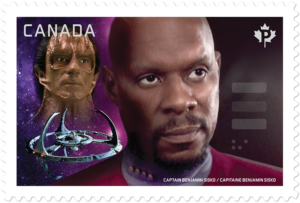 Posted to the space station Deep Space 9, near the planet Bajor, Captain Benjamin Sisko took to heart his mission to help the Bajorans recover from the Cardassian occupation. Dukat, the dangerous former prefect of the station, considered Sisko’s new role as a personal affront – and wanted revenge. This animosity led to escalating tensions between the Federation and a new, powerful enemy known as the Dominion, and placed Captain Sisko at the centre of a battle between good and evil.
 Sent to pursue renegades known as the Maquis, Captain Kathryn Janeway and the crew of the U.S.S. Voyager thought they’d be home in no time. Unexpectedly, Voyager and a Maquis vessel were transported to the other side of the galaxy. Far from home, the two crews united and began a decades- long journey back to the Federation. In the end, Janeway faced off against the enigmatic Borg Queen and used the Collective’s advanced technology to speed Voyager’s return home.
 One of Starfleet’s earliest pioneers, Captain Jonathan Archer represented United Earth before the founding of the Federation. In 2153, Archer and the Enterprise NX-01 responded when the mysterious Xindi suddenly attacked Earth. The Enterprise trailed the Xindi to a dangerous region of space known as the Delphic Expanse, where Archer confronted Commander Dolim, a genocidal Xindi-Reptilian convinced that the destruction of humanity would ensure the survival of his people.
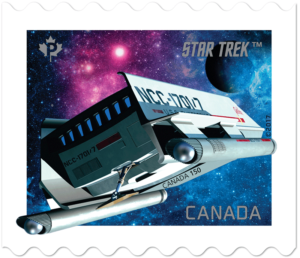 The U.S.S. Enterprise carried a fleet of shuttlecraft designed for short-range space exploration, planetary landings, and (often) dangerous missions. The first of these shuttles – named Galileo (NCC-1701⁄7) – met an explosive fate in orbit around Taurus II, seconds after its crew was beamed safely to the Enterprise. In honour of the spunky little craft, its name was passed on to future models, making it the most famous of the Enterprise sidekicks.
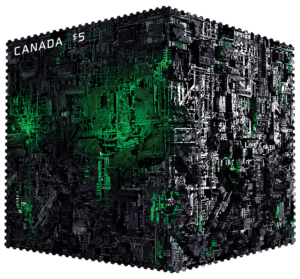 The cybernetic Borg had no interest in diplomacy; they sought only to achieve perfection by assimilating different species. Those assimilated lost all sense of individual identity and became merely an extension of the Borg Collective – a fate many considered worse than death. The appearance of a Borg cube – the Collective’s formidable spaceship – often meant the destruction of a civilization. Resistance, as the Borg said, was futile.
 MONTRÉAL, April 27, 2017 /CNW/ – Canada Post and Moshe Safdie, whose revolutionary Habitat 67 modular housing complex earned global accolades as an icon of urban living, today unveiled a stamp with an image of his futuristic structure representing the event for which it was built: Expo 67.
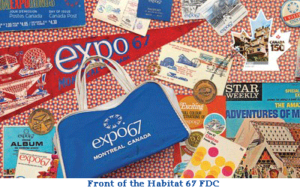 Safdie unveiled the stamp in the very building that forever placed his signature on his adopted city. With Habitat 67, Safdie – a bold, brash and brilliant young architect on the verge of launching a significant global career – captured an era of optimism, energy and progress. This project also launched his incredible career that has had him design prestigious buildings around the world, including the National Gallery of Canada, the Quebec Museum of Civilization, Marina Bay Sands in Singapore and the United States Institute of Peace in Washington, D.C.
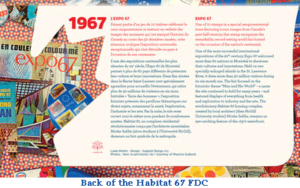 Those six months became a landmark moment for Canada – socially, culturally and politically. Several generations of Canadians have since pointed to it as the signature event of our centennial year. It featured pavilions from 62 countries, as well as Canada’s provinces and territories. It was an opportunity for Canadians to get better acquainted with Quebec culture. It attracted many notable figures of the time, including Queen Elizabeth II, U.S. President Lyndon B. Johnson, Princess Grace of Monaco, Jacqueline Kennedy and Robert F. Kennedy, and Bing Crosby. The Ed Sullivan Show was broadcast live from Expo 67 twice that May. Many Canadians associate Bobby Gimby’s popular centennial tune Ca-na-da with Expo 67.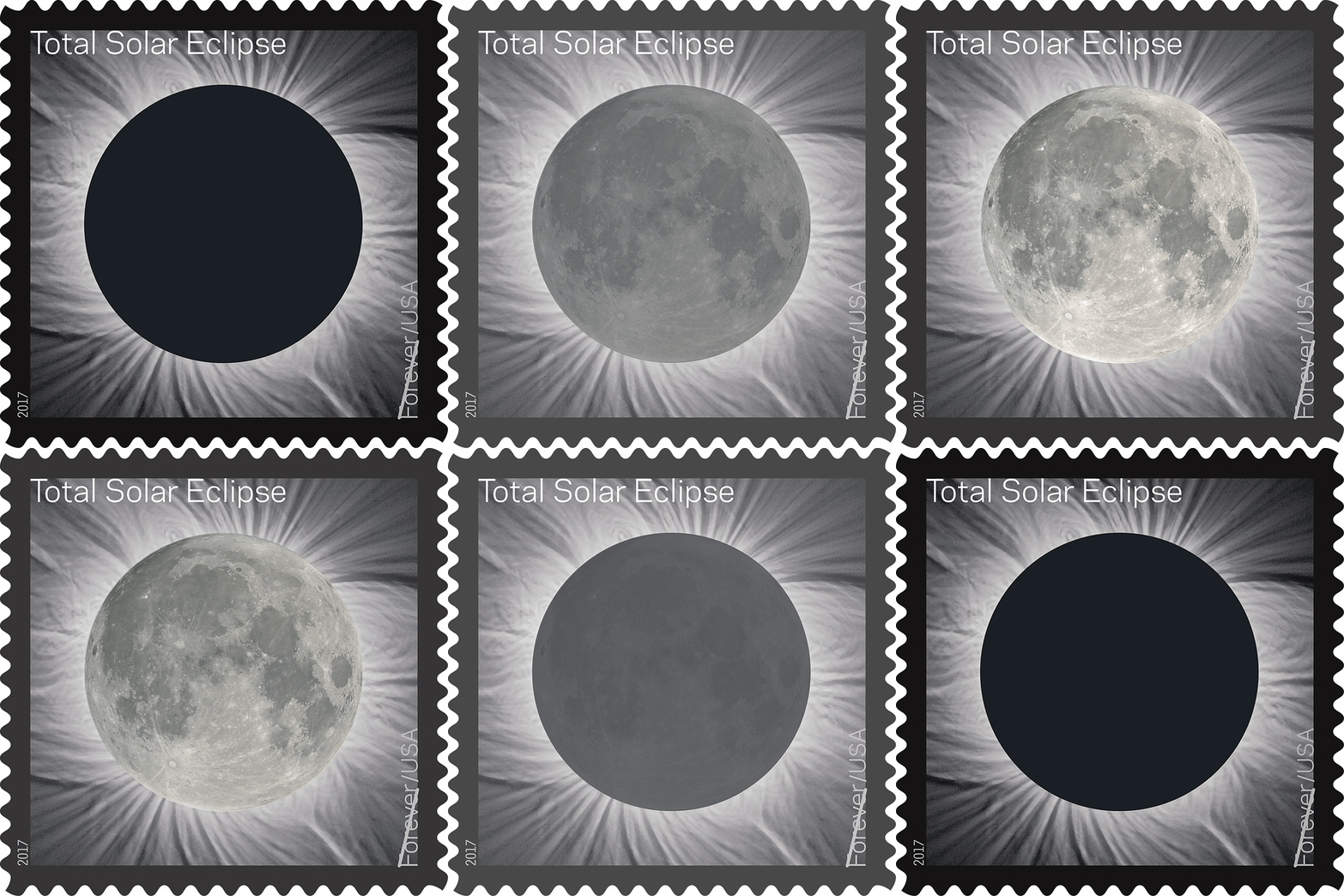
 Processed at: Banknote Corporation of America, Browns Summit NC
 Only the following pictorial postmark is permitted for the Total Eclipse of the Sun stamp. The word “Station” or the abbreviation “STA” is required somewhere in the design, because it will be a temporary station.
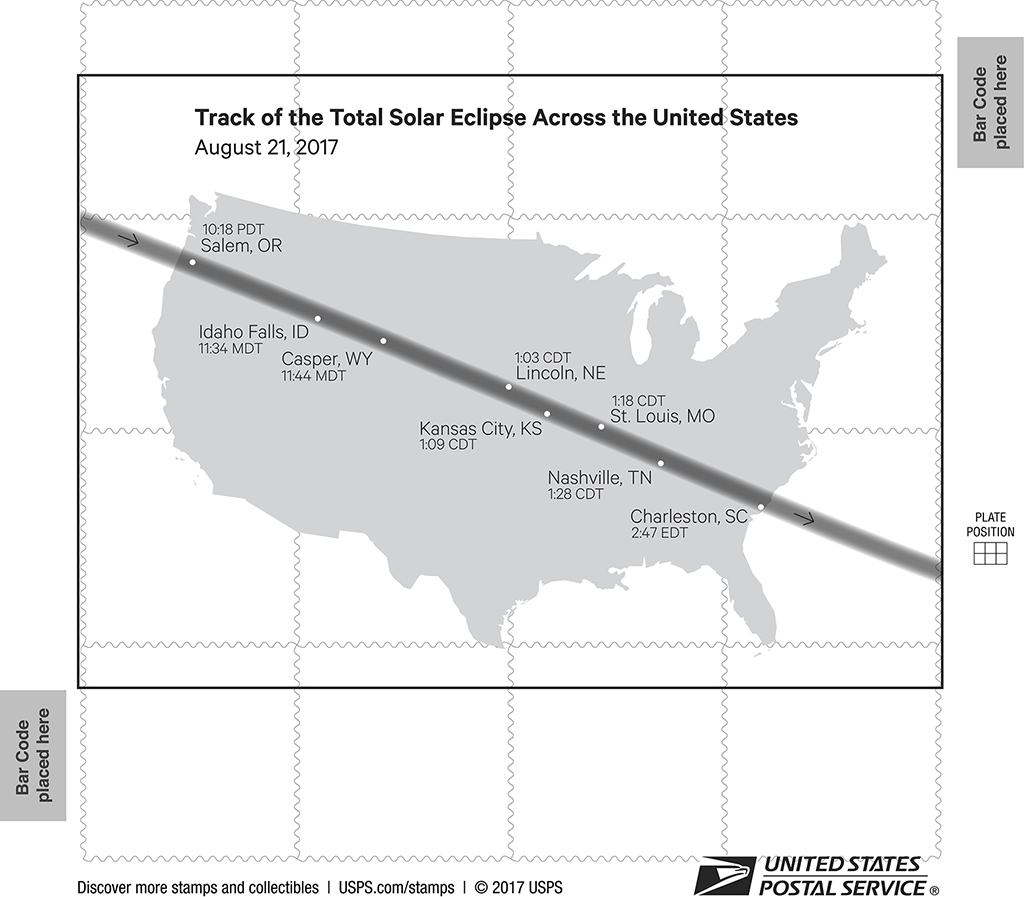 The back of the stamp pane provides a map of the August 21 eclipse path and times it may appear in some locations. Visit
 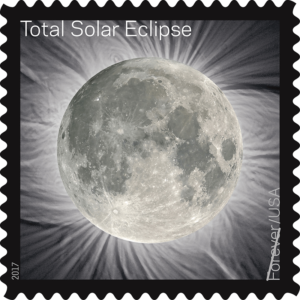 A total eclipse of the Sun occurs when the Moon completely blocks the visible solar disk from view, casting a shadow on Earth. The 70-mile-wide shadow path of the eclipse, known as the “path of totality,” will traverse the country diagonally, appearing first in Oregon (mid-morning local time) and exiting some 2,500 miles east and 90 minutes later off the coast of South Carolina (mid-afternoon local time).
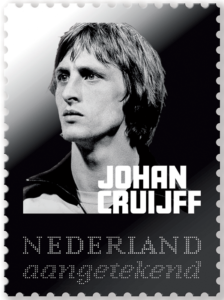 PostNL honours Johan Cruijff by issuing a pure silver stamp. This special stamp comes exactly one year after the death of the Dutch football legend, and marks the fifth time that PostNL has issued a silver postage stamp.
 Many of life’s special moments deserve personal attention. For that reason, the ten stamps feature wishes including gefeliciteerd (Congratulations), liefs (Love), veel geluk (Lots of luck), sterkte (Feel better), succes (Good luck), hoera (Hooray), fijne dag (Have a nice day), proficiat (Well done), voor jou (For you) and beterschap (Get well soon). Every stamp features an emoticon; a face depicted by punctuation marks. The stamp sheetlet also contains seven stickers that can be used to decorate the envelope or card, also with an emoticon.
 For this stamp sheetlet, Marenthe Otten designed both heart-shaped and square stamps. “The focus of each stamp is a wish appropriate to a special moment in the life of a loved one. The shape of a heart or flower emphasises the personal nature of the message. These wishes are in the form of colourful handwriting with cheery illustrations,” says the designer.
 The ‘For Special Moments’ stamp sheetlet consists of ten stamps marked with ‘Nederland 1’, which can be used for items weighing up to 20g destined for mail in the Netherlands. These stamps will be available from 27 March at all Bruna shops and via