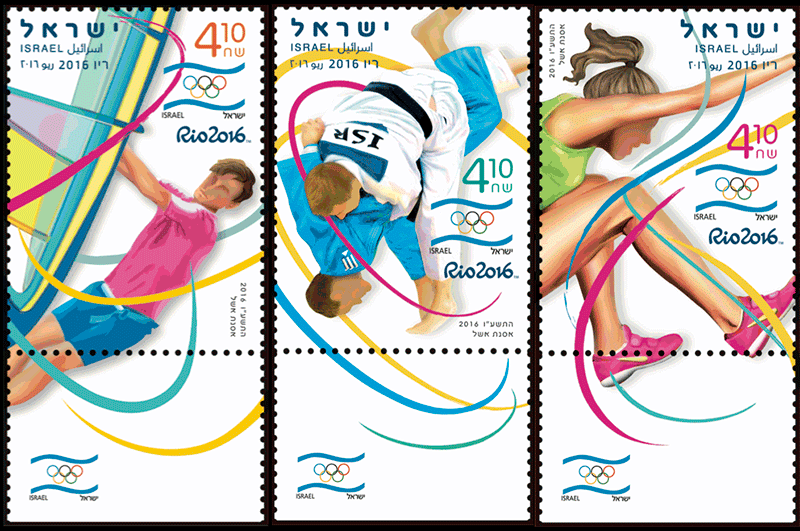
 The ancient Olympic Games were held over a period of 1500 years. The Games were reestablished in the late 19th century by Baron Pierre de Coubertin and the first modern Olympics took place in Athens in 1896.
Since then, the Olympic Games have been held regularly every four years, except during WWI and WWII.
The Summer Olympics constitute the largest event of any kind in the world.
The 31st modern Olympiad will commence in Rio de Janeiro, Brazil on August 5, 2016. This marks the first time that the Olympics have been hosted in South America.
Israel participated in the Olympic Games for the first time in Helsinki 1952. The infamous 1972 Munich games will eternally be mourned for the 11 members of the Israeli delegation who were murdered there – athletes, trainers and referees. Israel won its first Olympic medal in Barcelona in 1992 and its first gold medal in Athens 2004.
Israel’s Olympic medalists are:
Yael Arad – silver, Barcelona 1992; Oren Smadja – bronze, Barcelona 1992; Gal Friedman – bronze, Atlanta 1996; Michael Kolganov – bronze, Sydney 2000; Gal Friedman – gold, Athens 2004; Arik Ze’evi – bronze, Athens 2004; Shahar Zubari – bronze, Beijing 2008.
Track and Field – Triple Jump
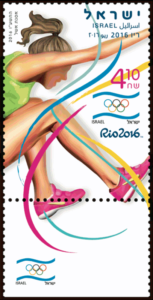 Track and Field – the queen of sports – is the most popular Olympic sport. Israeli athletes began participating in Olympic track and field in 1952.
Track and field includes 47 Olympic events – running, jumping and throwing. The triple jump begins with a run up start and is then comprised of the hop, the step and the jump.
In the triple jump event conducted at the first modern Olympics in 1896 all three stages started with the same leg. The current style was first instated in the Paris games of 1900.
The women’s triple jump was recognized as a world record event in 1990 and it became an Olympic event for the first time in Atlanta 1996.
The men’s world record – 18.29 meters – is held by Jonathan Edwards of Great Britain. The women’s world record – 15.50 meters – is held by Inessa Kravets of Ukraine. The Israeli men’s record holder is Nahum Rogel (17.20 meters) and the Israeli women’s record holder is Hanna Knyazyeva-Minenko (14.78 meters).
Hanna Knyazyeva-Minenko is the Beijing 2015 World Championship silver-medalist and she will represent Israel in the 2016 Olympic Games in Rio.
—Rafi Peled
Chairman, Israel Athletic Association
Judo
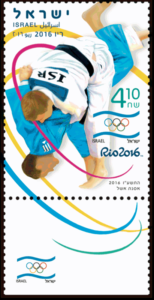 The Japanese martial art of Judo became an Olympic sport at the 1964 Tokyo Games. Judo is now one of the most popular sports in Israel and throughout the world.
The Israel Judo Championships have been conducted regularly since 1969 for men and since 1976 for women.
Judo is one of the sports in which Israel has earned the most Olympic medals: Israel’s first two Olympic medals were awarded to Yael Arad and Oren Smadja in Barcelona 1992, and Arik Ze’evi won an Olympic medal in Athens 2004.
Over the years, and especially in recent years, Israeli judokas have won numerous medals around the world, among them Yarden Gerbi’s noteworthy 2013 World Championship gold medal, a first in the history of Israeli judo.
—Sagi Gur
CEO, Israel Judo Association
Sailing – RS:X Windsurfing
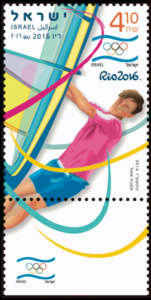 Sailing is one of Israel’s most prominent sports. The most prominent achievement in this field is the Olympic gold medal for windsurfing.
The RS:X windsurfer replaced the Mistral model in 2005.
The RS:X was first used at the 2006 Israeli Championships and marked the transition to the younger generation of windsurfers: Gal Friedman, Olympic gold medalist from the Athens 2004
games (Mistral model) came in fourth, while Shahar Zubari won the competition. In the women’s competition, Maayan Davidovich beat former World Champion Lee Korzits. Israel was represented at the 2008 Olympic Games in Beijing by Zubari and Davidovich, both of whom qualified for the medal sailings and Zubari even won a bronze medal.
Lee Korzits won four consecutive world championship titles and was ranked sixth in the London 2012 games. She is Israelís most decorated athlete.
Israel will be represented at the Rio 2016 Olympic Games by Israeli windsurfers Maayan Davidovich and Shahar Zubari.
—Smadar Pintov
CEO, Israel Sailing Association
Description of the Stamps
Track and Field – Triple Jump
Stamp design based on a photograph by Ariel Chissick.
Sailing – RS:X Windsurfing
Stamp design based on a photograph by Amit Schussel.
Judo
Stamp design based on a photograph provided courtesy of the Olympic Committee of Israel.
Official expression ìRio 2016î on the stamp: © 2016 International Olympic Committee.
The Olympic Committee of Israel logo on stamp and cancellation: © The Olympic Committee of Israel. Issue: June 2016
Technical Details:
Issue: June 21, 2016
Stamps Size (mm): H 40 W 30
Plates: 1020, 1021, 1022
Stamps per Sheet: 10
Tabs per Sheet: 5
Method of printing: Offset
Security mark: Microtext
Printer: Cartor Security Printing, France

 MoneyGram (NASDAQ: MGI) announced it has initiated support initiatives to help those impacted by the massive wildfires in Canada. From now through the end of June, MoneyGram is waiving fees for those who want to donate to the American Red Cross to support wildfire relief efforts.
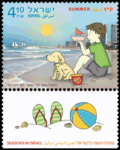 “We celebrate long, lazy summer days, vacation time and fun with our stamp for
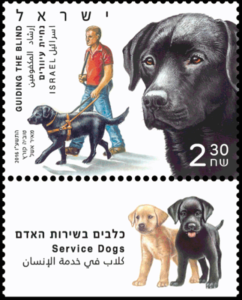
 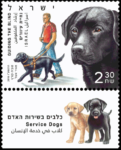 “It’s time we say thanks to “man’s best friend”. Dogs not only make wonderful pets but they serve humans in many different ways. Our
  These stamps will all be issued June 21st.
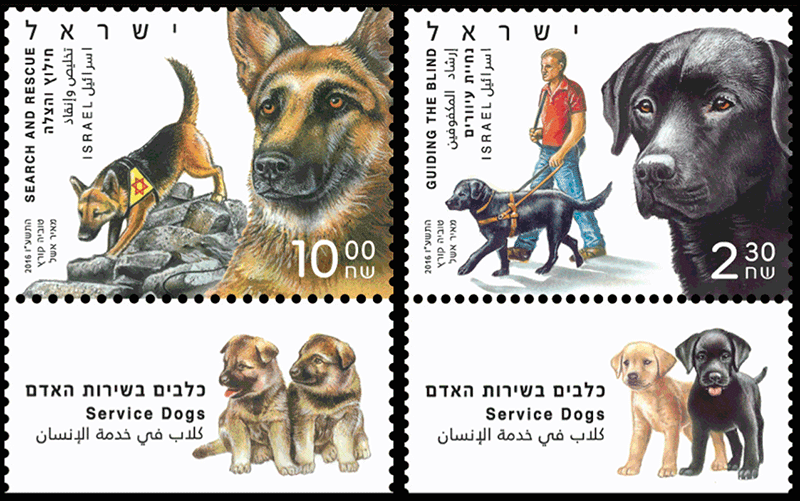 The connection between humans and ancient dogs (which evolved from wolves) began thousands of years ago. These dogs helped humans hunt and protected them and their possessions. The special bond has continued to grow and the dog is thought of as ìa manís best friendî. Dogs serve humans in many different ways: hunting, herding, transportation and guidance, defense and security, location, search and rescue, detection of drugs and explosives, aid to the disabled including guide dogs for the blind and even disease detection. In addition to individuals, dogs assist police and military security forces. These forces operate special canine units: the Israel Police Canine Unit and the IDF Oketz Special Canine Unit. These dogs go through a meticulous selection process from birth and later undergo significant training that requires great knowledge and patience.
 Guide dogs allow blind people to be independent and increase their self confidence. They are chosen from breeds that have proven over time to be suited to working with blind humans. In Israel most guide dogs are Golden Retrievers, Labrador Retrievers or a combination of the two.
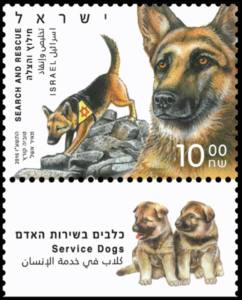
 Search and Rescue dogs belong to various different breeds, including the Belgian Shepherd Malinois, which appears on the stamp. S&R dogs perform a large variety of tasks, including locating missing persons and people trapped beneath rubble. Dogs can move and maneuver quickly in places that are difficult for humans to access. Their sense of smell and hearing are much more acute than those of humans. Such dogs have saved many lives in disaster areas. They are loyal helpers and enhance their teams’ operative abilities.
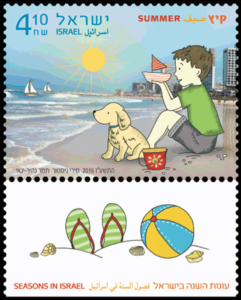 Our calendar consists of twelve months – the amount of time it takes the Earth to complete one full cycle around the Sun.
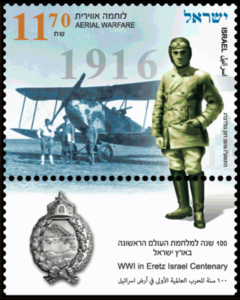 In October 1914, a few months after the outbreak of WWI, the Ottoman Empire aligned itself with Germany and Austria against the allied nations (Britain, France and Russia). The Great War, as it was called at the time, lasted for more than four years and fundamentally changed the history of the world, including the situation of Eretz Israel. In early 1915, the Ottoman military waged a campaign in the Sinai Peninsula, intending to conquer the Suez Canal. But the attack failed and the Turks were forced to retreat back to Eretz Israel. During the retreat the Turkish force was attacked repeatedly by British aircraft stationed in the Suez Canal area and since it had no planes of its own, the Ottoman army was powerless against these strikes.
 show or by mail.
 June 1 –
  PRODUCT RANGE AT A GLANCE
 Miniature Sheet: £6.04
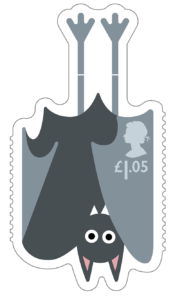
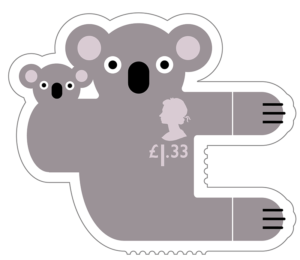 Andrew Ross who designed the stamps was challenged to devise interactive stamps that particularly appealed to children and encouraged them to brighten up their letters and cards. He wanted to ‘push the envelope’ whilst working within the constraints of the technical requirements around postage stamps including the need for them to be easily read by Royal Mail’s sorting machines. He came up with the idea of engaging, friendly and fun animal characters that could ‘cling’ to the top or side of envelopes. He wanted to create a variety of shapes and colours to generate interest but was mindful that each character had to sit comfortably alongside each other and have a degree of consistency so that they clearly
  looked like they were part of a set.
 Number of stamps: Six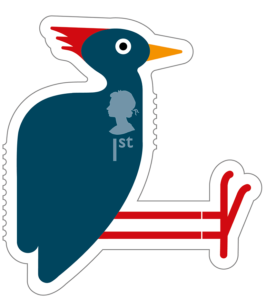
 First Day Covers:

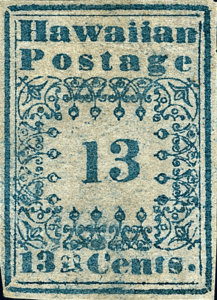 (New York, NY) — Renowned collector and Wall Street money manager William H. Gross will sell his acclaimed Hawaii stamp and cover collection during World Stamp Show – New York 2016 with his proceeds from the auction to be donated to nonprofit organizations, including The Smithsonian’s National Postal Museum. The collection features many of the most iconic rarities of Hawaiian philately, including ten Hawaiian Missionary stamps.
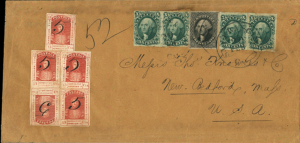 Lot #24 [shown on the left] — This is the only recorded cover with more than one of the rare 1857 “5” cents on 13-cent provisional surcharge (in this case, five examples), used in combination with United States postage. It is widely regarded as the most outstanding United States and Hawaiian mixed-franking cover outside of the Missionary issue. Pre-sale estimate: $250,000 – 350,000
 Just one: