
Updated March 11th: The Scott catalogue numbers for this issue are
- 5158 coil stamp (Banknote printing), serpentine die cut 11 vert.
- 5159 coil stamp (Ashton-Potter printing), serpentine die cut 9½ vert.
- 5160 booklet stamp (Banknote printing), microprinted “USPS” on right end of fourth red stripe, serpentine die cut 11¼x10¾ on 2 or 3 sides
- 5160a. Booklet pane of 10
- 5160b. Booklet pane of 20
- 5161 booklet stamp (Ashton-Potter printing), microprinted “USPS” on right end of second white stripe, serpentine die cut 11¼x10¾ on 2 or 3 sides
- 5161a. Booklet pane of 20
- 5162 ATM booklet stamp (Ashton-Potter printing), microprinted “USPS” on left end of second white stripe near blue field, serpentine die cut 11¼x10¾ on 2, 3 or 4sides
- 5162a. Booklet pane of 18
Updated January 27th: The unveiling of the stamp design at the first-day ceremony during Southeastern Stamp Expo: 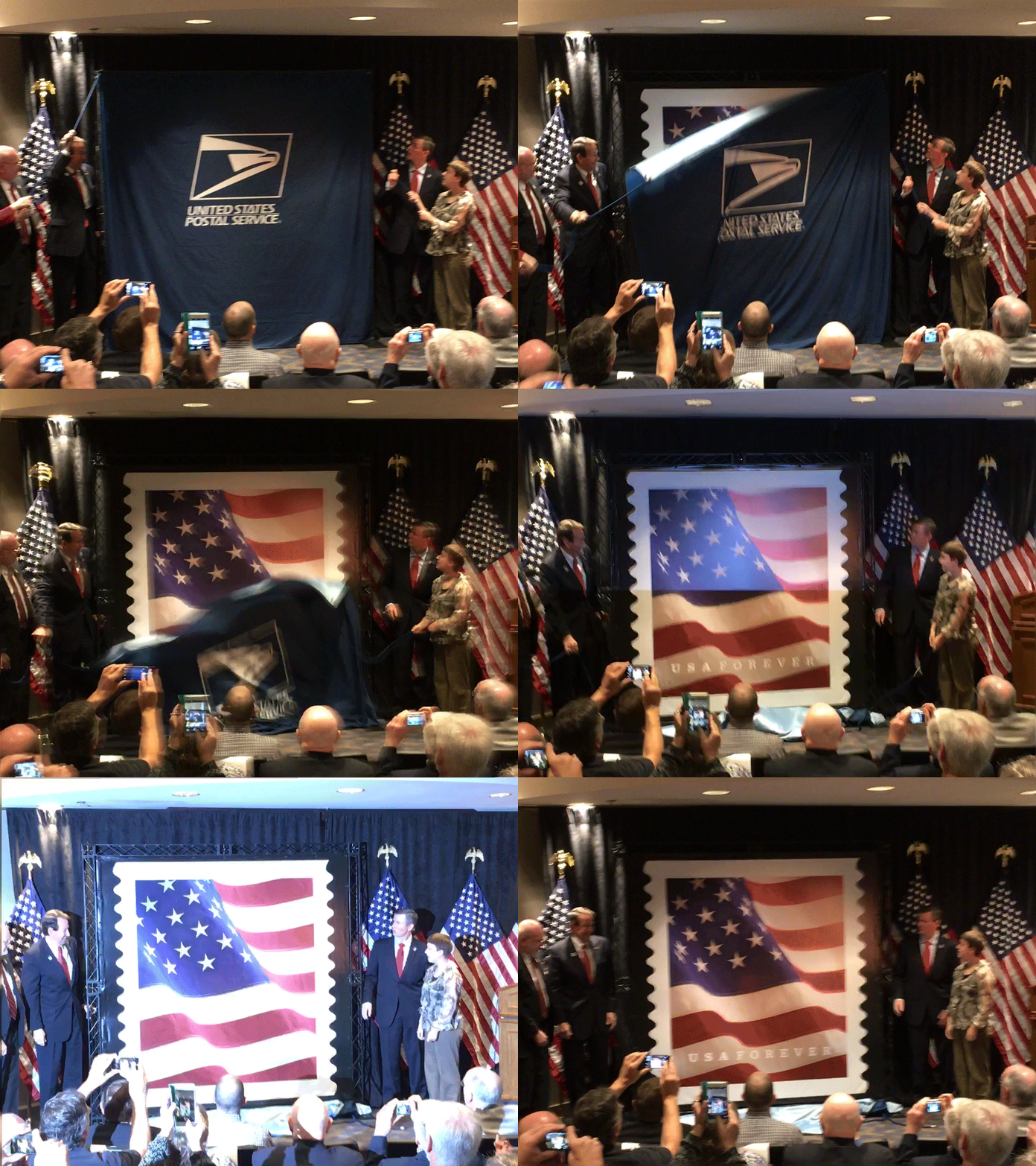 from left, Edwin L. Jackson, featured speaker; American Philatelic Society President Mick Zais; USPS Chief Human Resources Officer and Executive VP Jeffrey C. Williamson; and Pledge of Allegiance leader Beatrix Clark.
Updated January 27th: Here is the pictorial first day postmark for this issue: 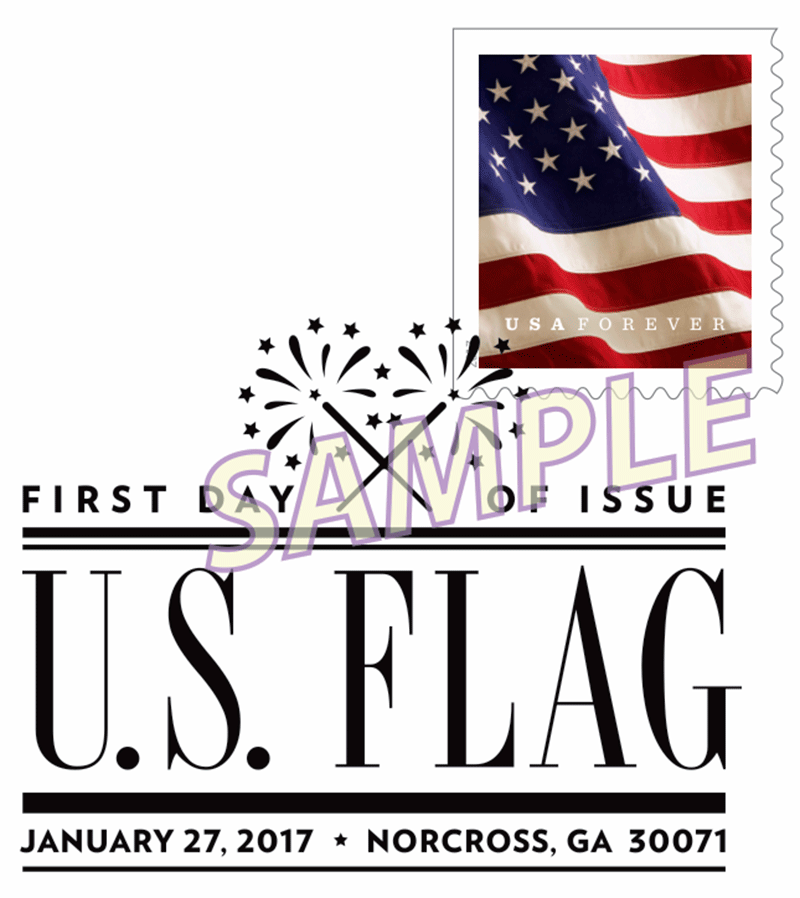 It measures 2” x 1.5”.
Updated January 18th:
Technical Specifications:
 Issue: U.S. Flag Stamp
Item Number: 564400
Denomination & Type of Issue: First-Class Mail® Forever
Format: ATM Sheetlet of 18 stamps (1 design)
Series: N/A
Issue Date & City: January 27, 2017, Norcross, GA 30071
Designer: Greg Breeding, Charlottesville, VA
Typographer: Greg Breeding, Charlottesville, VA
Existing Photo: Tom Grill
Modeler: Joseph Sheeran
Manufacturing Process: Offset, Microprint
Printer: Ashton Potter (USA) Ltd. (APU)
Printed at: Williamsvile, NY
Print Quantity: 109,080,000 stamps
Adhesive Type: Pressure-sensitive
Processed at: Ashton Potter (USA) Ltd.
Press Type: Muller Martini A76
Stamps per Sheetlet: 18
Paper Type: Nonphosphored Type III
Colors Stamp Side: Black, Cyan, Magenta, Yellow
Colors Cover Side: Black, Cyan, Magenta, Yellow
Stamp Orientation: Vertical
Image Area (w x h): 0.73 x 0.84 in/18.54 x 21.34 mm
Overall Size (w x h): 0.87 x 0.98 in/22.10 x 24.89 mm
Booklet Size (w x h): 2.61 x 6.125 in/66.29 x 155.58 mm
Plate Size: 720 stamps per revolution
Plate Numbers: “P” followed by four (4) single digits
Marginal Markings:
Cover Side: Header: “U.S. Flag”, “Eighteen First-Class Forever® stamps” • Barcode (564400) • USPS logo • Promotional text
Stamp Side: Plate block number in peel strip
Updated January 6th: The January 5th Postal Bulletin adds: Item 564400, $8.82 U.S. Flag ATM Sheetlet of 18 stamps, will not be available for ordering through SFS Web.
Updated December 22nd from the Postal Bulletin:
On January 27, 2017, in Norcross, GA, the U.S. Postal Service will issue the U.S. Flag First-Class Mail stamp (Forever priced at 49 cents), in one design. The formats available are a pressure-sensitive adhesive (PSA) booklet of 10 stamps (Item 674700) produced by security printer Banknote Corporation of America (BCA), a PSA booklet of 20 stamps (Item 672000) produced by security printers BCA and Ashton Potter (USA) Ltd. (APU), a PSA coil of 100 stamps (Item 749800) produced by security printers BCA and APU, and a PSA Automated teller machine (ATM) sheetlet of 18 stamps (Item 564400).
The stamp will go on sale nationwide January 27, 2017.
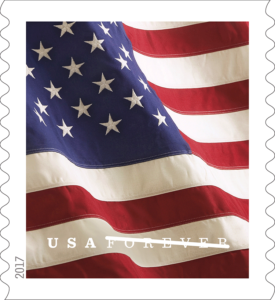
With the new U.S. Flag stamp, the Postal Service™ continues its tradition of celebrating patriotism with one of the most recognizable symbols of our nation. The stamp, sold in booklets of 10 and 20, coils of 100, and an ATM sheetlet of 18, features a detail from a photograph of the billowing Stars and Stripes. Terrence W. McCaffrey was the art director of the project and Greg Breeding designed the stamp with an existing photograph of the flag taken by Tom Grill.
Stamp Fulfillment Services will not make an automatic push distribution to Post Offices™. Post Offices may begin ordering stamps prior to the FDOI through SFS Web.
How to Order the First-Day-of-Issue Postmark:
Customers have 60 days to obtain the first-day-of-issue postmark by mail. They may purchase new stamps at their local Post Office, at The Postal Store® website at http://www.usps.com/shop, or by calling 800-782-6724. They should affix the stamps to envelopes of their choice, address the envelopes (to themselves or others), and place them in a larger envelope addressed to:
FDOI-U.S. Flag
Stamp Fulfillment Services
8300 NE Underground Drive, Suite 300
Kansas City, MO 64144-9900
After applying the first-day-of-issue postmark, the Postal Service will return the envelopes through the mail. There is no charge for the postmark up to a quantity of 50. There is a 5-cent charge for each additional postmark over 50. All orders must be postmarked by March 27, 2017.
There are two philatelic products for the booklet of 20:
• 672016 First-Day Cover, $0.93.
• 672030 Ceremony Program, $6.95.
There is one philatelic product for the coil of 100:
• 749816 First-Day Cover, $0.93.
There are no philatelic products for the booklet of 10.
Technical Specifications:
Issue: U.S. Flag Stamp
Item Number: 672000
Denomination & Type of Issue: First-Class Mail Forever
Format: Double-Sided Booklet of 20 (1 design)
Series: N/A
Issue Date & City: January 27, 2017, Norcross, GA 30071
Art Director: Terrence W. McCaffrey,New Braunfels, TX
Designer: Greg Breeding, Charlottesville, VA
Typographer: Greg Breeding, Charlottesville, VA
Existing Photo: Tom Grill
Modeler: Sandra Lane/Michelle Finn
Manufacturing Process: Offset, Microprint
Printer: Banknote Corporation of America
Printed at: Browns Summit, NC
Press Type: Alprinta 74
Stamps per Booklet: 20
Print Quantity: 1,750,000,000
Paper Type: Phosphor Tagged Paper, Block
Adhesive Type: Pressure-sensitive
Processed at: Banknote Corporation of America, Browns Summit, NC
Stamp Orientation: Vertical
Image Area (w x h): 0.73 x 0.84 in./18.54 x 21.34 mm
Stamp Size (w x h): 0.87 x 0.98 in./22.10 x 24.89 mm
Booklet Size (w x h): 5.52 x 1.96 in./140.21 x 49.78 mm
Colors: Cyan, Magenta, Yellow, Black
Plate Size: 960 stamps per revolution
Plate Numbers: “B” followed by four (4) single digits
Marginal Markings: • Plate number in peel strip area• © 2016 USPS in peel strip area • Promotional text • USPS Logo • Barcode
Technical Specifications:
Issue: U.S. Flag Stamp
Item Number: 672000
Denomination & Type of Issue: First-Class Mail Forever
Format: Booklet of 20 (1 design)
Series: N/A
Issue Date & City: January 27, 2017, Norcross, GA 30071
Art Director: Terrence W. McCaffrey,New Braunfels, TX
Designer: Greg Breeding, Charlottesville, VA
Typographer: Greg Breeding, Charlottesville, VA
Existing Photo: Tom Grill
Modeler: Joseph Sheeran
Manufacturing Process: Offset, Microprint
Printer: Ashton Potter (USA) Ltd. (APU)
Printed at: Williamsville , NY
Press Type: Muller Martini A76
Stamps per Booklet: 20
Print Quantity: 1,750,000,000 stamps
Paper Type: Nonphosphored Type III, Block Tag
Adhesive Type: Pressure-sensitive
Processed at: Ashton Potter (USA) Ltd. (APU)
Stamp Orientation: Vertical
Image Area (w x h): 0.73 x 0.84 in./18.54 x 21.34 mm
Stamp Size (w x h): 0.87 x 0.98 in./22.10 x 24.89 mm
Full Booklet Size (w x h): 5.52 x 1.96 in./140.21 x 49.78 mm
Colors: Cyan, Magenta, Yellow, Black
Plate Size: 1040 stamps per revolution
Plate Numbers: “P” followed by four (4) single digits
Marginal Markings: Header. “U.S. Flag” Twenty First-Class Forever Stamps• Plate numbers in peel strip area • © 2016 USPS in peel strip area
Technical Specifications:
Issue: U.S. Flag Stamp
Item Number: 749800
Denomination & Type of Issue: First-Class Mail Forever
Format: Coil of 100 (1 design)
Series: N/A
Issue Date & City: January 27, 2017, Norcross, GA 30071
Art Director: Terrence W. McCaffrey, New Braunfels, TX
Designer: Greg Breeding, Charlottesville, VA
Typographer: Greg Breeding, Charlottesville, VA
Existing Photo: Tom Grill
Modeler: Sandra Lane/Michelle Finn
Manufacturing Process: Offset, microprint
Printer: Banknote Corporation of America
Printed at: Browns Summit, NC
Press Type: Alprinta 74
Stamps per Coil: 100
Print Quantity: 2,000,000,000 stamps
Paper Type: Phosphor Tagged Paper, Overall
Adhesive Type: Pressure-sensitive
Processed at: Banknote Corporation of America, Browns Summit, NC
Colors: Cyan, Magenta, Yellow, Black
Stamp Orientation: Vertical
Image Area (w x h): 0.73 x 0.84 in./18.54 x 21.34 mm
Stamp Size (w x h): 0.87 x 0.98 in./22.10 x 24.89 mm
Plate Size: 744 stamps per revolution
Plate Numbers: “B” followed by four (4) single digits
Coil Number Frequency: Plate numbers every 31st stamp below stamp image
Technical Specifications:
Issue: U.S. Flag Stamp
Item Number: 749800
Denomination & Type of Issue: First-Class Mail Forever
Format: Coil of 100 (1 design)
Series: N/A
Issue Date & City: January 27, 2017, Norcross, GA 30071
Art Director: Terrence W. McCaffrey, New Braunfels, TX
Designer: Greg Breeding, Charlottesville, VA
Typographer: Greg Breeding, Charlottesville, VA
Existing Photo: Tom Grill
Modeler: Joseph Sheeran
Manufacturing Process: Offset, Microprint
Printer: Ashton Potter (USA) Ltd. (APU)
Printed at: Williamsville, NY
Press Type: Muller A76
Stamps per Coil: 100
Print Quantity: 2,000,000,000 stamps
Paper Type: Nonphosphored Type III, Block Tag
Adhesive Type: Pressure-sensitive
Processed at: Ashton Potter (USA) Ltd. (APU)
Colors: Black, Cyan, Magenta, Yellow
Stamp Orientation: Vertical
Image Area (w x h): 0.73 x 0.84 in./18.54 x 21.34 mm
Stamp Size (w x h): 0.8709 x 0.98 in./22.12 x 24.89 mm
Plate Size: 744 stamps per revolution
Plate Numbers: “P” followed by four (4) single digits
Coil Number Frequency: Plate numbers every 31st stamp below stamp image
Technical Specifications:
Issue: U.S. Flag Stamp
Item Number: 674700
Denomination & Type of Issue: First-Class Mail Forever
Format: Single-Sided Booklet of 10 (1 design)
Series: N/A
Issue Date & City: January 27, 2017, Norcross, GA 30071
Art Director: Terrence W. McCaffrey, New Braunfels, TX
Designer: Greg Breeding, Charlottesville, VA
Typographer: Greg Breeding, Charlottesville, VA
Existing Photo: Tom Grill
Modeler: Sandra Lane/Michelle Finn
Manufacturing Process: Offset, Microprint
Printer: Banknote Corporation of America
Printed at: Browns Summit, NC
Press Type: Alprinta 74
Stamps per Booklet: 10
Print Quantity: 100,000,000 stamps
Paper Type: Phosphor Tagged Paper, Block
Adhesive Type: Pressure-sensitive
Processed at: Banknote Corporation of America, Browns Summit, NC
Stamp Orientation: Vertical
Image Area (w x h): 0.73 x 0.84 in./18.54 x 21.34 mm
Stamp Size (w x h): 0.87 x 0.98 in./22.10 x 24.89 mm
Booklet Size (w x h): 5.316 x 1.74 in./135.03 x 44.20 mm
Colors: Cyan, Magenta, Yellow, Black
Plate Size: 560 stamps per revolution
Plate Numbers: “B” followed by four (4) single digits
Marginal Markings: • Plate number in peel strip area • © 2016 USPS in peel strip area • Promotional text • USPS Logo • Barcode • Verso: U.S. Flag, 10 First-Class Forever Stamps
Technical details for the ATM Sheetlet of 18 stamps will appear in a future edition of the Postal Bulletin.
Updated December 21st, 2016: USPS press release:
WHAT: First Day of Issue ceremony for the U.S. Flag Forever Stamp
WHO:
- USPS Chief Human Resources Officer and Executive Vice President Jeff Williamson
- American Philatelic Society President Mick Zais, Brigadier General, U.S. Army (ret.).
- USPS Director of Stamp Services Mary-Anne Penner
WHEN: Fri., Jan. 27 at 11 a.m.
WHERE:
Southeastern Stamp Expo, American Philatelic Society Stamp Show
Hilton Atlanta Northeast
5993 Peachtree Industrial Blvd.
Norcross, GA 30092
BACKGROUND: With the new U.S. Flag stamp, the Postal Service continues its tradition of celebrating patriotism with one of the most recognizable symbols of our nation. The stamp, sold in booklets of 10 and 20 and coils, features a detail from a photograph of the billowing Stars and Stripes. Terrence W. McCaffrey was the art director of the project and Greg Breeding of Charlottesville, VA, designed the stamp with an existing photograph of the flag taken by Tom Grill of New York. The credit line “© Tom Grill/Corbis” should appear in profile text associated with the stamp in accordance with standard practice.
From the USPS, September 20, 2016:
With the new U.S. Flag stamp, the Postal Service continues its tradition of celebrating patriotism with one of the most recognizable symbols of the nation. The stamp features a detail from a photograph of the billowing Stars and Stripes. Terrence W. McCaffrey was the art director and Greg Breeding designed the stamp with an existing photograph of the flag taken by Tom Grill.
 It measures 2.99″ x 1.39″. The pictorial postmark is:
 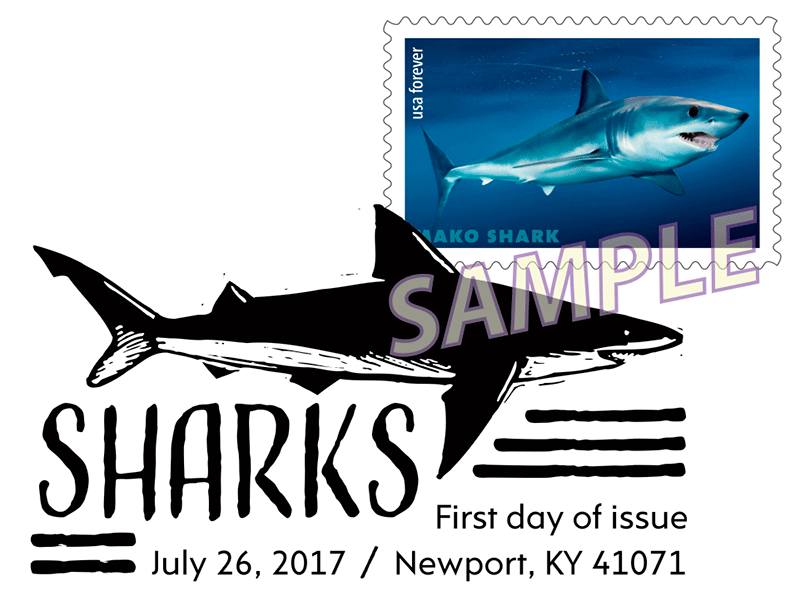 It measures 2.63″ x 1.5″.
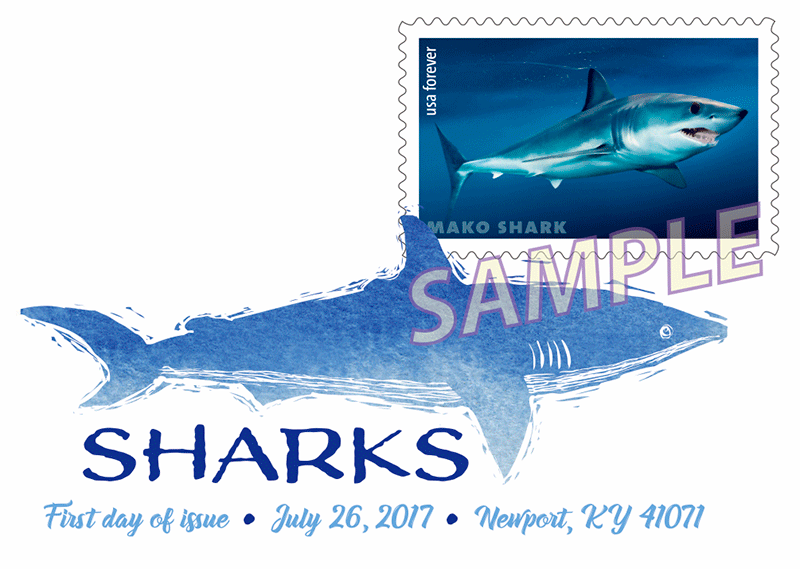
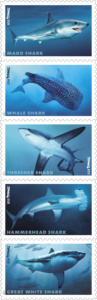 On July 26, 2017, in Newport, KY, the U.S. Postal Service® will issue the Sharks stamps (Forever® priced at 49 cents), in five designs, in a pressure-sensitive adhesive (PSA) pane of 20 stamps (Item 474500). The Sharks $9.80 pane of 20 stamps may not be split, and the stamps may not be sold individually. The stamps will go on sale nationwide July 26, 2017.
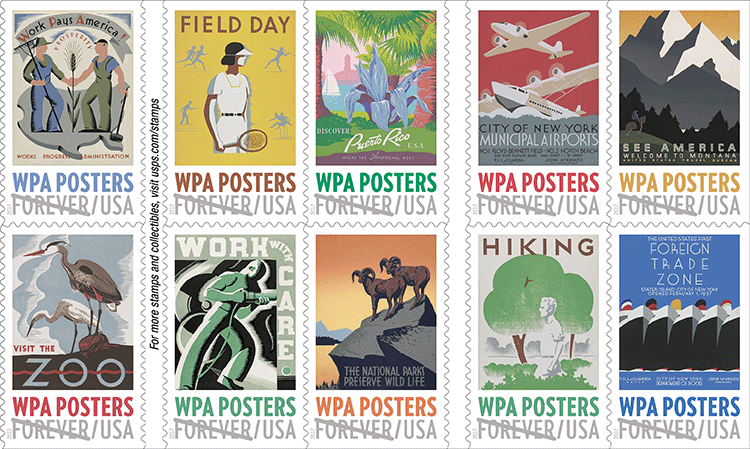
 The U.S. Postal Service celebrates these visually striking posters of the Workers Projects Administration (WPA) with stamps featuring 10 outstanding posters from the Library of Congress collection.
 Followers of the U.S. Postal Service’s Facebook page can view streaming video of the event at facebook.com/USPS<http://www.facebook.com/USPS>. The public is asked to share the news on Twitter and Instagram using the hashtag #WPAForever.
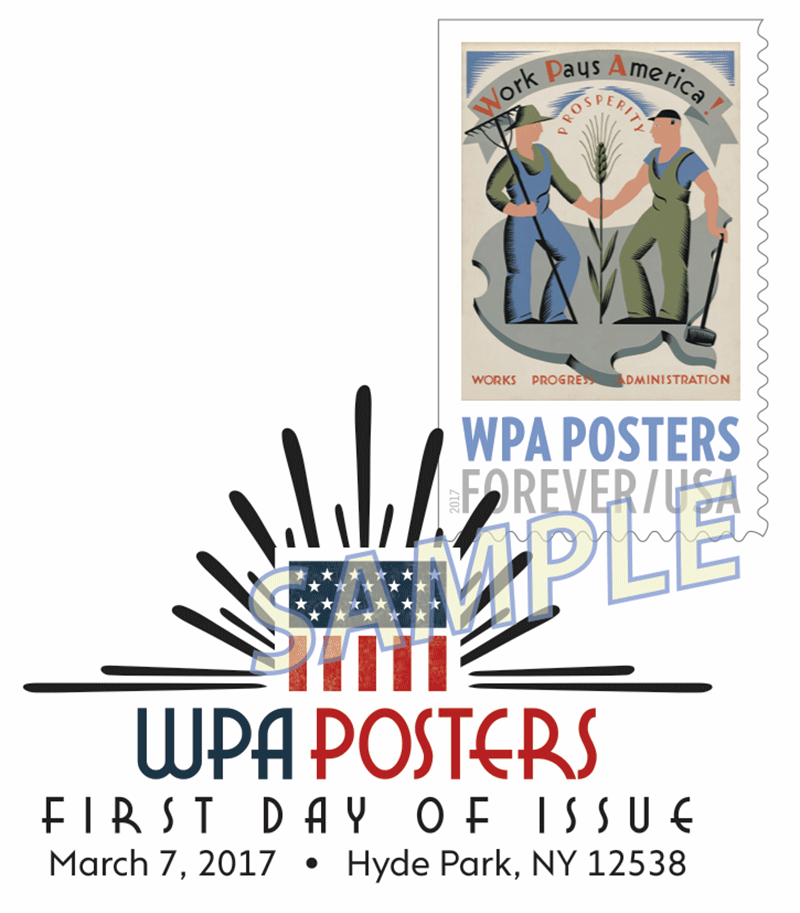 It measures 2.1” x 1.5”.
 What:
What:
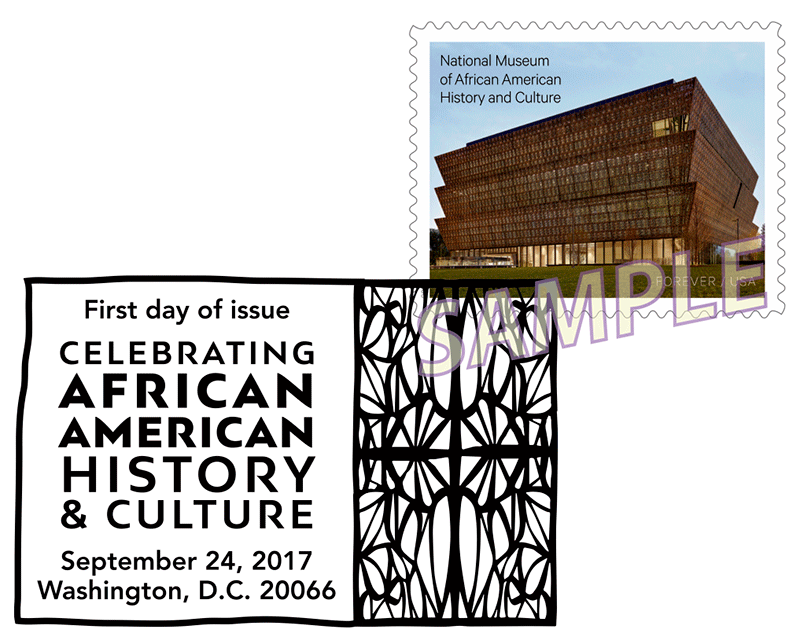 The B&W “rubber-composition” (hand) cancel measures 2.30″ x 1.49″.
 Customers have 60 days to obtain the first-day-of-issue postmark by mail. They may purchase new stamps at their local Post Office, at The Postal Store® website at usps.com/shop, or by calling 800-782-6724. They must affix the stamps to envelopes of their choice, address the envelopes (to themselves or others), and place them in a larger envelope addressed to:
 FDOI – Celebrating African American History and Culture Stamp
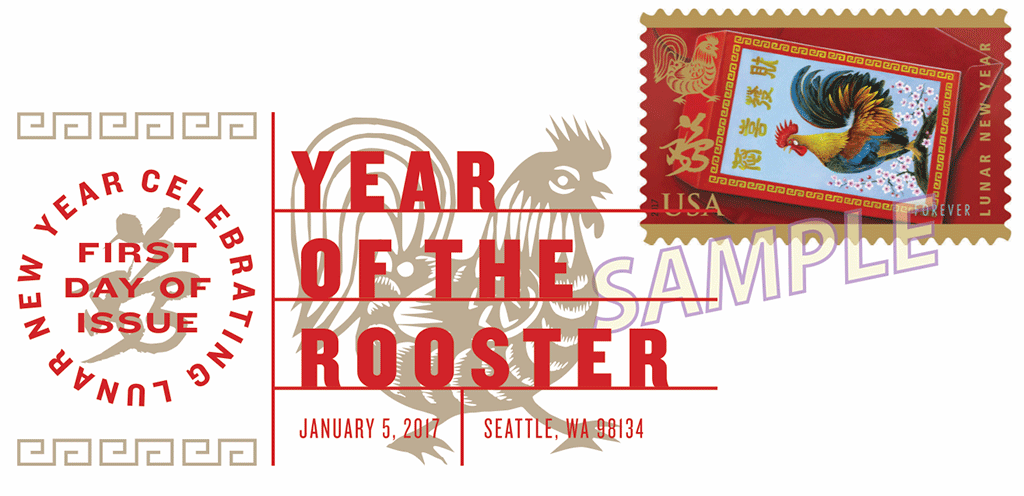 It measures 2.94″ x 1.31″. There is also a “special” postmark that local stations may use:
  It measures 2.98″ x 1.50″.
 On January 5, 2017, in Seattle, WA, the U.S. Postal Service will issue the Year of the Rooster First-Class Mail stamp (Forever priced at 47 cents), in one design, in a pressure-sensitive adhesive (PSA) pane of 12 stamps (Item 552000). The Year of the Rooster $5.64 pane of 12 stamps may not be split, and the stamps may not be sold individually.
 Only the pictorial postmark shown here is permitted for the Year of the Rooster stamp. The word “Station” or the abbreviation “STA” is required somewhere in the design, because it will be a temporary station.
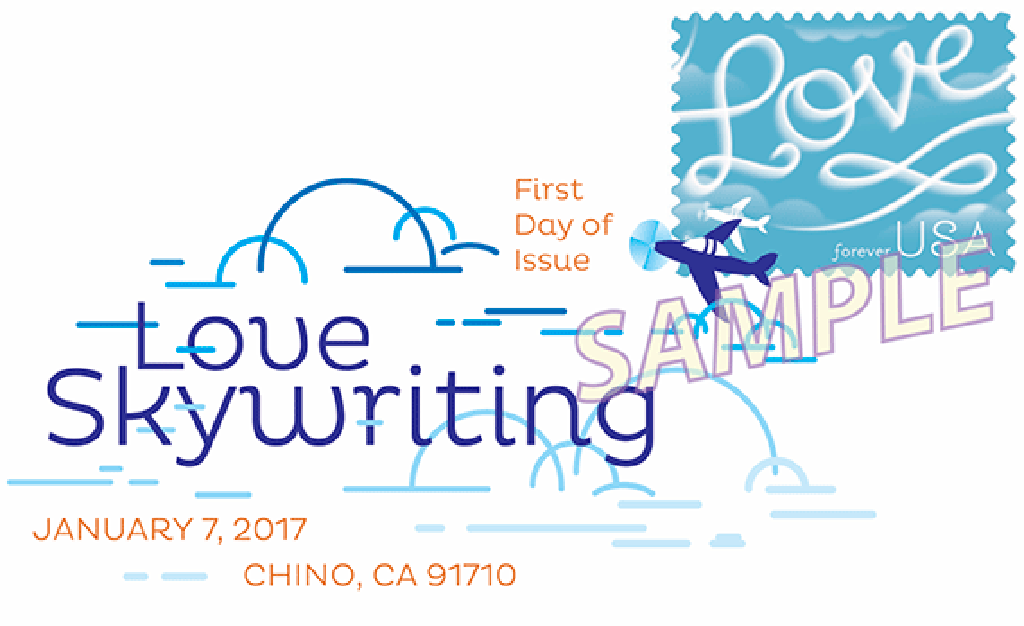 It measures 3.0″ x 1.5″.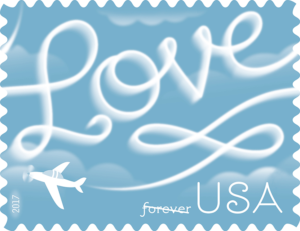
 BACKGROUND:
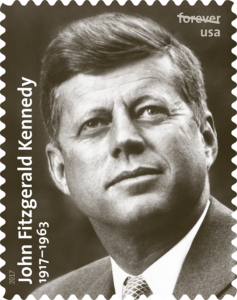 All but two of the issues appear to be what the USPS calls (or has called) “mail-use:” Issues for specific rates (Uncle Sam’s Hat, additional ounces; California Dogface Butterfly, nonmachineable surcharge rate) or will be issued as booklets for the non-collecting mailing public: sharks, flowers, flag, and so on. The John F. Kennedy stamp design is in the definitive format (height/width ratio). [In response to an e-mailed question, the USPS said that the JFK stamp is “a semi-jumbo stamp” with “a similar aspect ratio to our “special” sized stamps, but is proportionally larger.”] The exceptions are Fr. Theodore Hesburgh, although that may be a two-ounce stamp, and the museum.
 The United States entered “the War to End All Wars” — World War I — in 1917. Some historians feel this was the point at which the U.S. became a major world power, because the Americans turned the tide in the war. It would be shocking if the USPS does not issue at least one stamp for this historical event, and surprising if not several. (Israel’s 2016 stamp is shown on the left.)
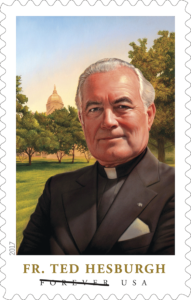 The Rev. Theodore M. Hesburgh (1917-2015) was an important mid-20th century educational, religious and civic leader. The stamp features an oil-on-panel painting of Father Hesburgh standing on the University of Notre Dame campus, where he served as president for 35 years. Appointed to the U.S. Commission on Civil Rights in 1957, Father Hesburgh helped compile reports on racial discrimination and the denial of voting rights that resulted in the Omnibus Civil Rights Act of 1964. A champion of causes ranging from education to immigration reform to the plight of underdeveloped nations, Father Hesburgh worked with many important organizations that reflected his beliefs. Art director Ethel Kessler designed the stamp with original art by Tim O’Brien.
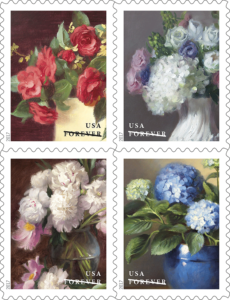 Flowers from the Garden features new stamps with four different paintings of flowers that come from typical American gardens, each bunch artfully arranged. One stamp features red camellias and yellow forsythia in a yellow pitcher, while on another there are white peonies and pink tree peonies in a clear vase. An arrangement of white hydrangeas, white and pink roses, green hypericum berries, and purple lisianthus in a white vase graces another stamp, while blue hydrangeas in a blue pot appear on another. Art director Derry Noyes designed the stamps with existing art by Elizabeth Brandon.
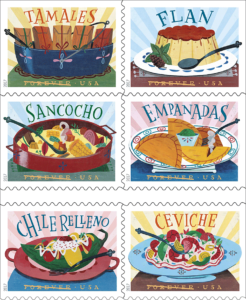 With the release of the new Delicioso Forever stamps, the Postal Service celebrates the influence of Central and South American, Mexican and Caribbean foods on American cuisine. This booklet of 20 stamps features six dishes from an array of Latin American culinary traditions that have found new life and variations in the United States. Each stamp showcases a bright and playful illustration of one of the following dishes: tamales, flan, sancocho, empanadas, chile relleno and ceviche. The names of the six dishes appear in a festive font above each image. Artist John Parra designed the stamps under the direction of Antonio Alcalá.
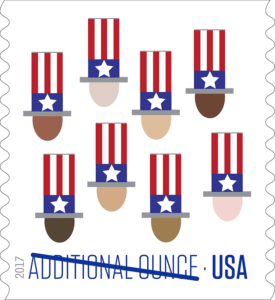 With the release of Uncle Sam’s Hat in 2017, the Postal Service celebrates one of the country’s most popular patriotic characters. Known especially for his large top hat decorated in varying patterns of stars and stripes, Uncle Sam has represented the bravery and fortitude of the American spirit for more than 150 years. The stamp features eight graphic top hats in Uncle Sam’s signature style. Red and white vertical stripes extend above a blue band with a white star and a gray brim. Beneath each hat is an oval shape representing a face, each in a different shade, meant to suggest the ethnic and racial diversity of the United States. Art director Antonio Alcalá designed the stamp. The words “ADDITIONAL OUNCE” on this stamp indicate its usage value. Like a Forever stamp, this stamp will always be valid for the rate printed on it.
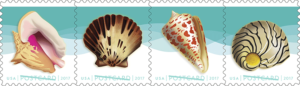 Four new postcard stamps celebrate the wonder of seashells. Each stamp depicts an iconic shell found in North American waters: the alphabet cone, the Pacific calico scallop, the zebra nerite, and the Queen conch, commonly known as the pink conch. The highly stylized stamp art expresses a lighthearted artistic view of shells. Horizontal swaths of white and blue in the background suggest waves washing the shells onto a beach. Art director Greg Breeding designed the stamps. Sergio Baradat created the stamp art.
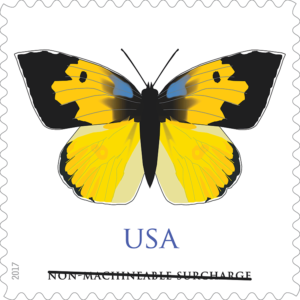 The California dogface graces the seventh non-machineable butterfly stamp for use on irregularly sized envelopes, such as square greeting cards, invitations or announcements. The stamp is a highly stylized, simplified image of a California dogface (Zerene eurydice) Ñ named for the forewing markings of the male butterfly, which bear a pattern that resembles a poodle head in profile. Greeting card envelopes printed with a silhouette of a butterfly indicate the need for additional postage or the use of a butterfly stamp. Tom Engeman created the stamp andÊ art director Derry Noyes designed it.
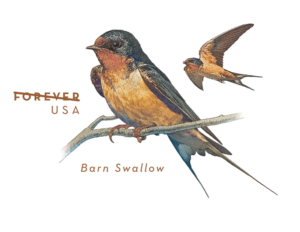 The Postal Service celebrates a favorite backyard bird on this Barn Swallow stamped envelope. It features a large illustration of a barn swallow perching and a smaller illustration above it, showing the bird in flight. The barn swallow (Hirundo rustica) originally nested in caves. As man-made structures began to dot the North American landscape, barn swallows adapted by building their mud nests under the eaves of barns, houses and bridges. Barn swallows are acrobatic flyers, and a single bird can catch and consume thousands of insects in one day. Art director William J. Gicker designed the stamp with original art by Matthew Frey.
 The National Postal Museum offers a series of public lectures and programs welcoming the National Museum of African American History and Culture to the Smithsonian family! In keeping with the new museum’s location in one of America’s most famous national parks—the National Mall—these programs will feature park rangers and other speakers spotlighting National Park Service sites associated with African American history. Many of these NPS sites are also featured in the National Postal Museum’s current exhibition Trailblazing: 100 Years of Our National Parks, on view until March 25, 2018.
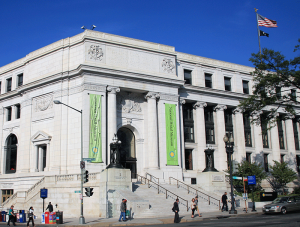 Evening Program
 January 9