Updated March 11th: The Scott catalogue number for this issue is 5156.
Updated January 27th: Here is the digital color postmark for this issue: 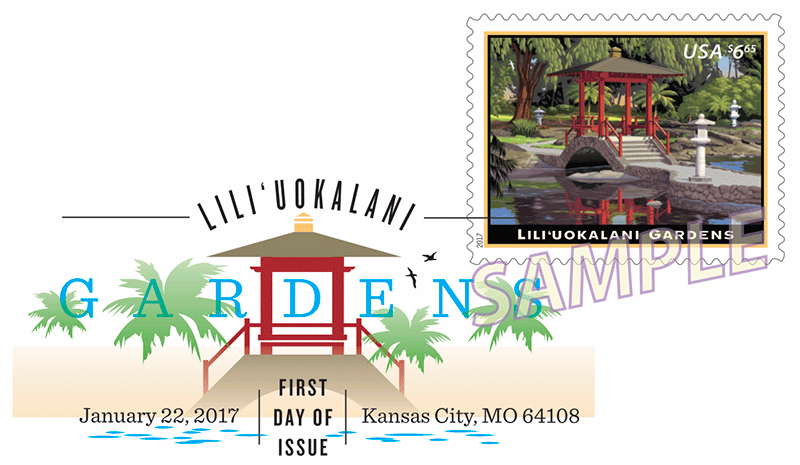 It measures 2.91″ x 1.39″.
Updated January 18th: From the USPS:
 A special ceremony for the Lili’uokalani Gardens Priority Mail stamp will be held Monday, Jan. 23, at 11:00 a.m. at the Shoroan Tea House, Lili’uokalani Gardens in Hilo.
Hilo Postmaster Alton Uyetake, Hawaii County Managing Director Wil Okabe and Friends of the Lili’uokalani Gardens President K.T. Cannon-Eger will participate in the ceremony to unveil an enlargement of the stamp.
While this is not a First-Day-of-Issue ceremony, stamp sales and cancellations will take place.
Also:
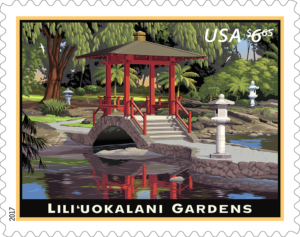
On January 22, 2017, in Kansas City, MO, the U.S. Postal Service will issue the $6.65 Lili’uokalani Gardens Priority Mail stamp, in one design, in a pressure-sensitive adhesive (PSA) pane of 4 stamps (Item 119900).
The stamp will go on sale nationwide January 22, 2017.
The U.S. Postal Service issues this Priority Mail stamp to coincide with the 100th anniversary of Lili‘uokalani Gardens in Hilo, Hawaii. Built on land donated by Queen Lili‘uokalani (1838–1917), the last Hawaiian monarch to govern the islands, the gardens were dedicated in 1917 and named in her honor. The stamp art features one of the gardens‘ most iconic structures, the red wooden shelter on a stone bridge spanning a portion of the pond. The bridge is surrounded by three of the gardens’ stone lanterns and lush tropical plants. Art director Greg Breeding designed the stamp with original art by Dan Cosgrove.
Stamp Fulfillment Services will make an automatic push distribution to Post Offices of a quantity to cover approximately 30 days of sales.
How to Order the First-Day-of-Issue Postmark:
Customers have 60 days to obtain the first-day-of-issue postmark by mail. They may purchase new stamps at their local Post Office, at The Postal Store website at http://www.usps.com/shop, or by calling 800-782-6724. They should affix the stamps to envelopes of their choice, address the envelopes (to themselves or others), and place them in a larger envelope addressed to:
FDOI – Lili’uokalani Gardens Stamp
USPS Stamp Fulfillment Services
8300 NE Underground Drive, Suite 300
Kansas City, MO 64144-9900
After applying the first-day-of-issue postmark, the Postal Service will return the envelopes through the mail. There is no charge for the postmark up to a quantity of 50. There is a 5-cent charge for each additional postmark over 50. All orders must be postmarked by March 22, 2017.
There are two philatelic products for this stamp issue:
- 119916 First-Day Cover, $7.09
- 119921 Digital Color Postmark, $7.80
Technical Specifications:
Issue: Lili’uokalani Gardens Stamp
Item Number: 119900
Denomination & Type of Issue: $6.65 Priority Mail Rate
Format: Pane of 4 (1 design)
Series: N/A
Issue Date & City: January 22, 2017, Kansas City, MO 64108
Art Director: Greg Breeding, Charlottesville, VA
Designer: Greg Breeding, Charlottesville, VA
Typographer: Dan Cosgrove, Chicago, IL
Artist: Dan Cosgrove, Chicago, IL
Modeler: Joseph Sheeran
Manufacturing Process: Offset, Microprint
Printer: Ashton Potter (USA) Ltd. (APU)
Printed at: Williamsville, NY
Press Type: Stevens, Vari-Size Security Press
Stamps per Pane: 4
Print Quantity: 12,000,000 stamps
Paper Type: Nonphosphored Type III, Block Tag Applied
Adhesive Type: Pressure-sensitive
Processed at: Ashton Potter (USA) Ltd. (APU)
Colors: Black, Cyan, Magenta, Yellow
Stamp Orientation: Horizontal
Image Area (w x h): 1.42 x 1.085 in/36.07 x 27.56 mm
Overall Size (w x h): 1.56 x 1.225 in/39.62 x 31.12 mm
Full Pane Size (w x h): 4.12 x 3.45 in/104.65 x 87.63 mm
Plate Size: 20 stamps per revolution
Plate Numbers: “P” followed by four (4) digits
Marginal Markings:
Front: Plate number in two corners of pane
Back: ©2016 USPS • USPS Logo • Four barcodes (119900) • Plate Position Diagram • Promotional Text
Updated January 5th: This stamp will be issued Sunday, January 22nd with no ceremony and a Kansas City, MO, postmark.
from the USPS December 28, 2016:
This Priority Mail stamp is being issued to coincide with the 100th anniversary of Lili’uokalani Gardens in Hilo, Hawai’i. Built on land donated by Queen Lili’uokalani (1838–1917), the last Hawaiian monarch to govern the islands, the gardens were dedicated in 1917 and named in her honor. Hilo’s Lili’uokalani Gardens are Japanese in style with influences of Hawaiian remains of lava flows, plantings of tropical trees and flowers, and a view of the Mauna Kea volcano — Hawai’i’s highest point. The stamp art features one of the gardens’ most iconic structures, the red wooden shelter on a stone bridge spanning a portion of the pond. The bridge is surrounded by three stone lanterns and lush tropical plants. Art director Greg Breeding designed the stamp with original art by Dan Cosgrove.
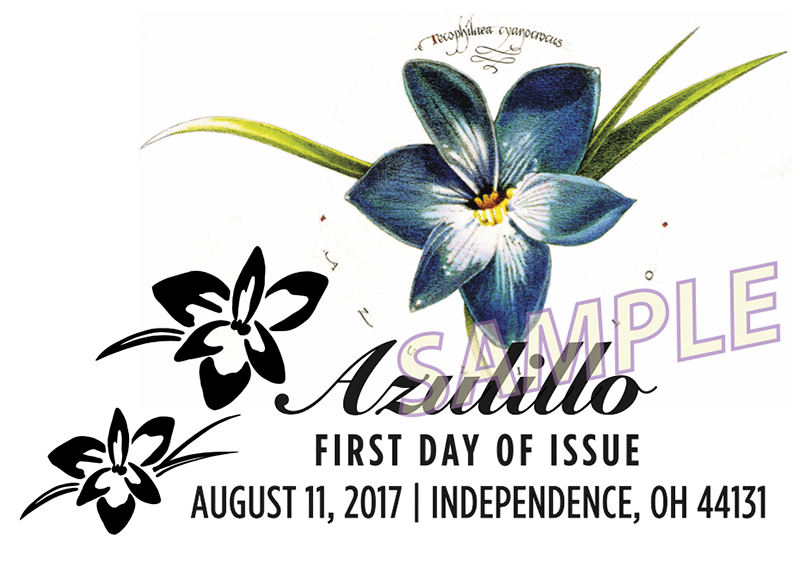
 On August 11, 2017, in Independence, OH, the U.S. Postal Service® will issue the Azulillo stamped card Forever® priced at 38 cents (34-cent postage + 4-cent surcharge) in one design.
 Customers have 60 days to obtain the first-day-of-issue postmark by mail. They may purchase new stamps at their local Post Office, at The Postal Store® website at usps.com/shop, or by calling 800-782-6724. They must affix the stamps to envelopes of their choice, address the envelopes (to themselves or others), and place them in a larger envelope addressed to:
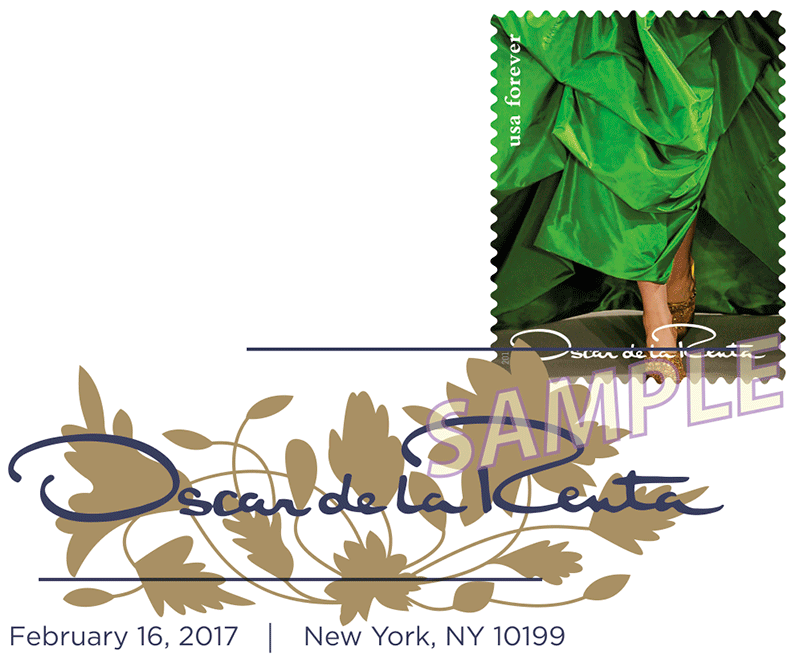
 It measures 2.9″ x 1.12″. In addition, there will also be a show pictorial for Americover.
 a. (49¢) Photograph of Oscar de la Renta
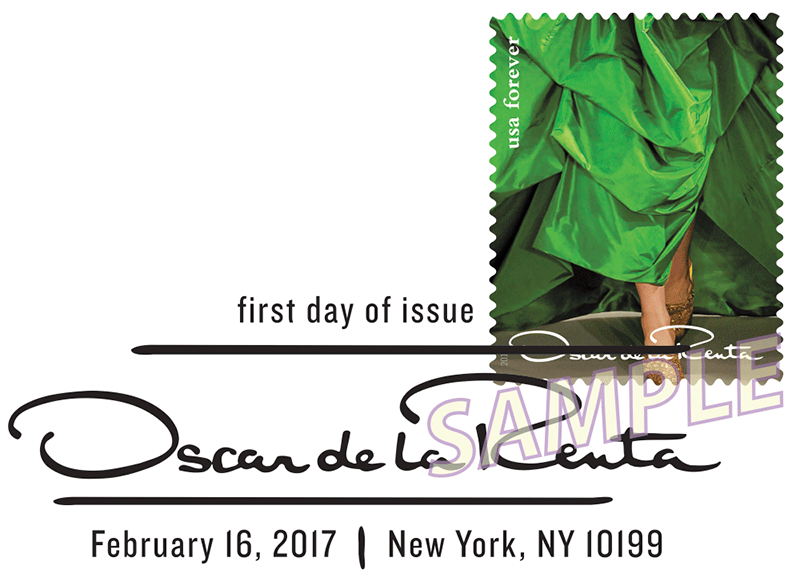
 It measures 3″ x 1.3″. Here is the design for the pictorial cancel:
  It measures 2.97″ x 1.14″. There is also a “special” postmark that local post offices may offer:
  It measures 2.87″ x .98″.
 The U.S. Postal Service is issuing the Oscar de la Renta Forever stamp to honor one of the world’s leading fashion designers. For 50 years, Oscar de la Renta created glamorous, sophisticated clothes that showcased the distinctively feminine attributes of the women who wore them. His innovative designs and close attention to detail elevated American style and brought international attention to New York as a world leader in fashion.
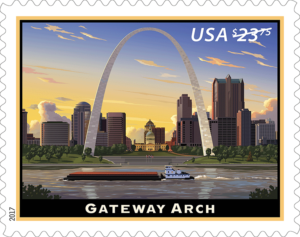 The Postal Service celebrates the Gateway Arch, in St. Louis, MO, with a new Priority Mail Express stamp. The Gateway Arch was built as a memorial to President Thomas Jefferson and the 19th-century traders and pioneers for whom St. Louis was the gateway to the West. The stamp art depicts the majestic stainless-steel arch at sunset in its setting on the banks of the Mississippi River. Towering above the city’s skyline, the Gateway Arch is reflected in the rippling water below, where a barge passes by. Designed by art director Greg Breeding, the stamp features a digital illustration created by Dan Cosgrove.
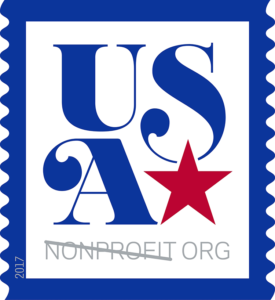 Patriotic Nonprofit, the new non-denominated, nonprofit-price stamp, showcases the letters “USA” in blue, accompanied by a bright red star on a white background with a blue border. To create the new design, the 2016 USA stamp art was rendered slightly smaller to accommodate the blue border. Intended for bulk mailings by authorized nonprofit organizations, this stamp will be issued in coils of 10,000. Art director Antonio Alcalá designed the 2017 Patriotic Nonprofit stamp using the 2016 USA stamp art he designed with Leslie Badani.
 With the presidential election behind us and the inauguration coming up, we are seeing the American Flag as the backdrop of much TV reporting. It got me wondering what might be found in the pantheon of American stamp issues that might make for an interesting way to give more depth to U.S. collecting. There is certainly nothing wrong with the traditional approach of collecting one of every U.S. stamp issued. And yet for many of us, new challenges beckon, and U.S. Flags is one that comes with a high level of knowledge, enthusiasm, and even offers a way to connect with non-collectors who have a love for America and its symbols.
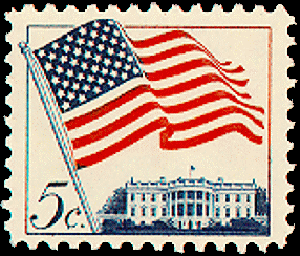 With the 1963 5¢ Flag Over White House (Scott #1208, right) issue, the U.S. Postal Service began an unbroken run of definitive (regular postage) stamps that extends to today. This movement really got into high gear with the issuance of the first plate number coil (18¢) Flag stamps in 1981. One of the post-1963 definitives (Scott #1891) is shown below.
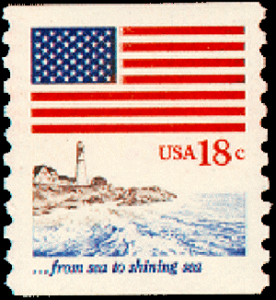 printers were needed to produce the multiple billions of Flag stamps needed by the public. Ultimately, the Bureau of Engraving and Printing (BEP) got out of printing U.S. stamps altogether in 2005. Multiple printers meant not just different plate numbers, but many different versions of each issue including: lick-and-stick, self-stick, tagging varieties, separation (perforation and die cut) varieties, print dates in the lower left corner, microprinting entries, slight design differences, and counting numbers on the back. Most of this is reflected in increasingly complex Scott U.S. Specialized Catalogue listings.
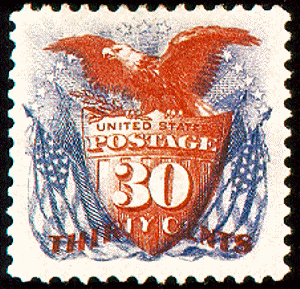 To the extent we think about it, most U.S. collectors would assume that the 30¢ 1869 stamp (Scott #121 at right) is the first issue with a U.S. flag. See the all-blue flags in the lower corners of the stamp? In fact, if one includes representations of the flag in the form of a shield, then the first U.S. stamp is the 30¢ Benjamin Franklin 1860 stamp (Scott #38). Note the stars-and-stripes shields in all four corners (below left). Had you ever noticed it before?
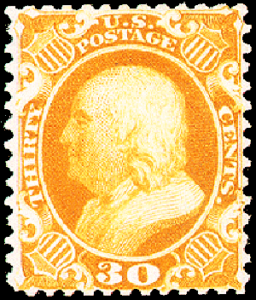 Would you like to guess how many face-different U.S. stamp designs include the various forms of the American flag? 25? 50? As many as 100? When I sat down with the catalogue to count them, I was surprised to tally over 200! Now, that does include denominated and non-denominated flag stamps that are otherwise the same, and the different color denominations of the 32¢ “G” definitives; but it does not include Stars-and-Stripes shields, or hard-to-identify dots flying from flag poles on federal buildings and ships, on monuments, uniforms, and airplanes.
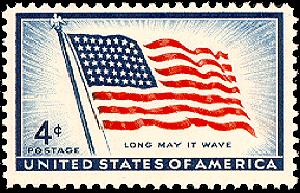 The first U.S. flag to be shown in color is the handsome 4¢ 1957 48-star flag (Scott #1094) shown on the right. The 1957 stamp also has the distinction of being the first U.S. stamp to be produced on the BEP’s new Giori press, which could do up to three colors from a single plate. Up to that point, multicolor stamps produced by BEP required separate plates for each color; a situation that required more time and effort, but also made the
 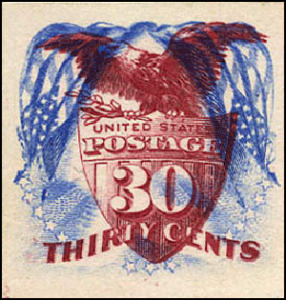 Bureau invert-prone. One of the inverts that resulted is on the 30¢ 1869, and you can see the upside down flags in the proof shown on the left (Scott #121aP4). One of the interesting aspects of U.S. stamp collecting is the search for what are called “design errors”; mistakes in the final design attributed to inadequate research, oversight, artistic license, and pure sloppiness.
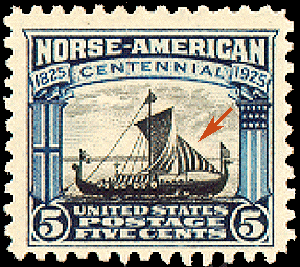 The 5¢ Norse-American stamp on the right (Scott #621) might be called a non-design error. It caused a bit of a sensation when it was issued in 1925 because the ship, clearly early Norse, not current American, is flying an American flag (arrow). The Post Office Department patiently explained that this was no mistake. The craft is a replica of a Viking “Dragon Ship”, and actually sailed from Norway to the United States between April 30, and June 13, 1893, to participate in the World’s Columbian Exposition. The stamp was designed using actual photographs of the replica.
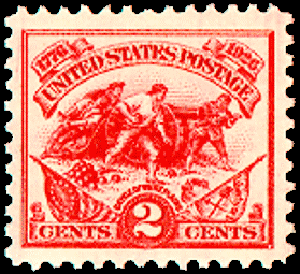 The 3¢ White Plains issue on the left was released in 1926 (Scott #629) for the 150th Anniversary of the Battle of White Plains, which took place on October 28, 1776. But the Stars and Stripes at the bottom left did not come into being until June 14, 1777.
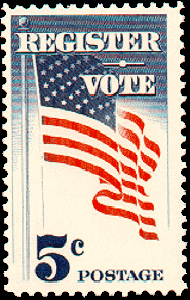 the same way that Queen Victoria’s presence on Great Britain #1 left no room for doubt as to its origin. The stamp did generate another question as there are only three red stripes next to the blue field of stars, while the correct number is four. Discussion resulted in a finding that the fourth stripe was present, but is hidden by the ripples of the flag.
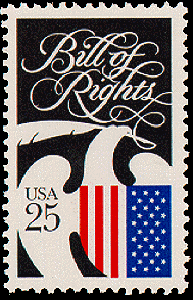 Another breach of etiquette is seen on the 25¢ “Bill of Rights” commemorative from 1989 (Scott #2421) seen in Figure 8. It should have been displayed with the stars on the left, and the stripes on the right; not as shown. A result is that we sometimes see the stamp applied upside down on covers as people observe correct flag —if not philatelic — etiquette.
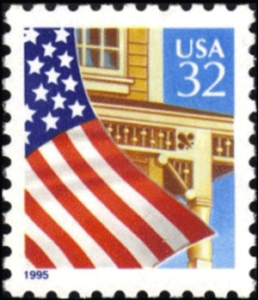 “Those who know the flag well will immediately see something amiss, but identifying the problem is slightly harder. The U.S. flag has 13 stripes, seven of which do not span the entire width of the flag, because of the field.
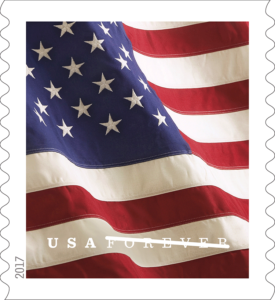 And if that is not enough to keep you busy, you can branch out into military and State Flags on U.S. stamps, Confederate Flags (dare I say), and even foreign flags on U.S. stamps. The Flag subject is a gift that keeps on giving! (Show at left: The 2017 U.S. Flag stamp.)
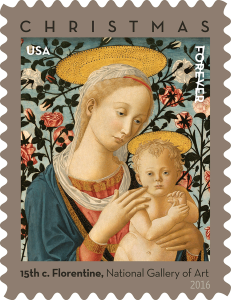 5143 (47¢) Florentine Madonna and Child
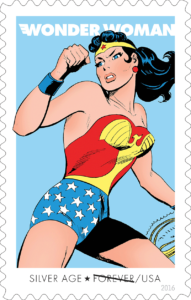 5149-5152 (47¢) Wonder Woman
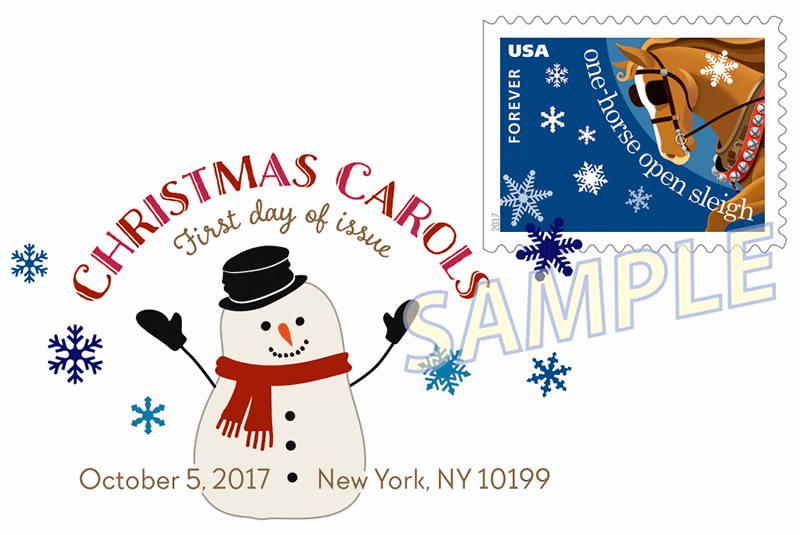 The Digital Color Postmark for this issue measures 2.27” x 1.45″.
 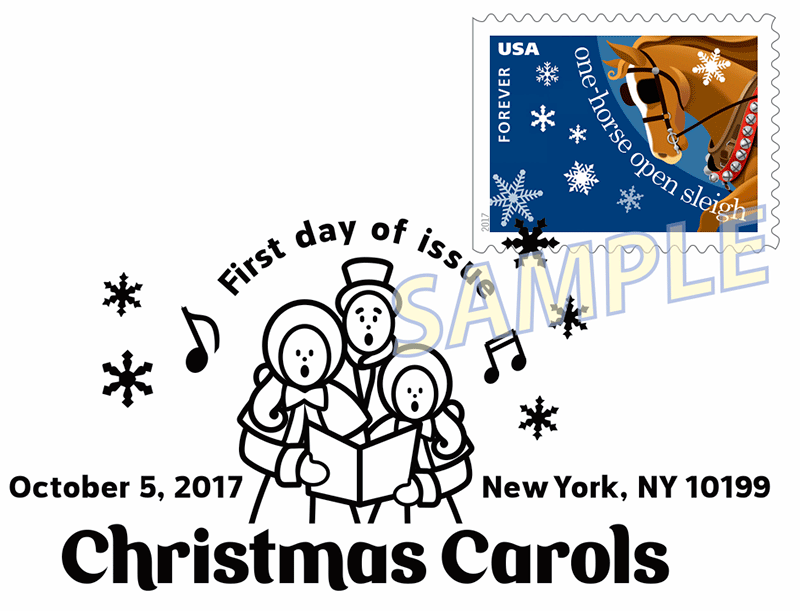 The B&W pictorial (rubber) postmark measures 2.99” x 1.70”.
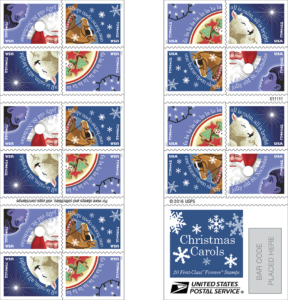
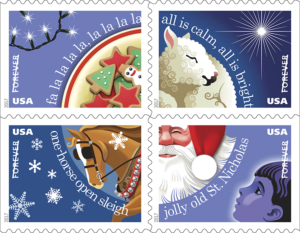 On October 5, 2017, in New York, NY, the U.S. Postal Service will issue Christmas Carols stamps (Forever priced at 49 cents) in four designs, in a pressure-sensitive adhesive (PSA) booklet of 20 stamps (Item 677300). The stamps will go on sale nationwide October 5, 2017.
 Issue: Christmas Carols Stamps
 The 2017 Christmas season will be celebrated with four new Forever stamps featuring images that illustrate four beloved Christmas carols: “Jingle Bells,” “Deck the Halls,” “Silent Night,” and “Jolly Old Saint Nicholas. ” Familiar lines from each song highlight the individual stamps. Shades of blue in the stamp backgrounds evoke the evening scenes from the four carols. This booklet of 20 stamps includes five of each design. The late Howard E. Paine was art director; artist Steve McCracken created the original art.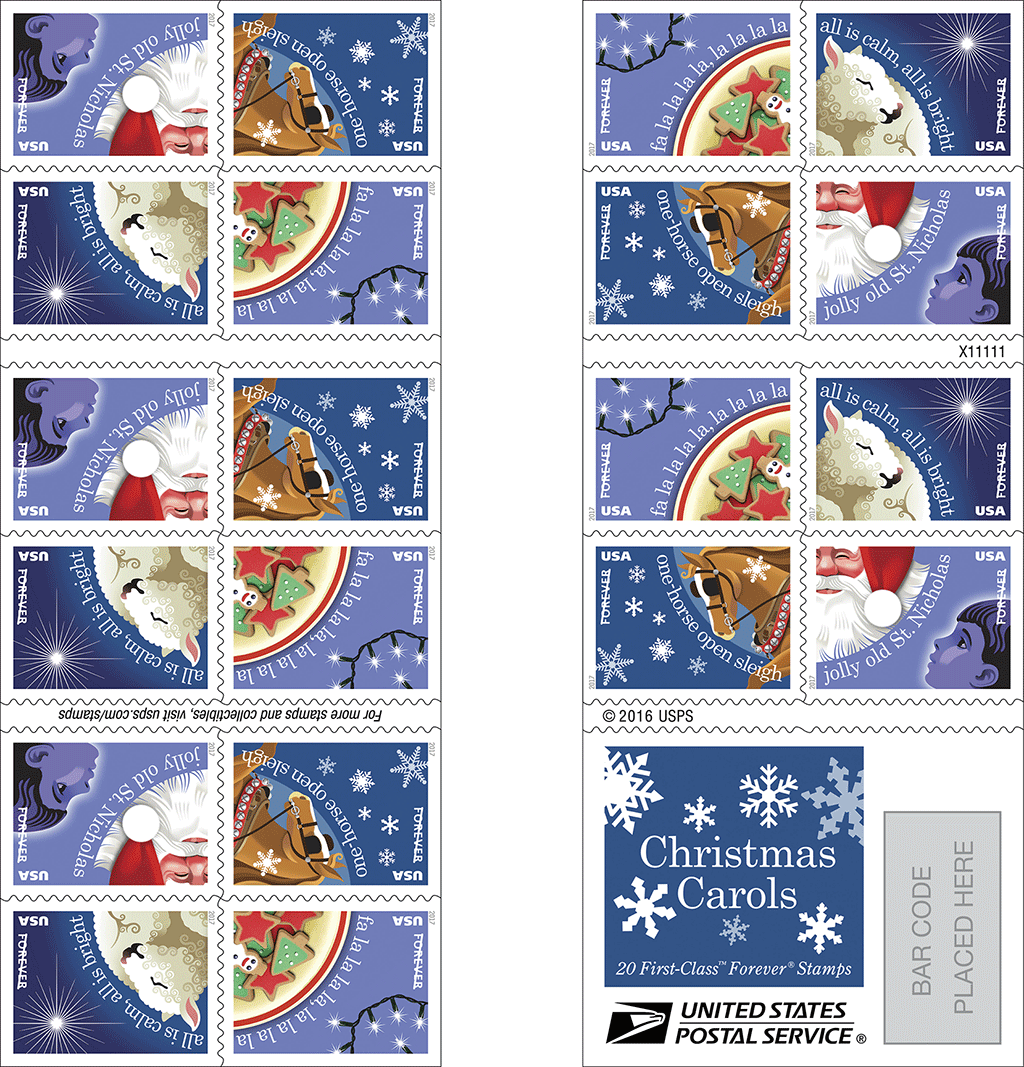
 WHAT:
WHAT: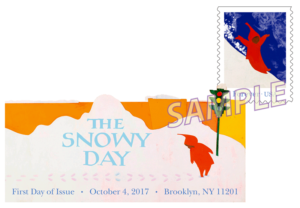 WHEN:
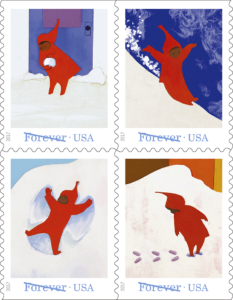
WHEN: The U.S. Postal Service showcases Ezra Jack Keats’ most beloved story, The Snowy Day. Written and illustrated by the celebrated children’s author, it was one of the first prominent 20th-century picture books centered on an African-American child. Each of the four new stamps in this 20-stamp booklet features a different illustration of main character Peter exploring and playing in his neighborhood while wearing his iconic red snowsuit. The images include Peter forming a snowball; sliding down a mountain of snow; making a snow angel; and leaving footprints in the snow. Art director Antonio Alcalá of Alexandria, VA, designed the stamps. The stamps may be pre-ordered in early Sept. for delivery shortly after the Oct. 4 issuance at usps.com/shop.
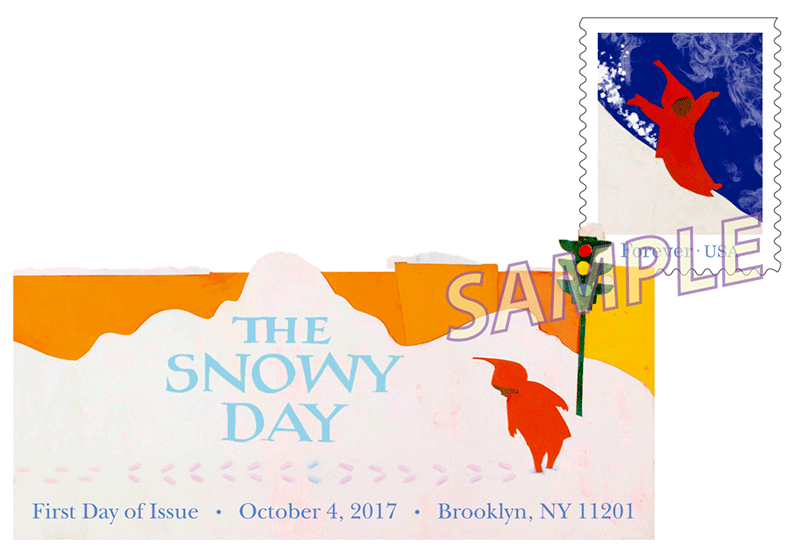 The Digital Color Postmark measures 3″x2.232″.
 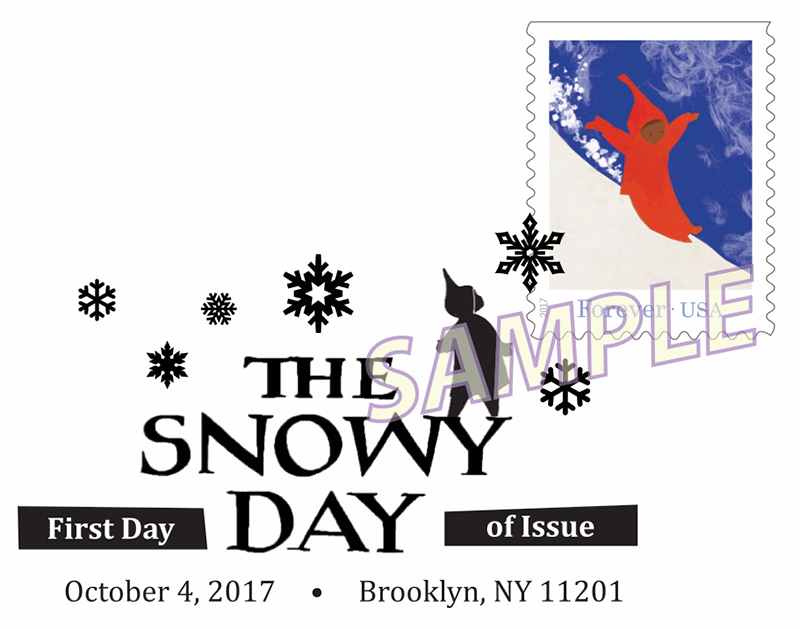 The B&W pictorial (rubber) postmark measures 2.353″ x 1.5”.
 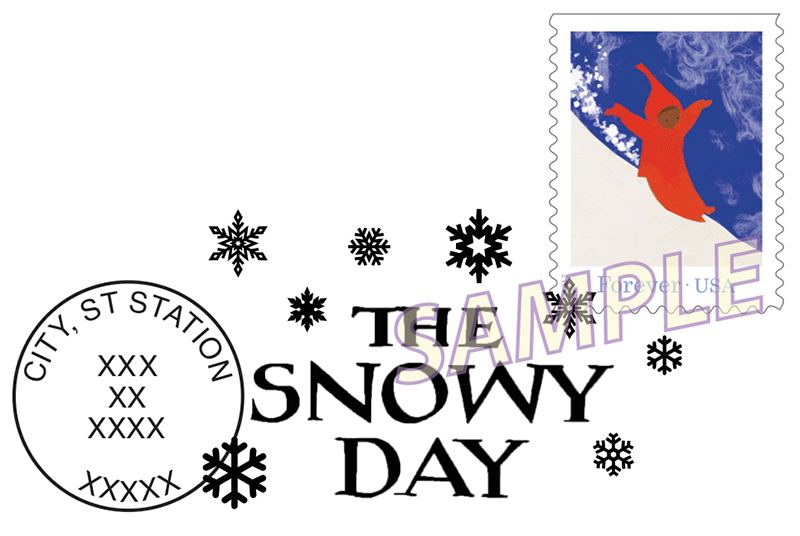 The special postmark for use by other post offices measures 2.7” x 1.232”.
 WHAT:
WHAT: BACKGROUND:
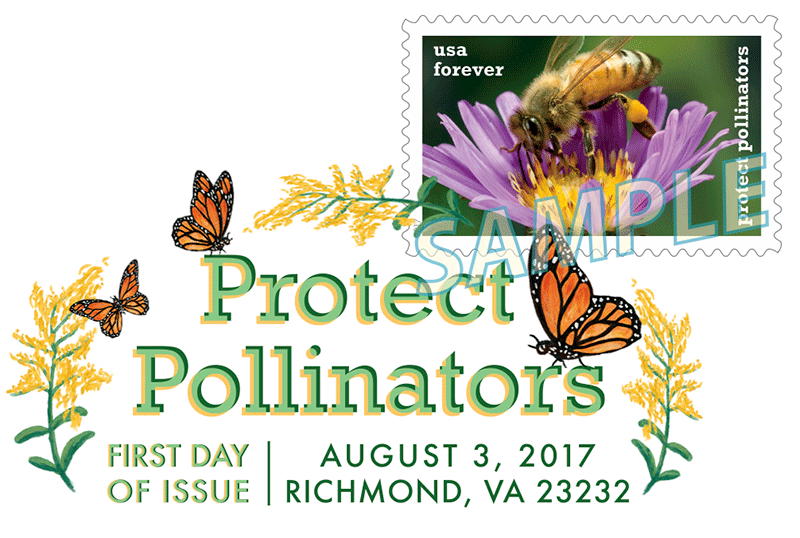 It measures 2.90″ x 1.45″.