Hotchner: “Investing” in New Issues

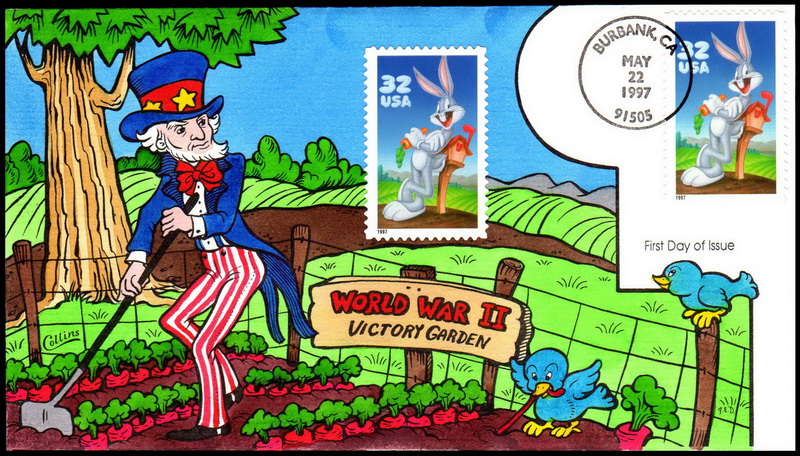
“Investing” in U.S. New Issues
by John M. Hotchner

My Dad was a serious collector who knew his philatelic A, B, Cs. He loved especially U.S. and German stamps, and went so far as to make his own albums. I learned much at his knee; both things to do and things not to do. After an unhappy incident when I was 12, we came to an agreement that we would collect different countries; with one exception, which I will get to.

The incident took place at a meeting of the New Delhi, India, Stamp Club in 1955, while he was assigned to India as the U.S. Information Agency’s liaison officer to All India Radio.

The meeting happened to have an auction, and I had just gotten my allowance – the princely sum of 5 Rupees per week (or about $1 U.S.). Added to money I’d saved, I had about 30 Rupees burning a hole in my pocket, and when a lot of Indian “Service” overprints came up, half a dozen hands went up around the room. I was in the back, looking in the equivalent of a penny box. I joined in the fun.

As the bids passed 10 Rupees, the sport of it all took hold of me, and I was determined to get the lot. As bidders dropped out, I failed to realize until too late that I was bidding against my father. He may not have realized he was bidding against me. But when he dropped out and I got the lot, and had to announce my name and club number, the cat was out of the bag.

On the way home, he was characteristically quiet; as was I. I had no idea of the storm to come. He was quiet for a week, and ultimately it was my mother who told me that he was furious, and I was guilty of improper behavior. To make a long story short, that was the end of my India collection, and he and I agreed not to be competitors in the future; enforced by our splitting of our collecting interests – except for United States, which he would collect mint, and I would collect used.

As part of his collecting he had been buying several sheets of U.S. mint new issues since the end of World War II, and he continued to do so – along with a lot of other stamp collectors – as a hedge against inflation. He saw stamps from the 1920s and 1930s doing fairly well in Fine-to-Very Fine condition, and made the assum

Howard Hotchner

ption that the trend would continue. So, he made an effort to put away at least a few VF panes of each new issue until he was disabled by Parkinson’s disease in the late 1980s. On his passing, I assumed his rather nice India collection, among others, and was also heir to a two-foot-high stack of U.S. mint sheets, not to mention a hefty holding of plate blocks that he had stashed away over the years.

I was not alone. It seemed that a great many collectors had the same idea post-WWII, and the Post Office Department thoughtfully upped the production runs to make certain that there would be plenty of stamps to satisfy demand.

The result was, and continues to be today, that panes of mint US commemoratives from the late 1940s onward are pretty much a drug on the market. Oh, there are a few that are “better” than face because of the subject portrayed, or because of shorter than usual production totals, but I found out to my chagrin that the holding was not going to bring even face value if sold. It was a buyers’ market as lots of other heirs had bales of mint U.S. to sell in bulk.

Luckily, I was by then writing columns for several philatelic publications, and – this being before the era of widespread use of the Internet – I had a considerable correspondence, and began to use the stamps for postage. Here it is 25 years later, and I am still using some of Dad’s hoard.

But it seems that the collector community and the heir community never connected, because collectors continue to buy and salt away panes of mint U.S. stamps. What with multiple designs in a pane, and smaller panes with fancy marginal art, a higher percentage of these more modern emissions do have premium value in the secondary market. But for the original buyer trying to sell them among quantities of other mint stamps including plate blocks, booklets and coil rolls, face value is about what can be expected if one is lucky.

And that ain’t so good when one considers the impact of inflation, and the rise in postal rates. More often, quantities of US mint stamps sell in clubs between collectors at 80 to 85% of face. And if selling to a dealer, the offers drop off precipitously as the face values of the stamps offered decrease. In fact, I recently saw a dealer describe his business practices as follows:

“I own thousands of face value stamps in my warehouse, and rarely take any to stamp shows. Yes, if I buy for 25-40% of face depending on content and condition and sell it for 70-80% of FACE, that is a great percentage markup. In my experience, the volume of sales will not justify the table space regardless. I really am not a great buyer for postage except as part of a much larger and better collection.”

I do see dealers at shows selling U.S. mint at face from large boxes of stock. And there seem to be lots of collectors poking through the material though I don’t know how much actually sells. The point is that a dealer who has to make a profit, and pay himself for the time he or she has put into acquiring and preparing the material to sell, has to buy at 30-40% below the sale price.

Many feel that this is unfair given what they or their collector relative put into the stamps. But “fairness” really does not enter into it. Supply-and-demand is what governs. And there is far more U.S. mint material for sale than there is demand to absorb it. Just like selling stocks at a loss, sometimes you win, and sometimes you lose.

My father was not looking to get rich quick. He bought prudently, in small quantities with low amounts of money, and based on what he saw as past performance. It was not irrational to expect that 20-25 years down the road, he would reap a modest profit. But, as it turned out, he would have done better to put the same amounts into, say, used $5 Columbians, or other premium U.S. stamps.

And yet, there continue to be collectors who follow the path of investing in mint panes, booklets and coil rolls. A few dynamics make this problematic. First, though the production quantities have decreased markedly, so has the percentage of collectors in the population. Add in the facts that inflation continues to rise, and postage rates continue to rise, while mail volume has declined and will likely continue to do so.

What this means is that the Postal Service is the only guaranteed winner in this equation. They get to use the money right now that collectors pay for stamps they stockpile and don’t “redeem” for many years into the future. And make no mistake: a great many of these “old” stamps are indeed ultimately going to be used for postage.

There are several lessons here. First is that buying mint U.S. stamps in quantity as an investment strategy will likely not turn out well. Second, if you decide to sell your accumulation while you can still benefit, do not sell everything as a single lot. Do your homework, and don’t be in a hurry. Watch buy prices for thematic commemoratives, booklets, coils, etc. that have acquired some premium value. You may not make a lot more than face, but at least you will do better than the 50-60% you would be offered for a large accumulation.

Third, find ways of selling what is left to other collectors at a small discount rather than to dealers at a large discount. Being a member of a stamp club is a plus because many collectors like to use older colorful stamps on their mail.

Fourth, be grateful that you are getting something back on your investment. For most hobbies and pastimes, you are buying pleasant memories, and maybe an investment in physical fitness, but you will get nothing back on the money you have spent on event tickets, golf club entry fees, tennis balls, etc.

Fifth, unless you are a movie star or a sports hero at the professional level, there is no such thing as easy money; and even for them that spigot can be turned off in a hurry if their performance or drawing power drops off. If you want to make money you have to work for it. And in stamps that means what may seem like an easy and sensible scheme, be it in mint stamps, first day covers, plate blocks, gold-replica stamps, or foreign new issues, rarely pans out. To be a successful investor, one must study the investing alternatives, past performance, collecting trends, supply versus demand, the real liquidity of different kinds of investment alternatives, and then make informed, clear-eyed, choices that are still only educated guesses.

But all of this is work, and in some sense is incompatible with why we start a hobby in the first place – to occupy our free time with a pleasurable activity. Investing may seem like a natural extension of collecting, but it is a different level of effort if done seriously; and one that can lead to disappointment with what had been at one time a fun hobby.


Should you wish to comment on this editorial, or have questions or ideas you would like to have explored in a future column, please write to John Hotchner, VSC Contributor, P.O. Box 1125, Falls Church, VA 22041-0125, or email, putting “VSC” in the subject line.

Or comment right here.

ATA Offers Exhibiting, Display Courses Online

[press release]
ATA to Offer Two Courses

The American Topical Association is offering two courses via Zoom during the month of May.

Wondering How to Mount and Display Your Collection? Make Your Own Album Pages! is three sessions at 6:00 p.m. Eastern on May 4, 6 and 11. It will show how to design pages on a computer and print them or take them to be printed.

The course will be taught by Martin Kent Miller, owner of The Philatelic Press, a design and marketing firm geared to the needs of philatelists. Martin has worked as a graphic designer for 30 years and enjoys making album pages. Also teaching will be Jeff Hayward, ATA first vice president, who works in the computer field and assists ATA with its technology. He is an avid collector who designs album pages for his many topics.

Cost is $25 for ATA members, $40 for non-members. Registration is open on the ATA website at www.americantopical.org.

Thematic Exhibiting: Steps to Success is a five-part course is designed to give students practical information to use in planning and developing a thematic exhibit. The five-part course will be offered on May 15 (4 p.m. Eastern), May 18 and 20 (6 p.m. Eastern) and May 22 and 29 (4 p.m. Eastern). Cost is $35 for members, $50 for non-members.
ATA president Dawn Hamman will present the first session, an overview of the decisions students need to make in planning; writing the thematic story; and acquiring and describing material. There will be a discussion of resources to use along the way. She is a thematic exhibitor, writer and editor.

The second session, taught by Martin Kent Miller, will cover layout and design, including choosing paper, page design basics, matting, typefaces and size. The owner of The Philatelic Press, a marketing and design firm geared to the needs of philatelists, Miller edits numerous publications, including First Days and The United States Specialist. He designs many publications for ATA, and edited the 2020 book, Topical Adventures – A Guide to Topical and Thematic Stamp Collecting.

The third session will be a case study, in which prominent thematic exhibitor Phillip Stager will go through the steps he took in developing his award-winning exhibit, The Wonderful World of Bamboo. Stager has been exhibitjng since high school and has won many top awards for his thematic exhibits. He is a retired philatelic judge who served as chief judge for the National Topical Stamp Show several times. He wrote the chapter on thematic exhibiting for Topical Adventures – A Guide to Topical and Thematic Stamp Collecting.

Jean Wang will lead the class on May 22: How to Choose a Wide Variety of Philatelic Items for Your Exhibit. She is the grand award winning exhibitor for Blood: A Modern Medicine, CANPEX, 2019, and one of the foremost thematic exhibitors working today. She will describe how she selected a wide range of philatelic items to tell the thematic story.

The final session of the course will be a wrap-up for students to report on their progress and ask questions.

Typically Dutch: Canal Houses [Netherlands 2021]

[press release]
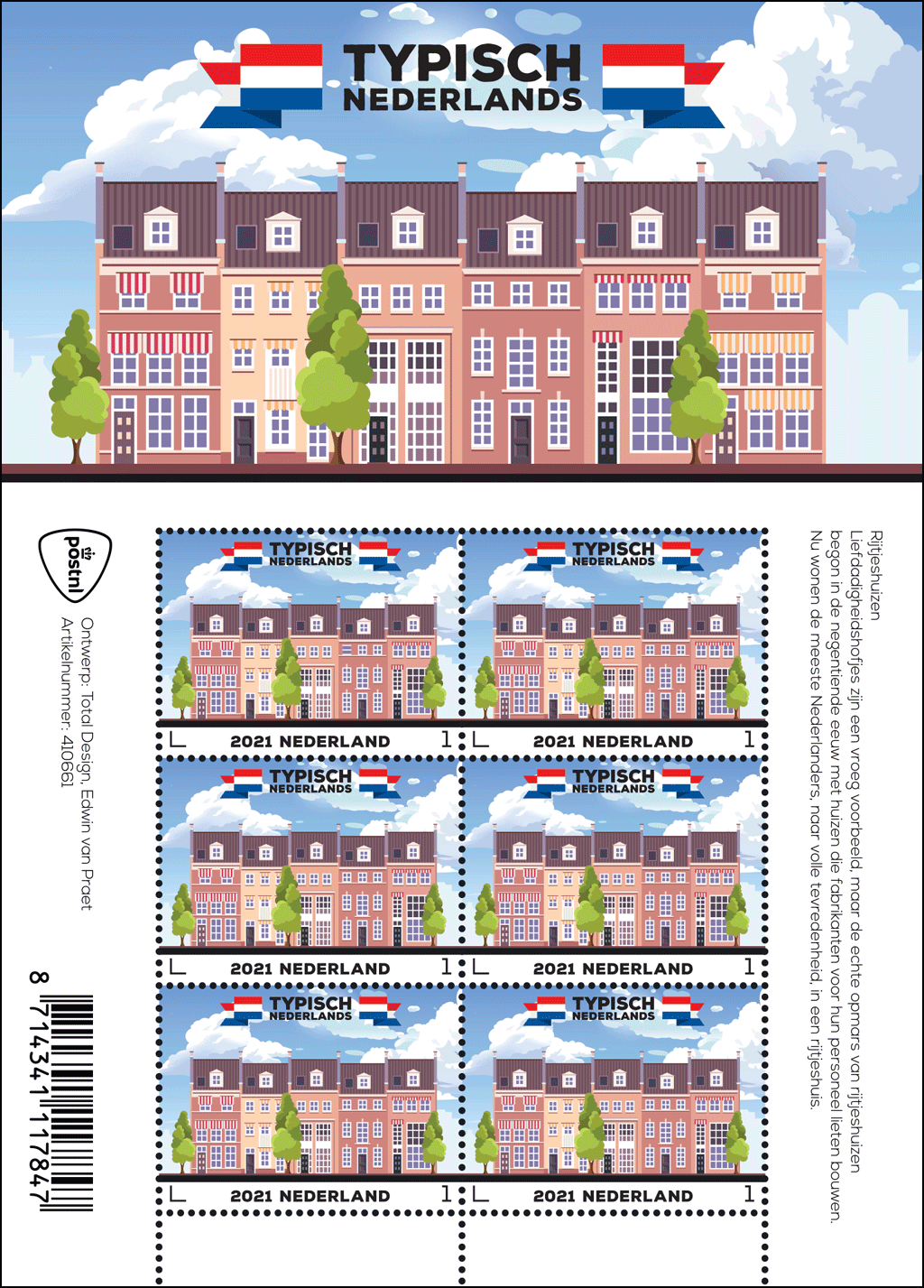
Typically Dutch: Iconic canal houses on new stamps

The Hague, March 25, 2021 – Wherever you go in the world, almost everyone knows the canals of Amsterdam. Five beautiful buildings on these canals have now been immortalized on the latest PostNL stamps from the Typically Dutch series.

In 2021, the series will focus on housing types and facades that are characteristic of our country. Stamps about traditional farmhouses and wooden houses have already been published. Issues on houseboats and terraced houses will follow later this year.

Colorful illustration
The Typically Dutch canal houses stamps show a colorful illustration of 5 canal houses from Amsterdam. The buildings, large and small, are adjacent. The silhouette of the façades on the canal behind it is visible on the left and right in the background. The depicted canal houses can be admired in real life on the Herengracht, the Oude Turfmarkt, the Brouwersgracht and the Leidsegracht.

Crescent shape
The Amsterdam canal belt, now a UNESCO World Heritage Site, has been laid out in phases. The Prinsengracht, Keizersgracht and Herengracht were dug in the early 17th century. From around 1660, the city extended the canals to the Amstel. Finally, the expansion to the Eastern Islands came about around 1680. This is how the map of Amsterdam got the typical crescent shape.

Painting
The stamps on the Amsterdam canal houses were designed by Edwin van Praet of Total Design from Amsterdam. Van Praet’s choice was based on the desire to show different buildings with different uses and different types of facades from different periods. He also wanted to emphasize that large and small buildings stand next to each other on the canals. Based on the typical appearance of the canal houses, Van Praet tried, as he says, to make “a painting”. “A romantic illustration as an ideal image of the canal house. There can be a list around it. ”

Availability
The Typically Dutch canal houses stamp sheet has 6 identical stamps with the denomination Nederland 1, intended for mail up to and including 20 grams with a destination within the Netherlands. The stamps are available from March 22, 2021 at the Bruna stores and via www.postnl.nl/bijzondere-postzegels. The stamps can also be ordered by telephone from the Collect Club customer service on telephone number 088 – 868 99 00. The period of validity is indefinite.

USPS Offers Own 2021 Inauguration Cover

[press release]
2021 Presidential Inauguration Collectible Available through USPS Postal Store

WASHINGTON, DC — Commemorate the 59th presidential inauguration with this souvenir envelope. The No. 10 envelope features portraits of President Joseph R. Biden and Vice President Kamala D. Harris, along with an illustration of the White House.

The envelope may be purchased for $12.95 on usps.com. The item number is 882158.

Postal Products
Customers may purchase stamps and other philatelic products through the Postal Store at usps.com/shopstamps, by calling 844-737-7826, by mail through USA Philatelic, or at Post Office locations nationwide.

Direct link to product

USPS Drops Express Mail Time of Day Guarantee

Am I misreading this, or does this change do away with a reason for businesses to use Priority Mail Express? 6 pm is after the close of business for most companies; certainly the close of their offices. In effect, it adds another day to the delivery.

[press release]
U.S. Postal Service Announces Changes to Delivery Time for Priority Mail Express, and Seeks to Transfer Bound Printed Matter Parcels to the Competitive Product List

WASHINGTON, DC — The United States Postal Service filed notice with the Postal Regulatory Commission (PRC) today seeking to transfer Bound Printed Matter (BPM) Parcels to the Competitive Product list, and simplifying the delivery time for Priority Mail Express (PME).

The changes to PME will take effect no earlier than May 23, 2021. The BPM Parcel change will take effect on a date yet to be determined, and is subject to approval by the PRC.

Currently, PME has three guaranteed delivery time windows within the 1 – 2 business day service standards: 10:30 a.m. (in select locations, for an extra fee), noon, or 3 p.m. The new single guaranteed delivery time will be 6 p.m. on the committed delivery day, regardless of package origin and destination.

The price of using PME as a shipping option will not change. The current price for PME flat rate envelope starts at $26.35. Additional pricing information can be found on our website.

BPM parcels contain advertising, promotional, directory or editorial material such as catalogs, books and other printed material, and can weigh up to 15 pounds. The contents must be securely bound by permanent fastening such as staples, spiral binding, glue, or stitching. The Postal Service has requested that the PRC change the classification of BPM parcels from a Market Dominant product to a Competitive product.

By transferring these parcels to the Competitive Product list, the Postal Service will have a greater opportunity to utilize product and pricing strategies to be market responsive and better aligned with the Postal Service’s shipping product portfolio.

Bound Printed Matter flats — generally catalogs up to three-quarters of an inch thick and weighing more than one pound — will remain as a Market Dominant product.

The PRC will review the changes before they are scheduled to take effect. The complete Postal Service filings can be found on the PRC site under the Daily Listings section at prc.gov/dockets/daily.

The Postal Service receives no tax dollars for operating expenses and relies on the sale of postage, products and services to fund its operations.

Big Summer 2021 Stamp Show Will Be Held

[press release]
Great American Stamp Show 2021: Let’s Go to Chicago!

The American Philatelic Society (APS) announced Thursday, March 25th, the kickoff for the Great American Stamp Show 2021. The show will take place at the Donald E. Stephens Convention Center in Rosemont, Illinois from August 12-15, 2021.

“We’ve waited patiently for some good news out of Illinois and Governor J.B. Pritzker delivered it last week,” said Scott English, Executive Director of the American Philatelic Society, “Illinois is moving very quickly toward easing restrictions and likely safely removing them by August.

Under the Illinois Recovery Plan, the state relaxed the Phase 4 restrictions for indoor dining and other events. When 70 percent of all Illinoisians aged 65 and older are vaccinated, Illinois enters the “Bridge Phase,” further lifting restrictions and allowing the Stephens Convention Center to open. Based on current projections, Illinois will enter the Bridge Phase within weeks. Once 50 percent of all residents aged 16 and older receive at least the first dose of the vaccine, the state will enter Phase 5.

“Every week, more Americans are receiving vaccinations and taking the proper precautions to stay safe. If we continue moving in this direction, the Great American Stamp Show will be the perfect way to bring the hobby together,” added English.

The APS has established metrics as a benchmark to moving ahead with the show. By May 15, 2021, we need commitments from 75 dealers, 25 societies, and at least 500 exhibit frames reserved. These benchmarks will provide a strong show for dealers and attendees without substantial financial risk to the APS.

“This will be the biggest show held in the past two years. We need everyone in the hobby to come together,” added English, “We need our dealers, societies, and exhibitors to rally and show the world the pandemic has made the hobby stronger. We can’t wait to see you in Chicago!”

Reservation forms, hotel information, and other show details will be regularly updated on the APS website at stamps.org/GASS.

USPS Unveils 10-Year Plan

[press release]
United States Postal Service Unveils 10-Year Plan to Achieve Financial Sustainability and Service Excellence
Aims to meet or exceed 95 percent network-wide, on-time delivery
Operates at break-even by FY2023 avoiding $160 billion in projected losses over the next 10 years

Highlights Of The ‘Delivering For America’ Plan

  • Preserves affordable, six-day mail and expands seven-day package delivery
  • Generates $24 billion in net revenue in part from enhanced package delivery services for business customers, including same-day, one-day and two-day delivery offerings
  • Improves cash flow to allow for investment of $40 billion in workforce, new vehicles, improved Post Offices, technology improvements, and infrastructure upgrades
  • With congressional support accelerates move to an electric delivery vehicle fleet
  • Adjusts select delivery standards to improve efficiency and reliability
  • Enhances customer experience via new suite of consumer and small business tools
  • Stabilizes workforce with a goal of cutting non-career employee turnover in half, and creating more opportunity for growth including more predictable progression into career workforce
  • Aligns pricing to reflect market dynamics
  • Asks for bipartisan legislation in Congress to repeal the retiree health benefit pre-funding mandate and to maximize future retiree participation in Medicare

WASHINGTON, DC – The United States Postal Service today released its 10-year Plan,‘Delivering for America,’ to return the organization to financial sustainability and achieve service excellence while maintaining universal six-day mail delivery and expanding seven-day package delivery.

“The need for the U.S. Postal Service to transform to meet the needs of our customers is long overdue,” said Postmaster General and Chief Executive Officer Louis DeJoy [right]. “Our Plan calls for growth and investments, as well as targeted cost reductions and other strategies that will enable us to operate in a precise and efficient manner to meet future challenges, as we put the Postal Service on a path for financial sustainability and service excellence.”

“The Board challenged Postal management to devise a Plan that was firmly rooted in our public service mission to bind the nation together,” said Ron Bloom, Chairman of the United States Postal Service Board of Governors. “The Plan will achieve service excellence, adapt the Postal Service to the evolving needs of the American people and address our obligation for financial sustainability. Through a wide-ranging process involving numerous talented and dedicated public servants throughout the organization and insightful input from many stakeholders, they have done just that. This Plan will revitalize this American treasure and we are excited to work with our union leaders, stakeholders and newly nominated Governors, once they are confirmed, as we move it forward.”

The comprehensive Plan includes a combination of investments in technology, training, Post Offices and a new vehicle fleet; modernizing the Postal Service’s processing network; adopting best-in-class logistics practices across delivery and transportation operations; creating new revenue-generating offerings in the rapidly expanding e-commerce marketplace and pricing changes as authorized by the Postal Regulatory Commission.

Successful implementation of the Plan requires partnership from legislative and regulatory stakeholders as its composition includes:

  • Self-help initiatives to provide billions in new revenue and cost reductions, while improving the predictability and reliability of service
  • Judicious implementation of new and existing pricing authorities
  • Legislative changes to retiree health benefit funding rules including requiring Medicare integration and eliminating the pre-funding requirement

DeJoy continued, “The Postal Service’s problems are serious but, working together, they can be solved. Our 10-year Plan capitalizes on our natural strengths and addresses our serious weaknesses. It ensures that we can better meet the nation’s evolving delivery needs, and do so with the higher degree of efficiency, precision and reliability that our business and residential customers expect and deserve. It can and must be done.”
The Plan was developed through a rigorous and holistic process that included reviewing reports by the Office of the Inspector General (OIG) and the Government Accountability Office (GAO), and consulting with numerous stakeholder groups.

Investing in People, Technology and Infrastructure
The Postal Service Plan will spur cash flow and savings to make $40 billion in capital investments over the next 10 years, many of which have been long-delayed due to the organization’s financial challenges of the past decade. This includes a recent multi-billion dollar contract to modernize the Postal Service’s delivery vehicle fleet, which is over 28-years old on average and unsuitable for accommodating growing package volume. The first of the new vehicles are expected to appear on carrier routes beginning in 2023. With Congressional support, our delivery fleet can be electric by 2035, substantially reducing our carbon footprint.

“Investing in the Postal Service’s future means investing in our people,” said DeJoy. “For too many years, Postal employees have been asked to do more with less – forced to employ antiquated systems, utilize outmoded equipment, and drive outdated vehicles. This drives up costs and slows down service for customers. We cannot afford to keep this up. We believe firmly in putting the 644,000 women and men of the Postal Service in the best possible position to succeed in their mission of service, while also enabling a more predictable progression from non-career employees into the career workforce. Our goal is to significantly reduce non-career annual turnover rates.”

Other planned investments include advanced package processing equipment; Post Office and facility upgrades; deployment of new mobile devices for carriers; new employee uniforms; best-in-class information technologies across the enterprise; and enhanced training and development to empower the workforce.

Enhanced Customer Experience and New Revenue Generating Offerings to Meet Business and Consumers’ Expanding E-Commerce Needs
The Postal Service has one of the best last mile delivery networks in the world, which enables the delivery of goods and services to more than 160 million addresses across the country. The Plan identifies several strategies to leverage this unparalleled end-to-end delivery network to generate $24 billion in new package net revenue growth and meet business and consumers’ rapidly evolving e-commerce needs.

This includes a new suite of services called USPS Connect, connecting businesses, large and small, to urban and rural communities across the nation. The Postal Service will expand its core package products, namely Priority Mail, Priority Mail Express, First-Class Package Service and Parcel Select to offer same day, next day and 2-3 day delivery options six to seven days a week.

Other offerings will include an enhanced Informed Delivery platform, enabling business and residential users to do more, such as provide carriers instructions on where to leave or pick-up packages, notify USPS to hold mail or schedule redelivery of packages before important items reach their mailboxes. Through these and other actions, the Plan also strengthens the mail channel for the nation’s commercial and personal needs.

Adjust Select Delivery Standards to Dramatically Improve Service Reliability
To drive greater network efficiency, the Postal Service will submit filings with the Postal Regulatory Commission to modify the service standards for First-Class Mail Letters and Flats, as well as First-Class Package Service. These modifications will shift volume from unreliable air transportation to more reliable ground transportation, and enable network improvements that will allow us to meet or exceed 95 percent on-time delivery across mail and shipping product classes. First-Class Mail traveling within a local area will continue to be delivered in one or two days and 70 percent of First-Class Mail will continue to be delivered within three days or less.

The Postal Service also anticipates using its processing facilities differently to reflect the dramatic increase in package volume and declines in mail volumes, and accommodate new revenue generating e-commerce offerings to better meet the needs of our customers. The plan anticipates an evaluation of facility operations, using the applicable regulatory processes.

Legislative Initiatives and Administrative Elements to Better Compete and Achieve Financial Sustainability
The most significant item the Postal Service is asking the 117th Congress to pass is legislation to require that retiree health benefits be integrated with Medicare, and that the expense associated with these benefits be based on vested benefits, which would reduce the Postal Service’s cash flow expenses by approximately $44 billion over 10 years. Legislation is also being supported to address burdensome retiree health benefit prefunding. We also propose that the Administration require the Office of Personnel Management to use a simple and fair method in how it apportions Civil Service Retirement System (CSRS) liabilities for employees who transitioned to the Postal Service from the Post Office Department. These requested changes will benefit current retirees, current employees and the Postal Service.

In addition, in the coming weeks, the Postal Service will submit a number of filings with the Postal Regulatory Commission regarding pricing, products and services, and infrastructure.

To learn more and view the full Plan, visit www.usps.com/deliveringforamerica. You can also view the Plan-at-a-Glance at https://about.usps.com/newsroom/national-releases/2021/usps-delivering-for-america-plan-at-a-glance.pdf.

The Postal Service receives no tax dollars for operating expenses and relies on the sale of postage, products and services to fund its operations.

Sustainability (Netherlands 2021)

[press release] [translated by Google]
Stamps show the value of sustainability

The Hague, 22 March 2021 – PostNL’s latest stamp sheetlet is based on the principle that people must pass on the earth from generation to generation as well as possible. In the

Click for a larger version

design of the sustainability stamps, this idea is visualized by handing over a globe: from parent to child, from one stamp to another.

The design refers to Dorien Pessers’ idea of the ecological constitutional state. This legal philosopher argues for a society with a new right of inheritance. In it you are grateful for what you receive from the previous generation and you are obliged to pass on this legacy to the next generation in good order.

Visual symbolism
The design of the Sustainability stamp sheetlet is a collective achievement of the graphic designers Reynoud Homan and Martijn de Wilde. According to Homan, PostNL’s sustainability objectives could play a role, but the extent to which was left to the designers. “We started looking for answers based on all kinds of questions. For example, about how the concept of sustainability has developed in recent years. What the visual symbolism is about climate change and sustainability.”

Emotional and poetic
The designers worked out several concepts, including those around the idea of passing on a well-preserved legacy. PostNL chose this concept without hesitation, says Homan. He was happy with that. “Especially because of the argument with which PostNL justified the choice, namely that this design was mainly emotional. For us this proposal was the most poetic.”

Ambitions
Stephan van den Eijnden, commercial director Mail of PostNL, supports the idea of the new sustainability stamps. This also ties in seamlessly with PostNL’s ambitions in this area. “We have set ourselves an ambitious goal to deliver all parcels and letters in the Benelux emission-free in the last mile by 2030 at the latest. We report on progress every year in our annual report. At the moment, almost all mail is already delivered emission-free. Currently, our mail deliverers walk and cycle more than 1200 times around the world per year to deliver the mail. ”

Sustainability
Index In November 2020, it was announced that PostNL once again ranks among the most sustainable companies in the world in the logistics and transport sector, with a third place on the prestigious Dow Jones Sustainability Index (DJSI). In the field of the environment, PostNL is even in first place within the sector.

Availability
The Sustainability stamp sheet consists of 6 stamps in 2 designs with the value indication Nederland 1, intended for mail up to and including 20 grams with a destination within the Netherlands. The stamps are available from March 22, 2021 at the Bruna stores and via www.postnl.nl/bijzondere-postzegels [direct link]. The stamps can also be ordered by telephone from the Collect Club customer service on telephone number 088 – 868 99 00. The period of validity is indefinite.

King Arthur (UK 2021)

[press release]  [click on illustrations for larger versions]
Royal Mail Issues Special Stamps That Tell The Story Of The Legend Of King Arthur

  • 10 stamps depict key moments in the legend of King Arthur and his knights, stories which have been re-imagined countless times
  • Stories of King Arthur have captivated people for a millennium and a half, with its sword in the stone, knights of the round table, quest for the Holy Grail and the wizard Merlin
  • At least 50 films, and hundreds of novels, have been produced about the story
  • Each of the images is an original illustration by concept artist, Jaime Jones
  • They are available from 16 March at www.royalmail.com/kingarthur, by phone on 03457 641641 and 7,000 Post Offices across the UK

Royal Mail has revealed images of 10 stamps, issued 16 March, that tell the story of the Legend of King Arthur.

The images, all original illustrations by concept artist, Jaime Jones, depict key moments in the life of King Arthur – brought to life with Jones’ unique style, creativity and attention to detail.

The Legend of King Arthur is one of the most enduring stories of all time. Though his tale is rooted in the fifth and sixth centuries, it has captivated people for a millennium and a half, with its sword in the stone, knights of the round table and the wizard Merlin. At least 50 films and hundreds of novels have been produced about the story, which over centuries has come to symbolise part of British identity.

Even for those who have never read an account of King Arthur and the Knights of the Round Table, the legend is rich in meaning, often representing high ideals and a golden age. There are magical elements: the wizard Merlin, the mysterious Lady or Ladies of the Lake and the sword Excalibur.

While many aspects of the legend are familiar – the doomed love between Guinevere and Lancelot, Arthur’s betrayal by Mordred, and the demise of the Round Table – what is less well known is that Arthur was neither a king nor English in the original legends. Nor were the characters, symbols or objects associated with the stories there from the start.

It is a reinvented Arthur, however, who has inspired many retellings. Arthur is everywhere in modern culture, providing a common point of reference for many of our experiences. The legends might claim that Arthur will come back again; it seems, however, that Arthur never left.

Philip Parker, Royal Mail, said: “These atmospheric illustrations bring to life the timeless stories of the King and the Knights of the Round Table. With its themes of magic, chivalry and quests, the enduring legend of King Arthur has entranced for centuries and will continue to do so.”

The stamps will be on sale from 16 March 2021. The full set of 10 stamps, available in a Presentation Pack, retails at £13.65 and will be available at www.royalmail.com/kingarthur, by phone on 03457 641 641 and in 7,000 Post Offices across the UK.

Stamp by Stamp:

Merlin holds baby Arthur, the future king, whose origins remain shrouded in mystery, and in Merlin’s power, until Arthur is revealed to be Uther Pendragon’s rightful son and heir.

Arthur’s birthright to the crown of England, according to later romance traditions, is confirmed when he pulls out the sword in view of the Archbishop of Canterbury and the whole court.

Arthur’s famed sword, Excalibur, is the gift of the Lady of the Lake, and a symbol of his tutelage by Merlin and his mission in the world. Destined for greatness, Arthur excels in all human virtues.

Despite Merlin’s warnings, Arthur chooses Guinevere as his wife. Her dowry, Thomas Malory tells us, is the Round Table, which Arthur will use to builda fellowship of knights united around the values of loyalty and equality.

Arthur’s nephew and chief counsellor, Sir Gawain, here swings his axe to chop off the head of the Green Knight, whose deadly Christmas game of blows startles Arthur’s court and challenges its values.

Around the Round Table, knights from Europe and all nations in the British Isles share the same values of loyalty and unite as equals to protect the weak and defend the realm.

Emblematic since Arthur Rackham’s illustrations dating from the early 20th century, Lancelot’s slaying of the dragon shows God’s grace granted to Lancelot in the fight with the Devil/darkness, despite Lancelot’s own sins.

Sir Galahad, the pure knight, is the epitome of perfection among Round Table knights, and the opposite of his father, Lancelot. His unique success

in the Grail Quest reveals the moral failures of Arthurian chivalry.
Arthur and Mordred meet one last time in battle, fulfilling their destiny: Arthur’s, to be mortally wounded by his own son, and Mordred’s, to commit the sin of patricide and treason.

The wounded Arthur departs for Avalon on a barge driven by three queens. This represents hope for the king’s return, and the agency of women in healing and in preserving his memory and stories.

Neil of U.S. Named FEPA Distinguished Philatelist

Current American Stamp Dealer & Collector editor emeritus and former American Philatelic Society president Randy Neil is one of five people invited this year to sign the Roll of Distinguished Philatelists. The other four are Europeans; Neil lives in suburban Kansas City. Neil is shown on the right speaking at the opening day of World Stamp Expo-2016 New York.

Neil has edited many other American philatelic journals and is the winner of many awards for both his writing and his service to philately. Among the most recent is the Charles J. Peterson Philatelic Literature Life Achievement Award in 2017. He was also the 2000 winner of the American Philatelic Society’s’ John N. Luff Award for Outstanding Service to the society, among the highest awards in U.S. philately.

Here is the March 15th announcement by the Federation of European Philatelic Associations, which is separate from the RDP:
Five new RDPs elected, including four from Europe

The Board of Election of the Roll of Distinguished Philatelists has invited five eminent philatelists to sign the Roll. They are:

  • Dénes Czirók, RDP, FRPSL (Hungary)
  • Dr. Seija-Riitta Laakso, RDP. FRPSL (Finland)
  • José Ramón Moreno, RDP, FRPSL (Spain)
  • Henrik Mouritsen, RDP, FRPSL (Denmark)
  • Randolph Neil, RDP, FRPSL (USA)

We are delighted that they have been awarded this recognition for their great achievements and send our warmest congratulations to them all. As 2021 is the centenary of the first signing of the Roll of Distinguished Philatelists [shown at right] in Harrogate, Yorkshire, this year’s signing will also take place in Harrogate in September.

Two other names will also be added to the list of ‘Fathers of Philately’ on the Roll. They are Alfred Moschkau (1848-1912) from Germany and Victor Suppantschitsch (1838-1919) from Austria. This aims to correct a historic injustice that occurred when, in the aftermath of the First World War, no German or Austrian names were included although there were many deserving candidates.

According to a press release from FEPA, “This year’s signing ceremony, on the occasion of the 100th anniversary of the first signatories to the Roll, will take place on Friday 24th September 2021 at the Crowne Plaza Hotel, Harrogate, U.K. during the Philatelic Congress of Great Britain.”

In naming Randy the 2018 Summer Seminar Distinguished Philatelist, the APS said, “Randy L. Neil’s background in the stamp collecting hobby began when he was 14 years old and became a columnist for the old Weekly Philatelic Gossip magazine. A proponent for progress in the hobby, Randy founded the MIDAPHIL national stamp show and the Collectors Club of Kansas City in 1971 and, with John Hotchner, the American Association of Philatelic Exhibitors in 1986. Randy served as the organization’s first president.

“An exhibitor since 1955, Neil has earned more than 65 gold medals and five national grand awards. While president of the American Philatelic Society (1993-97), Randy originated its John K. Tiffany Endowment Fund and brought a youthful group of new leaders and committee chairmen to the then 107-year old organization.”

I am proud to have been on of that “youthful group” elected to the APS Board in 1997. Five directors-at-large and a secretary, all elected for our first terms.

I have often referred to Randy as the “cheerleader for philately,” and it’s more true than you may realized: He started the Kansas City Chiefs’ cheerleading squad, served as CEO of the International Cheerleading Foundation for 30 years, wrote New York Times best-seller The Official Cheerleaders Handbook (1979) (and still available on Amazon) and was executive producer of the National Collegiate Cheerleading Championships on CBS-TV.

I once said “When I grow up, I want to be Randy Neil.” I still do.

— Lloyd A. de Vries

[An earlier version of this article stated the the Roll of Distinguished Philatelists was part of or sponsored by FEPA. They are independent of each other.]