Issue Date: 2nd Sept 2021
 [press release]
Royal Mail Issues 12 Special Stamps that Illustrate the Development of British Army Vehicles over The Decades
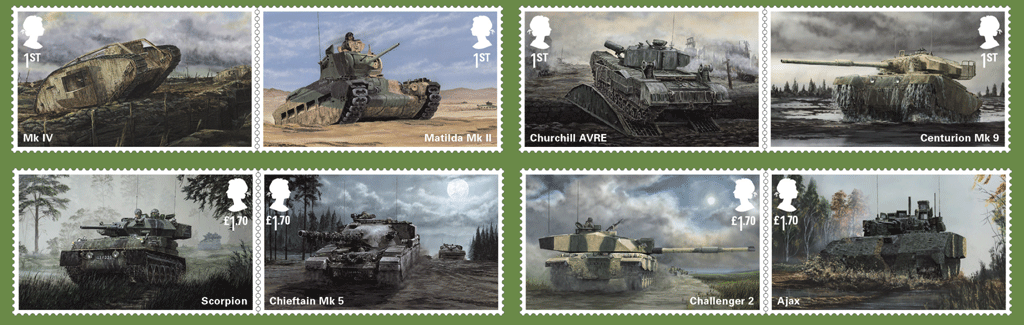
- The stamp set features stunning paintings of eight British Army Armoured Vehicles including Main Battle Tanks from across the decades.
- Seven of the eight stamps in the main set were painted exclusively for Royal Mail, by ex- Battle Tank crewman, turned military artist, Mick Graham.
- A further four stamps, presented in a miniature sheet, include a range of specialist support and patrol vehicles used by the British Army.
- Royal Mail worked closely with the Ministry of Defence on the stamp issue.
- The full set of 12 stamps, available in a Presentation Pack, retails at £16.20. The stamps and a range of collectible products are available at www.royalmail.com/britisharmyvehicles and go on general sale from 2 September 2021.
Royal Mail has revealed images of 12 Special Stamps that illustrate the development of British Army Vehicles over the decades.
Included are eight images featuring stunning paintings of important British Army Armoured Vehicles illustrated in action through the years since the First World War.
Seven of the eight stamps in the main set were exclusively illustrated for Royal Mail by military artist Mick Graham. Mick Graham was part of the 4th Royal Tank Regiment, serving for fifteen years, including as a Gunnery Instructor on Chieftain Tanks before turning his hand to art.
The British Army has always needed vehicles to transport food, munitions and supplies to allow soldiers to carry out their operations. For centuries, this meant the horse and wagon.
At the start of the First World War, however, breaking through trenches defended by barbed wire and machine guns required new vehicles. An innovative experimental armoured vehicle with a petrol engine, a turret for armament and tracks to cross broken ground was commissioned and nicknamed ‘Little Willie’.
Whilst this vehicle never saw combat action the innovation and experimentation which were hallmarks of its development led to the construction of the first rhomboid-shaped tanks, 49 of which first fought in September 1916. By the end of the war, Britain had developed most of the types of armoured vehicles still in service today: tank, armoured personnel carrier, self-propelled artillery and an engineer vehicle.
On the day the First World War ended, a floating tank was being trialled. Between the two world wars, the Army experimented with a fully mechanised force, including tracked scout carriers, tanks, gun tugs and trucks to ferry troops – controlled via newly effective radios.
Despite the success of the trials, the financial depression of the 1930s and the emphasis on the Royal Navy and Royal Air Force as the first line of defence meant that mechanisation was slower than the Army wanted.
At the beginning of the Second World War, the Army had 40,000 vehicles – and was the only fully mechanised force in Europe. Armoured divisions played a crucial role in mobile warfare in Europe and North Africa; Britain started the war with two of these armoured divisions and finished with eleven. Britain’s own vehicle production was supplemented by tens of thousands of trucks, jeeps and tanks from the USA, and by 1945 there were over 1.5 million vehicles in service.
The Cold War brought new requirements for Army vehicles, such as for some to be sealed against chemical and nuclear contamination, and new technologies, such as infrared or thermal imaging, enabling night-time use.
Recent campaigns have led to a range of vehicles to help patrol and protect troops and supplies against all-round attack. New developments and experimentation with digital technology are leading to the increasing fielding of remotely controlled and autonomous vehicles.
Matt Parkes, Director of Stamps & Collectibles at Royal Mail said: “These are some of the most important vehicles that have served the British Army since the First World War. Their impact both in combat and the development of armoured vehicles cannot be underestimated – and it is for this reason we mark these vehicles with a set of Special Stamps.”
Royal Mail worked closely with the Ministry of Defence on the stamp issue.
Product range at a glance:
- Stamp set AS7600 £10.20
- Miniature Sheet MZ168 £5.10
- Presentation Pack AP496 £16.20
- First Day Cover Stamps AF477 £12.90
- First Day Cover Miniature Sheet MF164 £6.80
- Stamp Souvenir AW196 £12.90
- Stamp Sheet Souvenir AW197 £6.80
- First Day Envelope AE432 £0.30
- Postcards AQ312 £5.85
- British Army Vehicles Matilda Mk II Framed Gallery print with stamp N3263 £59.99
- British Army Vehicles Centurion Mk 9 Framed Gallery print with stamp N3264 £59.99
- British Army Vehicles Chieftain Mk 5 Framed Gallery print with stamp N3265 £59.99
- 1st Full Stamp Sheet – 48 AS7600AFS £40.80
- 1st Half Stamp Sheet – 24 AS7600AHS £20.40
- £1.70 Full Stamp Sheet – 48 AS7600BFS £81.60
- £1.70 Half Stamp Sheet – 24 AS7600BFS £40.80
Mk IV – 1st class
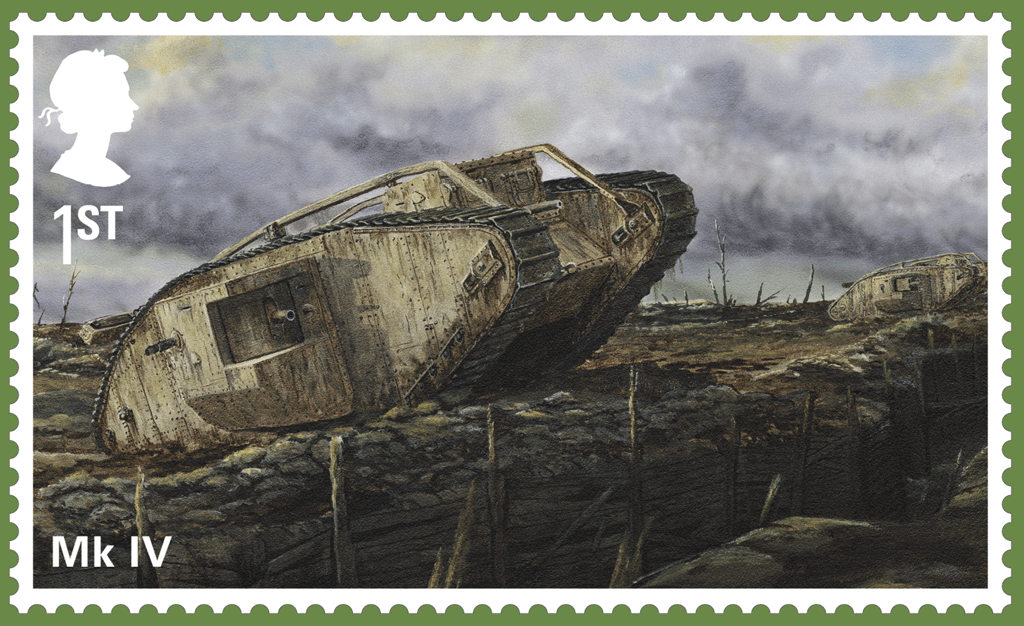 The first use of Mark I tanks on the Somme in September 1916 had mixed results, but British Commander-in-Chief General Douglas Haig saw their potential and ordered 1,000. The Mark II and III tanks were made in small quantities, but it was the Mark IV, with over 1,200 made, that saw the most use before the war’s end. Tanks were designated either ‘male’ or ‘female’, according to gun types fitted. The male Mark IV tanks had shorter six-pounder guns than on the Mark I, and the housings could be pushed into the vehicle to simplify rail movement. The eight-strong crews saw their tanks work well at the Battle of Messines in June 1917 but then flounder in mud at Passchendaele. Doubts were raised about the expense and usefulness of the tank, but the Mark IVs were to prove their worth in a mass attack by over 400 at Cambrai in November 1917.
Matilda Mk II – 1st class
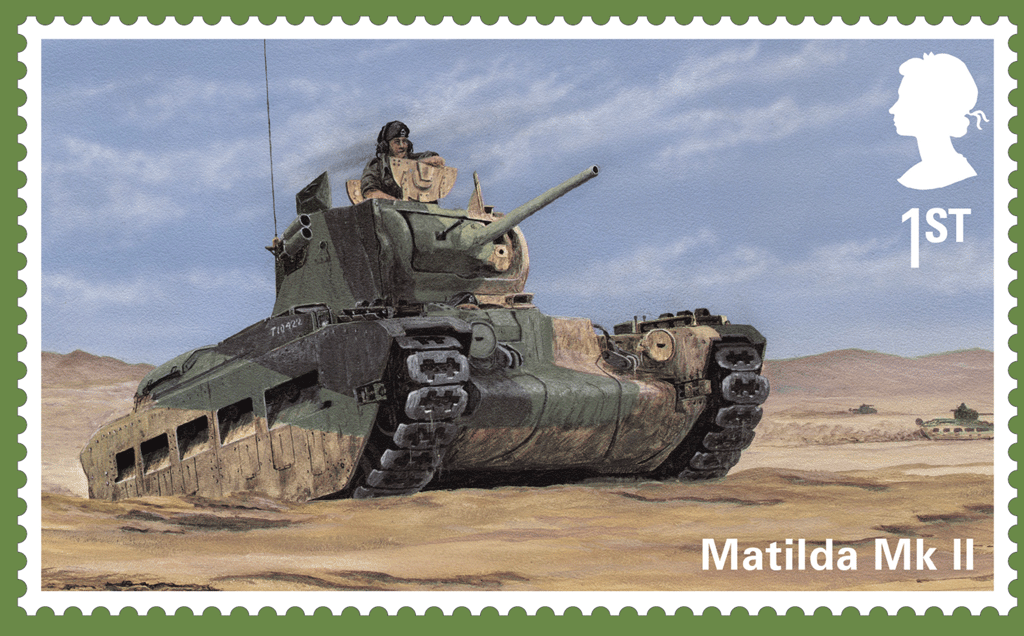 The A12 Infantry Tank, or Matilda, was the second in a series of infantry tanks that Britain put into production just before the Second World War. It was thought that three types of tank would be needed: small light tanks for reconnaissance, cruiser tanks to exploit breakthroughs and infantry tanks that would attack a defended position with the infantry. As they were more heavily armoured, infantry tanks were slower (9mph off-road), but this was considered adequate as they were to support infantry on foot. The Matilda II saw action in France in 1940, its thick armour making it impervious to the standard German 37mm anti-tank gun. Against Italian opposition in North Africa, the success of the Matilda led to it being called ‘The Queen of the Desert’. Its small turret prevented the fitting of a larger gun, so from 1942 the Matilda was relegated to use in the Far East, where the Japanese fi elded only lighter tanks.
Churchill AVRE – 1st class
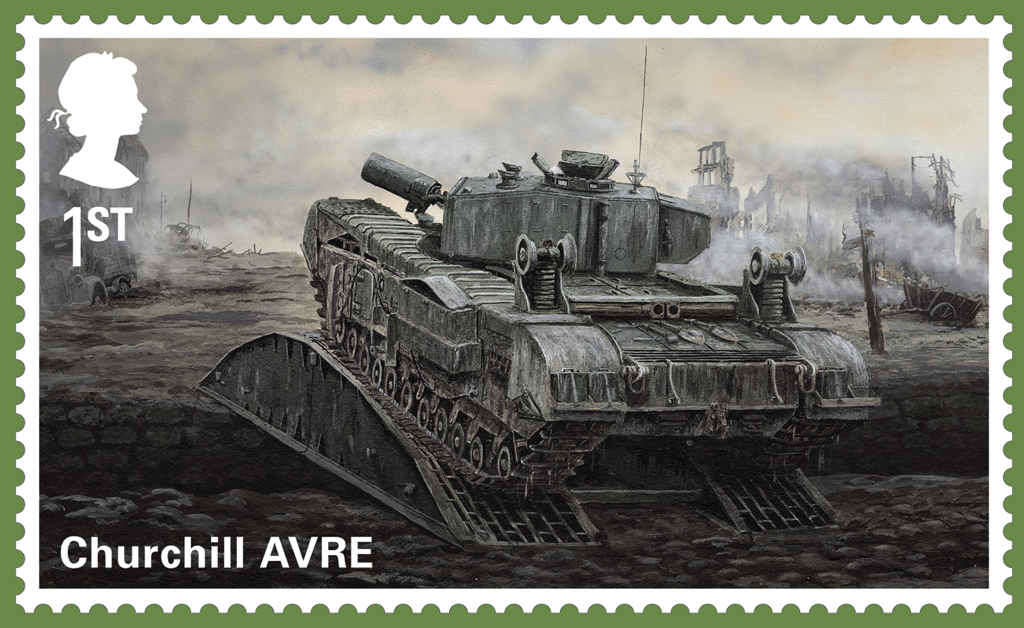 The costly failure of the raid at Dieppe in 1942 led a Canadian Royal Engineer Lieutenant JJ Denovan to propose a conversion of the Churchill infantry tank. In the turret, a spigot mortar, called the Petard, could fire a 40lb (18kg) demolition charge to a range of 200 yards. This would have a devastating effect on defensive structures or obstacles. Fixtures on the tank allowed it be adapted – to carry large loads or devices such as bobbin to lay trackway or demolition charges. The AVREs – Armoured Vehicles Royal Engineers – were issued to the 79th Armoured Division, 60 for each of three assault regiments, and they first went into action on D-Day (6 June 1944). Along with other specialised vehicles of the 79th Armoured Division, the AVREs were issued across Field Marshal Bernard Montgomery’s 21st Army Group in the North West Europe campaign, and they were considered a great success.
Centurion MK 9 – 1st class
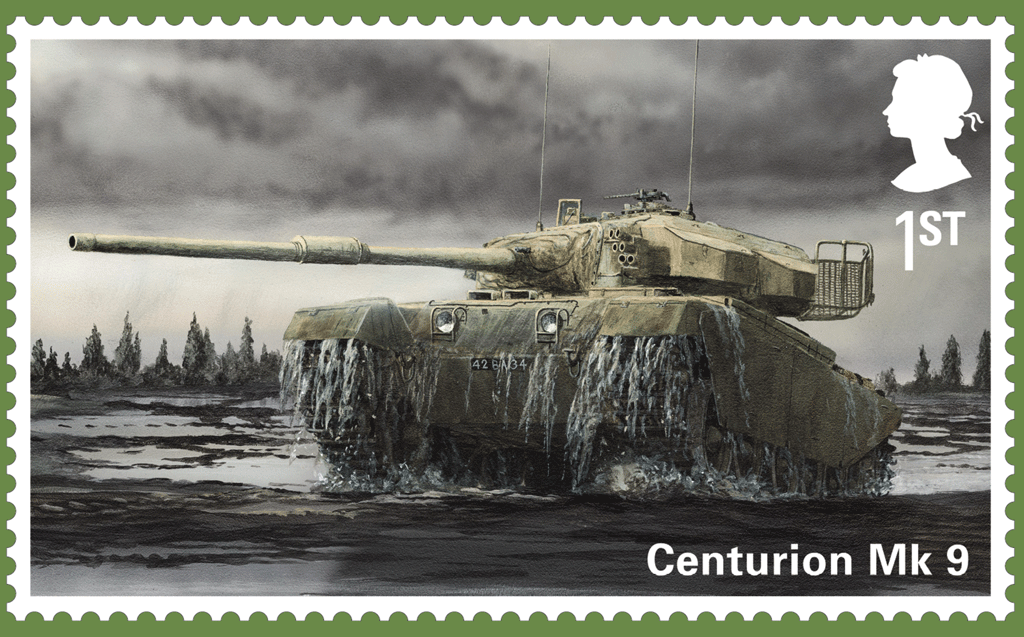 The Centurion was the British answer to the German Panther tank, developed in the Second World War. It missed seeing wartime action by a month but went on to have a long service life. The tank went through 13 marks (or models) in British Army service, showing an ability to be upgraded. It started with a 17-pounder gun, then a 20-pounder, followed by the very successful L7 105mm gun. The Rolls Royce Meteor engine gave the tank 650 horsepower – double that of most other wartime tanks. However, earlier models had a range of only 60 miles (97km), so a fuel mono-trailer was used until a larger internal tank was provided. The Mark 9 tank was an improved, rebuilt version of the Mark 7 with the L7 105mm fitted. This powerful gun became a NATO standard. The Centurion tank first saw action in the Korean War and was a huge export success, with some tanks still in service.
Scorpion – £1.70
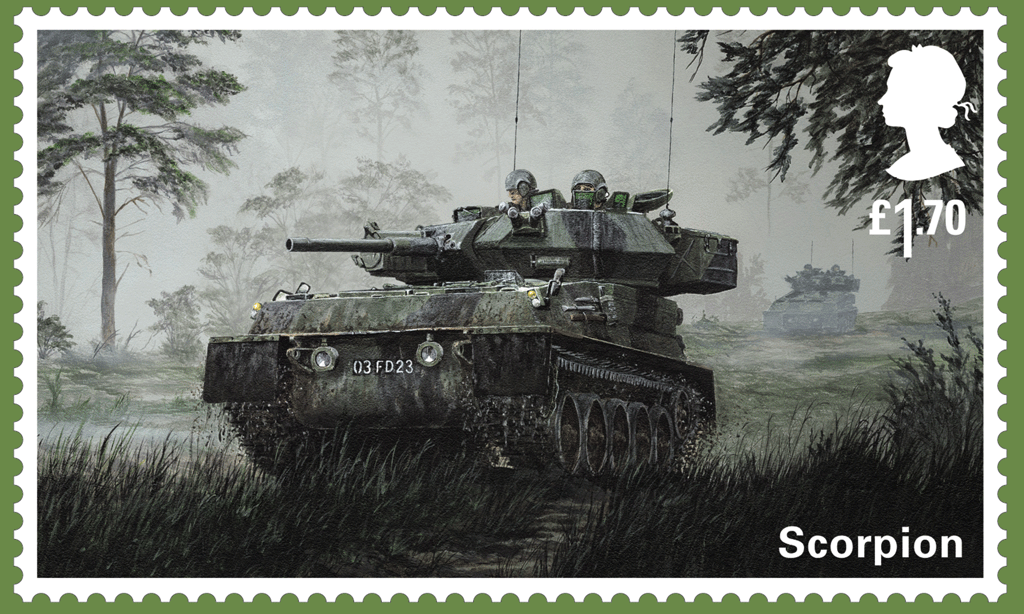 The Scorpion was part of a family of vehicles designed by Alvis in the 1960s around a number of common components. The 76mm low-velocity gun could fire a range of ammunition types and gave the small, light (8 tonnes) tank quite a punch. With aluminium armour (to keep weight down) and the Jaguar J60 4.2-litre petrol engine (the same as the E-type sports car), the tank’s top speed of 45mph made the Scorpion a difficult target to hit as a reconnaissance vehicle. Two Scorpions could fit inside a C-130 Hercules transport plane, and the original width specification was to allow it to pass through Malaysian rubber plantations. It was exported widely, and Scorpions are still in service. The vehicle saw action with the British Army in the Falklands conflict and in the First Gulf War before being withdrawn from service in 1994. Many remember the vehicle as the Action Man toy tank.
Chieftain Mk 5 – £1.70
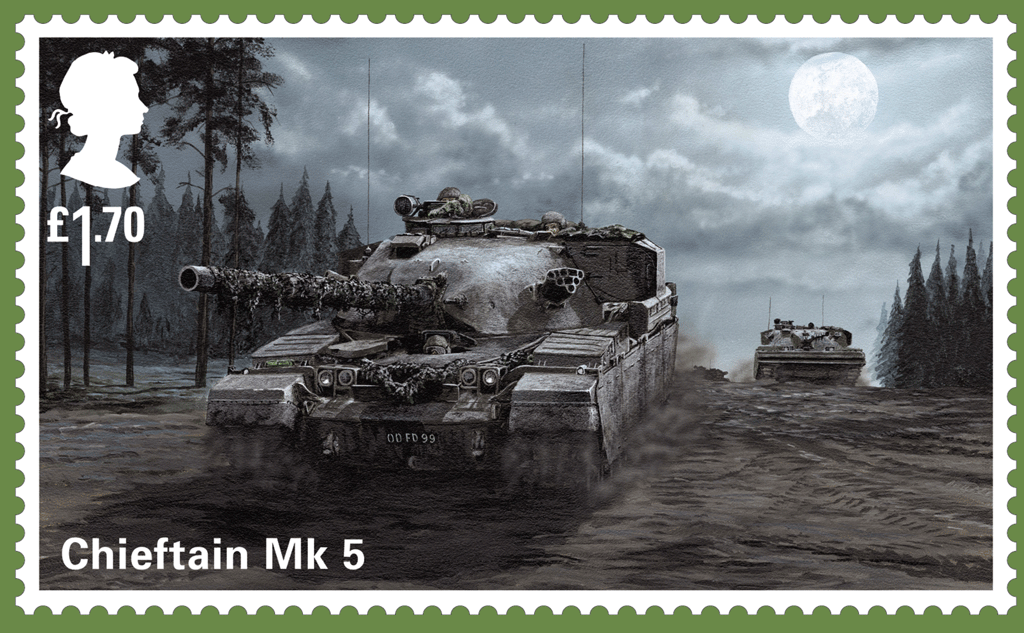 Britain decided that the priority for a main battle tank (MBT) in the Cold War was to have the best firepower and great protection; mobility was seen as less important. The stabilised 120mm gun was tremendously accurate compared to those of the wartime generation, and it was placed in a new style of mounting without a traditional mantlet (or shield). The driver had a semi-recumbent driving position, meaning that the hull could be lower, to present a smaller target. The steel armour was sloped to increase the level of protection, and additional ‘Stillbrew’ armour was added when the Soviets introduced the 125mm gun. However, the L60 engine had many reliability issues in service – a definite weakness of the tank. The tank was upgraded, running through 12 marks, after being introduced to the Army in 1967. It had some export success in the Middle East and left British service as a gun tank in the late 1990s.
Challenger 2 – £1.70
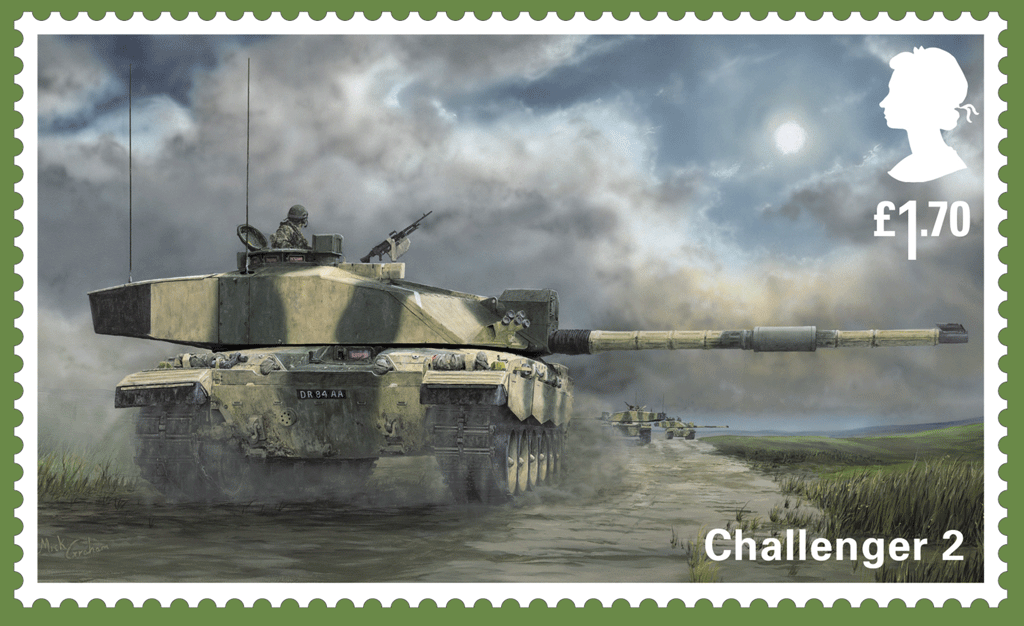 The Challenger 2 tank was initially started as a private venture by Vickers Defence, given that the Army saw the Challenger 1 (a design originally intended for the Shah of Iran) as only a stop-gap vehicle. The Challenger 2 was issued to regiments in 1998 after extensive testing. It has Chobham armour, a still-secret composite arrangement of material including ceramics that gives much greater protection than steel alone against modern weapons. When going into action, extra armour can be fitted to the tank, along with a range of other devices, such as electronic countermeasures. The Challenger 2 has a 120mm rifled gun that can fire a range of ammunition types and a thermal imaging system to allow it to fight at night. The Perkins diesel engine creates 1,200 horsepower. As with many tanks, the vehicle is being upgraded to respond to new threats and challenges on the modern battlefield.
Ajax – £1.70
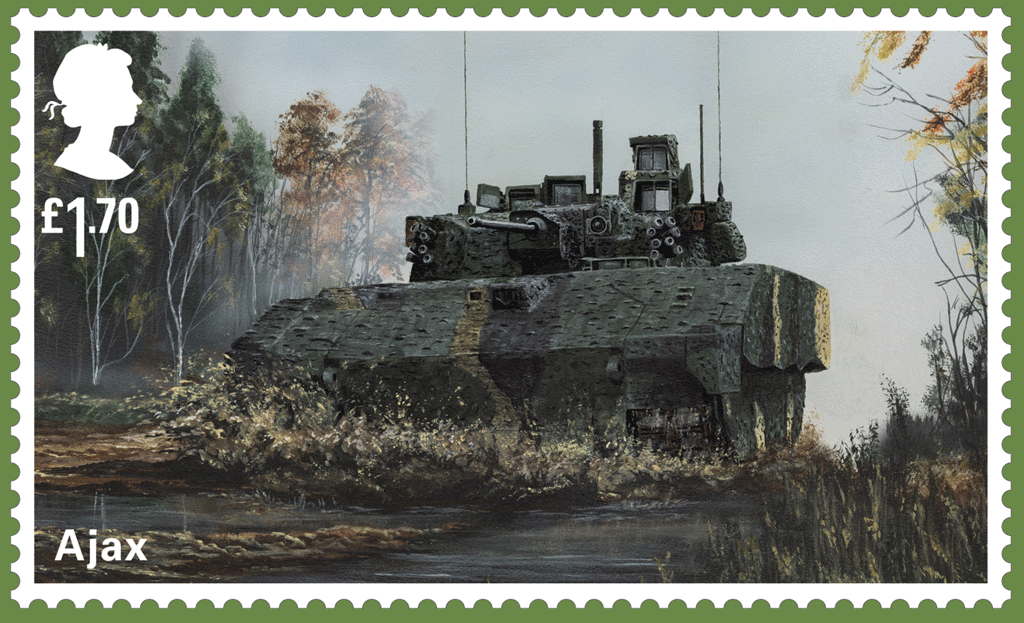 Ajax is the scouting vehicle in a new family of 589 medium-weight armoured vehicles just coming into service with the British Army. Using state-of-the-art digital technology, the Ajax has advanced intelligence, surveillance, target acquisition and reconnaissance (ISTAR) capabilities and can process and share digital information with other vehicles and higher formations. The Ajax has a turret mounting a new 40mm cased telescoped armament system (CTAS) that can fire a variety of ammunition types accurately on the move. The vehicle is protected by modular armour and a number of defensive systems to detect threats, one of which has acoustic shot detection sensors that can tell the crew the direction of incoming fire. The Ajax family consists of six variants based on a common chassis: Ajax (turreted, reconnaissance and strike vehicle), Ares (reconnaissance and armoured personnel carrier), Argus (engineer reconnaissance), Athena (command and control), Atlas (equipment support recovery) and Apollo (equipment repair).
Stamps – Technical Details:
Number of stamps: 8
Value of Stamps: 4 x 1st and 4 x £1.70
(4 x Horizonal se-tenant pairs)
Illustrations: Mick Graham Art © Royal Mail Group Ltd 2021, except for Challenger 2 © Mick Graham Art
Design: Royal Mail Group Limited
Stamp Format: Landscape
Stamp Size: 50mm (w) x 30mm (h)
Printer : International Security Printers
Print Process: Lithography
Perforations: 14 x 14
Phosphor: Bars as appropriate
Gum: PVA
Miniature Sheet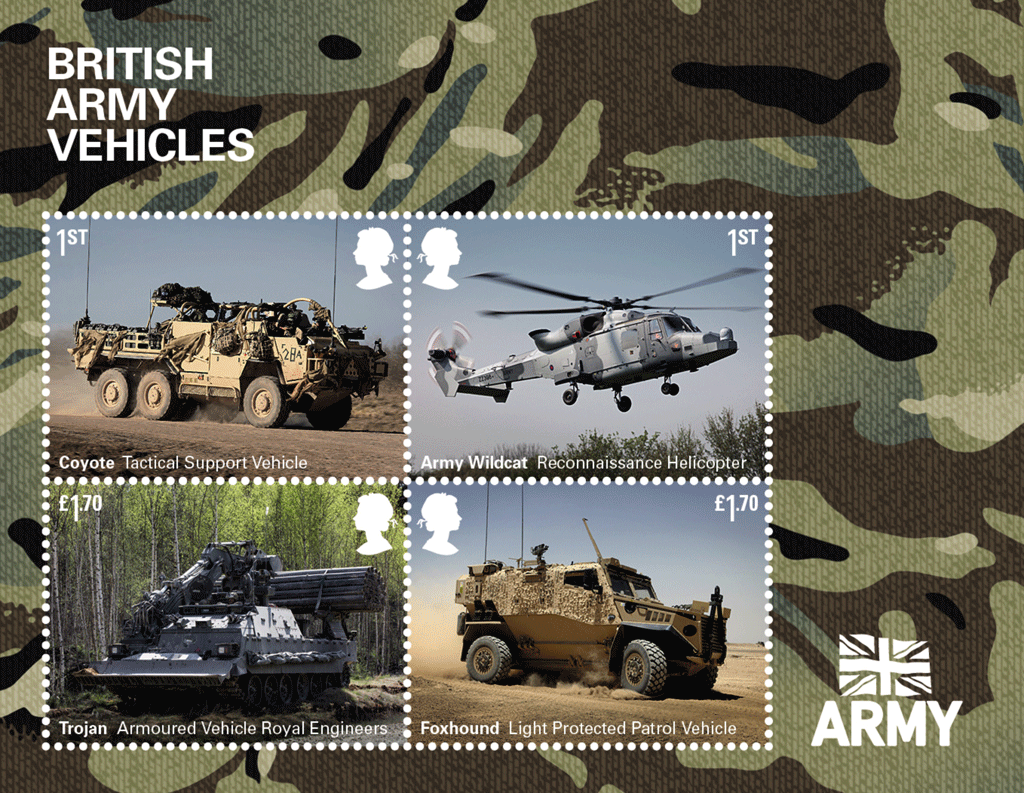 An additional four stamps featuring a range of non-combat vehicles used by the British Army
- 1st Class: Coyote (Tactical Support Vehicle)
- 1st Class: Army Wildcat (Reconnaissance Helicopter)
- £1.70: Trojan (Armoured Vehicle Royal Engineers)
- £1.70: Foxhound (Light Protected Patrol Vehicle)
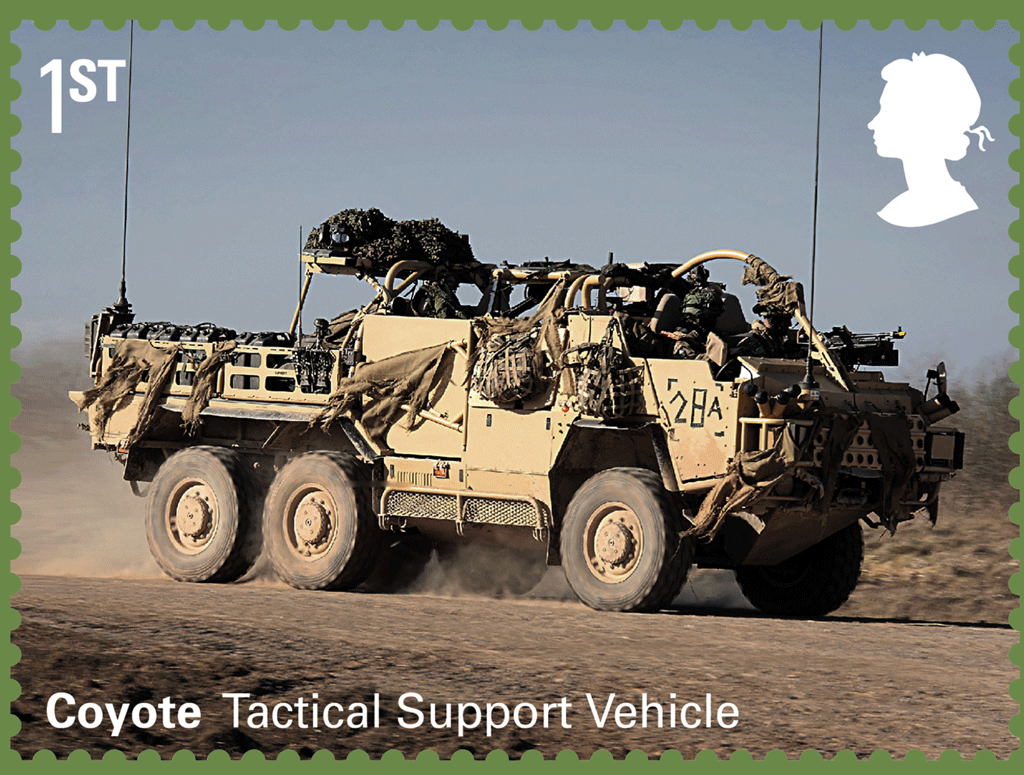 The Coyote Tactical Support Vehicle is based on the Jackal but has six wheels instead of four. The extra wheels allow it to carry a heavier load and up to five soldiers, and it can act as a support vehicle for the Jackal. The Jackal and Coyote have superb off-road capability and are used for reconnaissance and patrolling.
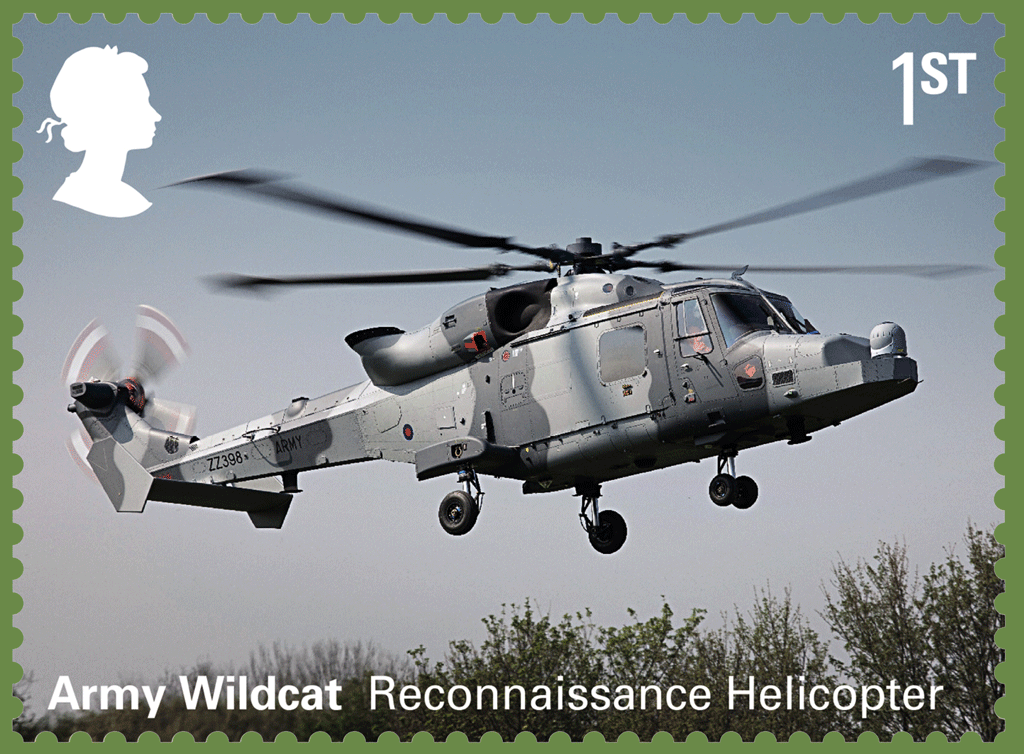 The Wildcat AH Mk 1 Reconnaissance Helicopter has a number of roles to fulfil for the Army (‘AH’ in this variant stands for ‘Army Helicopter’): airborne reconnaissance, command and control, transport of six troops or supplies, and the carrying of a sophisticated battlefield surveillance system. The Army ordered 34 Wildcats and the Royal Navy 28 in a slightly different configuration.
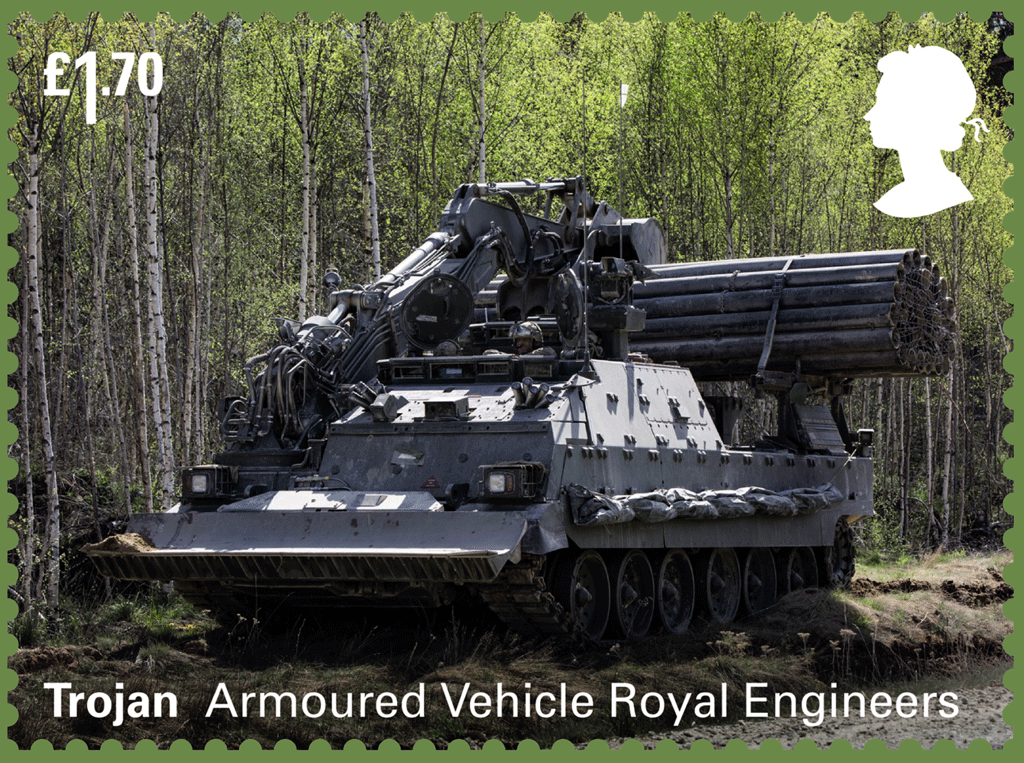 Trojan is an armoured engineer vehicle that is equipped to clear obstacles on the battlefield. It can have a dozer blade or a mine plough fitted to the front, has an excavator arm and can position a fascine – a large bundle of plastic pipes – in a gap to allow other vehicles to cross. It can also tow a trailer-mounted, rocket-propelled mine-clearing system
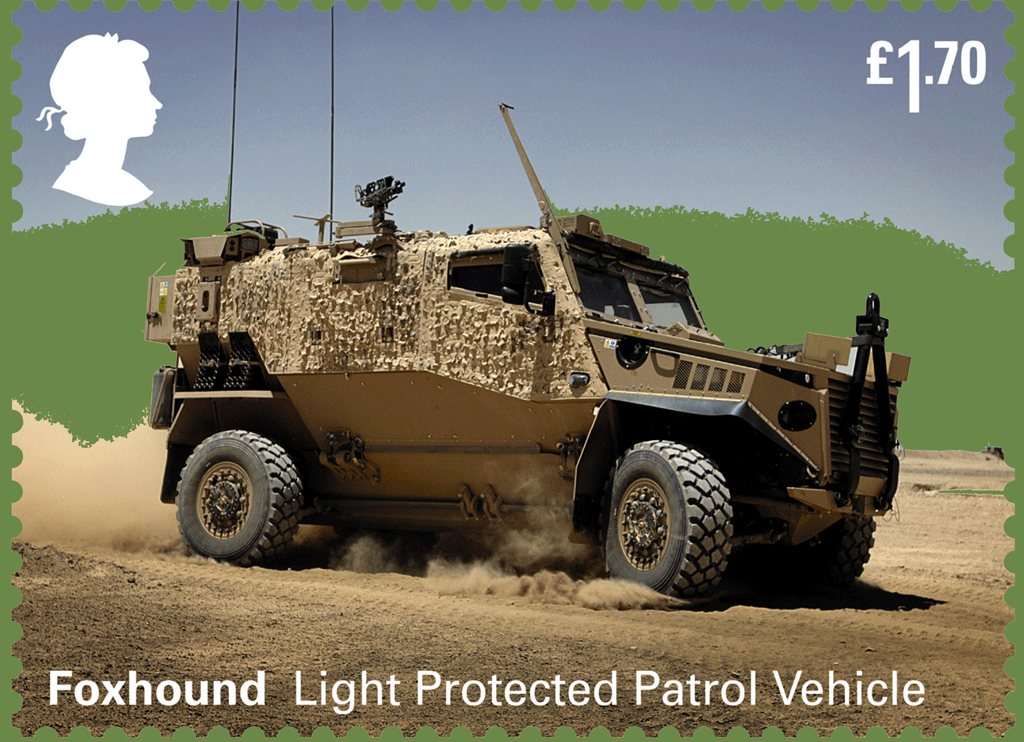 The Foxhound is a lightweight and fast patrol vehicle, with a maximum speed of 70mph. It has a V-shaped hull to channel the blast from mines or improvised explosive devices (IEDs) away from the underside of the vehicle. It has a crew of two and can carry up to four troops in the rear
Miniature Sheet – Technical Details
Number of stamps: 4
Value of Stamps: 2 x 1st and 2 x £1.70
Design: Studio Up
Acknowledgements: Coyote photo © HOT SHOTS/Alamy Stock Photo; Army Wildcat, Foxhound and Trojan photos: UK MOD © UK Crown copyright 2021; Army logos are trade marks of the UK Secretary of State for Defence and used under licence
Sheet Size: 115mm x 89mm
Stamp Size: 41mm (w) x 30mm (h)
Printer : International Security Printers
Print Process: Lithography
Perforations: 14.5 x 14
Phosphor: Bars as appropriate
Gum: PVA
First Day Cover – Stamps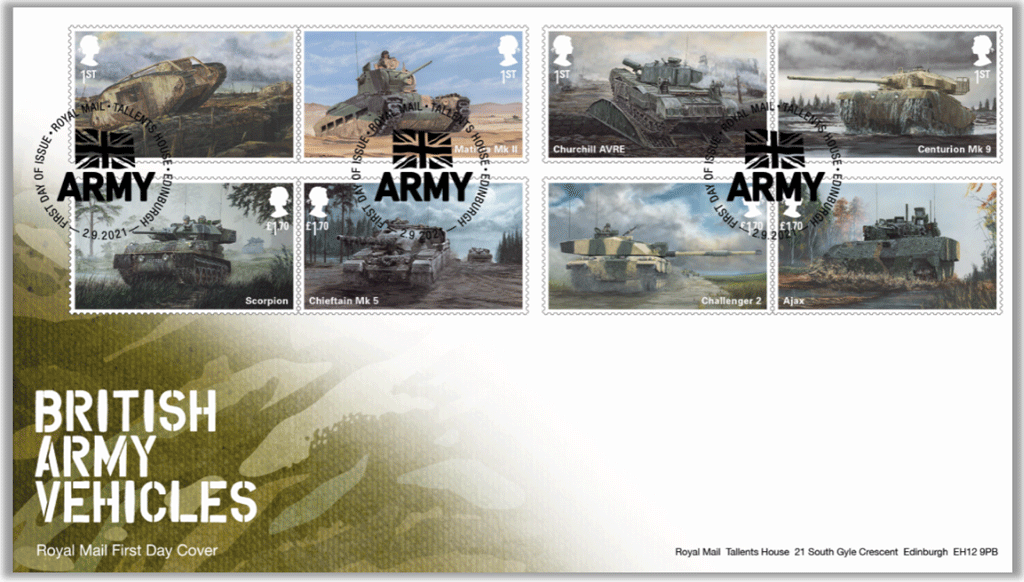
An authentic Ministry of Defence security hologram is affixed to the back of the envelope.
The First Day Cover is a unique time-limited and personalised collectible which includes all 8 British Army Vehicles stamps postmarked on their first day of issue – 2nd September 2021.
Customise your First Day Cover with your choice of two special edition British Army Vehicles postmarks.
Talents House postmark – Location: Tallents House, Edinburgh, Image: – Features a British army logo.
Alternative postmark – Location: Bovington, Wareham
Bovington is the location of The Tank Museum and, according to David Willey, still is the ‘home of the tank’ for the British Army.
The handstamp features an illustration of tank tracks.
You can even personalise your envelope with a name address of your choice making this an ideal collectible for yourself or a wonderful surprise gift for a friend or relative.
Inside the envelope is an information card with more details about the British Army Vehicles stamp issue
• Includes all eight British Army Vehicles Special Stamps
• Postmarked on the stamps’ first day of issue
• Personalised with name and address of customer’s choice
• Choice of 2 postmark designs
First Day Cover – Miniature Sheet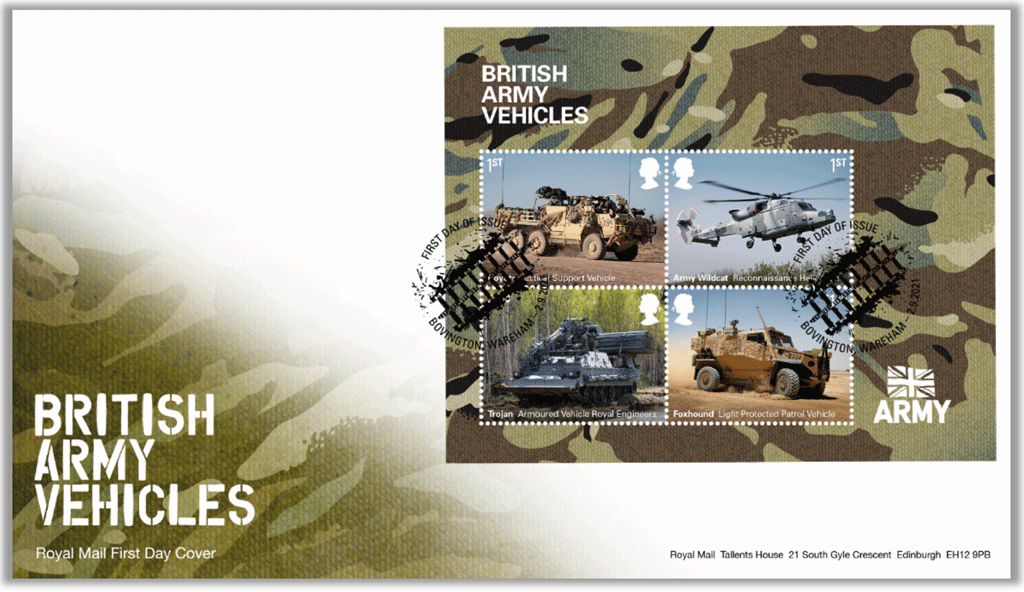
An authentic Ministry of Defence security hologram is affixed to the back of the envelope.
The First Day Cover is a unique time-limited and personalised collectible which includes all 4 British Army Vehicles miniature sheet stamps postmarked on their first day of issue – 2nd September 2021.
Customise your First Day Cover with your choice of two special edition British Army Vehicles postmarks.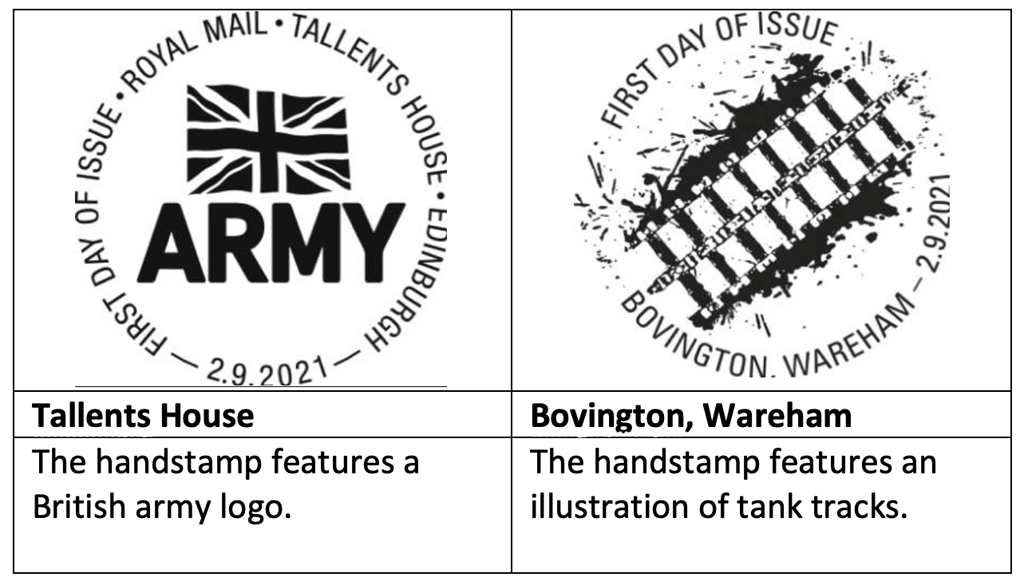
Talents House postmark – Location: Tallents House, Edinburgh. The handstamp features a British army logo.
Alternative postmark – Location: Bovington, Wareham
Bovington is the location of The Tank Museum and, according to David Willey, still is the ‘home of the tank’ for the British Army.
The handstamp features an illustration of tank tracks.
You can even personalise your envelope with a name address of your choice making this an ideal collectible for yourself or a wonderful surprise gift for a friend or relative.
Inside the envelope is an information card with more details about the British Army Vehicles stamp issue.
• Includes all four British Army Vehicles miniature sheet Special Stamps
• Postmarked on the stamps’ first day of issue
• Personalised with name and address of customer’s choice
• Choice of 2 postmark designs
Stamp Souvenirs
The Stamp Souvenir is a non-personalised version of the traditional First Day Cover, meaning it will not have the customer’s name and address printed on the front and will be available on sale for 3 months after the stamp issue date – until 2nd December 2021. The stamps are cancelled with the alternative Bovington, Wareham postmark.
An authentic Ministry of Defence security hologram is affixed to the back of the envelope.
FDC Postmarks
Customers can personalise their First Day cover with a choice of postmarks available. The alternative postmark location represents the Tank Museum in Bovington, Dorset.
First Day Envelope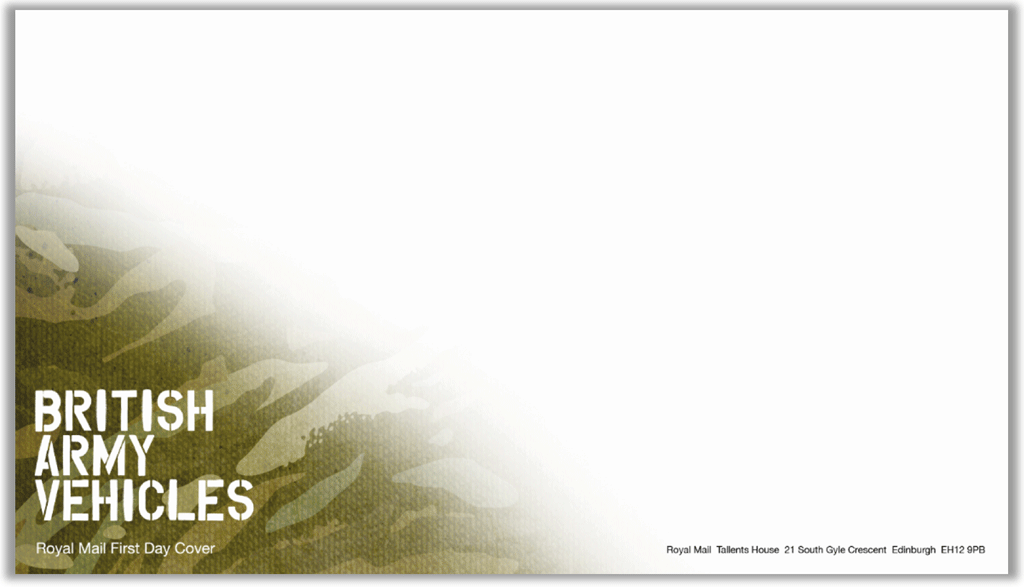
An [unserviced] envelope featuring the issue title set against a camouflage pattern
Information Card (Filler Card)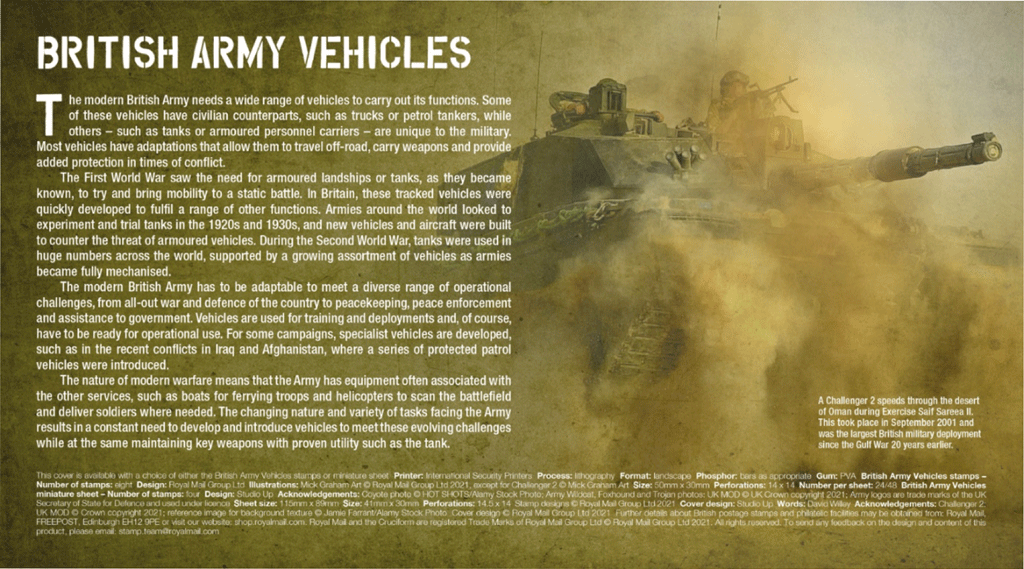 The information card is included inside the First Day Envelope, FDC and Stamp Souvenir and Stamp Sheet Souvenir. It provides a brief overview and specifications for the stamp issue. It was written by David Willey, Curator at the Tank Museum.