
Updated October 13th: According to the October 13th Postal Bulletin, local post offices may now order this souvenir sheet for sale, although they may not sell less than the entire product.
Updated May 14th: Here are the first day postmarks: 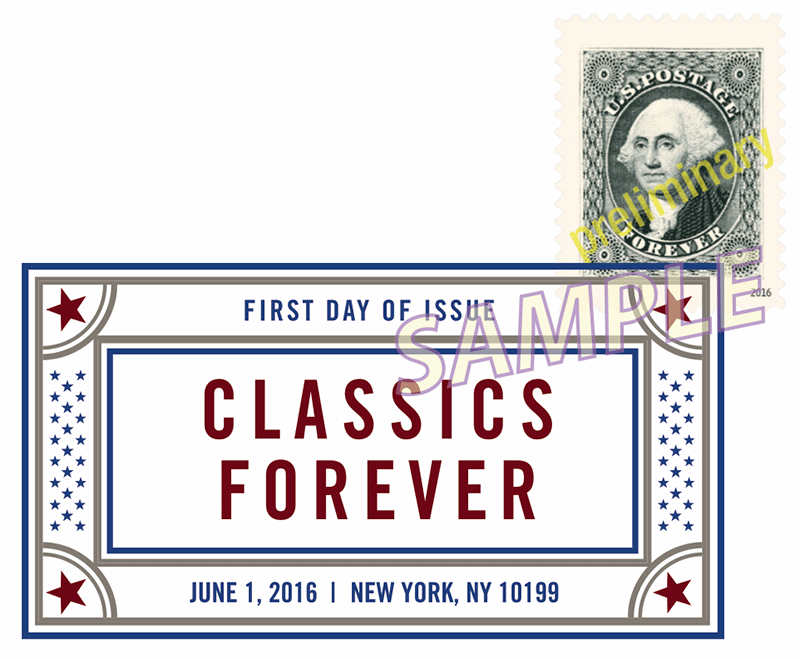
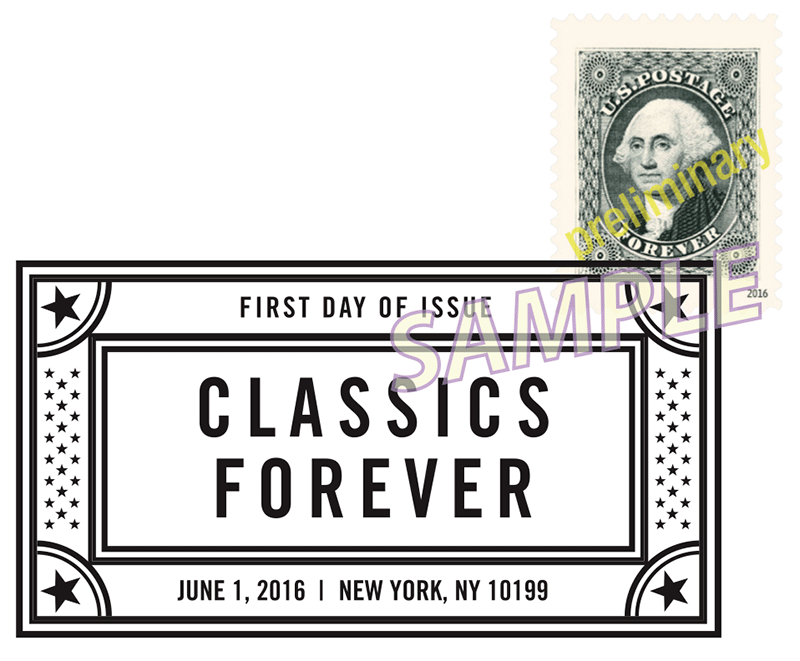 Both postmarks measure 2.81” x 1.50″.
Updated May 11th, from the Postal Bulletin:
 In the article “Stamp Announcement 16-18: Classics Forever Stamps, in Postal Bulletin 22440 (4-28-16, page 51), the following information has been updated:
The Classics Forever stamps will be available for purchase at the World Stamp Show on June 1, 2016. The stamps can also be purchased through the following channels: The Postal Store® website at www.usps.com⁄shop or our toll-free number, 800-782-6724. These stamps will not be available for purchase at Postal Retail Units.
Technical Specifications:
Issue: Classics Forever
 Item Number: 586800
Denomination & Type of Issue: First-Class Mail Forever®
Format: Souvenir Sheet of 6 stamps (6 designs)
Series: N⁄A
Issue Date & City: June 1, 2016, New York, NY 10199
Designer: Antonio Alcalá, Alexandria, VA
Art Director: Antonio Alcalá, Alexandria, VA
Typographer: Antonio Alcalá, Alexandria, VA
Modeler: Sandra Lane⁄Michelle Finn
Manufacturing Process: Intaglio, Offset
Printer: Banknote Corporation of America
Printed at: Browns Summit, NC
 Press Type: Alprinta 74
Stamps per Pane: 6
Print Quantity: 18 million stamps
Paper Type: Phosphor Tagged Paper, Block
Adhesive Type: Pressure-sensitive
Processed at: Banknote Corporation of America, Browns Summit SC
Colors: PMS 9180⁄Cream, 4545⁄Beige, 7528⁄Tan, 7530⁄Gray, 488⁄Flesh, Warm Gray 8⁄Gray, Intaglio Black, Intaglio Blue
Stamp Orientation: Vertical
Image Area (w x h): 0.77 x 1.05 in.⁄19.56 x 26.67 mm
Overall Size (w x h): 0.91 x 1.19 in.⁄23.11 x 30.22 mm
 Full Pane Size (w x h): 4.75 x 6.5 in.⁄120.65 x 165.10 mm
Press Sheets Size (w x h): 24.25 x 13.125 in.⁄615.95 x 333.38 mm
Plate Size: 60 stamps per revolution
Plate Numbers: None
Marginal Markings – Back: © 2016 USPS • USPS logo • Plate position diagram • Barcode (586800) in upper right and lower left corners of pane • Promotional text
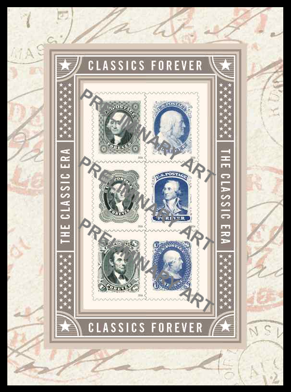
Updated May 5th: The final design: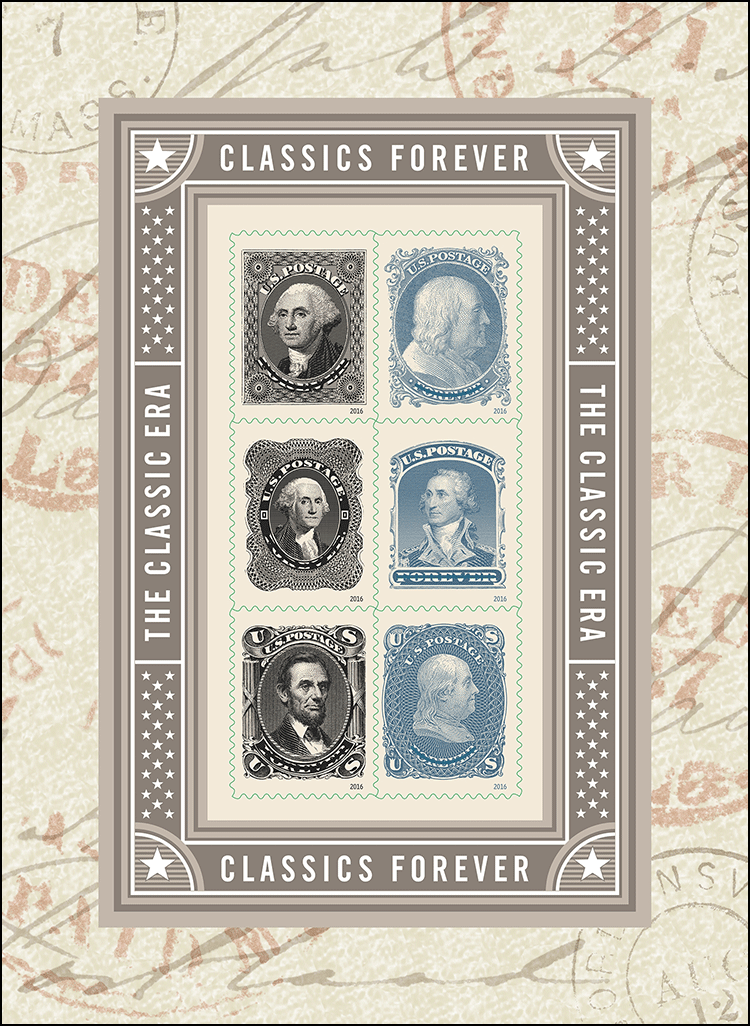
Updated April 29th, from the Postal Bulletin: [still no illustration -VSC]
On June 1, 2016, in New York, NY, the U.S. Postal Service® will issue the Classics Forever stamps (Forever® priced at 47 cents) in six designs, in a pressure-sensitive adhesive (PSA) souvenir sheet of six stamps (Item 586800). The Classics Forever souvenir sheet of six stamps may not be split, and the stamps may not be sold individually.
The Classics Forever stamps, which will appear in the May 12, 2016 edition of the Postal Bulletin (PB 22441), will go on sale nationwide June 1, 2016.
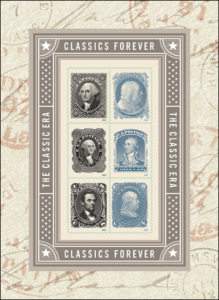
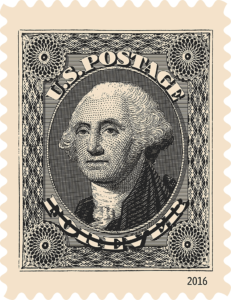
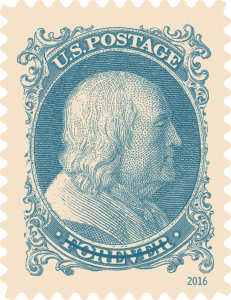
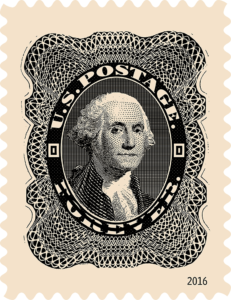
This souvenir sheet is issued in celebration of the long history of U.S. postage stamps — and in appreciation of stamp collectors and philatelists everywhere. The elaborately designed sheet features new versions of six of America\u0027s earliest and most alluring stamps, now issued as Forever stamps to make them easily distinguishable from the mid 19th-century originals. The intaglio-printed designs featured are George Washington (1851, originally 12 cents), Benjamin Franklin (1851, originally one cent), George Washington (1860, originally 24 cents), George Washington (1860, originally 90 cents), Abraham Lincoln (1866, originally 15 cents), and Benjamin Franklin (1861, originally one cent). The selvage is composed of postal cancellations and script from envelopes contemporaneous with the stamps. These elements are arranged on a buff-colored background with a textured look to evoke stationery of the period. An inner border evoking star-spangled patriotic bunting also bears the title “Classics Forever” at top and bottom and the words “The Classic Era” on either side. Eric Madsen created the artwork for the selvage. Art director Antonio Alcalá designed the issuance.
Initial Supply to Post Offices: Item 586800, $2.82, Classics Forever (Forever priced at 47 cents) Commemorative PSA Souvenir Sheet of Six Stamps
There will be no initial supply to Post Offices™ as these stamps will only be available for ordering through The Postal Store® website at http:⁄⁄www.usps.com⁄shop, by calling 800-782-6724, or at the World Stamp Show.
How to Order the First-Day-of-Issue Postmark:
Customers have 60 days to obtain the first-day-of-issue postmark by mail. They may purchase new stamps through The Postal Store website at http:⁄⁄www.usps.com⁄shop, or by calling 800-782-6724. They should affix the stamps to envelopes of their choice, address the envelopes (to themselves or others), and place them in a larger envelope addressed to:
Classics Forever Stamps
Special Events Coordinator
380 West 33rd Street
New York, NY 10199-9998
After applying the first-day-of-issue postmark, the Postal Service™ will return the envelopes through the mail. There is no charge for the postmark up to a quantity of 50. There is a 5-cent charge for each additional postmark over 50. All orders must be postmarked by August 1, 2016.
There are six philatelic products for this stamp issue:
- 586806, Press Sheet with Die-cut, $28.20 (print quantity 8,000)
- 586810 Keepsake, $15.95
- 586816 First-Day Cover (set of 6), $5.46
- 586821 Digital Color Postmark (set of 6), $9.72
- 586824 Framed Art, $39.95
- 586830 Ceremony Program (random single), $6.95
Technical details for Classics Forever stamps will appear in the May 12, 2016 edition of the Postal Bulletin (PB 22441).
 From the USPS, March 31, 2016: This souvenir sheet features new versions of six of America’s earliest and most alluring stamps, now issued as Forever® stamps to make them easily distinguishable from the mid-19th-century originals. America’s early stamps presented a new means of honoring the Revolution’s heroes. The 1851 George Washington and Benjamin Franklin stamps were issued when dramatically reduced rates made the mail more accessible to a growing, migrating population. (These are represented on the top row of the souvenir sheet.) The quick public appreciation of their beautifully engraved portraiture also made stamps a perfect mode of tribute to Abraham Lincoln, martyred just after guiding the Union to victory in the Civil War.
Whether a collector is interested in the great Americans depicted, the artistry, the printing technology of the day, the quirks and evolution of historical postal practices, or the communications enabled by the originals, there is something for everyone in these beautifully evocative stamps.
1851 George Washington, originally 12 cents
Several unusual aspects attract collectors to the George Washington stamp released in 1851. Although its original 12-cent denomination paid the way for certain heavy domestic letters sent afar, such use was uncommon and the rationale for a stamp of this particular value is not well understood. Envelopes bearing this Washington stamp tend to carry it in combination with other denominations or, more often, paired to cover the 24-cent rate for letters to the United Kingdom. The 12-cent stamp was sometimes cut in half to pay six cents of postage until the practice of using bisected stamps was prohibited.
Three printing plates were evidently created, but no trace remains of the second plate nor of any stamps printed by it. The tight spacing on the first plate was typical of the imperforate stamps it produced. Stamps from this plate were eventually perforated, with the perforations violating the edges of the design. The individual stamp images on the plate labeled “Plate 3” were spaced to accommodate perforation once that innovation came to U.S. stamps.
1851 Benjamin Franklin, originally one cent
Only George Washington has been honored on more U.S. stamps than Benjamin Franklin. The Franklin stamp introduced in 1851 was commonplace in its original use, sold for a penny, affixed to advertising circulars and local letters, and printed in great quantities. Although a single stamp design was intended, advanced collectors differentiate many types. Intricate engraved designs were not consistently transferred to the printing plates, so the scrolled ornamentation varies in detail from stamp to stamp. As plates wore, fine features became muted, then were re-emboldened as engravers scraped out grooves. Tiny curls appeared in some fraction of stamps— believed to be artifacts of fine threads left behind by printers’ polishing cloths. Ink batches ranged from pale blue to indigo. Perforations were added in 1857. By studying such variations, some experienced and keen-eyed philatelists can assign a single stamp to its corresponding plate and to the specific position on that plate’s grid of 200 stamps. These variations also help collectors narrow the stamp’s period of origin within the decade-long press run. This stamp-collecting specialty, known as plating, requires time, patience, and the resources to obtain abundant stamps. Collectors who plate this stamp have kept it in high demand.
The profile of Franklin was engraved for Toppan, Carpenter, Casilear & Co., the printing firm that held the exclusive stamp-printing contract for a decade starting in 1851. The likeness is based on a bust carved by French sculptor Jean-Jacques Caffiéri, a likeness Franklin himself favored. Fittingly, this complex stamp honoring the nation’s first Postmaster General continues to captivate the most advanced collectors.
1860 George Washington, originally 24 cents
The need for a 24-cent denomination, previously met by doubling the 12-cent Washington stamp, was realized in 1860 with another stamp honoring Washington. This was the first U.S. stamp issued exclusively with perforations. Like the 12-cent stamp of 1851, this engraved likeness is based on Gilbert Stuart’s iconic Washington portraiture. Here Washington faces a bit to the viewer’s right, a mirror image of the original Stuart portrait. Ink colors vary and are referred to by collectors as lilac and grey-lilac. Some stamps exist in red-lilac but were never in circulation. Those are believed to be printer’s proofs.
Though the entire press run of 1860 Washington stamps was modest—estimated at about 736,000—a great many went unsold and were recalled by the Post Office Department, then destroyed.
1860 George Washington, originally 90 cents
Washington is honored once again on the 90-cent issue of 1860. The engraved portrait on this rarity, widely considered one of the most beautiful stamps of the period, is based on a John Trumbull painting, made circa 1792, that portrays General Washington in 1776. Trumbull had served as a personal aide to Washington during the Revolution and went on to share an artists’ studio with Gilbert Stuart. At 90 cents, this was by far the highest denomination to date, a stamp meant to facilitate large international mailings.
The useful life of this stamp was less than a year. Mail service between the Union and the Confederacy ended as the Southern states seceded. A grace period during which older stamps could be traded for the new 1861 issues was cut short as tensions escalated into civil war. All stamps issued prior to the summer of 1861 were deemed invalid. The tactic of demonetizing the older issues rendered stockpiled stamps worthless and prevented black-market sales by Southerners to Northerners, transactions that would have helped to bankroll the Rebel cause. Following the war, piles of these obsolete stamps kept by Southern postmasters found their way to dealers. An unusual consequence of this is that mint-condition examples remain more common than genuinely used ones, so collectors must be wary to avoid faked cancellations on this 90-cent Washington, and authenticate its provenance.
1866 Abraham Lincoln, originally 15 cents
In a single momentous week in April 1865, Robert E. Lee surrendered at Appomattox Court House and Lincoln was assassinated. The Post Office Department honored the martyred president with a grey-black 15-cent stamp. Issued in 1866, it is considered by many collectors to be the world’s first mourning stamp. Although it was not officially designated as anything other than a general release, the intent behind its issuance was unquestionable, as no previous stamp had been released so quickly after the death of its subject.
The beautifully engraved likeness is based on a photograph by Christopher Smith German, whose studios were located in Lincoln’s hometown of Springfield, Illinois. The source photograph is one of the first in which Lincoln, then president-elect, revealed his newly grown beard.
It is a lesser-known aspect of Lincoln’s career that he, like Benjamin Franklin, served as a postmaster. Legend has it that young postmaster Lincoln would deliver mail—stashed in his hat—as he crossed paths with residents of New Salem, Illinois. His tenure as a village postmaster was less illustrious than Franklin’s national position, but the job familiarized Lincoln, then in his mid-twenties, with local citizens whose trust he earned in his position as postmaster and whose support he would come to rely upon as a politician.
1861 Benjamin Franklin, originally one cent
When pre-Civil War stamps were demonetized, replacements were needed. The National Bank Note Company won the exclusive contract to engrave and print stamps in 1861, a contract previously held by the firm of Toppan, Carpenter, Casilear & Company. National Bank Note produced a striking new design for the one-cent Benjamin Franklin stamp, released August 1861. Its portrait was based on a bust by French sculptor Jean-Antoine Houdon. The stamp was printed in an inadvertent variety of blues including shades that collectors describe as bright, deep, pale, and milky.
Dozens of other Franklin stamps have followed, as the U.S. Postal Service® takes great pride in its own Founding Father. Franklin was a communications genius who revolutionized mail service in the Colonies, served as the new nation’s first Postmaster General, surveyed routes, standardized postal rates, and greatly sped delivery. His creation of a postal system safe from British control was among his greatest contributions to the American Revolution.
Stamps of this 1861 release are the oldest U.S. stamps still valid for use on mail, but the famously frugal-minded Franklin would undoubtedly advise against using the valuable originals for postage.
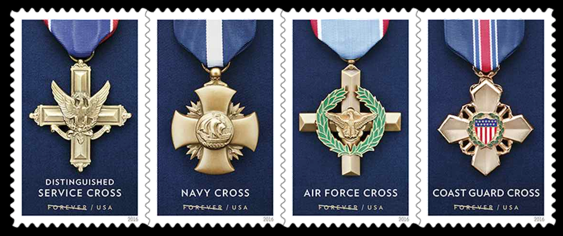
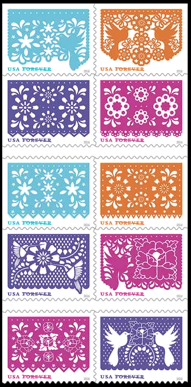 Henry James, Literary Arts, 3-ounce rate.
 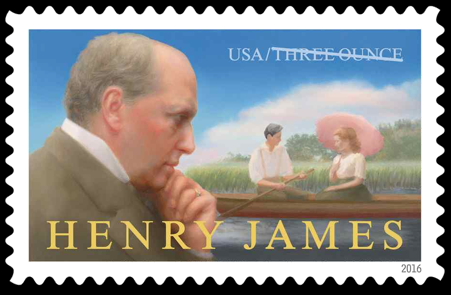 All but James will be issued at World Stamp Show-NY 2016
 On March 22,
  BELLEFONTE, PA – The world’s largest stamp collector’s organization, the American Philatelic Society (APS), is pleased to announce a new partnership with the U.S. Postal Service Federal Credit Union (USPS FCU), a Clinton, Maryland-based federal credit union serving current and retired employees of the U.S. Postal Service nationwide. The arrangement includes making the APS a Select Group, allowing APS members to join the USPS FCU. In addition, the USPS FCU will become a presence at national APS stamp shows, providing financial educational opportunities to both groups’ memberships, supporting APS youth education programs, and becoming a partner in promoting stamp collecting.
 “We are excited about the opportunity to partner with the U.S. Postal Service Federal Credit Union,” said Scott English, APS Executive Director. “Not only will we be adding a respected financial service provider for our members, we will also have a great partner in supporting the U.S. Postal Service and stamp collecting.”
 The American Philatelic Society is the world’s largest stamp collecting organization with more than 31,000 members around the world. The organization, founded in 1886, is dedicated to promoting the cultural and historical significance of U.S. and international stamps, creating a safe place to buy and sell stamps, and providing educational opportunities for both collectors and non-collectors of all ages. You can learn more about the APS or become a member at www.stamps.org.
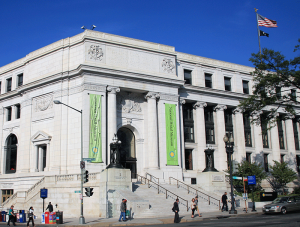 The American First Day Cover Society’s pre-Americover tour will include special presentations at the National Postal Museum.
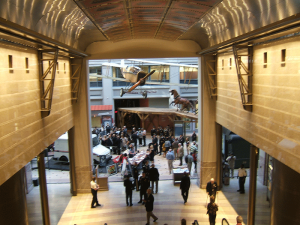 At the NPM, former National Park Service interpretive planner Paul Lee will present a special Sundman lecture, “Parks, Postmarks, and Postmasters: Post Offices Within The National Park System.” The program combines real-life drama and human interest.This year is the centennial of the National Park Service.
 After lunch, NPM Chief Curator Daniel Piazza (left) will give a guided tour of “Trailblazing: 100 Years of Our National Parks,” followed by a tour of the rest of the facility. Members of the group will have a chance to see their own cachets in the Owney the Postal Dog FDC exhibit.
 0044..
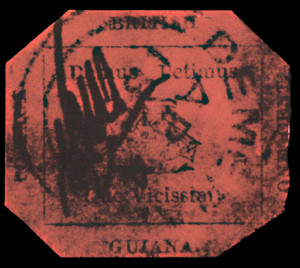 The world’s most valuable stamp will be there, the unique British Guiana one cent magenta, which was sold at auction June 17, 2014 for $9.48 million dollars to fashion shoe designer Stuart Weitzman. Its celebrated story of being found in 1873 by a 12 year old schoolboy is legendary. The stamp is on a three-year loan to the Smithsonian’s National Postal Museum and will be in a special display case at their booth through Friday of the show.
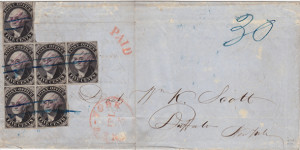 originally of 240 examples, are nearly intact with just a couple dozen of each removed. The 1d sheet has never been shown outside of the United Kingdom, while the 2d sheet has never been on public display anywhere. A presentation about them, “Postal Reform & the Penny Black,” will be given at 10:30 AM on Tuesday, May 31 by Douglas N. Muir, Senior Curator, Philately, The Postal Museum.
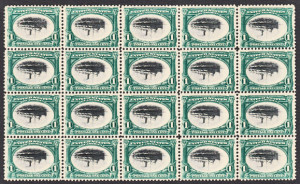 dealing with Great Britain’s penny postage program of 1840. The stamp, lettered A I, comes from the first row of the sheet printed from the first printing plate 1a completed on April 8, 1840. The stamp is attached on a sheet of stout paper together with a proof of a Mulready, as presented by Rowland Hill to the Council of Academicians on April 10 for approval of the proposed design, which was enthusiastically given. At the top of this sheet Wallace inscribed in his own hand, “1st Proof of Penny Postage Stamp Cover, presented to Mr. Wallace by the Right Honable. The Chancellor of the Exchequer, Francis Thornhill Baring, April 10th, 1840.” and endorsed beneath the stamp, “Universal Penny Postage Fly or Loose Stamp, presented to me Mr Wallace as above” and noted “ These come into public use on the 6th of May 1840”.
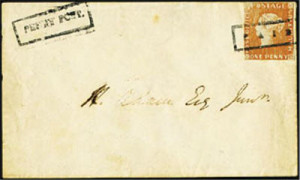 The postal history of the small Indian Ocean island of Mauritius is forever entwined with the story behind its first issue of 1847. Lady Gomm, wife of the governor, was planning a lavish ball and decorated the invitation envelopes with new-fangled postage stamps hastily produced by a local watch maker. Each was to have been inscribed “Post Paid,” but shortly after being released were found to bear “Post Office” instead. It is believed fourteen 1d orange red and twelve 2d deep blue stamps have survived, along with only three Ball covers. The only such cover in public hands will be on display, from the collection of Vikramm Chand.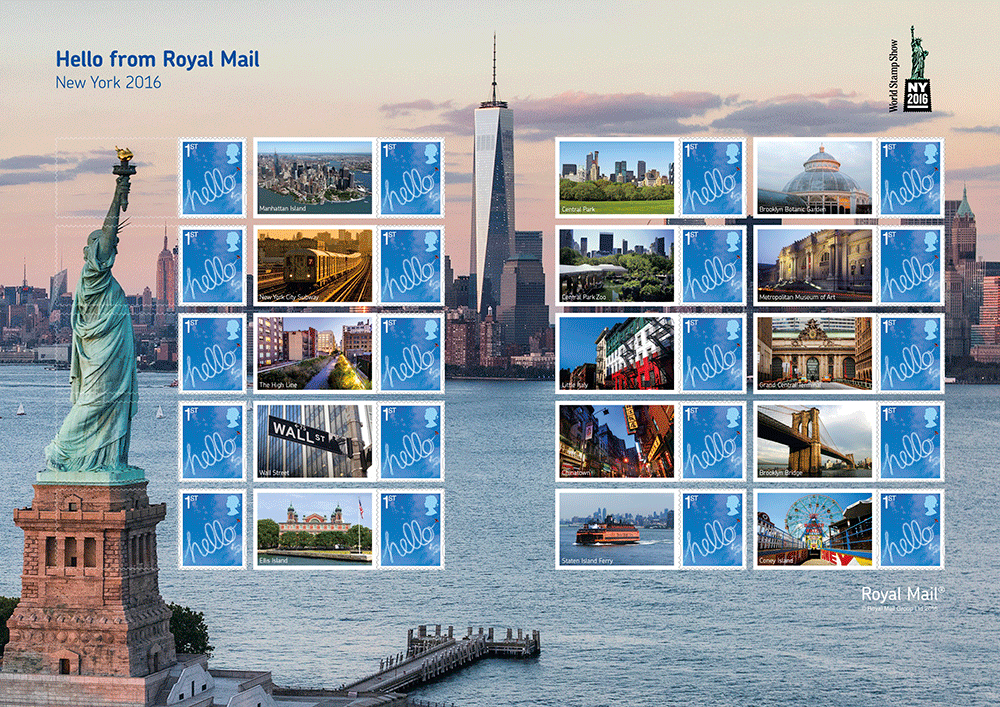
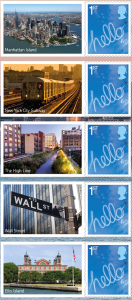 New York City Subway
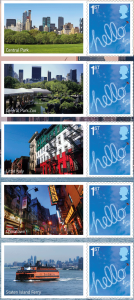 Central Park Zoo
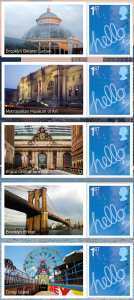 Metropolitan Museum of Art
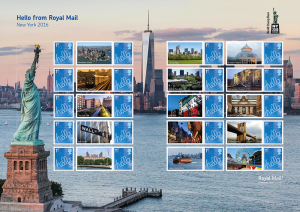 Number of stamps: 20
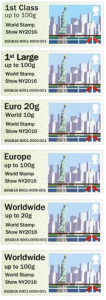 The New York Collector’s Strip – GB Version
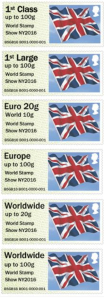 Rates – 1st up to 100g, 1st Large up to 100g, Euro 20g/World 10g, Europe 100g, Worldwide up to 20g, Worldwide up to 100g. This product will feature the ‘World Stamp Show NY2016’ overprint and only be available from Tallents House by mail order. Price: £7.75 per strip Code: ZS044
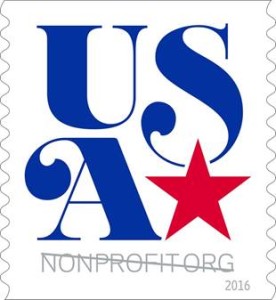 On April 28, 2016, in Dulles, VA, the U.S. Postal Service® will issue the USA nondenominated, nonprofit organization stamp (5-cent value), in one design, in a pressure-sensitive adhesive (PSA) coil of 10,000 (Item 777500).
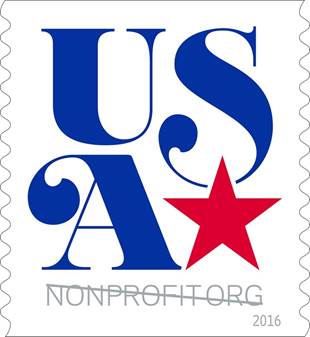 On April 28, 2016, in Dulles, VA, the U.S. Postal Service will issue the USA nondenominated, nonprofit organization stamp (5-cent value), in one design in a pressure-sensitive adhesive (PSA) coil of 10,000 (Item 777500).
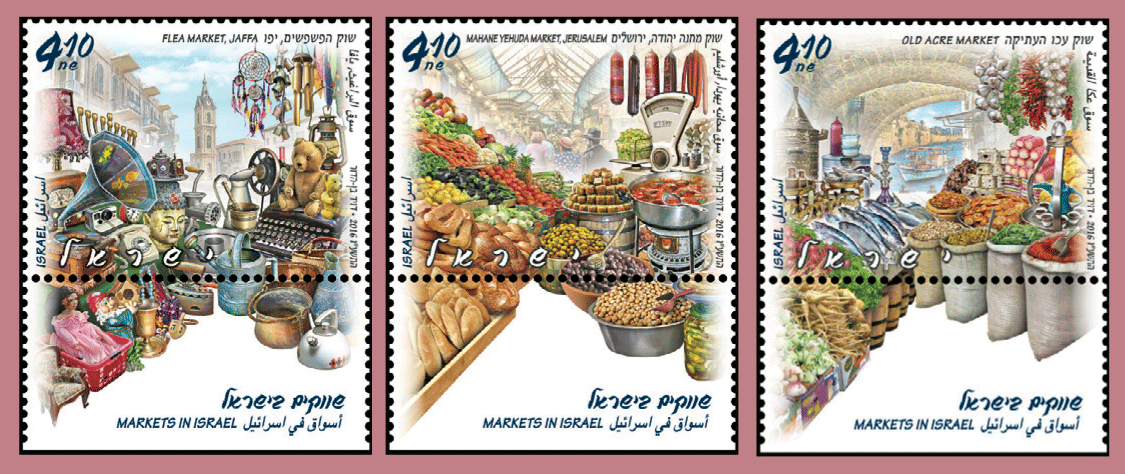
 The Bridge of Strings in Jerusalem was designed by Spanish architect Santiago Calatrava so this makes for a most fitting visual image to express the bridge of friendship developed over 30 years between Israel and Spain.
 Our stamp for Spring stands out in this collection with its stunning red wildflowers. What a great season that symbolizes blooming and renewal!
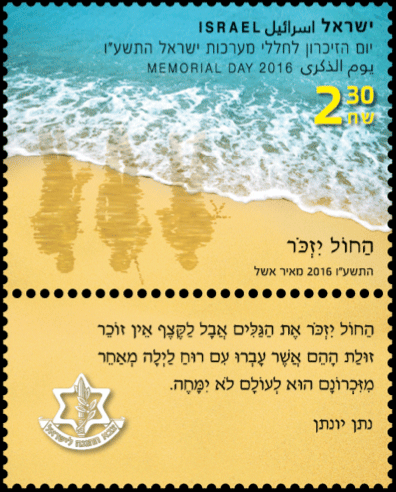
 by Natan Yonatan, “The Sand Will Remember”.

 BELLEFONTE, PA – Construction of a new $2.6 million library caused a roof leak at the American Philatelic Center, headquarters of the American Philatelic Research Library (APRL) and the American Philatelic Society (APS). During a rainy weekend, water leaked into the recently-completed George Turner Rare Book Room threatening some of the hardest-to-find philatelic literature in world. Quick action by the library staff, with assistance from Penn State University Libraries, minimized the long-term damage to books and other material.
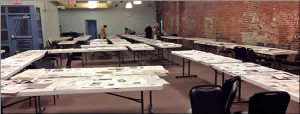 Along with putting the library materials out to dry, Murray contacted Sue Kellerman, head of the Penn State University Libraries Preservation Department. Kellerman and members of her staff were soon on site to assess the damage and provide expert advice. They even lent the APRL equipment, including fans to circulate air and hygrometers to measure humidity.
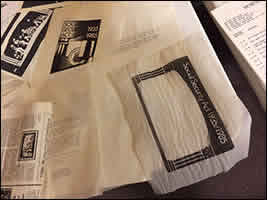 As long as the emergency conservation measures are effective, the monetary impact for the APRL will be small and related to treatment of rare books. The library will attempt to replace unsalvageable auction catalogs through donations. For a list of the catalogs lost and information about donating replacement copies, see http://blog.stamplibrary.org/?p=3106.