
Updated April 18th: The unveiling of the stamp design at the first-day ceremony. Photo courtesy Chris Lazaroff. 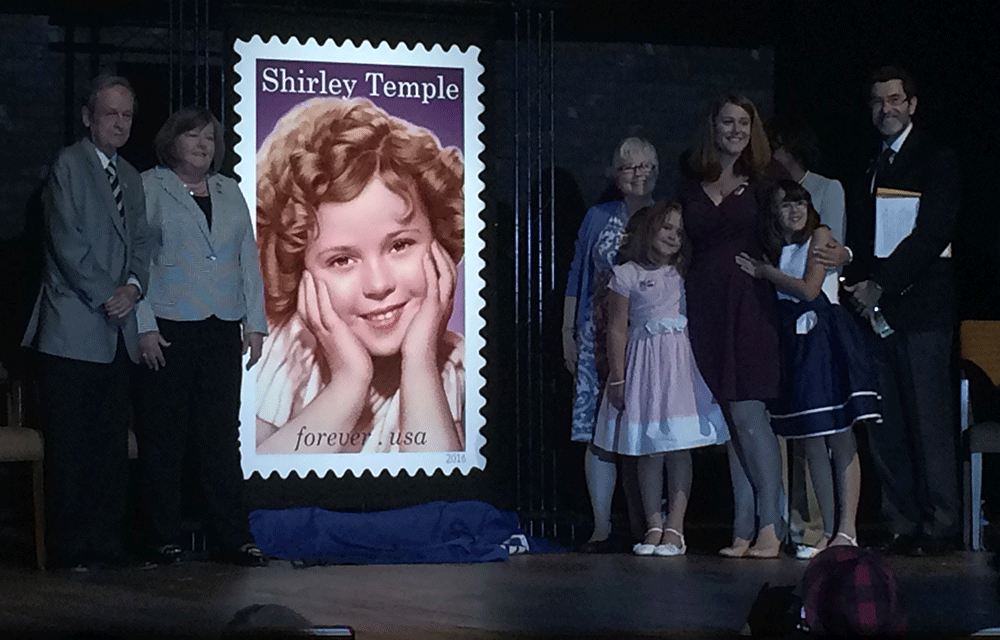 Updated April 4th: Here are the first day postmarks for this issue.
 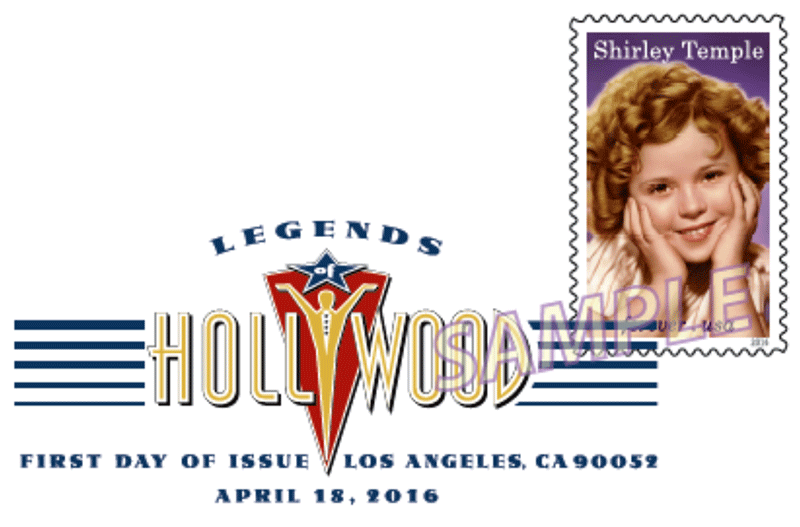 The Digital Color Postmark measures 3″x1.3″
 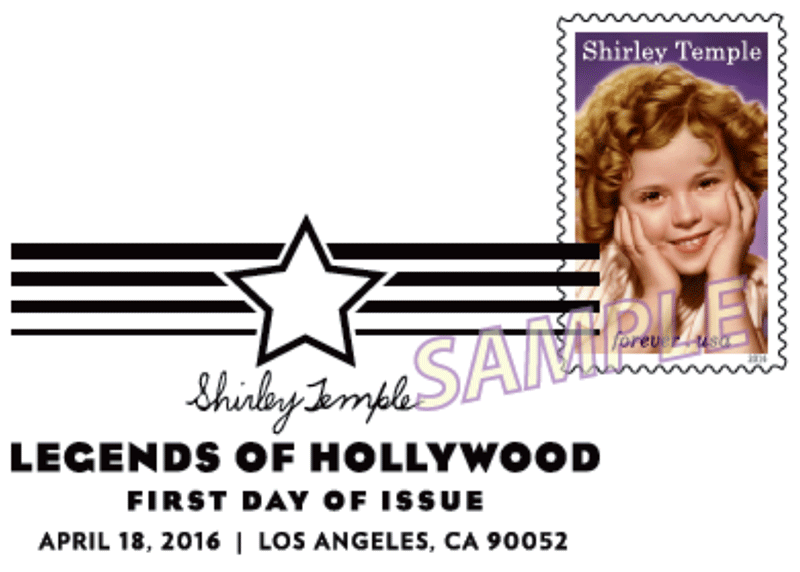 The B&W “hand cancel” measures 2.6″x1.5″
Updated March 31st: From the Postal Bulletin:
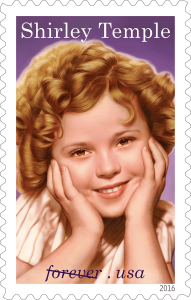 On April 18, 2016, in Los Angeles, CA, the U.S. Postal Service® will issue the Shirley Temple stamp (Forever® priced at the First-Class Mail® rate) in one design, in a pressure-sensitive adhesive (PSA) pane of 20 stamps (Item 473900).
The stamp will go on sale nationwide April 18, 2016.
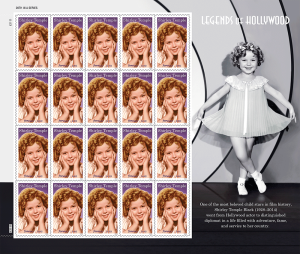
With the 20th stamp in the Legends of Hollywood series, the U.S. Postal Service honors actress and diplomat Shirley Temple Black (1928–2014). As a child, Temple was the most famous film star in the world; as an adult, Black had a distinguished career in diplomacy, serving as a delegate to the United Nations, U.S. ambassador to Ghana and Czechoslovakia, and U.S. Chief of Protocol. She received the Kennedy Center Honors in 1998 and a lifetime achievement award from the Screen Actors Guild in 2006. The stamp art features a painting by Tim O\u0027Brien based on a 1935 still image from Curly Top, one of her iconic movie roles. The selvage features a publicity photo from the 1933 short film, Managed Money. The Shirley Temple artwork is based on photos courtesy of © Twentieth Century Fox Film Corporation. The stamp pane includes selvage and verso text. Art director Ethel Kessler designed the stamp and pane.
How to Order the First-Day-of-Issue Postmark:
Customers have 60 days to obtain the first-day-of-issue postmark by mail. They may purchase new stamps at their local Post Office, at The Postal Store® website at http:⁄⁄www.usps.com⁄shop, or by calling 800-782-6724. They should affix the stamps to envelopes of their choice, address the envelopes (to themselves or others), and place them in a larger envelope addressed to:
Shirley Temple Stamp
U.S. Postal Service
Attn: Marketing
7001 South Central Avenue, Room 307
Los Angeles, CA 90052-4200
After applying the first-day-of-issue postmark, the Postal Service will return the envelopes through the mail. There is no charge for the postmark up to a quantity of 50. There is a 5-cent charge for each additional postmark over 50. All orders must be postmarked by June 18, 2016.
There are eight philatelic products for this stamp issue:
- 473906 Press Sheet with Die-cut, (print quantity 2,000), $84.60
- 473910 Keepsake, $11.95
- 473916 First-Day Cover, $0.91
- 473918 First-Day Cover Full Pane, $11.90
- 473919 Cancelled Full Pane, $11.90
- 473921 Digital Color Postmark, $1.62
- 473924 Framed Art, $19.95
- 473930 Ceremony Program, $6.95
[Note that there is no no-die-cut press sheet for this issue. —VSC]
Technical Specifications:
Issue: Shirley Temple
Item Number: 473900
Denomination & Type of Issue: First-Class Mail Forever
Format: Pane of 20 (1 design)
Series: Legends of Hollywood
Issue Date & City: April 18, 2016, Los Angeles, CA 90052
Designer: Ethel Kessler, Bethesda, MD
Art Director: Ethel Kessler, Bethesda, MD
Typographer: Ethel Kessler, Bethesda, MD
Artist: Tim O’Brien, Brooklyn, NY
Modeler: Joseph Sheeran
Manufacturing Process: Offset, Microprint, “USPS”
Printer: Ashton Potter (USA) Ltd. (APU)
Printed at: Williamsville, NY
Press Type: Muller A76
Stamps per Pane: 20
Print Quantity: 22 million stamps
Paper Type: Nonphosphored Type III, Block Tag Applied
Adhesive Type: Pressure-sensitive
Processed at: Ashton Potter (USA) Ltd. (APU)
Colors: Black, Cyan, Magenta, Yellow, PMS 2627C Purple
Stamp Orientation: Vertical
Image Area (w x h): 0.84 x 1.42 in.⁄21.34 x 36.07 mm
Overall Size (w x h): 0.98 x 1.56 in.⁄24.89 x 39.62 mm
Full Pane Size (w x h): 8.474 x 7.169 in.⁄215.24 x 182.10 mm
Press Sheet Size (w x h): 25.922 x 22.007 in.⁄658.42 x 558.98 mm
Plate Size: 180 stamps per revolution
Plate Numbers: “P” followed by five (5) single digits
Marginal Markings:
Front: Plate numbers in two corners of pane
• Verso-text • Header “Legends of Hollywood – 20th in a series”
Back: © 2015 USPS • USPS logo • Plate position diagram • Barcode (473900) in upper right and lower left corners of pane • Promotional text • Proprietary Information • Verso-text
 Updated March 16th: Postmaster General Megan Brennan will be the “dedicating official” at this ceremony.
Updated March 10th: From the USPS: The Legends of Hollywood: Shirley Temple Forever Stamp will be issued Mon. Apr. 18 at 1:30 p.m. in Los Angeles at the Geffen Playhouse, 10886 Le Conte Ave., Los Angeles, CA 90024.
press release:
With this 20th stamp in the Legends of Hollywood series, the U.S. Postal Service honors actress and diplomat Shirley Temple Black. The world’s most famous film star as a child, she went on to a distinguished career in public service and international affairs.
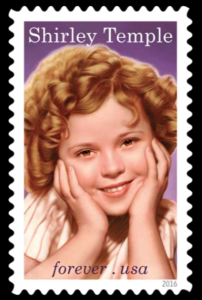 The stamp art is a painting by artist Tim O’Brien; it is based on a 1935 image from Curly Top, one of the child star’s iconic movie roles. The stamp has the words “Shirley Temple” along the top, with “Forever” and “USA” on the bottom. The selvage features a publicity photo from the 1933 short film Managed Money. The Shirley Temple artwork is based on photos © Twentieth Century Fox Film Corporation. The pane’s selvage and verso include biographical text about her acting and diplomatic careers. Art director Ethel Kessler designed the stamp and pane.
Shirley Temple was born on April 23, 1928, in Santa Monica, California. She began dance lessons when she was just three years old, and that early start paid off when she was cast in Baby Burlesks, a series of one-reel film shorts that parodied actual movies, with small children cast in the roles usually played by adults. At age five, she signed a contract with Fox Film Corporation. Her brief appearance in the feature film Stand Up and Cheer, released in 1934, started her on the road to stardom. Singing “Baby, Take a Bow,” the diminutive actress stole the show.
Seven more full-length movies followed in 1934, among them Little Miss Marker, which featured her first starring role, and Bright Eyes, which included what became one of her signature songs, “On the Good Ship Lollipop.” That same year, a toy company produced and sold the Shirley Temple doll, which remains one of the most collectible dolls ever made. Coloring books, paper dolls, dresses, and recordings of songs from her movie roles were just a few of the other products inspired by America’s favorite star.
Shirley Temple tap-danced with some of the film greats, including Buddy Ebsen and Jack Haley, but her most famous—and possibly favorite—dance partner was Bill “Bojangles” Robinson, with whom she starred in four movies. She called him “Uncle Billy,” and he called her “Darlin’,” and they remained friends for the rest of his life.
 Mired in the economic tribulations of the Great Depression, moviegoers found joy and escape from everyday cares in the child star’s bright smile, deep dimples, and irrepressible spirit. Her hairstyle, made up of 56 perfect corkscrew curls, was the envy of little girls everywhere. However, her adorable looks were not her only asset; Shirley Temple was also a talented performer. She took the roles written for her—usually involving a motherless or orphan child who melts the hearts and fixes the problems of the adults around her—and raised them to a level beyond cliché.
Simply put, Shirley Temple was the biggest star in Hollywood in the mid- to late 1930s. She was photographed wherever she went, her every move followed by adoring fans and reporters. The studio received more fan mail addressed to her than to adult stars like Greta Garbo. She was America’s bright light during the Depression, offering cheer and hope with each smile. President Franklin D. Roosevelt himself praised her for helping to lift the spirits of a nation facing one of its greatest challenges.
The Academy of Motion Picture Arts and Sciences recognized Shirley Temple’s contribution not only to Hollywood but also to the culture in general. She was awarded the first-ever juvenile Oscar at the 1935 Academy Awards ceremony in recognition of her outstanding contribution to screen entertainment during the previous year. She went on to be the number one box-office draw for four years in a row.
Girls grow up, even movie stars, and by age 12, Shirley Temple’s film career had reached its peak. Fans who had worshipped the adorable little girl did not embrace the adolescent actress. Her parents decided that she should go to school rather than be tutored at the studio, and she made movies during her summer vacations. Although she was still cast in good roles, such as her part in Since You Went Away (1944), performances did not capture a new audience. She retired from movies at age 21.
In 1950, Shirley Temple married Charles Black. With him, her daughter Linda Susan from her earlier marriage to John Agar, and her two children, Charles and Lori, from this second marriage, she enjoyed a happy, everyday family life. Black also spent a brief but memorable time working in television, starring in two series for children that involved the retelling of fairy tales and other stories. Along with Black, some of Hollywood’s biggest stars played roles in these television shows.
During her years in Hollywood, Black had involved herself in public service, and that commitment never wavered. During the 1960s, she served as president of the National Multiple Sclerosis Society, raising funds and awareness. This was a very personal cause for her because her brother George suffered from the debilitating disease. In 1961, she co-founded the International Federation of Multiple Sclerosis Societies. It was also during the 1960s that she became active in politics.
A successful fund-raiser for various Republican candidates, Black herself ran for Congress in 1967. Though her bid was unsuccessful, her candidacy raised her profile in the party. President Richard Nixon appointed her a delegate to the United Nations in 1969, the beginning of her distinguished career in diplomacy.
Although Black’s appointment to the U.N. delegation was at first considered only a political reward for her support, her dedication and work ethic proved to doubters that she was a serious and knowledgeable delegate. Her name, she recognized, might open doors to opportunities, but only by doing her job well could she continue to qualify for such appointments.
In 1972, Black, who had already proven her resilience, once more pioneered the way for other women when she became one of the first public figures to candidly acknowledge her breast cancer and mastectomy. Her courage in talking publicly—she held a news conference from her hospital bed—is widely credited with helping to make the discussion about breast cancer, alternatives to radical mastectomies, and a woman’s right to be part of the decision regarding her treatment acceptable in the public forum. In response, she received more than 50,000 cards and letters of appreciation and admiration.
Black was appointed U.S. ambassador to Ghana in 1974. She had experience working on African issues from her days at the U.N., but this was her first ambassadorial assignment, and career diplomats were skeptical. The Ghanaians accepted her wholeheartedly, and as Black proudly told President Gerald Ford later, she was made an honorary tribal chief.
President Ford appointed Black the U.S. Chief of Protocol in 1976. The protocol office plans the visits of foreign dignitaries to the U.S.; manages Blair House, the presidential guesthouse; and oversees all the ceremonial and official functions of the president, among numerous other duties. The first woman to hold the office, Black was an ideal choice, combining her experience in diplomacy with her natural charisma, charm, and organizational skills. Among her tasks was planning key elements of the inaugural celebrations for President-elect Jimmy Carter, Ford’s successor. Her mother was ill at the time, but Black carried out her duties perfectly. After her mother passed away, Black resigned and returned to private life.
Between diplomatic posts, Black wrote her autobiography, Child Star, and in 1983 she became a charter member of the newly formed American Academy of Diplomacy. A few years later she was appointed Honorary Foreign Service Officer of the United States, the first person to be awarded this honor.
President George H. W. Bush appointed Black U.S. ambassador to Czechoslovakia in 1989. Twenty-one years prior to her arrival in Prague as ambassador, Black had visited the city to organize Czechoslovakia’s entry into the International Federation of Multiple Sclerosis Societies. During her stay, Warsaw Pact forces invaded the country to crush reform efforts, and she witnessed firsthand the violence that accompanied the invasion. It was fitting, then, that during her tenure as ambassador, the country overthrew its Communist government and began its peaceful division into two countries, the Czech Republic and Slovakia, which became official after she had returned to the U.S.
Black’s career as a diplomat was eventful, but her earlier career as a movie star was not forgotten. In 1998, she was a Kennedy Center Honors recipient, and a year later the American Film Institute included her as one of the 50 greatest screen legends. The Screen Actors Guild presented her with their Life Achievement Award in 2006.
Shirley Temple Black died on February 10, 2014. She had been a diplomat longer than she had been an actress, and her contributions were great in both of those careers. She brought joy to moviegoers at a dark time in American history and earned the respect and admiration of the American people for her role in diplomacy.
From the USPS:
Legends of Hollywood series
FDOI: Information to come. (Second Quarter) (Her birthday was April 23rd)
Format: Pane of 20
With the 20th stamp in the Legends of Hollywood series, the U.S. Postal Service® honors actress and diplomat Shirley Temple Black (1928–2014).
As a child, Temple was the most famous film star in the world.
As an adult, Black had a distinguished career in diplomacy, serving as a delegate to the United Nations, U.S. ambassador to Ghana and Czechoslovakia, and U.S. Chief of Protocol.
She received the Kennedy Center Honors in 1998 and a lifetime achievement award from the Screen Actors Guild in 2006.
The stamp art features a painting by Tim O’Brien based on a 1935 still image from Curly Top, one of her iconic movie roles. The selvage feature a publicity photo from the 1933 short film Managed Money.
Shirley Temple was Hollywood’s top box office draw for four consecutive years: 1935, 1936, 1937 and 1938. She was, and still is, the most famous (and successful) child star of all time. Read more about her at Internet Movie Data Base and Wikipedia. 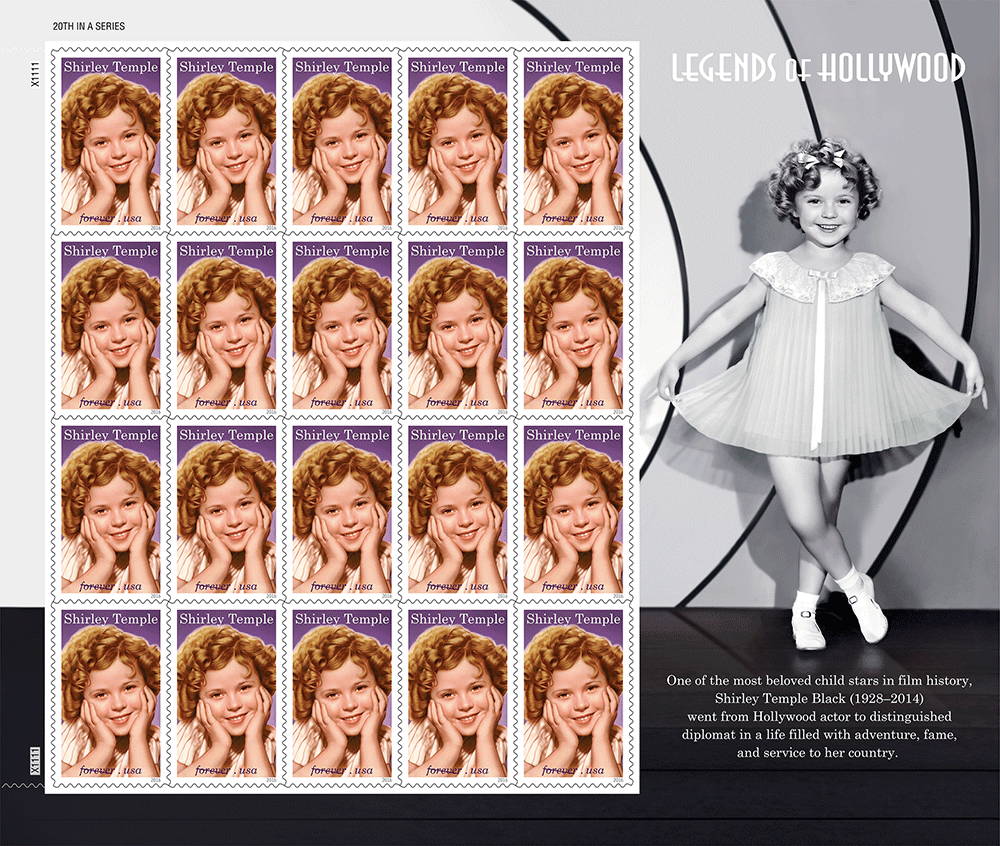
 5145-5148 (47¢) Holiday Window Views
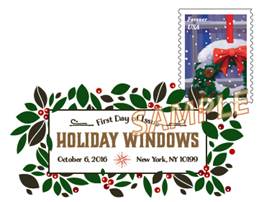 It measures 2.94” x 1.48”. The B&W postmark for this issue is the standard 4-bar First Day of Issue postmark.
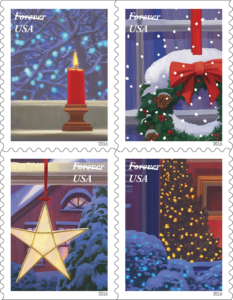 On October 6, 2016, in New York, NY, the U.S. Postal Service® will issue the Holiday Windows stamps (Forever® priced at 47 cents), in four designs, in a pressure-sensitive adhesive (PSA) booklet of 20 stamps (Item 681500).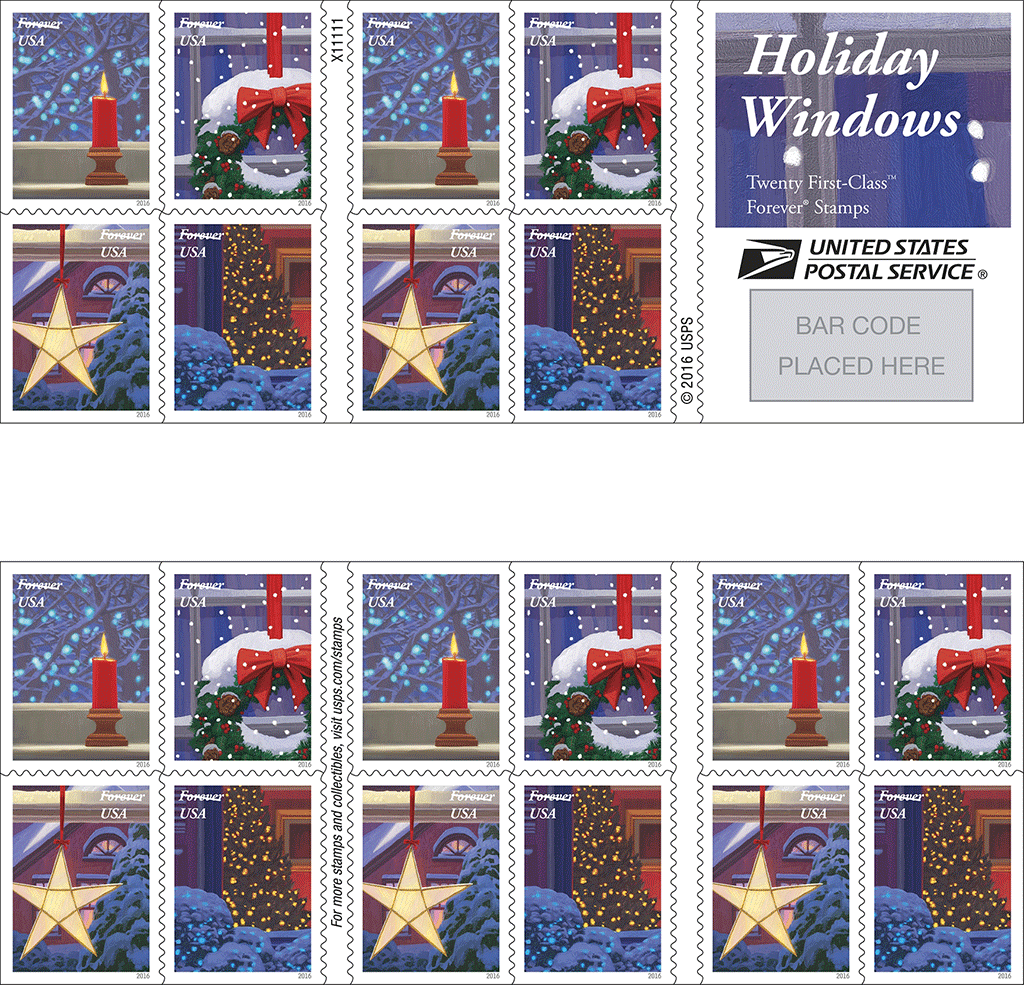
 As someone who has collected stamps since age 8, I value the leadership that APS provides to the hobby. I would be honored to serve as APS Treasurer providing my many years of experience in a wide variety of financial business disciplines to the organization. When consulting for not-for-profit organizations I always emphasize that board members should chart the future course and provide the necessary resources, so the organization can achieve its strategic goals. Boards should not micromanage organizations, rather, provide executive oversight and direction. I ask for your vote so I can bring to APS my many skills, to help them in achieving future success.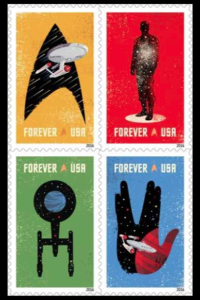
 Envelopes for Priority Mail but not Express. (asked by Marty Frankevicz of Scott Publishing)
 Featuring a design that evokes centuries of tradition, this stamp commemorates the two most important festivals—or eids—in the Islamic calendar: Eid al-Fitr and Eid al-Adha. The gold-colored calligraphy on this stamp was created by world-renowned calligrapher Mohamed Zakariya of Arlington, Virginia.
 With this pane of 16 stamps, the U.S. Postal Service® showcases some of the more visually compelling full-disk images of the planets obtained during this era. Eight new colorful Forever® stamps, each shown twice, feature Mercury, Venus, Earth, Mars, Jupiter, Saturn, Uranus, and Neptune.
 With this issuance, the U.S. Postal Service® recognizes the history-making first reconnaissance of Pluto in
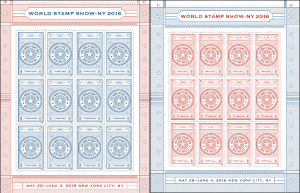 This souvenir sheet commemorates the decennial World Stamp Show that will be held from May 28 to June 4, 2016, at the Jacob Javits Convention Center in New York City. The design will be based on the two stamps issued in 2015 to announce the upcoming World Stamp Show-NY 2016 and inviting philatelists and amateur stamp enthusiasts to attend. Printed in Intaglio.
 This issue celebrates soda fountain favorites—the cold, sweet treats beloved by people of all ages. [Note that the middle stamp is wider than the other 4. -LdeV]
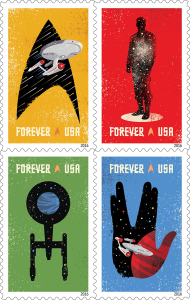 Celebrating the television show Star Trek on the 50th anniversary of its premiere, these four new stamps showcase four digital illustrations inspired by elements of the classic program:
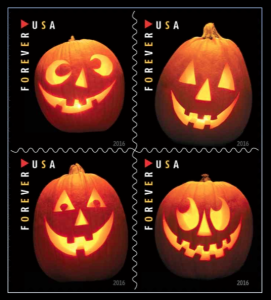
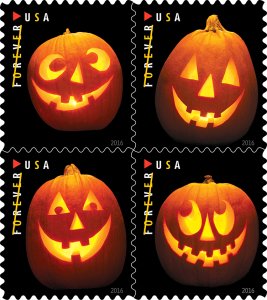 In the spirit of Halloween, the U.S. Postal Service® issues these delightfully eerie stamps featuring photographs of four different jack-o’-lanterns.
 Celebrating the rugged and reliable work vehicles that Americans have driven for nearly a century, each of the four new stamps features one of the following iconic models:
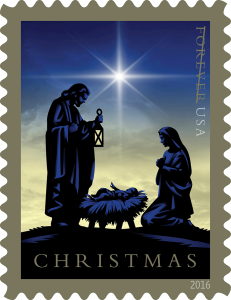 The stamp art depicts a peaceful yet powerful image of the Holy Family silhouetted against a dawn sky. The baby Jesus lies in a straw-filled manger in the center of the picture with Mary kneeling to the right and Joseph standing to the left, holding a lantern. A bright star shines over the scene.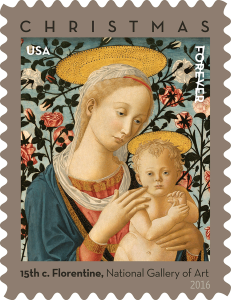
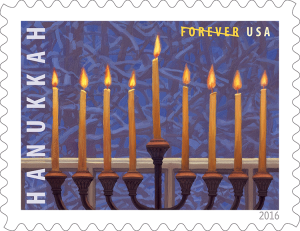 The 2016 Hanukkah stamp features a warm, elegant illustration of a holiday menorah in the window of a home.
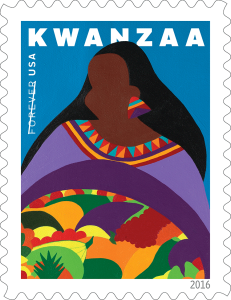 The 2016 Kwanzaa stamp continues its tradition of honoring an annual holiday that celebrates African-American family, community, and culture with this vibrant new stamp design. Bold colors depict a young African-American woman as the embodiment of Africa. She wears a lavender dress with a collar of African design that also appears in her earring. In front of the woman sits a large purple bowl overflowing with fruits and vegetables, symbolizing the abundance of African first harvest celebrations that inspired the creation of Kwanzaa.
 This round stamp features a detailed photograph of the moon. Taken as the full moon rose over Fort Lauderdale, Florida, the image captures the brilliant surface of Earth’s only natural satellite. The selvage features a small tree line silhouetted against the night sky.
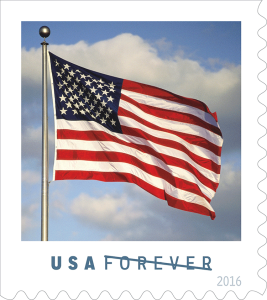 Format: Booklets of 10 and 20, Coils of 100
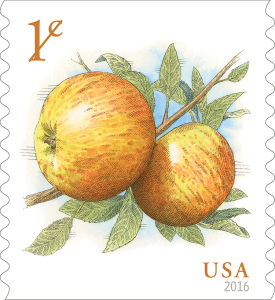 FDOI: Information to come.
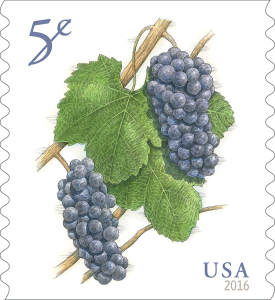 Grapes 5-Cent (1 design)
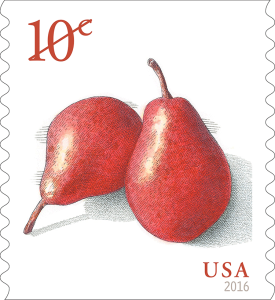 Pears 10-Cent (1 design)
 Format: Pane of 10
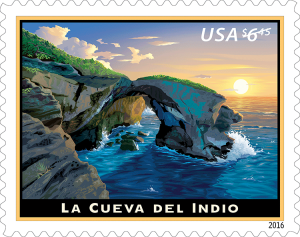 Format: Pane of 10
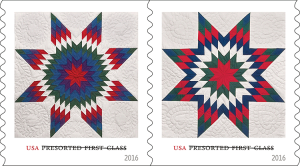 With evocative names like Blazing Star, Touching Stars, and Starburst, stars are one of the most popular design motifs for American quilters. The 2016 Presorted First-Class Mail® stamps feature two versions of one of those favorites, the Lone Star pattern. [This implies to me there will be future “quilts” stamps. -LdeV]
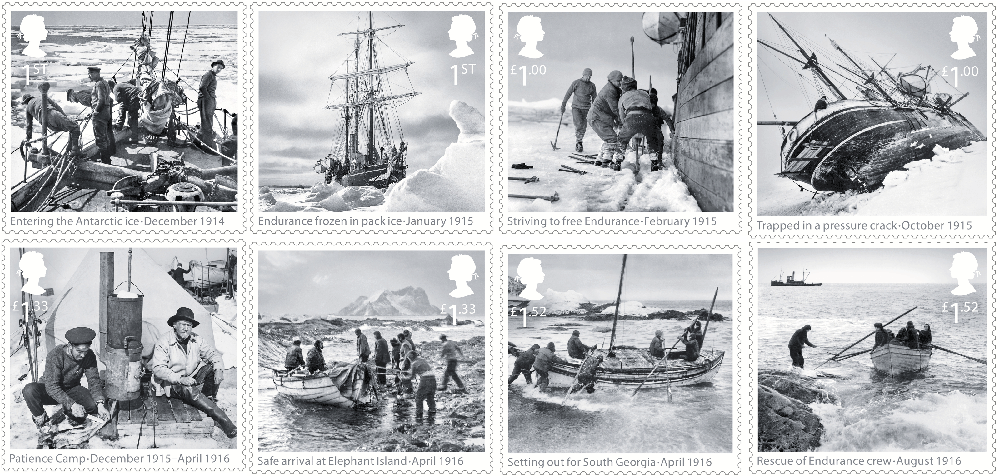 Described as ‘The Greatest Survival Story of All Time’ by Sir Edmund Hillary, the Imperial Trans-Antarctic Expedition led by Ernest Shackleton is regarded as the last of the heroic expeditions of the polar regions.
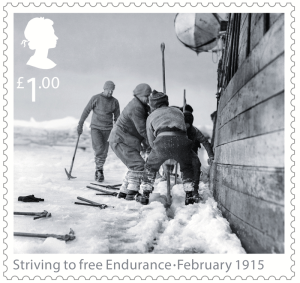
 During an attempt to be the first to cross Antarctica, Shackleton and his crew were 80 miles from their destination when their vessel, Endurance, became stuck in sea ice and after four months was crushed. All 28 men were left stranded, drifting on the ice for another six months, having dragged three boats and provisions from the ship.
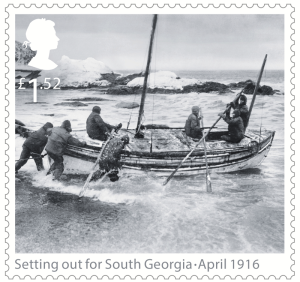
 800 miles of notoriously treacherous Southern Ocean to find South Georgia (the most remote outpost of the British Empire).
 He reached this whaling station almost one year after they left the ice. He then organised expeditions to rescue the remainder of his crew, which occurred in 1916. The voyage, which was recorded by pioneering photographer Frank Hurley, made Shackleton one of the most celebrated sailors and leaders of all time.
 Number of stamps: Eight
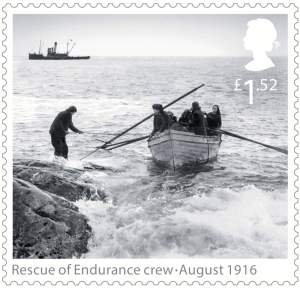 Stamp Size: 37 (w) x 35(h) mm
 Your 3-member Board of Vice Presidents not only serves as part of the larger APS Board, but as the disciplinary body which considers cases of alleged misconduct by members, weighing the evidence pursuant to the APS Bylaws. The three of us have a wide and deep background in leading philatelic organizations, as well as a combined 122 years involved in the American Philatelic Society.
 This has nothing to do with stamps, unless I throw in that Great Britain earlier this year issued Star Wars stamps to commemorate (hype?) the new film The Force Awakens. (Illustration of one is on the right.)
 Check. One last remaining Jedi, living alone in a remote location? Check. Good-guy fighter pilots, shown in closeup wearing orange jump suits? Check. The top, ultimate leader of the Bad Guys who is deformed and makes Lord Voldemort look like a male model? Check. Faceless soldiers in white plastic armor? Check. I mean, it’s 30 years later: What are the chances this New Order is going to have exactly the same armor and officers’ uniforms as the old evil Empire that is in the earlier films?
 A friend recently told me he had accumulated quite a lot of Presidential Series material, and was thinking about what to do with it. He knew of my interest in the issue, and asked me “How do you collect the area? I want to get my material organized and developed into a collection. But I sure don’t want to start out on too grand a scale, and be overwhelmed — or worse, lose interest.”
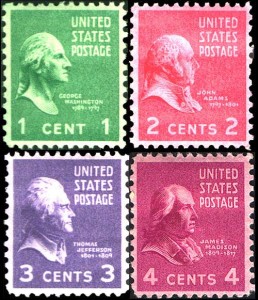 Keep in mind that the Prexies (as they are often called), despite being 78 years young, are relatively modern by collecting standards. Thus, they combine — for 90% of the material — ease of availability with reasonable prices.
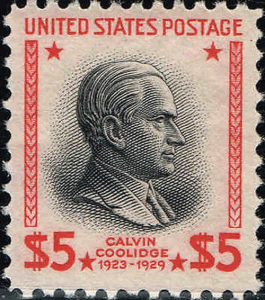 Regarding the sheet stamps, meaningful subdivisions include the following possibilities:
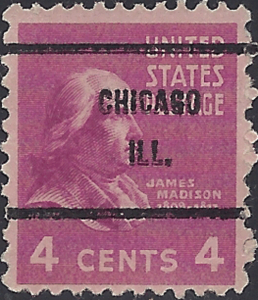 Precancels — both Bureau-printed (in the high hundreds of locations), and locally-printed (in the thousands of locations).
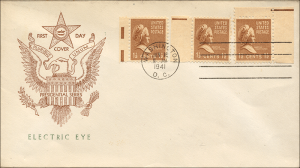 The dangers of transportation of the mails as shown by wreck and crash mail (air, ship, train, mail trucks, etc.)
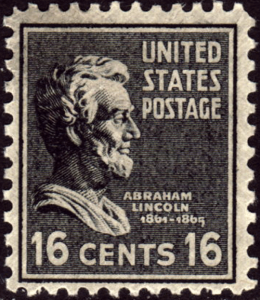 A consequence of getting involved in specialties like the Presidentials is the need for information to explain the things you have found, and to inform your search for new material. Essential to every Prexie collector is the book by Roland Rustad, titled The Prexies, released by the
 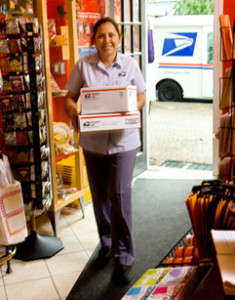 You know all that aggressive marketing this holiday season by the U.S. Postal Service? It appears to be paying off.
 the-clock. The USPS is also delivering on Sunday for the equivalent of about 25,000 routes. UPS and FedEx don’t usually deliver on Sundays.