Hotchner: Collecting FDCs Can Be Fascinating

First Day Cover Collecting Includes Fascinating Byways
by John M. Hotchner

hotchnerAs a kid I sent off for First Day Covers (FDCs) of new issues, and was thrilled when cancelled covers arrived in the mailbox. And then, for whatever reason I can’t recall, I turned up my nose and dropped FDCs as a collecting area. It was foolish of me to do that — perhaps influenced by the mantra among experienced collectors that FDCs were only for beginners.

What I didn’t realize at the time was the rich diversity of First Day Covers. They actually go back to the 19th century, when a stamp might have been used on a known first day of release, but there was no organized first day ceremony, and no organization keeping track. Stamps were placed on sale at post offices as received and the result is that the Scott U.S. Specialized Catalogue generally lists Earliest Documented Use (EDU) dates in this era rather than first days.

It is a sport among collectors of 19th century U.S. stamps to find covers or socked-on-the-nose stamps that push the EDU dates further back than the Scott listing. There are also a good many EDUs listed for the first 20+ years of the 20th century, as it seems that only commemoratives had stated first days until the coming of the 1922 Fourth Bureau Issue definitives. By this time, there were many collectors of FDCs, but the only identifier was the cancellation date. If you didn’t know what to look for, you could easily miss the significance of a FDC.

linn610That all changed when George W. Linn, the founder of Linn’s Stamp News, added text to the covers he prepared for the issuance of the perf 11 flat-plate Warren G. Harding Memorial stamp (Scott 610), released on September 1, 1923, shortly after the death-in-office of the president. As shown here, his covers had black mourning bands and the words “In Memoriam, Warren G. Harding, Twenty-Sixth President, Born Nov. 2, 1865 Died August 7, 1923.” These covers exist in several different sizes.

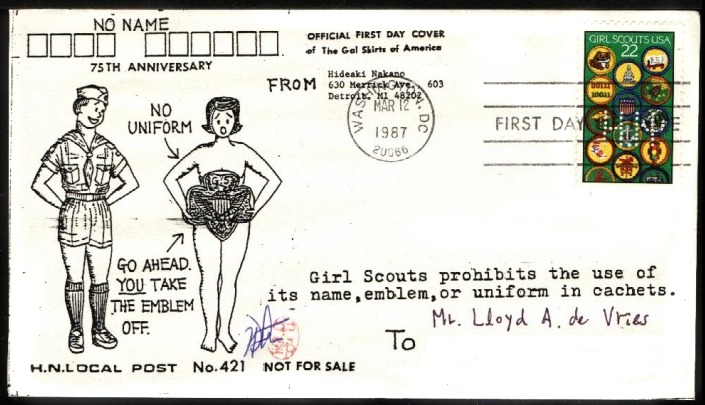
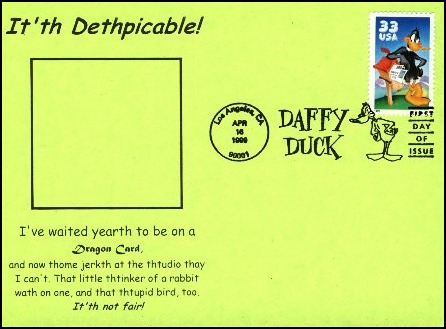
That changed the playing field. Text or illustrations on a first day cover have come to be called “cachets,” and cachetmakers sold their creations; competing to create the most popular art. Some collectors chose a cachetmaker and tried to get every one of his or her covers for their first days. Other collectors rejected this new fad, and stayed with the plain cancelled cover. It is estimated that until about 1936, the majority of FDCs were of the uncacheted type, and virtually all were addressed and actually went through the mail.

In 1937, the now familiar “First Day of Issue” cancellation was used for the first time on the 3¢ stamp commemorating the Northwest Ordinance of 1787 (Scott 795). This is a curiosity as a significant percentage of FDCs dating back to this time — some would say a majority — have not actually been cancelled on the first day. The requester generally has had up to 30 days after issuance to send in cacheted covers to have the stamp and first day cancel added.

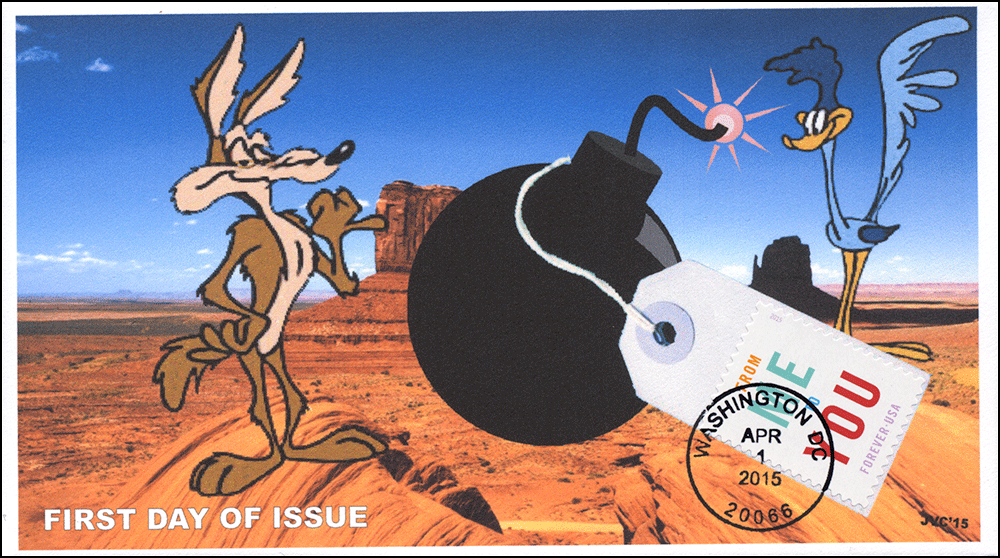
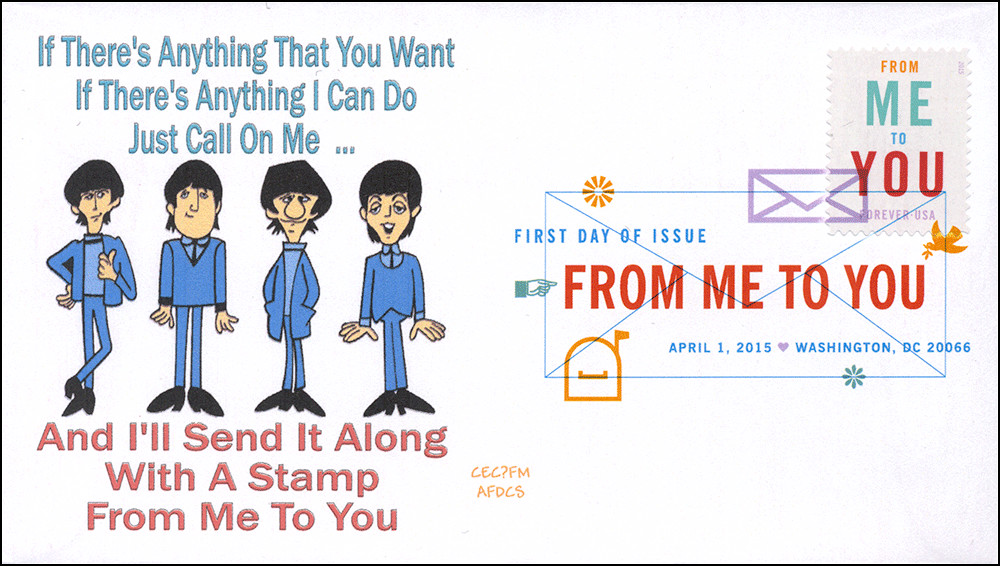
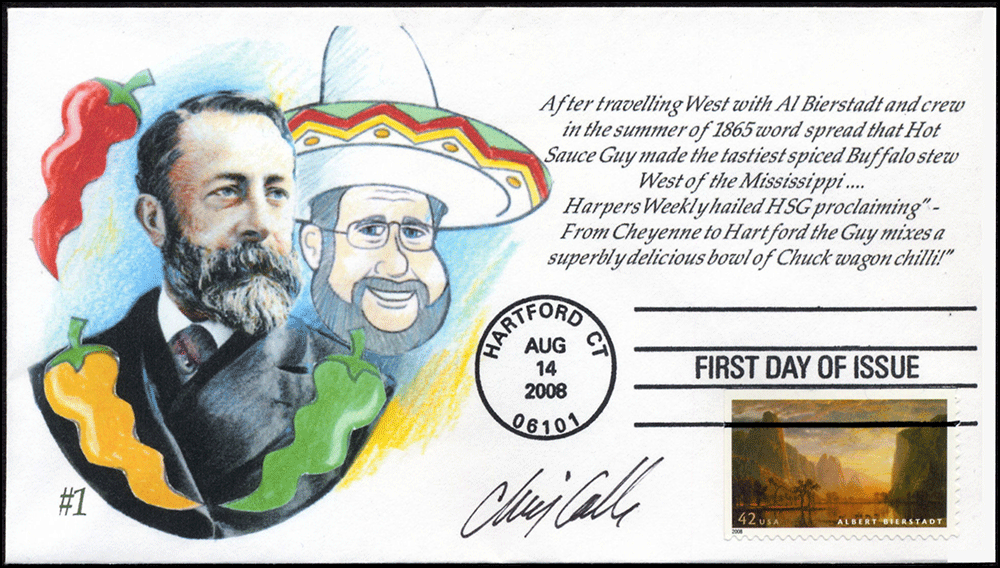
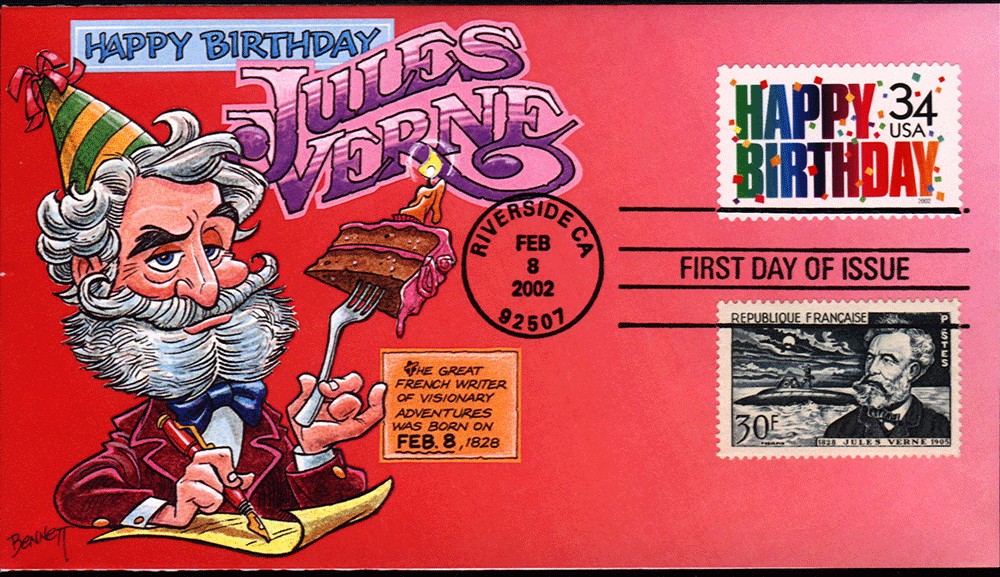
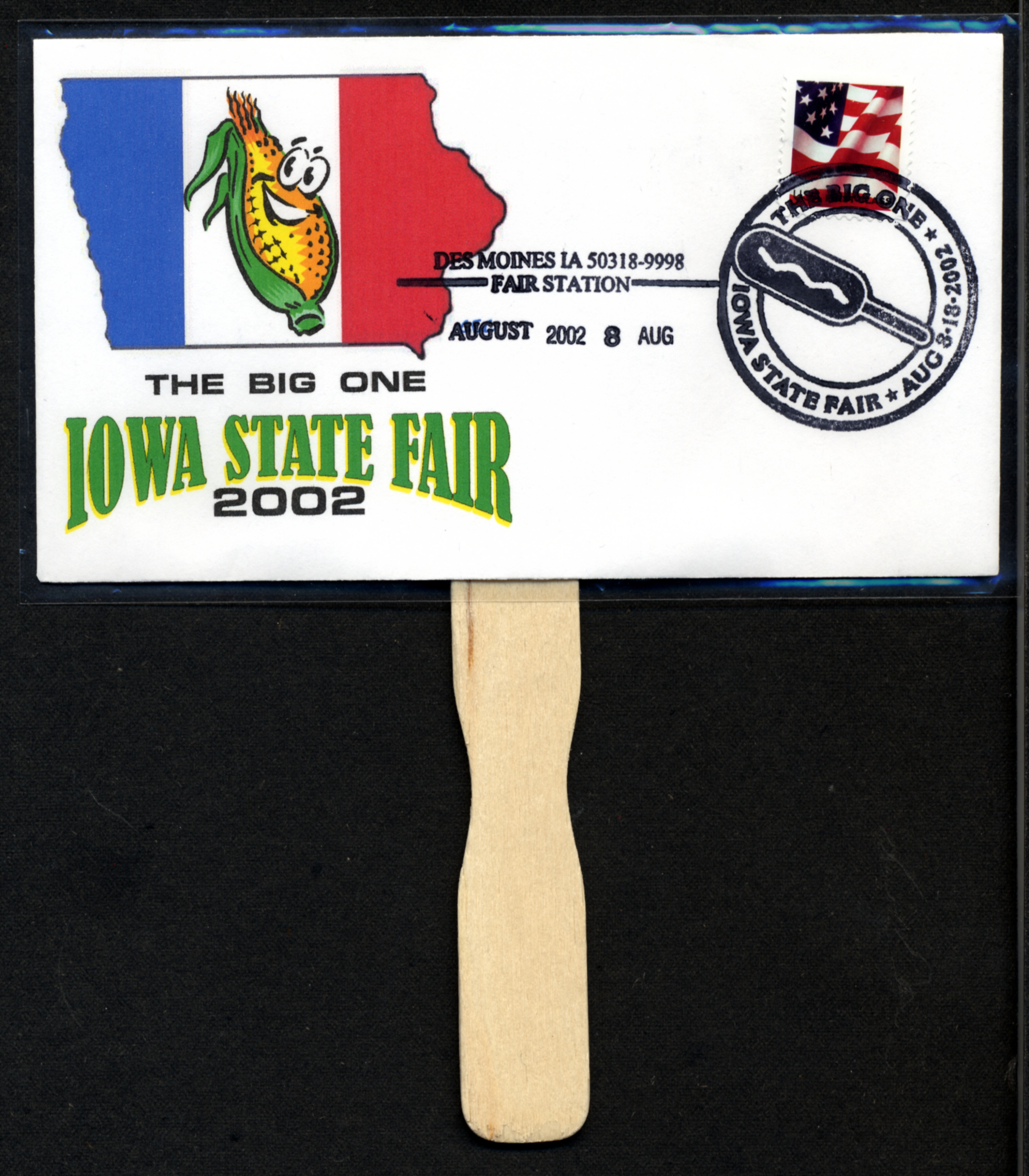
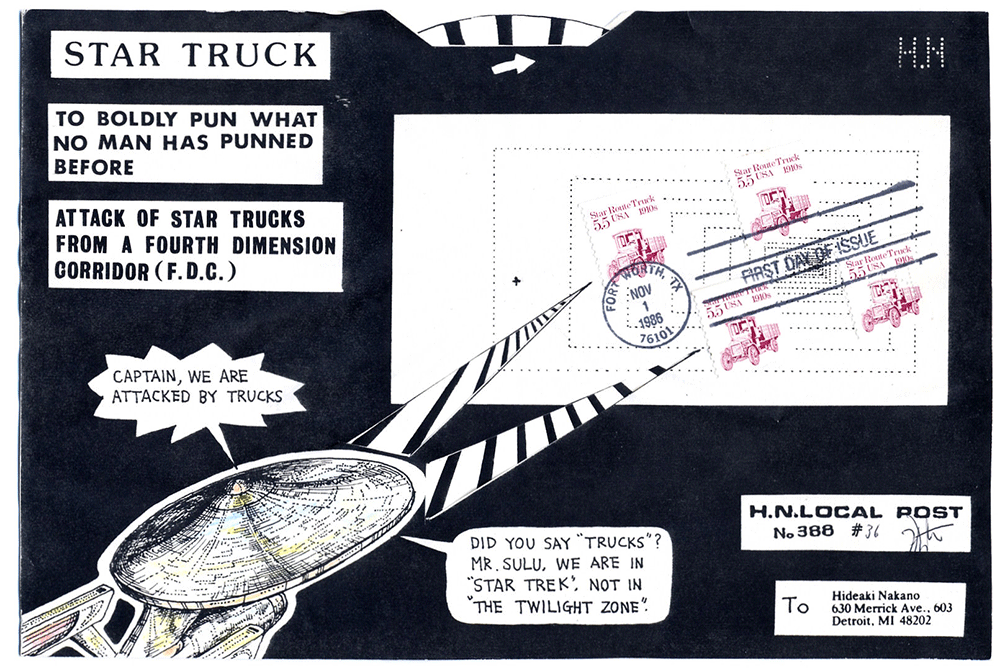
Although it has developed that there are standard printed cachets that are most often encountered, ArtCraft being most often seen, many other cachetmakers have had long, or shorter runs producing their unique art. Often printed in small quantities, and sometimes hand drawn in even smaller quantities, FDC collectors of today often enjoy collecting the sc737motherswork of a specific cachetmaker. Others focus in on the stamp, and try to get as many different cachets as can be found for that stamp.

I’ve returned to FDC collecting as a member of the latter group. Although I accumulate the FDCs associated with about a dozen commemoratives, my favorite stamps are the Mothers of America issues of 1934 (an example is shown at above right), and the Adlai Stevenson issue of 1965. (A Marg cachet is shown at left.) The latter illustrates another aspect of sc1275marg2my FDC collecting. In this case, the United Nations Association of the United States of America (a non-governmental organization), used the occasion of the release of the Stevenson stamp to do a special cachet, and stuffed these envelopes with a fund-raising letter.

Other organizations used standard philatelic cachets, but included fund=raising letters, or letters trying to sell a product by relating the stamp issuance to it. An example is a letter included with an ArtCraft cachet for the Stevenson issue from the Prudence Mutual Casualty Company of Chicago, Illinois. Quoted in part it says:

“This FDC honors Adlai Stevenson and comes to you from Bloomington, Illinois, where the Ambassador to the United Nations grew up and is buried…. President Johnson requested the issuance of this stamp in a letter to PMG John A. Gronouski, in which he noted that ‘Adlai Stevenson enlarged our horizons as Americans and helped to light the hopes of mankind all around the world.’… President Johnson, recognizing the importance of the fight against Cancer, authorized issuance of a special stamp in April, 1965, in honor of the Crusade Against Cancer. At the same time, Prudence designed a new Cancer Expense Policy which protects the policy owner against the extreme costs of cancer to a maximum of $10,750.00. Every individual and family should have this low-cost protection.”

It is signed by a printed signature of the president of Prudence.

I find these types of FDCs fascinating and collect the full range of business and non-profit cachets and messages; regardless of which stamp was being released. One sub-genre of these is Congressional FDCs. These were prepared with the idea of sending them to friends and constituents with letters soliciting support for initiatives the Congressperson was involved in, and less often, support for their reelection efforts.

I also dabble in autographed FDCs, pre-first days, and have a pretty good collection of programs from first day ceremonies. The point here is that FDC-collecting can be a serious challenge, a fascinating reflection of the times of the stamps, and an excellent glimpse of the history behind the stamp. Whether you choose to collect the current stamps on standard cachets or to go further afield as noted above, FDC collecting is just plain fun.

There is a national association of FDC collectors called the American First Day Cover Society (AFDCS) devoted to helping collectors understand and appreciate the field.


Should you wish to comment on this column, or have questions or ideas you would like to have explored in a future column, please write to John Hotchner, VSC Contributor, P.O. Box 1125, Falls Church, VA 22041-0125, or email, putting “VSC” in the subject line.

Or comment right here..

U.S. Civil War First Day Ceremony (2015)

[The article on the stamps themselves is here.]
[Photos courtesy VSC member Rollin Berger]

appo5Long lines and a post office that hadn’t read the first-day instructions from USPS Cancellation Services in Kansas City. The clerks brought the only the cancels intended for Five Forks to the first day ceremony at the Appomattox Court House National Park, but didn’t bring enough stamps. For that, they might be forgiven, because the National Park Service rangers estimated 10-15,000 people at A.C.H. on the 150th anniversary of the surrender that all but ended the Civil War, versus the approximately 50 visitors it gets on a normal day.

There was also frustration at the Appomattox post office, where clerks refused to allow use of the red registry dater every post office must have – even after several calls from USPS Stamp Fulfillment Services. Resolution had to await the return of the postmaster from A.C.H. around 4 p.m. before the dater could be used.

However, VSC member Foster Miller appo3(shown here) says this was an excellent, if long, first day ceremony.

The advance USPS press release said reenactors portraying Generals Robert E. Lee and Ulysses Grant would bring to life the surrender, and thattwo descendants of soldiers portrayed in the painting on which the Appomattox stamp is based would attend: Dennis Bigelow, descendant appo1of Lt. Col. Chas. Marshall, Lee’s aide at the Appomattox surrender (pictured to Lee’s immediate right in stamp image); and Al Parker, descendant to Grant’s Military Secretary Lt. Col. Ely S. Parker (pictured to Grant’s immediate left). Parker, by the way, was a Native American.

Virginia Governor Terry McAuliffe was among the dignitaries at the ceremony.

First day covers were being sold at the ceremony by the Capital District Civil War Round Table, including unserviced ArtCraft cacheted envelopes for $5 each. appo4

Gifts of Friendship U.S. First Day Ceremony

[main article on the stamps is here]

[press release; photos and video stills courtesy USPS]
Gifts of Friendship Forever Stamps Celebrate Centennial of Gift of Dogwoods to Japan
Flowering Dogwood and Cherry Trees Adorn Stamps Issued in U.S. and Japan

gifts_cer07gifts_cer08WASHINGTON — The U.S. Postal Service and Japan Post jointly issued Gifts of Friendship Forever stamps today, celebrating the American issuance during the Cherry Blossom Festival in Washington, DC. [The ceremony was held adjacent to the Tidal Basin, with this view nearby —VSC]

The stamps feature beautiful images of flowering dogwood and cherry trees and honor the enduring connection between two nations on the centennial of the gift of dogwood trees from the United States to Japan in 1915.

gifts_cer06“These trees bring renewed life each spring after the long winter months and are celebrated on both sides of the Pacific Ocean with annual festivals that echo the spirit of friendship,” said Postal Service Chief Sales and Marketing Officer Nagisa Manabe (left). “I’m honored to be a part of this special moment that honors our collective history and heritage.”

Joining Manabe in dedicating the stamps were National Cherry Blossom Festival President Diana Mayhew and National Conference of State Societies United States Cherry Blossom Queen Rainey Sewell, among others. gifts_cer05From left, Judy de Torok, Manager, Industry Engagement and Outreach, Consumer & Industry Affairs, USPS; Diana Mayhew, President, National Cherry Blossom Festival; unidentified; Eriko Minami, Japan Flowering Dogwood Queen; Rainey Sewell, National Conference of State Societies United States Cherry Blossom Queen; USPS CMO Nagisa Manabe.gifts_cer14A postal clerk applies the Japanese postmark.
gifts_cer11Some VSC members waiting on line outside the autograph and sales tent: On the far left, American Philatelist editor Jay Bigalke and on the far right, Foster Miller.
gifts_cer10gifts_cer12Above two photographs: Autographing first day ceremony programs.
gifts_cer13The sales area. gifts_cer03Eriko Minami, Japan Flowering Dogwood Queengifts_cer02Rainey Sewell, National Conference of State Societies United States Cherry Blossom Queengifts_cer04Judy de Torok, Manager, Industry Engagement and Outreach, Consumer & Industry Affairs, USPSgifts_cer01Diana Mayhew, President, National Cherry Blossom Festival

Photographers (Canada, 2015)

[press release]

Works of Canada’s best photographers explored further with new set of stamps
Series traces history of photography over the past 150 years
OTTAWA, April 7, 2015 /CNW/ – Seven more of Canada’s best photographers will be celebrated tomorrow as Canada Post releases the third issue of stamps in a five-year series on photography. The work of Nina Raginsky, Sam Tata, Geoffrey James,Larry Towell, Geneviève Cadieux, Conrad Poirier and Harold Mortimer-Lamb was carefully selected with the assistance of leading curators and gallery owners to showcase some of the quintessential Canadian photographs of the past 150 years.

Canadian-Photography-2015-Domestic_RAGINSKY-Stamp-400PNina Raginsky began taking photographs in 1962 with her father’s Nikon F – the only camera she ever owned. She is known for her portraits of people she has encountered as a street photographer in Montréal and throughout Quebec, as well as in Mexico,England, Vancouver, Victoria and other parts of British Columbia. She is an officer of the Order of Canada and her work appears in the National Gallery of Canada. Selected for this series is Shoeshine Stand, shot in Vancouver, B.C., in 1974.

Canadian-Photography-2015-Domestic_TATA-Stamp-400PSam Tata is a photojournalist and portrait photographer who immigrated to Canada in 1956. His portraits of Canadian artists, writers, poets and photographers are an important contribution to Canadian photography. In 1989, he was the subject of a retrospective exhibition at the Canadian Museum of Contemporary Photography. Selected for this series is Angels, shot on Saint Jean-Baptiste Day in Montréal, Que., in 1962.

Canadian-Photography-2015-US_JAMES-Stamp-400PGeoffrey James was born in Wales and immigrated to Canada in 1966. James took the portrait Alex Colville on the TantramarMarshes, selected for this stamp series, in 1970 while he was writing a profile of the Canadian painter for Time Canada. His work shows the effects people have had on the land, from asbestos mining in Quebec to the border between the U.S. and Mexico atTijuana. In 2012, he received a Governor General’s Award in Visual and Media Arts.

Canadian-Photography-2015-Domestic_TOWELL-Stamp-400PLarry Towell began travelling the world in the early 1980s to document the struggles of the landless and dispossessed in the most prominent uprisings of the time. The photographer, poet, film maker and musician is the author of 14 books of photography and is the recipient of numerous international awards, including the inaugural Henri Cartier-Bresson (France), le prix Nadar(France), the Leica Oskar Barnack (Germany) and several World Press accolades (Holland). Towell was Canada’s first member of the prestigious Magnum Photo Agency and is one of the most decorated Canadian photojournalists. Selected for this series isIsaac’s First Swim, shot in Lambton County, Ontario, in 1996.

Canadian-Photography-2015-Int_CADIEUX-Stamp-400PGeneviève Cadieux presents the body as a landscape, focusing on small details such as a bruise or scar in extreme close-ups. A woman’s red lips are the subject of the photograph selected for this stamp eries, La Voie Lactée. Cadieux is also interested in the way art integrates into the urban environment. Many of her works are installed in public spaces. She is a winner of the 2011 Governor General’s Award in Visual and Media Arts.

Canadian-Photography-2015-Domestic_POIRIER-Stamp-400PConrad Poirier. Born in the Montréal area in 1912, Poirier freelanced for newspapers such as La Presse, the Gazette, Le Samediand La Patrie, capturing images of sporting events as well as popular entertainment artists. His celebrity photographs defined him as an early paparazzo. He shot many well-known event and street photographs between 1936 and 1946, work he called his “New Vision” photography. Selected for this series is Friends and Family and Trips. In front of Simpsons, shot in in Montréal in 1936.

Canadian-Photography-2015-Domestic_MORTIMER-Stamp-400PHarold Mortimer-Lamb was a Renaissance man who worked as a mining engineer, journalist, art critic, photographer and artist. Mortimer-Lamb came to Canada from England in 1889, settling in British Columbia. While his professional life was devoted largely to mining, he developed an early interest in photography, specializing in soft-focus romantic portraits. After relocating to Montréal early in 1900, he later returned to Vancouver where he opened an art gallery and began to paint. Selected for this series isSoutham Sisters, c. 1915-1919.

About the stamps
The stamps measure 36 mm x 30 mm (horizontal) and 30 mm x 36 mm (vertical) and are available in booklets of 10 domestic stamps and of six U.S. and International denominations. Two souvenir sheets (one of one vertical stamp and two horizontal stamps; one of four horizontal stamps) measure 150 mm x 75 mm. They were printed by Canadian Banknote and designed byStephane Huot. The Official First Day Cover cancellation site is Montréal, Quebec.

World War I Mule Corps (Israel 2015)

[press release]

Zion Mule Corps – 100th Anniversary
The Founding of the Mule Corps
isr_mulesAt the onset of WWI, the Turks who ruled Eretz Israel expelled all citizens of enemy countries who refused to become Ottoman subjects. Many of those expelled were Jews who had come from Russia before the war and nearly 11,000 of them made their way to the Egyptian city of Alexandria, which was under British rule.

Ze’ev Jabotinsky, who came to Alexandria from Russia as a military correspondent in early December 1914, proposed founding a volunteer Jewish combat battalion that would participate in the efforts to conquer Eretz Israel from the Turks. Aided by Joseph Trumpeldor, who had come to Alexandria after being expelled from Eretz Israel, he recruited some 200 young Jews from among the expelled as well as the local Egyptian Jewish community. Participants in a meeting held on March 5, 1915 signed a binding agreement to serve in the battalion.

Although the British refused to establish a Jewish combat unit, they did agree to form a transport corps of Jewish mule drivers. Disappointed, Jabotinsky left Egypt and travelled to London to continue to promote the idea of a Jewish combat battalion. Trumpeldor, on the other hand, accepted the British proposition and volunteered to help establish the corps.

On April 1, 1915 the members of the Zion Mule Corps, or as they were known “The Mule Corps”, were sworn in. Anglo-Irish Lt. Colonel John Henry Patterson was appointed to command the corps and Joseph Trumpeldor became his second-incommand.

The Corps on the Gallipoli Front
In April 1915, a large British military force landed on the shores of the Gallipoli peninsula, not far from the city of Istanbul, the capital of the Ottoman Empire. On April 16, 1915, after only a brief twoweek training period, the Mule Corps joined the main force which had landed on the southern shore of Gallipoli. The stamp is adapted from a photo of the Mule Corps soldiers as they came ashore in Gallipoli.

mulecxlIt quickly became apparent that the British action on the Gallipoli peninsula was a failure. The Turks fought fearlessly and the invading forces suffered heavy casualties. The Mule Corps soldiers, who transported ammunition and supplies to the troops on the front line, executed their difficult and wearing job very well. Despite the danger and the terrible conditions, the Jewish volunteers persevered under fire, in the mountainous terrain of the peninsula, until the British withdrawal and departure from Gallipoli on the night of January 1, 1916. During this period the Corps suffered nine casualties and approximately 50 of its men were wounded. Ninety men were present at the final parade before the British departure, approximately 25% of the original force, and only 11 of them were among the volunteers who had come ashore on April 27, 1915.

The End of the Mule Corps
A few months after returning to Egypt, the Mule Corps was disbanded on May 26, 1916. At Trumpeldor’s initiative, some 120 members of the corps reenlisted. They were sent to Britain, where they served as the core of the newly formed 38th Battalion of the Royal Fusiliers, the first Jewish combat unit within the framework of the British military.

Description of the First Day Cover
The First Day Cover incorporates the façade of the Beit Hagdudim (Jewish Legions) Museum – Avichail, which commemorates the memory and heroism of the members of the Jewish battalions of WWI. The quote taken from the founding declaration of the Mule Corps: “A corps of Jewish volunteers that shall make itself available to the government of England in order to participate in the liberation of Eretz Israel… every volunteer shall swear to sacrifice his strength and his life” symbolizes the courage and sacrifice of the pioneers of the first Jewish military force of the modern era.

Issue: April 2015
Stamp Size (mm): H30/W40
Plate: 979
Stamps per Sheet: 15
Tabs per Sheet: 5
Method of printing: Offset
Security mark: Microtext
Printer: Cartor Security Printing, France

Stamp & Cancellation Design: Osnat Eshel, Tuvia Kurtz
FDC design: Osnat Eshel

Dinosaurs (Canada, 2015)

[CPC press release
Dinosaurs come to life on Canada Post stamps

Dinosaurs-Stamp-Ornithominus-400POTTAWA, April 9, 2015 /CNW/ – With a unique 3-D-like design that breaks through the boundaries of a typical stamp, Canada Post brings to life five prehistoric animals that once roamed Canada. The prehistoric beasts in this new stamp issue – Dinos of Canada – range from Tyrannosaurus rex, depicted in a light feathery coat with cavernous jaws agape, to Euoplocephalus tutus, whose tail ended in a massive club.

“Canada’s rich geography and spectacular landscape define this country and who we are,” says the CANADA POST - Dinosaurs come to life on Canada Post stampsHonourable Lisa Raitt, Minister of Transport, responsible for Canada Post. “We have a special fascination for the creatures that walked this land in the ancient past. With these stamps, we rediscover the magic they hold for us.” [Raitt is shown at right with Canada Post president and CEO Deepak Chopra, the Toronto Raptor and students from Jesse Ketchum Public School.]

“Canadians young and old marvel at these wonders of nature and will be intrigued to discover in this stamp issue fascinating clues to the lives these dinosaurs lived,” says Canada Post President and CEO Deepak Chopra. “Our stamp program tells Canada’s story. This is a story like no other.”

The animals pulse with life, charged by the multilevel embossing and holographic foiling used in most of the designs. They tear their way through barren background images of Dinosaur Provincial Park, one of Canada’s richest sources of dinosaur fossils.

Wild-eyed and sharp-toothed, the creatures are vividly illustrated by highly regarded paleoartist Julius Csotonyi of Vancouver. Design is by Andrew Perro of Toronto, who has designed several Canadian stamps.

“It was important to strike an effective balance in pose and colour patterns that were gripping and imposing yeDinosaurs-Stamp-Chasmosaurus-400Pt scientifically accurate or plausible,” says Csotonyi, an award-winning natural history illustrator and biological sciences graduate.

Canada has proven a rich hunting ground for dinosaur remains, with discoveries made from the badlands of Alberta to the Bay of Fundy area. The finds selected for this stamp issue were made in Western Canada and chosen in consultation with the Canadian Museum of Nature.

The animals depicted are:

  • Dinosaurs-Stamp-Tylosaurus-400PTylosaurus pembinensis, a giant sea-dwelling reptile that could open its jaws wide like a snake and swallow large prey. It patrolled the inland sea that divided North America 80 million years ago. A skeleton displayed at the Canadian Fossil Discovery Centre in Modern, Man. is the largest mosasaur skeleton on exhibit in the world. Nicknamed “Bruce,” the centre refers to it as “the T. rex of the sea.”
  • Chasmosaurus belli, a relative of the famous Triceratops. Its large frill was supported by a bony framework that was likely used for display, not defence. A baby Chasmosaurus was recently found in Dinosaur Provincial Park. It was less than three years old when it died.
  • Dinosaurs-Stamp-Tyrannasaurus-400PTyrannosaurus rex, the “tyrant king” of dinosaurs. High school teacher Robert Gebhardt discovered one of the largest and most complete skeletons of its kind in Saskatchewan in 1991. The skeleton has been nicknamed “Scotty.”
  • Ornithomimus edmontonicus, now known to have sported long arm feathers. It used its speed to outrun predators and to hunt for prey, which included small lizards and mammals.
  • Euoplocephalus tutus, an herb-eater that was known for its spiky, plated armour. Its complex and unusual series of nasal passages may have warmed inhaled air, improved the animal’s sense of smell or helped it vocalize.

About the stamps
Dinosaurs-Stamp-Euoplocehalus-400PWhile each stamp frame is 28.5 mm x 28.5 mm, the dinosaurs burst out in varying configurations. The stamps are available in booklets of 10. They were printed by Lowe-Martin and designed by Andrew Perro with illustration by Julius Csotonyi and photography by Judy Arndt. The souvenir sheet of five stamps (below) measures 159 mm x 65 mm. The uncut press sheet of eight souvenir sheets measures 608 mm x 358 mm and features an enlargement of the T. rex that appears on the stamp. The cancel image on the Official First Day Cover is that of the Ornithomimus edmontonicus. The cancellation site is Drumheller, Alta., home of the Royal Tyrrell Museum of Paleontology, one of Canada’s most important dinosaur museums. can_dino_souv

Stars Turn Out For Maya Angelou Stamp

[The main article on the stamp itself is here.]

s_maya_angelouWashington, DC’s Warner Theatre was filled to capacity (listed at 1,847 people) for what some veteran first-day-ceremony-attending VSC members say was one of the best ceremonies in years. The Postal Service had anticipated and promoted the appearances of Oprah Winfrey and former Ambassador Andrew Young, but for the second Washington ceremony in a role, White House senior adviser Valerie Jarrett and Attorney General Eric Holder attended, plus First Lady Michelle Obama.

Also at the ceremony were almost every African-American member of the House, two daughters of Malcolm X (who was a friend of Angelou), and Washington DC native Roberta Flack. There were also mainstream television camera crews and reporters from the non-philatelic press, such as The Washington Post, whose article is here.

Henry Louis Gates was one of the few celebrities with a tie to Angelou who wasn’t in attendance. “Henry Gates called me to tell me that his proposal for the Maya Angelou stamp was approved,” said Winfrey. Gates is a member of the USPS Citizens Stamp Advisory Committee.

There was a dance tribute by the Duke Ellington School of the Arts Dance Ensemble. angelou_cer02The ceremony ran almost two hours.

There was no autographing line. However, one VSC member was able to obtain autographs from Young and artist Rossin on his ceremony program.

Here are the Postal Service press release and photos; there are more photos taken from the USPS video at the end (added April 11th).

[USPS press release]

Maya Angelou Receives Stamping Ovation
First Lady, Oprah Winfrey, Ambassador Andrew Young, Join Postmaster General in Dedication
angelou_cer01WASHINGTON — Michelle Obama, Oprah Winfrey, Ambassador Andrew Young and other notables joined Postmaster General Megan Brennan in dedicating the Dr. Maya Angelou Forever Stamp today. [Master of ceremonies and MSNBC talk-show host Melissa Harris Perry is shown on the right.] The ceremony took place before a capacity crowd at Washington, DC’s Warner Theatre. Angelou fans are encouraged to share the news on social media using the hashtag #MayaForever.

“Maya Angelou was an author who broke down the barriers of literary form,” said Postmaster General Megan Brennan. “Throughout her many written works, she explored themes of identity, race and displacement — and did so in a distinct style that stretched over time and place. Her stories embodied the pain of her personal struggle — but more than anything else, they epitomized the triumph of courage and the human spirit. She committed angelou_cer03her life to ideas that elevated our sense of what it means to be human, and to advance understanding, compassion, and reconciliation.”

“She’d get a big kick out of this moment,” said Winfrey (at left). “Being honored and commemorated by the Postal Service with her own stamp, for the big, bold bodacious, life she dared to live, in a way that dazzled and gave meaning to those of us who knew her and many who didn’t.”

angelou_cer07“Phenomenal Maya,” said Young (at right). “Rising still from Stamps, Arkansas, and in our hearts to a Forever Stamp. We’re singing your song forever, Maya.”

“Dr. Maya Angelou was a dancer, a singer, an actress, a director of film, a poet, an autobiographer, a social commentator, a teacher and an activist,” said Angelou’s son Guy Johnson. “Yet if you asked her what her life mission was, she’d answer that she had to confront injustice wherever she found it and remind each of us that we are more alike than unalike. It was her belief that every one of us has the responsibility of being our brothers’ and sisters’ keepers. For if human angelou_cer05beings are to survive the grave difficulties that range from ethnic hatred and religious conflict to the destruction of the environment, it can only be done if we unite together to develop coherent and effective remedies.” [At left are Guy Johnson and Colin Johnson.]

“Maya Angelou left a stamp on everything and everyone she touched,” he added. “It is only fitting that the U.S. Postal Service is bringing out a stamp in recognition of her life’s work. Her family is extremely grateful of the honor that is being bestowed upon her.”

Also attending the ceremony were Angelou’s grandsonangelou_cer06 Colin Johnson; poet Sonia Sanchez (below right); author and journalist Sophia Nelson; Howard University English professor Eleanor Traylor; poet and civil rights activist Nikki Giovanni (below left); and Atlanta-based artist Ross Rossin, whose portrait of Angelou was used for the stamp. The back story on the portrait and the connection to Young and Winfrey can be found here. Melissa Harris-Perry served as master of ceremonies.

As an author, poet, actress, and champion of civil rights, Angelou (1928–2014) was one of the most dynamic voices in 20th-century American literature. The book, “I Know Why the Caged Bird Sings,” an autobiographical account of her childhood, gained wide acclaim for its vivid depiction of African-American life in the South.

angelou_cer04The stamp showcases Rossin’s 2013 4 feet by 4 feet oil-on-canvas portrait of Angelou. The large hyper-realistic painting is part of the Smithsonian National Portrait Gallery’s collection, where it will be on display through Nov. 1. The stamp features this quote from an interview Angelou conducted:  “A bird doesn’t sing because it has an answer, it sings because it has a song.”

The stamp pane includes a short excerpt from Angelou’s book, “Letter to My Daughter.” It reads: “Try to be a rainbow in someone’s cloud.” Art director Ethel Kessler of Bethesda, MD, designed the stamp.

Special dedication ceremonies for the Maya Angelou Forever stamp are also scheduled for [April 7] in Detroit, Los Angeles and Santa Ana, CA; Stamps, AR, April 8; Stockton, CA,  April 11.

angelou_cer11Believe it or not, the USPS-supplied stills (photos) didn’t include Postmaster General Meg Brennan! angelou_cer08angelou_cer10angelou_cer09angelou_cer12angelou_cer13angelou_cer14angelou_cer15A few more photos, courtesy VSC member Rollin Berger: angelou_cer16I couldn’t see it in the unveiling photo I posted earlier, but there in the center of the group, green dress, is First Lady Michelle Obama. Thanks to Rollin for pointing her out.angelou_cer17

U.S. Scott Catalogue Numbers (April Update)

4672a 1¢ƒ Bobcat coil, dated “2015,” microprinting on bobcat’s leg
4905b Circus imperforate souvenir sheet of 3, #4905d, 2 #4905c
4905c 50¢ Circus Wagon, imperforate
4905d $1 Circus Clown, 57x48mm
4905e Circus imperforate souvenir sheet of 3 with gold omitted in sheet margin
4957 (49¢) Chinese New Year – Year of the Ram
4958 (49¢) Robert Robinson Taylor
4959 (49¢) Rose and Heart
4960 70¢ Tulip and Heart
4961 (10¢) Flag self-adhesive coil – Stripes at Left, Stars at Right
4962 (10¢) Flag self-adhesive coil – Stars and White Stripe
4963 (10¢) Flag self-adhesive coil – Stars at Left, Stripes at Right
a. Strip of 3, #4961-4963

U689 $5.75 Glade Creek Grist Mill stamped envelope

AFDCSers To Tour USAF Museum

[press release]
usafm_exterior_webThe American First Day Cover Society has chosen the National Museum of the U.S. Air Force for its pre-Americover 2015 tour.

Americover 2015 will be held in Columbus, Ohio, August 14-16, about 75 minutes from Wright-Patterson Air Force Base, near Dayton. A bus will take participants from the show site, the DoubleTree by Hilton Columbus-Worthington, to the museum and back again. The museum is the oldest and largest military aviation museum in the world, and features more than 360 aerospace vehicles and missiles on display amid more than 17 acres of indoor exhibit space.

ww2gallery_web“This tour will resonate with first day cover collectors in particular,” said Chris Lazaroff, chair of Americover 2015. “Most, if not all, of the aircraft shown on the ‘Advances in Aviation’ sheet issued at Americover 2005 will be on display.”

The price, which covers bus transportation, is $28 if purchased before July 1st, and $35 after that date. Tickets may be purchased online at www.afdcs.org/register or by mail, using the insert in the March-April issue of First Days, the official journal of the AFDCS.

Each year, a group from Americover tours local sites the day before the show opens. There is also a Sunday evening event involving dinner; this year, it will be at the famous Schmidt’s restaurant in Columbus’ German Town district.

coldwargallery_webThere is a special Americover room rate of $99 at the DoubleTree by Hilton Columbus-Worthington, which includes Wednesday and Sunday nights. There also will be two bourses (commercial dealers and cachetmakers) at the show, a banquet, meetings, a youth table, a hospitality suite, live and silent auctions, seminars, a U.S. first day ceremony, and a forum by a postal official involved with first day covers.

For more information on Americover 2015 and the AFDCS, contact the AFDCS at P.O. Box 16277, Tucson, Ariz. 85732-6277, email showinfo@afdcs.org or visit www.afdcs.org.

Spellman Museum Helps With Old Collections

[press release]

WHAT’S IN YOUR ATTIC?
ANNUAL STAMP ROADSHOW
SUNDAY APRIL 12 NOON – 3:00

Do you have old stamp albums or boxes of stamps just collecting dust in your closet or attic?  Have you inherited some stamp albums or envelopes from a relative and wonder if they have any value? Do you think that perhaps those stamps you purchased as a child are now worth a fortune?

The  Museum is holding its annual Stamp Roadshow on Sunday April 12 from noon to 3:00.  The day is similar to TV’s “Antiques Roadshow.”

For only $35, stamp experts will review stamp collections and provide information about how you might be able to potentially sell the collection, give advice about how to add to the collection to continue with the hobby as well as recommend how to properly store the stamps.

Evaluations will be done on a first-come, first-served basis and will last up to thirty minutes.  The Museum will also accept donations of collections which can then qualify as a charitable tax deduction.

Those who are not able to attend or have large collections and need more time with the Museum’s curator are urged to call the Museum at 781-768-8367 to schedule an individual appointment for another date.   The fee is the same.

Admission to the entire Museum that day is free.  There will also be activities for the children including stamp hunts and stamp designing.  All children will receive a free packet of stamps and a booklet about stamp collecting.  Current exhibits include: Presidents on Stamps, Celebrating Women’s History Month, America in Space on Stamps, U.S. Love stamps, Comic Books and Stamps, Rural Free Delivery History and antique children’s postal games and stamp cases.

MARK YOUR CALENDARS (upcoming events):

THURSDAY – April 23 – Noon to 4:00
CELEBRATE EARTH DAY
Bring your used objects to be recycled
by decorating with postage stamps.

SATURDAY – April 25 – 1:00 – 4:30
Boy Scout Merit Badge program
To register email to scouts.

SUNDAY – April 26 1:00 – 2:30
Comic book and old toys and games
evaluations by an expert. Bring as much as you want.
(Free with Museum admission)

REGULAR MUSEUM HOURS: Thursdays to Sundays, Noon to 5:00. The Museum will be closed on Easter.

Programs for schools, scouts, senior groups, homeschoolers and other organizations can be scheduled for any day of the week and also in the evenings.  Powerpoint presentations can also be presented offsite such as at public libraries and senior centers.

The Museum’s Activity Room is also available for rental for meetings and other functions.

ATTENTION TEACHERS:  With the school year going to almost to the end of June, the Museum offers a great educational program as a way for elementary students to end their year with a fun and educational experience. Programs using US and world stamps cover such subjects as geography, presidents, biographies and general stamp collecting and can be brought to the classroom for a reasonable fee.  Field trips to the Museum are also available.  For more info email schoolprograms.

APRIL IS NATIONAL CARD AND LETTER WRITING MONTH
Are you old enough to remember the Perry Como TV show and his song “Letters, We Get Letters, We Get Stacks and Stacks of Letters”?  Well, April is the time to send stacks of letters to friends.

The Postal Service has declared April as National Card and Letter Writing Month.  Their announcement stated:

“The writing, sending and receiving of letters, post cards and greeting cards is a tradition that has preserved our nation’s history and changed lives. Unlike other forms of communications, card and letter writing is timeless, personal and immediately tangible.

The Museum will provide free postage for all your personal letters and cards this month.  Just bring them during regular hours and the Museum will use colorful vintage commemoratives as postage to mail them to your friends.  Or you can stop by your local post office and get the new “From Me to You” Forever stamps which were issued on April 1.

ANNUAL POSTAL SYMPOSIUM THIS MONTH
Copies of the collection of papers from the first symposium are available from the Museum.

The Museum will host an all-day postal history symposium co-sponsored by the United States Stamp Society, with support from the American Philatelic Society, on Thursday, April 30 starting at 9:00 am. This year’s theme is “The Challenging 20th Century: Men, Machines and Modernization.” The all day program is one day before the opening of the WSP Philatelic Show in nearby Boxboro.

The symposium presenters include Rodney Juell, “The Men Who Made the Stamps of the 1920s,” Edward Grabowski, “Philately and International Mail Order Fraud,” George S. Norton, “Technology in the Envelope: Use of Microfilm and Voice Recordings in the Mail during World War II” and Roger S. Brody, “The Bureau Leaves the Field.” Admission to the symposium is free but the Museum asks that attendees register at registration.  For questions contact symposium.