Year of the Dog (U.S. 2018)

The Scott catalogue number for this issue is 5254.

From the USPS; further updates will appear after the initial, introductory entry:

Year of the Dog (Celebrating Lunar New Year series)The Year of the Dog stamp is the 11th of 12 stamps in the Celebrating Lunar New Year series. The Year of the Dog begins Feb. 16, 2018, and ends Feb. 4, 2019.

This stamp will be issued January 11th, in Honolulu, Hawaii, with a first-day ceremony. Past Lunar New Year stamps have used the First Day Of Issue four-bar postmark as the first-day “hand cancel.”

From the USPS, December 28th:
Postal Service to Celebrate 2018 Lunar New Year
Issuing Year of the Dog Forever Stamp

What: The U.S. Postal Service rings in 2018 with the Year of the Dog Forever stamp. It’s the 11th of 12 stamps in the Celebrating Lunar New Year series. The Year of the Dog begins Feb. 16, 2018, and ends Feb. 4, 2019. The event is free and open to the public. Please share the news using the hashtag #LunarNewYear.

Who: Larry Muñoz Jr., vice president Area Operations (A) – Pacific Area,
U.S. Postal Service
Douglas D.L. Chong, president, Hawaii Chinese History Center
Pamela Young, “Mixed Plate,” KHON2 TV

When: Thursday, Jan. 11, 2018, 11:00 a.m., Hawaii-Aleutian Standard Time

Where: Chinatown Cultural Plaza
100 N. Beretania Street
Honolulu, HI 96817

Background: The Lunar New Year is the most important holiday of the year for many Asian communities around the world and is celebrated primarily by people of Chinese, Korean, Vietnamese, Tibetan, and Mongolian heritage.

The U.S. Postal Service introduced its Celebrating Lunar New Year series in 2008. The series will continue through 2019 with a stamp for the Year of the Boar. Year of the Dog is being issued as a souvenir sheet of 12 self-adhesive Forever stamps.

Art director Ethel Kessler worked on the series with illustrator Kam Mak, a Hong Kong-born artist who grew up in New York City’s Chinatown and now lives in Brooklyn. The artwork focuses on some of the common ways the Lunar New Year holiday is celebrated. The Year of the Dog illustration, originally created using oil paints on panel, depicts an arrangement of lucky bamboo (Dracaena braunii). To the right is a lozenge-shaped piece of red paper with the Chinese character fu, meaning good fortune, rendered in calligraphy — a common decoration on doors and entryways during Lunar New Year festivities.

Kessler’s stamp design also incorporates two elements from the previous series of Lunar New Year stamps: Clarence Lee’s intricate cut-paper design of a dog and the Chinese character for “dog,” drawn in grass-style calligraphy by Lau Bun.

Updated January 5th from the Postal Bulletin:

On January 11, 2018, in Honolulu, HI, the U.S. Postal Service® will issue the Year of the Dog First-Class Mail® stamp (Forever® priced at 49 cents) in one design, in a pressure-sensitive adhesive (PSA) pane of 12 stamps (Item 564800). The stamp will go on sale nationwide January 11, 2018.

The Year of the Dog stamp is the 11th stamp issue for the 12-stamp Celebrating Lunar New Year series. The Year of the Dog begins February 16, 2018, and ends on February 4, 2019. The stamp art depicts an arrangement of lucky bamboo (Dracaena braunii) and a red, lozenge-shaped Lunar New Year decoration. On the night of New Year’s Eve, families gather and feast on foods that bring good luck and hang lozenge-shaped pieces of red paper with finely written good luck characters from doors and entryways.

Artist Kam Mak created this original painting. Art director and stamp designer Ethel Kessler incorporated elements from previous Celebrating Lunar New Year stamps — Clarence Lee’s intricate cut-paper design of a dog and the Chinese character for “dog,” drawn in grass-style calligraphy by Lau Bun — to create continuity between the stamps in the series.

Item 564800, $5.88 Celebrating Lunar New Year: Year of the Dog (Forever priced at 49 cents) Commemorative Souvenir Sheet of 12 Stamps
Stamp Fulfillment Services (SFS) has completed an automatic push distribution to Post Offices™ of a quantity to cover approximately 30 days of sales.

[Note that the price of this stamp will go up to 50¢ on January 21st. —VSC]

How to Order the First-Day-of-Issue Postmark:
Customers have 60 days to obtain the first-day-of-issue postmark by mail. They may purchase new stamps at their local Post Office, at The Postal Store® website at usps.com/shop, or by phone at 800-782-6724. They must affix the stamps to envelopes of their choice, address the envelopes (to themselves or others), and place them in a larger envelope addressed to:

FDOI – Year of the Dog Stamp
USPS Stamp Fulfillment Services
8300 NE Underground Drive, Suite 300
Kansas City, MO 64144-9900

After applying the first-day-of-issue postmark, the Postal Service will return the envelopes through the mail. There is no charge for the postmark up to a quantity of 50. There is a 5-cent charge for each additional postmark over 50. All orders must be postmarked by March 11, 2018.

Philatelic products for this stamp issue are as follows:

  • 564806, Press Sheet with Die-cut, $35.28.
  • 564810*, Digital Color Postmark Keepsake (2 panes), $13.95.
  • 564816*, First-Day Cover, $0.93.
  • 564821*, Digital Color Postmark, $1.64.
  • 564824*, Framed Art, $39.95.
  • 564830*, Ceremony Program, $6.95.

Technical Specifications:

Issue: Year of the Dog Stamp
Item Number: 564800
Denomination & Type of Issue: First-Class Mail Forever
Format: Pane of 12 (1 design)
Series: Celebrating Lunar New Year
Issue Date & City: January 11, 2018, Honolulu, HI 96820
Designer: Ethel Kessler, Bethesda, MD
Art Director: Ethel Kessler, Bethesda, MD
Typographer: Ethel Kessler, Bethesda, MD
Artist: Kam Mak, Brooklyn, NY
Modeler: Sandra Lane/Michelle Finn
Manufacturing Process: Offset, Microprint
Printer: Banknote Corporation of America
Printed at: Browns Summit, NC
Press Type: Alprinta 74
Stamps per Pane: 12
Print Quantity: 15,000,000 stamps
Paper Type: Phosphor Tagged Paper, Block
Adhesive Type: Pressure-sensitive
Processed at: Banknote Corporation of America, Browns Summit NC
Colors: Cyan, Magenta, Yellow, Black, Pantone 872, Pantone 342
Stamp Orientation: Horizontal
Image Area (w x h): 1.42 x 0.84 in./36.07 x 21.34 mm
Overall Size (w x h): 1.56 x 0.98 in./39.62 x 24.89 mm
Full Pane Size (w x h): 7.24 x 5.92 in./183.90 x 150.37 mm
Press Sheets Size
(w x h): 21.97 x 11.965 in./558.04 x 303.91 mm
Plate Size: 144 stamps per revolution
Plate Numbers: N/A
Marginal Markings:
Back: © 2017 USPS • USPS logo • Barcode (564800) • Promotional text • Verso: Celebrating Lunar New Year text

Updated January 8th:

Here is the design of the Digital Color Postmark for this issue: It measures 3” x 1.64”.

Here is the B&W pictorial postmark design: It measures 2.86”x 1.30”. This is the first Lunar New Year stamp issued by the U.S. with a pictorial first-day “rubber composition” postmark.

Here is the “special” postmark local post offices may use: It measures 2.9” x 1”

Love Flourishes (U.S. 2018)

The Scott catalogue number for this issue is 5255.

From the USPS; further updates will appear after the initial, introductory entry:

Love Flourishes (Love series) Love Flourishes is the latest stamp in the Love series. The stamp art features a fanciful garden of colorful flowers surrounding the word “Love.”

This stamp will be issued January 18th in Phoenix, Arizona, with a first-day ceremony.

From the USPS, December 28th:
LOVE IS IN THE AIR
Postal Service Issuing Love Flourishes Forever Stamp

What: The U.S. Postal Service celebrates love of all kinds with the Love Flourishes Forever stamp. The event is free and open to the public. Please share the news using the hashtag #LoveStamp.

When: Thursday, Jan. 18, 2018, 10:00 a.m., Mountain Standard Time

Where: CREATIVATION
Phoenix Convention Center
Ballroom North 120B
100 N. 3rd Street
Phoenix, AZ 85004

Background: The Love Flourishes stamp art features a fanciful garden of colorful flowers surrounding the word “Love” written in cursive script. Hand-painted with opaque watercolors on paper by artist Anna Bond, the original art is whimsical and vibrant, at once retro and timeless. The flower garden includes stylized roses, peonies, and dahlias in pink, coral, and yellow, with pale blue-green berries and gold fronds and leaves. The word “Forever” appears in the lower right-hand corner of the stamp, and “USA” is on the lower left. Art director Greg Breeding designed the stamp using Bond’s original art.

Thanks to VSC member Lefty Dundee (see comment below) for the link to CREATIVATION.

Updated January 5th from the Postal Bulletin:

On January 18, 2018, in Phoenix, AZ, the U.S. Postal Service® will issue the Love Flourishes First-Class Mail® stamp (Forever® priced at 49 cents) in one design, in a pressure-sensitive adhesive (PSA) pane of 20 stamps (Item 564700). The stamp will go on sale nationwide January 18, 2018.

Love Flourishes is the latest stamp in the popular Love series. The stamp art features a fanciful garden of colorful flowers surrounding the word “Love” written in cursive script. Hand-painted with gouache on paper by artist Anna Bond, the original art is whimsical and vibrant, at once retro and timeless. The flower garden includes stylized roses, peonies, and dahlias in pink, coral, and yellow, with pale blue-green berries and gold fronds and leaves. Art director Greg Breeding designed the stamp.

Item 564700, Love Flourishes (Forever priced at 49 cents) Pane of 20 Stamps
Stamp Fulfillment Services (SFS) will make an automatic push distribution to Post Offices™ of a quantity to cover approximately 30 days of sales.

How to Order the First-Day-of-Issue Postmark:
Customers have 60 days to obtain the first-day-of-issue postmark by mail. They may purchase new stamps at their local Post Office, at The Postal Store® website at usps.com/shop, or by phone at 800-782-6724. They must affix the stamps to envelopes of their choice, address the envelopes (to themselves or others), and place them in a larger envelope addressed to:

FDOI – Love Flourishes Stamp
USPS Stamp Fulfillment Services
8300 NE Underground Drive, Suite 300
Kansas City, MO 64144-9900

After applying the first-day-of-issue postmark, the Postal Service™ will return the envelopes through the mail. There is no charge for the postmark up to a quantity of 50. There is a 5-cent charge for each additional postmark over 50. All orders must be postmarked by March 18, 2018.

Philatelic products for this stamp issue are as follows:

  • 564706, Press Sheet with Die-cut, $78.40.
  • 564710 Digital Color Postmark Keepsake, $11.95.
  • 564716 First-Day Cover, $0.93.
  • 564721 Digital Color Postmark, $1.64.
  • 564724 Framed Art, $39.95.
  • 564730 Ceremony Program, $6.95.

Technical Specifications:

Issue: Love Flourishes Stamp
Item Number: 564700
Denomination &
Type of Issue: First-Class Mail Forever
Format: Pane of 20 (1 design)
Series: Love
Issue Date & City: January 18, 2018, Phoenix, AZ 85026
Designer: Greg Breeding, Charlottesville, VA
Art Director: Greg Breeding, Charlottesville, VA
Typographer: Anna Bond, Winter Park, FL
Artist: Anna Bond, Winter Park, FL
Modeler: Sandra Lane/Michelle Finn
Manufacturing Process: Offset, Microprint
Printer: Banknote Corporation of America
Printed at: Browns Summit, NC
Press Type: Alprinta 74
Stamps per Pane: 20
Print Quantity: 250,000,000 stamps
Paper Type: Phosphor Tagged Paper, Overall
Adhesive Type: Pressure-sensitive
Processed at: Banknote Corporation of America, Browns Summit NC
Colors: Pantone 4505, Cyan, Magenta, Yellow, Black
Stamp Orientation: Horizontal
Image Area (w x h): 1.05 x 0.77 in./26.67 x 19.56 mm
Overall Size (w x h): 1.19 x 0.91 in./30.23 x 23.11 mm
Full Pane Size (w x h): 5.635 x 5.425 in./143.13 x 137.80 mm
Press Sheets Size
(w x h): 22.54 x 10.85 in./572.52 x 275.59 mm
Plate Size: 320 stamps per revolution
Plate Numbers: B followed by five (5) single digits
Marginal Markings:
Front: Plate numbers in four corners of pane
Back: © 2017 USPS • USPS logo • Barcode (564700) in upper right and lower left corners of pane • Promotional text
• Plate position diagram

Updated January 8th:

Here is the design of the Digital Color Postmark for this issue: It measures 3″ x 1.56″. Here is the design for the B&W pictorial first-day postmark:It measures 2.85″ x 1.63″

Hotchner: Finding Time

Finding Time to Collect
By John M. Hotchner

Busy! Busy! Busy! That is what we all seem to be; running from commitment to commitment, keeping up with family, keeping up with current events in this election year so we can be responsible voters, paying attention to the grass, the roof, the siding, taking out the garbage, and a thousand other things that seem to rate high on the Must Do list.

I think one of the things getting in the way of stamp collecting these days is the multiplicity of things to do (including 900 TV channels, the iPhone, the time required for exercise, etc.); much of which were not there to tempt us 50-and-more years ago when stamp collecting was in its heyday; before its share of the population began to decline. Oh yes, and don’t let me forget the increased responsibilities we have when both spouses work, with the need to apportion household chores in ways that were not an issue when my father brought in the bucks, and my mother took care of the kids and the house.

It is a different world; and in many ways a better and more satisfying one despite the more hectic pace we keep up. As a retiree, I thought I would spend my days at leisure, but I seem to be busier than ever. I’m told that this is not an unusual situation.

So, given that it is difficult to shoehorn into the day discretionary activities like stamp collecting, how to find (or make) time to work on our collections? Many people I have known have said at one time or another that they ‘don’t have time to do such-and-such.’

It may be true for them, but it is a phrase I never use. I prefer to think of that problem in terms of making time to do the things I really want to do. If I can’t, then I don’t want to do them badly enough! What follows is my sharing of how I fit stamp collecting into my day.

I have to start off this little essay by owning up to the fact that I do not own the revealed truth. I have some ways that I find time, but recognize that they may not work for you. And there may be others I could benefit from, and I am looking forward to hearing from readers with your hints about how you find time. I will share these in a future column.

My primary ‘trick’ is to treat household chores as the first priority. While that might seem counterintuitive, the division of labor in our house is clear, and the things I am supposed to do get done with a minimum of fuss. Getting them done to my wife’s satisfaction leaves me in charge of the time that is left. And I can devote it to collecting activities without recrimination or guilt.

Secondly, I prioritize my collecting activities at a high level so that it is both normal and natural for me to spend some time every day working on my collection; doing the never-ending tasks that are needed to organize; to keep the collection from taking over first closets, then the dining room table, then the whole house.

Contrary to scientific studies that say multitasking is bad practice, even unhealthy, I’ve been doing it for 60 years, and it works for me. I can’t just watch TV, or talk on the phone, or stand in a line. These are opportunities to catch up on philatelic reading, outline articles, sort, catalog, answer mail.

In truth, there are some creative things like actually writing the articles and designing exhibit pages that need full attention, but it is surprising how much can be done with other lighter activities.

Another helpful practice is my penchant for the evening nap. Conking out for 90 minutes after dinner allows me to work uninterrupted and fairly fresh, into the wee hours. At that time there are no interruptions, and it is not unusual that I lose track of time.

Even when I had a day job, this allowed me “stamp collection time” for a couple of hours each evening.

Another element is motivation. When what I did was all up to me, there was not much motivation to get on with it. Then I began joining clubs and societies and getting involved in their projects and specialties. Suddenly, there was more reading to keep up with, more interesting specialty areas to dig into, more things to look for on my stamps, and on the other end of the equation, more people interested in what I was doing; sometimes even waiting for the results of my activities; as in hoping for trading material to be available, or the results of my research.

In my job, I traveled — a lot; up to a third of the time. This gave me all sorts of opportunities. My ‘airplane reading’ file provided enjoyment on long flights. Evenings while others might be out for lavish dining or other night-time activities, I more often sat in my hotel room working on a project; be it washing, bringing an album current, checking with magnifier in hand for plate varieties, doing sales book pages, or whatever needed to be done. Not only did I save a lot of money — money that could be available for philatelic purchases — I kept off extra pounds, arrived for work the next day refreshed, and I had a sense of accomplishment to boot.

These days I travel to see grandchildren and for the occasional stamp show. Stamp projects are always part of my packing. I am hopeful that the grandchildren pick up more than a little of my enthusiasm for collecting; and not just a sense that grandpa is obsessed with little bits of paper. Some have given it a try, but gone on to other things. Others show little interest beyond asking what I am doing. But even there, I like to think I am sowing seeds.

My own four children got into the hobby to the point of exhibiting, but moved on. One is a certified collector — but of sports cards! Perhaps the longer term benefit to them was simply seeing me enjoying my philatelic work, day-in and day-out. (All of them spent some time in my “real” office also.) Each of them has an excellent work ethic, and I would like to think that part of their development was internalizing what they saw as my enjoyment in my work; though it is hard to think of my philatelic endeavors as “work” in the usually-accepted sense.

Which leads me to talk a little bit about the benefits of working on your stamp collection. Getting done what you get done is its own reward, but there are hidden benefits as well. Getting into your project of the day mostly banishes your other cares; some of which can be heavy burdens about which you can do little but try to live through. With stamps, you are able to organize that corner of your world in a pleasing way. So, you gain relaxation, stress reduction, exercise your organizing skills, and some level of control over a largely uncontrollable world.

Some people take pills to achieve those goals. Not my path!

So, it is the wise person who finds in hobbies a more natural method of stress management. Whether philately, sports cards, coins, comic books, or whatever else floats your boat, it is good to put some effort into establishing goals and working toward them.


Should you wish to comment on this column, or have questions or ideas you would like to have explored in a future column, please write to John Hotchner, VSC Contributor, P.O. Box 1125, Falls Church, VA 22041-0125, or email, putting “VSC” in the subject line.

Or comment right here.

Stamp Dealer Arrested In Health Fraud Scheme

The October 27th Virtual Stamp Club radio feature was about one of the few African-American stamp dealers, Kevin Custis, whose day job was being a physician.

Was. He was one of four doctors arrested and indicted in early December on charges of defrauding Medicaid, Medicare and other public health programs of millions of dollars. In all, 20 people were accused of taking part in the scheme, including the Surgeon of the New York Police Department. That’s Custis’ mugshot on the right.

You can read more about the arrests on WABC-TV’s website. There was also a less-than-flattering article on Custis in The Daily Beast in January 2016.

Custis had booths at shows under the trade name “Stampmen.” He specialized in foreign stamps. I last saw him at the Clifton, NJ, show in October. He is listed as a member of the American Stamp Dealers Association on its website, but is not listed as a dealer-member of the American Philatelic Society.

There is now an addendum at the bottom of the radio feature’s script page about the arrest.

Topical Tidbits Tops 300 Pages

[press release]
Topical Tidbits Tops 300 Pages

The latest issue of the American Topical Association’s website feature, Topical Tidbits, brings its total pages to more than 300—all available free online. The colorful pages of the new issue of Topical Tidbits take philatelists of all ages south of the border to Mexico, with facts, games, puzzles and lots of stamp images about our southern neighbor.

Aimée Devine, assistant coordinator of ATA youth services, has been creating the features since 2012 through her Perforated Press design service. Each issue includes a downloadable album page for the topic. Past topics, which are all still available on the ATA website at www.americantopicalassn.org, include: Canada, Magic of Disney, Laura Ingalls Wilder, Gingerbread, The Statue of Liberty, and many more.

Topical Tidbits are designed as an adjunct to the “Stamps Teach” program developed by APS. The pages are used extensively as teaching modules in classrooms, for stamp club activities, and as at-home fun for all ages. They have helped get young people interesting in topical collecting.

The Mexico issue includes a map of Mexican states, with stamps for each. There are sections on Day of the Dead and papel picado (pierced paper), which were shown on the 2016 Colorful Celebrations U.S. issue. Readers can try their hand at designing a traditional Mexican dress, and match the Mexican products stamps series to their description in Spanish.

All issues of Topical Tidbits can be viewed and printed at www.americantopicalassn.org/tidbits.shtml For more information, contact ATA at PO Box 8, Carterville, IL 62918-0008, americantopical@msn.com

CBS Radio Stamp Collecting Feature Ends

by Lloyd A. de Vries

The CBS version of my weekly radio stamp collecting feature will end on the final day of 2017. CBS News, Radio, has canceled the feature, saying no station was playing it anymore. (That may be news to friends who say they were hearing it every Sunday morning on KNX Los Angeles.)

It debuted April 4, 1997, and has been a part of the Weekend Feature Package offered to CBS Radio Network stations ever since. In its 20¾ years, there were only five repeats! And all 1,000+ ran between 59 and 61 seconds.

Since 1999, a version of the feature has also been available on my website, The Virtual Stamp Club. Eventually, there were two basic versions every week: The minute-long piece, for CBS and breaks in the web-radio show “APS StampTalk;” and a version that was often longer, which ran on VSC and KNLS, an evangelical shortwave service.

The pieces were always written for a mass audience, not stamp collectors, and rarely used philatelic jargon. In fact, they rarely used “philatelic” — making it hard to talk about the bigest stamp collecting organization in the U.S., the American PHILATELIC Society! It was kept to one minute, so that commercial radio stations would run it.

On the left, as I interviewed the head of Scott Publishing for radio, he snapped a picture of me for Scott Stamp Monthly.

Nearly all the pieces were positive and upbeat. The major exceptions were a few complaining about the U.S. Postal Service, which every collector of modern U.S. stamps does.

On the right, I interviewed supermodel Heidi Klum in 2002.

My plans for “the feature” aren’t firm at this point, but I do intend to continue it on The Virtual Stamp Club site. However, I’m not sure it will remain weekly.

I won’t miss the pressure of having to have a new piece (and a new subject) every Thursday morning, or producing features in advance if I were traveling. On the other hand, I had a great deal of fun with them and they were often more creative than my “day job” radio work.


Israel: 5 Issues + ATM Label in December 2017

From Israel Post. These stamps will be issued December 19, 2017:

Snakes, Submarines and Sport Arenas and are just a few of the popular topics that are included in the last stamp issues of 2017.

The magnificent gold –domed Russian church named the Gorny Convent in Jerusalem was chosen as the topic for the Joint Issue with Russia. The church represents Russia’s deep religious bond to Jerusalem and the joint issue expresses Russia’s friendship with Israel.

Some people scream and others have them as pets but Snakes are first and foremost an important component in the food chain of predators and prey. Although no one wants to get bitten by a snake, it is imperative that they are kept safe as part of ensuring healthy ecological systems.

Submarines are an important part of any navy and this stamp set shows the history of the submarines acquired by Israel’s Navy. Today, interestingly, some of the most innovative parts of the new sophisticated submarines are manufactured in Israel.

Today, when you visit one of the Ancient Roman Arenas represented on this stamp set you can close your eyes and imagine the noise, the atmosphere, the cheering on, bloody shows, gladiators and chariot races. All this is depicted on the stamps which represent three types of Roman arenas that are found in Israel: theater, amphitheater and hippodrome.

Israel recognizes the importance of Integrating People with Disabilities in Society and promoting their increased involvement in the life of the country, not only as those who receive but also as those that want to contribute and share their talents with society.

A delightful illustration is found on this year’s Season’s Greetings from the Holy Land ATM label. Perfect to send good wishes to friends around the world.

Submarines in Israel (Israel 2017)

These stamps will be issued December 19, 2017. From Israel Post:

The Israeli Navy did not have any submarines when it was founded in March 1948. The thought of acquiring and operating submarines did not ripen until a few years later. It was a bold and innovative step for the teams slated to operate these submarines as well as the technical personnel who would maintain them. Submarine personnel are selected meticulously, as they must be extremely level-headed and professional, and beyond all else must be able to work and live as a team.

S Class Submarine, 1959
The Navy’s flotilla of submarines was established in 1959 and included two outdated submarines purchased from the British Navy’s surplus. These submarines, with all their limitations, served as a first step for Israel’s young Navy. One of them, the INS (Israeli Naval Ship) Tanin, participated in a daring operation during the Six Day War.

T Class Submarine, 1967
Based on its experience to that point, it was decided that the Navy should acquire newer submarines, the T Class, which were also British-made. The second in the series, the INS Dakar, sank en route to Israel with its entire crew of 69 onboard. The cause remains a mystery to this day. The Navy subsequently decided not to purchase any more used submarines, but rather to order new ones.

Gal Class Submarines, 1976
The Gal Class Submarines were manufactured in Britain to the Israeli Navy’s specifications. The first in the series arrived in Israel in 1976. The submarines in this series were very stealthy and reliable.

Today, the Israeli Navy operates new, sophisticated submarines. Some of the most innovative parts are manufactured in Israel. The Navy has made great strides since the initial decision to incorporate submarines into its fleet, largely thanks to the first generations of visionary submariners who forged the way.

Description of the Stamps
The stamps in this set feature three submarine models. The tabs show a submariner working on the submarine.

The photographs are courtesy of the Clandestine Immigration and Naval Museum in Haifa. The First Day Cover shows the Gal Submarine as it ceremoniously enters the Haifa Port in the 1970’s.

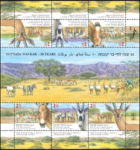
Snakes in Israel (Israel 2017)

From Israel Post. These stamps will be issued December 19, 2017. Larger image below.

Israel is home to many different reptile species thanks to its location at the meeting point of three different continents and the wealth of habitats it provides. Some 100 reptile species make their homes here, among them approximately 40 species of snakes, nine of which are venomous.

Snakes are an important component in ecological systems and in the food chain of predators and prey. They feed on arthropods, fish, fowl, small mammals and other reptiles, including snakes, each species according to its size and abilities. Snakes are preyed upon by birds, hedgehogs, mongooses and other animals.

Snakes also face other dangers – dwindling numbers of habitats, accidents with vehicles on the roads and agricultural equipment in the fields, as well as intentional harm by humans. All the snakes and other reptile species in Israel are protected by law and it is illegal to harm them. It is imperative that they are kept safe, as part of ensuring healthy ecological systems.

Schokari Sand Racer (Psammophis schokari)
Length: to 120 cm

This is a rear fanged snake, i.e. it has venomous back teeth. The venom is not injected by a quick bite but rather through a prolonged bite. Like the other sub venomous snakes found in Israel, the Schokari Sand Racer is not hazardous to humans. It is thin and fast and has a number of different attributes: in the northern and central areas of the country it most commonly has four dark lengthwise stripes against a brownish-yellow background whereas the snakes in the south have faded lengthwise stripes or none at all. There is a dark stripe along the sides of the head, beside the eyes. This is one of the only snake species in Israel that can be found throughout the entire country, from Mt. Hermon in the north to Eilat in the south. It is common in different habitats, climbs on shrubs, walls, etc. It feeds on a wide range of animals: arthropods, reptiles, birds and small rodents.

Large Whip Snake (Dolichophis jugularis)
Length: to 250 cm

The Large Whip Snake is not venomous. It is large and shiny and its appearance changes when it reaches maturity. When young, this snake is brown or grey with black and white spots. The mature snake (usually more than 120 cm in length) is completely black. In both instances, the shade of the lower jaw is lighter than the body. It feeds on different animals: reptiles, birds, rodents and more. These snakes are commonly found in agricultural areas, where their food supply is abundant, thus they are frequently killed by farming equipment. Found from Mt. Hermon in the north to the Beer Sheva area in the south.

Palestine Viper (Daboia palaestinae)
Length: to 135 cm

The Viper is venomous and the most dangerous to humans of all the snake species found in Israel, due to the potency and quantity of its venom, as well as its prevalence in inhabited areas. Its background color is yellowish, light brown or grey, with a lengthwise zigzag stripe that is brown with dark edges. Sometimes this stripe appears broken. There are additional spots on the sides of the body. This snake’s head is significantly wider than its neck and it has small scales. It is common in various habitats (including sand) in the Mediterranean region, from Mt. Hermon in the north to the Beer Sheva area in the south. It is prevalent around agricultural communities, where it is attracted to the rodents found in chicken coops, storerooms, cowsheds, etc. This Viper is responsible for the vast majority of cases in which humans are bitten in Israel. Hospitals have an antidote for its venom, which is given to the injured as needed.

Rules of Caution
In the field: high-top shoes are recommended; do not stick one’s hand into concealed places (day or night); shake out equipment and shoes after spending the night outdoors. In inhabited areas: avoid piles of pruned branches, scrap-iron, stones, etc. Keep the area clear of food scraps that attract rodents.

If You See a Snake
In the field: allow the snake to find its way by itself. Do not approach it or try to trap it. At home or in the yard: call a trained snake catcher. Keep children and animals away from the snake and try to keep it in sight until the catcher arrives. A list of licensed snake catchers is posted on the Israel Nature and Parks Authority website. Some local authorities also provide snake catching services.

First Aid in Case of Snakebite
What to do: calm the injured person, lie them down and take them to the hospital (even if he/she feels well). If the bite is on the arm or leg, it is possible to put a splint on the limb (like in the case of a fracture). Remove any rings, bracelets, watch, etc. from the injured person. If possible, take a photo of the snake.

What not to do: do not cut or burn or suck the bitten area. Do not block the blood vessels with a tourniquet. Do not put ice on the bite site, do not sterilize the spot with alcohol, do not let the injured person drink hot liquids or alcohol. Do not try to catch the snake. These guidelines do not replace medical consultation and treatment.

— Noam Kirshenbaum
Editor and Publisher, Nature in Israel

Ancient Roman Arenas (Israel 2017)

From Israel Post. These stamps will be issued December 19, 2017.

Entertainment and sporting events constituted a significant part of the cultural activity in ancient Rome. The city rulers, who coined the phrase “bread and circuses”, distributed free food and built arenas as a way to placate the masses. Roman soldiers and officials brought their customs to every corner of the vast empire and contributed to the dissemination of this culture among local populations. Thus, these arenas became an important part of the urban landscape in Eretz Israel during the Roman Period.

The most common arena was the semi-circular Theater, in which all seats faced the front stage. Every self-respecting city built a theater and overall more than 30 theaters of varying sizes were constructed in Eretz Israel. The theater was adopted from the Greeks who preceded the Roman Period. Dramas, comedies and tragedies were performed in the Greek theaters, but the audiences’ tastes changed and in the Roman Period most of the performances were pantomimes and social satire. Rabbi Abbahu, an amora (Jewish Talmudist) and head of a yeshiva who lived in Caesarea in the 4th century described a satire performance in which actors dressed as animals took the stage as part of a show that mocked Jewish customs. The Jerusalem Talmud features a description of the role of an actor in a pantomime who hires the services of female musicians and dancers, applauds them, dances and plays the cymbals before them.

The elliptic Amphitheater, in which the audience sat around a central stage, was built outside the city. This venue hosted bloody performances, mostly featuring battles between gladiators or men versus animals. The Amphitheater also served as a venue for executions, as those sentenced to death were pitted against wild animals or were forced to fight for their lives in hopeless battles. These brutal shows were well liked by the Romans but not by local residents. Only a few Amphitheaters were discovered in Eretz Israel and these were built in cities where Roman troops were posted, such as Beit She’an, Caesarea and Beit Guvrin. The Jewish Sages, who generally forbade watching these bloody shows, allowed it in unusual circumstances “because shouting saves”: customarily, the audience was given the right to decide whether to kill the warrior who lost the battle, and Jewish spectators could lend their voices against the killing and possibly even save the life of a Jew fighting in the ring.

The Hippodrome (hippos = horse) was also built outside the city and mainly served as a venue for chariot races. The seats were placed along the long sides of the arena. One end had a curved wall and the other had a straight wall where the chariot gates were located. A grand divider decorated with statues and columns was erected in the center of the arena, between the two tracks. The chariots rode around this divider repeatedly during the race. The winning chariot driver got to hold a palm spoon and Sages equated the waving if the lulav during the Sukkoth festival to victory before God.

The Jewish Sages rejected the foreign culture brought to Eretz Israel by the Romans and considered it to be a complete contradiction to Jewish culture. “One may go to synagogues and places of Torah study or one may go to theaters and circuses” (Bereishit Rabbah 67:4). However, the Sages were well aware of what occurred at those entertainment venues and used this reality to illustrate their views to their followers.

Description of the Stamps and Sheet Margins
The illustrations on the stamps, the sheet margins and the cancellation were inspired by mosaics from the Roman Period and by 18th and 19th century works of art describing that period (books, paintings, posters).

Tab illustrations: based on photos by Moshe Rimer (Caesarea); Carole Raddato (Beit Guvrin); Israeltourism (Beit She’an).

Cover: adaptation of a photo by Israeltourism.