Less than four months after American Philatelic Society executive director named Martin Miller as part of his “senior leadership team,” responsible for all “content” (editorial matters) at the USA’s largest stamp collecting organization, Miller has decided to leave, and a replacement has been named. The APS press release, with a correction to the number of years Kellner has been an APS member: It will be 47 years on January 1, 2019:
APS Welcomes New Leadership in Content Management
 Today the American Philatelic Society named Mark A. Kellner as Chief Content Officer replacing Martin Miller. Miller, who joined the APS staff in October 2017, will be taking a new position closer to his home in South Carolina.
Kellner, who recently became a Life Member of the APS, first joined the Society in 1972 and his collecting interests include United States, Great Britain, Guernsey, Jersey, the Isle of Man and Israel. After attending Boston University’s College of Communications, Kellner began a journalism career including philatelic and non-philatelic newspapers.
Mark was an enterprise reporter for the Deseret News in Salt Lake City, and a 24-year contributor and columnist to The Washington Times. He also wrote a tech column on handheld computing for the Los Angeles Times, and earlier was a reporter at the Times Leader in Wilkes- Barre, Pennsylvania.
“Mark’s career as a journalist, editor, and author remind us how diverse and talented the APS membership can be,” said APS Executive Director Scott English. “With the experience that Mark brings to the team, we will be able to bring exciting content to the APS membership both in print and online.”
Kellner’s career included serving as Editor-in-Chief for PC Portables, News and Industry Editor for MISWeek, editor of the Adventist News Network, and News Editor for Adventist Review and Adventist World magazines. He has also authored three books, including WordPerfect 3.5 for Macs for Dummies® and God on the Internet.
“It’s the privilege of a lifetime to serve the American Philatelic Society and its members,” Mark said. “I look forward to developing and enhancing content for the website and keeping The American Philatelist and Philatelic Literature Review at the top of the field.”
Kellner will join the APS staff on January 7, 2019.
About Mark
A Life Member of the American Philatelic Society who first joined nearly 47 years ago, Mark A. Kellner has collected stamps for many years. His interests include stamps from the United States, Great Britain, Guernsey, Jersey, the Isle of Man and Israel.
Mark began his journalism career by contributing a stamp column to the Queens Tribune in New York City, owned by another collector, Gary Ackerman, who later served 15 terms in the U.S. House of Representatives. He also wrote for Linn’s Stamp News and spent several years as Stamp Collector’s Washington, D.C., correspondent. During that time, he was the first to report plans by then-Postmaster General Anthony M. Frank to release a commemorative honoring Elvis Presley, which was released in January 1993.
Along with his philatelic writing, Mark’s been a newspaper reporter and columnist in New York City; Wilkes-Barre, Pennsylvania; Washington, D.C., Los Angeles, and Salt Lake City, Utah. His most notable connections were with The Washington Times, where he was a contributor for 24 years, and the Deseret News in Salt Lake City, where he was an enterprise reporter.
Mark also served as Editor-in-Chief of PC Portables magazine, as well as News and Industry Editor for MISWeek, and as a staff writer for Federal Computer Week, Government Computer News, and Unix Today. He’s the author of WordPerfect 3.5 for Macs for Dummies® and God on the Internet.
For 11 years, Mark served at the world headquarters of the Seventh-day Adventist Church in Silver Spring, Maryland, first as editor of the movement’s Adventist News Network news service and then as News Editor for Adventist Review and Adventist World magazines.
The Kellners currently reside in Salt Lake City, along with Jacques Kellner, Mark’s father, who introduced Mark to stamp collecting, a lifelong pursuit for both men.
“We do expect to move,” the New York City native tells The Virtual Stamp Club. His immediate predecessor, Martin Miller, spent one week a month working from home in South Carolina. Miller’s predecessor, Jay Bigalke, spent three weeks a month working from home and one in Bellefonte. Executive director Scott English has expressed a preference for someone working in-house full-time.


 February –
  2019 marks the bicentenaries of the birth of both Queen Victoria and Prince Albert. She is the second longest reigning monarch in British history. Six stamps will chart her life in period paintings, from childhood and marriage to Prince Albert, to marking her long reign.
 December 21st:
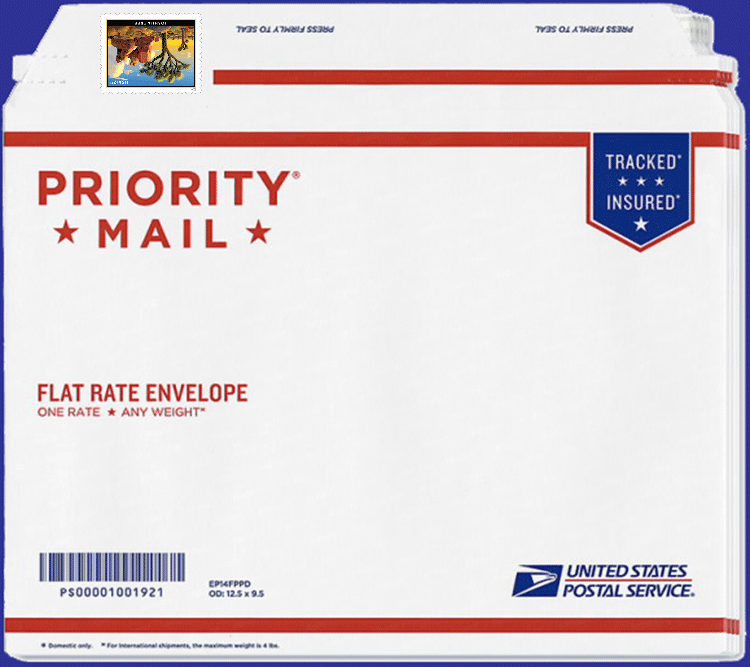 Celebrating the desolate beauty of the Joshua tree (Yucca brevifolia) and its distinct desert environment, this Priority Mail stamp depicts a common scene throughout much of the Mojave and Sonoran Deserts. Using the bold colors of the sun’s reflection off the trees, rocks, and other shrubby vegetation, artist Dan Cosgrove illuminates the desert scene in warm, golden hues. Art director Greg Breeding designed the stamp.
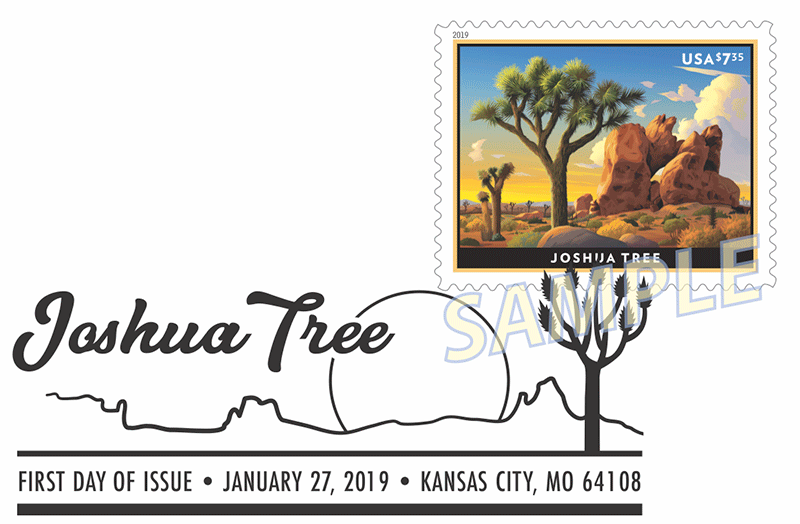 The B&W Pictorial measures 2.98″x1.21″.

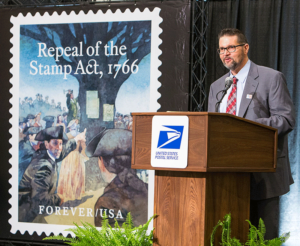 American Philatelic Society executive director Scott English has signed a contract renewal, through August 2021. (English is shown at right at a first-day ceremony in 2016.)
 5332 (50¢) Christmas – Head of Santa Claus
 A U.S. Treasury Department task force, ordered by President Trump, is proposing an overhaul to the U.S. Postal Service, including (and perhaps in particular) how it prices packages delivered by e-commerce companies like Amazon.
 Sustainable Path Forward, provides a series of recommendations to overhaul the United States Postal Service’s (USPS) business model in order to return it to sustainability without shifting additional costs to taxpayers.