U.S. Previews 2019 Stamp Program

Added December 1: We can expect a stamp on or about June 12th for President George H.W. Bush, who passed away this morning at the age of 94. He was born June 12, 1924, and U.S. custom is that former presidents are honored with a stamp on their first birthday after their death.

The Virtual Stamp Club’s 2019 U.S. stamp program grid can be found here.

[press release; click on the name of the issue to go to its individual page and a larger image]
Arts, Entertainment, History and Culture Headline the 2019 Forever Stamp Lineup
Love, Walt Whitman and State and County Fairs Among Other Subjects Featured

WASHINGTON — In the spirit of the coming new year, the U.S. Postal Service has revealed several of the new Forever stamps and other stamps to be issued in 2019.

Since 1847, the stamp program has celebrated the people, events and cultural milestones unique to the history of the United States. The 2019 stamp subjects continue this rich tradition.

“The miniature works of art illustrated in the 2019 stamp program offer something for everyone’s interest about American history and culture,” said U.S. Postal Service Stamp Services Executive Director Mary-Anne Penner (right). “From legendary poet Walt Whitman to the entertainment genius of Gregory Hines to the majestic beauty of our Wild and Scenic Rivers, this program is diverse and wide ranging and tells America’s story on stamps.”

Here’s a sneak peek:

Hearts Blossom
Hearts Blossom is the latest stamp in the Love series from the U.S. Postal Service. The stamp art features the word “Love” in cursive script below 12 colorful hearts meant to visually express love’s joyful, bountiful nature. The color palette — red, purple, orange and pink — is intended to create a happy and positive feeling. Art director Antonio Alcalá designed the stamp.

Year of the Boar
The Year of the Boar is the 12th and final stamp in the Celebrating Lunar New Year series. The Year of the Boar begins on Feb. 5, 2019, and ends on Jan. 24, 2020. The stamp art depicts several bright pink peach blossoms on a branch. Peach blossoms, which often bloom just in time for Lunar New Year, mark the beginning of spring in Chinese culture. Artist Kam Mak created this original painting. Art director and stamp designer Ethel Kessler incorporated elements from the previous series of Lunar New Year stamps — Clarence Lee’s cut-paper design of a boar and the Chinese character for “boar,” drawn in grass-style calligraphy by Lau Bun — to create continuity between the series.

Gregory Hines
The 42nd stamp in the Black Heritage series honors Gregory Hines (1946–2003), whose unique style of tap dancing injected new artistry and excitement into a traditional American form. A versatile performer who danced, acted and sang on Broadway, on television and in movies, Hines developed the entertainment traditions of tap into an art form for a younger generation and is credited with renewing interest in tap during the 1990s. Art director Derry Noyes designed the stamp, which features a 1988 photograph by Jack Mitchell.

Cactus Flowers
This issuance celebrates the beauty of cactus flowers with a booklet of 20 stamps. Each stamp depicts a photograph of the flower of one of these ten cacti: Opuntia engelmannii, Rebutia minuscula, Echinocereus dasyacanthus, Echinocereus poselgeri, Echinocereus coccineus, Pelecyphora aselliformis, Parodia microsperma, Echinocactus horizonthalonius, Thelocactus heterochromus and Parodia scopa. Within the booklet, each stamp design is featured twice. With new DNA studies, botanists sometimes reclassify plants. As of the printing of these stamps, the scientific names were accurate. Cacti also have common names, with some plants having several different names in popular use. Art director Ethel Kessler designed the stamps with existing photographs taken by John P. Schaefer.

Alabama Statehood
This stamp celebrates the bicentennial of Alabama statehood. Alabama became the 22nd state in the Union on Dec. 14, 1819. The stamp art is a photograph taken at sunset in Cheaha State Park. Alabama photographer Joe Miller took the picture from the park’s Pulpit Rock Trail. With Pulpit Rock in the foreground, most of the area in the valley below the overlook is part of the Talladega National Forest, which surrounds the state park. The name of the state and the year of statehood are included in the stamp art. The art director is William J. Gicker. Greg Breeding designed the stamp with Miller’s existing photograph.

Marvin Gaye
With this new stamp in the Music Icons series, the U.S. Postal Service honors Marvin Gaye (1939‚Äì1984) — the “Prince of Soul” — one of the most influential music performers of his generation. The stamp design features a portrait of Gaye inspired by historic photographs. The stamp pane is designed to resemble a vintage 45 rpm record sleeve. One side of the pane includes the stamps, brief text about Gaye’s legacy, and the image of a sliver of a record seeming to peek out the top of the sleeve. Another portrait of Gaye, also inspired by historic photographs, appears on the reverse along with the Music Icons series logo. Art director Derry Noyes designed the stamp pane with original art by Kadir Nelson.

USS Missouri
The Postal Service celebrates USS Missouri (BB-63), America’s last battleship, with the issuance of a commemorative stamp in 2019, coinciding with the 75th anniversary of Missouri’s commissioning on June 11, 1944. The stamp art depicts Missouri in the disruptive camouflage she wore from her commissioning until a refit in early 1945. Missouri earned numerous combat awards and citations during her decades of service, which include World War II, the Korean War and Operation Desert Storm. She played a momentous role when she hosted the ceremony marking Japan’s surrender and the end of World War II. Designed by art director Greg Breeding, the stamp features a digital illustration by Dan Cosgrove.

Post Office Murals
This pane of 10 stamps features five different murals designed to add a touch of beauty to Post Office walls and help boost the morale of Americans during the era of the Great Depression. On the stamp art, the town or city and state in which the work of art is located is printed underneath each mural. The murals included are: “Kiowas Moving Camp” (1936) Anadarko, Oklahoma; “Mountains and Yucca” (1937) Deming, New Mexico; “Antelope” (1939) Florence, Colorado; “Sugarloaf Mountain” (1940) Rockville, Maryland; and “Air Mail” (1941) Piggott, Arkansas. Art director Antonio Alcalá designed the stamps.

U.S. Flag
With this new 2019 stamp, the Postal Service celebrates the American flag, the most recognizable symbol of our nation. The stamp features a U.S. flag, one of several on the flagpoles near the end of Chicago’s Navy Pier, waving in a May breeze. The photograph was taken by art director Antonio Alcalá.

Wild and Scenic Rivers
This issuance celebrates Wild and Scenic Rivers — exceptional American streams that run freely through natural landscapes without man-made alterations. The pane of a dozen different designs features photographs that represent the more than 200 rivers or river segments designated within the Wild and Scenic Rivers System.

First row, left to right: Merced River (Michael Melford, photographer), Owyhee River (Michael Melford, photographer), Koyukuk River (Michael Melford, photographer)

Second row, left to right: Niobrara River (Michael Melford, photographer), Snake River (Tim Palmer, photographer), Flathead River (Tim Palmer, photographer)

Third row, left to right: Missouri River (Bob Wick, staff photographer for Bureau of Land Management), Skagit River (Tim Palmer, photographer), Deschutes River (Bob Wick, BLM, photographer)

Fourth row, left to right: Tlikakila River (Michael Melford, photographer), Ontonagon River (Tim Palmer, photographer), Clarion River (Bob Wick, BLM, photographer). Small type on the bottom of each stamp indicates the name of the river. Michael Melford’s photograph of the Merced River is featured again in the selvage. Art director Derry Noyes designed the pane using existing photographs.

Walt Whitman
With this stamp, the 32nd in the Literary Arts series, the Postal Service honors poet Walt Whitman (1819‚Äì1892) on the bicentennial of his birth. The stamp features a portrait of Whitman based on a photograph taken by Frank Pearsall in 1869. In the background, a hermit thrush sitting on the branch of a lilac bush recalls “When Lilacs Last in the Door-yard Bloom’d,” an elegy for President Abraham Lincoln written by Whitman soon after Lincoln’s assassination on April 14, 1865. Considered by many to be the father of modern American poetry, Whitman broke away from dominant European poetic forms and experimented with free verse and colloquial expressions, writing powerfully about nearly every aspect of 19th-century America. The artist for the stamp was Sam Weber. Art director Greg Breeding designed the stamp. The words “THREE OUNCE” on this stamp indicate its usage value. Like a Forever stamp, this stamp will always be valid for the rate printed on it.

Frogs
In 2019, the Postal Service issues Frogs, four new stamps in a booklet of 20, featuring digital illustrations of four North American frogs: the Pacific tree frog, the northern leopard frog, the American green tree frog and the squirrel tree frog. Working with a primarily green color palette and touches of brown, artist Nancy Stahl captured the essence of each animal with enough important defining features to make each recognizable. Art director William J. Gicker designed the stamps.

State and County Fairs
Four whimsical se-tenant stamps celebrate the fun of America’s state and county fairs. The stamps were designed to work together as a panorama of fair activities, while each stamp also works as an individual picture. The stamp on the far left shows farmers unloading produce behind a white fence. In the second stamp, a child holding a chicken sits atop the same fence, with carnival rides — a Ferris wheel and merry-go-round — in the background. Those rides can be seen in the third stamp, where some fairgoers admire the livestock behind the fence while others walk, balloons in hand, toward a sweets stand. The last stamp shows children at the stand buying treats from the vendor. The art director was Greg Breeding. Mike Ryan designed the stamps with original art by Mick Wiggins.

Woodstock
This stamp issuance celebrates the 50th anniversary of the Woodstock Music and Art Fair, held in the small farming community of Bethel, New York, in August 1969. It was the most famous rock fair in history and an expression of the youth counterculture of the 1960s. The stamp art, designed by art director Antonio Alcalá°, features the image of the dove from graphic artist Arnold Skolnick’s promotional 1969 poster for the fair along with some of the poster’s words: “3 Days of Peace and Music.” In the stamp art the words are stacked in the background in brilliant colors along with the year 1969, USA, and Forever (the value of the stamp). The white dove stands in the foreground.

Winter Berries
The Winter Berries booklet of 20 stamps celebrates four of winter’s small yet vibrant offerings: the winterberry (Ilex verticillate), the juniper berry (Juniperus communis), the beautyberry (Callicarpa Americana) and the soapberry (Sapindus Saponaria). The stamp art features highly detailed botanical portraits of each plant that highlight the bold colors and rich textures of their berries. Artist Steve Buchanan worked with art director Antonio Alcalá to create these four new stamps.

Joshua Tree
Celebrating the desolate beauty of the Joshua tree (Yucca brevifolia) and its distinct desert environment, this Priority Mail stamp depicts a common scene throughout much of the Mojave and Sonoran Deserts. Using the bold colors of the sun’s reflection off of the trees, rocks, and other shrubby vegetation, artist Dan Cosgrove illuminates the desert scene in warm, golden hues. Art director Greg Breeding designed the stamp.

Bethesda Fountain
With this Priority Mail Express stamp, the Postal Service commemorates the Bethesda Fountain, one of Central Park’s most iconic structures. Dedicated in 1873, the fountain is a gathering place beloved by New Yorkers and out-of-town visitors alike. The stamp art features a stylized depiction of the fountain. The illustration was first rendered as a pencil sketch and then scanned and finished digitally. Art director Greg Breeding designed the stamp with original art by Dan Cosgrove.

Coral Reefs
Four new postcard stamps celebrate the beauty and wonder of coral reefs. Each stamp depicts a type of stony coral, along with associated reef fish, in a highly stylized manner: elkhorn coral, shown with two French angelfish; brain coral, with a spotted moray eel; staghorn coral, with bluestriped grunts; pillar coral, with a coney grouper and neon gobies. Art director Ethel Kessler designed the stamps. Tyler Lang created the stamp art.

California Dogface
The California dogface graces the seventh non-machineable butterfly stamp for use on irregularly sized envelopes, such as square greeting cards, invitations or announcements. The stamp art was digitally created using images of preserved butterflies as a starting point. The result is a highly stylized, simplified image of a California dogface (Zerene eurydice) rather than an exact replica. Nationally known artist Tom Engeman created the stamp art. Art director Derry Noyes designed the stamp.

US Flag Stamped Envelope
A familiar sight on public buildings and private homes alike, the American flag has been portrayed in myriad ways on U.S. postage. This stamped envelope features a graphic design of the flag that evokes a rich sense of history even as it presents a recognizable icon in a fresh, contemporary way. Kit Hinrichs created the artwork for this stamped envelope. Ethel Kessler served as art director.

Postal Products
Customers may purchase stamps and other philatelic products through the Postal Store at usps.com/shop, by calling 800-STAMP24 (800-782-6724), by mail through USA Philatelic, or at Post Office locations nationwide. Forever stamps will always be equal in value to the current First-Class Mail 1-ounce price.

Information on ordering first-day-of-issue postmarks and covers is at usps.com/shop under “Collectors.” A video of the ceremony will be available on Facebook.com/usps.

The Postal Service receives no tax dollars for operating expenses and relies on the sale of postage, products and services to fund its operations.


February 17th: Comments are now closed for this page. Please go to the individual issue’s page to comment on that issue. You can go to those individual pages quickly by clicking on the issue name above.

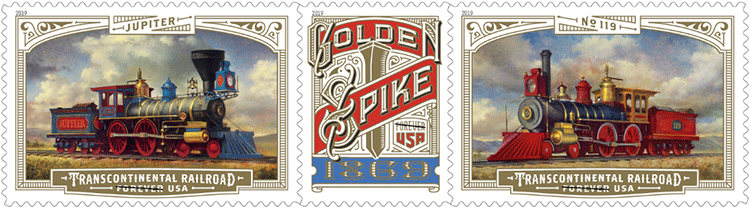
Subjects that were not on this initial list, but have since been announced, can be found on The Virtual Stamp Club‘s 2019 U.S. Stamp Program, such as Transcontinental Railroad or the expected Moon Landing anniversary. If you would like to discuss another subject that should be on the 2019 U.S. stamps, but so far hasn’t been announced, please ask the moderator to open a discussion.

U.S. Postal Rates Change In January

The U.S. Postal Service will raise many, but not all, of its rates on January 27, 2019. The Postal Regulatory Commission, an independent agency with oversight, approved the entire USPS proposal on November 13, 2018.

The price for mailing a letter will rise by 5 cents, to 55 cents for the first ounce. However, the price for additional ounces will go down, from 21 cents to 15, “so a 2-ounce stamped letter, such as a typical wedding invitation, will cost less to mail, decreasing from 71 cents to 70 cents,” the USPS said in its October 10th press release announcing its request.

There are two types of mail handled by the USPS: Market Dominant and Competitive. “Market Dominant” are services where the agency has a near-monopoly, such as delivering letters and advertising flyers. “Competitive” are services where the USPS is not the only supplier. Its competition includes companies like United Parcel Service, DHL and Federal Express.

Market Dominant increases, by law, must be no greater than the rate of inflation, which in the past 12 months was 2.5%. However, individual rates can rise more than that, so long as the average is at or below the Consumer Price Index.

The prices for Competitive products, on the other hand, must not be subsidized by the revenue from Market Dominant products; that is, as a group, Competitive products must pay their own way.

“The Commission found that the rates for both classes of mail meet all statutory requirements and may take effect, January 27, 2019, as planned,” said the PRC.

New Priority Mail and Express Mail stamps, as well as some definitives, will be issued, likely on the date the new rates go into effect, January 27, 2019. See our preview of the U.S. 2019 stamp program.

One major change, however, is in “First-Class Package Service—Retail,” which the USPS calls “a lightweight expedited offering used primarily by businesses for fulfillment purposes.” It includes tracking, at about half the cost of Priority Mail.

Right now, these packages are a flat rate of $3.50 for up to four ounces. After late January, the rate would range from $3.66 to $4.06 for up to four ounces, depending on distance. The service includes tracking.

To determine a domestic zone, use this tool on the USPS website. Choose the second tab, “Get Zone for ZIP Code Pair.”

Here are the basic Mailing Services or Market Dominant prices changes:

Product
Letters (1 oz.)
Letters additional ounces
Letters (metered 1 oz.)
International Letters (1 oz.)
Domestic Postcards
Current
50¢
21¢
47¢
$1.15
35¢
Proposed
55¢
15¢
50¢
$1.15
35¢

The domestic Priority Mail Retail Flat Rate price changes are:

Product
Small Flat Rate Box
Small Flat Rate Box
Large Flat Rate Box
APO/FPO Large Flat Rate Box
Regular Flat Rate Envelope
Legal Flat Rate Envelope
Padded Flat Rate Envelope
Current
$7.20
$13.65
$18.90
$17.40
$6.70
$7.00
$7.25
Proposed
$7.90
$14.35
$19.95
$18.45
$7.35
$7.65
$8.00

70th Birthday of Prince Charles (UK 2018)

[press release]
Royal Mail Issues Stamps To Commemorate 70th Birthday Of Hrh The Prince Of Wales

Issued: November 14, 2018

  • Six stamps show HRH The Prince of Wales undertaking official duties and with family members
  • Images include a new portrait of The Prince with HRH The Duke of Cambridge and HRH The Duke of Sussex in RAF uniform, taken at the recent RAF centenary commemorations
  • HRH The Prince of Wales is the eldest son of Her Majesty The Queen and the Heir to the Thrones of the United Kingdom and 15 other Commonwealth realms. He is also the future Head of the Commonwealth
  • Prince Charles Philip Arthur George was born on 14 November 1948, the first-born child of Princess Elizabeth and the Duke of Edinburgh
  • He became Heir Apparent and Duke of Cornwall aged three, following his mother’s accession to the Throne
  • The stamps are available now to pre-order from www.royalmail.com/princeofwales and go on general sale from Thursday 14 November by phone on 03457 641 641 and in 7,000 Post Offices throughout the UK

Royal Mail has announced the release of a set of stamps to commemorate the 70th birthday of HRH The Prince of Wales.

The stamps, contained within a special miniature sheet, depict The Prince undertaking official duties and with his family. One of the stamps includes a new portrait of The Prince with The Duke of Cambridge and The Duke of Sussex in RAF uniform, taken at the recent RAF centenary commemorations at Buckingham Palace. The Prince of Wales is Marshal of the Royal Air Force.

Other images show: a portrait of The Prince of Wales; an image of The Prince of Wales with The Duchess of Cornwall; The Prince of Wales and his sons at Cirencester Park Polo Club; The Prince of Wales at the Castle of Mey and The Prince of Wales greeting school children during a visit to Llancaiach Fawr Manor, in Wales.

The Prince of Wales is the eldest son of Her Majesty The Queen, the Heir to the Thrones of the United Kingdom and 15 other Commonwealth realms. He is also the future Head of the Commonwealth.

Prince Charles Philip Arthur George Windsor was born on 14 November 1948. Aged three, he became Heir Apparent and Duke of Cornwall following his mother’s accession to the Throne.

His investiture as Prince of Wales in 1969 was followed by a career in the Royal Navy until 1976 when he assumed full-time royal duties in support of The Queen. During that same year he started his first charity, The Prince’s Trust, with the help of £7,500 in Royal Navy severance pay.

Royal Mail spokesperson Philip Parker said, “Royal Mail is proud to release this six-stamp tribute to HRH The Prince of Wales, featuring delightful images of the Prince and his family.”

The stamps are available now at www.royalmail.com/princeofwales and on general sale by phone on 03457 641 641 and in 7,000 Post Offices throughout the UK.

Stamp By Stamp

  • Portrait of HRH The Prince of Wales (photo credit © Hugo Burnand)
  • HRH The Prince of Wales and HRH The Duchess of Cornwall (photo credit © Clarence House)
  • HRH The Prince of Wales with his sons, HRH The Duke of Cambridge and HRH The Duke of Sussex (photo credit © Chris Jackson/Getty Images)
  • HRH The Prince of Wales and his sons at Cirencester Park Polo Club (photo credit © Barry Batchelor/PA Archive/PA Images)
  • HRH The Prince of Wales at the Castle of Mey (photo credit © John Paul)
  • HRH The Prince of Wales greets school children during a visit to Llancaiach Fawr Manor (photo credit © Camera Press London)

Scott Catalogue Update – U.S. (November 2018)

5312 (50¢) John Lennon – red shoulders
5313 (50¢) John Lennon – red lilac shoulders
5314 (50¢) John Lennon – dark violet shoulders
5315 (50¢) John Lennon – blue shoulders
a. Vert. strip of 4, #5312-5315

5316 (50¢) First Responders

5317 (50¢) Birds in Winter – Black-capped chickadee
5318 (50¢) Birds in Winter – Northern cardinal
5319 (50¢) Birds in Winter – Red-bellied woodpecker
5320 (50¢) Birds in Winter – Blue jay
a. Block of 4, #5317-5320
b. Convertible booklet pane of 20, 5 each #5317-5320

5321 (50¢) Hot Wheels – Purple Passion
5322 (50¢) Hot Wheels – Rocket-Bye-Baby
5323 (50¢) Hot Wheels – Rigor Motor
5324 (50¢) Hot Wheels – Rodger Dodger
5325 (50¢) Hot Wheels – Mach Speeder
5326 (50¢) Hot Wheels – Twin Mill
5327 (50¢) Hot Wheels – Bone Shaker
5328 (50¢) Hot Wheels – HW40
5329 (50¢) Hot Wheels – Deora II
5330 (50¢) Hot Wheels – Sharkruiser

December Stamps (Netherlands 2018)

“Vintage with a dash of kitsch and glitter.” The following was translated using Google Translate and will be replaced by the official PostNL English translation when we get it.

The December stamps of PostNL were designed this year by Sanny van Loon. The illustrator from Amsterdam is known for the cheerful and colorful work that she makes for Flow Magazine. Her illustrations are also popular on Instagram.

Each stamp sheet contains 20 December stamps in ten different designs. Sanny’s specific style in the 10 illustrations is clearly recognizable with color areas and some line details. In her work so-called half-colors, which she constantly composes herself, play an important role. For the December stamps she combined golden yellow, warm red and Christmas green with ice blue.

More text to come.

Christmas 2018 (Britain 2018)

[press release]
Royal Mail Reveals 2018 Christmas Special Stamps

  • Six stamp designs celebrate one of the best-loved traditions of a UK Christmas – posting festive greetings to friends and family
  • The humble postbox takes centre stage on all the 2018 Christmas Special Stamps
  • Each postbox on the stamps features a cypher from the six Monarchs of the last one hundred years
  • Gloucestershire based artist, Andrew Davidson, illustrated the images; since 1982, he has worked on over 12 stamp issues for Royal Mail
  • Royal Mail’s Christmas stamps feature secular and religious imagery in alternate years
  • Christmas stamps of the Madonna and Child at the 1st and 2nd Class rates will also be available from Post Offices
  • Help Royal Mail’s postmen and women deliver this year’s festive mail by posting early this Christmas and using the postcode
  • The stamps are on sale from 1 November 2018. They will be available atwww.royalmail.com/christmas2018, by phone on 03457 641 641 and in 7,000 Post Offices across the UK

Royal Mail has revealed the images of its 2018 Christmas Special Stamps.

The six stamp designs celebrate one of the UK’s best-loved Christmas traditions – sending festive greetings in the post to friends and family far and wide.

Available in 1st Class, 2nd Class, Large letter and overseas values, the images on the stamps were illustrated byGloucestershire-based artist, Andrew Davidson.

Whilst creating the images, Andrew discovered, that, in just over one hundred years, there have been six Monarchs, as such, each of the postboxes on the stamps features a Monarch’s cypher.

The postboxes vary in design – from the early hexagonal ‘Penfold’ design of the 19th century to contemporary postboxes and ‘lamp’ boxes (those affixed to posts) – all still in use today.

Andrew said: “Knowing my illustrations on the 2018 Christmas stamps will be winging their way around the world delivering Season’s Greetings to friends and family, gives me a real sense of festive joy.”

Since 1982, Andrew has worked on over 12 stamp issues for Royal Mail.

As is usual, religious Christmas stamps of the Madonna and Child in 1st Class and 2nd Class rates will also be available from Post Offices.

Post Early for Christmas
Royal Mail is encouraging customers to post their festive greetings early, and order their online gifts and shopping well in advance, to help its postmen and women deliver the bumper festive mailbag.
UK latest recommended posting dates for Christmas 2018 are:

  • Tuesday 18 December for Second Class Mail
  • Thursday 20 December for First Class Mail
  • Saturday 22 December for Special Delivery

Further information is available at www.royalmail.com/greetings

Hotchner: Chicken Little is Wrong Again!

By John M. Hotchner

Stamp collecting is dead! So said the venerable New York Times on September 29, 2017, in an op-ed titled “Stamped Out” by Eugene L. Meyer. The sub-head said, “In the Internet age, philately has lost its once-worldly charms.”

In the April 2017 issue of American Stamp Dealer & Collector, the American Stamp Dealers Association magazine. I wrote a response to a similar voice of doom published in the Wall Street Journal. What I said then bears repeating now, what follows is an update of what I said in April 2017, under the heading, “A Waning Hobby? Not On Your Life!” I don’t as a matter of practice repeat columns or themes, but I’ll make an exception here as the column will be new to most readers:

What follows refers to an article in the May 31, 2016 issue of the Wall Street Journal titled “The Last Bastion of a Waning Hobby.” It talked about the author’s visit to the Champion Stamp Company, which he described as the last remaining street level stamp shop in New York City.

So the question for today is: “Is Stamp Collecting a Waning Hobby or Stamped Out?” My answer is that the hobby hit bottom some years ago, but I believe it is on the way back up. But it is coming back as a hobby nearly unrecognizable to those of us who began when stamp collecting was properly described as the King of Hobbies, and the Hobby of Kings.

In other words, it has evolved in a great many ways. Let’s look at some of the changes over the (can it be?) 70 years since I began to collect:

The “product” has changed. What used to be mostly needs-based issuance programs, worldwide, with mostly monocolor stamps, has turned into a multicolor, collector- and profits-driven enterprise to which postal administrations cater shamelessly. Today, thousands of stamps, souvenir sheets, varieties and more are issued that will never see the country from which they purport to come. And the only mail you will see them on is the rare first day cover that has actually gone through the post.

In addition, the subjects with heft — history, national symbols, founders and rulers, and the national points of pride in industry, science, etc. — now make up a much smaller percentage of what is issued. Instead we get birds and flowers, pets, pop culture, international themes that help to sell the product abroad, and other such pap.

What is collected has changed. In the good old days, we collected countries. Some of us even attempted the world. No more. Now it is topicals that rule; with specific time periods of countries rather than the entire country a close second. Covers, a collecting category barely thought about in the mid-20th Century, are now a major draw, and the more involved the collector, the more likely he or she is to include covers.

The demographics of the hobby have changed. It used to be that almost every grade school kid gave the hobby a try. Now, most kids are unfamiliar with stamps, have never been inside a post office, and the concept of writing a letter is as foreign as dialing a rotary telephone. For these reasons, the concept of stamps as a utilitarian product or as a point of pride in country has given way to stamps as art or as a reflection of another interest (e.g. space exploration),

The methods of commerce have changed. The village stamp shop has nearly disappeared. Dealers and sales sites on the Internet have taken their place, along with some continuing periodic bourses and annual stamp show events in and near larger towns and cities. Some dealers are no longer populating bourses at all, or as often; finding that they are doing just fine with an Internet presence. The computer is now an essential tool for collectors.

Even auctions, which continue to do well, have had to set higher minimums for lots in order to cover their catalogs’ production and other business costs; which have also driven up buyers’ and sellers’ commissions.

The need to join a club or society has decreased as the presence of personal computers (and iPads, iPhones and other such tools) has proliferated. So much information and so many resources are available to collectors for free on the Internet that collectors who have never experienced the benefits of receiving a philatelic publication in the mail, philatelic friendships in person, or trading relationships, don’t see the need to pay for being involved in the organized part of the hobby.

The economics of publishing have changed. It is no secret why memberships and subscriptions are down, and costs to subscribers are going up. Paper, printing, and mailing costs are all on the upswing, and have been for the last 20 years. So, the satisfying feeling of receiving and holding hard copy in your hands is rapidly disappearing as philatelic publishing migrates to the Internet. Many of us old timers are adapting, though with some angst; but it is a change that has both positive and negative aspects.

The concept of condition has changed. Because of modern technology, perfection of printing and centering is now not only possible, but expected. And today’s collector has chosen to apply the new standards to old stamps where perfection is seldom seen. This includes the rage for undisturbed gum that has never been sullied by a hinge, a positive mania for Very Fine-or-better centering, and looking down one’s nose at any cancellation that does not look like it was cancelled-to-order.

Stamp collecting no longer looks like an obvious choice for youth, or even millennials. In the ‘40s to ‘70s maybe even a majority of grade schoolers gave stamp collecting a try — even if only to squirrel away a few stamps; just because some of your friends or siblings were doing it; and because the Postal Service supported school stamp clubs. Today, hardly any of the kids you might be friends with are doing it. They are doing electronics, organized sports, hanging out at the mall, and God knows what else that provides much more immediate pleasurable feedback. For some time now, we have been raising generations of kids who want it all NOW. Stamp collecting gives pleasure, but it is mostly a source of delayed gratification as collectors painstakingly build something they can be proud of.

The cost of involvement has changed. Even if a collector is satisfied with average condition and used stamps (and leaving aside the increased number of issuances per year with ever higher face values), the cost of albums and yearly supplements, stock books, glassines, catalogues, and other collecting implements has soared. It can be moderated by making one’s own pages using computer software, but that makes collecting more difficult. Speaking of which…

…Getting started as a novice in collecting just isn’t as easy as it used to be. Several reasons have already been mentioned, but let’s add the high face value of normal postage stamps, let alone stamps for high-value services, which puts the yearly cost of collecting current mint stamps out of the reach of youth and even young marrieds looking for a hobby. Collect used stamps, and they can no longer be removed from the envelopes for which they paid postage — if you can find such envelopes, given that computer-vended postage, meters and other such electronic stamp substitutes have all but pushed real postage stamps out of the mail system. Add to this the fact that stamp collecting is a hobby best passed from one generation to the next one-on-one. How does that happen when today’s stamp collectors won’t go to a stamp club (most of which resemble a retirement community; though a vital one), an ever smaller percentage of the population is serious about collecting, and real live dealers are not available locally to serve as mentors.

The attitude toward stamps as a collectible at the entry level has changed. Collectors used to start collecting because it was fun. If one got serious enough about it later on, then some element of the investing mindset might become part of the equation. But for a long time now, we have been emphasizing the money side of everything to our kids, and they have gotten the message. Even if fun is part of the equation, a weather eye on what the collection will sell for at some future time is now an early consideration — and those who sell are not looking to get back some moderate percentage of their “investment,” they are looking for a profit! And they are bitterly disappointed when they don’t get it — if you believe the letters to the editor columns of the philatelic press.

If there is a common theme to what has been laid out above, it is the effects of the electronic age on both the hobby and on the minds of potential collectors. But there are other themes too; chief among them being the increasing costs of being a collector, the willingness of stamp producers to kill the goose that laid the golden egg by going for short-term profits instead of long-term growth of the base, and the changing nature of the hobby and what collectors want from it.

I said in the introduction that I think the hobby’s popularity has bottomed out and we are on an upswing. The Chicken Littles among us don’t see it, but I think it is true because I think that the hobby and most individual collectors are adapting. The negative influences of the computer and the Internet also have some positives. Information and answers to questions are much easier to get, as our hobby institutions (including the dealer community) adapt to the Internet world. I also think that if stamps are less appreciated as stamps, they are more appreciated as art, and as a reflection of the breadth of our world’s activities.

I think that if stamp collecting is less attractive to kids, it is and can be much more attractive than it used to be to adults in mid-life — if we take the trouble to promote it that way. Finally, I think that the high end of the hobby is just as satisfying as it used to be in terms of the joys of owning wonderful, scarce, and even expensive material. In this way, it is not unlike being a connoisseur of art, wine, rare books, coins or other collectibles.

My conclusion is this: As long as the collector gene is part of the make-up of human beings, the hobby will continue and prosper. It will be different from what we grew up with, and we who are part of it will need to adapt rather than quit in disgust. Our hobby will still need to be passed on to new collectors one-on-one, and each of us has a role in that task.

But it is anything but a “Waning Hobby” or “Stamped Out,” both of which imply that it is just south of extinction! Nothing could be further from the truth!


Should you wish to comment on this column, or have questions or ideas you would like to have explored in a future column, please write to John Hotchner, VSC Contributor, P.O. Box 1125, Falls Church, VA 22041-0125, or email, putting “VSC” in the subject line.

Or comment right here.

ATA Wins Philatelic Promotion Award

From the American Topical Association:
The American Topical Association has achieved 1st place in the 2018 CG International Philatelic Promotion Awards. The competition concluded at the International Stamp Fair Sindelfingen on 27 October 2018. It was conducted by Auction House Christoph Gärtner GmbH & Co. KG. The honor, consisting of stèle awards, certificates, and a cash prize, was presented for the best overall entry to promote philately. ATA’s entry included an issue of its journal Topical Time – edited by Wayne Youngblood – and its youth activity booklet The Magical World of Stamp Collecting – edited by Aimée Devine with contributions from MaryAnn Bowman. This is the first time the ATA has placed this high in the CG International Philatelic Promotion Award, having won second place in 2016. Your membership in ATA makes its participation in philatelic activities possible. Thank you for your membership support! Learn more about this award at here.

Christmas (Canada 2018)

Issue date: November 2nd.

From Details magazine:

The Secular Stamps:
This year, Canada Post continues its long tradition of Christmas stamps with a secular issue that’s designed to inspire plenty of warm thoughts. The three stamps – domestic, U.S. and international rates – display colourful folk-art inspired depictions of traditional cold-weather wear, the very items you’ll likely find under many trees this Christmas.

Did you know European settlers brought wool- producing sheep to North America, as early as the mid-17th century, to keep their families’ feet warm with knitted socks? Or that worsted caps worn by voyageurs are possibly the predecessor of what we now call toques? What about early Canadians who definitely warmed up with fur-lined mitts made of animal skin, a style that likely originated with the Inuit? In Canada, even dressing for the cold connects us with the past.

At this gift-giving time of year, Canada Post will deliver on the wish list of discerning collectors with a limited edition uncut production press sheet that features multiple booklets from this issue, along with booklets of the 2018 sacred Christmas stamp (page 10). Also included is a bonus pack of all four stamp booklets plus two Official First Day Covers and a souvenir sheet. Unlike uncut press sheets specifically designed as collectibles, the production press sheet is made up of actual booklets before they’re cut for sale. This Canada Post first is sure to make the season very merry and bright for collectors.


The religious stamp:
Few stories have inspired as many creative interpretations as the Nativity. For centuries, artists have used the methods and media of their time to express their vision of the birth of Christ.
This year’s stamp, designed by Montréal-based Paprika and illustrated by Daniel Robitaille, employs the simple but rich symbolism of traditional folk art to revitalize the essential elements: the Holy Family, their humble accommodations, the makeshift crib and the heralding star of Bethlehem. Imagery on the Official First Day Cover continues the story, showing the intrepid Magi following the star to seek the Infant King. Warm colours evoke a sense of family intimacy and peace that befit the season.

[press release]
Annual Christmas stamps mark the beginning of the festive season
Canadians can choose either sacred or secular themes for their holiday greetings.

OTTAWA – Nothing marks the beginning of the holiday season like the arrival of the first Christmas card or letter. That’s been so for a long time: Canada issued the world’s first Christmas stamp – bearing a map of the British Empire and the words “Xmas 1898,” and since 1964, Canadians have been treated to holiday-themed stamps every Christmas.

This year, holiday mailers can again choose stamps with a sacred or secular theme. The sacred PERMANENT™ domestic-rate stamp features a rendering of the Nativity that is inspired by folk art.

The secular stamps offer bright and colourful illustrations of knitwear – socks (PERMANENT domestic rate), a hat (US rate) and mitts (International rate) – that evoke the warm and cozy items traditionally found under many a Canadian Christmas tree.

Both stamp issues are designed by the firm Paprika (Montréal), illustrated by Daniel Robitaille and printed by Colour Innovations (Toronto).

In a philatelic first, Canada Post is making available a limited edition of 500 uncut production press sheets, which feature several of each of the stamp booklets. This collectible is packaged for gift-giving. It includes a bonus gift of both the sacred and secular booklets (four in all); a secular souvenir sheet; and two Official First Day Covers, which are cancelled in St. Joseph, Man., (sacred) and Cardigan, P.E.I. (secular).

Stamps are available online or at postal outlets throughout Canada. The uncut press sheet is available online only at canadapost.ca/shop.

Canada’s 2019 Stamp Programme

Canada Post has a preview (“sneak peak”) of its 2019 stamp programme in the latest issue of its Details philatelic catalogue:

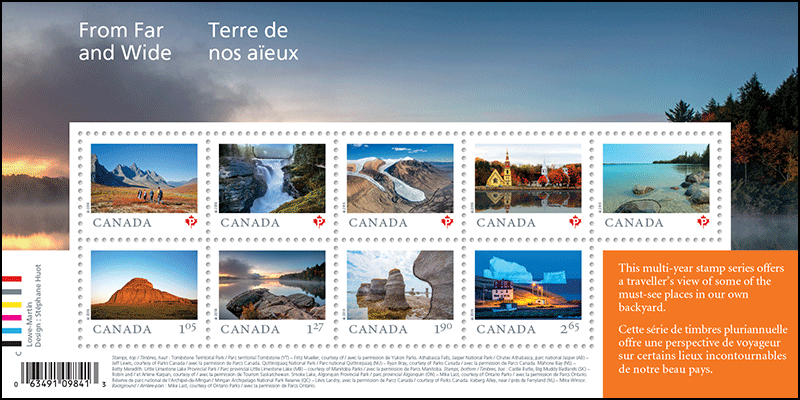
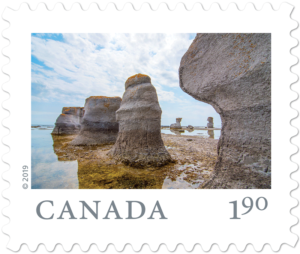
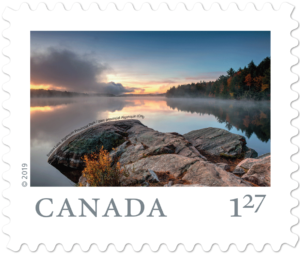
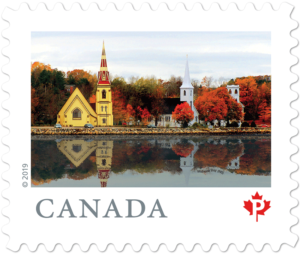
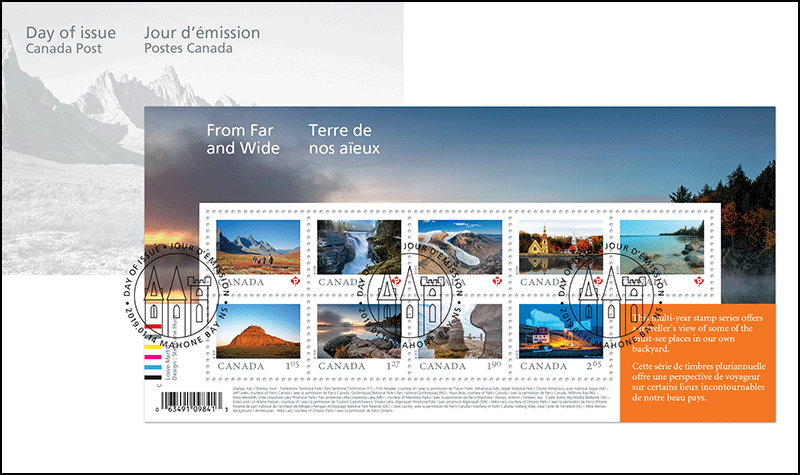
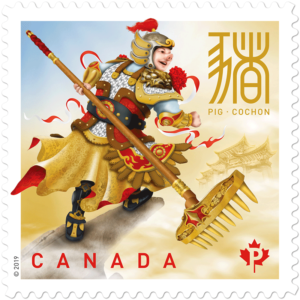
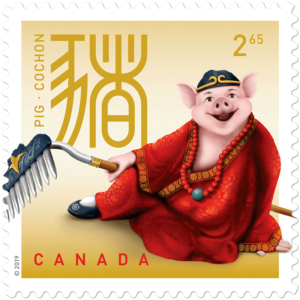
  • We’ll kick off 2019 with a new definitive of Her Majesty Queen Elizabeth II (January 14), more from the From Far and Wide series (January 14) and our Lunar New Year stamps welcoming the Year of the Pig (January 18).
  • In February, our Black History stamp salutes Albert Jackson, the first Black Canadian letter carrier. Gardenias bloom in our flower issue, and we pitch toward spring with a nod to the Vancouver Asahi baseball team.
  • Watch carefully as bears lumber across our stamps, and learn how Canadian ingenuity in aviation has made us soar.
  • We’ll bring back the past to relive the Red River Resistance, the founding of Manitoba and the legacy of historic covered bridges. Nature gets its due with stamps depicting endangered turtles, and some tasty Canadian desserts will whet your appetite.
  • As usual, the year ends with a semi-postal fundraising stamp for your generous donations that directly support the Canada Post Community Foundation, plus sacred and secular Christmas issues.
  • During the year, we’ll also release commemorative envelopes to mark the 150th anniversaries of the Fusiliers Mont-Royal, the Fusiliers du St-Laurent and the Princess Louise Fusiliers.