Updated September 23rd: Official FDCs, booklet pane, sheet illustrations at bottom of page.
Updated September 21st:
[press release]
Canada Post pays tribute to the masterful Leonard Cohen
Three stamps celebrate world-renowned songwriter and his work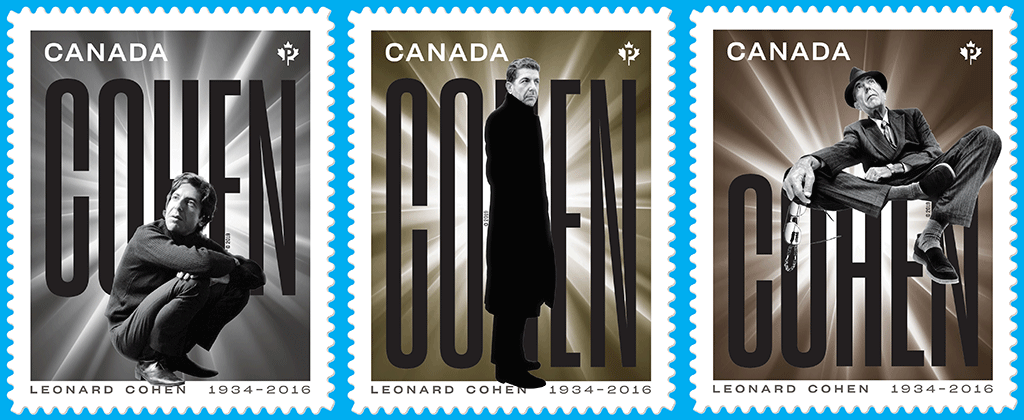 MONTRÉAL – Canada Post today unveiled three stamps honouring Leonard Cohen, whose songs over a five-decade career distilled the desire and pain of romantic love and
  explored the darkness and light of the human experience.
The stamps were unveiled in the city of his birth, as Cohen’s record label, Sony Music, announced the release of new music from Cohen and a forthcoming album release titled Thanks for the Dance.
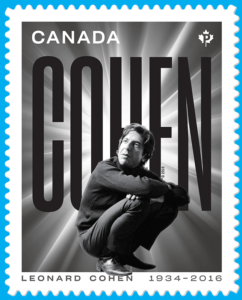
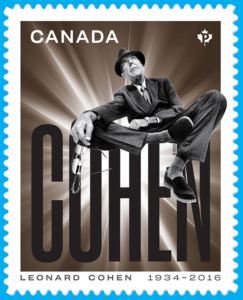
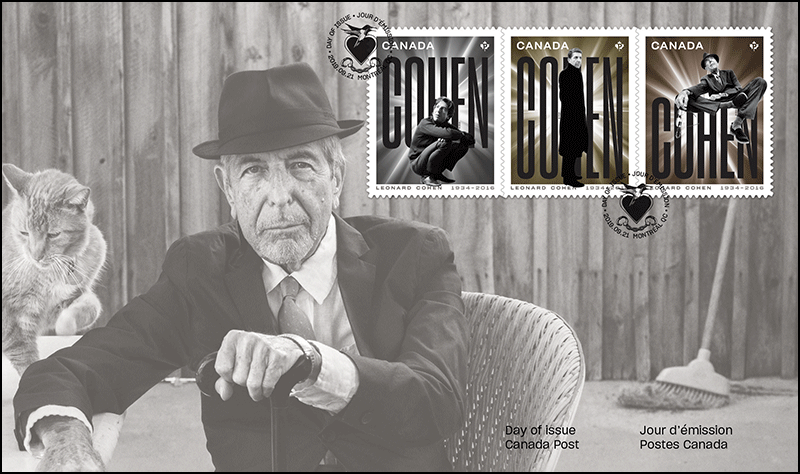
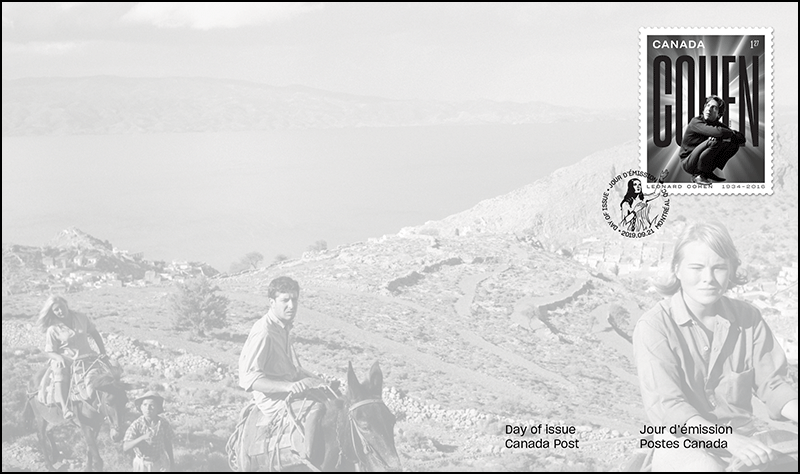
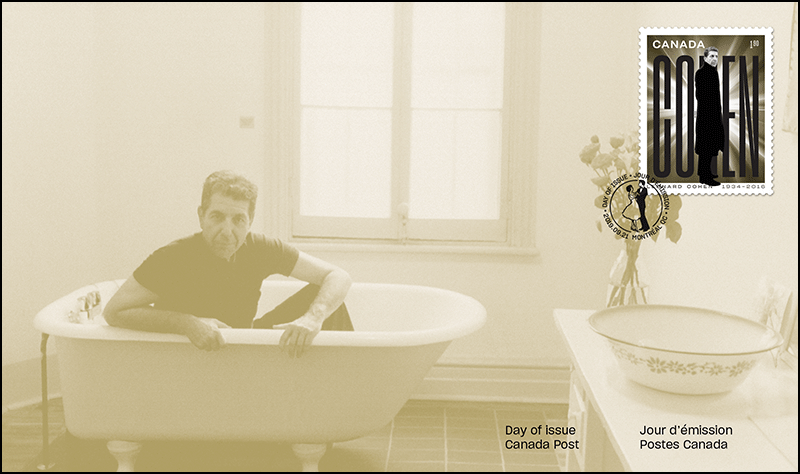
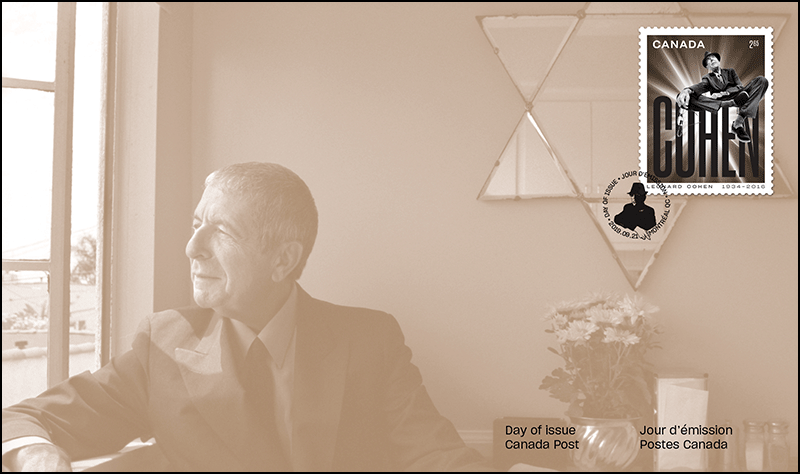
The stamps will be available tomorrow, September 21, on what would have been Cohen’s 85th birthday. The images on the stamps and the Official First Day Covers highlight three periods of this accomplished Canadian’s music career:
- his impressive debut in the 1960s, including two songs that became enduring favourites, “Suzanne” and “So Long, Marianne”;
- the resurgence of his popularity in the 1980s and the early 1990s, with his unforgettable and oft-covered “Hallelujah” (1984);
- and his performances on an 18-month world tour he undertook in his seventies, followed by a final burst of creative genius. A month after the October 2016 release of his critically acclaimed album You Want It Darker, Cohen died at 82. He was posthumously awarded the JUNO Award for Artist of the Year in 2017, as well as Album of the Year; the title track of You Want It Darker won the 2018 Grammy Award for Best Rock Performance.
Born on September 21, 1934, in Montréal, Cohen took an unlikely path into pop music. In 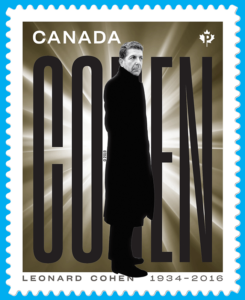 the mid-1960s, the income from writing four books of poetry and two novels left him struggling “to pay my grocery bill,” he once recalled. After returning to Canada from the Greek island where he’d lived for years, the self-taught guitarist discovered the folk music movement sweeping North America. He tried his hand at writing songs. He played some privately for singer Judy Collins, who loved them. A folk and pop star, she sang two of them on her next album, becoming one of the hundreds of artists who would record Cohen’s songs during his life. He released his first album, Songs of Leonard Cohen, in 1967.
After several albums, Cohen’s place in the pantheon of the world’s great songwriters was secure, and he was inducted into several music halls of fame. He earned a Governor General’s Performing Arts Award for Lifetime Artistic Achievement and a Grammy Lifetime Achievement Award.
A warm, spiritual and intellectual man, Cohen also had a self-deprecating sense of humour. When he died, countless singers, musicians and others publicly mourned his passing, expressing their respect for his work and their deep affection for him. Leading papers around the world published obituaries, reflecting his global stature.
 “Leonard was always deeply appreciative of his Canadian heritage, and would have been moved by this honour from Canada Post,” says Robert Kory, Cohen’s manager, estate trustee and friend.
“Canada Post is proud to pay tribute to this memorably gifted man whose words and music have touched Canadians and people around the world,” says Jessica McDonald, Chair of the Board of Directors, Canada Post.
The stamps were unveiled in the Glass Court at the Montréal Museum of Fine Arts, overlooking the Leonard Cohen mural that rises 21 storeys above Crescent Street.
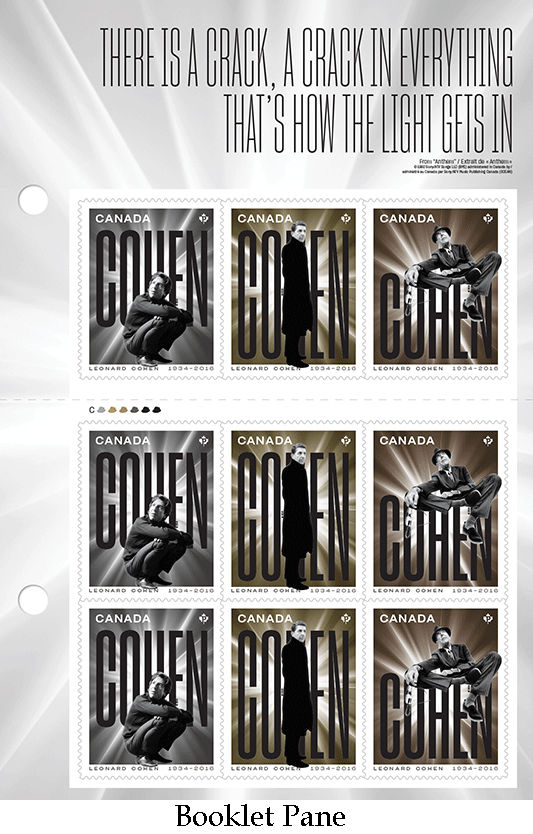
The Permanent domestic-rate stamps, designed by Paprika of Montréal, with photographs by Jack Robinson, Claude Gassian and Platon, and printed by Lowe Martin, are available in a book of nine, with three of each design. Other collectibles, including a four-pack of Official First Day Covers, a collectible pane and a folded uncut press sheet packaged in a simulated album cover and liner, are available at selected post offices or at www.canadapost.ca/shop.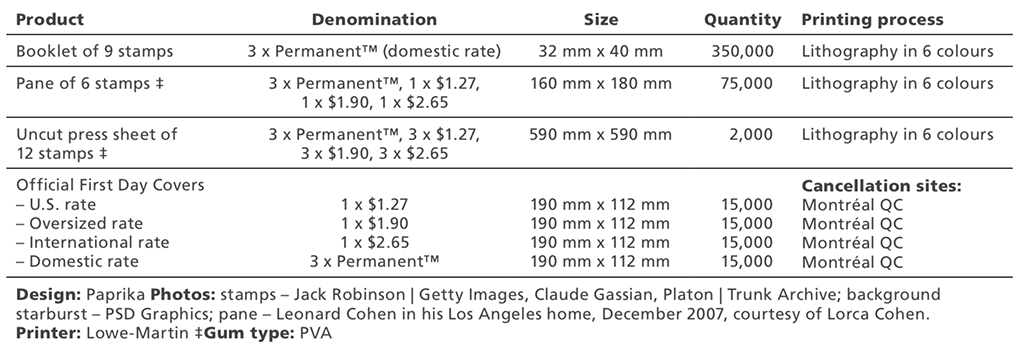
[en Francais]
Postes Canada rend hommage au grand Leonard Cohen
Trois timbres célèbrent l’auteur-compositeur de renommée mondiale et son œuvre
MONTRÉAL – Aujourd’hui, Postes Canada a dévoilé trois timbres en l’honneur de Leonard Cohen, dont les chansons, créées pendant une carrière qui a duré cinquante ans, parlent du désir et de la douleur que suscite l’amour romantique et explorent les revers sombre et heureux de l’expérience humaine.
Les timbres ont été dévoilés dans la ville natale de Leonard Cohen, alors que la maison de disques de l’artiste, Sony Music, a annoncé le lancement de nouvelles chansons et la parution prochaine d’un album intitulé Thanks for the Dance.
Les timbres seront en vente dès demain, le 21 septembre, date à laquelle l’artiste aurait eu 85 ans. Les motifs des timbres et des plis Premier Jour officiels illustrent trois périodes de la carrière musicale de ce Canadien accompli :
- Ses débuts impressionnants dans les années 1960 et deux chansons qui ont marqué à tout jamais l’histoire de la musique,Suzanne et So Long, Marianne;
- Son regain de popularité dans les années 1980 et au début des années 1990, quand il a écrit l’inoubliable et souvent reprise Hallelujah (1984);
- Ses spectacles dans le cadre d’une tournée mondiale de 18 mois qu’il a entreprise passé ses 70 ans, suivie des derniers élans de son génie créatif. Un mois après le lancement de l’album acclamé par la critique You Want It Darker, en octobre 2016, Leonard Cohen est décédé à l’âge de 82 ans. En 2017, il a reçu à titre posthume un prix JUNO pour l’artiste de l’année ainsi que pour l’album de l’année, et la chanson titre You Want It Darker a remporté le prix Grammy 2018 pour la meilleure performance rock.
Né le 21 septembre 1934 à Montréal, Leonard Cohen suit un parcours inusité vers la musique pop. Il aurait mentionné une fois que vers le milieu des années 1960, il avait peine à payer l’épicerie avec les revenus tirés de ses quatre recueils de poésie et de ses deux romans. Après de nombreuses années passées sur les îles grecques, ce guitariste autodidacte revient au Canada et découvre le vent de musique folk qui balaie l’Amérique du Nord. Il se met alors à écrire des chansons. Il en joue quelques-unes en privé à la chanteuse Judy Collins, qui les adore. Cette étoile de la musique folk et pop inclut par la suite deux de ces chansons dans son album, ce qui fait d’elle l’une des centaines d’artistes à avoir enregistré des chansons de Leonard Cohen en son vivant. L’artiste lance son premier album, Songs of Leonard Cohen, en 1967.
Après avoir lancé plusieurs albums, la place de Leonard Cohen dans le panthéon des auteurs-compositeurs les plus éminents dans le monde est assurée, et il est intronisé plusieurs fois. Il reçoit le Prix du Gouverneur général pour les arts du spectacle (PGGAS) de la réalisation artistique et un prix Grammy Lifetime Achievement.
De nature chaleureuse, spirituelle et intellectuelle, Leonard Cohen pratiquait aussi l’autodérision. Quand il est mort, d’innombrables chanteurs et musiciens ainsi que d’autres personnes ont publiquement pleuré son décès et exprimé leur affection profonde pour cet homme et leur respect pour son œuvre. Les plus grands journaux du monde publient sa nécrologie, ce qui témoigne de sa stature internationale.
« Leonard a toujours été fier de ses racines canadiennes et il aurait été touché par cet hommage que lui rend Postes Canada », affirme Robert Kory, gérant, exécuteur testamentaire et ami de l’artiste.
« Postes Canada est fière de saluer la mémoire de cet homme remarquablement doué dont les paroles et la musique ont touché les Canadiens et des gens de partout dans le monde », dit Jessica McDonald, présidente du Conseil d’administration de Postes Canada.
Les timbres ont été dévoilés au Musée des beaux-arts de Montréal, dans la verrière ayant vue sur la grande murale de 21 étages de Leonard Cohen qui surplombe la rue Crescent.
Les timbres Permanents au tarif du régime intérieur, conçus par la maison Paprika de Montréal, ornés des photographies de Jack Robinson, Claude Gassian et Platon, et imprimés par Lowe Martin, sont offerts en carnets de neuf vignettes, trois pour chaque motif. D’autres articles de collection, dont un jeu de quatre plis Premier jour officiels, un feuillet et une planche non coupée présentée dans un emballage imitant une couverture et une pochette d’album, sont offerts dans certains bureaux de poste et à www.postescanada.ca/achat.
Original announcement:
[press releases]
Canada Post to unveil stamp set honouring Leonard Cohen
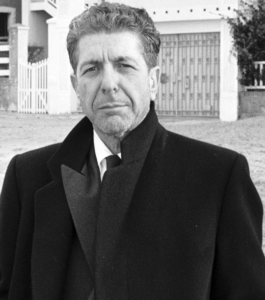 MONTRÉAL – Canada Post will unveil a stamp set honouring Leonard Cohen at the Montreal Museum of Fine Arts, overlooking the grand Cohen mural on Crescent Street, on Friday, September 20.
The stamps will be available to the public on September 21, on what would have been Cohen’s 85th birthday.
WHAT: Unveiling of a stamp set celebrating the life and work and Leonard Cohen
WHERE: Montreal Museum of Fine Arts, Glass Court
1380 Sherbrooke Street West
Montréal
WHEN: Friday, September 20, 5 pm
Postes Canada présentera un dévoilement de timbre rendant hommage à Leonard Cohen
 MONTRÉAL – Postes Canada tiendra le dévoilement de timbre rendant hommage à Leonard Cohen au Musée des beaux-arts de Montréal, dans la verrière ayant vue sur la grande murale de Leonard Cohen sur la rue Crescent, le vendredi 20 septembre.
Les timbres seront en vente dès le samedi 21 septembre, date à laquelle l’artiste aurait eu 85 ans.
QUOI: Dévoilement de timbre rendant hommage à Leonard Cohen
OÙ: Musée des beaux-arts de Montréal, la verrière
1380, rue Sherbrooke Ouest
Montréal
QUAND: Le vendredi 20 septembre à 17 h
Updated September 23rd: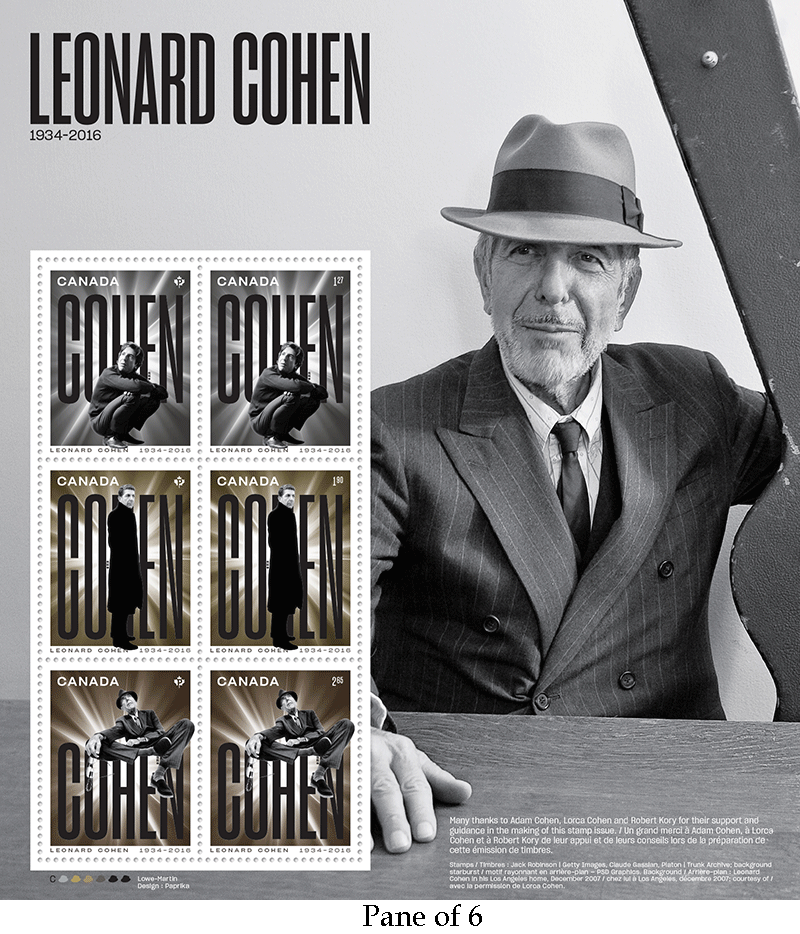

 “None Swifter Than These: 100 Years of Diplomatic Couriers” opens Sept. 14 at the Smithsonian’s National Postal Museum. Developed by the Diplomatic Security Service of the U.S. Department of State, the exhibition is on view through Jan. 26, 2020.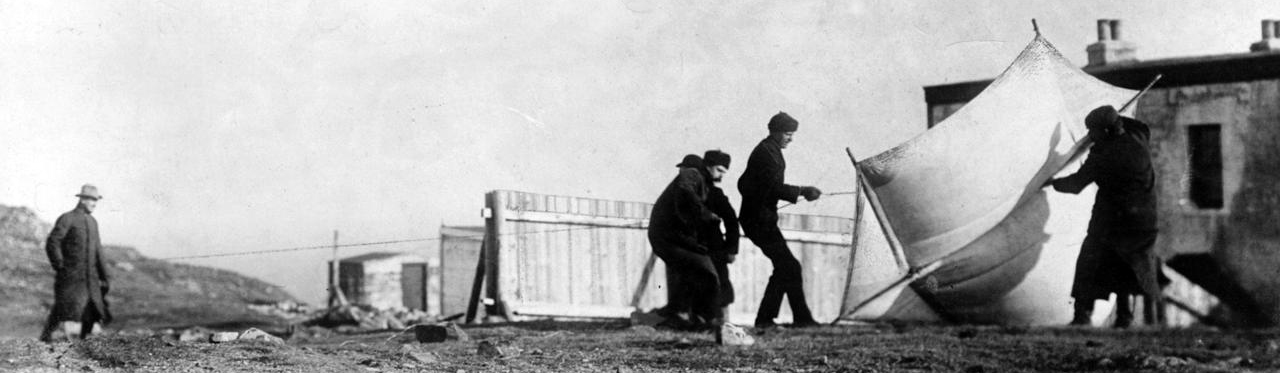



 be presented in two Miniature Sheets
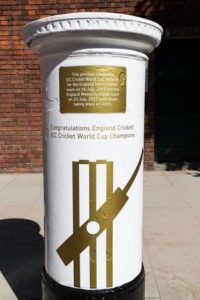
 host to the 2019 men’s and 2017 women’s tournaments. The paintwork will be in place for three months and will be complemented by a permanent gold plaque
 The men’s Miniature Sheet comprises four stamps; each capturing a moment of celebration following England’s thrilling World Cup Final victory against New Zealand at Lord’s Cricket Ground.
 Each sheet will include two 1st Class stamps, alongside two £1.60 value stamps and retail at £4.60. Fans can pre-order the stamps now; online at
  Royal Mail has also decorated 15 special edition postboxes at each venue used in the tournament to mark the historic achievement of both England teams. The first postbox painted was outside Lord’s Cricket Ground where both sold-out finals were held.
 Bristol County Ground – Bristol

 CHICAGO – Chicago Philatelic Society (CPS) will present its annual philatelic exhibition, CHICAGOPEX, Nov. 22, 23 and 24, 2019, at the
 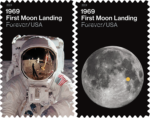 5399 Moon Landing – Astronaut
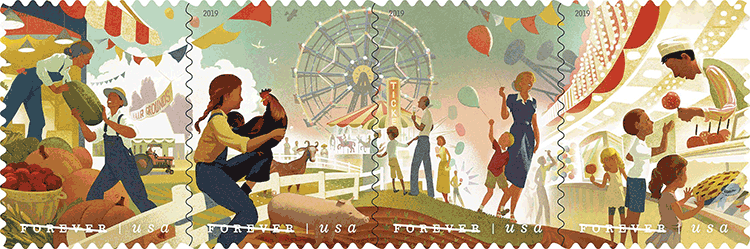 5401 Unloading Produce
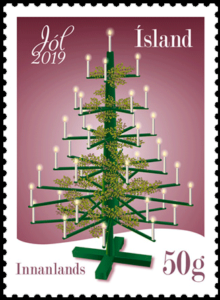 In a letter, Vilhjalmur Sigurdsson, Iceland Post’s Head of Philately, says the agency’s philatelic operations, PostPhil, will cease at the end of 2019, after about 90 years in operation.
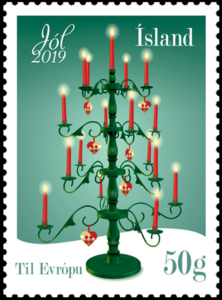 “The current management of Iceland Post Ltd., prefers if possible to stop issuing new stamps altogether,” Sigurdsson writes. “If the company must keep on issuing new stamps in 2020 and onward the number of new stamps will be very few each year and there will be no service for stamp collectors.” What stamp production remains may be handled by outside contractors.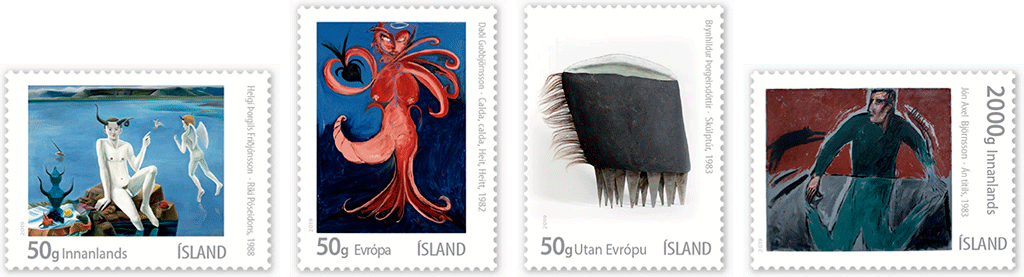
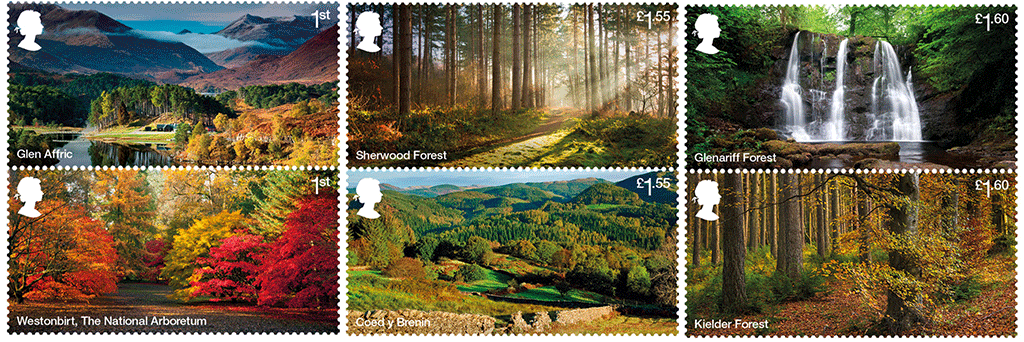
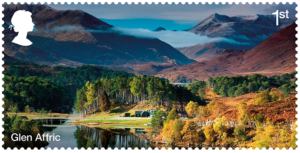 Glen Affric in Inverness-shire, is managed by Forestry and Land Scotland and is a fragment of the once extensive Caledonian Forest. Its rugged Scots pines and graceful birches are the signature trees in a landscape where forest, lochs, river and mountains combine to create the perfect Highland setting, which is breath-taking at any time of year but especially when the birches take on their golden apparel.
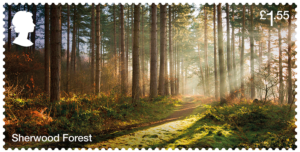 Sherwood Forest in Nottinghamshire is famous for its rich assemblage of ancient oak trees, such as the Major Oak. The atmospheric image on the stamp shows a fine stand of conifers in the early morning light, reflecting the mixed planting found across the whole forest.
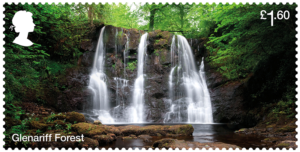 Managed by the Forest Service Northern Ireland, Glenariff Forest Park in County Antrim, boasts a beautiful mixture of views and trails that allow the visitor to enjoy a wide variety of walks and activities. Probably the most spectacular of these is the Waterfall Walk, a steep path up the vertical sides of the gorge and along elevated boardwalks taking in a succession of dramatic and world-famous waterfalls.
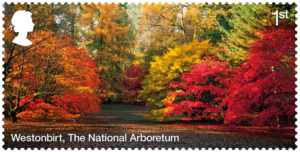 Westonbirt, The National Arboretum is the Forestry Commission’s flagship collection of trees in England. First created by the wealthy Holford family almost 200 years ago, it is one of the most beautiful and diverse botanical collections in the world. The 600-acre (243ha) site with 17 miles (27km) of paths showcases 3,000 tree species, including the Japanese maples seen on the stamp in autumnal colours.
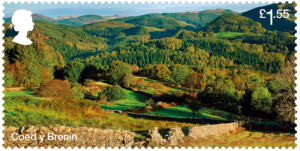 Located near Dolgellau in the Snowdonia National Park, Coed y Brenin is now one of the flagship forests of Natural Resources Wales. Commercial softwood forestry across some 7,650 acres (3,093ha) of Forest Park combines with recreational facilities for mountain-bikers and a network of spectacular scenic trails for hikers, based around the impressive visitor centre.
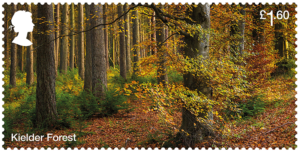 Kielder Forest in Northumberland is the largest human-made forest in Britain, stretching 250 square miles (647sq km); around 75 per cent is covered by trees. The Forestry Commission harvests around 500,000 cubic metres of timber here each year. The felled areas are replanted using a mixture of conifer and broadleaf trees, and parts are left open to create a diversity of habitats.
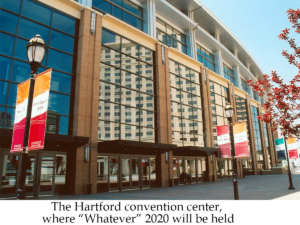 Beginning in Hartford 2020, the annual American Philatelic Society stamp convention will be a joint show with the American Topical Association and the American First Day Cover Society. In the past, the annual show has been called StampShow, StampShow / National Topical Stamp Show, StampShow/NTSS, and other variations on these themes. We need your helpful suggestions to create a new and permanent name for the yearly show.