Announced by the USPS on October 24, 2022.
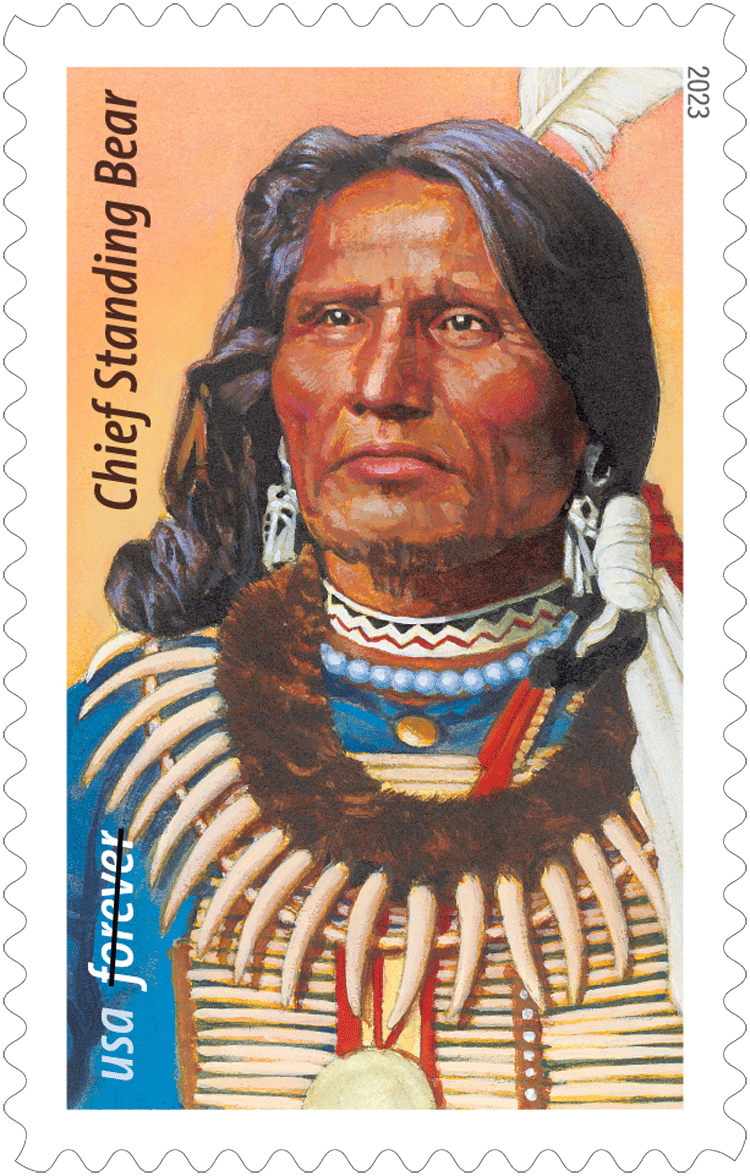 This stamp issuance honors Chief Standing Bear (ca. 1829-1908), who won a landmark court ruling in 1879 that determined that Native Americans were persons under the law with inherent rights to life, liberty and the pursuit of happiness. The stamp features a portrait of Chief Standing Bear by Thomas Blackshear II, based on a black-and-white photograph taken in 1877. The color of Standing Bear’s attire was based mainly on contemporary descriptions. Art director Derry Noyes designed the stamp.
New information will appear below the line, with the most recent at the top.
Updated July 1st:
The Scott catalogue number for this issue is 5798.
Updated April 7th from the Postal Bulletin:
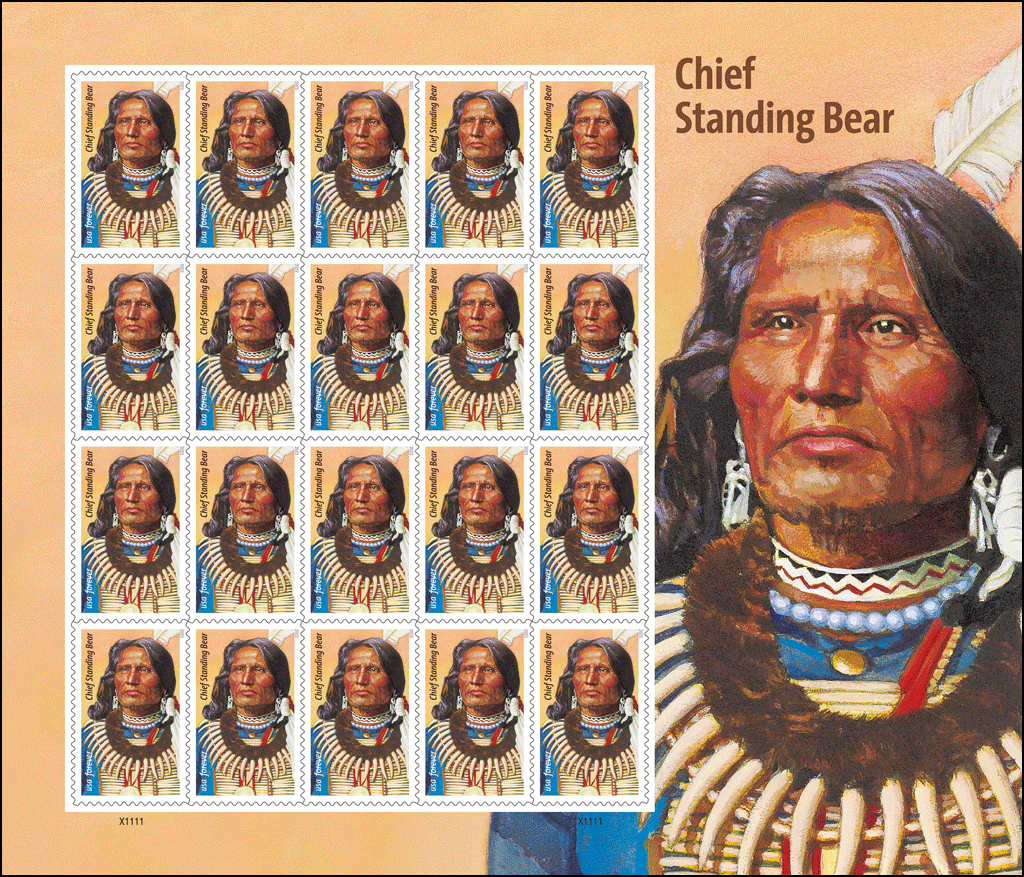
On May 12, 2023, in Lincoln, NE, the United States Postal Service® will issue the Chief Standing Bear stamp (Forever® priced at the First-Class Mail® rate) in one design, in a pressure-sensitive adhesive (PSA) pane of 20 stamps (Item 483700). This stamp will go on sale nationwide May 12, 2023, and must not be sold or canceled before the first-day-of-issue.
The Postal Service™ honors Chief Standing Bear (ca 1829–1908), who won a landmark court ruling that determined a Native American was a person under the law with an inherent right to life, liberty, and the pursuit of happiness. The stamp features a portrait of Chief Standing Bear by Thomas Blackshear II based on a black-and white-photograph taken in 1877. The color of Standing Bear’s attire was based mainly on contemporary descriptions. Art director Derry Noyes designed the stamp.
No automatic distribution.
How to Order the First-Day-of-Issue Postmark:
Customers have 120 days to obtain the first-day-of-issue postmark by mail. They may purchase new stamps at their local Post Office™ or at The Postal Store® website at store.usps.com/store/home. They must affix the stamps to envelopes of their choice, address the envelopes (to themselves or others), and place them in a larger envelope addressed to:
FDOI – Chief Standing Bear Stamp
USPS Stamp Fulfillment Services
8300 NE Underground Drive, Suite 300
Kansas City, MO 64144-9900
After applying the first-day-of-issue postmark, the Postal Service will return the envelopes through the mail. There is no charge for the postmark up to a quantity of 50. There is a 5-cent charge for each additional postmark over 50. All orders must be postmarked by September 12, 2023.
Technical Specifications:
Issue: Chief Standing Bear Stamp
Item Number: 483700
Denomination & Type of Issue: First-Class Mail Forever
Format: Pane of 20 (1 design)
Series: N/A
Issue Date & City: May 12, 2023, Lincoln, NE 68501
Art Director: Derry Noyes, Washington, DC
 Designer: Derry Noyes, Washington, DC
Artist: Thomas Blackshear II
Modeler: Ty Schroeder
Manufacturing Process: Offset, Microprint
Printer: Ashton Potter (USA) Ltd (APU)
Press Type: Muller A76
Stamps per Pane: 20
Print Quantity: 18,000,000 stamps
Paper Type: Nonphosphored Type III, Block Tagged
Adhesive Type: Pressure-sensitive
Colors: Black, Cyan, Magenta, Yellow, Pantone 4625C
Stamp Orientation: Vertical
Image Area (w x h): 0.84 x 1.42 in / 21.336 x 36.068 mm
Overall Size (w x h): 0.98 x 1.56 in / 24.892 x 39.624 mm
Full Pane Size (w x h): 8.5 x 7.24 in / 215.90 x 183.896 mm
Press Sheets Size (w x h): 22.09 x 25.87 in / 561.086 x 657.098 mm
Plate Size: 180 stamps per revolution
Plate Number: “P” followed by five (5) single digits in two corners
Marginal Markings:
Front: Header: Chief Standing Bear • Plate number in bottom 2 corners
Back: ©2022 USPS • USPS logo • Two barcodes (483700) • Plate position diagram (9) • Promotional text
Updated April 6th:
Here are the first-day postmarks for this issue: 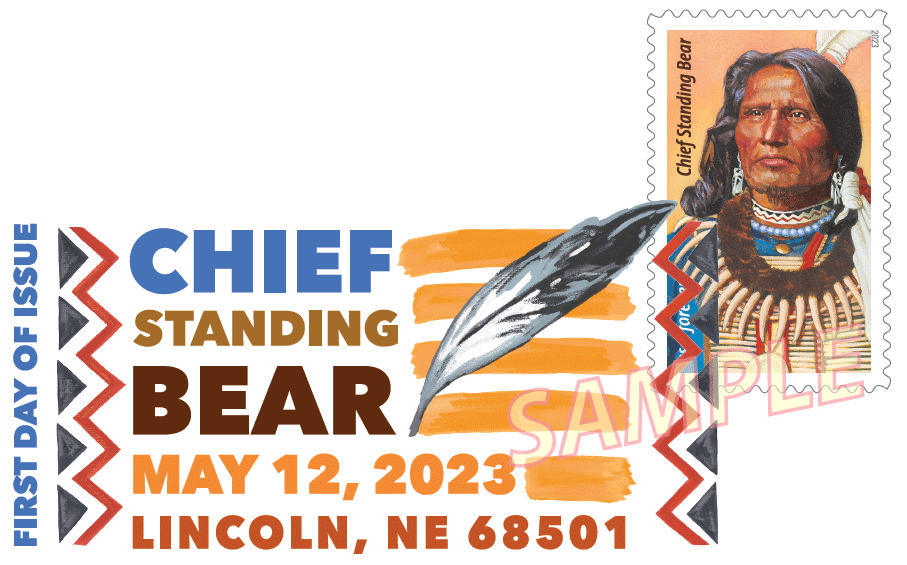 The Digital Color Postmark measures 2.92″ x 1.45″
 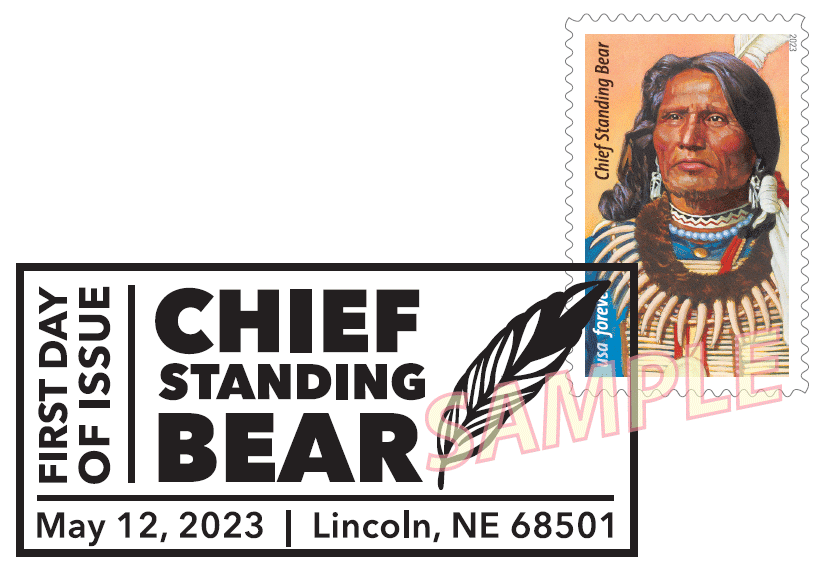 The pictorial postmark measures 2.58″ x 1.21″
Here is what the full pane of 20 will look like: Updated January 10th:
This stamp will be issued Friday, May 12, in Lincoln, NE. There is a statue of the Chief on the Centennial Mall in Lincoln. In 1879, he won a court case establishing that Native Americans were people and entitled to civil rights. The City of Lincoln’s website and Wikipedia have more. The Chief Standing Bear (project) website is something of a disappointment.