Typically Dutch: Flower Fields

[from PostNL’s press release] [click on any of the pictures for larger versions]
Typically Dutch – Flower Fields

Date of issue: 20 March 2023
Appearance: sheet of six stamps in six identical designs
Item number: 430361
Design: Adam Lane and Edwin van Praet, Total Design, Amsterdam

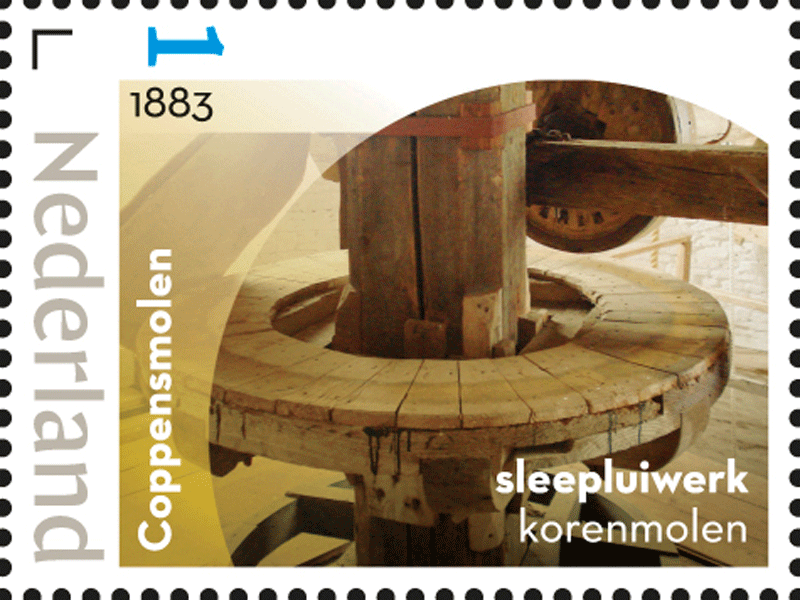
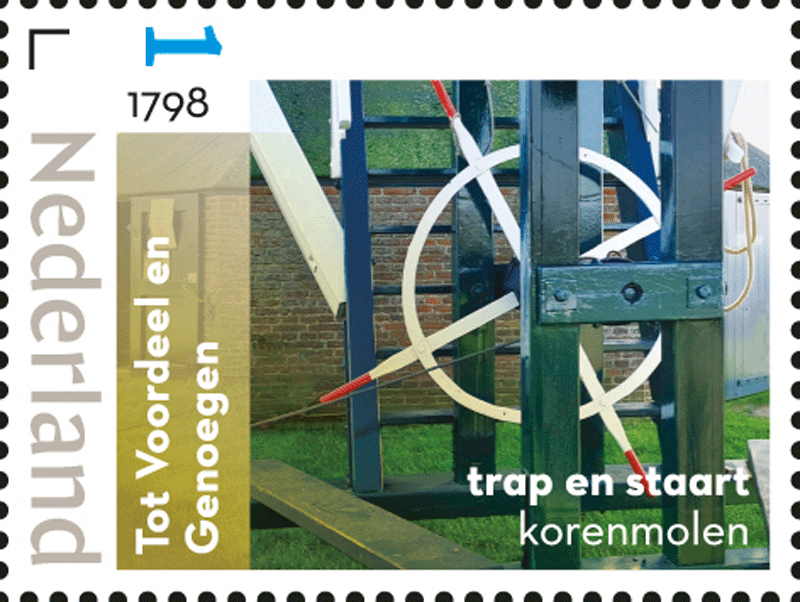
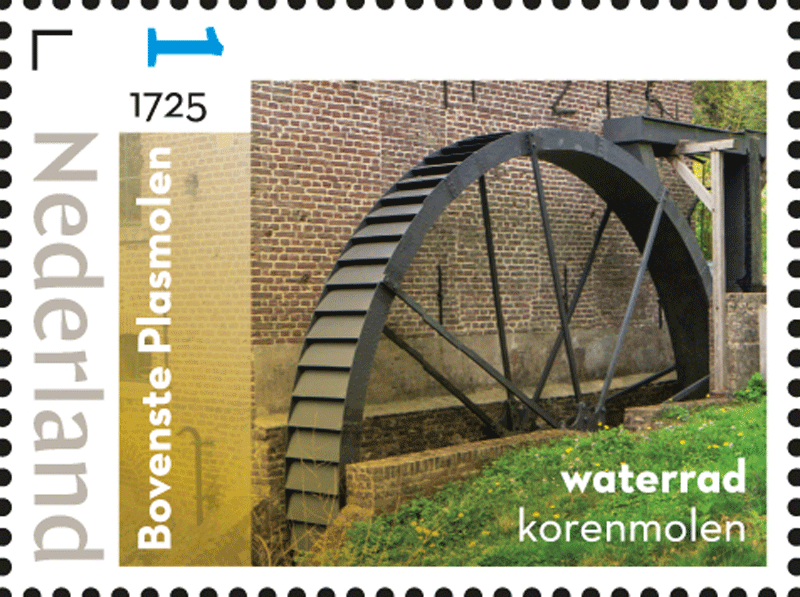
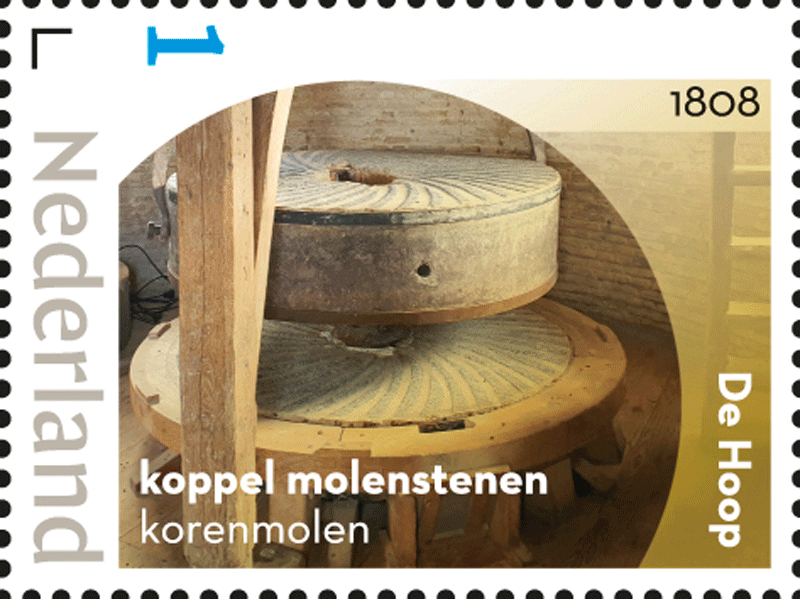
On 20 March 2023, PostNL will publish the Typically Dutch – Flower Fields stamp sheet. This issue is the third in the Typically Dutch series this year. The multi-annual series started in 2020 and, in 2023, will be dedicated to a variety of sights and attractions that are significant for and typical of the Netherlands. The six identical postage stamps will be marked ‘Nederland 1’, the denomination for items weighing up to 20g destined for the Netherlands. A sheet of ten stamps costs €6.06. The Typically Dutch – Flower Fields issue was designed by senior graphic designer Adam Lane and creative director Edwin van Praet from Total Design in Amsterdam. As part of this stamp series, stamps featuring museums (2 January) and mills (13 February) were published earlier this year. Stamps featuring cheese markets (15 May) and the wadden mud flats (14 August) will follow later this year.

The first flower fields were created between Leiden and Haarlem on geest lands at around 1850. Geest land soil consists of sand mixed with clay or peat, a type of soil that proved very suitable for growing flower bulbs. Such bulb fields can also be found elsewhere in the Netherlands, including in northern Noord-Holland, near Venlo, on Texel, in north-western Friesland, in the Noordoost Polder and on the Zeeland and Zuid-Holland islands. The flowering of the fields annually attracts around 2 million tourists. After the crocuses in February, tulips, daffodils and hyacinths bloom from March to May. In late summer, gladioli, dahlias, carnations and asters take over for the next colourful period.

Flowers may be lovely, but really, cultivation is all about the bulbs themselves multiplying underground.

The floriculture of flowers and plants is an important economic sector in our country, with an export value of €7.3 billion in 2021. The Netherlands also plays an important role in the trade of flowers grown elsewhere. 52 percent of the world trade in cut flowers, both home grown and imported from other countries, passes through Dutch hands. The FloraHolland cooperation is the world’s largest flower auction, handling over 90 per cent of Dutch trade. The history of Dutch flower culture dates back to the 16th century, when the tulip first arrived in the Netherlands. The famous flower originated in the Ottoman Empire (present-day Turkey) and was first planted by Carolus Clusius in the hortus botanicus in Leiden. Its name, tulip, also comes from the East. Ottoman sultans wore the flower on their turban – dūlbend in Persian – which is what the word tulip is derived from, meaning white tulip.

Design: The Typically Dutch – Flower Fields stamp sheet features colourful illustrations of stylised tulips. Each stamp features three tulips side by side. The stem and leaves of the tulip on the left and right continue on the stamp below. The iconic shapes of the tulips are grouped in a tight pattern across the stamps. The pattern is interrupted on the sheet edge. The background of the stamp sheet and stamps is a soft shade of green. The other colours match the background: purple, yellow and pink for the tulips’ flowers, dark green for the stem and leaves. Along the bottom of each stamp runs a white strip containing the sorting hook, the year 2023, the country (Nederland) and the denomination (1). The logo for the Typically Dutch series is printed above each stamp, with a folded Dutch banner on the left and right. The Typically Dutch logo appears once more on the top edge of the sheet, while the right edge features a short explanatory text. The title of this issue on flower fields in the Netherlands is printed in dark green on the sheet border between the large pictorial logo at the top of the stamp sheet and the stamps.

The choice of the tulip as the flower on the stamps of Typically Dutch – Flower Fields was pretty obvious, stamp designer Edwin van Praet believes. ‘It is a typically Dutch flower. In fact, you won’t find a flower that’s more Dutch than the tulip. Moreover, it is pretty easy to turn the tulip into an iconic shape. Tulips are at their most beautiful when you see them outside together. I often travel along the geest lands by rail, from The Hague to Amsterdam and back. In spring, you can admire the flower fields with their gorgeous colours through the train window. You really get the best views from the train.’

The other stamp designer, Adam Lane, has also got to know the Dutch flower fields. ‘I cycled there once, from Amsterdam to Lisse. In England, where I come from, flowers are a lot less important than they are here. And when you see flowers in England, they usually come from the Netherlands. For the design of the flower field stamps, I used the simplest geometric tulip shape. It is the art of leaving things out – the balance between slightly too much and too little detail. When you put multiple tulip shapes in a pattern, they become easily recognisable. It also helps that the colours remind you of a bouquet. Or rather, of a field full of flowers.’

The Typically Dutch – tulips stamps are available while stocks last at the post office counter in Bruna shops and through the webshop. The stamps can also be ordered by phone from the Collect Club customer service on telephone number +31 (0)88 868 99 00. The validity period is indefinite.

Technical Details:

Stamp size: 40 x 30mm:
Sheet size: 122 x 170mm
Paper: normal with phosphor print
Gum: gummed
Printing technique: offset
Printing colours: cyan, magenta, yellow and black
Print run: 75,000 sheets
Appearance: sheet of 6 stamps in 6 identical designs
Design: Adam Lane and Edwin van Praet, Total Design, Amsterdam
Printer: Cartor Security Printers, Meaucé-La Loupe, France
Item number: 430361

China Society Backs Boston 2026 Show

[press release] [click on any of the pictures for larger versions]
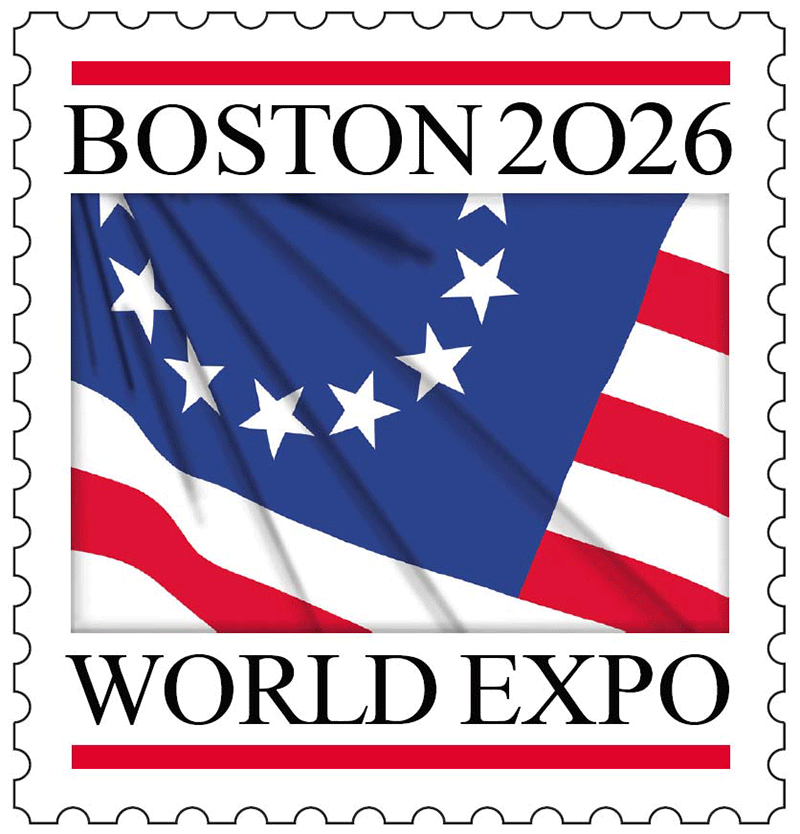
China Stamp Society Joins Boston 2026

Boston 2026 World Expo is pleased to announce that another major society will be participating in the international exposition.

China Stamp SocietyThe China Stamp Society plans on holding its annual convention and additional seminars for those interested in philately of the region according to H. James Maxwell, show liaison and editor of the group’s award winning bi-monthly publication, “The China Clipper.”

Formed in 1936 the CSS is the world’s largest English-speaking philatelic society specializing in China and related regions, including Hong Kong, Macau, Manchukuo, Tibet, Shanghai and the Treaty Ports, Foreign Offices in China and the Japanese Occupation of China. It is the oldest affiliate of the American Philatelic Society. Their web site is at chinastampsociety.org.

President of Boston 2026 Yamil Kouri and Executive Director Mark Butterline both welcomed the news. “We are happy organizations continue to choose our exhibition as their society’s destination of choice for meetings and conventions. An additional thanks to those, including the CSS, that are able to financially support us as well,” said Kouri.

Philatelic groups from around the world are encouraged to contact Mark Schwartz, Boston 2026 Society Chair, as soon as possible by email at Mark.Schwartz@Boston2026.org to make their show interests known, whether it be for a society table or meeting space.

Boston 2026 World Expo takes place May 23-30, 2026, at the Boston Convention & Exhibition Center. Full show details may be found at boston2026.org and on Twitter and Facebook.

Current U.S. Postal Rates (as of July 2023)

These are the current basic rates, as of July 9, 2023:

Product
Letters (1 oz.)
Additional ounces
Letters (metered 1 oz.)
Domestic Postcards
International Postcards
International Letter (1 oz.)
Priority Mail Express Flat Rate Envelope
Priority Mail Flat Rate Envelope
Large Envelopes (flats) (1 oz.)
Ground Advantage, starts at
Prices
66¢
24¢
63¢
51¢
$1.50
$1.50
$28.75
$9.65
$1.35
$4.75


Scott Catalogue U.S. Update (March 2023)

5745 (60¢) Love – Kitten and Heart
a. Imperforate
5746 (60¢) Love – Puppy and Heart
a. Imperforate
b. Horiz. or vert. pair, #5745-5746
c. Imperforate horiz. or vert. pair, #5745a-5746a

5747 (48¢) Two Sailboats, serpentine die cut 11¼x11
5748 (48¢) One Sailboat, serpentine die cut 11¼x11
a. Horiz. or vert. pair, #5747-5748
5749 (48¢) One Sailboat coil stamp, serpentine die cut 9½ vert.
5750 (48¢) Two Sailboats coil stamp, serpentine die cut 9½ vert.
a. Pair, #5749-5750

5751 $9.65 Florida Everglades
5752 $28.75 Great Smoky Mountains

5753 (63¢) Ernest J. Gaines

Flying Scotsman (UK 2023)

[press release] [click on any of the pictures for larger versions]
Royal Mail Marks Flying Scotsman’s Centenary with a Set of Special Stamps
The Final Set Of Special Stamps Featuring Her Late Majesty Queen Elizabeth’s Silhouette

  • Steam locomotive Flying Scotsman celebrates its 100th anniversary in 2023
  • The 12-stamp set features the National Railway Museum’s Flying Scotsman in various locations across the UK:
    • Pickering Station on the North Yorkshire Moors Railway
    • In the Yorkshire Dales National Park
    • Crossing the Ribblehead Viaduct in the Yorkshire Dales National Park
    • Steaming through the town of Blyth in Northumberland
    • In a blizzard at Heap Bridge on the East Lancashire Railway
    • Crossing the Royal Border Bridge at Berwick-upon-Tweed
    • At London’s Victoria Station
    • In close-up at Shildon, County Durham
  • A further four stamps presented in a miniature sheet show images of Flying Scotsman and London North Eastern Railway (LNER) poster artwork from the 1920s and 1930s
  • These will be the final Special Stamps to feature Her Late Majesty Queen Elizabeth’s silhouette
  • The stamps are available to pre-order now at www.royalmail.com/flyingscotsman and by telephone on 03457 641 641
  • All 12 stamps in a Presentation Pack go on general sale from 9 March and are priced at £17.70

Royal Mail and the National Railway Museum are marking the 100th anniversary of steam locomotive Flying Scotsman with a set of 12 Special Stamps.

The images feature Flying Scotsman in various locations across the UK:

  • Pickering Station on the North Yorkshire Moors Railway
  • The ‘Christmas Dalesman’ steam special in the Yorkshire Dales National Park
  • The ‘Cathedrals Express’ crossing the Ribblehead Viaduct in the Yorkshire Dales National Park
  • Steaming through the town of Blyth in Northumberland
  • In a blizzard at Heap Bridge on the East Lancashire Railway
  • The ‘Cathedrals Express’ excursion crossing the Royal Border Bridge at Berwick-upon-Tweed
  • At London’s Victoria Station
  • In close-up at Locomotion in Shildon, County Durham

A further four stamps presented in a miniature sheet feature images of Flying Scotsman and London North Eastern Railway (LNER) poster artwork from the 1920s and 1930s.

  • ‘Scotland by the Night Scotsman’ poster, artwork by Robert Bartlett, 1932
  • ‘LNER train service to and from Scotland’ advertisement, designed by HL Oakley, 1923
  • ‘Edinburgh: Mons Meg’ poster, artwork by Frank Newbould, 1935
  • ‘Refuelling the Flying Scotsman’ poster, artwork by Frank Newbould, 1932

David Gold, Director of External Affairs & Policy, Royal Mail, said: “Flying Scotsman is a national treasure of engineering and design that conjures up the golden age of steam travel. This remarkable locomotive epitomises the romance of rail travel and is loved all by people over the world. We are honoured to mark this landmark milestone with a set of Special Stamps.”

Royal Mail worked closely with Bob Gwynne, Associate Curator at the National Railway Museum, (part of the Science Museum Group), to select the images featured on the stamps that were chosen from amongst hundreds of period photographs.

About Flying Scotsman:
The steam locomotive Flying Scotsman left the LNER’s Doncaster Works in February 1923.

It was named the following year after the principal express which ran between London and Edinburgh. In 1928, it hauled the first regular non-stop service from London to Edinburgh.

Built as an ‘A1’ class engine with a boiler pressure of 180psi (pounds per square inch), it was rebuilt in 1947 as an ‘A3’, with a higher boiler pressure of 220psi.

The engine ushered in an era of big locomotives, and its long history of operation has included several ‘firsts’, such as being the first steam locomotive to achieve a speed of 100mph (161kmh).

Over a 40-year career on British rails, Flying Scotsman travelled over two million miles (3.2 million km) and became the first steam locomotive to reach a speed of 100mph (161kmh).

After Flying Scotsman’s retirement from scheduled service in 1963, it was bought by businessman Alan Pegler and given a1920s LNER livery and the number 4472. Pegler was ambitious, and in 1969 he took his loco on a ‘Buy British’ tour of the United States. The journey attracted big crowds, and over several years the engine steamed from Texas to Canada and then over the Rockies to San Francisco, garnering publicity but losing Pegler his fortune.

The locomotive was rescued from an uncertain fate by British millionaire Sir William McAlpine, who returned it to the UK in 1973, determined that this national treasure would never again be threatened with exile. In 1988, Flying Scotsman went to Australia for the country’s bicentenary and visited Sydney, Melbourne, Alice Springs and Perth. The tour ‘down under’ was a triumph, with the return journey via Cape Horn ensuring another ‘first’: the locomotive had circumnavigated the globe.

Since 2004, Flying Scotsman has been part of the collection of the National Railway Museum in York, following a global public campaign to save the engine for the nation. As the oldest operating steam locomotive on the main line, it remains a potent symbol of the steam age and an inspiration to many.

Her Late Majesty Queen Elizabeth’s silhouette:
Flying Scotsman’s stamp issue will be the last to feature the silhouette of Her Late Majesty Queen Elizabeth.

The silhouette has been in constant use on Special Stamps since 1968 (55 years).

The first version of Queen Elizabeth’s silhouette to appear on Special Stamps was adapted from a 1953 design by sculptor and medallist, Mary Gillick, used on coinage from 1953 to 1967. It was first used on the Landscapes stamp issue in May 1966.

Stamp illustrator, David Gentleman, re-worked the Gillick Head silhouette. The updated design was first used on the British Bridges issue in 1968 and has remained in use until today.

The only occasion on which the silhouette has not featured on a Special Stamp is when an actual image of The Queen was used in the design of the stamp.

Future Special Stamps will feature a silhouette of His Majesty King Charles III.

The stamps are available to pre-order now at www.royalmail.com/flyingscotsman and by telephone on 03457 641 641. A Presentation Pack including all 12 stamps in the set is available on general sale from 16 February and priced at £17.70.

VSC adds:

There are 32 philatelic products available for this issue, including three different first day covers, each available with one of two postmarks (Doncaster and Tallents House). The third cover above is a “Prestige FDC.” There is also a set of postcards:
Thematic Exhibiting Workshop March 4 & 11

[press release]
ATA Offers Thematic Exhibiting Creativity Workshop, March 4 and 11

The American Topical Association will offer a two-session workshop titled Thematic Exhibiting: Connecting Through Creativity on consecutive Saturdays, March 4 and 11, beginning at 4 p.m. Eastern Time via Zoom.

This how-to workshop on developing the thematic exhibiting storyline through creativity is taught by exhibiting multi-award winner Dr. Jean Wang.

In the first workshop session, Wang will show examples from her Blood: A Modern Medicine exhibit to demonstrate how thematic exhibitors can use creativity and draw on all branches of philately to illustrate a non-philatelic story. After the first session, participants may send a scan of a potential exhibit item for her review and comment. Participants also have the option to outline a point they want to make in their non-philatelic story to garner Wang’s advice on exhibit items to seek.

Session number two provides discussion, sharing and brainstorming opportunities for participants based on details from the first session. This high-engagement workshop will maximize participants’ planning options by capitalizing on live interaction with Wang.

Dr. Jean Wang is a hematologist and leukemia researcher in Toronto, Canada. She has received 19 awards and myriad accolades for her thematic exhibiting, including Grand Awards for her Blood exhibit in CANPEX 2019 and ORAPEX 2022. Wang’s philatelic expertise includes receiving Royal Philatelic Society of Canada’s Long-time Contribution Award. She is a member of the Canada Post Stamp Advisory Committee.

The workshop series costs $25 for ATA members and $45 for non-members. If non-member participants choose to join ATA at the time they register for the workshop, the cost for both the workshop and annual membership is $60 for US residents and $70 for international residents, which are discounted rates. Registration is quick and easy on the ATA website. For more information and to register for the workshop, go to the ATA website [direct link].

AFDCS Zoom Feb. 26: GW Bicentennial

[press release] [click on any of the pictures for larger versions]
GW Bicententennial FDCs Zoom Talk on February 26

The next American First Day Cover Society educational Zoom presentation will be held on Sunday February 26, 2023 at 8PM EST/7PM CST/6PM MST/5PM PST. Tricia Richmond will provide a presentation on first day covers and event covers of the 1932 US George Washington Bicentennial issue.The presentation is free to all. AFDCS membership is not required.

Here is the Zoom information for the presentation:
Click here for the link

Meeting ID: 856 4348 9109
Passcode: 215959

Tricia Richmond produces McIntosh Cachets along with her daughter Darcy. Tricia is a member of the Fred C. Sawyer North Texas Chapter and the Art Cover Exchange.

APS Offers Cancellations Course in Cleveland

[press release] [click on any of the pictures for larger versions]
GASS ’23 Pre-Show Learning Event – All About Cancellations

The APS is again hosting a pre-show learning event prior to the Great American Stamp Show ’23 in Cleveland, Ohio: “All About Cancellations”

Date: Wednesday, August 9th, 8:00 a.m. – 5:00 p.m. (lunch on own)

Instructor: Gary Wayne Loew

Location: Westin Downtown Cleveland, OH

Cost: $50 APS member / $100 non-members

Registration Deadline: July 21, 2023

Whether you are a postal historian or a marcophilist, postal cancellations are central to the understanding of the postal artifacts that we collect. This course is designed to provide you with a very thorough background about cancellations. Collectors of every country and every specialization will want to attend this in-depth course.

The course is limited to ONLY 30 PARTICIPANTS so register now!

The course will include three major topics:

    • Classification & Categorization Systems
    • Types of devices
    • Uses

The presentation materials will be profusely illustrated with cover examples of each topic.

While primary emphasis will be on U.S. and British Empire materials, worldwide examples will broaden your understanding of philately from every continent. You will return home with a robust package of course materials to give you a firm foundation for additional personal research.

About the Instructor
Gary Wayne Loew is a philatelic researcher and postal historian. He is the retired APS Director of Expertizing and Editor-in-Chief of The American Philatelist and the Philatelic Literature Review. He is also the author of over 80 philatelic articles and book reviews. His two-volume book, Fundamentals of Postal History, is scheduled for publication in early 2026. Gary has lectured widely on many topics about postal history. His proudest philatelic accomplishments include the numerous roles he has played in digitizing journals for the USPCS, USSS, and the complete run of the U.S. Postal Bulletin. An APS life member, he is a member of over thirty philatelic societies and clubs.

Great American Stamp Show 2023 Update (February)

A few updates on Great American Stamp Show 2023, which will include the American First Day Cover Society’s Americover 2023:

  • The show hotel block is 72% booked. A sellout appears likely; don’t dawdle! At $139 a night (show rate), you’re not likely to do much better in downtown Cleveland.
  • Function tickets (banquets, etc.) are now on sale on the website.
  • A pre-show learning course has been scheduled: “All About Cancellations,” taught by Gary Loew, on Wednesday, August 9th. Click here for more information. The course is limited to 30 participants.

More information on the show: here

Radio: Forever Fakes

The Stamp Collecting Report
A radio feature by Lloyd de Vries

Download or listen to this report as an MP3 sound file.

Too good to be true.

The Stamp Collecting Report, I’m Lloyd de Vries.

You may have seen the ads on Facebook: One hundred Forever flag stamps for half the 55 dollars you’d pay at the post office. If you click on the link, you’ll go to a website with the Postal Service name at the top.

The red flags should go up right away. First, a hundred stamps now will cost you 63 dollars, not 55. The actual web address isn’t U-S-P-S-dot-com. And the Postal Service never sells its stamps to ANYONE at a discount.

If you get anything at all for your money, they will be counterfeits — fake stamps. They’re missing certain markers and the printing is bad. In the past, the Postal Service would return your mail to you because it didn’t have enough postage. Now, the agency wants permission to just throw away mail with counterfeit stamps. You won’t know your bill payment wasn’t delivered until you get the shutoff notice.

And that’s NOT stamp collecting. I’m Lloyd de Vries of The Virtual Stamp Club.


The Stamp Collecting Report began in 1997 as a 60-second weekly feature distributed to CBS Radio Network stations by CBS News as part of its Weekend Feature Package. Eventually, longer versions were recorded for this website and a Christian evangelical shortwave service. The Report ended its CBS run in 2017 with only six repeats in some 1,040 weeks. It is now produced solely for The Virtual Stamp Club on an occasional basis.

Go to Report Index • Return to Virtual Stamp Club Home Page