This stamp will be issued October 23rd in New York City at the ASDA National Postage Stamp Show 2014. The design and subject have not been announced.
Linn’s Stamp News reports these will be available in a pane of 10.
This stamp will be issued October 23rd in New York City at the ASDA National Postage Stamp Show 2014. The design and subject have not been announced.
Linn’s Stamp News reports these will be available in a pane of 10.
This multi-stamp issue is now confirmed, probably to be issued in August in Washington, D.C. (The June 26th Postal Bulletin confirms August 7th in Washington.)
From the USPS May 30th:
Fruits, vegetables, cheeses, flowers, and other fresh products invitingly displayed on tables or bins — farmers markets invite us to share America’s agricultural bounty.
Four se-tenant stamps depict a table laden with typical farmers-market fare. The stamp on the far left has among its products various fresh breads such as baguettes and rolls, cinnamon buns, cookies, artisan cheeses, and both brown and white eggs. The produce on the second stamp includes vegetables and fruits: apples, eggplants, watermelons, peppers, grapes, potatoes, broccoli, and gourds. Cut flowers adorn the next stamp, with bouquets of bright flowers next to a bucket of sunflowers and a collection of celosia. The final stamp on the far right features live plants, with various herbs, tomatoes, and flowers like marigolds and nasturtiums. Most items bear handwritten labels that identify the product and its price.
The artist chose and arranged the products so that each stamp has a large focal point; each stamp is complete in itself yet forms a cohesive whole with the entire stamp strip. The stamp art was created using acrylic paint.
Text on the back of the 20-stamp sheet describes the appeal of farmers markets.
Farmers markets are an old idea that’s new again. Markets were once the main way Americans shopped. As towns and cities grew in the 19th century, farms were pushed farther from the population hubs, and new distribution systems and permanent in-town shops increasingly became the middlemen between consumers and farmers. However, in 1976 Congress passed the Farmer-to-Consumer Direct Marketing Act, and the number of markets has soared once more.
Farmers markets flourish in every U.S. state and territory. Some markets thrive in permanent locations that operate year round; others are open only once a week during the harvest season. There are markets that sell just produce and meats; others also offer seafood, breads, prepared foods, or dairy products. Markets might include locally sourced honey or artisan crafts like soaps and candles. Live plants or cut flowers brighten many markets, and some markets feature live music or children’s activities, voter-registration drives, or local master gardeners offering advice. There are almost as many different combinations of goods and activities as there are markets.
Considered by many to be the new town square, farmers markets offer, as they did in the past, a gathering place for diverse groups of neighbors to meet and mingle and to share news, recipes, and stories—in short, to create a new sense of community.
Art director Greg Breeding designed the stamps with illustrations by Robin Moline.
The Farmers Markets stamps are being issued as Forever® stamps. These Forever stamps will always be equal in value to the current First-Class Mail® one-ounce rate
From the Postal Bulletin, July 10th:
On August 7, 2014, in Washington, DC, at The White House Farmers Market, the U.S. Postal Service will issue Farmers Markets (Forever First-Class Mail priced at 49-cents), in four designs, in a pressure-sensitive adhesive (PSA) pane of 20 stamps (Item 472500).
The stamps will go on sale nationwide August7, 2014.
The U.S. Postal Service celebrates the abundance and bounty of America’s farmers markets with four colorful se-tenant stamps depicting a table laden with products found at a typical farmers market. The stamp on the far left has, among its products, various baked goods, artisan cheeses, and eggs. The produce on the second stamp includes vegetables and fruits. Cut flowers adorn the third stamp. The stamp on the far right features live plants. Most items bear handwritten labels that identify the product and its price. Text on the back of the pane of 20 stamps describes the appeal of Farmers Markets. Art director Greg Breeding designed the stamps, which were illustrated by Robin Moline.
How to Order the First-Day-of-Issue Postmark:
Customers have 60 days to obtain the first-day-of-issue postmarkby mail. They maypurchase new stamps at their local Post Office, at The Postal Store website at www.usps.com/shop, or by calling 800-STAMP-24. They should affixthe stamps to envelopes of their choice, address the envelopes (to themselves or others), and place them in a larger envelope addressed to:
Farmers Markets
Special Events
PO Box 92282
Washington, DC 20090-2282
After applying the first-day-of-issue postmark, the Postal Service will return the envelopes through the mail. There is no charge for the postmark up to a quantity of 50. Formore than 50, customers have to pay five cents each. All orders must be postmarked by October 6, 2014.
There are ten philatelic products for this stamp issue:
Technical Specifications:
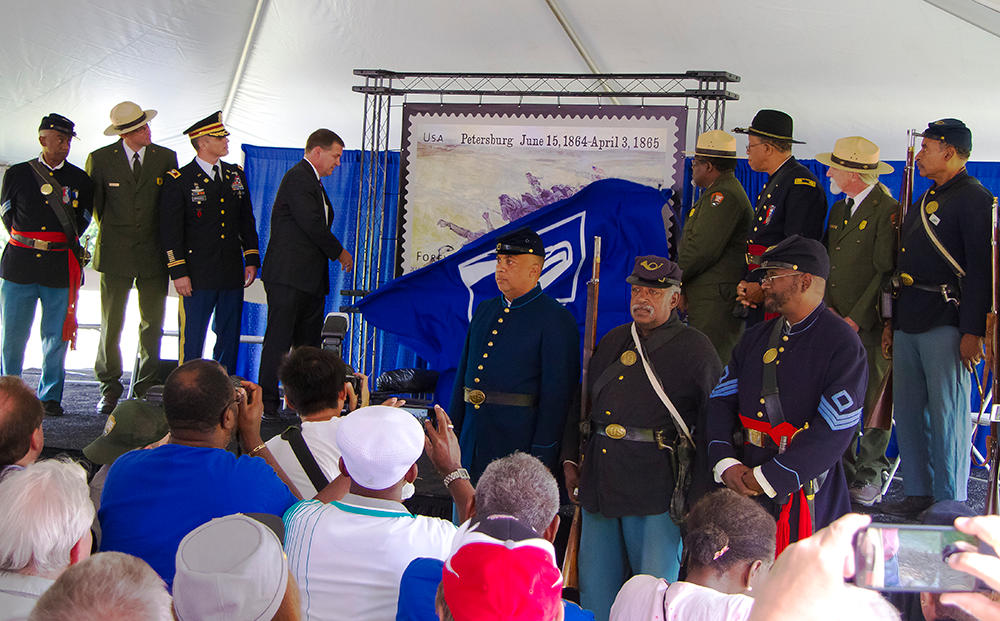
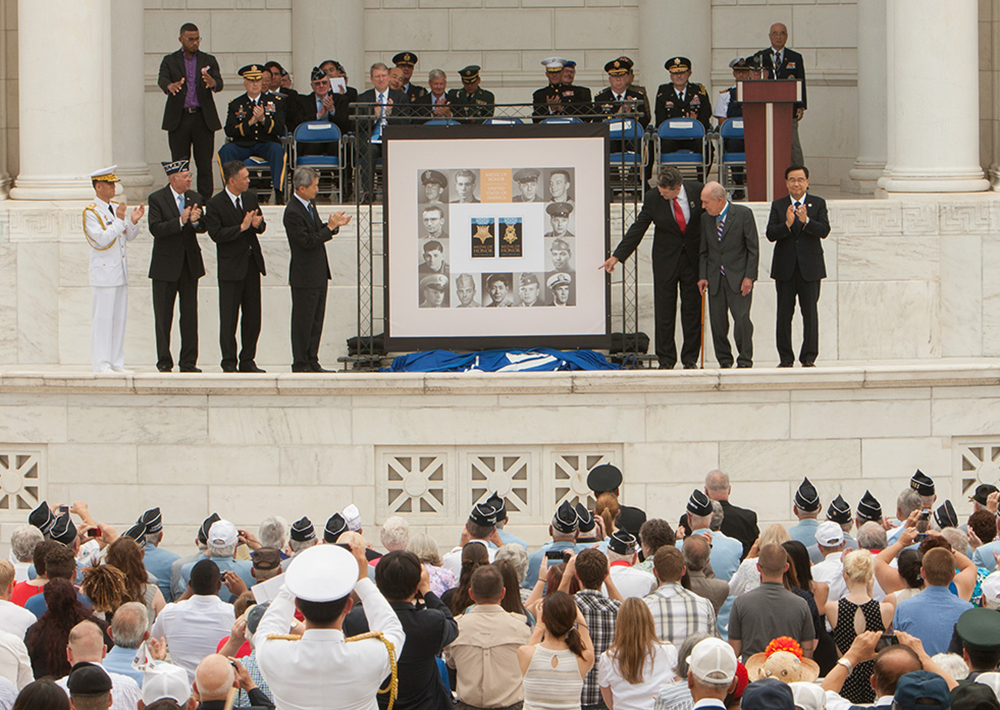
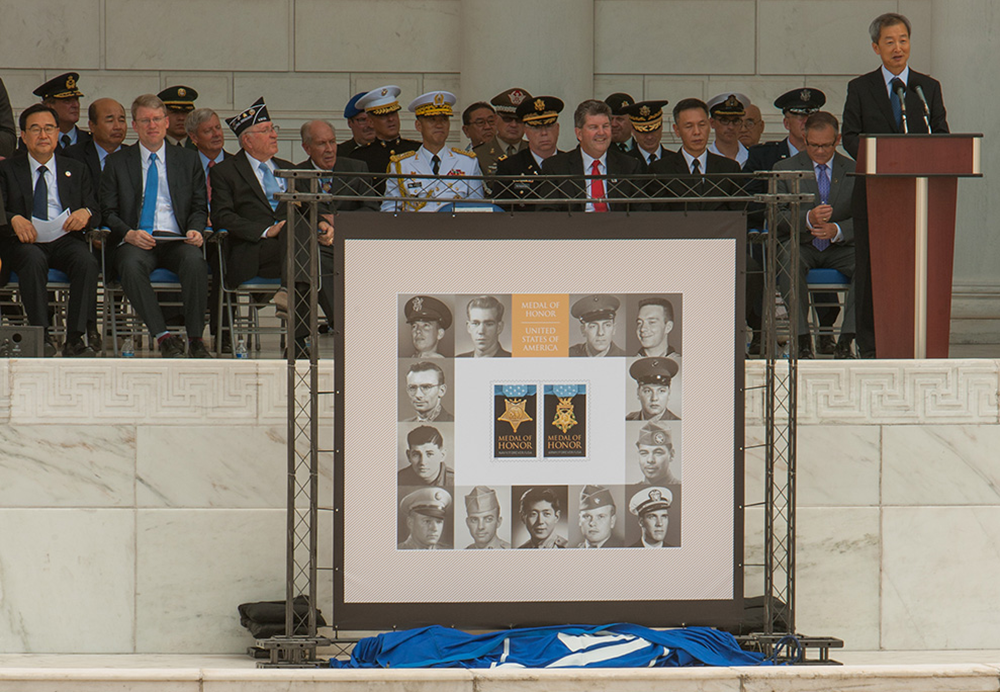
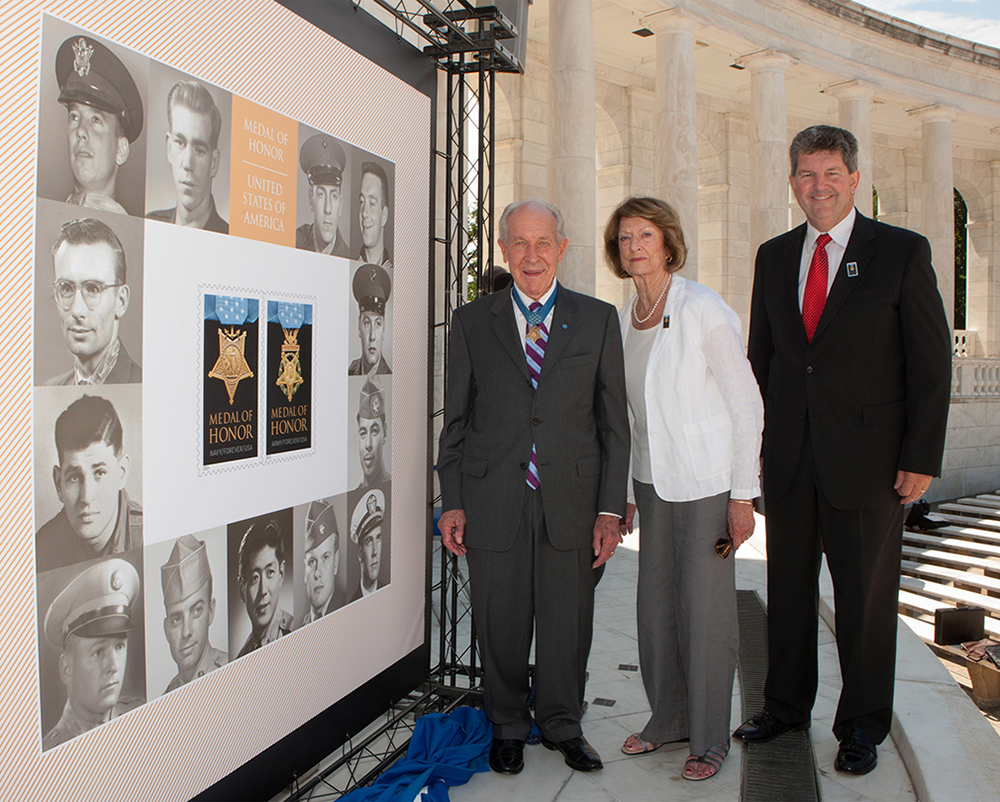
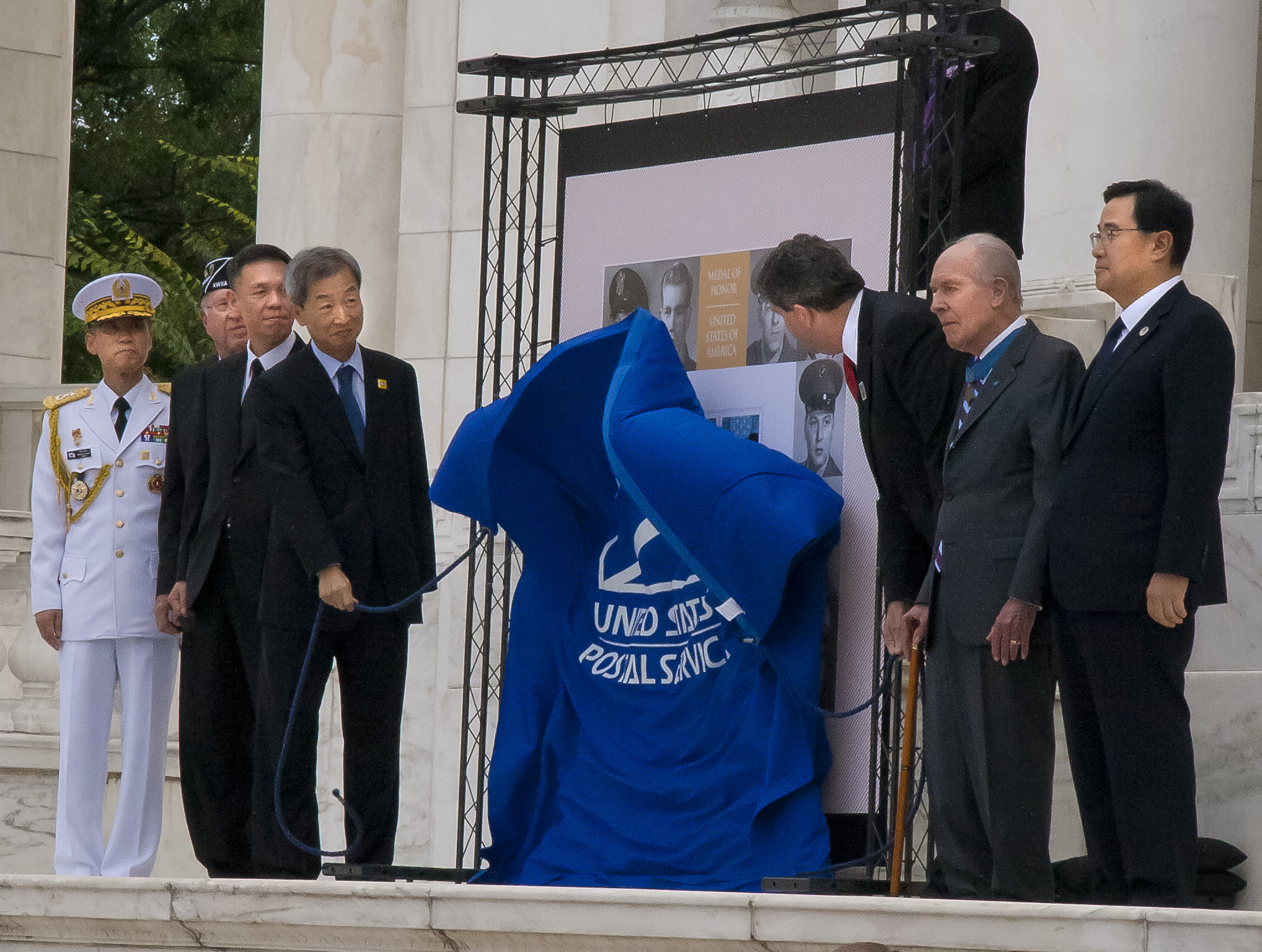
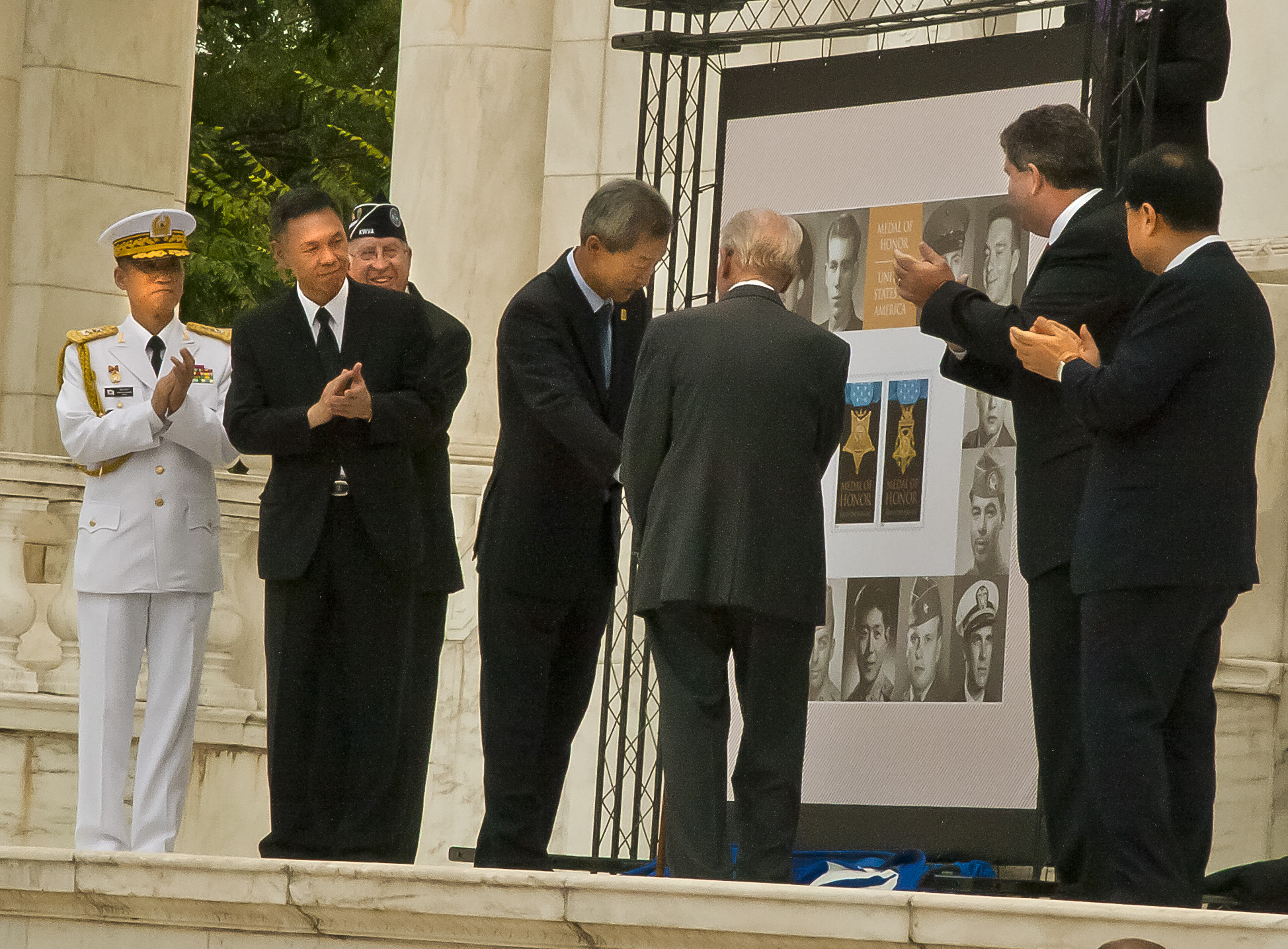
Issue: Farmers Markets StampsThe unveiling at the first day ceremony:
L to R:
July 28th: Here is the design for this issue.
This stamp will be issued September 13th at Fort McHenry in Baltimore, in conjunction with the Anniversary Festival there. (See the Friends of Fort McHenry website, which says in part, “Events crescendo on September 13 with a star-studded patriotic concert and extraordinary fireworks display over Fort McHenry and the Baltimore harbor.” There is no mention on that page of the stamp, nor on other sites’ pages about the 10-day festival.
The first-day ceremony will be held at 11:00 a.m., the USPS tells us. (added June 12th: The National Park Service expects huge crowds, about 20,000 people, on September 13th. Plan accordingly; mass transit? The ceremony will be held inside the Fort itself.)
This is the second or third stamp this year honoring the bicentennial of “The Star-Spangled Banner,” depending on how you count. A “Star-Spangled Banner” definitive, also featuring Fort McHenry, was issued January 28th (http://virtualstampclub.com/lloydblog/?p=170) with an additional varieties on March 3rd. (This is also obviously the year for stamps named “Spangled,” because the Butterfly Greeting Card stamp subject was the Great Spangled Frtillary!)
From my article in October about the partial program preview: “We weren’t shown the design for the Wqr of 1812 stamp, but the subject will be the Battle of Fort McHenry. It includes soldiers manning a cannon, the “Star-Spangled Banner” in the background, colored by “the rockets’ red glare. A portrait of the fort’s commander by Rembrandt Peale is on the back.”
From USPSstamps.com, July 28th:
The War of 1812, sometimes called “the forgotten conflict,” was a two-and-a-half-year confrontation with Great Britain that brought the United States to the verge of bankruptcy and disunion. With this 2014 issuance, the U.S. Postal Service continues its commemoration of the bicentennial of a war that ultimately helped forge our national identity and gave us our national anthem, “The Star-Spangled Banner.”
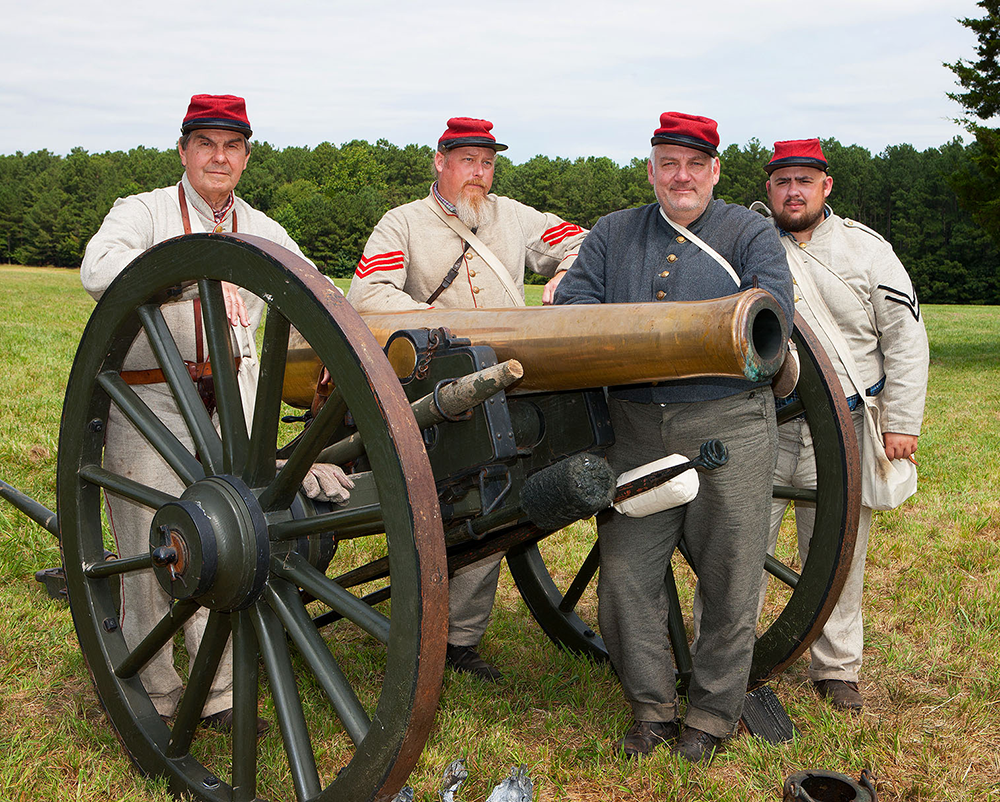
The stamp’s subject for the third year of the war is the bombardment of Fort McHenry in Baltimore, Maryland, in September 1814. Using mixed media, stamp artist Greg Harlin, a specialist in historical paintings, depicts the battle from the vantage point of a group of soldiers manning a cannon in defense of Fort McHenry. The stamp art also gives prominence to “the rockets’ red glare” that Maryland native Francis Scott Key wrote about in “The Star-Spangled Banner.”
A portrait by Rembrandt Peale of the fort’s commander, George Armistead, appears on the reverse of the stamp sheet (courtesy of the Maryland Historical Society). The selvage engraving on the front of the sheet is a black and white version of a painting by Percy Moran depicting Key aboard the ship from which he witnessed the battle. The stamp sheet includes verso text and selvage text.
For some 25 hours beginning on the morning of September 13, a squadron of the Royal Navy fired more than 1,500 rounds of shells and rockets at Fort McHenry, which was designed to protect Baltimore from attacks by sea. Key witnessed this massive display of firepower from the deck of an American flag-of-truce vessel, where he had just completed negotiations with the British for the release of an American prisoner.
On the morning of September 14, Key realized the bombardment had been a failure when he saw the British squadron withdrawing downriver. He was moved to write “The Defence of Fort McHenry” to the tune of an old English song, and it quickly gained wider recognition under the title “The Star-Spangled Banner.”
Greg Breeding served as art director and designer for the stamp.
The War of 1812: Fort McHenry stamp is being issued as a Forever stamp in self-adhesive sheets of 20. This Forever stamp will always be equal in value to the current First-Class Mail one-ounce rate.
From the Postal Bulletin of August 21st:
On September 13, 2014, in Baltimore, MD at the Anniversary Festival at Fort McHenry, the U.S. Postal Service® will issue The War of 1812: Fort McHenry (Forever® priced at 49 cents) commemorative First-Class Mail® stamp, in one design, in a pressure-sensitive adhesive (PSA) pane of 20 stamps (Item 588200). The $9.80 The War of 1812: Fort McHenry pane may not be split, and the stamps may not be sold individually.
The stamp will go on sale nationwide September 13, 2014.
In 2014, the Postal Service continues its commemoration of the War of 1812, a conflict with Great Britain that many Americans viewed as the nation’s “Second War of Independence.” The stamp subject is the bombardment of Fort McHenry in Baltimore, MD, in September 1814. Illustrated with mixed media by noted historical painter Greg Harlin, the stamp art depicts the battle from the vantage point of a group of soldiers manning a cannon in defense of the fort. The stamp art also gives prominence to “the rockets’ red glare” that Francis Scott Key wrote about in “The Star-Spangled Banner.” A portrait by Rembrandt Peale of the fort’s commander, George Armistead, appears on the reverse of the stamp pane (courtesy of the Maryland Historical Society). The selvage engraving on the front of the pane is a black and white version of a painting by Percy Moran depicting Key aboard the ship from which he witnessed the battle. The stamp pane includes verso text and selvage text. Art director Greg Breeding designed the stamp and pane.
How to Order the First-Day-of-Issue Postmark:
Customers have 60 days to obtain the first-day-of-issue postmark by mail. They may purchase new stamps at their local Post Office, at The Postal Store® website at http://www.usps.com/shop, or by calling 800-STAMP-24. They should affix the stamps to envelopes of their choice, address the envelopes (to themselves or others), and place them in a larger envelope addressed to:
War of 1812: Ft. McHenry
Postmaster
900 E. Fayette Street
Baltimore, MD 21233-9998
After applying the first-day-of-issue postmark, the Postal Service will return the envelopes through the mail. There is no charge for the postmark up to a quantity of 50. For more than 50, customers have to pay five cents each. All orders must be postmarked by November 12, 2014.
There are 11 philatelic products for this stamp issue:
Technical Specifications:
Issue: The War of 1812: Fort McHenry Stamp
Item Number: 588200
Denomination & Type of Issue: First-Class Mail Forever Commemorative
Format: Souvenir Sheet of 20 (1 design)
Series: War of 1812
Issue Date & City: September 13, 2014, Baltimore,
MD 21233
Designer: Greg Breeding, Charlottesville, VA
Art Director: Greg Breeding, Charlottesville, VA
Typographer: Greg Breeding, Charlottesville, VA
Artist: Greg Harlin, Annapolis, MD
Engraver: WRE/ColorTech
Modeler: CCL Label, Inc.
Manufacturing Process: Gravure
Printer: CCL Label, Inc.
Printed at: Clinton, SC 29325
Press Type: Dia Nippon Kiko (DNK)
Stamps per Pane: 20
Print Quantity: 30 million stamps
Paper Type: USPS-P-1238, Phosphor Tagged Paper, Block, Nonphosphored Type III
Adhesive Type: Pressure-sensitive adhesive
Processed at: CCL Label, Inc., Clinton, SC
Colors: Yellow, Magenta, Cyan, Tan 7535, Black
Stamp Orientation: Horizontal
Image Area (w x h): 1.42 x 1.09 in./36.07 x 27.56 mm
Overall Size (w x h): 1.56 x 1.23 in./39.62 x 31.12 mm
Full Pane Size (w x h): 10.25 x 7.25 in./260.35 x 184.15 mm
Press Sheet Size (w x h): 10.25 x 36.25 in./260.00 x 921.00
Plate Size: 100 stamps per revolution
Plate Numbers: N/A
Marginal Markings: Front: Side Header: The War of 1812: Fort McHenry • Descriptive text
Back: © 2014 USPS • USPS logo • Plate position diagram in lower right corner • Barcode (588200) in lower left corner • Promotional text Portrait of George Armistead • Descriptive text
The first-day postmarks:
The black-and-white postmark measures 2.87″ x 1.18″
The Digital Color Postmark measures 2.81″ x 1.31″
4892 (49¢) Charlton Heston
4893 ($1.15) Map of Sea Surface Temperatures
4894 (49¢) Flag with 5 Full and 3 Partial Stars self-adhesive coil stamp
4895 (49¢) Flag with 3 Full Stars self-adhesive coil stamp
4896 (49¢) Flag with 4 Full and 2 Partial Stars self-adhesive coil stamp
4897 (49¢) Flag with 2 Full and 2 Partial Stars self-adhesive coil stamp
a. Strip of 4, #4894-4897
4898 (49¢) Circus Posters – Barnum and Bailey Circus Poster with Clown
4899 (49¢) Circus Posters – Sells-Floto Circus Poster
4900 (49¢) Circus Posters – Ringling Bros. Barnum and Bailey Circus Poster with Dainty Miss Leitzel
4901 (49¢) Circus Posters – Al. G. Barnes Wild Animal Circus Poster
4902 (49¢) Circus Posters – Ringling Bros. Shows Poster with Hillary Long
4903 (49¢) Circus Posters – Barnum and Bailey Circus Poster with Tiger
4904 (49¢) Circus Posters – Ringling Bros. Barnum and Bailey Circus Poster with Elephant
4905 (49¢) Circus Posters – Carl Hagenbeck-Wallace Circus Poster
a. Block of 8, #4898-4905
by John M. Hotchner
In a previous column I mentioned that my history in the hobby stretches back over 60 years, and it got me thinking. In many respects I’ve had two jobs – my means of putting food on the table for my family, and a nearly equal amount of time week-by-week devoted to the hobby. The financial returns have been modest, but the enjoyment has been a gift; whether time spent working on my own collections, or writing and editing time, or working with others helping to build the hobby’s infrastructure.
What came to me as I thought about the 60 years is the wide range of friendships I have had, but would not have, had I not gotten involved in organized philately, in exhibiting and judging, and recruiting for the hobby. One of the wonderful things about our hobby is that everyone, both the well-known names and the beginning collector are equal in our enjoyment of the collecting experience. When I began at the “beginning collector” end of that spectrum, I asked a lot of questions of anyone I thought might be able to answer. And it was rare that I did not get a cheerful, helpful answer.
All these years later, remembering back to those days, it is clear that I have gone through a role reversal. I now get to field a lot of the questions collectors have, but that is terrific, because I have always treasured the opportunity to hear about what others at all levels of the hobby think about what is happening in the philately, what they collect and why, and the odd things they find and enjoy. Perhaps that is one of the motivations of my becoming a philatelic writer. But the bottom line is that I feel privileged that my pursuits have allowed me to meet and get to know a great many wonderful people.
I want to take the rest of this column to name some of them; some names you will recognize, others not. My object is to acknowledge and say thanks; but also to make clear that we all stand on the shoulders of those who came before. I’d also like to entice you further into the hobby as I know that you will enjoy the experience AND will find that involvement is a one way ticket to friendships and associations that will enrich your life as they have enriched mine.
I must start with my father, Howard Hotchner, a Brooklyn boy who began collecting stamps before age ten and never quit. Of his three children I was the only one to catch the disease from him, but I was well and truly hooked early, and benefited for 40 years from his knowledge, encouragement and guidance. In the early years, my enthusiasm for the hobby was matched by that of high school (and beyond) buddy Bob Olds, who through his own enthusiasm stoked my philatelic fires, and remains a dedicated collector to this day.
Several of Dad’s friends were also mentors and friends to me: Jacques Minkus, Ernie Kehr, Elizabeth Denny Vann, Bill Hermann, Herman Neugass, Jan van der Vate, Bill Waldrop, Wes Capar, Bill Littlewood, Bud Petersen, and others now gone, pushed or pulled me along the path. Minkus and his Washington, D.C. staffers Morris and Hilda Flint even gave me a part-time job at the Minkus operation in the Woodward & Lothrop Department Store, just a few blocks from the White House, that lasted several years.
In the local Dolley Madison Stamp Club, those I got to know well over many years included Ray Hall, Margaret Babb, Ralph Walker, Mary Onufrak, Hank Simpson, Charlie Baker, Eric Emsing, Ann Brown, Tom Bristol, Miles Manchester, Gil Corwin, Carl Troy, Marilyn Mattke, Jim Cross, Bill Olcheski, and Harry Wohl, a few of whom are still above the sod, and remain good friends.
When the time came to get deeply into interest areas beyond my father’s, I got to know by mail such people as George Brett, Vernon Bressler, Jack Molesworth, Dick Graham, and Joe Bush. They could have ignored the twerp who asked a lot of what must have seemed to be elementary questions, but they were unfailingly gracious, and the dealers among them spent far more time on my queries than I spent money with them!
Eventually I got knowledgeable enough to trade information and material with others sharing my philatelic persuasions. Among them I would recognize with special fondness Larry Weiss, Frank Pogue, Pete Martin, Dan Pagter, Phil Nazak, Hugh Wynn, Jerry Wagshal, Charles Rudd (from New Zealand), Pip Wilcox, Doug Lehmann, Jim Cotter, Ernie Mosher, Don Evans, John Briggs, Ella Sauer, Lyle Hall, Tom Current, Ray Garrison, Jack Beachboard, Steve Datz, Bruce Mosher, Howard Gates, Bill Hatton, Ray Fehr, Bob Collins, Lou Caprario, Alex Hall, Brian Saxe, Arne Rasmussen (of Denmark), Ernest Malinow (of the UK), and Lou Repeta.
My first expedition into organized philately beyond my local club was in our Virginia State Federation, and there were many who befriended the new kid: Joe Harowitz, Alma Snowa, Jo Bleakley, Rudy Roy, Mike Falls, Darrell Ertzberger, Ed and Fran Rykbos, Leroy and Cora Collins, and last but not least, Don Jones and his wife Mary Ellen, who have become lifelong friends and in doing so went a long way toward convincing my wife Nanette that philately can be a positive despite its stealing time from a marriage.
Speaking of marriage reminds me of children, and my four Rick, Jay, Posey and James each took a turn at the hobby, and dropped it in favor of other activities. But unlike when they begged me to stop smoking, all have been and continue to be supportive of the old man’s obsession with little bits of colored paper.
The Virginia Philatelic Federation led me into exhibiting and then to judging, and it was here that I met and was taken under the wing of the colorful Clyde Jennings who must have despaired at times of my geeky and shy approach to life, but encouraged me to do things I had never dreamed of by telling me repeatedly that I could — and should. Other early mentors and founts of knowledge included Bud Hennig, Bill Bauer, Bud Sellers, Phil Ireland, Gordon Torrey, Charlie Peterson, John Foxworth, Pete Robertson, Bob Odenweller, and George Guzzio.
As I got established in the hobby, I was lucky enough to meet and learn from/work with contemporaries Steven Rod, Randy Neil, Peter McCann, Stan Luft, Jim Lee, Dick Winter, Steve Schumann, Rich Drews, Francis Kiddle (of the UK), Dan and Pat Walker, Steve Luster, Jackie Alton, Jamie Gough, Karol Weyna, Scott Shaulis, Ed Jarvis, Jim Mazepa, Alan Warren, “Connie” Bush, Ted Bahry, Edgar Hicks, Cheryl Ganz, Roland Essig, Steve Suffet, Art Groten, Jack Harwood, Steve Washburne, John Warren, Pat Walters, Joann and Kurt Lenz, Henry Sweets, Eliot Landau, Nick Lombardi, Roger Brody, Phil Stager, Hideo Yokota, Bill Waggoner, Joe Ward, Ann Triggle, Jane Fohn, Nancy Zielinski-Clark, Charles Verge, Phil Rhoade, Abraham Gelber (of Costa Rica), Paolo Comelli (of Brazil), and Jay Jennings (son of Clyde).
And it has been a privilege to get to know some of the rising generation of leaders typified by Tim Bartshe, David McNamee, Liz Hisey, Tony Dewey, Tony Wawrukiewicz, Tom Fortunato, Lloyd de Vries, Larry Fillion, Vesma Grinfelds, Alex Haimann, John Allen, Andy Kupersmit, Mike Lampson, Cemil Betanov, Steve Davis, David McKinney, Dzintars Grinfelds, John Phillips, Rudy de Mordaigle, Don David Price, Tim Hodge, and Dan Piazza.
Randy Neil deserves a special note. The man is a marvel. I was lucky to work with him in founding the American Association of Philatelic Exhibitors, U.S. Stamps & Postal History (the predecessor of USSN), in establishing American Stamp Dealer & Collector magazine, and on a dozen initiatives in APS. No one else in the hobby has been more creative in making it an attractive pastime.
When I first ran for a Director position on the APS Board, it was then Director of Administration Frank Sente with whom I had worked as head of the Chapter Activities Committee who told me to go for it. People not already mentioned that I met during the APS years that have been sources of inspiration include Keith Wagner, Mercer Bristow, George Martin, Bob Lamb, Janet Klug, Steve Reinhard, Dana Guyer, Barb Johnson, Ada Prill, Ray Ireson, Norm Holden, Dorothy Blaney, Cheryl Edgcomb, Ken Martin, Wade Saadi, David Straight, Kitty Wunderly, Ernie Bergman, Gordon Morison, Steve Zwillinger, Joe Cleary, Dave Flood, and Bob Zeigler.
My writing career really began with a go-ahead from Ed Neuce, then editor of Linn’s, but so many wonderful people have been talented editors, supporters and collegial colleagues over the years including Mike Laurence, Ken Lawrence, Dick Graham, Les Winick, Ken Wood, Rob Haeseler, Michael Schreiber, Denise McCarty, Donna Houseman, Fred and Elaine Boughner, Barth Healey, Charlie Yeager, Len Piszkiewicz, George Amick, Jim Czyl, Allison Cusick, Fred Baumann, Michael Baadke, Wayne Youngblood , Joe Brockert, John and Elaine Dunn, Dan Barber, Dane Claussen, Dick Sine, Jay Bigalke, and Brian Baur.
Other organizations and other people played a role in my philatelic life, be it as elder mentors and guides, and/or colleagues on projects to push the philatelic boulder up the mountain a few more inches. Among them are Bill Schumann, Jacques C. Schiff, Jr., Jim McDevitt, Mike Bush, Robert Morgan, Michael Dixon, Harry Chamberlain, Elmer Cleary, Ralph Nafziger, Tom Breske, Doug Quine, David Beeby, George Godin, Jerry Kasper, Howard Petschel, Dennis Clark, Gene Zhiss, Stan Kenison, Hal Griffin, Al Kugel, Wilson Hulme, John Cali, Ed Dykstra, Carl Burnett, Jay and Denise Stotts, Steve Turchik, Jim Lee, Jack Williams, Kay Don Kahler, Gary DuBro, and Tony Crumbley.
To think that I might have missed meeting the great majority of these people if I’d remained a “closet collector!” And this is not a complete list. I have undoubtedly left out people who should be mentioned, but faulty memory and lack of space don’t permit a comprehensive list.
Also, among those named, many could be mentioned in several categories. Again, I simply want to convey the breadth of influences on my philatelic life, and by doing so illustrate how by allowing ourselves the freedom to get involved, we can enrich our lives in undreamed of ways.
As a collector of new-issue U.S. first day covers and a journalist who covers U.S. stamps, it’s important for me to know what stamps are being issued by the U.S. Postal Service. Sometimes, I know more about new issues than the clerks in the post offices.
Here are some of the more amusing things I’ve overheard in recent months — at several post offices, I hasten to add, not just one.
Upon seeing Songbirds used for postage on one of my “first-class flats,” a fill-in clerk said, “Oh, those are pretty. What country are they from?”
At another post office recently, I asked for a specific recent issue.
“I don’t have that, but I do have the Clown stamps.”
Trying to be amusing, I replied, “No, thanks, I don’t need the clowns, nor the acrobats or the tigers.”
“We don’t have the acrobat or tiger stamps.”
“Yes, you do. They’re on that same Circus [Posters] sheet with the clowns.”
“Oh.”
And this one had nothing to do with new issues, but the other day, I heard a clerk tell the same customer, within a few minutes, “I haven’t done one of these in years” and (sarcastically) “I guess you know my job better than I do.”
Sometimes, yes.
[press release]
AFDCS OFFERS NEW EDITION OF CURRENT CACHETMAKERS DIRECTORY – FREE!
A new edition of the American First Day Cover Society’s Directory of Current Cachetmakers is now available as a free download on the society’s website, www.afdcs.org On-demand printed copies are $5.00 plus $2.00 postage and handling and may be ordered in the Marketplace section of the AFDCS website, or from AFDCS Sales, Post Office Box 44, Annapolis Junction, MD 20701-0044.
This is the eleventh edition of the popular directory. The AFDCS hopes to produce new editions several times a year. The directory is now compiled by Ron Allen of Kentucky.
It lists cachetmakers both by their trade names and their real names (with a cross-reference), their regular mail addresses, websites, e-mail addresses, and telephone numbers. The listings also indicate how often a cachet line is produced, what its first FDC was, and for what countries and what topics cacheted FDCs are made.
It includes both AFDCS members and cachetmakers who are not, and there is no charge for a listing. A form to request a listing is included in this edition, as well as information on how to reach Allen. The form can also be completed online at www.afdcs.org/cmform.php.
“We want to list every first day cover servicer currently producing cacheted FDCs, regardless of whether they are members of the AFDCS or not,” said society president Lloyd A. de Vries. “Of course, we think all cachetmakers should be members, and that membership offers them many benefits.”
The American First Day Cover Society is the world’s largest not-for-profit organization dedicated to the collecting of FDCs. Each issue of First Days is published in full color and includes articles, columns, Society business, a non-commercial Cover Exchange, and the best collection of FDC advertisements anywhere, at affordable rates.
For more information on the AFDCS, visit www.afdcs.org or write to the AFDCS, P.O. Box 16277 Tucson, Arizona 85732-6277, or e-mail afdcs@afdcs.org.
[press release]
AMERICOVER 2014 CELEBRATES ARTCRAFT CACHETS’ 75TH ANNIVERSARY
Americover 2014, the annual first day cover show and convention, celebrates the best of stamp and cover collecting in the New York/New Jersey area, and marks an important anniversary at the same time.
Americover 2014, sponsored by the American First Day Cover Society, will be held August 15-17 at the DoubleTree by Hilton Somerset Hotel & Conference Center, 200 Atrium Driver, Somerset, NJ 08873. A special Americover 2014 room rate of $97 – the 23rd year in a row with an Americover hotel rate of less than $100!
The theme of Americover 2014 is the 75th anniversary of ArtCraft Cachets, the oldest line still producing first day cover envelopes today.
Thursday’s pre-show tour begins with a tour of the Washington Press, home of ArtCraft, as well as White Ace albums. The Americover visitors will also meet current ArtCraft artist Susan Jorritsma.
The Americover 2014 bus will then take the visitors to New York City, for a quick tour of the Financial District, Nassau Street (once the greatest collection of stamp businesses in the world), and the Collectors Club of New York. The tour then goes to the famed Katz’s Deli, where lunch may be purchased, before heading to the World Trade Center site and then Champion Stamp Company, the only street-level stamp store left in New York.
Sunday evening, after the show closes, Americover visitors will go out to dinner at the Stage House Tavern, with rustic American fare and hearty portions. This event is limited to just 30 people, so register early!

During the show, the annual President’s Banquet will be held Friday evening, featuring the Taste of Tuscany Buffet with three entrees: tortellini carbonara, chicken marsala or fillet of sole with a spicy tomato sauce. (Special dietary needs can be accommodated if specified before June 30.) Following the meal, the results of the annual AFDCS Earl Planty Cachet Contest will be announced, as will the winners of the polls for cachetmakers of the 20th century, (fourth) quarter century, and decade (2000-2009).
Unlike other World Series of Philately shows, Americover’s exhibit awards are not presented at its banquet (which is held Friday night), but at the AFDCS Business Meeting Saturday morning.
Saturday evening’s “food event” will be held late – about 9 p.m., after the Cachetmakers Night Owl Bourse. The fare at the post-bourse party includes pizza, crudité platters (vegetables) and more.
Americover 2014 events may be purchased individually or as part of a discounted package. There is also a discount for purchasing event tickets before the end of June. There is an order form in the April 2014 issue of First Days and on the AFDCS website, www.afdcs.org/register .
Besides these events, Americover 2014 will also have two bourses (commercial dealers and cachetmakers), WSP competitive exhibits meetings, a youth table, a hospitality suite, live and silent auctions, seminars, and possibly a U.S. first day ceremony. A forum by a postal official involved with first day covers is also on the schedule.
For more information on Americover 2014 and the AFDCS, contact the AFDCS at P.O. Box 16277, Tucson, Ariz. 85732-6277, email showinfo@afdcs.org or visit www.afdcs.org.
[press release]
The American Topical Association has announced the launching of the biggest benefit to stamp collectors in its 65-year history. A five-year undertaking has resulted in doubling the number of its topical checklists to nearly 1200. The lists are being produced from a regularly updated database.
Already the world’s leading supplier of topical stamp checklists, the ATA is making the lists available to members from a new database containing almost 400,000 stamps and 578,502 topical listings.
Creating, merging and updating the listings have been the tasks of committed volunteer Karen Cartier, with technical assistance from her son, Michael. The project included adding topical listings from almost every page of the Scott Standard Postage Stamp Catalogue, as well as all new issues.
“ATA checklists began when members sent in their lists for other members to use. Hundreds did,” said ATA president Jack André Denys. “Now that Karen Cartier has included every Scott-listed topical stamp in the database, our checklist service has made a huge leap forward. We are indebted to her for her time and perseverance in this colossal task.”
ATA checklists, available in a spreadsheet format or printed, include the country, date of issue, Scott number, denomination, and a description of what is depicted on the stamp. They are invaluable to topical collectors in researching and acquiring stamps. In some cases, meter stamps, postmarks, postal stationery and other items are included. Lists will be regularly updated, and members have the option to receive annual updates.
With nearly 1200 topics to choose from, collectors have a much greater choice for collecting major topics such as railroads and butterflies, to minor topics like hedgehogs and hurricanes. Hundreds of new lists not previously available through ATA, such as World War I and various lists relating to World War II, are being introduced.
Complete listings of the ~1200 checklists, according to Topic and also Alphabetical, are posted on the ATA website. A bonus listing of ~200 People shown on stamps is also included there.
Checklists are available to ATA members at a nominal price. Cost is a penny per item on the checklist—with Mini-lists for 50¢ and Maxi-lists over 5,000 items for $50. Membership information is available at www.americantopicalassn.org or by calling the ATA office at 618-985-5100.
“It’s important to note that these checklists will never be ‘finished,’” said executive director Vera Felts, “as we will be constantly updating them, and making them more complete and accurate than ever before. As always, the help of ATA members is important in keeping the database information current and correct.”
[press release]
Jack André Denys to Receive Highest ATA Award
Jack André Denys has been selected to receive the American Topical Association’s highest award, at its 65th annual show in St. Louis, June 27-29. The Distinguished Topical Philatelist award will be presented to Denys, who has served as president since 2008, the longest of any president.
Jack is a life-long philatelist, who has shown leadership and vision in his role as ATA president. The ATA has enjoyed a membership increase the last three years. The TopicalsOnLine website for buying and selling topical stamps, electronic and archive versions of Topical Time and a comprehensive checklist database of topical stamps are among the major accomplishments during his tenure.
Among topical collectors and exhibitors, Jack is known as a champion of the hobby and mentor to countless new philatelists over many years. His casual demeanor and wit add to the collegial atmosphere ATA members enjoy.
His exhibit on the Bayeux Tapestry has earned 10 gold awards, qualifying him for the American Association of Philatelic Exhibitors’ prestigious Diamond Award. It has also received the AAPE Creativity Award, the APS Award of Excellence, and the American Philatelic Congress Award for Excellence in Written Text. It received the Reserve Grand (2007) and the Grand (2008) at the National Topical Stamp Show. Internationally, the exhibit has merited a large vermeil with special prize at Washington 2006, and a vermeil at London 2010. Albrecht Dürer is another of his collecting and exhibiting interests.
A member of APS, AAPE, and founder of the ATA Dürer study unit, Denys is a prolific philatelic writer who contributes to numerous journals. In 2011, he received the Randy L. Neil Award for the best article in The Philatelic Exhibitor, “Myth-Busting Thematic Rules.”
The National Topical Stamp Show will be held June 27-29 at the Renaissance St. Louis Airport Hotel. The Distinguished Topical Philatelist award will be presented to Denys at the show’s banquet on June 28. For show information see www.americantopicalassn.org.