Fish To Football: Americover 2018 Tour Details

[press release]
Americover 2018 Tour Offers Everything From Football To Fish

The American First Day Cover Society’s pre-Americover 2018 tour will provide an opportunity for participants to visit some of Atlanta’s best tourist attractions. It will drop off the Americover attendees within two blocks of the College Football Hall of Fame, the Georgia Aquarium, the World of Coca Cola, the Center for Civil and Human Rights museum, and CNN World Headquarters.

Americover 2018 will be held August 3-5 at the Hilton Atlanta Northeast, 5993 Peachtree Industrial Blvd. Peachtree Corners, GA 30092, just 20 miles from downtown Atlanta. The tour bus will depart from the hotel Thursday morning, August 2, and return in the afternoon. Participants will be able to choose any of the nearby venues, or even spend time in Centennial Olympic Park.

The price for the tour includes the hassle-free bus transportation, and is $25 if purchased on or before June 30, and $30 after that date, if space is still available.

Tickets may be purchased online at www.afdcs.org/register or by mail, using the insert in the March-April issue of First Days, the official journal of the AFDCS. Non-members are welcome on the tour and can use the website or request a copy of the Americover 2018 event order form by sending a self-addressed stamped envelope to the AFDCS, PO Box 44, Annapolis Jct., MD 20701-0044.

Americover 2018 is the AFDCS’ annual show, convention and celebration of first day cover collection. Each year, it is held in a different part of the country. In 2017, it was in the Cleveland area; in 2019, it will be in Saint Louis. Americover is part of the American Philatelic Society’s World Series of Philately, and the winners of its competitive exhibitions are automatically entered in the annual Champion of Champions competitions.

There is also a Sunday evening event involving dinner; this year, it will be at The Crossing, a steakhouse in the former train station of Norcross, Ga.

As is customary, those attending the Americover tour and food events receive special cover souvenirs designed by leading cachetmakers.

There is a special Americover room rate of $99 at the Hilton Atlanta Northeast, which includes Wednesday and Sunday nights. There also will be two bourses at the show (commercial dealers and cachetmakers), a banquet, meetings, award-winning FDC exhibits, a youth table, a hospitality suite, live and silent auctions, seminars, a forum by a U.S. Postal Service official involved with first day covers, and possibly a U.S. first day ceremony.

For more information on Americover 2018 and the AFDCS, contact the AFDCS at P.O. Box 16277, Tucson, Ariz. 85732-6277, email showinfo@afdcs.org or visit www.afdcs.org.

“Royal” Treat for Young Collectors

[press release]
Royal provides exciting programme for young philatelists

The Royal Philatelic Society London is to organise a philatelic visit to London for young philatelists aged between 18 and 35. This follows a successful initiative arranged by the Club de Monte Carlo last year.
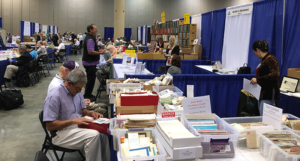
London is still regarded as the philatelic capital of the world and the programme aims at proving this claim. The visit will include the following philatelic highlights:

  • September 12: Guided Tour of Autumn Stampex and in the evening attending the RPSL President’s Dinner
  • September 13: Guided Tour of the Royal Philatelic Society London where a part of The Royal Philatelic Collection will be exhibited by gracious permission of Her Majesty The Queen.
  • September 14: Guided Tour of the British Library Philatelic Collection and The Postal Museum London

The costs of travel, accommodation and attendance at the dinner will be sponsored in full. Other expenses (meals, etc) will have to be paid for by the delegates.

Unfortunately, the number of participants is limited to maximum 20. The selection of the participants will be based on their philatelic CV.

All participants must be members of the RPSL or should apply for membership. For those still full time students, there is ‘associate membership’ with an annual fee of only £10. All others should apply for full membership.

More information is available from John Davies FRPSL, Council Member of the RPSL, who has arranged the programme (davies1890@btinternet.com).

Changes In Major Stamp Shows

Compex has a new weekend this year, and its theme will be the Illinois Bicentennial.

The American Philatelic Society will no longer sponsor a winter stamp show. They’ve never really lived up to their potential. Instead, elements such as the special exhibits and meetings will be hosted at other stamp shows.

Americover 2020 will be held in conjunction with APS StampShow 2020. Meanwhile, the American First Day Cover Society has big plans for Americover 2018.

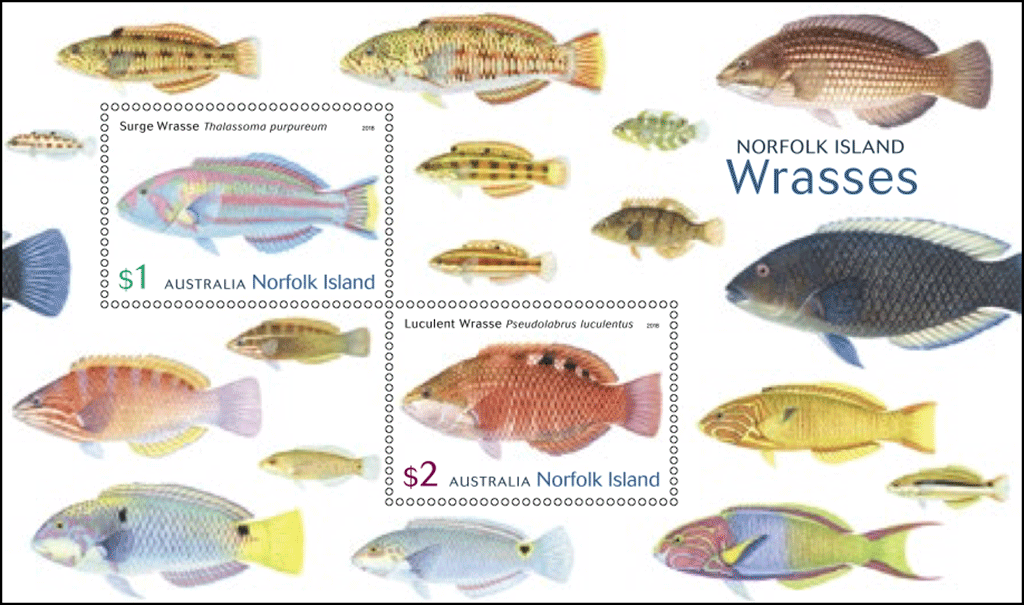
Norfolk Island Wrasses (Australia 2018)

Issue date April 30, 2018:
From Australia Post’s Stamp Bulletin:

The reef at Emily Bay, Norfolk Island is a popular spot for snorkelling, due to its clear water and an abundance of fish species.

The most predominant in terms of individual species are wrasses (Labridae) – a large and often brightly coloured family of fish that inhabit coral reefs and other temperate waters.

As each wrasse species has differing colour patterns across male, female and (sometimes) juveniles, from 17 species in the reef there are almost 50 spectacular colour variations.

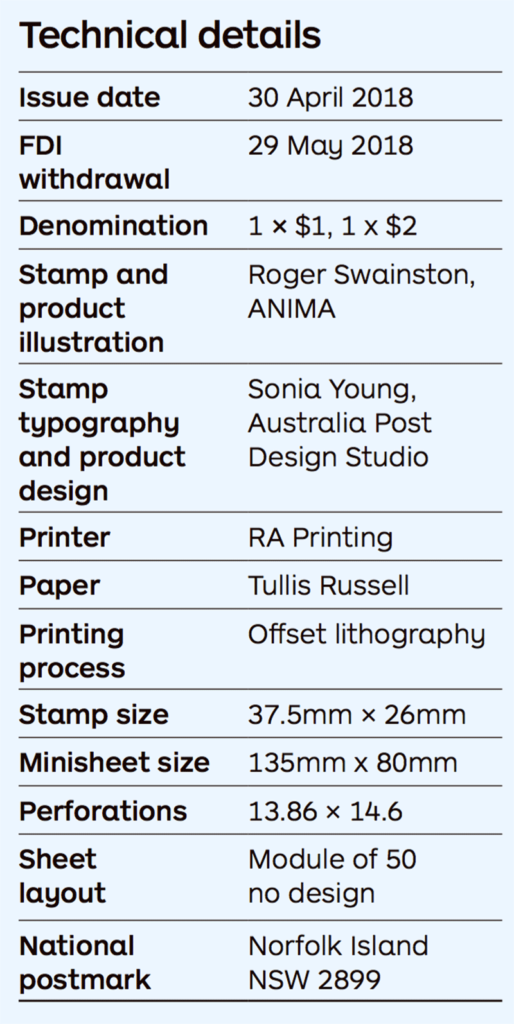
The stamps in this issue, illustrated by renowned painter, naturalist and zoologist Roger Swainston, feature the vividly coloured adult male Surge Wrasse (Thalassoma purpureum) and the striking orange-red Luculent Wrasse (Pseudolabrus luculentus).

Queen Elizabeth II’s Birthday (Australia 2018)

Issue date April 17, 2018:
From Australia Post’s Stamp Bulletin:

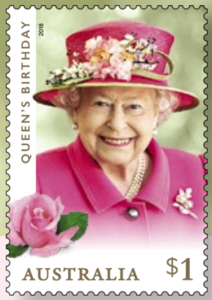
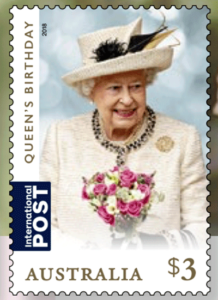
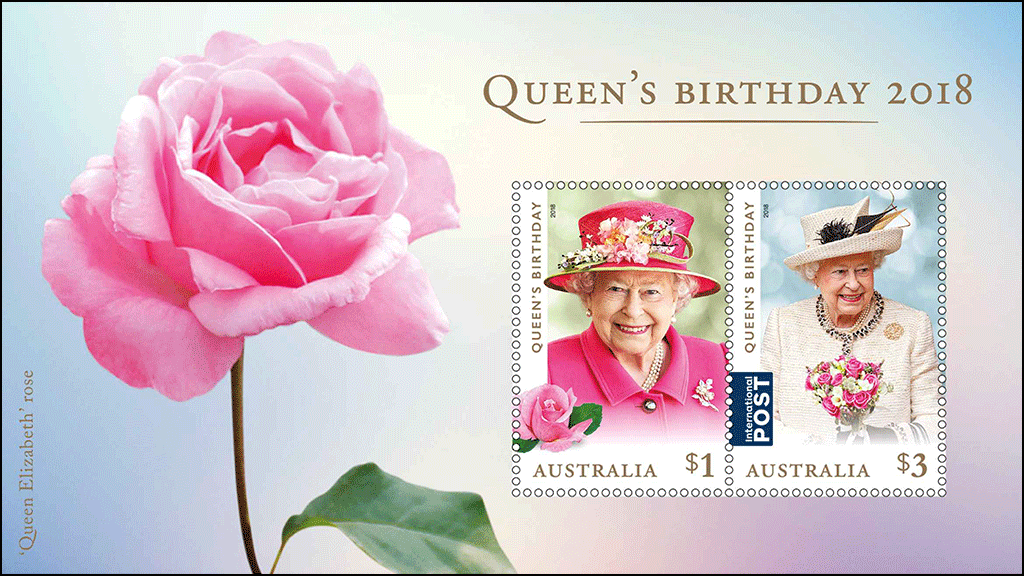
In 2018, we mark the 92nd birthday of Her Majesty Queen Elizabeth II with two designs that feature a floral theme. On the domestic-rate stamp, the Queen is pictured during her 90th birthday celebrations in April 2016. The Queen was photographed arriving to open the Alexandra Gardens Bandstand, in Windsor, as part of a day of visits with Prince Philip. On the international-rate stamp, the Queen is attending a 2015 service to mark Commonwealth Day –
the celebration of the Commonwealth of Nations.

The domestic stamp also features a close-up photograph of the ‘Queen Elizabeth’ (also known as ‘Queen of England’)
– a tall grandiflora rose introduced in 1954. The Queen Elizabeth rose was named to recognise the Queen’s ascension to the British throne in 1952 and subsequent coronation in 1953.


[press release]
Australia Post adds a floral touch to commemorate Her Majesty’s 92nd birthday

Australia Post is releasing two floral-themed stamps to commemorate the 92nd birthday of Her Majesty Queen Elizabeth II.

Born on 21 April 1926 and christened Elizabeth Alexandra Mary, Queen Elizabeth II was the first child of The Duke and Duchess of York, who later became King George VI and Queen Elizabeth.

Australia Post Philatelic Manager Michael Zsolt said; “Her Majesty Queen Elizabeth II is the most featured person on Australian stamps. Creating something fitting to honour Her Majesty each year is a proud philatelic tradition in Australia.”

This year’s Queen’s Birthday stamp issue and associated products feature a floral theme, with a particular focus on the Queen Elizabeth rose (also known as ‘Queen of England’), which was released in 1954 to honour the Queen’s ascension to the British throne in 1952 and her subsequent coronation on 2 June 1953.

Australia Post will also release a postal and numismatic cover to commemorate the 65th anniversary of the Queen’s coronation later this year.

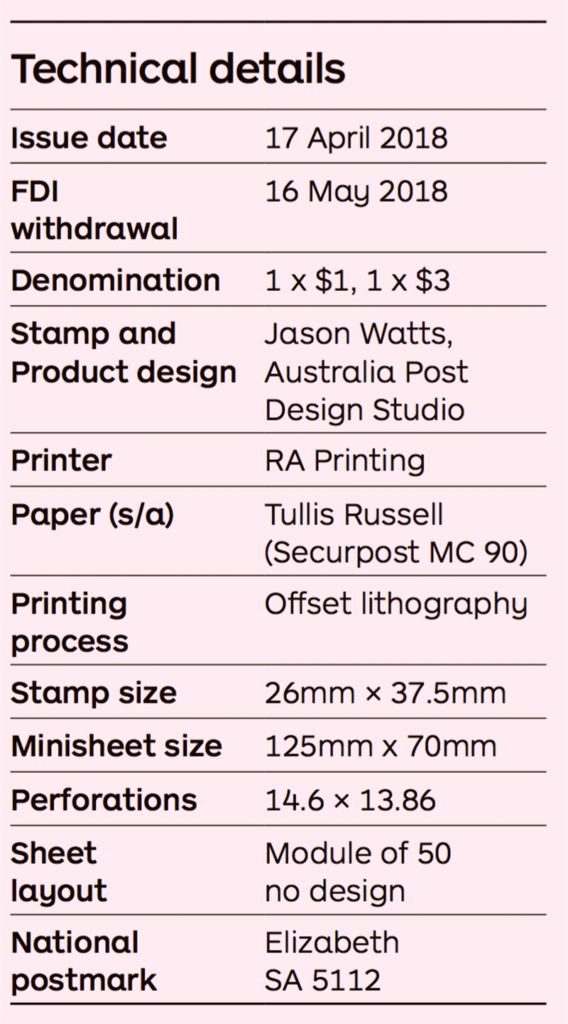
The Queen’s Birthday 2018 stamps were designed by Jason Watts of the Australia Post Design Studio. The issue includes one domestic base-rate ($1) stamp and one international ($3) stamp featuring:

  • Queen Elizabeth II with Queen Elizabeth rose: This domestic base-rate stamp captures the Queen arriving to open the Alexandra Gardens Bandstand in Windsor, during public celebrations for her 90th birthday in April 2016, along with a close-up photograph of the Queen Elizabeth rose.
  • Queen Elizabeth II on Commonwealth Day: The international stamp features the Queen attending the 2015 Commonwealth Day service at London’s Westminster Abbey. Commonwealth Day is the celebration of the Commonwealth of Nations, held annually on the second Monday in March.

The products associated with this stamp issue are a minisheet, stamp pack, first day cover, maxicard set, booklet of 10 x $1.00 stamps, sheetlet of 5 x $3 stamps and a medallion cover.The Queen’s Birthday 2018 stamp issue is available from 17 April 2018 at participating Post Offices, via mail order on 1800 331 794 and online at auspost.com.au/stamps, while stocks last. Please visit auspostcollectables.com.au for more information on this stamp issue.

Crabeater Seal (Australia 2018)

Issue date March 27, 2018:
From Australia Post’s Stamp Bulletin:

This stamp issue focuses on the Crabeater Seal (Lobodon carcinophaga), which is thought to be the most numerous of the six seal species found in Antarctica. It has a circumpolar distribution and is largely restricted to the pack-ice zone of Antarctica, which uctuates in area as the pack-ice expands and contracts with the seasons. While it has been observed congregating in large groups, the Crabeater Seal is more commonly observed in groups of around three or as a solitary animal, partly the result of it occupying oating pack-ice, which can break into smaller floes.

The four stamps in this issue illustrate some aspects and behaviours of the Crabeater Seal: the female gives birth to a single pup each spring, which it raises alone; the species is generally a solitary animal or congregates in small groups; and while it is ungainly on ice, the Crabeater has great skill in the water. It can dive to around 600 metres and for periods of about 25 minutes.

Bees (Canada 2018)

Issue date May 1, 2018:

From Canada Post’s Details magazine:

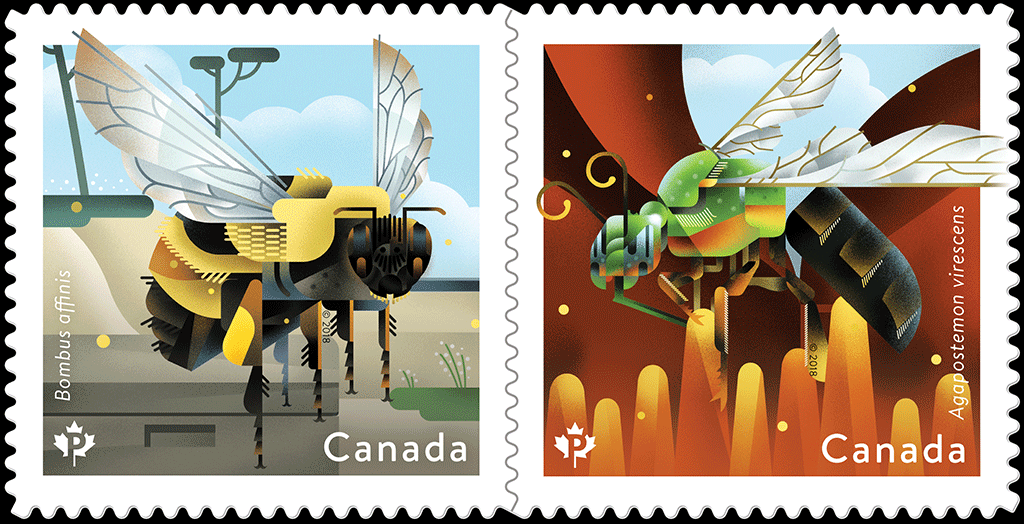
When bees begin to appear, it is a sure sign that summer is on the way – and designer Andrew Perro and illustrator Dave Murray have come up with a honey of an issue to help celebrate.

Experts believe there are approximately 4,000 species of bees native to North America. Two of the more than 850 species native to Canada can be found on our latest stamp issue.

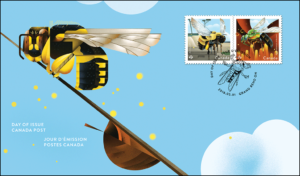
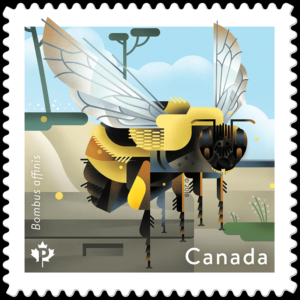
The rusty-patched bumble bee (Bombus affinis), once common in parts of Ontario and Quebec, was the first bee species to be listed by the Committee on the Status of Endangered Wildlife in Canada (COSEWIC). The metallic green bee (Agapostemon virescens), one of many sweat bee species, digs its nest in the ground and can be found throughout southern Ontario. The Official First Day Cover features another Canadian native – a small eastern resin bee (Anthidiellum notatum), which constructs a unique nest from resin and gravel.

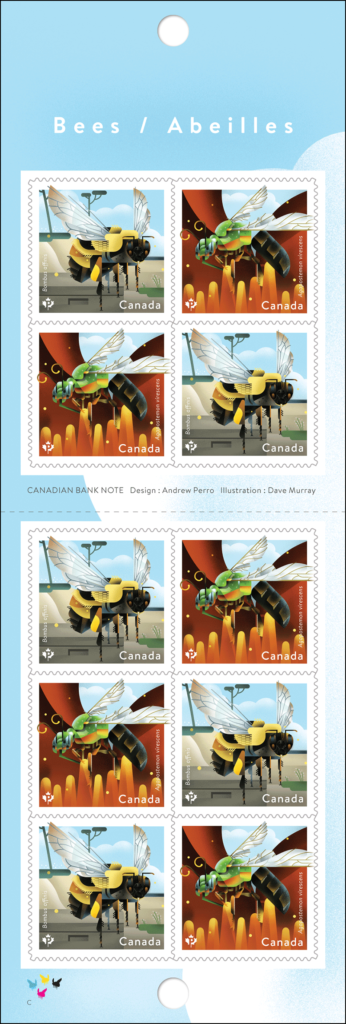
This issue’s distinctive design is bound to create some buzz. Don’t get stung – get yours now!

Updated May 1:

[press release]
Bold and beautiful, bee stamps pay tribute to native pollinators

GRAND BEND, ON, May 1, 2018 /CNW/ – With spring flowers in bloom and summer coming soon, Canada Post unveiled a pair of stamps that are sure to create a buzz – as much for their unique design as for the subject they celebrate.
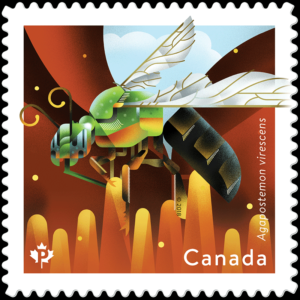
Two native bees appear in the new issue, including the extremely rare rusty-patched bumble bee (Bombus affinis) and its colourful and more common co-star, a metallic green bee (Agapostemon virescens). Both are featured on the Official First Day Cover, which is cancelled in Grand Bend, Ontario, near Pinery Provincial Park – the last known location of a rusty-patched bumble bee in Canada.

Once common in parts of southern Ontario and Quebec, the rusty-patched bumble bee was the first bee species to be assessed as Endangered by the Committee on the Status of Endangered Wildlife in Canada. In contrast, the metallic green bee – often spotted carrying loads of pollen on its back legs – is still found throughout southern Canada.
There are approximately 4,000 species of bees native to North America and more than 850 native to Canada. Many bee populations, however, are in decline due to habitat loss, pesticide use and climate change. Canadians can do their part to help nurture their numbers by planting native flowers, allowing more of their property to grow wild, and avoiding the use of pesticides and chemical fertilizers.

The stamps were designed by Andrew Perro of Toronto and illustrated by Dave Murray, a Toronto artist known for his cubist takes on portraits and pop culture, based on detailed information and images from some of Canada’s foremost bee experts.

Queen Elizabeth II Coronation (Canada 2018)

Issue date: April 20, 2018

From Canada Post’s Details magazine:

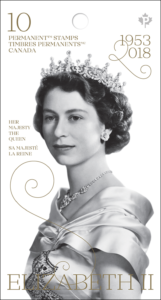
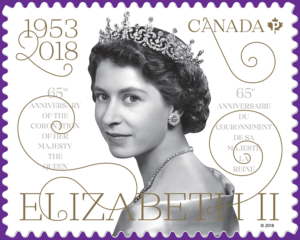
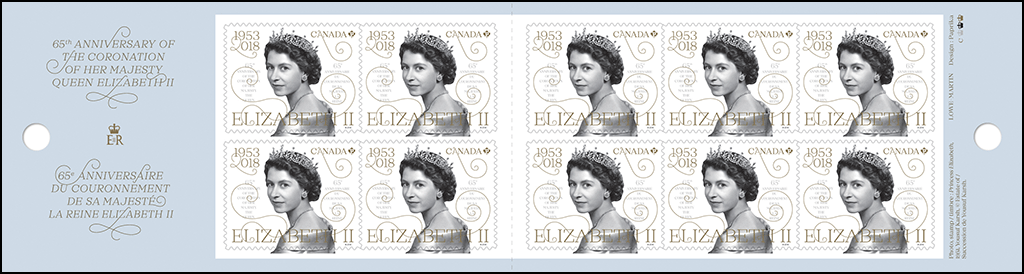
June 2 of this year marks the 65th anniversary of the coronation of Her Majesty Queen Elizabeth II – the longest reigning monarch in British history. Many “more mature” Canadians will recognize the Karsh photo on the cover of the stamp booklet from a series of five coronation stamps issued in the spring of 1953.
The portrait on this new stamp is from a famous sitting in July 1951, when the Queen was still known as Her Royal Highness Princess Elizabeth. Over a period of more than 40 years, Karsh photographed Her Majesty on five occasions, two of them before she became Queen.

One of the world’s most photographed women, Queen Elizabeth has had her likeness captured by some of the world’s most famous portrait photographers, including Dorothy Wilding, Lord Snowdon, Cecil Beaton and Annie Leibovitz. It is this image by Armenian-Canadian Yousuf Karsh, however, that is best known to generations of Canadians.

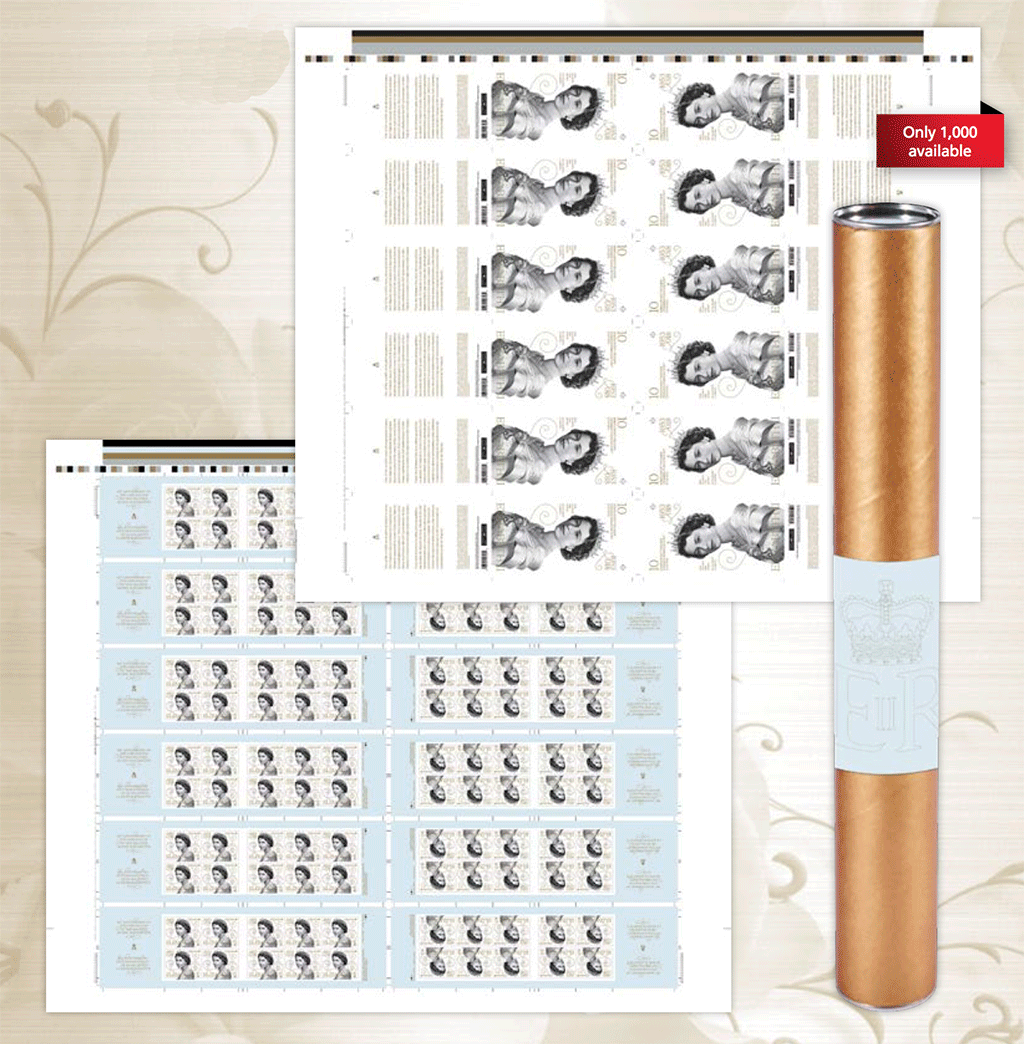
Canada Post also says this issue features something new: “This double-sided uncut press sheet, our first to feature stamp booklets, showcases the front, back and inside panels of 12 self-adhesive stamp booklets celebrating the 65th anniversary of the coronation of Her Majesty Queen Elizabeth II.” Item #414083149 is $102. Only 1,000 available.
[press release April 20th]
New stamp celebrates 65-year reign of Queen Elizabeth II, longest-reigning sovereign in Canada’s modern era

OTTAWA, April 20, 2018 /CNW/ – Canada Post’s latest stamp features a portrait of then-Princess Elizabeth months before her accession to the throne. The image is part of a series of famous pictures taken by renowned Canadian photographer Yousuf Karsh in 1951.

Her Excellency the Right Honourable Julie Payette, Governor General of Canada, along with Jessica L. McDonald, Chair of the Board of Directors and Interim President and CEO of Canada Post, unveiled the stamp during a ceremony at Rideau Hall.

At 25, Elizabeth became Queen when her father, King George VI, died in the winter of 1952. Her coronation was delayed to allow for an appropriate mourning period. The coronation took place in Westminster Abbey on June 2, 1953. Three million people lined the streets of London along the procession route. Canadians celebrated with fireworks, parades and horse races; and the Governor General issued a silver spoon to each Canadian child born on coronation day.
An estimated 227 million people around the world watched the coronation, which was the first to be televised. Other firsts followed:

  • Queen Elizabeth was the first monarch to be crowned Queen of Canada.
  • She was the first British monarch to visit Australia and New Zealand.
  • On her first Royal Tour of Canada in 1957, she became the first sovereign to open Parliament by reading the Speech from the Throne.
  • The Queen has made 22 Royal Tours of Canada – more than any other nation in the Commonwealth.
  • In 2007, she became the longest-living British monarch and in 2015 she became Britain’s longest-reigning monarch.

Added July 3rd, from Canada Post:
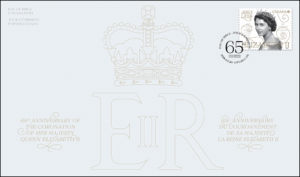
The Official First Day Cover featuring the stamp for the 65th anniversary of the coronation of Her Majesty Queen Elizabeth II contains a typo in the French text on the reverse. It reads that 2017 marks the anniversary of the coronation; the correct year is 2018. Canada Post apologizes for the error.

War Memorials (Australia 2018)

[press release]
Australia Post features war memorials on latest stamp issue
Issue Date: April 10, 2018

In the lead up to Anzac Day, Australia Post is releasing a commemorative stamp issue that recognises the significance and diversity of war memorials.In the lead up to Anzac Day, Australia Post is releasing a commemorative stamp issue that recognises the significance and diversity of war memorials.

Australia Post Philatelic Manager Michael Zsolt said war memorials began to appear in different forms following the immense loss of life during World War I.

“Each memorial stands as a symbol of sacrifice – a place to reflect upon the impact of war and to honour those who have died serving their country or are serving today,” Mr Zsolt said.

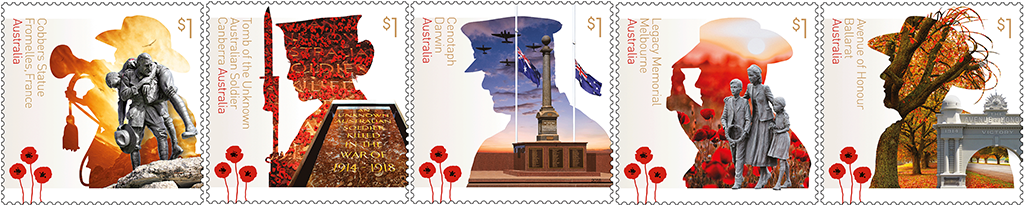
This stamp issue, created by Visua founder Gary Domoney, is the fifth and final in the five-year series, A Century of War, which focuses on the Australian experience of war across the last century, since WWI.

The memorials featured on the base-rate ($1) stamps are:

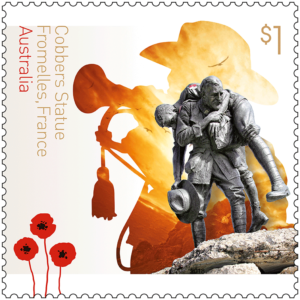
  • Cobbers Statue – the Australian Memorial Park in Fromelles, France. The statue, sculpted by Peter Corlett, is in memory of the fallen soldiers of the Battle of Fromelles on 19 July 1916. It depicts Sergeant Simon Fraser, 58th Battalion, carrying a wounded man on his back. The word “Cobber” was used by Fraser in a letter he wrote in 1916, in which he described the rescue of two men: “Then another man about 30 yards sang out, ‘Don’t forget me, cobber’. I went in and got four volunteers with stretchers, and we got both men in safely.”
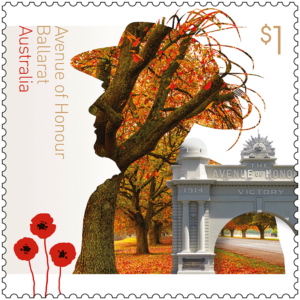
  • Avenue of Honour, Ballarat – the longest and one of the earliest memorial tree plantings of its type, spanning 22 kilometres and incorporating the Ballarat Arch of Victory. The Ballarat memorial is one of 547 known avenues of honour in Australia, and commemorates all service personnel equally, in order of enlistment rather than rank. It was created to honour the 3,912 Ballarat district men and women who served in WWI.
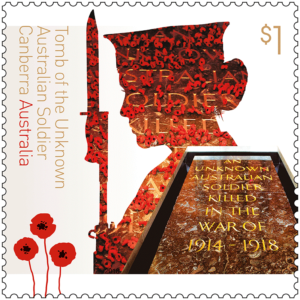
  • Tomb of the Unknown Australian Soldier, Canberra – located in the Hall of Memory at the Australian War Memorial, it holds the remains of an unknown soldier who died on the Western Front and bears the simple inscription “An Unknown Australian Soldier Killed in the War of 1914–1918”. The tomb symbolises the 23,000 Australian soldiers killed in WWI and whose bodies were never recovered and returned, but lie in the ground far from their home.
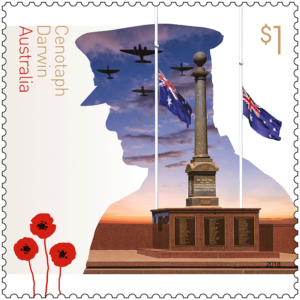
  • Darwin Cenotaph – commemorates Australian personnel who have served in all conflicts since WWI and was the first such memorial in the Northern Territory, dedicated in 1921. It has been relocated several times and now overlooks the Darwin Harbour, the site of the Japanese air attack during World War II, on 19 February 1942. It is located on the site where the 14th Anti-Aircraft Battery was positioned when it fired the first shots in defence of Australia on Australian soil.
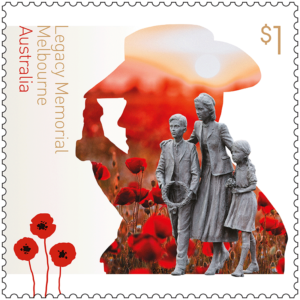
  • Legacy Memorial, Melbourne – established by Legacy, a voluntary organisation supported by volunteers, veterans and service personnel. Legacy assists approximately 65,000 families of veterans who have died or been incapacitated by their military service. The statue Widow and Children, sculpted by Louis Larmen, is a memorial to those who serve and those who bear the scars of war at home. It is set in the Legacy Garden of Appreciation at the Shrine of Remembrance.

The products available with this stamp issue are a minisheet, stamp pack, first day cover, maxicard set, booklet of 10 x $1.00 stamps, medallion cover, prestige booklet, prestige cover and 2 x postal and numismatic covers.

The War Memorials stamp issue is available from 10 April 2018 at participating Post Offices, via mail order on 1800 331 794 and online at auspost.com.au/stamps while stocks last. Please visit auspostcollectables.com.au for more information on the War Memorials stamp issue.

Finches (Australia 2018)

[press release]
Colourful Australian finches highlighted in new stamps
Issue date: March 16, 2018

Australia Post is celebrating the diverse beauty of Australian finches in its latest stamp issue, which features colourful illustrations of the small birds.Australia Post’ is celebrating the diverse beauty of Australian finches in its latest stamp issue, which features colourful illustrations of the small birds.

Australia is home to 19 species of native finch, including firetails and mannikins. These beautiful birds belong to the Estrildidae family of the Passeriformes order, an extensive grouping of songbirds. Also known as grass-finches, they are distinctive in appearance, making some of them popular as aviary birds. Australia’s finches are separate from the Ploceidae family, or the “true finches”, which occur in the Americas, Eurasia and Africa.

Ornithologist Wayne Longmore, who consulted on the stamp issue, said: “Australian finches are varied, colourful and full of character; these four stamps represent those three things, and they include both the unusual and common.”

The four domestic base-rate ($1) stamps, designed by John White of the Australia Post Design Studio, feature the illustrations of wildlife artist Kevin Stead, who is a frequent contributor to Australian Geographic magazine.

The stamps in this issue feature the following species:

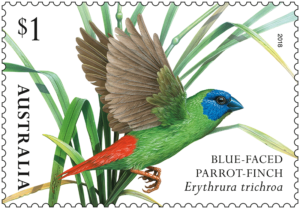
  • The Blue-faced Parrot-Finch (Erythrura trichroa) has some 10 subspecies across Australia, Melanesia and Micronesia. It is renowned for its blue face and bright green body. In Australia, its territory is restricted to just the eastern side of Cape York Peninsula, as far south as Cairns.
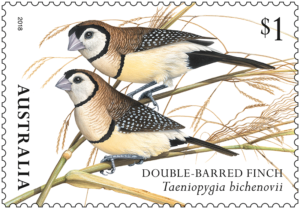
  • The Double-barred Finch (Taeniopygia bichenovii) takes its name from the two narrow black bands across its pale chest and encircling much of its face. The Double-barred Finch stays close to surface water and occupies a range of habitats, including pandanus, long grasses, open forests, scrublands and grassy woodlands.
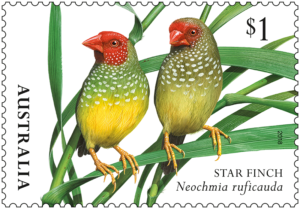
  • The Star Finch (Neochmia ruficauda) is a brightly coloured species, with great individual variation in its plumage. It is mainly olive green with a scarlet face and white spots on its underparts and tail, but the depth of scarlet on the face and the number and size of its spots varies by bird. Always close to water, the Star Finch prefers tall, rank grasses, swamp rushes and moist green vegetation.
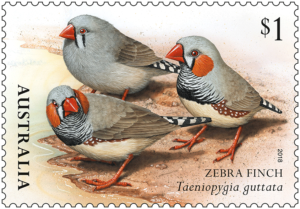
  • The Zebra Finch (Taeniopygia guttata) is named for the adult male’s finely barred black-and-white chest and more heavily barred tail. It also has a conspicuous orange ear patch below a blue-grey brow and a bright orange beak. This species covers most of continental Australia and as such has a varied habitat, including rank grass, spinifex tussocks and mulga woodlands, as well as urban parks and backyards.

The products available with this stamp issue are a first day cover, stamp pack, maxicard set, booklet of 10 x $1 stamps and a roll of 100 x $1 stamps. The Australian Finches stamp issue is available at participating Post Offices, via mail order on 1800 331 794 and online at auspost.com.au/stamps, while stocks last.

Visit auspostcollectables.com.au for more information on the Australian Finches stamp issue.