Happy Birthday (US 2026)

Announced by the USPS on February 17, 2026:

For the first time since 2021, the Postal Service will issue a stamp designed especially for birthday invitations, cards, letters and packages. “I am excited that we are issuing new Happy Birthday stamps. Many customers have submitted ideas for occasion-specific stamps such as these and we are pleased to be able to fulfill this request from the public,” said Lisa Bobb-Semple, USPS stamp services director. Lisa Congdon designed the stamp using her own artwork. The project was art directed by Greg Breeding.

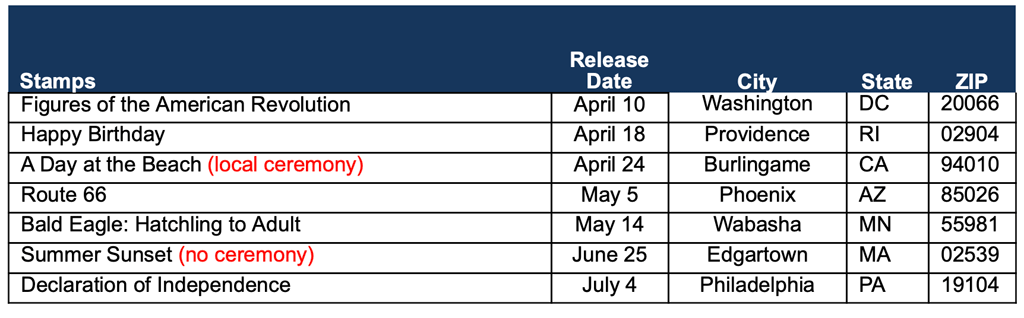
This stamp will be issued April 18 in Providence, RI. Additional information will appear below the line, with the most recent at the top.


Updated May 29th:
The Scott catalogue number for this issue is 6069.

Updated May 20th:
The Technical Details incorrectly provided a size for this issue’s press sheets. There were no press sheets for this issue. That information has now been deleted from the list below.

Updated April 15th:
Technical Specifications:

Issue: Happy Birthday Stamp
Item Number: 582200
Denomination & Type of Issue: First-Class Mail Forever®
Format: Pane of 20 (1 design)
Series: N/A
Issue Date & City: April 18, 2026, Providence, RI 02904
Art Director: Greg Breeding, Charlottesville, VA
Designer: Lisa Congdon, Portland, OR
Artist:: Lisa Congdon, Portland, OR
Modeler: Sandra Lane / Michelle Finn
Manufacturing Process: Offset, Microprint
Printer: Banknote Corporation of America
Press Type: Alprinta 74
Stamps per Pane: 20
Print Quantity: 40,000,000 stamps
Paper Type: Phosphor, Block Tag
Adhesive Type: Pressure-sensitive
Colors: Custom Blue, Magenta, Yellow, Black
Stamp Orientation: Vertical
Image Area (w x h): 0.7700 x 1.0500 in. / 19.5580 x 26.6700 mm.
Overall Size (w x h): 0.9100 x 1.1900 in. / 23.1140 x 30.2260 mm.
Full Pane Size (w x h): 5.7600 x 5.5500 in. / 146.3040 x 140.9700 mm.
Plate Size: 320 stamps per revolution
Plate Number: “B” followed by four (4) single digits
Marginal Markings:
Front: Plate number in four corners of pane
Back: © 2026 USPS • USPS logo • Two barcodes (582200) • Plate position diagram (8) • Promotional text

Updated April 12th:
The philatelic products for this issue include wrapping paper, four designs, 24″x36″, for $18.95

Updated March 30th:
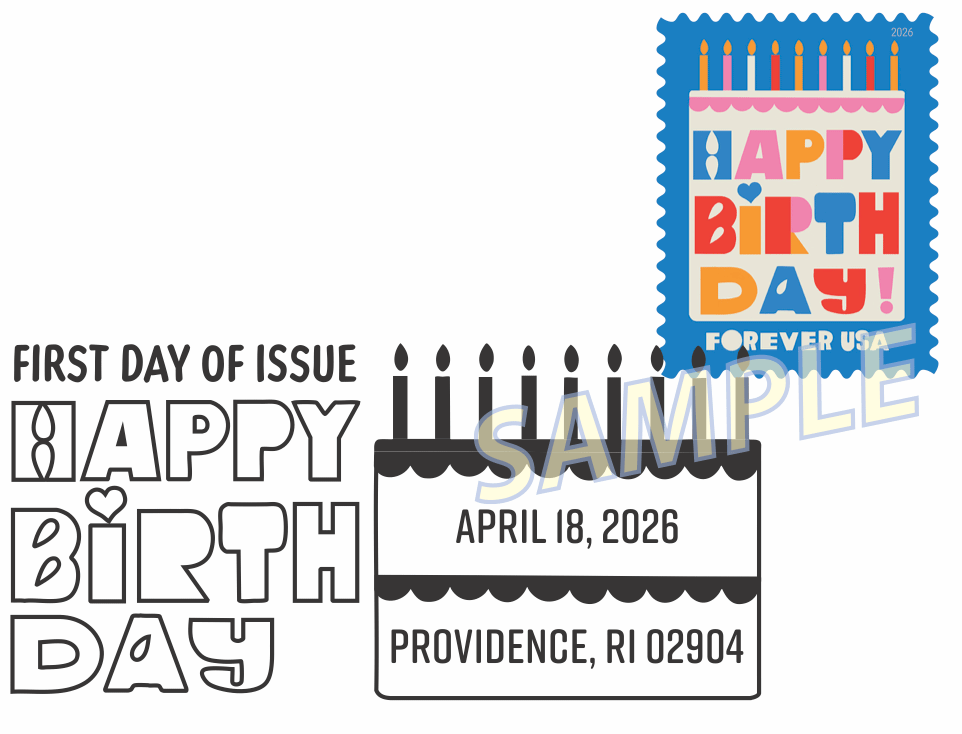
Here are the first-day postmarks for this issue: The Digital Color Postmark measures 2.91″ x 1.43″The Pictorial Postmark measures 2.50″ x 1.18″

Updated March 26th:
Although the first-day postmarks were shown in the Postal Bulletin a week ago, I’m told they are not yet finalized and so the larger, clearer versions are not yet available for us.

Updated March 19th:
On April 18, 2026, in Providence, RI, the United States Postal Service® will issue the Happy Birthday stamp (Forever® priced at the First-Class Mail® rate), in one design, in a pressure-sensitive adhesive (PSA) pane of 20 stamps (Item 582200). This stamp will go on sale nationwide April 18, 2026, and must not be sold or canceled before the first-day-of-issue.

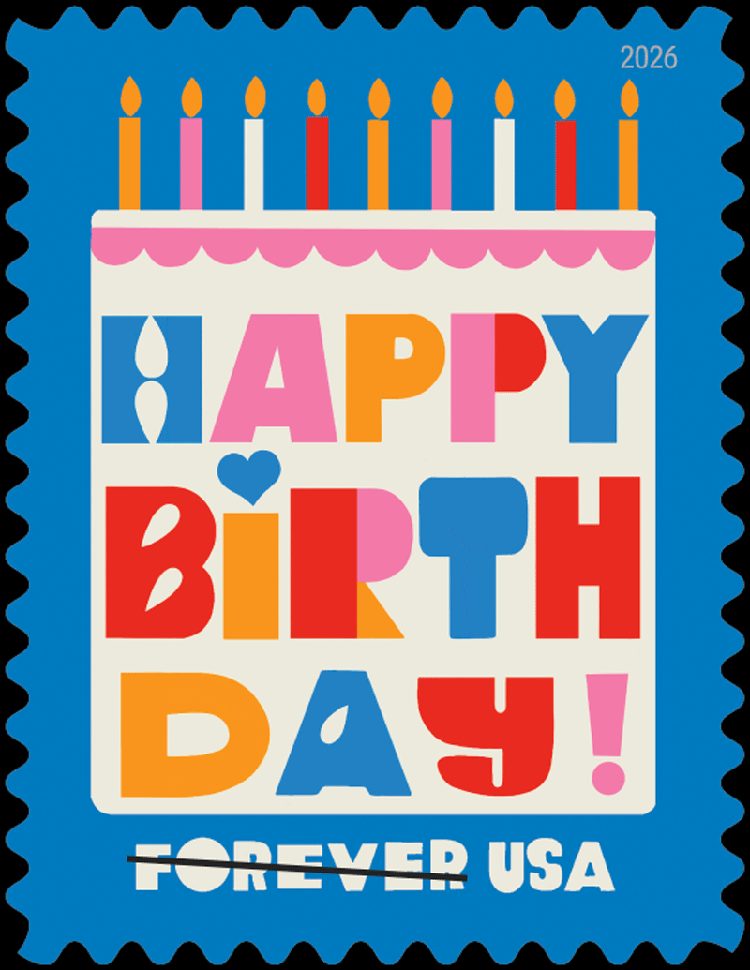
For the first time in five years, USPS® will issue a stamp designed especially for birthday invitations, cards, letters, and packages. The stamp features an illustration of an oversized white birthday cake with bright and colorful candles and capital letters spelling out HAPPY BIRTH DAY! on three lines. Lisa Congdon designed and illustrated the stamp. Greg Breeding was the art director.

No automatic distribution.

How to Order the First-Day-of-Issue Postmark:
The first-day-of-issue postmark is a postmark notating the day a stamp is first authorized for use by the Postal Service™. Customers have 120 days to obtain the first-day-of-issue postmark by mail. All requests for first-day-of-issue postmarks (Traditional or Digital Color Postmark) must be sent to the following address with the choice of Traditional or Digital Color Postmark identified. All orders must be postmarked by August 18, 2026.

FDOI – Happy Birthday Stamp
USPS Stamp Fulfillment Services
8300 NE Underground Drive, Suite 300
Kansas City, MO 64144-9900

Technical specifications are not yet available.

Updated March 10th:
[ceremony details] [click on any of the pictures for larger versions]
The Postal Service Says Happy Birthday!

What: The U.S. Postal Service is commemorating the annual celebration that everyone enjoys with a new Happy Birthday stamp. The stamp will be released at the first Perfect Pairing Pop-Up Party — an event that is being planned and hosted by the Greeting Card Association.

The first-day-of-issue event is free and open to the public.

When: Saturday, April 18, 2026, at 11 a.m. Eastern

Where: Track 15 [a restaurant]
1 Union Station
Providence, RI 02903

RSVP: Attendees are encouraged to register at usps.com/happybirthdaystamp.

Background: The new Happy Birthday stamp will be the fifth stamp issued by the Postal Service specifically designed to light up birthday invitations, cards, letters and packages. As a Forever stamp, it will always be equal in value to the current First-Class Mail 1-ounce price.

News about the stamp is being shared with the hashtag #HappyBirthdayStamp.

US Adds Spring Dates, 2 Issues (US 2026)

[press release] [click on any of the pictures for larger versions]
Happy Birthday Stamps Make A Come Back in 2026
First-day-of-issue dates, locations for spring and early summer releases also revealed
WASHINGTON — The U.S. Postal Service today announced two new stamps to be released later in 2026: Happy Birthday and a nonprofit-price stamp featuring a summer sunset. Additional stamp subjects will be announced in the coming weeks and months. These designs are preliminary and may change.

Happy Birthday
For the first time since 2021, the Postal Service will issue a stamp designed especially for birthday invitations, cards, letters and packages. “I am excited that we are issuing new Happy Birthday stamps. Many customers have submitted ideas for occasion-specific stamps such as these and we are pleased to be able to fulfill this request from the public,” said Lisa Bobb-Semple, USPS stamp services director. Lisa Congdon designed the stamp using her own artwork. The project was art directed by Greg Breeding.

Summer Sunset
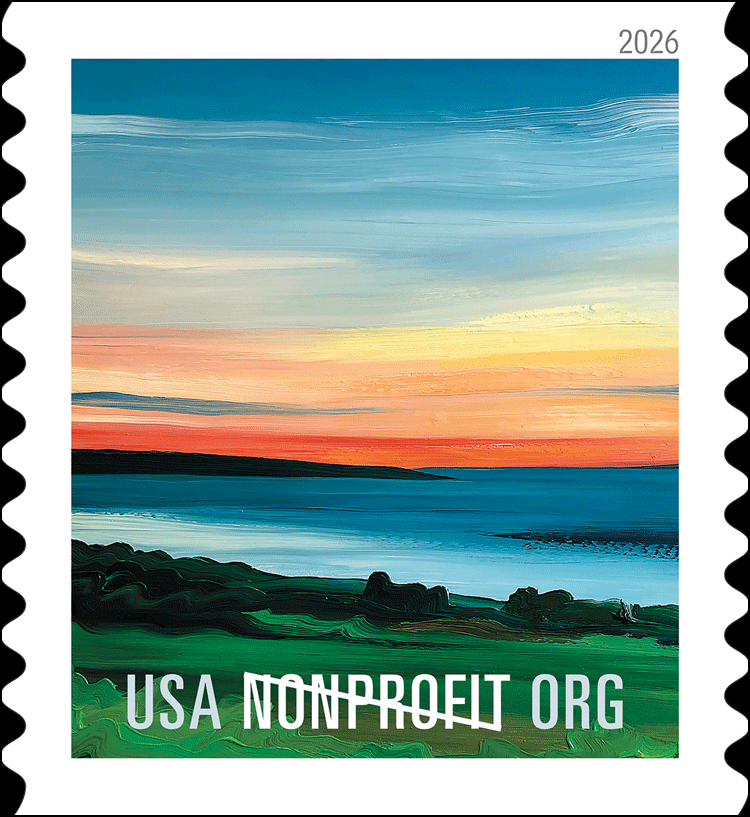
Summer Sunset is a new nondenominated, nonprofit-price stamp intended for bulk mailings by authorized nonprofit organizations. The stamp features an oil painting of a sunset in Menemsha, a small fishing village in the town of Chilmark, MA, on Martha’s Vineyard by local artist Rachael Cassiani. “Sunsets are universally appealing,” said Derry Noyes, an art director for USPS who designed the stamp. “A postage stamp that celebrates looking out over a body of water at the end of a summer day seems to fit well for a nonprofit organization.” Summer Sunset will be sold in self-adhesive coils of 3,000 and 10,000.

The U.S. Postal Service also announced release dates and locations for many stamp issues in spring and early summer.

Recurring Memories (Netherlands 2026)

[from PostNL press materials] [click on any of the pictures for larger versions]
New Dutch Design – Recurring Memories

Issue date: 16 February 2026
Format: Sheet of 6 special stamps in 2 different designs, with denomination 1 for mail up to 20 grams within the Netherlands
Item number: 460261
Design: Nicole Uniquole in collaboration with second-year Graphic Design students at ArtEZ, University of the Arts (Zwolle)

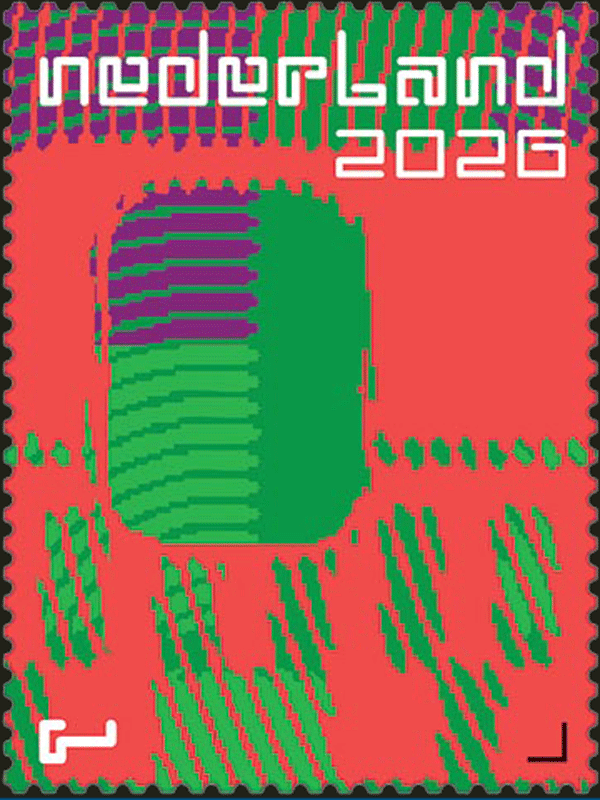
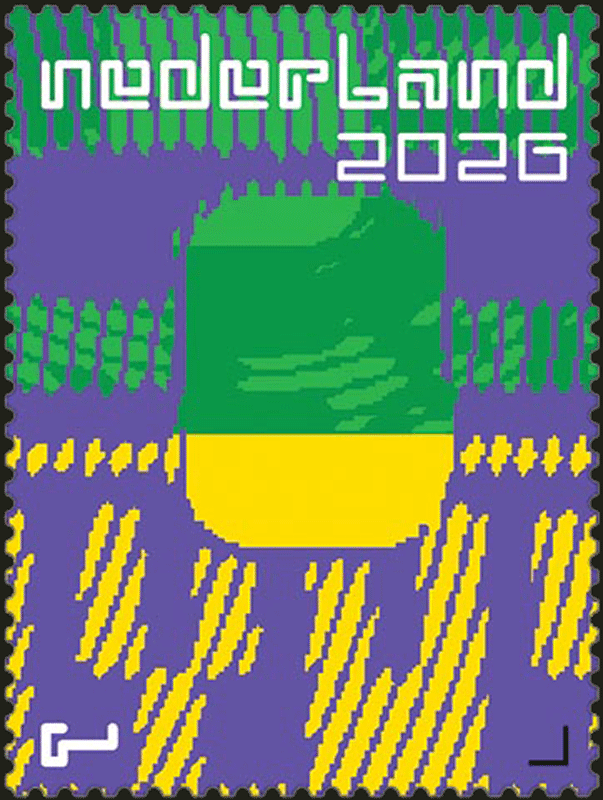
On 16 February 2026, PostNL will issue the stamps New Dutch Design – Recurring Memories, the first stamp sheet this year in the New Dutch Design series, which showcases work by the next generation of Dutch graphic designers. The design was created during the 2024–2025 academic year by second-year Graphic Design students at ArtEZ in Zwolle, in collaboration with Nicole Uniquole. The stamps bear denomination 1 for mail up to 20 grams within the Netherlands.

The New Dutch Design series is once again dedicated to the theme of ‘celebration’, expressed through colour and form. Each year, second-year students are free to interpret this theme in their own way. For the 2025 stamps, students explored the theme through various ‘rituals’. For 2026, the new group of students chose the call to ‘make it bold’. With 4 different stamp designs, they invite us to pause, let go, remember, and above all celebrate life.

The first issue is titled Recurring Memories. Later this year, the series will include Taste the Atmosphere (11 May), Glow of the Moment (10 August), and Echo of the Party (28 September). Each stamp bears denomination 1 for mail up to 20 grams within the Netherlands. The price for a sheet of 6 stamps is €8.40 (US$10.00).

Design
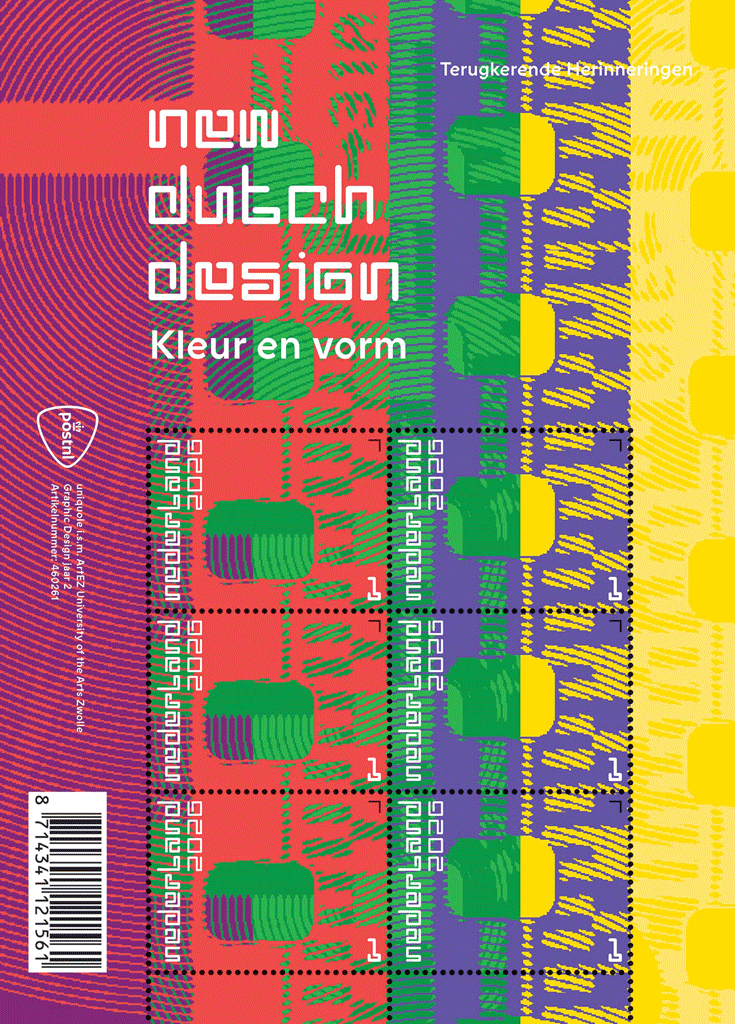
Recurring Memories is dominated by a large, full-bleed graphic illustration. The image combines a scanned and highly enlarged strip of photographic film with a pattern of concentric circles. This pattern appears in various places and intersects the film strip in different ways. The sheet contains 6 stamps in 2 designs, each featuring the transport perforation of the film strip in a central role. The perforation appears in different positions, colours, and details in the 2 designs. The scanned edge of the film strip on the right side of the stamps also varies. The 3 stamps on the left are mainly green and orange, while the 3 on the right feature green, blue, and yellow. These colours are repeated on the sheet border. On the left border, the circle pattern appears in purple and orange; on the right, the scanned film edge is shown in light and dark yellow. The colours and patterns of the stamps continue across the top border and the tabs below.

All 21 students at second-year Graphic Design students at ArtEZ contributed intensively to the concepts and designs. Curator Nicole Uniquole guided the students on behalf of PostNL, organising inspiration sessions and a visit to the National Archives, where the design process of nearly all Dutch stamps is documented.

Uniquole says what she values most is guiding the next generation of graphic designers on a real project: “Not just an exercise on paper, but a PostNL stamp that will soon be in the shops. I love immersing students in real-world design practice: with real deadlines, real choices, real impact,” she said. ” For students, this is both portfolio and practical experience: an official stamp on their CV that the Netherlands will use for postage. Education and practice merge here. You see the new generation grow as their concepts move towards production. Being able to offer that with PostNL is fantastic.”

One of the ideas that contributed to the design was childhood memories. “During brainstorming, we landed on the analogue film roll,” said student Eline van de Streek. “While photography is almost always digital today, it wasn’t in the past — even when our generation was growing up. Our parents mainly took analogue photos of us as children. So these are literally memories of our youth.”

The design focuses on the film roll itself, not the images recorded on it.

Student Aliesje de Blok sees a revival: “I often see people with analogue cameras, especially young people. I do it too—it’s great fun.” And Soof van de Weg explains why: “Analogue photos have a glow, a magic that modern cameras can’t capture.”

Technical Data:
Stamp size: 40 x 30 mm
Sheet size: 122 x 170 mm
Paper: standard with phosphor coating
Gumming: gummed
Printing technique: offset
Colours: cyan, magenta, yellow, and black
Print run: 75,000 sheets
Format: sheet of 6 stamps in 2 different designs
Denomination: 1 for mail up to 20 grams within the Netherlands
Design: Nicole Uniquole in collaboration with second-year Graphic Design students at ArtEZ, University of the Arts (Zwolle)
Printer: Koninklijke Joh. Enschedé B.V., Haarlem
Item number: 460261

Note: PostNL does not sell directly to collectors in North America. Its website refers to a company called Nordfirm, which says it sells Dutch new issues at face value. The Virtual Stamp Club has no connection to this company.

Collectors may also wish to contact the U.S. firm Bombay Stamps, which can also obtain first day covers upon request, with lower shipping fees. The email is sales@bombaystamps.com Again, The Virtual Stamp Club has no connection to this company.

Hornby Model Trains (UK 2026)

[press release] [click on any of the pictures for larger versions]
All Aboard: Royal Mail Reveals Stamps Honouring Iconic Hornby Model Railways

  • Issue date: 19 February (but not in any post offices until 27 February)
  • The main set of eight stamps features specially commissioned photography of Hornby models
  • A further four stamps, presented in a miniature sheet, showcase Hornby’s heritage with nostalgic designs featuring classic packaging, catalogue covers and promotional artwork
  • The stamps and a range of collectible products are available to pre-order now at www.royalmail.com/hornby and by telephone on 03457 641641

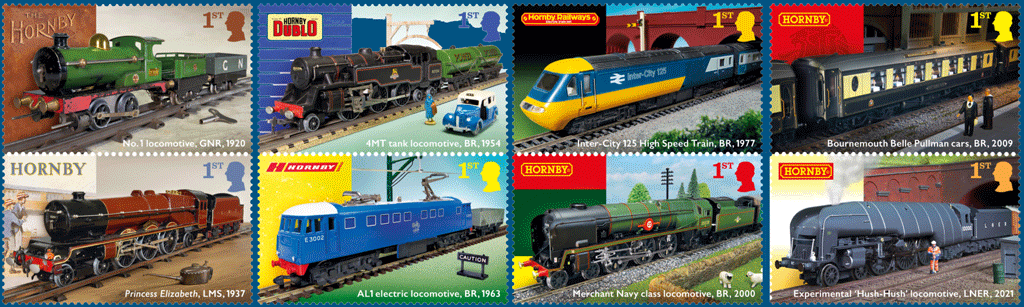
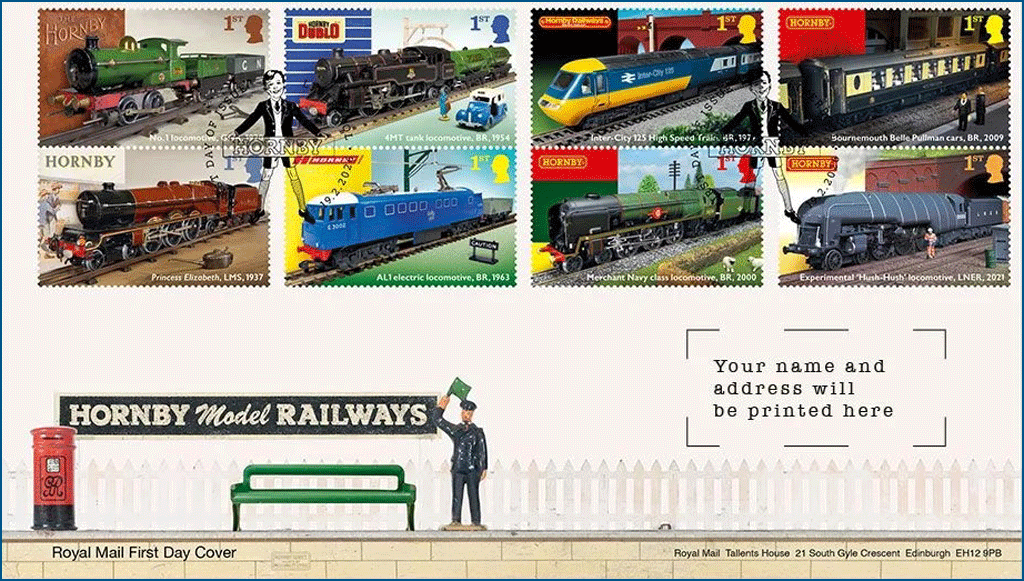
Royal Mail is issuing a set of 12 stamps to celebrate the world of Hornby Model Railways, a brand that has shaped British hobby culture for over a century.

Frank Hornby, the inventor of Meccano, produced his first clockwork Hornby Series trains in 1920. In 1929 the first models representing real British locomotives arrived.

Each stamp features an exclusive photograph of an iconic Hornby model, specially commissioned by Royal Mail.

Stamps in the set are:

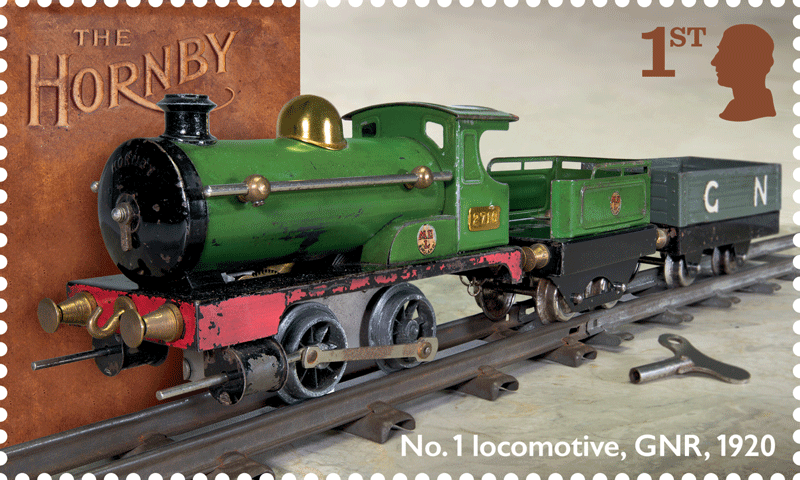
  • No.1 locomotive, GNR (1920)
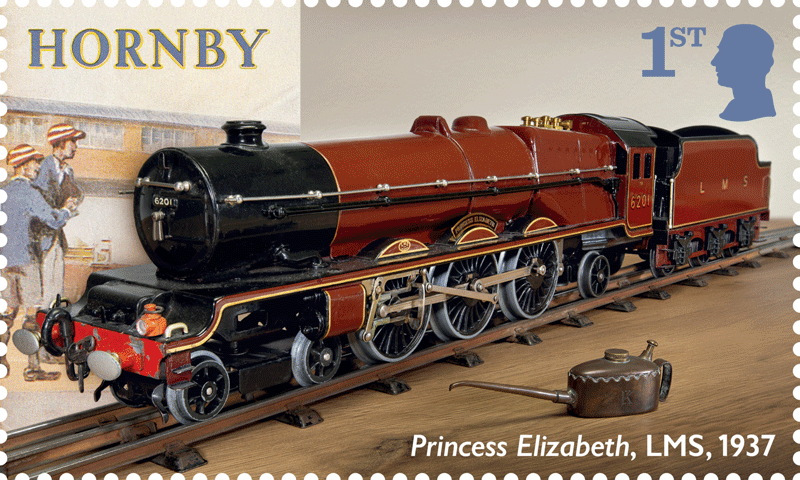
  • Princess Elizabeth, LMS (1937)
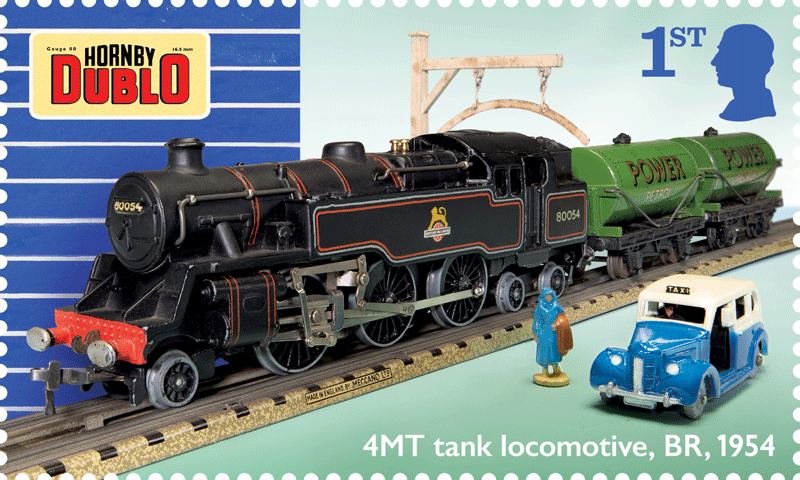
  • 4MT tank locomotive, BR (1954)
  • AL1 electric locomotive, BR (1963)
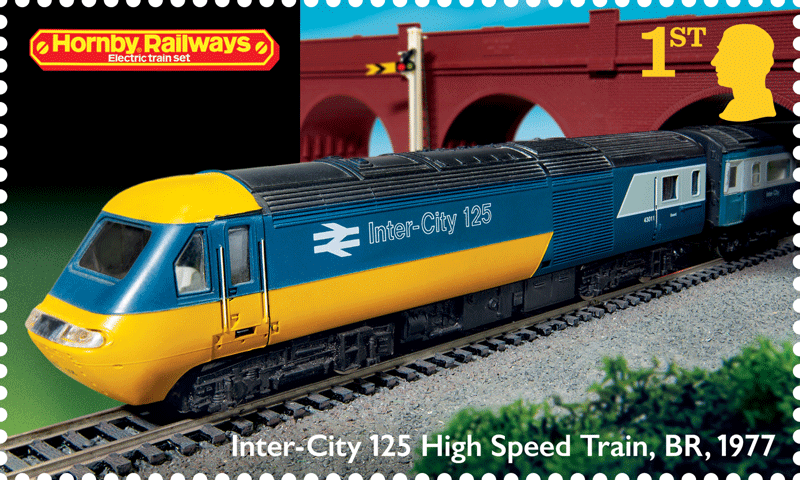
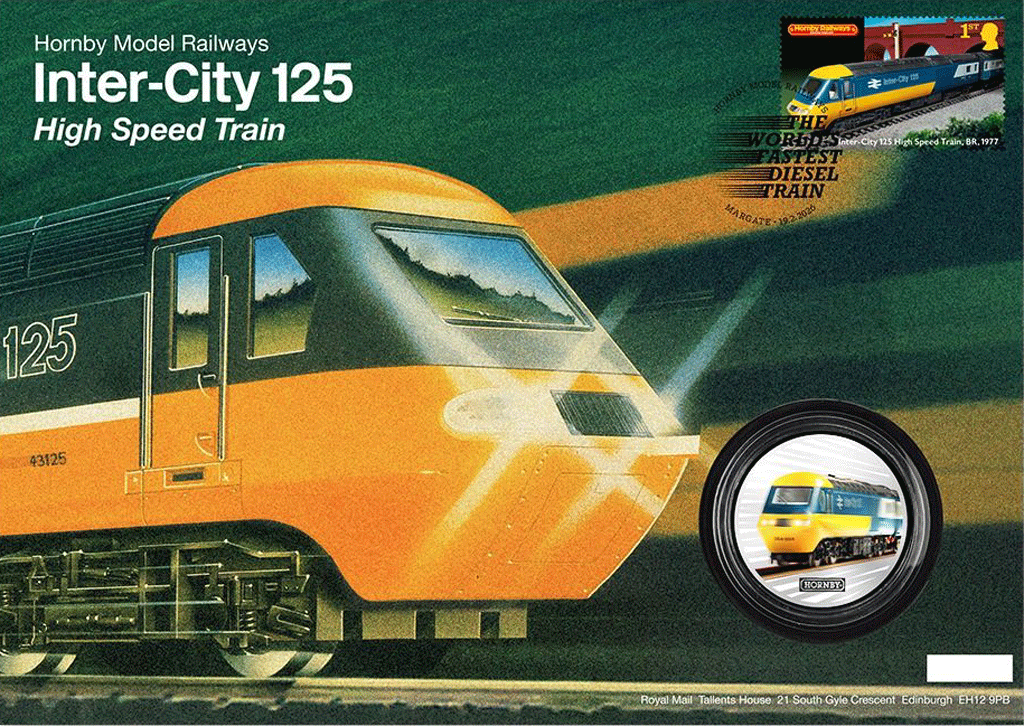
  • InterCity 125 High Speed Train, BR (1977)
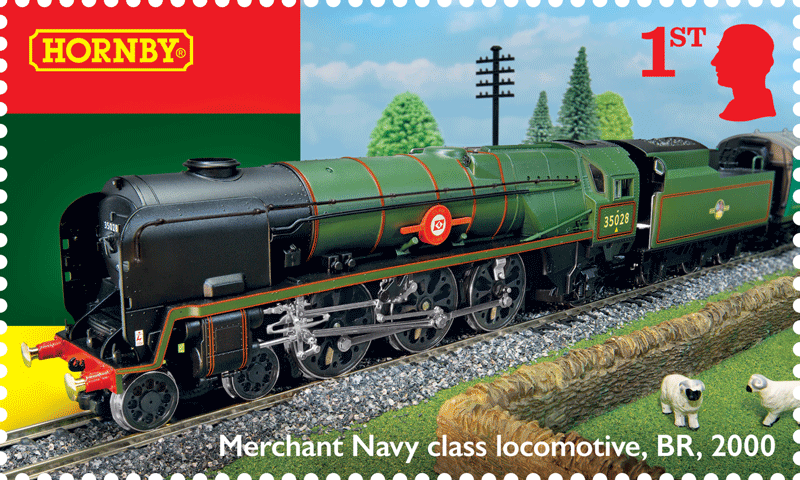
  • Merchant Navy class locomotive, BR (2000)
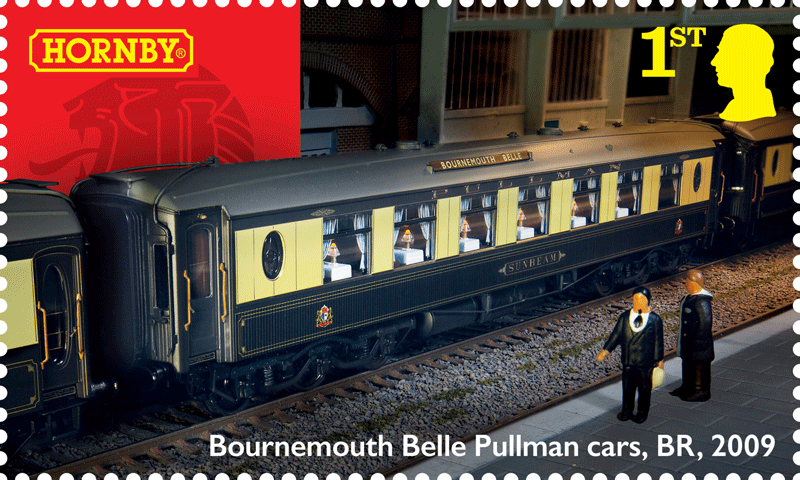
  • Bournemouth Belle Pullman cars, BR (2009)
  • Experimental ‘Hush-Hush’ locomotive, LNER (2021)

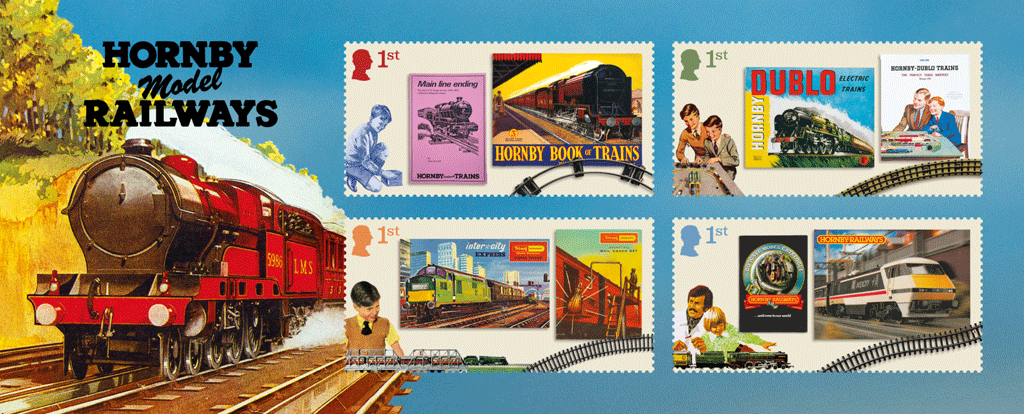
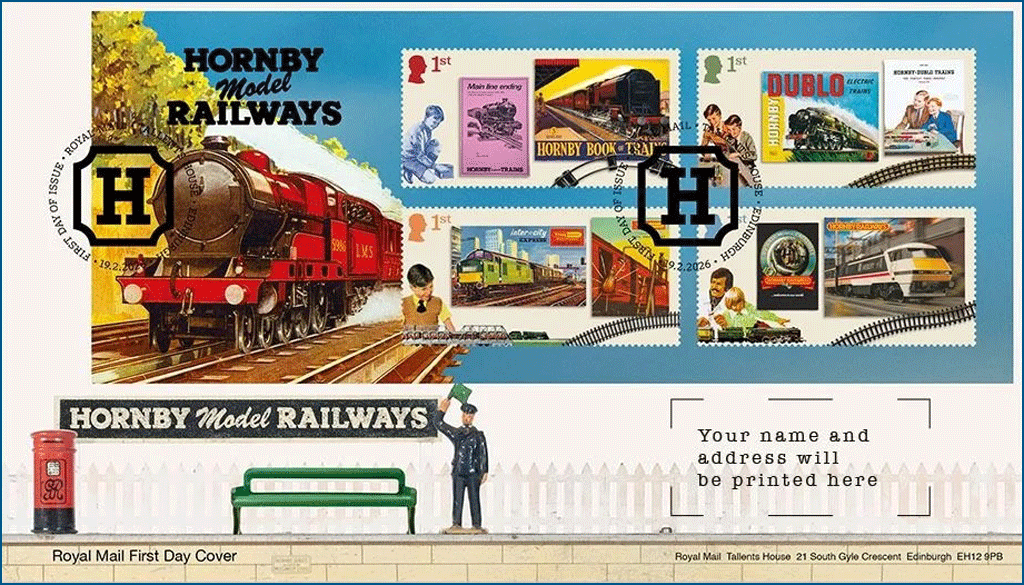
An additional four stamps presented in a vibrant miniature sheet celebrate the rich heritage of Hornby through four nostalgic designs, each featuring classic packaging, catalogue covers and promotional artwork from different eras.
The stamps are set against an illustration of a London, Midland and Scottish Railway (LMS) locomotive in full steam.

Royal Mail worked with renowned model railway historian and author, Pat Hammond, on the stamp issue.

David Gold, Director of External Affairs & Policy, Royal Mail, said: “Hornby trains entertained millions, preserved the romance of rail travel, and become a cultural icon of British design and imagination. Each of these stamps celebrates a piece of history, of Hornby’s craftsmanship and its role in British culture for generations.”

Martyn Weaver, Brand MD, Hornby, said: “To see Hornby Model Railways celebrated on Royal Mail stamps is a real honour. Hornby has been part of British life for more than a century, inspiring creativity, craftsmanship and a lifelong interest in railways and modelling. These stamps recognise the enduring appeal of model railways and the role the hobby continues to play in bringing people together across generations.”

Pat Hammond, Archivist to the Train Collectors Society, said: “The Hornby brand is over 100 years old and that is a major achievement. It is part of Britain’s heritage, and long may it be so.”

Hornby Railways:
Hornby’s story began in 1920, when Frank Hornby, the inventor of Meccano, introduced his first clockwork Hornby Series trains. These 0 gauge models, crafted from pressed steel, brass and tinplate, were twice the size of today’s 00 gauge scale. By the late 1920s, Hornby had launched electrically driven train sets and in 1929 introduced models based on real British locomotives. The iconic LMS Princess Elizabeth locomotive appeared in 1937, followed by the debut of the smaller 00 gauge system, Hornby Dublo, in 1938.

The introduction of plastic mouldings and a two-rail system marked a new era, and by the late 1970s Hornby was producing highly detailed models that appealed to both children and adult enthusiasts. Highlights included the British Railways High Speed Train (HST), released in 1977, which became one of the brand’s best-selling models.

Hornby continued to innovate into the 21st century, combining heritage with cutting-edge technology. From live steam locomotives and digital control systems to collaborations with beloved brands such as Thomas and Friends and Harry Potter, Hornby has remained a leader in model railways.

Today, the company boasts an extensive tooling stock and continues to create authentic, finely detailed models that celebrate Britain’s rich railway history.

The stamps, and a range of collectible products (including the medal cover, £24.99, shown on the left), are available to pre-order now at www.royalmail.com/hornby and by telephone on 03457 641 641. A Presentation Pack including all 12 stamps is priced at £21.30. The stamps go on general sale on 19 February from Royal Mail and from 27 February in selected Post Office branches.

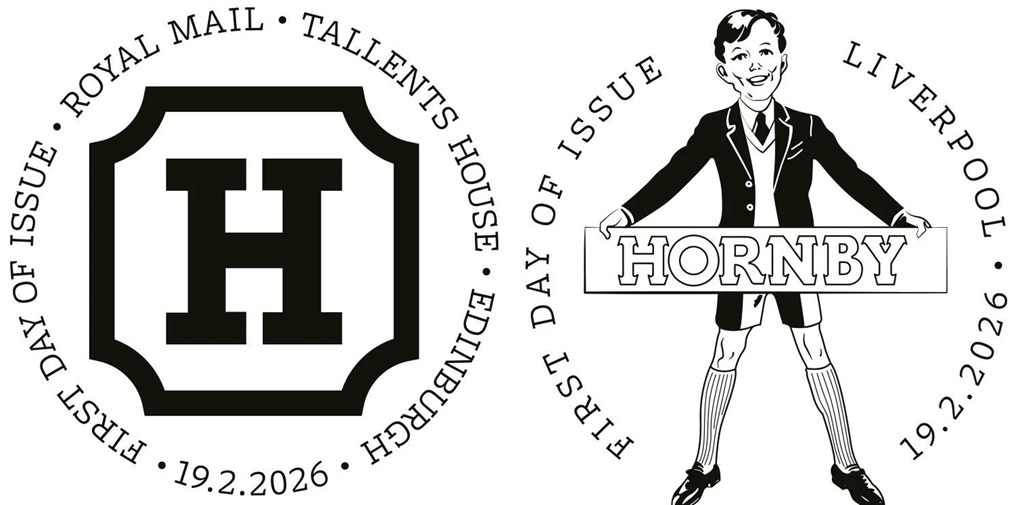
These are the two first-day postmarks offered:You can find information on last October’s Steam Locomotives issue here.

Hip-Hop Trailblazers (Canada 2026)

[press release] [click on any of the pictures for larger versions]
New stamp set pays tribute to hip-hop trailblazers Maestro Fresh Wes, Michie Mee and Muzion
This year’s Black History Month stamps celebrate early hip-hop in Canada

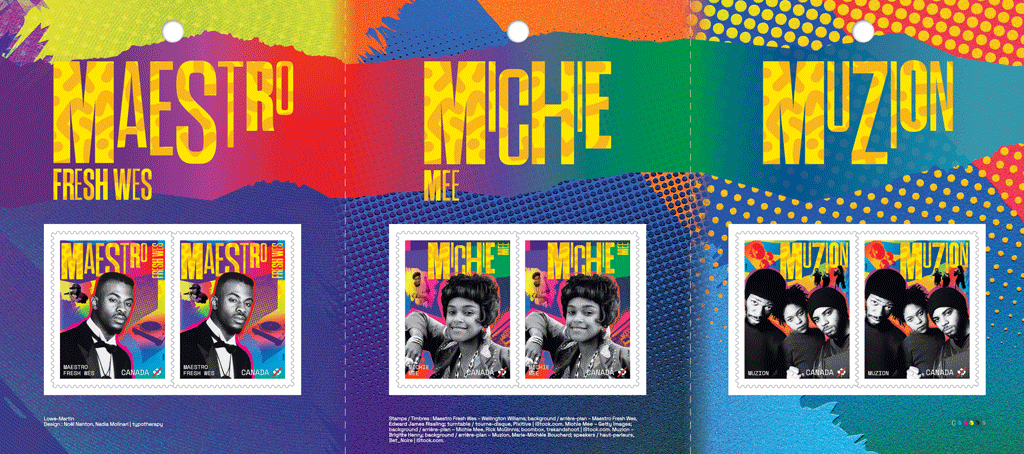
TORONTO – On January 28, 2026, Canada Post unveiled a new Black History Month stamp set celebrating the vibrant roots of hip-hop in Canada. The stamps pay tribute to three of the country’s most dynamic hip-hop trailblazers – Maestro Fresh Wes, Michie Mee and Muzion. Each of the artists is recognized for helping to shape the genre in Canada, while infusing the music with a uniquely Canadian sound.

Maestro Fresh Wes
With his 1989 debut album Symphony in Effect, Maestro Fresh Wes (b. Wesley Williams, 1968) became the first Canadian MC to break into the mainstream. The album’s monster hit single “Let Your Backbone Slide” was the first Canadian rap song to go gold, while the album itself went platinum. In 1991, the JUNO Awards introduced a new category, Best Rap Recording – Symphony in Effect took the win. Over his career, Maestro released nine studio albums and became an author, actor and motivational speaker. In 2024, he was inducted into the Canadian Music Hall of Fame and received the Governor General’s Performing Arts Award for Lifetime Artistic Achievement.

Michie Mee
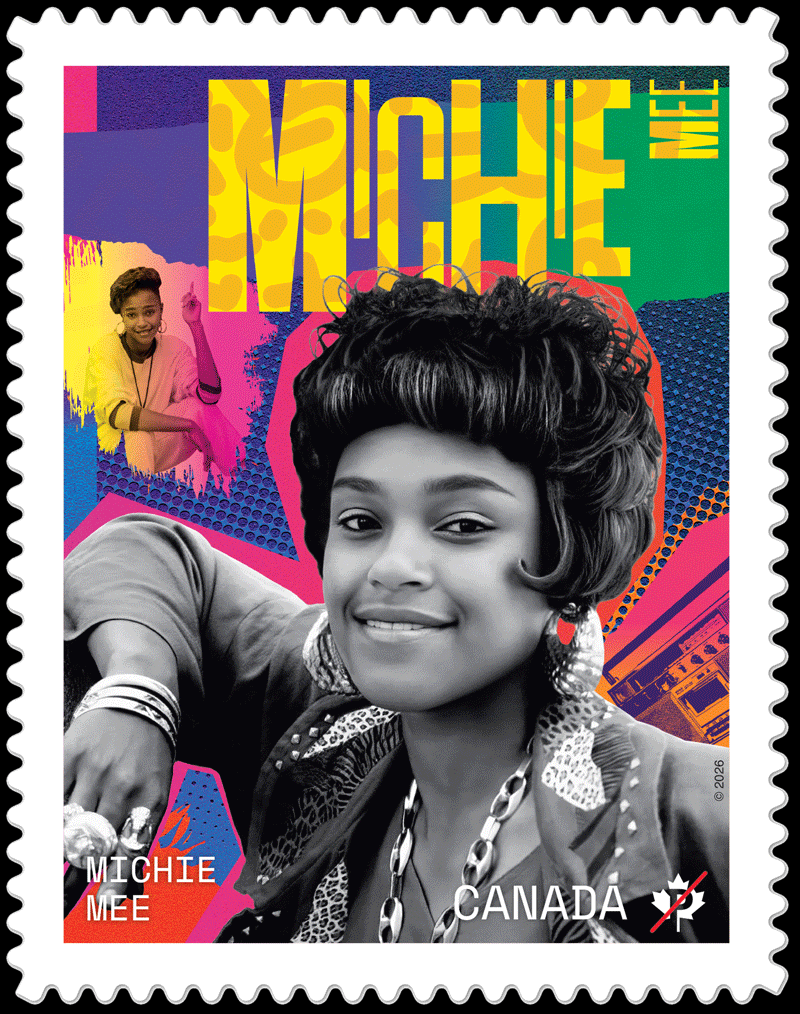
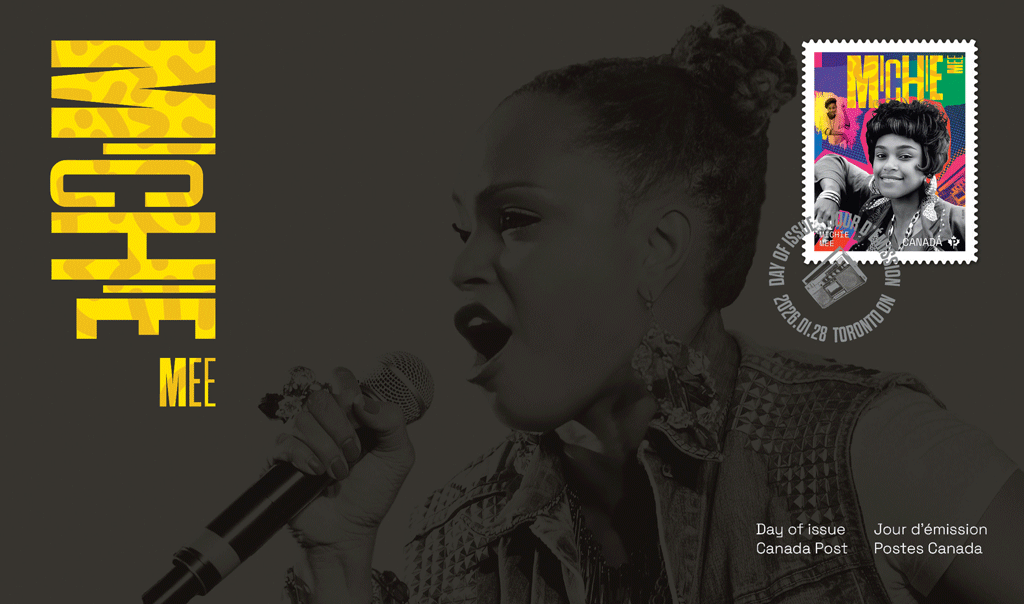
Michie Mee (b. Michelle McCullock, 1970) was Canada’s first hip-hop superstar and built a reputation for continually pushing boundaries. The iconic MC exploded onto the scene in the late 1980s and was among the first to bring Jamaican Patois into her rhymes. In 1987, she released her debut single “Elements of Style,” which was an instant hit. A year later, she became the first Canadian MC to sign with a major U.S. label. In 1991, she released her first album, Jamaican Funk – Canadian Style, which combined rap with dancehall and reggae. Later that decade, she joined Raggadeath, a group known for fusing heavy metal and reggae.

Muzion
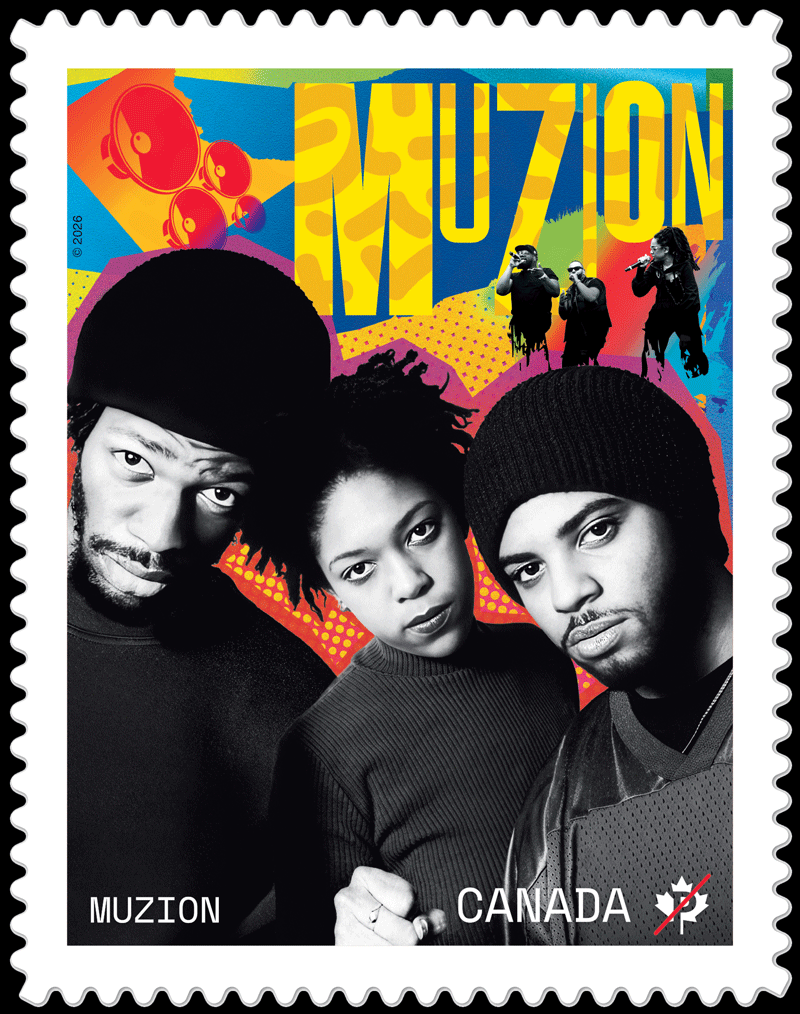
Hailing from Montréal, Muzion brought a distinct sound to the world of hip-hop, layering French, English and Haitian Creole into their music. The group was formed in 1996 by MCs J.Kyll (Jenny Salgado), Imposs (Stanley Salgado), and Dramatik (Jocelyn Bruno). Their two albums Mentalité moune morne… (Ils n’ont pas compris) (1999) and J’rêvolutionne (2002) received multiple honours, including Félix Awards for Hip-Hop Album of the Year. Their hit single “La vi ti nèg” won a 2004 Canadian Urban Music Award. Muzion’s influence stretched into the wider culture. The trio, who were all born to Haitian parents, helped empower marginalized communities to see themselves as integral to the fabric of Quebec and Canada.

About the stamps
This stamp set is a shout-out to the vibrant roots of hip-hop in Canada. The titles are crafted using varied type sizes, echoing the rhythmic nature of hip-hop’s sound. Printed with fluorescent inks that glow under black light, metallic silver and black duotone portraits, and layered matte and gloss varnishes, these stamps evoke the bold, nostalgic aesthetic of the late 1980s and early 1990s.

The stamps were designed by Noël Nanton and Nadia Molinari of typotherapy. Various photographs were used in this set: Maestro Fresh Wes – Wellington Williams; background – Edward James Rissling. Michie Mee – Getty Images; background – Rick McGinnis. Muzion – Brigitte Henry; background – Marie-Michèle Bouchard.

The issue, which was printed by Lowe-Martin, includes six Permanent™ stamps and three Official First Day Covers. The cancel sites are Toronto for Maestro Fresh Wes and Michie Mee, and Montréal for Muzion.

Stamps and collectibles will be available at canadapost.ca and postal outlets across Canada beginning on January 28, 2026.

Technical Details:
Product: Hip-Hop in Canada (2026): booklet of 6 Permanent™ stamps
Article: 414308111
Quantity: 130,000 booklets of six Permanent™ stamps
Printing process: Lithography in 5 colours, Matte Aqueous & Gloss Varnish
Price: $7.44

Product: Hip-Hop in Canada (2026) – Maestro Fresh Wes: Official First Day Cover
Article: 414308131
Quantity: 6,000
Cancel: Toronto, Ontario
Price: $2.24

Product: Hip-Hop in Canada (2026) – Michie Mee: Official First Day Cover
Article: 414309131
Quantity: 6,000
Cancel: Toronto, Ontario
Price: $2.24

Product: Hip-Hop in Canada (2026) – Muzion: Official First Day Cover
Article: 414310131
Quantity: 6,000
Cancel: Montréal, Quebec
Price: $2.24

Design: Noël Nanton, Nadia Molinari | typotherapy
Printer: Lowe-Martin The Concert Hall in Toronto, Tuesday, January 27, 2026. Photo by Andrew Williamson Photography, provided by Canada Post.

The artists react to being commemorated on these stamps:

The artists talk about their music:

Maestro Fresh Wes, Michie Mee and Muzion talk about the early days of hip-hop in Canada:

Concorde Supersonic Airliner (UK 2026)

[press release] [click on any of the pictures for larger versions]
Royal Mail Marks the 50th Anniversary of Concorde’s First Commercial Flight

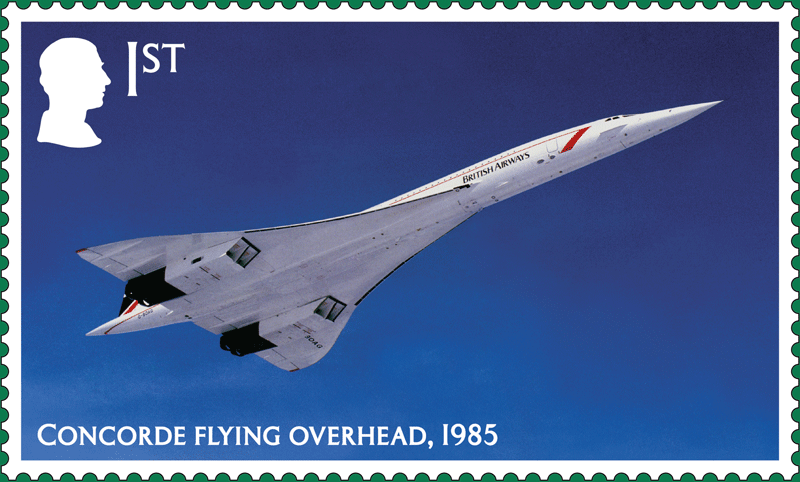
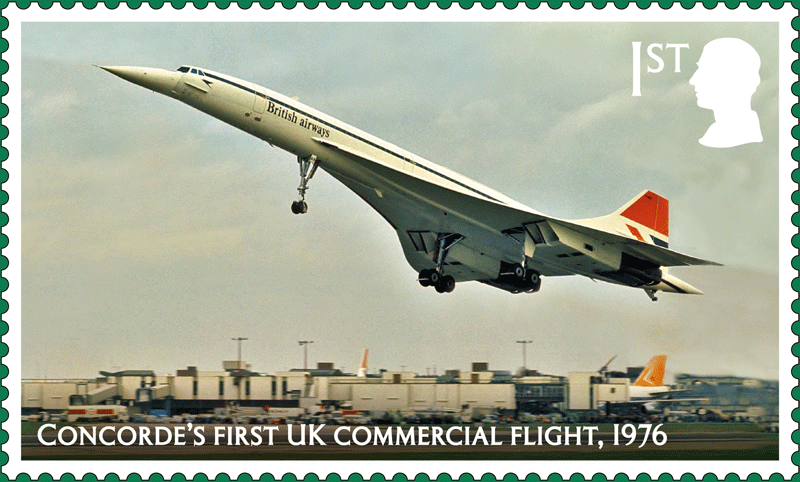
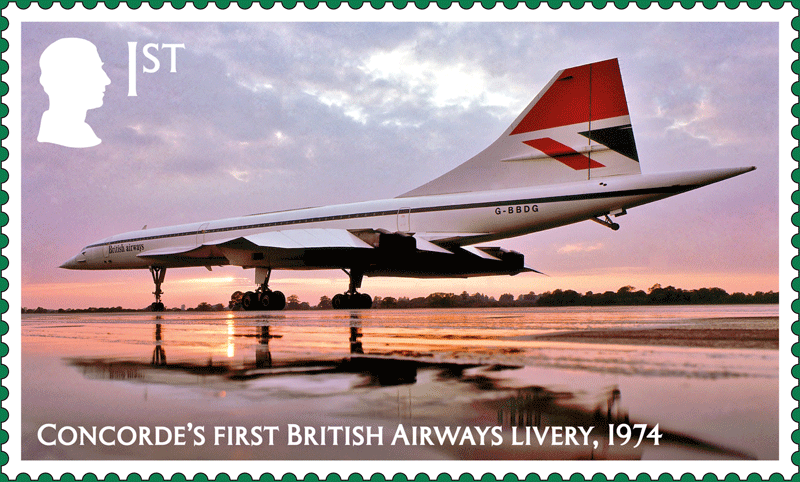
  • The set comprises eight stamps featuring stunning photography of the British Airways aircraft throughout its history, including its first and last commercial flights
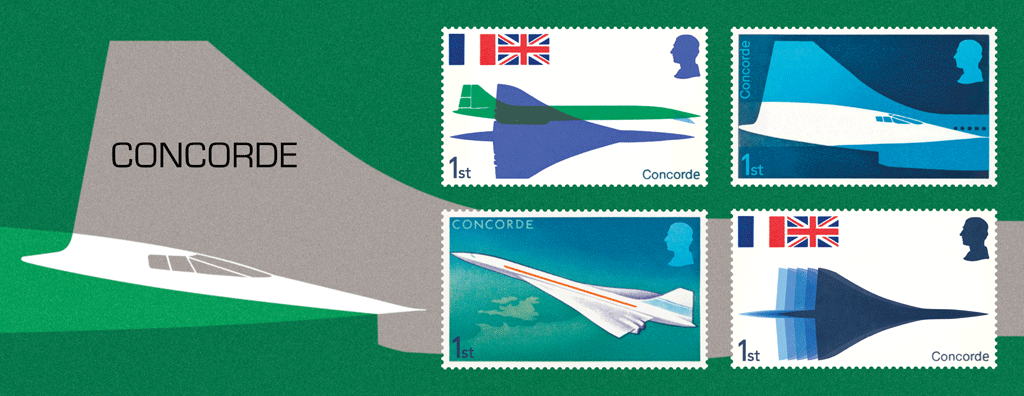
  • A further four stamps, presented in a miniature sheet, includes three re-released stamp images and a never-before-seen design, previously shortlisted but not adopted
  • The stamps and a range of collectible products are available now at www.royalmail.com/concorde and by telephone on 03457 641641

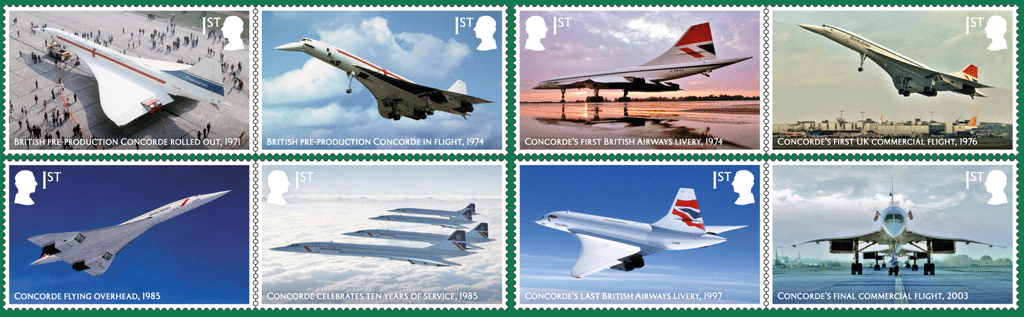
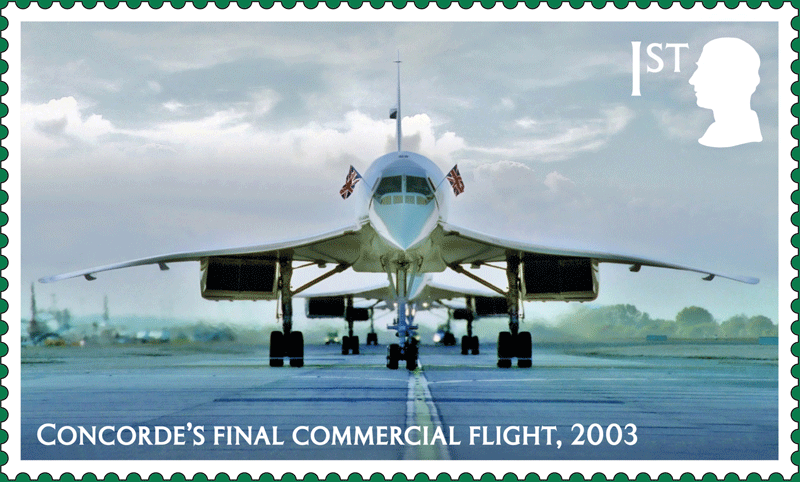
Royal Mail on 21 January issued a set of 12 stamps to mark the 50th anniversary of Concorde’s first commercial flight, in 1976.

The main set of eight stamps features stunning photography of the British Airways aircraft throughout its history, including its first and last commercial flights. One of the stamps uses photography of four Concordes flying in formation to celebrate 10 years of service.

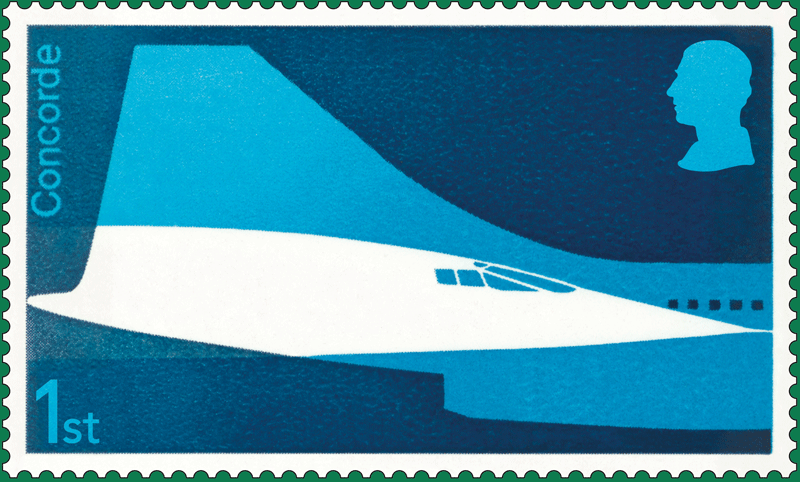
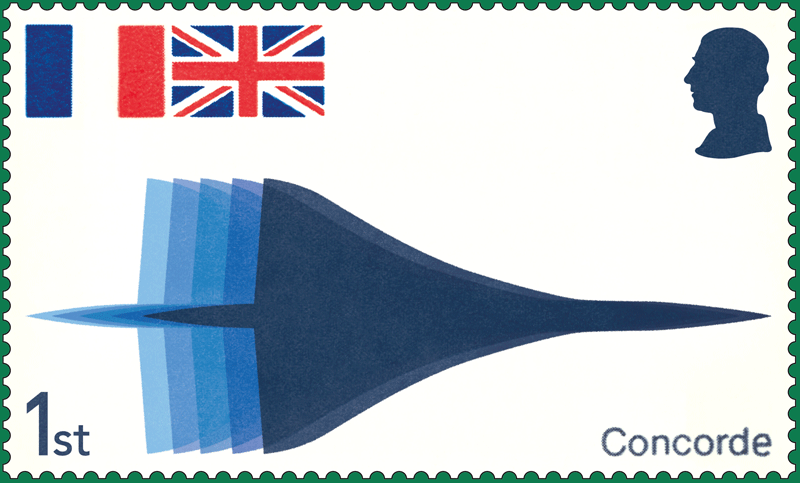
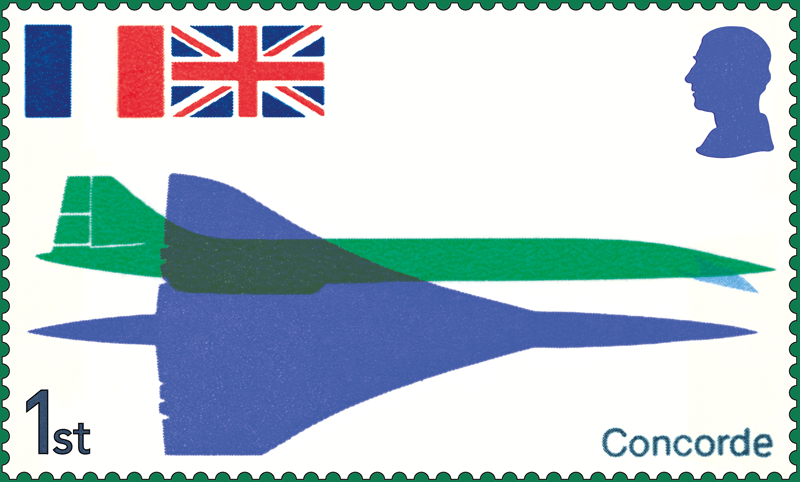
A further four stamps, presented in a miniature sheet, include three previously issued stamp images and one never-before-seen design.

Commissioned for the 1969 ‘First Flight of Concorde’ issue, two are designed by influential British stamp designer David Gentleman, and one by Michael and Sylvia Goaman. Royal Mail are re-releasing the stamps, now showing the King Charles III silhouette, along with a fourth stamp design by David Gentleman that was previously shortlisted but not adopted in the 1969 set.

The miniature sheet border image is inspired by the design of the original presentation pack from 1969.
The idea of stamps to be issued following the first flight of Concorde was agreed in July 1967 by the British and French postal services, albeit not using a common design. The decision was revealed to the British public on 14 December that year.

Five leading designers were invited to submit concepts for a new series of British stamps celebrating Concorde and the collaboration between France and the United Kingdom. The stamps were intended to capture the innovation and international partnership behind the supersonic aircraft.

Postmaster General Edward Short shortlisted five designs from the submissions. His final choice – one by the Goamans, two by Gentleman – received the approval of Queen Elizabeth II in January 1968.

David Gold, Director of External Affairs & Policy, Royal Mail, said: “Concorde remains one of the most iconic achievements in aviation history, and we’re proud to celebrate its legacy with this special set of stamps. These designs pay tribute to the innovation, elegance, and engineering excellence that made Concorde a symbol of British ingenuity and ambition.”

Hamish McVey, Director of Marketing, British Airways, said: “Concorde represents a landmark chapter in our history at British Airways, embodying the pioneering spirit of British innovation and creativity that remains integral to our brand today. The Royal Mail’s celebration of 50 years since her maiden flight highlights the enduring admiration many people still hold for this remarkable aircraft.”

First commercial flight of Concorde – 21 January 1976:
On Wednesday, 21 January 1976, at precisely 11:40 GMT, the captains of two Concordes – British Airways in London and Air France in Paris – simultaneously pushed forward the throttles and unleashed, for the first time with commercial passengers, the full force of their reheated, Rolls-Royce Olympus engines.
Supersonic passenger services had begun.

Air France Concorde F-BVFA, the first of seven Concordes destined for Air France, flew to Dakar in West Africa to refuel and then on, across the Atlantic Ocean, to Rio de Janeiro. British Airways had taken delivery of G-BOAA, the first of its seven Concordes, just a week before and, on 21 January 1976, ‘Alpha Alpha’ spearheaded the British assault on the sound barrier.

Flying at subsonic speeds initially, over Paris, the Alps and Venice, ‘Alpha Alpha’ then broke through the sound barrier over the Adriatic Sea and accelerated to Mach 2, faster than a rifle bullet, while the champagne flowed. Crossing Lebanon and Syria in just six minutes and arriving in Bahrain just over three-and-a-half hours after leaving Heathrow, the passengers had experienced something special that day and were whisked away to a celebratory banquet hosted by the Amir of Bahrain.

Fifty years ago, history was made, with supersonic travel undoubtedly becoming one of the greatest milestones in aviation history.

The stamps, and a range of collectible products, are available from today (21 January) at www.royalmail.com/concorde and by telephone on 03457 641 641. A Presentation Pack including all 12 stamps is priced at £21.30.

Supersonic fact file:
1. CONCORDE GREW UP TO 20CM IN LENGTH DURING SUPERSONIC FLIGHT
Once through the sound barrier, the air in front of the aircraft was compressed and, like a hand-operated bicycle pump, would get hot, causing materials to expand. The temperature on the nose of the aeroplane would reach 127°C, despite the ambient air being –60°C. On slowing, Concorde cooled down again and shrank back to its original size. A special type of aluminium alloy was used, which could withstand the long-term stress.

2. THE ENGINE INTAKES WERE CONTROLLED BY THE FIRST DIGITAL COMPUTERS IN CIVIL AVIATION
Just ahead of each Olympus engine, the air intakes had hydraulically driven ramps fitted in the roof which, at speeds above Mach 1.3, would lower and create a supersonic shockwave in the mouth of the intake. This would slow down the air from about 1,350mph (Mach 2) to 350mph (Mach 0.5) in just 11ft (3.4m), boosting the thrust by up to 25 percent.

3. CONCORDE WAS THE ONLY CIVIL AIRCRAFT TO BE FITTED WITH AFTERBURNERS
Used on take-off and to blast through the sound barrier (Mach 1), afterburners gave a further boost in thrust of some 20 percent. They were not needed above speeds of Mach 1.7, as the engine intakes were efficient enough by then to help Concorde ‘supercruise’, meaning the aircraft could climb and accelerate in supersonic flight without needing its afterburners.

4. CONCORDE HAD A ‘DROOPED SNOOT’
As Concorde’s wings were not fitted with flaps and slats like a conventional aeroplane, it came in to land at a very high nose-up ‘attitude’ (angle). To enable the pilots to see the runway ahead of them, Concorde’s nose and integrated visor could be lowered by 12.5 degrees. Above 280mph, the nose was fully raised and the visor acted as a heat shield in supersonic flight.

5. RECORD FLIGHT TIME ACROSS THE ATLANTIC: 2 HOURS, 52 MINUTES AND 59 SECONDS
In a record that still stands today, Concorde completed the fastest journey between London and New York by any passenger airliner. On 7 February 1996, Concorde ‘Alpha Delta’ flew from New York to London in a second under 2 hours and 53 minutes.

The Bull (Netherlands 2026)

[from press materials] [click on any of the pictures for larger versions]
The Bull

Issue date: 15 January

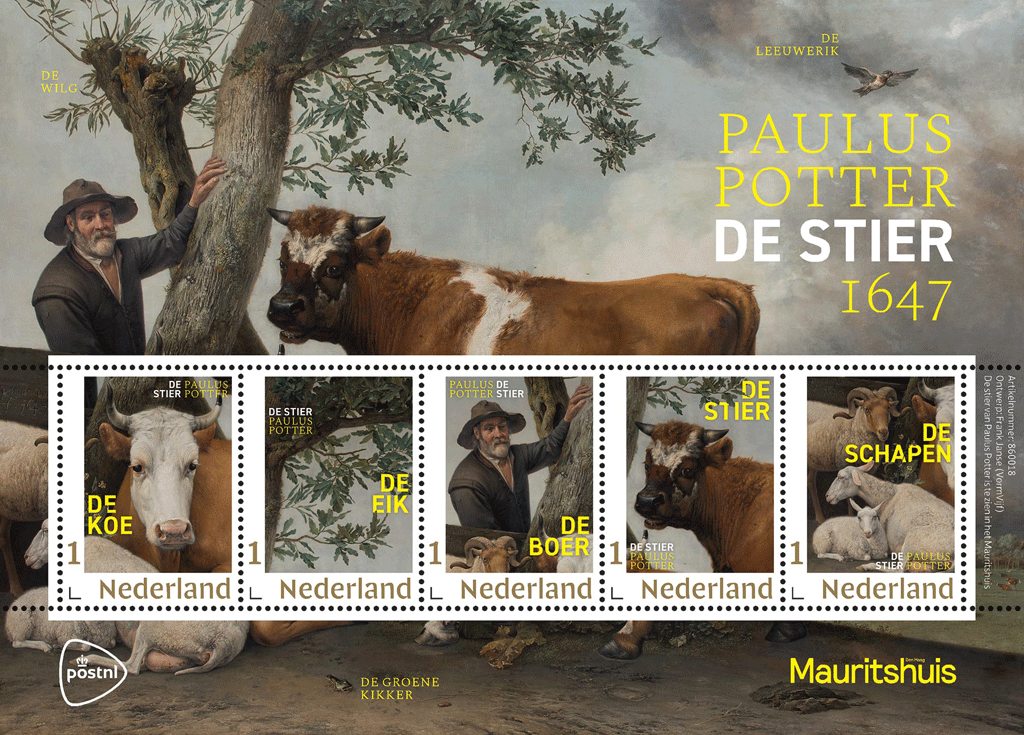
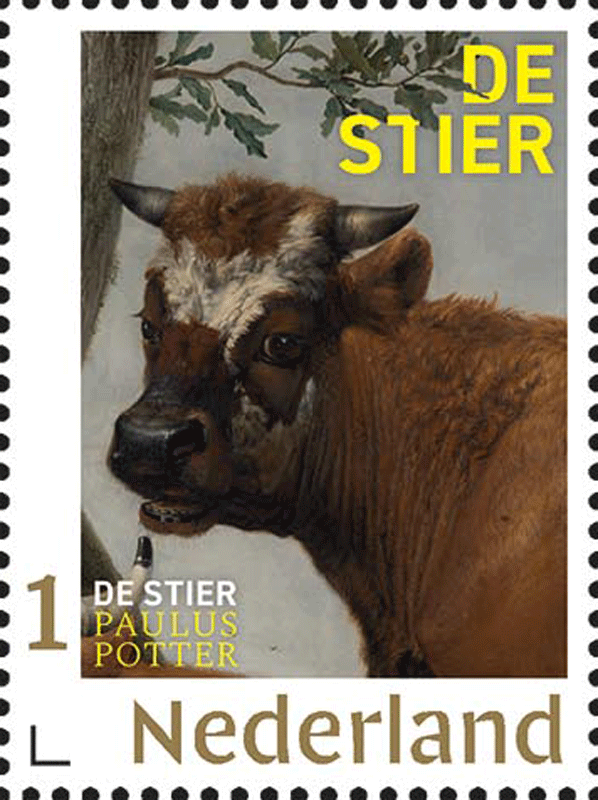
To mark the unveiling of the restored painting by Paulus Potter, “The Bull,” PostNL, in collaboration with the Mauritshuis art museum [English language website and Wikipedia entry] in The Hague, will release the “The Bull” stamp sheet on January 15, 2026. The stamps feature the main characters from the 1647 painting: the cow, the oak tree, the farmer, the bull, and the sheep. A sheet of 5 stamps costs €7.00 and are available only from PostNL’s philatelic outlets and in the Mauritshuis gift shop.

The PostNL stamp program allows the flexibility to issue stamps to commemorate special events, such as this.

What makes the 1647 oil painting The Bull so remarkable is that such an ordinary thing as a bull appears on this enormous canvas. At 236.5 x 341 cm (about 93 x 134 inches, or 7 feet 9 inches by 11 feet), Paulus Potter (1625-1654) paid meticulous attention to the smallest details, such as the skylark, the green frog in the foreground, the flies on the bull’s back, and the cow’s wet nose with whiskers. The painting is therefore known as the epitome of Dutch naturalistic painting.

The bull looks at the viewer, as do the reclining cow and the standing ram. Potter has rendered the animals’ coats in detail, with thickly applied layers of paint. Even the marks of the shearing are visible on the reclining dairy sheep, which has just been shorn.

During the nearly two-year restoration, yellowed varnish layers were removed, as well as most of the retouching paint from previous restorations. The painting was then given a new layer of varnish that discolors more slowly. Only then did the restorers retouch the damaged areas. By working on the varnish, the restoration work is always reversible.

Janse depicted the painting in its entirety on the stamp sheet margin, extending below the five stamps. The stamps themselves feature portraits of the various protagonists in the painting: the cow, the oak tree, the farmer, the bull, and the sheep. The characters are described in large capital letters on the stamps, in a vibrant yellow. The same typography is applied to the sheet margin, alongside the green frog, the lark, and the willow. The name of the painter Paulus Potter also appears on the sheet margin and the stamps, either above, below, or above the title of the issue, “The Bull.”

Technical Specifications:
Stamp size: 30 x 40 mm (wxh)
Sheet size: 170 x 122 mm (wxh)
Plain paper with phosphor print
Gummed gum
Printing technique: Offset
Printing colors: cyan, magenta, yellow, black, and gold
Count of 6,000 sheets
Appearance: Sheet of 5 frame stamps in 5 different designs
Value indication: 1 for mail up to 20 grams destined for the Netherlands
Design: Frank Janse, Gouda
Printing company: Royal Joh. Enschedé B.V., Haarlem
Item number: 860018

Finale of “Stranger Things” (UK 2026)

[press release] [click on any of the pictures for larger versions]
Royal Mail Celebrates Finale of Global Hit Series Stranger Things

Issue date: 13 January

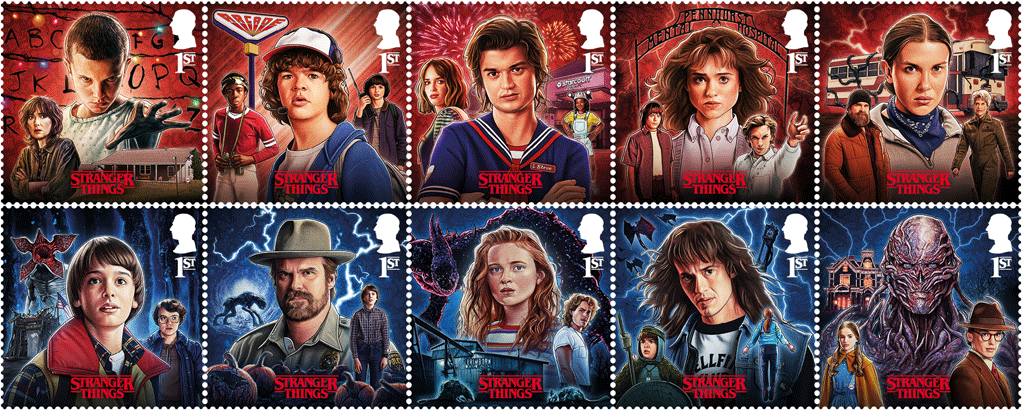
  • The main set of 10 stamps depict key characters across the series
  • The stamps were exclusively created by British artist, Kyle Lambert – the illustrator who creates posters for each season of Stranger Things
  • The stamps and a range of collectible products are available to pre-order now at www.royalmail.com/strangerthings and by telephone on 03457 641641

Royal Mail has issued a set of 14 stamps to celebrate the critically acclaimed science-fiction series from Netflix, Stranger Things.

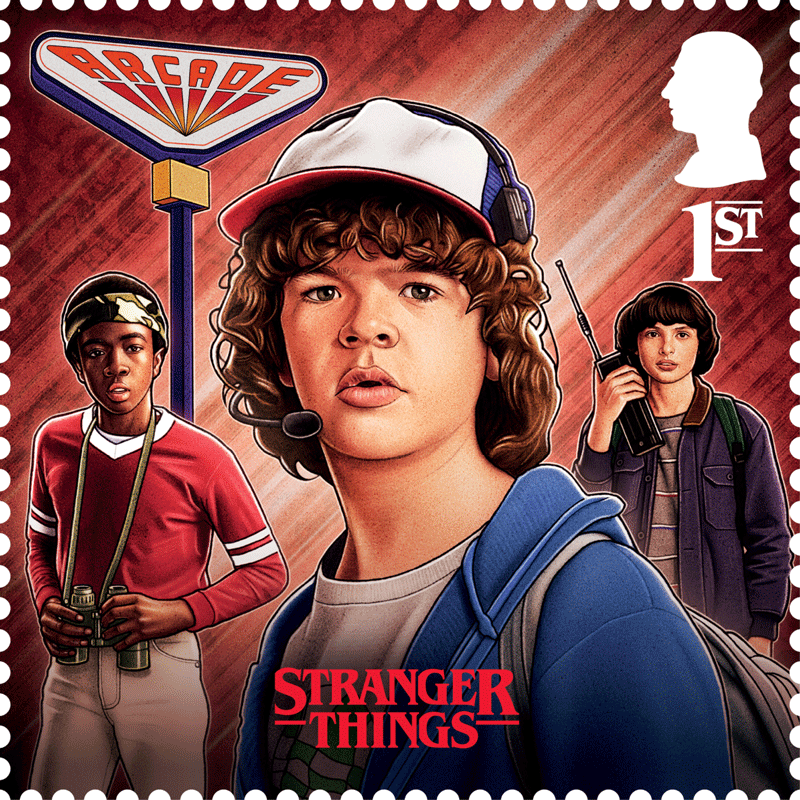
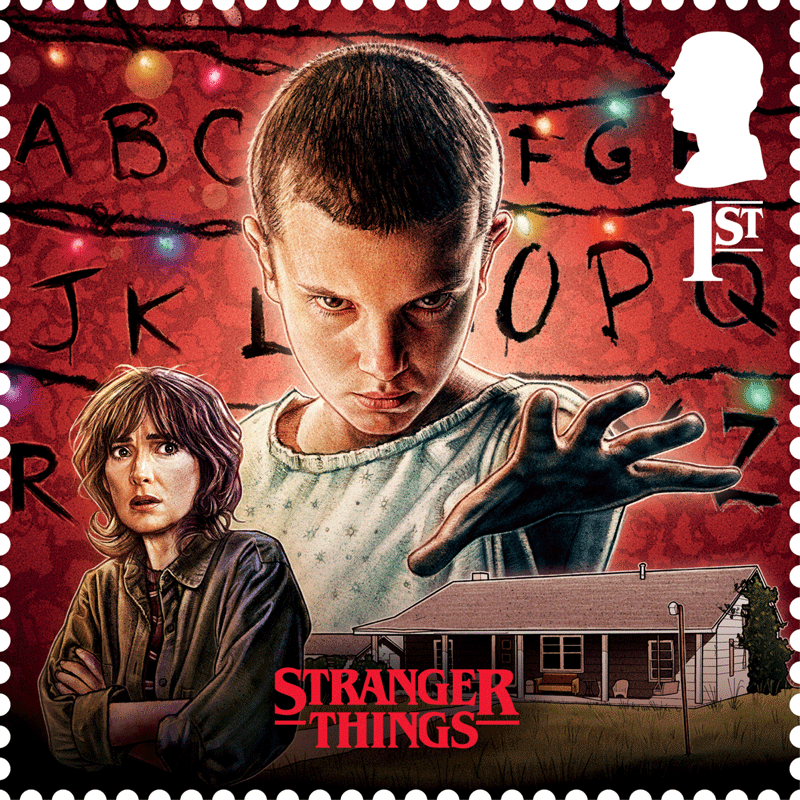
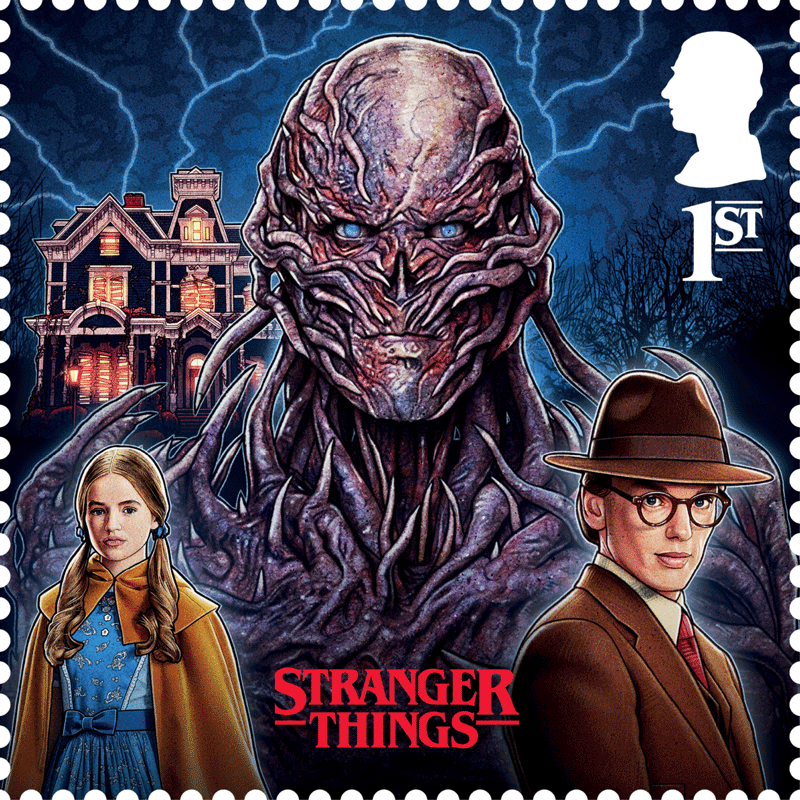
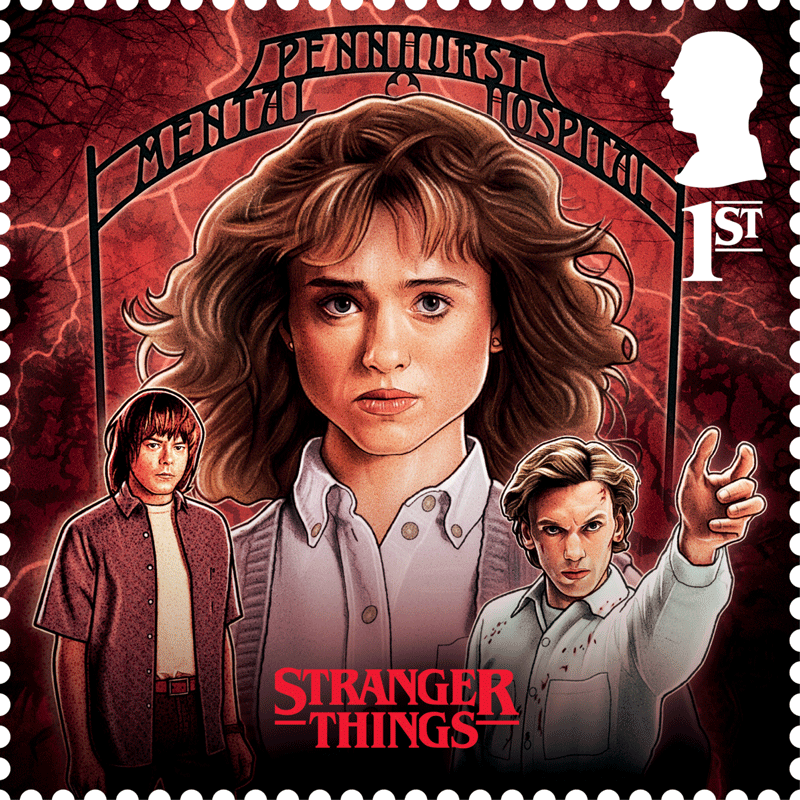
The 10 stamps in the main set show key characters from across the series. Five stamps represent the characters in the Rightside Up – the ‘real’ world – with a red background, and five represent the alternate dimension with a blue background, known as the ‘Upside Down’. Each vertical pair of the stamps represents a season, beginning with the two left-hand stamps from season one.

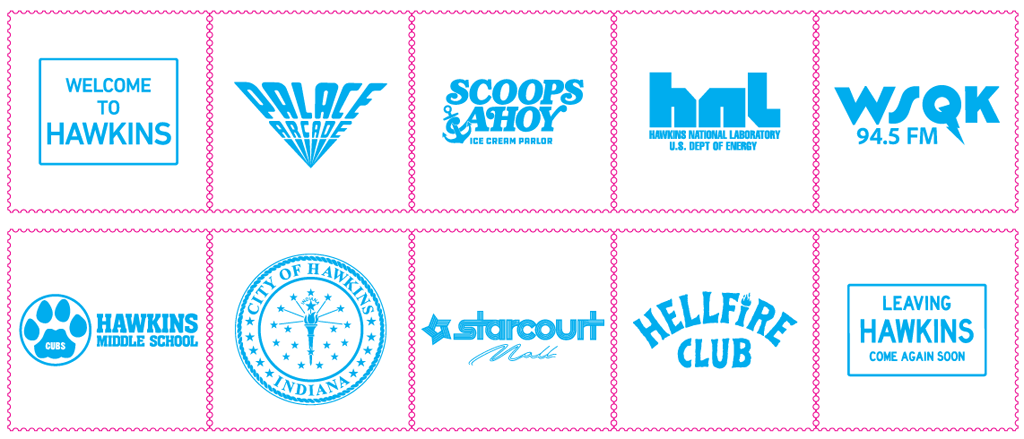
When shining a UV light over the stamps, iconic logos from the series appear:In addition, the font used for the ‘1ST’ value of the stamps replicates the typeface used for the series.

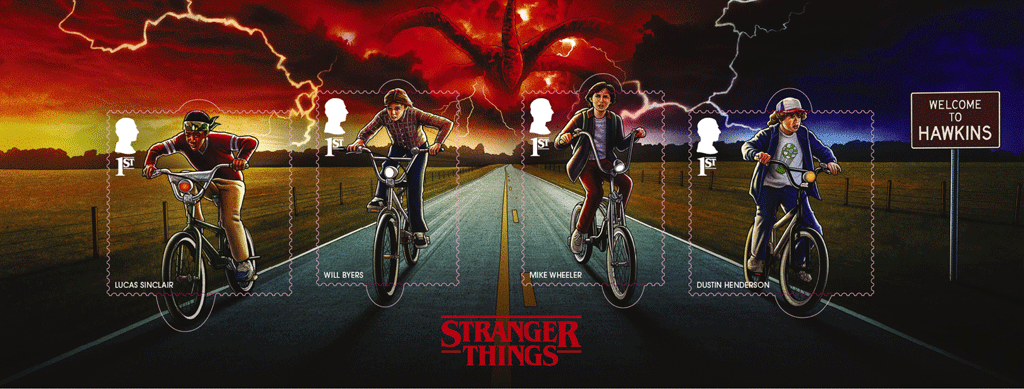
The four stamps in the miniature sheet consists of an illustration showing the four friends riding their iconic 80s bikes.

Royal Mail worked with British artist Kyle Lambert, the illustrator who creates posters for each season of Stranger Things, to design bespoke illustrations for the stamp issue. He has created iconic illustrated posters for all five seasons of the series, and his artwork has been featured on billboards, merchandise, comic books and global advertising campaigns making him a major visual storyteller for the franchise.

Set in the 1980s, the series centres around the residents of the fictional small town of Hawkins, Indiana, who are plagued by a hostile alternate dimension known as the Upside Down.

Since the series was first released on Netflix in July 2016, it has attracted a record viewership and a global fanbase, winning numerous awards across the entertainment industry. Praised for its characterisation, atmosphere, writing, soundtrack and acting – with an ensemble cast including British actors in leading roles – the fifth and final series launched on 27 November 2025 and concluded on New Year’s Day, available only on Netflix.

David Gold, Director of External Affairs & Policy, Royal Mail, said: “We’re thrilled to celebrate Stranger Things with this striking stamp collection. Each design captures the essence of the series – from its unforgettable characters to the eerie imagery that has gripped audiences worldwide – making this a true tribute to one of modern television’s most popular shows.”

The stamps, and a range of collectible products, are available to pre-order now at www.royalmail.com/strangerthings and by telephone on 03457 641 641. A Presentation Pack including all 14 stamps is priced at £24.70. The stamps go on general sale from 13 January.

Experience Nature — Birds of Saba (Netherlands 2026)

[from PostNL material] [click on any of the pictures for larger versions]
PostNL brings birds from Saba to life on new stamp sheet

Issue: Experience Nature — Birds of Saba
Issue date: 5 January 2026
Format: sheet of 10 stamps in 10 different designs, denomination 1 for items up to 20 grams destined for addresses within the Netherlands
Item number: 460161
Design: Frank Janse, Gouda
Photography: Dreamstime, Shutterstock and Wikimedia Commons (Korall, lwolfartist, Mykola Swarnyk)
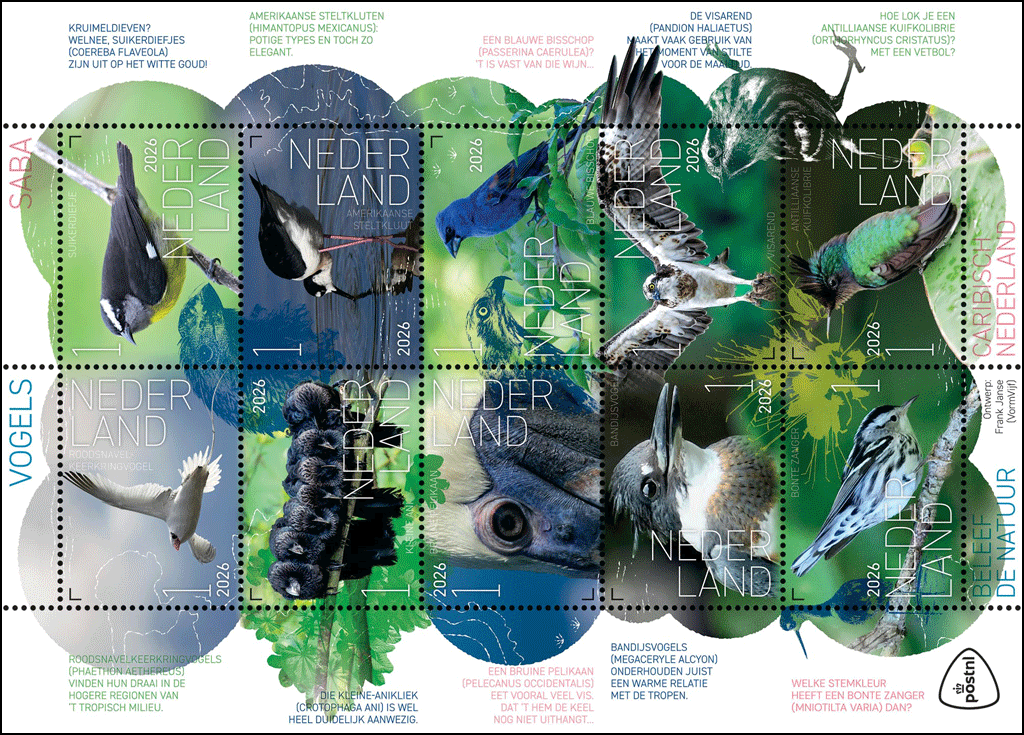
PostNL is issuing the “Experience Nature – Birds of Saba” stamp sheetlet. The sheetlet consists of ten different stamps featuring birds found on the Caribbean island of Saba. With this issue, PostNL continues its multi-year “Experience Nature” stamp series, which focuses on the nature of the Caribbean Netherlands.

These islands boast an extraordinary biodiversity by Dutch standards, with thousands of plant and animal species. In 2026, the focus will successively be on birds, butterflies, underwater life and flora of the windward island of Saba.

Biodiversity of the Caribbean Netherlands
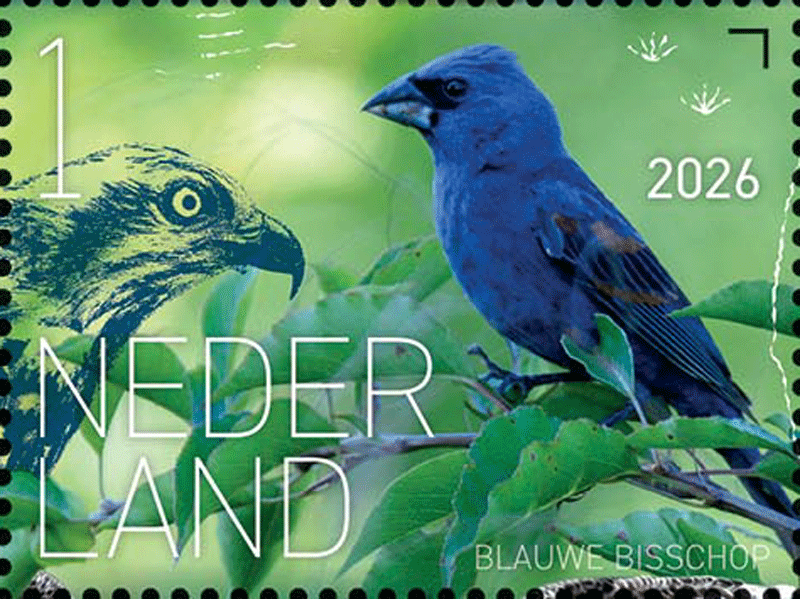
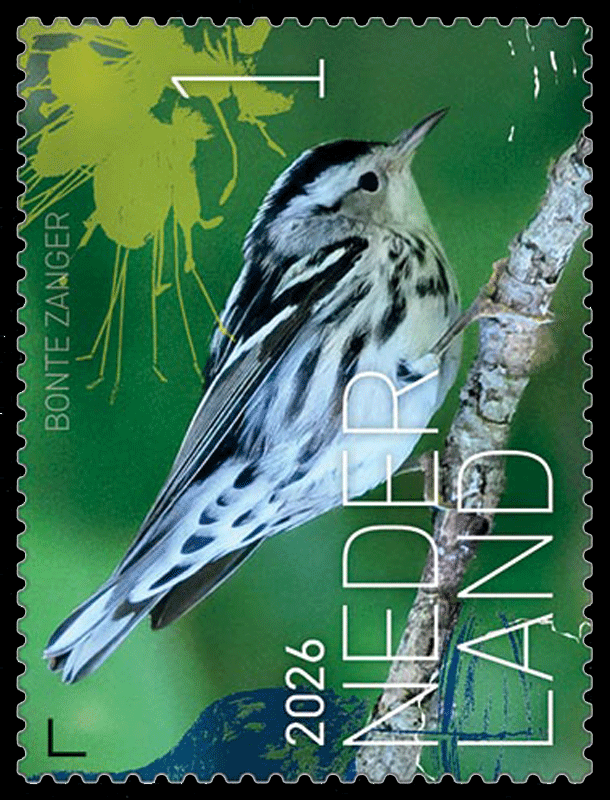
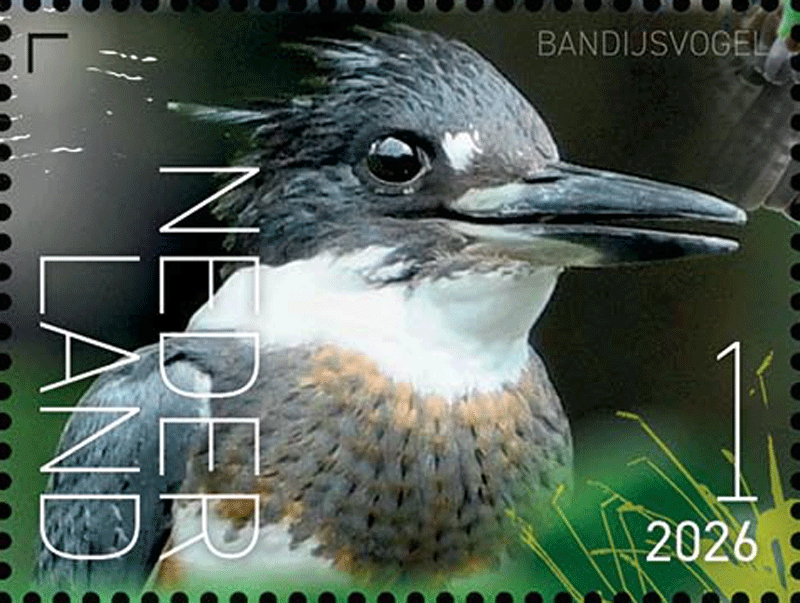
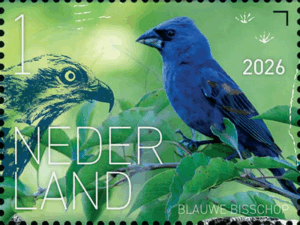
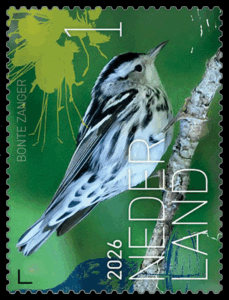
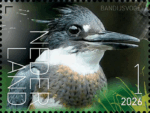
The stamp sheetlet features images of the red-billed tropicbird, bananaquit, smooth-billed ani, black-necked stilt, brown pelican, blue grosbeak, belted kingfisher, osprey, black-and-white warbler and Antillean crested hummingbird. The birds are depicted in their natural habitat and demonstrate Saba’s high biodiversity. Despite its small size, the island boasts a remarkably rich bird life.
“Experience Nature – Birds of Saba” is part of a series dedicated to the Caribbean Netherlands from 2024 to 2026. In 2026, Saba will be the focus, with stamp sheets featuring not only birds but also butterflies, underwater life, and the island’s flora.

The island of Saba, like Bonaire and Sint Eustatius, has a special status within the Netherlands. Collectively, these three islands are known as the Caribbean Netherlands. Together with Aruba, Curaçao and Sint Maarten, they form the Caribbean part of the Kingdom of the Netherlands. Roughly circular, the island measures about 4.5 kilometres across (about 2.8 miles) and covers an area of 13 square kilometres (5 square miles). Geologically, Saba is a dormant volcano with four lava domes. Its slopes descend steeply to the sea, and its coastline is rocky. At 870 metres, Mount Scenery is the highest point in the Netherlands. The climate is humid tropical, and the island is covered with secondary rainforest.
Birds are a popular subjects for stamps. “I think it’s mainly the freedom of birds that appeals to people,” said designer Frank Janse. “For a graphic designer, bird photos are rewarding images to work with. Birds are easily recognisable thanks to their iconic shapes, whether circling in the sky or perched on a branch.”

Design
The stamp sheet was designed by graphic designer Frank Janse from Gouda. Through the use of continuous images, circular shapes, and transparent layers, the ten stamps form a cohesive whole, emphasizing the interconnectedness of nature.
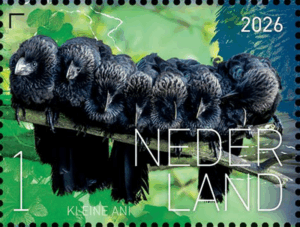
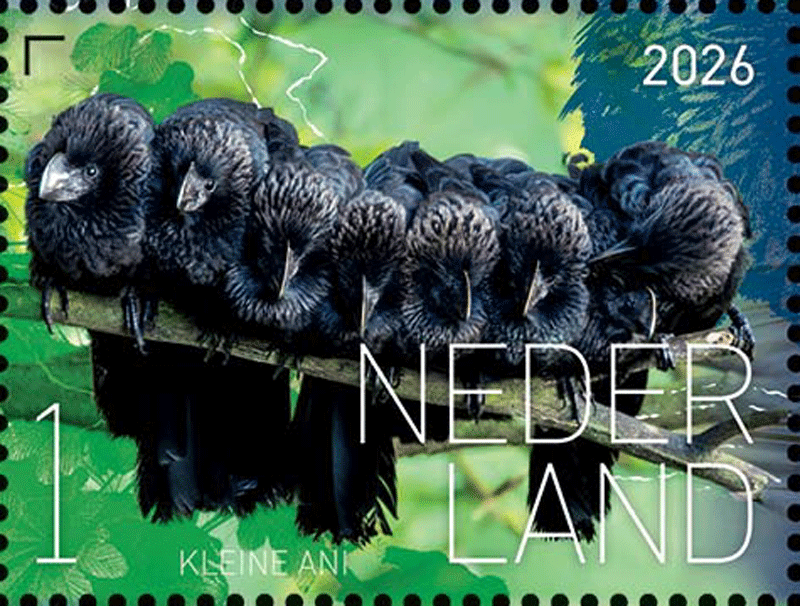
When selecting bird species for these stamps, Janse aimed for maximum variety. “Large and small species, forest, water and coastal birds – and of course, with the osprey, a bird of prey. Based on this distribution, I looked for striking photos I could crop for more variation.” Groups of birds usually don’t work well on stamps because of the small format. “Still, I made an exception for the amusing photo of the smooth-billed anis,” Janse said [above right]. “It looks like a cartoon scene, with them chatting on a twig. The photo’s colours help, with deep black against a light green background.”

Availability
The stamp sheet is available, while supplies last, at PostNL sales points, through the post office in Bruna stores, and online via the PostNL website. The ten stamps have a denomination of “1” for mail up to 20 grams destined for mail within the Netherlands.

Technical Specifications:
Stamp size: 40 x 30 mm
Sheet size: 122 x 170 mm
Paper: normal with phosphor coating
Gumming: self-adhesive
Printing technique: offset
Colours: cyan, magenta, yellow and black
Print run: 275,000 sheets
Format: sheet of 10 stamps in 10 different designs
Denomination: 1 for items up to 20 grams destined for addresses within the Netherlands
Design: Frank Janse, Gouda
Photography: Dreamstime, Shutterstock and Wikimedia Commons (Korall, lwolfartist, Mykola Swarnyk)
Printer: Koninklijke Joh. Enschedé B.V., Haarlem
Item number: 460161

The Species:

Red-billed tropicbird (Phaethon aethereus)
A seabird from the tropicbird family, found over tropical oceans and breeding on islands in the tropics. Adults are almost entirely white, with a red bill – hence the name – and a wingspan of about one metre. Both sexes have similar plumage. Body length is 91 to 107 cm, including the distinctive elongated tail feather of 46 to 56 cm. This migratory bird is not a strong swimmer and is often seen far out at sea, sometimes hundreds of kilometres from land. It feeds on flying fish and squid, caught by plunge-diving from considerable heights.

Bananaquit (Coereba flaveola)
A songbird from the tanager family, found in northern and eastern South America and the Caribbean. Both sexes have a black crown, a white eyebrow stripe and a bright yellow breast and belly. The chin is light grey and the upperparts blackish-grey. The bananaquit grows up to 11 cm long. Usually solitary, it gathers in groups only where food is abundant. It feeds mainly on nectar, sometimes on fruit. To reach nectar, it pierces the flower base, avoiding pollination – hence its name ‘little thief’.

Smooth-billed ani (Crotophaga ani)
A member of the cuckoo family, found in Florida, Central and South America and the Galápagos Islands. This black bird, also called gladsnavelani in Dutch, has a long tail, short wings and a large, distinctive bill. Both sexes have similar plumage. It measures up to 35 cm and weighs about 125 grams. It nests low in dense shrubs during the warm season and is always seen in noisy groups. It forages mainly on the ground, eating grasshoppers and other insects, and follows livestock to snatch disturbed insects. It even perches on animals to remove ticks.

Black-necked stilt (Himantopus mexicanus)
A wader with very long legs from the stilt family, found as a resident in much of South and Central America, including the Caribbean. This black-and-white bird has long pink legs that extend well beyond the tail in flight. A continuous black area runs from the back along the nape to the head, forming a cap that covers the entire top of the head down to just below eye level, except for a small white patch around the bill and above the eye. It grows to about 35 cm. It forages mainly in mudflats and lake shores, and in very shallow coastal waters, feeding on invertebrates such as shrimp, worms, flies, molluscs, small fish and tadpoles.

Brown pelican (Pelecanus occidentalis)
A waterbird from the pelican family, found along the coasts of North and Central America, the Caribbean and northern South America. Mostly silver-grey and brown, with a white or whitish-yellow head and a chestnut-brown neck. The greenish bare facial skin and throat pouch become more colourful during breeding. Both sexes have similar plumage. It measures 100 to 150 cm and weighs over 3.5 kg. This bird uses its throat pouch as a fishing net. Unlike other pelicans that hunt cooperatively, brown pelicans plunge-dive from height to catch fish.

Blue grosbeak (Passerina caerulea)
A songbird from the cardinal family, found from the southern United States to Costa Rica. This migratory species breeds in northern Mexico and the southern US and winters in Central America. The male is 13 to 20 cm long, with reddish-brown wing bars and stripes on its back, brown eyes, rounded wings and a deep blue bill. The female is similar in size but mostly brown with a hint of blue. Naturally shy, they nest in low trees or shrubs 1 to 2.5 metres above ground, often at the edge of open areas for quick access to food. Summer offers the best chance to spot them as they forage for seeds in fields.

Belted kingfisher (Megaceryle alcyon)
A kingfisher species migrating from Canada and Alaska southwards to Mexico, Central America and the South American and Caribbean coasts. It has a dark head with a broad white collar around the neck. A dark, often iridescent band crosses the chest, giving the bird its name. The rest of the underparts are white, while most of the plumage is grey, with females showing reddish patches along the breast and belly under the wings. It measures 28 to 33 cm and weighs 113 to 178 grams. The nest is in an underground chamber at the end of a tunnel, usually dug into

Osprey (Pandion haliaetus)
The osprey is the only species in the osprey family. With the exception of Antarctica, it is found across all continents. In flight, it is easily recognised by its entirely white underside, chocolate-brown upperparts and slightly ‘angled’ wings. A dark stripe runs through the eye. Both sexes share the same plumage.
It is a relatively small eagle that likes to hover motionless above water before diving for a fish just below the surface with outstretched talons. When it spots a fish, the osprey plunges headfirst and, at the last moment, throws its legs forward to seize its prey. Its talons are razor-sharp, and its feet are equipped with small spines to grip the slippery catch more securely.

Black-and-white warbler (Mniotilta varia)
The black-and-white warbler is a songbird from the American warbler family. It breeds in Canada and the eastern United States and winters further south, as far as northern South America. This bird has a long bill and striking black-and-white plumage, which explains its English name. Its call is a high-pitched whistle, and its body length ranges from 11.5 to 14 cm.
Unlike most American warblers that forage among leaves, the black-and-white warbler climbs and creeps along trunks and thick branches, searching for food such as insects, larvae and spiders, which it extracts from bark crevices with its long bill. The nest is usually built low to the ground in a shrub or at the base of a tree, well hidden. Only the female incubates the eggs, but the male helps feed the chicks.

Antillean crested hummingbird (Orthorhyncus cristatus)
The Antillean crested hummingbird belongs to the hummingbird family. It occurs on Puerto Rico and the windward islands of the Caribbean. The male has an iridescent green plumage on its upperparts that, depending on the light, can appear yellowish or even coppery. Only the flight feathers are dark grey with a purple sheen. The bill is black, slender and straight. The male also sports an upright, shimmering cyan-green crest. The female is less colourful and lacks the crest. This tiny bird measures 8 to 9 cm and weighs between 3½ and 4 grams. It inhabits mangroves, wet and dry tropical lowland forests, thickets and gardens. It feeds mainly on nectar, which it extracts while hovering in front of flowers like a miniature helicopter. The female catches up to 2,000 insects and spiders per day to meet the protein needs of her growing chicks.

Note: PostNL does not sell directly to collectors in North America. Its website refers to a company called Nordfirm, which says it sells Dutch new issues at face value. The Virtual Stamp Club has no connection to this company.

Collectors may also wish to contact the U.S. firm Bombay Stamps, which can also obtain first day covers upon request, with lower shipping fees. The email is sales@bombaystamps.com Again, The Virtual Stamp Club has no connection to this company.

Canada Post Outlines 2026 Stamps

[press release] [click on any of the pictures for larger versions]
2026 stamp lineup celebrates Canadian hip-hop, a sweet and timeless Quebec tradition, and much more
Canada Post captures the spirit of Canada through the people, events and stories featured in upcoming stamp issues

OTTAWA – Today Canada Post announced its 2026 stamp lineup, which features several milestones, people and cultural events that have helped define Canadian identity.

Here are some highlights:

  • Next year’s annual Black History Month stamp dives into the careers and achievements of Canadian hip-hop pioneers.
  • Colourful scenes from the temps des sucres (sugaring-off season) and Quebec’s cabanes à sucre (sugar shacks) – traditions that are part of the intangible heritage of Quebec – grace these stamps.
  • The popular Places of Pride issue returns, remembering significant events and locations across Canada that 2SLGBTQIA+ people fought to make their own.
  • A new stamp commemorates the 100th anniversary of The Royal Canadian Legion, known for its National Poppy Campaign and roughly 1,350 branches that serve as community hubs across the country.
  • A fascinating look at four wolf species found across Canada.
  • In response to a growing demand for blood donations, a new stamp raises awareness and encourages Canadians to give.
  • A set of three eerie jack-o’-lanterns help kick off October’s spooky season.

The list of new stamps also includes the continuation of several popular annual series with a fresh take for 2026:

  • New Truth and Reconciliation stamps commemorate Orange Shirt Day.
    • The annual flower series showcases the delicate blooms of ornamental cherry blossoms.
    • A stamp raising funds for the Canada Post Community Foundation aims to deliver a brighter future for children and youth.
    • For Remembrance Day, a new design commemorates the service of Chinese Canadians sent on secret missions behind Japanese lines in Asia.
    • Unique stamps celebrate the holidays of Eid, Diwali, Hanukkah and Christmas.

    Individually, the stamps tell their own rich stories. Collectively, they paint a bigger picture of what makes Canada special. The independent Stamp Advisory Committee recommends subjects for the annual program, and members rely on thoughtful input from groups and individuals to choose subjects that capture important themes and histories that reflect the shared values of Canadians nationwide.

    [en Francais pour les médias d’information]
    Le programme des timbres-poste de 2026 célèbre le hip-hop canadien, une délicieuse tradition québécoise et plus encore
    Postes Canada saisit l’esprit du pays à travers les personnes, les événements et les histoires dont parlent ses prochaines émissions de timbres.

    OTTAWA – Aujourd’hui, Postes Canada a dévoilé son programme de timbres-poste de 2026 qui inclura des personnes, des moments marquants et des événements culturels qui aident à définir l’identité canadienne.

    En voici les points saillants :

    • Le timbre annuel du Mois de l’histoire des Noirs saluera la carrière et les réalisations de pionniers et pionnières du hip-hop canadien.
    • Des timbres illustreront par des scènes colorées le temps des sucres et la cabane à sucre, des traditions inscrites au patrimoine immatériel du Québec.
    • La très populaire émission de timbres sur les Lieux de la Fierté sera de retour, nous rappelant les événements et endroits importants au Canada pour lesquels la communauté 2ELGBTQIA+ s’est battue.
    • Un nouveau timbre commémoratif soulignera le 100e anniversaire de la Légion royale canadienne, connue pour sa Campagne nationale du Coquelicot et ses quelque 1 350 filiales qui servent de carrefours communautaires à l’échelle du pays.
    • Des timbres jetteront un regard fascinant sur quatre espèces de loups que l’on retrouve au Canada.
    • Un nouveau timbre sensibilisera la population canadienne à la demande croissante pour les dons de sang et l’encouragera à se retrousser les manches.
    • Un trio de citrouilles illuminées donnera le coup d’envoi à l’effrayante saison d’octobre.

    La liste des nouveaux timbres comprend également la suite de plusieurs séries annuelles populaires, revampées pour 2026 :

    • De nouveaux timbres sur la vérité et la réconciliation en commémoration de la Journée du chandail orange.
    • Les délicates fleurs de cerisiers ornementaux pour la série annuelle sur les fleurs.
    • Un timbre philanthropique pour la Fondation communautaire de Postes Canada dont l’objectif est d’offrir un avenir meilleur aux enfants et aux jeunes du pays.
    • Pour le jour du Souvenir, un timbre commémoratif au sujet du service des Canadiens d’origine chinoise envoyés en mission secrète derrière les lignes japonaises en Asie.
    • Des vignettes uniques pour célébrer l’Aïd, Diwali, Hanoukka et Noël.

    Individuellement, chaque timbre raconte une riche histoire. Ensemble, ils brossent le tableau de ce qui rend le Canada unique. Le Comité consultatif sur les timbres-poste, qui travaille de façon indépendante, recommande les sujets du programme annuel, en s’appuyant sur la contribution réfléchie de groupes et de particuliers pour choisir des histoires et des thèmes importants qui reflètent les valeurs de la population canadienne.