Scott Catalogue Update (September 2025)

UX649 Schooner postcard
UY56 Schooner reply postcard

6023 250 Years of Delivering
a. post office loading dock
b. customers at post office entrance
c. equestrian statue
d. dogs and their walkers
e. coffee shop entrance
f. USPS driver waves
g. park bench
h. people and animals
i. carrier accesses blue curbside collection box
j. balloons at rooftop party
k. carrier at apartment cluster box
l. restaurant customers wave
m. carrier accesses green USPS relay box
n. Next Generation Delivery Vehicle in profile
o. bookstore entrance
p. USPS carrier checks her watch
q. carrier delivers to man at old house
r. winter tree
s. crowd of pedestrians in street
t. carrier holds child at home

6024 Benjamin Franklin

6025-8 SpongeBob SquarePants
6025 Bikini Bottom characters Sandy Cheeks, Patrick Star, Plankton, Mr. Krabs, SpongeBob, Gary, and Squidward Tentacles
6026 SpongeBob face with mouth open
6027 SpongeBob face with mouth closed
6028 SpongeBob and Patrick

Cachet Winners: It Runs In The Family

Awards in the recent American First Day Cover Society cachetmaking contest for 2024 issues went to three mother-daughter pairs and one father-mother-daughter family unit. We also missed a grandfather/granddaughter combo at first, because of the difference in last names.

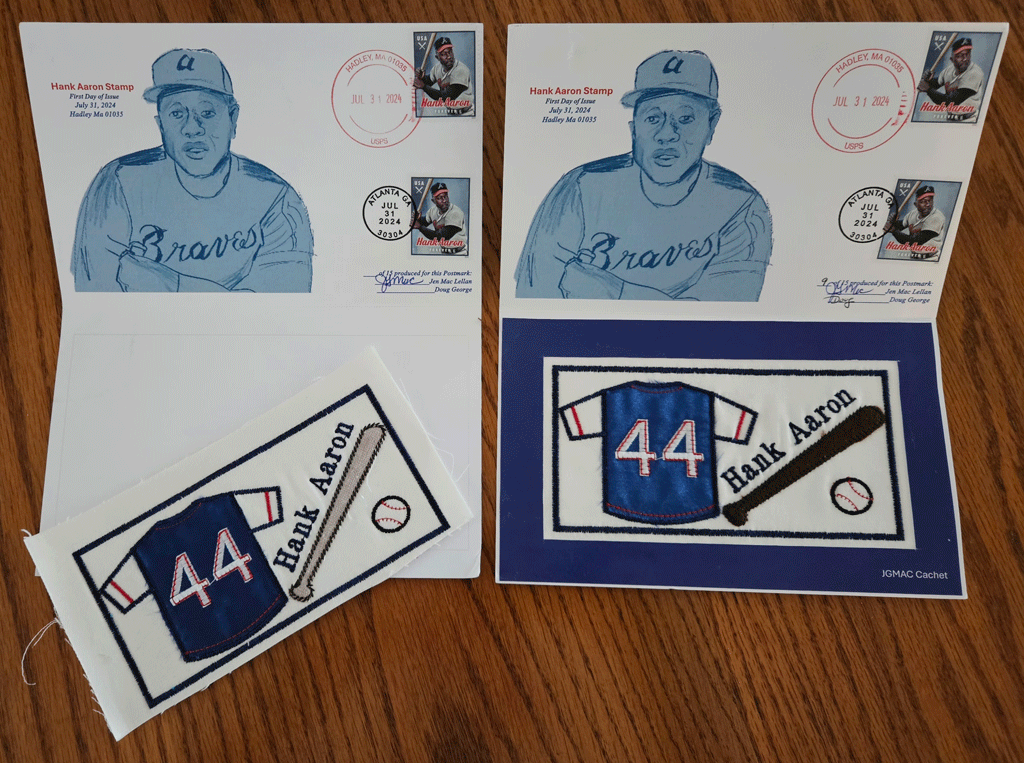
And the top award went to a brother-sister collaboration: Doug George and his sister Jennifer MacLellan, both of Massachusetts, produced what the judges decided was the best cachet of the year, a first day cover that was a booklet with a tiny embroidered baseball jersey for the Hank Aaron issue. It was also the winner in the Esoteric category. (Photo on the left.)

Marrah Reichert who tied for first place in the Juniors 10 and Under category, is Kevin Colton‘s granddaughter. Last year, he won the overall Top Cachet award. This year, his Holiday Joy FDCs won second in Se-Tenant Covers, third for the Big Dog Race in Event Covers, and he continued his domination of Foreign Covers with first- and second-place wins. But that’s Marrah’s Lunar New Year FDC shown here. She’s now 11 but was 10 when she produced this cachet.

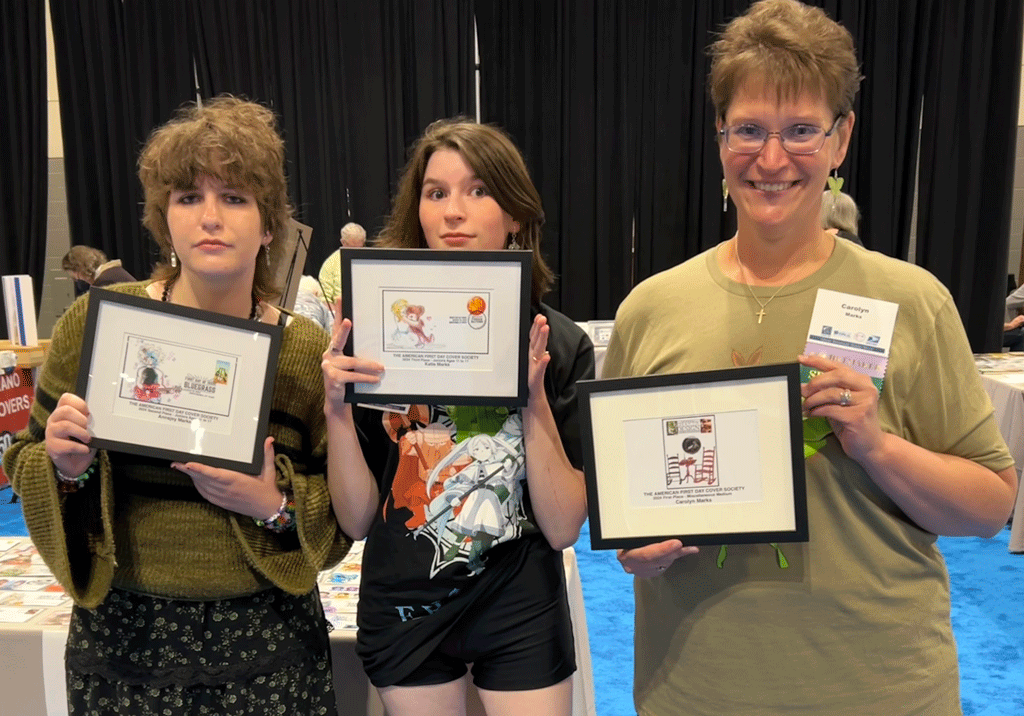
Carolyn Marks designed the Miscellaneous Medium category winner for Shaker Design, while daughters Annajoy and Katelyn took home their own plaques for Juniors Ages 11 to 17 for, respectively, Bluegrass and Pinback Buttons. That’s Annajoy, Katelyn and Carolyn, left to right, in the photo.

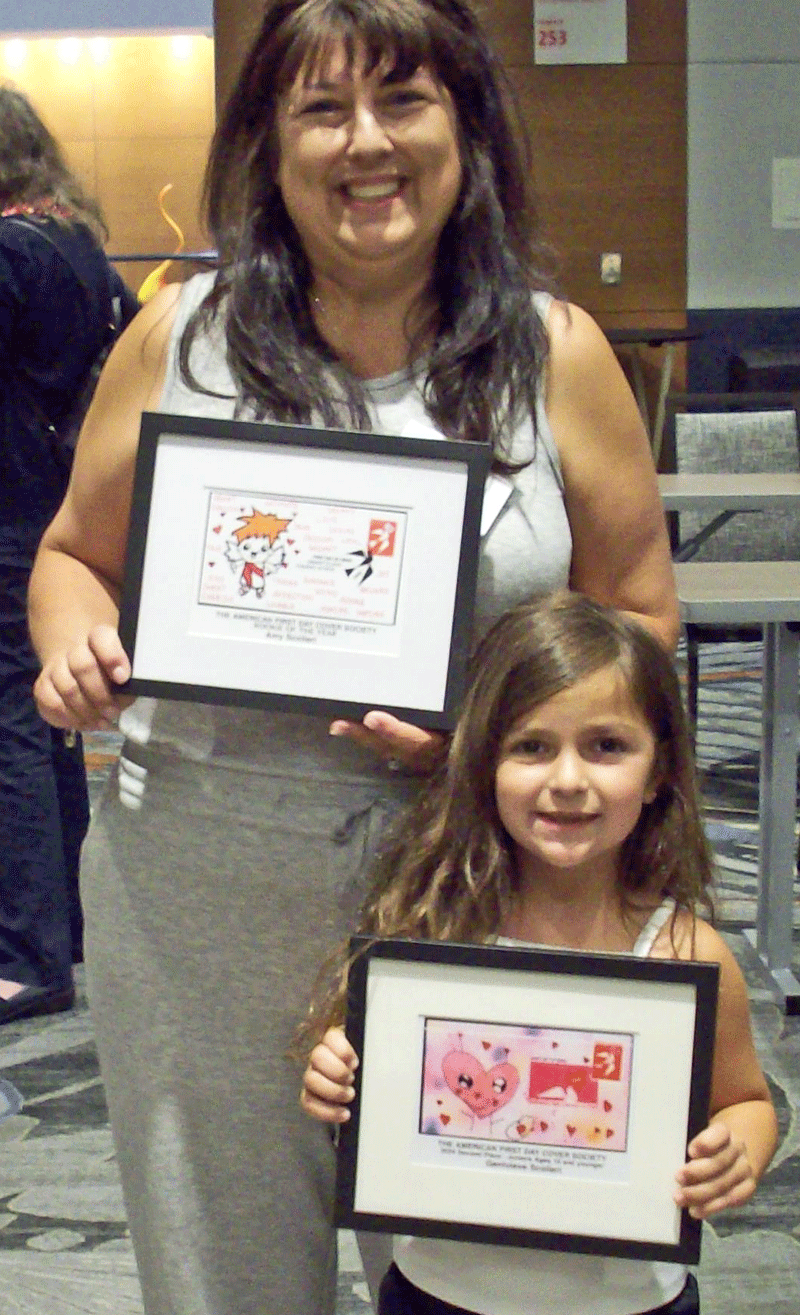
Mother Amy Scolieri won Rookie of the Year honors, while daughter Genivieve placed second in Juniors Ages 10 and Younger. That’s Amy and Genivieve in the photo. Father Gregory Scolieri won second and third in Hand-Drawn/Hand-Colored/Hand-Painted. (His photo is below.)

Tricia Richmond won in the Printed Artwork/Design, Multicolored and Noncommercial categories, while adult daughter Darcy Richmond took second place Miscellaneous Medium and third in Noncommercial. The Richmonds were not able to attend Americover/Great American Stamp Show 2025, where the awards were presented.

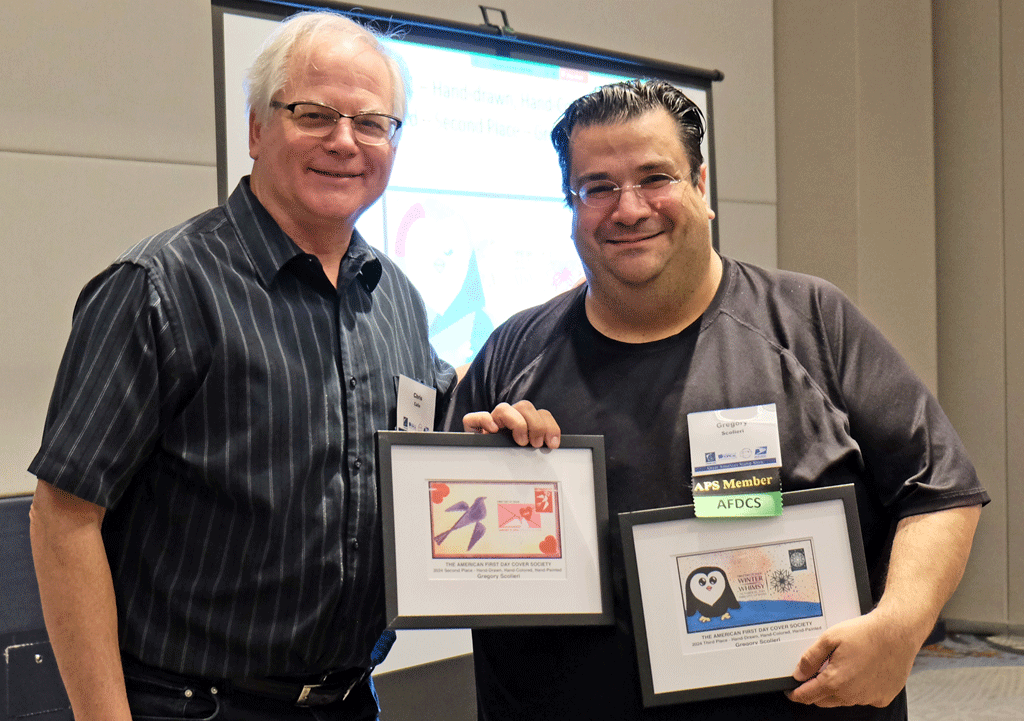
There’s even a father-daughter connection of sorts. Arianna Calle, now a college student, has won in the Junior categories in the past. This year, she placed second in the Hand-Colored/Hand-Painted and Printed from Original Artwork, first and second in Hand-Colored/Hand-Painted and Printed from Non-Original Artwork, and first in the Printed/Single-Color. Her father Chris provided the artwork for the second-place Event cover of the year. (Chris ran the contest, but swears he did not get involved in Arianna’s categories. But he did get to flash a big smile while holding two of her awards.)

Back to that George family: Doug won first and third in the Hand-Colored/Hand-Painted and Printed from Original Artwork category, second and a tie for third in single-color, first place on his own in Duck covers and third in a collaboration in that category, and first and third in the Se-Tenant issues category. Sister Jennifer, on her own, won third place in Esoteric.

“Both my sister and I were shocked and amazed that we won the Top Cachetmaker award this year,” Doug told The Virtual Stamp Club. “Just being able to work with my brother and connect and learn from him is rewarding enough,” added Jennifer.

“The Hank Aaron booklet design was all Doug’s idea,” she said. ” It was great to see his vision come together.”

The Hank Aaron FDC combines her embroidery wizardry with other cachetmaking techniques.

We promised you a photo of Gregory Scolieri, here receiving his award from competition chair Chris Calle.

You can see the complete (illustrated) list of winners here on The Virtual Stamp Club, starting here.

Photos courtesy of Doug George.

McFarlane Book Wins AFDCS Literature Award

Press Release
McFarlane Exhibiting Book Wins AFDCS Ward Award

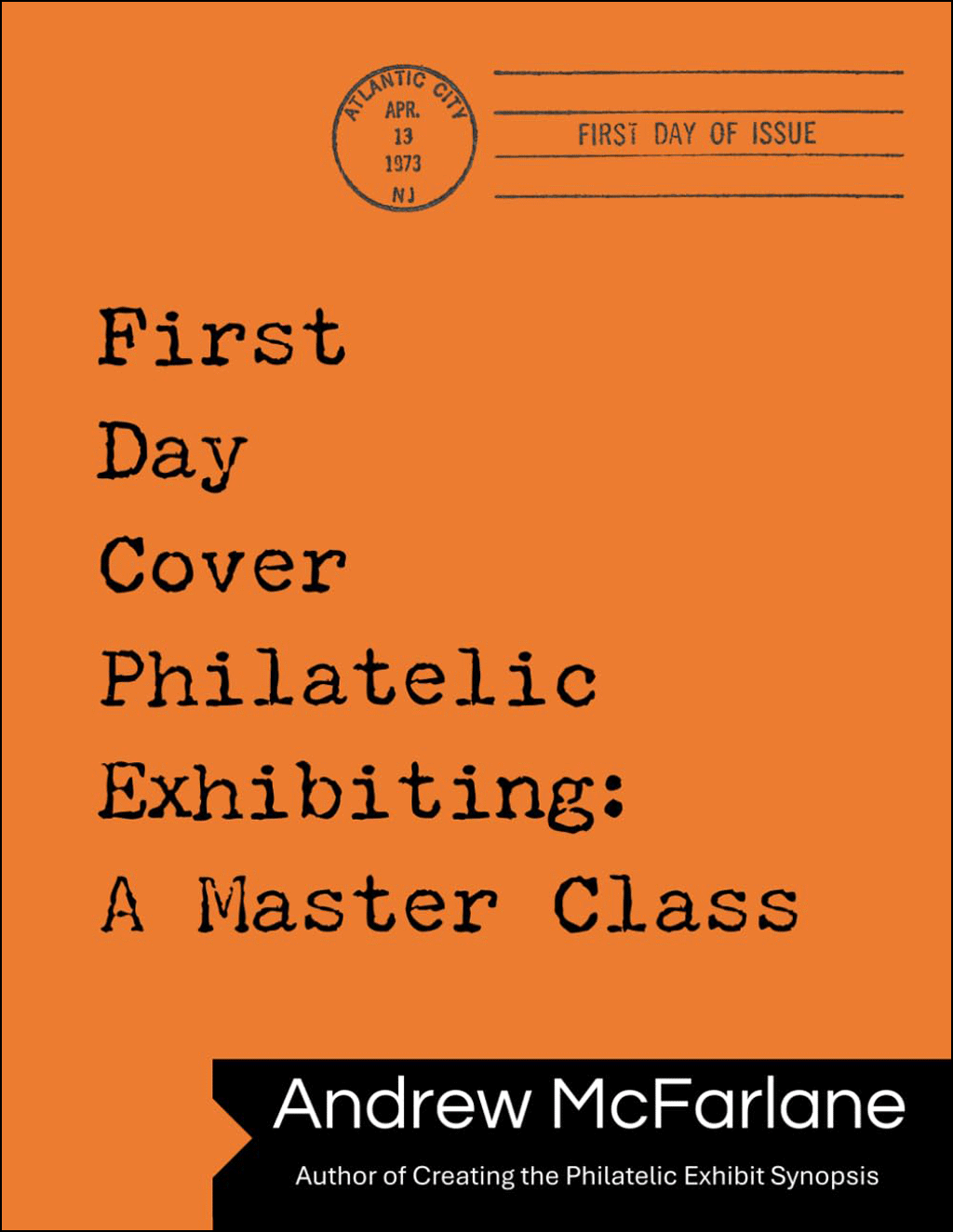
First Day Cover Philatelic Exhibiting: A Master Class by Andrew McFarlane is the 2024 winner of the American First Day Cover Society’s annual Philip H. Ward, Jr., Memorial Award for Excellence in First Day Cover Literature. It also won the Grand Award in the 2025 Great American Stamp Show literature competition as well as a large gold. The more than 500-page book was published by Exhibitors Press and is available on Amazon in both hardcover and paperback editions. Autographed copies may be ordered from his website.

The first four volumes of Kenneth M. Stern’s ongoing series of catalogues of Walter G. Crosby First Day Covers, covering 1928 through 1943, was the runner-up. The fifth and final volume, 1944 through 1949, was published earlier this year. All are also available on Amazon and Stern publishes updates on his website.

“It’s an honor even to be considered,” said McFarlane. “Receiving the award goes beyond anything I’d ever dreamed.”

As an exhibitor, he has won more than seven national exhibition Grand Awards, including that of the American First Day Cover’s Americover in 2005, 2011 and 2013. McFarlane, an IT consultant, also is the recipient of the American Association of Philatelic Exhibitors’ Diamond Award for multi-frame exhibiting. He lives in Pennsylvania’s Pocono Mountains with his wife Caroline.

Philip Henry Ward, Jr., began servicing first day covers in 1909. An electrical engineer by trade, he wrote on new issues for The American Philatelist, Mekeel’s Weekly Stamp News and The Weekly Philatelic Gazette in the early 20th century.

The American First Day Cover Society is a not-for-profit educational organization. In addition to publishing its journal First Days, the AFDCS also publishes handbooks and catalogues, and promotes the collecting of both modern and “classic” issues and cachets, as well as exhibiting FDCs. It offers awards for outstanding first day cover exhibits and an annual contest for cachetmakers, and is a co-host of the annual Great American Stamp Show.

For more information about the AFDCS, visit www.afdcs.org, e-mail afdcs@afdcs.org or write the AFDCS at Post Office Box 57, Somerset, WI 54025-0057.

USPS “Easter Eggs” on 2025 Stamps

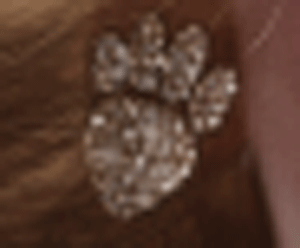
I haven’t seen these mentioned elsewhere, but we learned at Great American Stamp Show that there are at least two “Easter Eggs” or hidden images in U.S. stamp designs for 2025. The first was on the Betty White stamp: Her visible earring is in the shape of a paw print, to represent her love and advocacy for animals:The second is on a stamp not yet issued, one of the Holiday Cheer stamps:On the one with the birds, at least two of the snowdrops on the branches have “frost” inside them. (The one shown here is sideways.)And I’m told there will be others in 2026.

Monty Python (UK 2025)

[press release] [click on any of the pictures for larger versions]
And Now for Something Completely Different!
Set of 10 Stamps Celebrate Monty Python

  • Issue date: 14 August
  • Six stamps in the main set celebrate unforgettable characters from the iconic television series, Monty Python’s Flying Circus
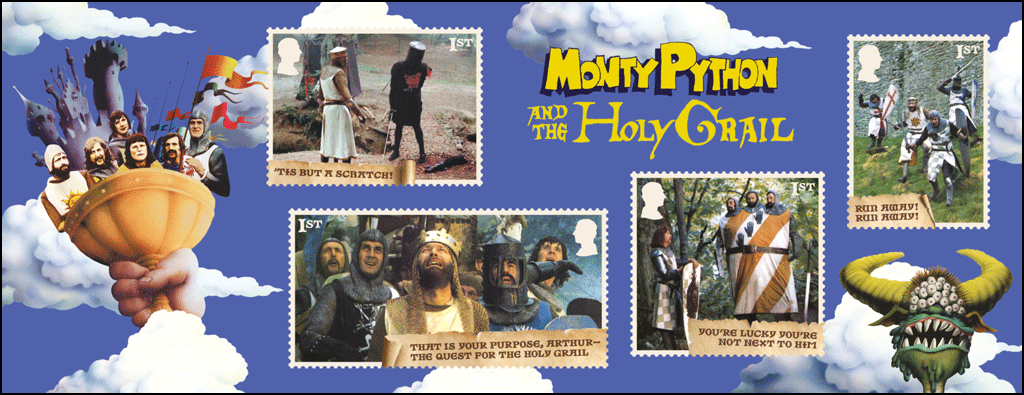
  • A further four stamps, presented in a miniature sheet, celebrate the 50th anniversary of the cult film, Monty Python and the Holy Grail
  • The stamps and a range of collectible products are available to pre-order at www.royalmail.com/montypython and by telephone on 03457 641641

Royal Mail has announced that a set of 10 stamps will pay tribute to one of Britain’s most influential and enduring comedy troupes – Monty Python.

The main set of six stamps celebrates the unforgettable characters and sketches from Monty Python’s Flying Circus, the iconic British comedy series that redefined television humour. Each stamp features a vibrant montage of scenes and cut-out illustrations, perfectly capturing Monty Python’s unique blend of wit, satire and absurdity.

The stamps showcase legendary moments from the show, including the Spanish Inquisition, the Ministry of Silly Walks, the Lumberjack Song, the Dead Parrot Sketch, Nudge Nudge and Spam.

And in honour of 50 years of the cult 1975 film, Monty Python and the Holy Grail, a further four stamps, presented in a miniature sheet, celebrate the film that redefined spoof cinema and cemented the group’s international status.

Scenes featured are:

      • The Black Knight’s defiant “’Tis but a scratch!”
      • King Arthur and his knights receiving their divine quest
      • The panicked cry of “Run away! Run away!” from a failed charge
      • Sir Robin’s encounter with the Three-Headed Giant – “You’re lucky, you’re not next to him!”

    From iconic television sketches to blockbuster films, chart-topping albums, and sold-out live performances, the legendary group – Graham Chapman, John Cleese, Terry Gilliam, Eric Idle, Terry Jones, and Michael Palin – has been at the forefront of comedic innovation for nearly sixty years, captivating audiences across generations with their unique blend of wit, satire, and surreal humour.

    Sir Michael Palin said: “Very glad to share a stamp with the nude organist!”

    David Gold, Director of External Affairs and Policy, Royal Mail, said: “Monty Python has left an indelible mark on global comedy, all while remaining unmistakably British at its core. From their groundbreaking television debut to a string of iconic films, this stamp collection honours a body of work that has shaped the comedic landscape for nearly six decades.”

    The stamps, and a range of collectible products, are available to pre-order at www.royalmail.com/montypython and by telephone on 03457 641 641. A Presentation Pack including all 10 stamps is priced at £17.90. The stamps go on general sale from 14 August.


The set of stamps is £10.20 or about $13.70 USD. The souvenir sheet is £6.80 or USD$9.13. The additional products include the presentation pack, first day covers, medal covers (FDCs), postcards, framed stamps and a fan sheet.

Want To See An Encore for a Favorite U.S. Issue?

[press release] [click on any of the pictures for larger versions]
USPS Stamp Encore Voting Open Now
Vote for your favorite stamp to be reissued in 2026

WASHINGTON — The U.S. Postal Service is excited to announce the Stamp Encore Contest. To celebrate the organization’s 250th anniversary, and gear up to celebrate the country’s 250th anniversary, the public is invited to select a stamp pane from the past for re-printing as part of the 2026 Stamp program.

The Postal Service chose 25 stamp panes from some of its bestselling and most popular stamp issuances of the recent past. Voting is open through Sept. 30, both online and by mail. You can view the official rules and vote online at stampsforever.com/vote, or print a paper ballot from the website and mail it in.

This is an open invitation — everyone is welcome, and you can vote as many times as you want.

The Postal Service plans to announce the winning stamp design in May 2026 at the Boston 2026 World Expo to coincide with America’s 250th anniversary celebrations.

Until then, the results will be a secret.

List of stamps:

Art of Disney: Magic (2007)
Bugs Bunny (1997)
DC Comics Super Heroes (2006)
Flag Act of 1818 (2018)
Have a Ball! (2017)
Mail a Smile (2015)
Peanuts (2001)
Star Wars: Droids (2021)
Wonder Woman (2016
Batman (2015)
Charles M. Schulz (2022)
Disney Villains (2017)
Frozen Treats (2018)
Heritage Breeds (2021)
Message Monsters (2021)
Send a Hello (2011)
Total Eclipse of the Sun (2017)
Bioluminescent Life (2018)
Classics Forever (2016)
Emancipation Proclamation (2013)
Happy Birthday (2021)
Let’s Celebrate (2020)
Mister Rogers (2018)
Star Trek (2016)
Transcontinental Railroad (2019)

AFDCS Seeks Board Candidates

[press release]
Self-nominations are now open for the Board of Directors of the American First Day Cover Society, the largest not-for-profit FDC organization in the world. Each year, the membership of the AFDCS elects four people to serve on its board for three-year terms.

Those running for the board must be members in good standing and are expected to submit a statement of no more than 300 words and a photo. There is no other “qualifying process” for nominations: No 10-member petitions, minimum tenure in the AFDCS, nor the ability to recite cachet catalogue numbers from memory. Reasonable proficiency with email is expected.

Once elected, Directors are expected to attend the one in-person meeting a year (held at the convention) and ad hoc online meetings, participate in email discussions and vote electronically on matters that come before the board. The candidates are announced at Americover, the annual convention (held this year in conjunction with Great American Stamp Show) and the ballot and their statements are mailed to members in the fall. The terms begin on January 1.

Mark Gereb of New Jersey is chairing the AFDCS 2025 Nominating Committee, aided by Tris Fall of Pennsylvania and John Peterson of California. Those wish to run, or who would like more information, should contact Mark at rec.sec@afdcs.org.

The AFDCS Board of Directors consists of 12 elected members, plus three ex-officio members: the president, editor, and general counsel. (The Society’s complete bylaws are available at www.afdcs.net/bylaws). Directors are not compensated in any way for serving on the board, although they may receive reimbursement for expenses not related to serving on the board or attending meetings.

The American First Day Cover Society is a not-for-profit 501(c)(3) educational organization, established in 1955. It publishes the award-winning bimonthly journal First Days, as well as handbooks and catalogues, maintains a YouTube channel, and promotes the collecting of both modern and “classic” issues and cachets, as well as the exhibiting of FDCs.

For more information about the AFDCS, visit www.afdcs.org, e-mail afdcs@afdcs.org or write the AFDCS at Post Office Box 57, Somerset, WI 54025-0057.

U.S. Scott Catalogue Update (July 2025)

6003 (73¢) Army 250th Anniv.
a. Imperforate
6004 (73¢) Navy 250th Anniv.
a. Imperforate
6005 (73¢) Marine Corps 250th Anniv.
a. Imperforate

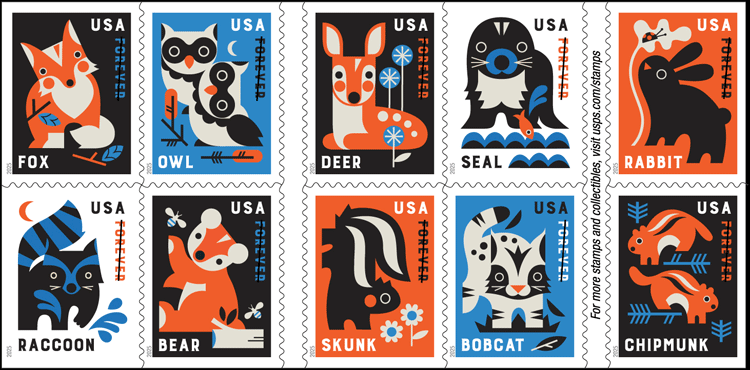
6006 (73¢) Baby Wild Animals – Fox
6007 (73¢) Baby Wild Animals – Owls
6008 (73¢) Baby Wild Animals – Deer
6009 (73¢) Baby Wild Animals – Seal
6010 (73¢) Baby Wild Animals – Rabbit
6011 (73¢) Baby Wild Animals – Raccoon
6012 (73¢) Baby Wild Animals – Bear
6013 (73¢) Baby Wild Animals – Skunk
6014 (73¢) Baby Wild Animals – Bobcat
6015 (73¢) Baby Wild Animals – Chipmunks
a. Block of 10, #6006-6015
b. Convertible booklet pane of 20, 2 each #6006-6015

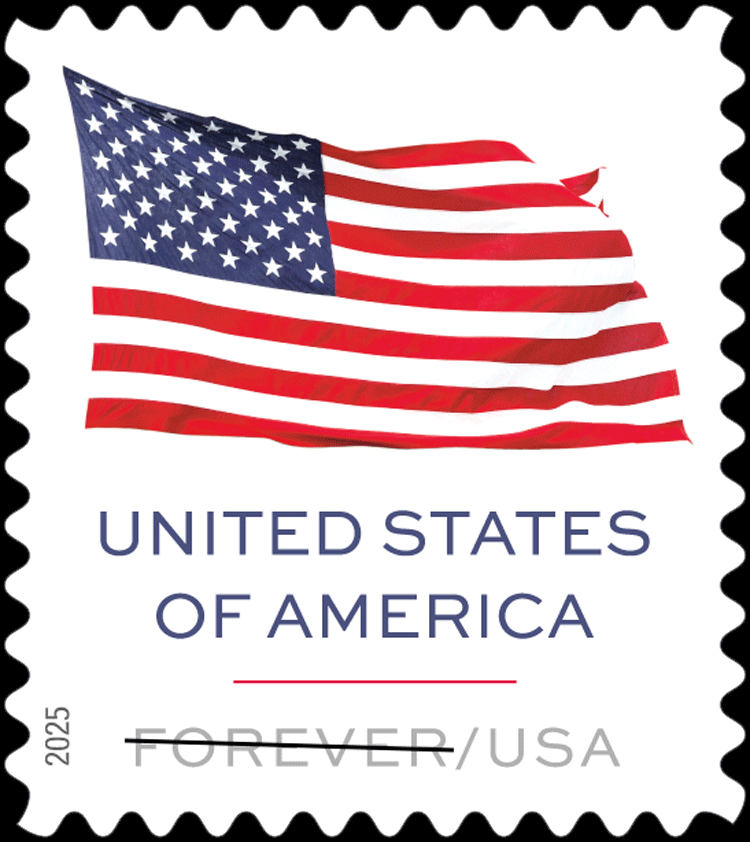
6016 (73¢) Flag, sheet stamp, serpentine die cut 11¼x11
6017 (73¢) Flag, coil stamp (Ashton-Potter), serpentine die cut 9½ vert., adjacent on roll
6018 (73¢) Flag, coil stamp (Ashton-Potter), serpentine die cut 10 vert., separated on roll
6019 (73¢) Flag, coil stamp (Banknote), serpentine die cut 11 vert.
6020 (73¢) Flag, booklet stamp (Ashton-Potter), serpentine die cut 11¼x11 on 2 or 3 sides, microprinted “USPS” at right of lower right corner of blue flag field
a. Convertible booklet pane of 20
6021 (73¢) Flag, booklet stamp (Banknote), serpentine die cut 11¼x11 on 2 or 3 sides, microprinted “USPS” near center of bottom flag stripe
a. Convertible booklet pane of 20

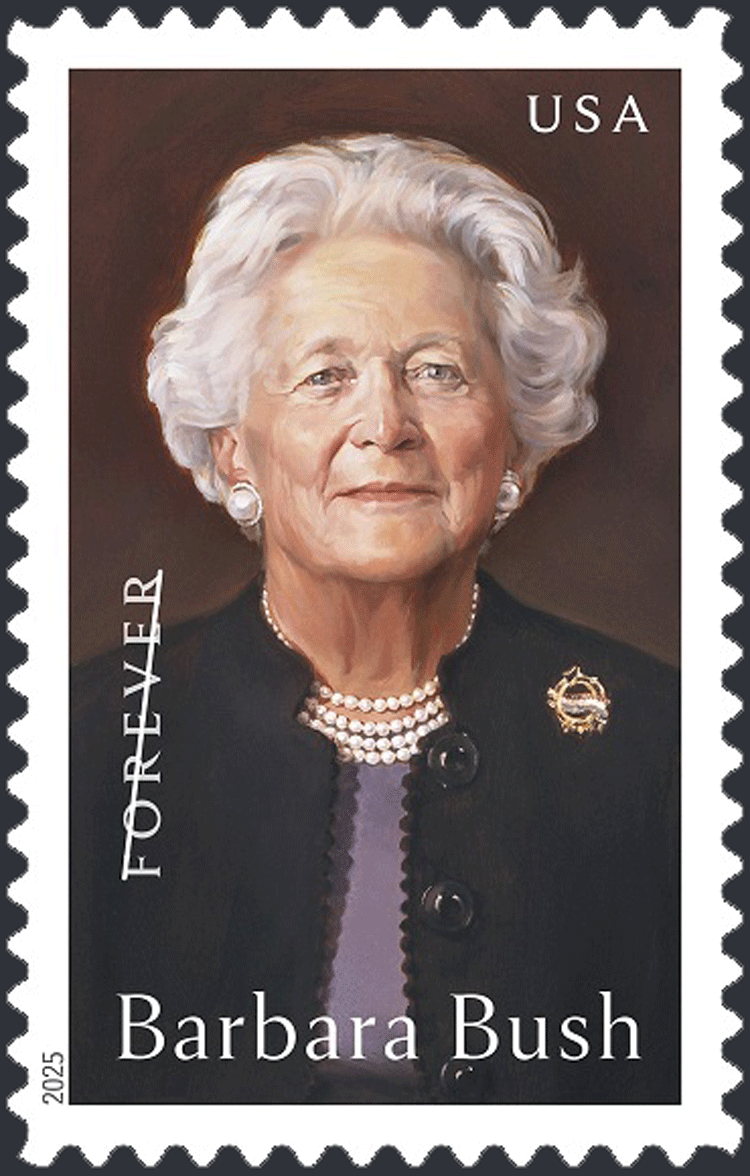
6022 (73¢) Barbara Bush
a. Imperforate

The Magic Of Mushrooms (UK 2025)

[press release] [click on any of the pictures for larger versions]
The Magic Of Mushrooms

  • Issue date 3 July
  • A set of 10 new stamps celebrates the extraordinary diversity and ecological importance of mushrooms that can be found across the United Kingdom
  • Images reveal a hidden world of remarkable beauty, colour and shapes
  • The stamps and a range of collectible products may be ordered at www.royalmail.com/mushrooms and by telephone on 03457 641641

Royal Mail has revealed images of 10 stamps that showcase the extraordinary diversity and ecological importance of mushrooms that can be found across the United Kingdom.

Mushrooms featured in the issue are: Chicken of the Woods; Clustered Bonnet; Scarlet Waxcap; Morel; Scarlet Elf Cap; Penny Bun; Amethyst Deceiver; Collared Earthstar; Fly Agaric; and Turkey Tail.

Royal Mail worked with mycologist Geoffrey Kibby, one of Britain’s foremost experts on identifying mushrooms in the field. Kibby has written numerous books, which he also illustrates. He also produces field guides on the larger fungi of both Europe and North America.

Fungi occupy every possible ecological niche and are a vital part of the world’s ecosystems, with many species forming symbiotic partnerships with trees, shrubs and other plants.

Mushrooms come in an amazing diversity of shapes, colours and textures. From the bizarre earthstars, which open to reveal a ball-like structure full of spores, to the sponge-like and very edible morels, there are over 4,000 mushroom varieties in the UK.
These range from edibles, such as the penny bun, to the toxic fly agaric, with its distinctive, white-spotted red cap. The often-startling colours of fungi can be surprising, for example the intense violet of the amethyst deceiver, a common species in autumn woodlands everywhere. Not all mushrooms have a cap and a stem.

Many form simple cups, of which arguably the most beautiful is the scarlet elf cup, while others are tough and bracket-shaped, such as the colourful turkey tails or the often large and striking chicken of the woods.

A common species on oak logs is the clustered bonnet, known for its unusual but difficult-to-define smell resembling that of paint, flour or cucumber. In undisturbed old meadows, you can find the beautiful scarlet waxcap. one of several species used by ecologists and nature agencies as indicators of nationally important grasslands. The variety of fungi is extensive, and we are only now learning of their importance in our world’s ecology.

David Gold, Director of External Affairs and Policy, Royal Mail, said: “Few people will be familiar with the breadth, variety and beauty of the fungi that are of such biological importance to our natural environment. Mushrooms play an essential role in the delicate balance of life around us, yet largely go unnoticed. In these stamps their contribution to the natural environment is duly recognised.”

Mycologist, Geoffrey Kibby said: “Fungi are finally getting the attention that they deserve in literature, education and on TV, and now their amazing diversity and importance to our ecology is being celebrated in this excellent set of Royal Mail stamps. The species illustrated show the wide variety of fungi to be found in the British countryside, emphasising their importance as a vital part of the fascinating biodiversity to be found in our islands.”

The stamps, and a range of collectible products, are available at www.royalmail.com/mushrooms and by telephone on 03457 641 641. A Presentation Pack including all 10 stamps is priced at £13.75

Stamp-by-stamp:
CHICKEN OF THE WOODS Laetiporus sulphureus The common name of this popular edible mushroom relates to its texture and taste when cooked. The very large, flattened brackets, up to 50cm across, are found on standing or fallen trees, especially oaks, chestnuts and other deciduous species. The yellow to orange colours and fleshy texture make it difficult to mistake for any other mushroom. The underside of each bracket has thousands of minute pores from which the spores are ejected. This mushroom appears in the early summer and continues throughout the autumn.

CLUSTERED BONNET Mycena inclinata Wherever you find fallen oak logs, you may see the clustered bonnet, one the most common and widespread British species of Mycena. The reddish brown stems, paler at the top, pale grey-brown caps and rather strong odour – sometimes likened to wet paint, cucumber or flour – are good identification characteristics. Several other species of Mycena grow in clumps on logs, but this is perhaps one of the easiest to identify.

SCARLET WAXCAP Hygrocybe coccinea This is one of the most beautiful mushrooms. Its scarlet cap can be found in late autumn in open, undisturbed, unfertilised meadows. The lamellae, or gills, on the underside of the cap and the fragile, waxy stem are both reddish-orange, with the stem being almost white at the base, while the thin reddish flesh is nearly odourless. The caps can reach up to 4cm across. There are several other red species of waxcap, differing in subtleties of colour, texture, size and smell, all best identified using a good field guide.

MOREL Morchella vulgaris Morels are found from March to May and are considered to be prized edibles. There are several very similar species, of which this is one of the more common; its sponge-like head is where its spores are formed in special cells, from which they are ejected in huge numbers in a smoke-like puff. The greyish-brown head can be up to 8cm tall. When cut in half, the body is hollow. This mushroom is widespread in the UK and found in mixed woods on rich soils.

SCARLET ELF CUP Sarcoscypha austriaca Found in the late winter through spring, this beautiful species can reach 5–6cm across and often occurs in groups along fallen, mossy branches in wet or humid deciduous woodlands. It is widespread and locally frequent in some parts of the UK. The outer surface of the cup is whitish and finely woolly, formed of microscopic curly hairs. If disturbed by tapping, it often fires clouds of spores up from the inner cup surface. It has an almost identical twin, Sarcoscypha coccinea, differing in microscopic features.

PENNY BUN Boletus edulis Also known as cep, this is one of the most famous edible mushroom species in Europe, celebrated in numerous cuisines. A robust species, it has caps that can reach 25cm across, varying from yellowish brown to dark chestnut. The fleshy stems have a fine white mesh or network on the surface, while the spongy pores on the underside of the caps are white, then yellowish. The flesh is thick, white and unchanging when cut. This fairly common mushroom can be found in the autumn in mixed woods throughout the UK.

AMETHYST DECEIVER Laccaria amethystina Small troops of amethyst deceivers may appear almost as soon as the autumn rains begin. They push up through the fallen leaf litter in forests across the UK. The amethyst deceiver’s small size and striking colour when fresh of bright amethyst violet on all its parts help make it one of the easier mushrooms to identify. However, when this mushroom is old, the colour fades to a dull greyish lilac or even buff. Theviolet gills may be dusted with the white spores it produces.

COLLARED EARTHSTAR Geastrum michelianum This mushroom starts growing closed up, rather like an onion, but then the outer tissues split and fold back into star-like arms, lifting the central ball up from the ground. Inside the ball are spores that puff out when the ball is struck by rain drops or falling debris. Earthstars are fairly common in the autumn in mixed woodlands and hedgerows and can reach up to 12cm across. This mushroom is also commonly called Geastrum triplex, but that is now known to be a different species from Southeast Asia.

FLY AGARIC Amanita muscaria This is the classic toadstool illustrated in children’s books of fairy tales around the world, but many people do not realise that it is a real fungus. Widespread over the whole of the UK from around August to December, it is most commonly found in birch woods, although it will grow with other trees too. The white spots are the remains of a veil that once covered the entire fungus when young. The fly agaric is one of several poisonous species in the genus Amanita, some of which are deadly.

TURKEY TAIL Trametes versicolor Bracket fungi, or polypores, produce bracketshaped bodies and usually grow on tree trunks or branches. One of the most common of the smaller bracket fungi found in deciduous woodlands throughout the UK, turkey tail is remarkably variable in the colour of the concentric zones, with purples, browns, greens and even bluish shades all being common. The fruiting bodies are tough but flexible, and the pale cream undersides have thousands of minute pores from which the spores are ejected.