
Most stamp collectors would count themselves lucky to have half the philatelic resume that Doug Kelsey had. Quiet and not one to boast, even those of us who thought we knew him well were surprised at what we didn’t know until his death.
Douglas Aden Kelsey: 1949–2020
By Alan Warren
American First Day Cover Society Executive Secretary Doug Kelsey, 70, of Tucson, Arizona, died on July 28 after suffering a stroke in mid-June and developing COVID-19 complications during rehab.
“For nearly 30 years, as volunteers and leaders came and went, Doug was the backbone of the society, guiding us and providing the support that kept this organization running,” said AFDCS President Lloyd A. de Vries. “But more than that, Doug was a friend, and I will miss him personally.”
 Kelsey was born September 3, 1949. He served as executive director of the AFDCS from 1991 until 2011, at which time the position was altered and named executive secretary. He also served many years on the society’s board of directors.
He began collecting in 1960 and exhibiting in 1962. His wide collecting interests included first day covers, meter stamps, airmails, postal stationery, revenues, and Brazil and Australia. In 2002 he won the Americover grand award for his 1962 Project Mercury first day covers. He received the society’s Glenn Michel special recognition award in 2001, its Distinguished Service Award in 2007, and was named AFDCS Honorary Life Member 21 in 2008.
In 2012 Kelsey was honored by the American Philatelic Society with its Nicholas Carter Volunteer Award for national promotion and service. He was an accredited APS judge.
He held offices in several other organizations, including executive director of the American Topical Association, vice president and director of the United States Philatelic Classics Society, treasurer of the St. Helena, Ascension and Tristan da Cunha Philatelic Society,  president of the Machine Cancel Society, executive director of the Postal History Foundation, and secretary-treasurer of the Meter Stamp Society.
Kelsey authored several hundred articles, columns, catalogs, and monographs that included the United States Meter Stamps First Days and Earliest Known Uses. For fourteen years he wrote a column for Linn’s Stamp News and was former editor of the Postal History Foundation’s Heliograph.
Following seven years’ service in the United States Air Force, Kelsey was an executive for Coca Cola Bottling where he was responsible for sales, distribution, advertising, and special projects. He then served as executive director of American Outback—a non-profit organization devoted to the preservation of American wildlife and wilderness. He was also executive director of the Tucson Association of Executives from 1999 until the time of his death.
-0-
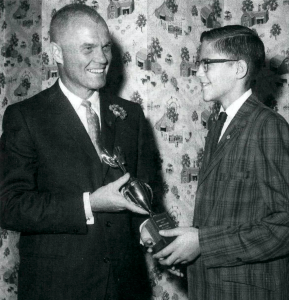 In the February 2002 issue of American Philatelist, Kelsey wrote about the 1962 Project Mercury first-day and his collection, and recounted how that collection’s display at the Ohio State Fair won him a chance to meet astronaut John Glenn, an Ohio native.
Kelsey, already more than six feet tall, revealed how Glenn is standing on a box in this photo, because a NASA public relations worker decided “We can’t have a 12-year-old looking down on a national hero!”
—Lloyd de Vries
According to his official obituary, Doug is survived by his wife Oralia and his stepdaughters Ana and Briseida, his sister Linda Simonds, daughters Julie Stack and Jennifer Murray, and grandchildren Jaime Kelsey, Justina Outler, Christopher Murray, and Ashley Murray.
“Born in Columbus, Ohio he attended his first year of college at Ohio State University located there. Throughout his life he was a fierce Buckeye fan.
“He graduated with a BA from St. Mary’s University in San Antonio, Texas in !971. He served a six year tour of duty with the US Air Force from 1971 to 1977.”
 The

 The
 And VSC member Joseph Goodwin is
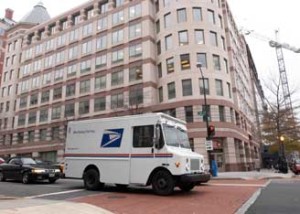 Postal agencies are rarely attention-getting issues in political races, but 2020 is a year like no other: The U.S. Postal Service is a lead item in the presidential election coverage.
 residence.



 Returning to London following a traumatic experience in the Afghanistan war, injured army medic Dr John Watson is on the hunt for a flatmate when he is introduced to Sherlock Holmes, a unique figure who describes himself as “the world’s only consulting detective”. The pair move into shared lodgings at 221B Baker Street, only for Watson to be drawn into an unexpected adventure when Sherlock begins investigating a series of bizarre ‘serial suicides’ that have left Scotland Yard baffled. Coming to the aid of Detective Inspector Greg Lestrade, Holmes soon discovers that each of these deaths is actually the work of the same sinister killer, who has the apparent ability to move undetected through the streets of London.
 and John Watson are drawn into a cat-and-mouse game with London’s most notorious criminal, the enigmatic James Moriarty. The challenge is simple: working against the clock, Sherlock must solve a series of crimes, each more fiendish and challenging than the last. Ranging from the seemingly natural death of a popular TV star to the theft of important government files, each case adds another piece to Moriarty’s sinister, unfolding puzzle. Having successfully completed all five tests – and survived a bruising encounter with a master assassin known only as The Golem – Holmes accepts Moriarty’s invitation to join him at a deserted swimming pool where the criminal mastermind finally reveals his true identity.
 photographs of a member of the Royal Family on her phone, and calls on Holmes and Watson to retrieve the device. When our heroes track the flirtatious Adler to her London flat she escapes, taking the phone with her. But Sherlock is unable to forget his encounter with this alluring woman, and when her dead body is found he is deeply affected. It later transpires that Adler – who has also been passing information to Moriarty and threatening to blackmail the government – faked her demise to evade a gang of terrorists, who plan to bomb a transatlantic flight. Only Sherlock has the knowledge necessary to stop them.
 question following another encounter with the devious Moriarty. Having carried out audacious attacks on the Bank of England, Pentonville Prison and the Tower of London, Moriarty is captured in possession of the Crown Jewels. He is swiftly brought to trial, only to be unexpectedly acquitted – because, as Sherlock discovers, the crime lord either threatened or bribed the jury. Having gained his freedom, Moriarty manipulates the public and the media into believing that Sherlock is a fraud who carried out crimes only to ‘solve’ them himself. Matters culminate in a face-to-face showdown between Sherlock and Moriarty on the roof of a hospital, from where Sherlock apparently plummets to his death.
 and eliminated the last vestiges of Moriarty’s criminal empire. He reintroduces himself to Dr Watson, only to be surprised when his old friend doesn’t welcome him with open arms. Watson, who is soon to be married to Mary Morstan, has spent the intervening years trying to come to terms with Sherlock’s death, and is understandably annoyed to discover that he has simply been in hiding. But the pair set aside their differences when Sherlock saves John from a kidnapping, and are soon on the case of a respected Lord who appears to have vanished on the London Underground. The case leads them to a bomb plot against the Houses of Parliament, and the revelation that there is a new master villain in town.
 second sibling – a sister, Eurus, described as a genius to rival Isaac Newton, but with a total absence of human empathy. Eurus is being held in a secret maximum-security prison situated on an island in the North Sea, a last-resort facility housing the country’s very worst criminals. Holmes and Watson travel to the prison to confront Eurus, only to find that she has used her extraordinary powers of persuasion to take over the facility, bending the staff and fellow prisoners to her will. To avert a horrific tragedy, Sherlock and John must undergo a series of psychological trials designed to test the bonds of friendship between them.
 5475 (55¢) Enjoy the Great Outdoors – Child building sandcastle
 5480 (55¢) Hip Hop – MC with microphone rapping

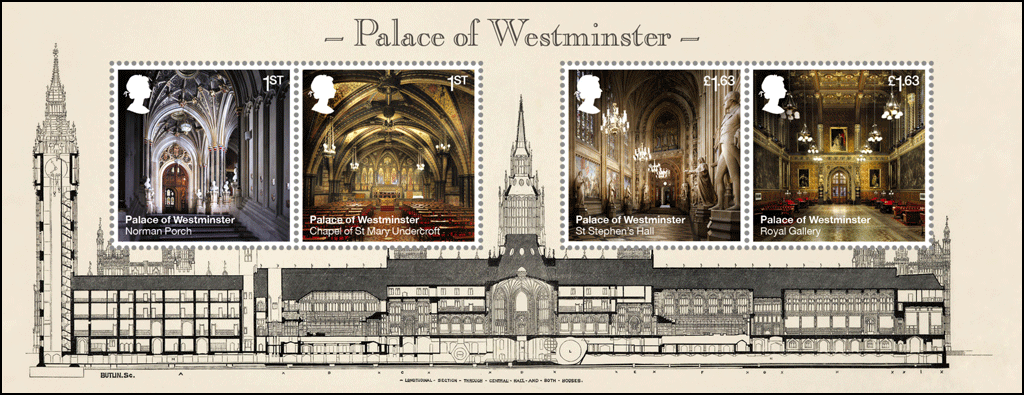
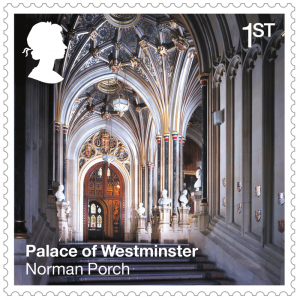 Westminster Abbey, as a UNESCO World Heritage site.
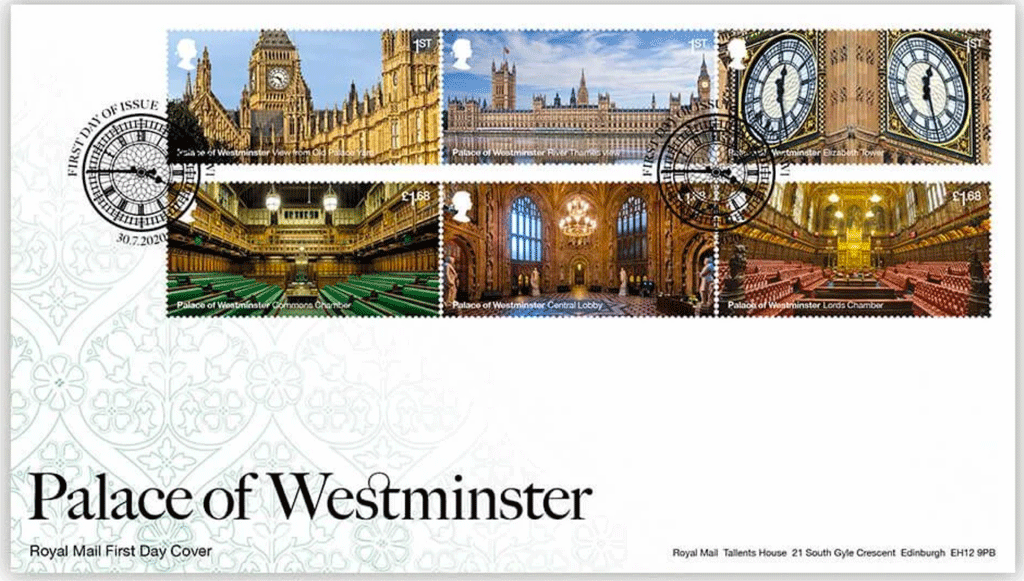
 In 1835 a Parliamentary Committee decided that the Palace should be rebuilt.
 ertaken by Barry’s son, Edward Barry.
 between 1288 and 1290 during the reign of Edward I. There are 399 steps from ground level to the lantern.
 During the Blitz, the palace received several direct hits, and in 1941 the Commons Chamber was destroyed. The new chamber was designed by Sir Giles Gilbert Scott in a modern, pared-down Gothic Revival style, in places using wood from indigenous trees donated by the nations of the Commonwealth.
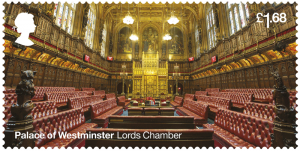 Sir Lindsay Hoyle, Speaker of the House of Commons, said: “Not only is the Palace of Westminster one of the best-known landmarks in the world, it is a living building – a workplace for MPs, peers and staff, as well as a tourist attraction and UNESCO World Heritage Site.
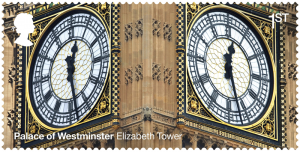 Lord Fowler, the Lord Speaker, said: “For 150 years, this striking and significant building has been a symbol of our democracy, but also a place of important work as the home of the House of Lords and House of Commons.
 Philip Parker, Royal Mail, said: “The Palace of Westminster is one of the most recognisable buildings in the world. Our new stamps mark the anniversary of the completion of its rebuilding and celebrate the genius of its Gothic Revival architecture and design.”

 source of knowledge and inspiration for all. A special anniversary section of Parliament’s online shop will also be available – showcasing a collection of products specifically related to the famous building which houses Parliament which include the official guidebook, the encaustic tiles used throughout the Palace, and the popular Palace of Westminster tree ornament.
 Celebrate the holidays with Holiday Delights. Inspired by folk art but with a modern graphic vibe, these charming stamps will add a touch of whimsy to your holiday mailings. With a traditional palette of red, green and white, illustrator Kirsten Ulve channeled her love of Christmas, vintage ornaments and Scandinavian folk art to create unique digital illustrations of four holiday icons: a prancing reindeer with antlers; an ornament tied with a bow and ready to hang; a tree topped with a star; and a stocking holding a teddy bear and a sprig of holly. Art director Antonio Alcalá designed the stamps.
 The Digital Color Postmark measures 2.69″ x 1.43″
 The Pictorial Postmark measures 2.56″ x 1.23″
 envelopes (to themselves or others), and place them in a larger envelope addressed to:
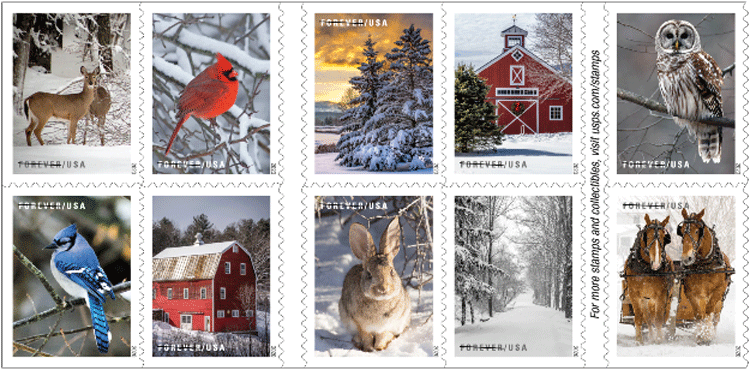
 Winter Scenes celebrates the beauty and serenity of seasonal sights amid snowy landscapes. The 10 different photographs featured in this booklet of 20 stamps showcase the special allure of winter, with iconic scenes from the northern United States. Art director Derry Noyes designed the stamps with existing images taken by various photographers.
 New information will appear below the line, with the latest at the top.
 The Digital Color Postmark measures 2.97″ x 1.42″
 The pictorial postmark measures 1.94″ x 1.19″
 Winter Scenes stamps (Forever® priced at the First-Class Mail® rate) in 10 designs, in a pressure-sensitive adhesive (PSA) double-sided booklet of 20 stamps (Item 683000). The stamps will go on sale nationwide October 16, 2020, and must not be sold or canceled before the first-day-of-issue.
 Modeler: Joseph Sheeran
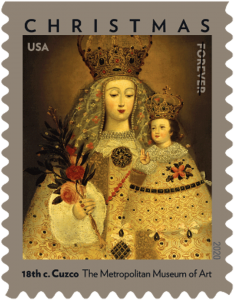 This Christmas stamp (Our Lady of Guápulo) features a detail of the painting “Our Lady of Guápulo.” Painted in the 18th century by an unknown artist in Cuzco, Peru, “Our Lady of Guápulo” is from the collection of the Metropolitan Museum of Art in New York. Enrobed in a pyramidal gown speckled with jewels and holding a scepter woven with roses and leaves, a crowned Virgin Mary looks down at a similarly adorned Christ Child in her left arm. Art director Greg Breeding designed the stamp.
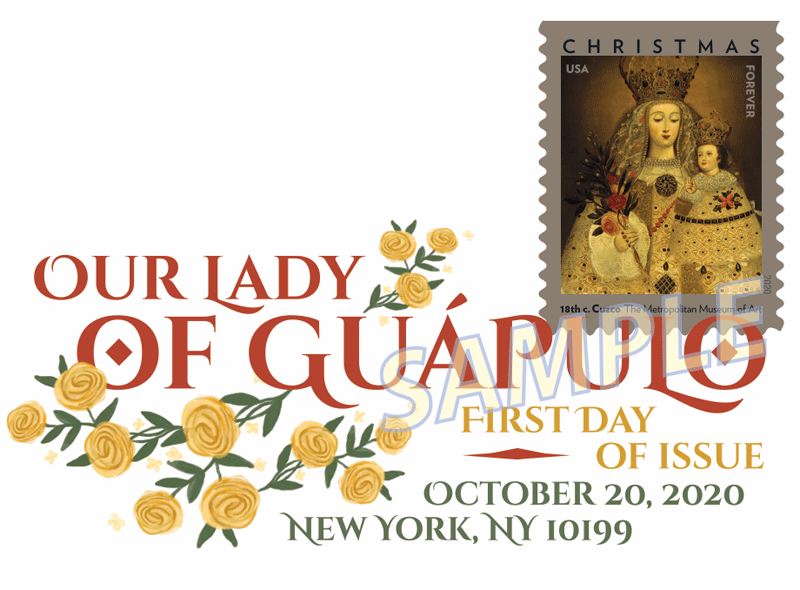 The Digital Color Postmark for this issue measures 2.91″ x 1.26″
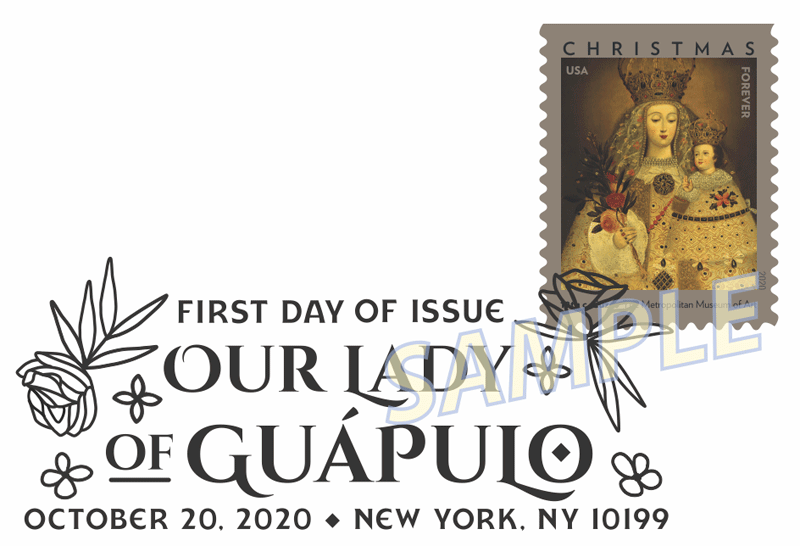 The pictorial postmark measures 2.58″ x 1.07″
 This new stamp celebrates the joyous Jewish holiday of Hanukkah. The stamp art’s colorful digital illustration shows the lighting of the nine-branched Hanukkah menorah on the last evening of the holiday. All eight of the Hanukkah candles have been lit, and the child is reaching up to replace the shamash, the helper candle used to light the others in the menorah. Art director Ethel Kessler designed the stamp with original art by Jing Jing Tsong.
 With this new stamp, the Postal Service continues its tradition of celebrating Kwanzaa. The annual Pan-African holiday, which takes place over seven days from Dec. 26 to Jan. 1, brings family, community and culture together for many African Americans. The stamp design features the face of a woman in profile with her eyes closed. Her contemplative demeanor signifies the ways in which observers of Kwanzaa reflect on the seven founding principles, the Nguzo Saba, and their role in everyday life. A kinara (candleholder) with the seven lit candles (mishumaa saba) sits in front of her. Cool tones evoke a sense of inner peace, and vibrant design elements give the artwork a celebratory feel. Art director Antonio Alcalá designed the stamp with original artwork by Andrea Pippins.
 ailable for purchase while supplies last: [click on the issue to go to its page]