[press release] [click on any of the pictures for larger versions] Canada Post unveils Diwali stamp celebrating the arrival of the Festival of Lights New stamp showcases traditional torana and diya, honouring one of the world’s most widely celebrated festivals
BRAMPTON, Ontario – Canada Post is issuing a new stamp marking the arrival of Diwali, a major festival observed by Hindus, Sikhs, Buddhists, Jains and other communities in Canada and around the world.
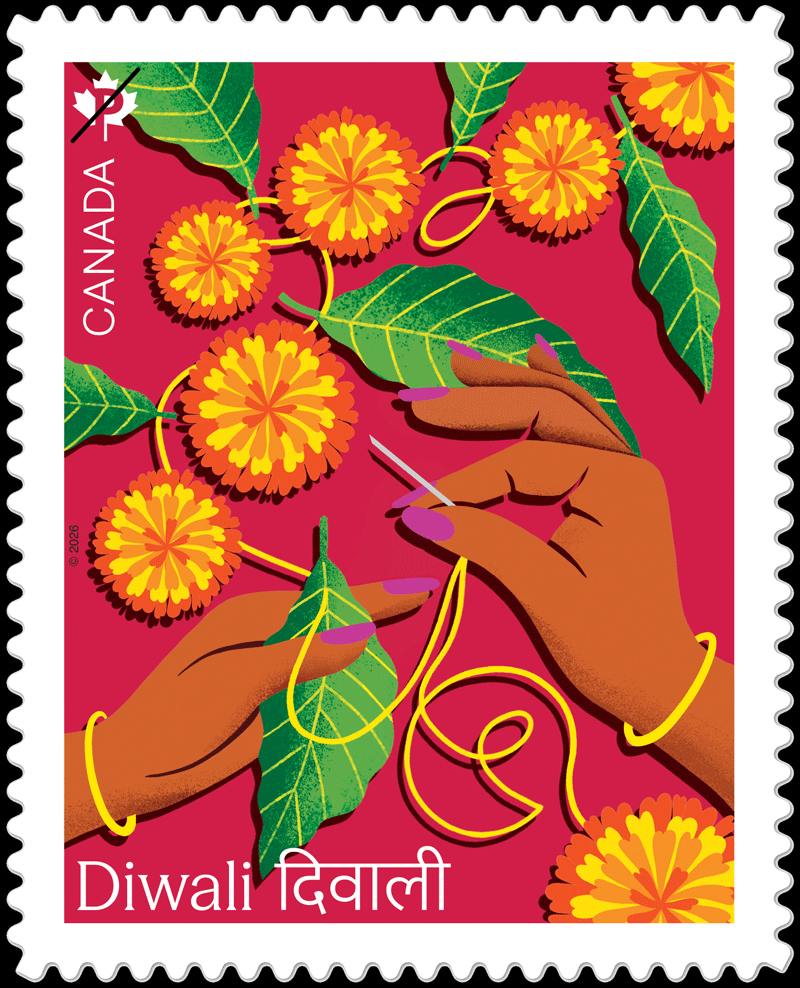
The stamp features an original illustration of a woman’s hands as she strings together marigolds and mango leaves to make a traditional torana – an ornate garland to be draped across the entrance of a home or temple. Like other auspicious decorations that feature prominently during the holiday, toranas are intended to welcome guests and invite Lakshmi, the goddess of prosperity, to bestow good fortune on those who enter. Part of the string forms the outline of a diya, a clay oil lamp that is an important symbol of Diwali. Diyas are often displayed during the festival to commemorate the triumph of light over darkness.
Also called the Festival of Lights, the holiday celebrates the triumph of good over evil and light over darkness. While communities observe Diwali on different days and in different ways, the festivities often include fireworks, gift exchanges between family and friends, and the giving of food to those in need. This year, Diwali begins on November 8.
The stamp is one of several annual issues that showcase events of importance to Canada’s culturally diverse population. Others include yearly stamps celebrating Eid, Hanukkah and Christmas. Canada Post has issued a new Diwali stamp each year since 2020.
About the stamp
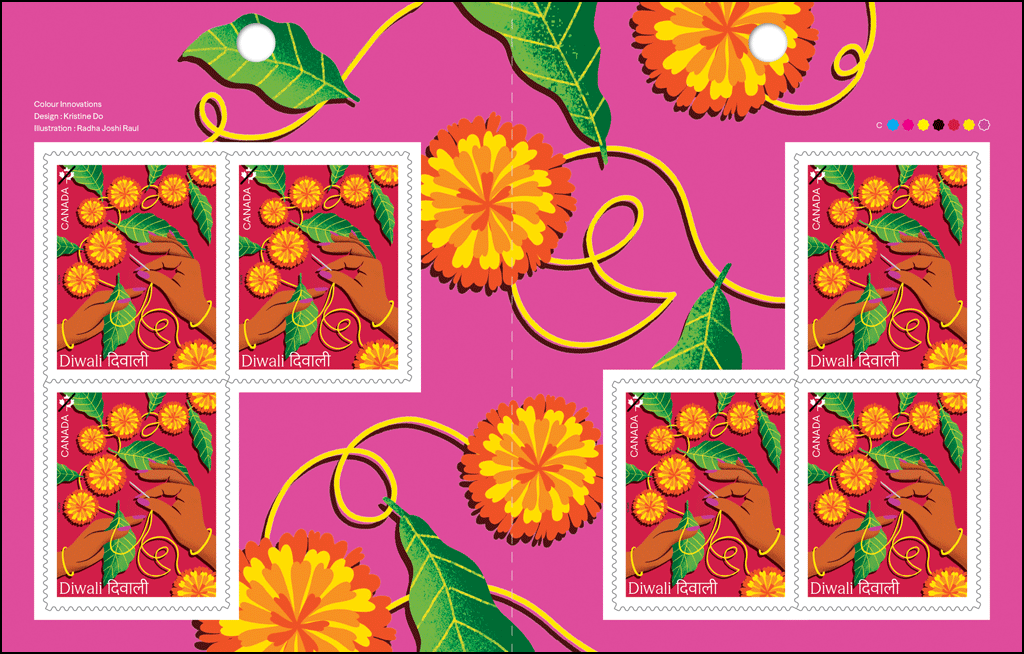
The new Diwali stamp issue was designed by Kristine Do and illustrated by Radha Joshi Raul. It was printed by Colour Innovations and includes a booklet of six Permanent™ stamps and an Official First Day Cover [below]. The cancel location is Brampton, Ontario. [It’s very faint on the illustration and probably the actual OFDC, but it is touching the upper left corner of the stamp. —VSC]
The stamps and collectibles will be available at canadapost.ca and at select postal outlets across Canada beginning October 19.
[press release] [click on any of the pictures for larger versions] New stamps highlight the ecological importance of wolves in Canada Stamps feature striking, close-up images of wolves found in different parts of the Canadian wilderness
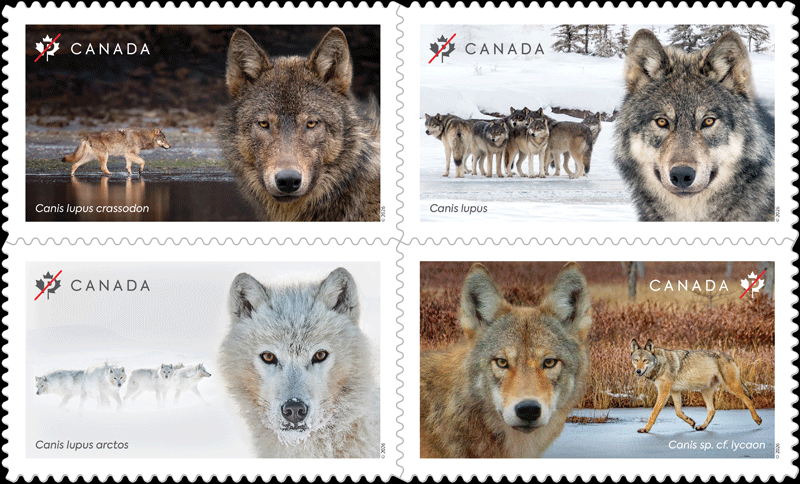
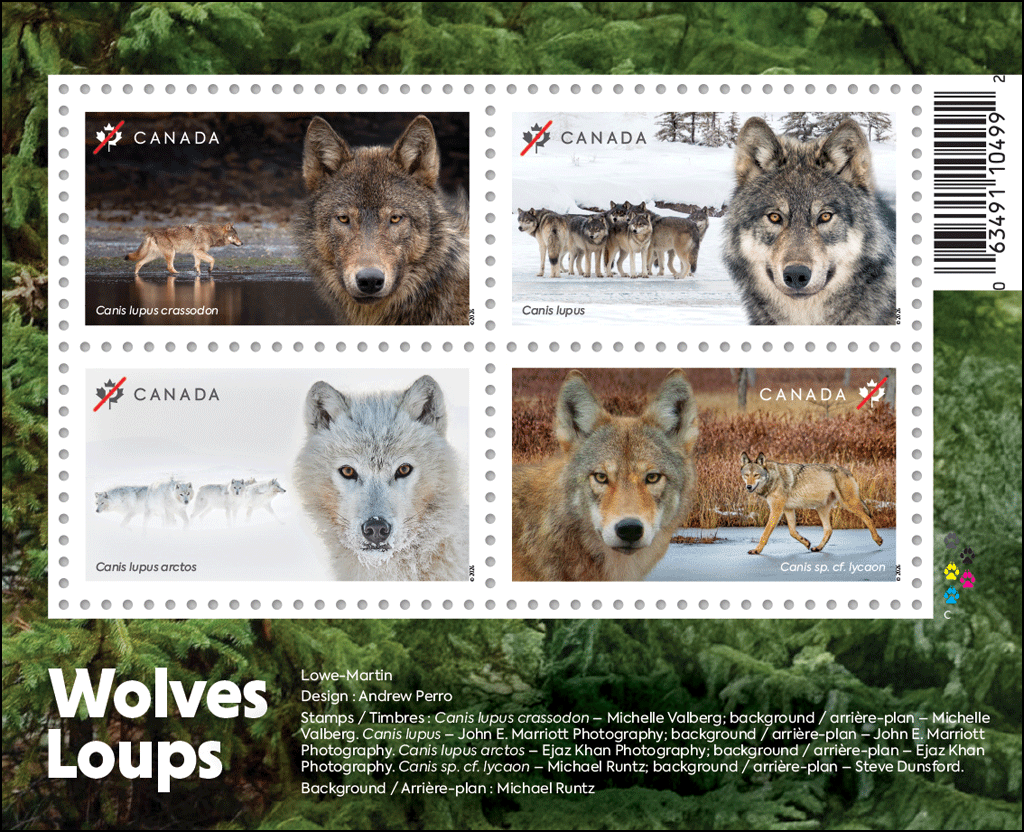
WHITNEY, Ont. – Canada Post issued on August 13 new stamps highlighting the role wolves play as a keystone species.
Wolves contribute significantly to the health and biodiversity of the ecosystem. The intelligent hunters are often associated with the North and remote Canadian landscapes, and they also figure prominently in many Indigenous cultures.
These social animals use co-operative hunting and share responsibility for raising their young – a behaviour seen in only a small percentage of mammals. With sharp senses that help them detect prey almost two kilometres away, wolves hunt small and large animals, including caribou, deer, elk, moose, bison and evenmuskoxen.
Stamps feature wolves in different regions of the country
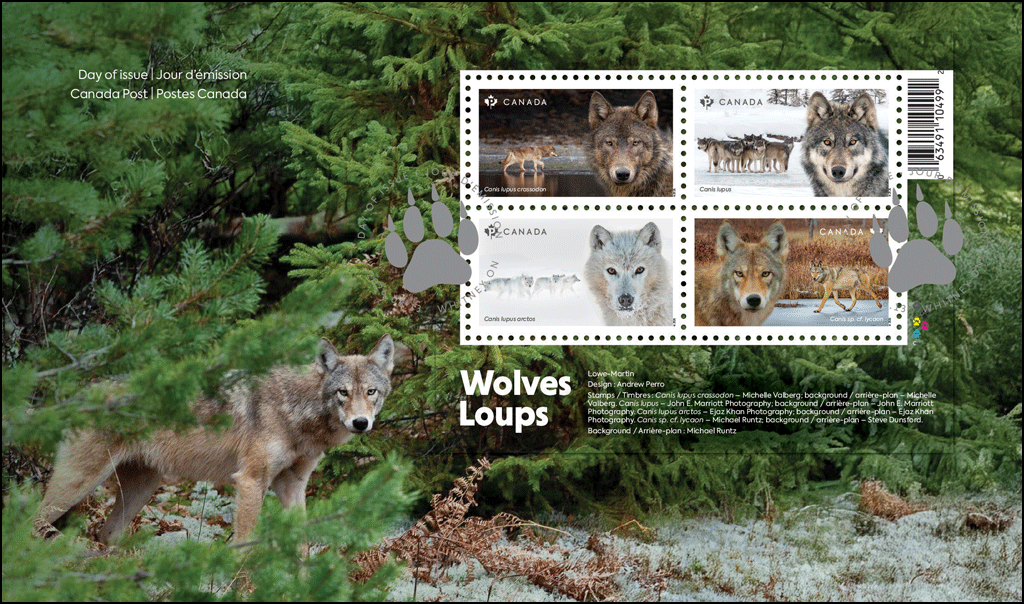
The grey wolf (Canis lupus) is the largest and most widespread wolf in Canada, found everywhere except the Maritimes.
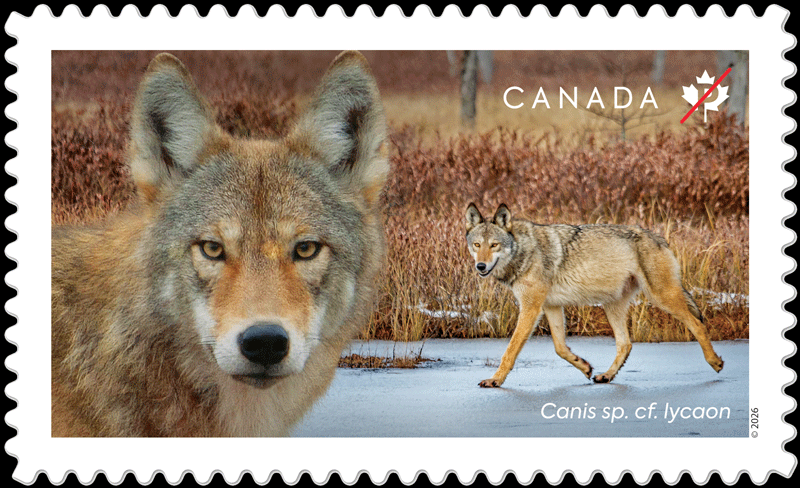
Only slightly bigger than an eastern coyote, the eastern wolf (Canis sp. cf. Lycaon) is a federally listed species at risk that lives mainly in Algonquin Provincial Park in central Ontario and in southwestern Quebec. It has an estimated population of 200 to 1,000 mature wolves.
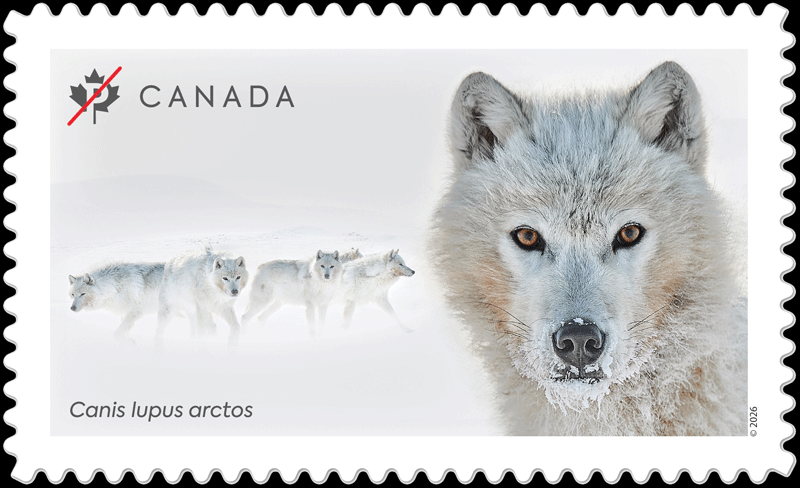
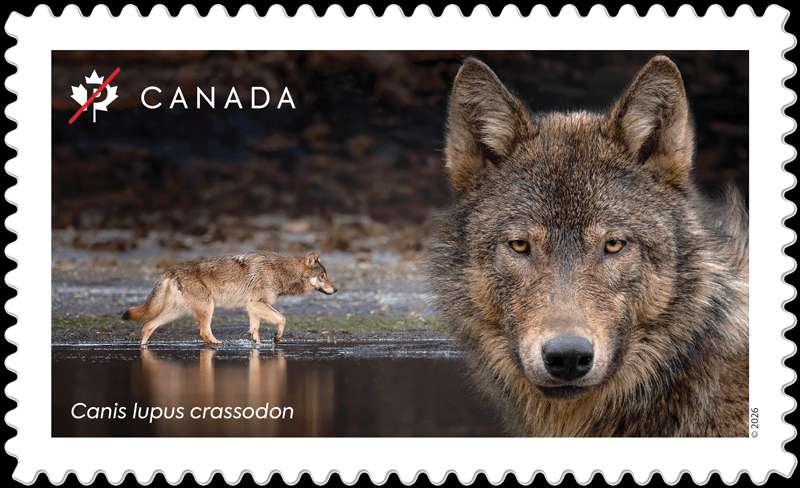
The Arctic grey wolf (Canis lupus arctos) is a nomadic hunter well adapted to the northern climate, while the coastal grey wolf (Canis lupus crassodon) is a strong swimmer that lives along Canada’s Pacific coast and near-shore islands.
About the stamps
Each stamp presents a close-up view of wolves in Canadian landscapes. The booklet cover and interior contain additional photographs of coastal grey wolves on Vancouver Island. The stamps are designed by Andrew Perro, featuring photography by Michelle Valberg (Canis lupus crassodon), John E. Marriott (Canis lupus, Ejaz Khan (Canis lupus arctos), Michael Runtz and Steve Dunsford (Canis sp. Cf. lycaon). This issue is printed by Lowe-Martin and includes a booklet of eight Permanent™ domestic rate stamps, an Official First Day Cover (OFDC), a souvenir sheet and four postage-paid postcards that can be sent worldwide. The location of the cancellation mark on the OFDC is Whitney, Ontario, near the east gate of Algonquin Provincial Park. [The OFDC and postcards are shown below.]
Stamps and collectibles are now available at canadapost.ca and at select postal outlets across Canada.
[en Francais pour les médias d’information] De nouveaux timbres mettent en vedette les loups au Canada et leur importance pour l’environnement Les timbres présentent des images saisissantes en gros plan de loups vivant dans différentes étendues sauvages canadiennes.
WHITNEY, Ont. – Postes Canada a émis de nouveaux timbres qui mettent en vedette une espèce clé : les loups.
Les loups contribuent de façon importante à la santé et à la biodiversité de l’écosystème. Chasseurs intelligents souvent associés au Nord et aux vastes étendues sauvages du Canada, ces animaux occupent également une place prépondérante dans de nombreuses cultures autochtones.
Animal social, le loup coopère de façon organisée pour chasser et élever ses petits, un comportement observé chez seulement un faible pourcentage de mammifères. Grâce à ses sens aiguisés qui lui permettent de repérer les proies à près de 2 km de distance, le loup chasse de petits et de grands animaux, y compris le caribou, le cerf, le wapiti, l’orignal, le bison et même le bœuf musqué.
Des timbres qui présentent des loups dans différentes régions du pays Le loup gris (Canis lupus, le plus grand et le plus répandu au Canada, se retrouve partout sauf dans les Maritimes.
À peine plus gros qu’un coyote de l’Est, le loup de l’Est (Canis sp. cf. lycaon) est inscrit sur la liste fédérale des espèces en péril et vit principalement dans le parc provincial Algonquin dans le centre de l’Ontario ainsi que dans le sud-ouest du Québec. On estime sa population à entre 200 et 1 000 individus adultes.
Le loup gris de l’Arctique (Canis lupus arctos est un chasseur nomade bien adapté au climat nordique, tandis que le loup gris côtier (Canis lupus crassodon) est un bon nageur qui vit sur la côte canadienne du Pacifique et ses îles côtières.
À propos des timbres
Chaque timbre présente une image en gros plan de loups dans des paysages canadiens. La couverture et l’intérieur du carnet comportent des photos supplémentaires de loups gris côtiers sur l’île de Vancouver. Les timbres ont été conçus par Andrew Perro à partir de photos de Michelle Valberg (Canis lupus crassodon), de John E. Marriott (Canis lupus, d’Ejaz Khan (Canis lupus arctos, de Michael Runtz et de Steve Dunsford (Canis sp. cf. lycaon). Imprimée par Lowe-Martin, cette émission comprend un carnet de huit timbres PermanentsMC au tarif du régime intérieur, un pli Premier Jour officiel, un bloc-feuillet et quatre cartes postales port payé. Le lieu d’oblitération est Whitney (Ontario), près de la porte est du parc provincial Algonquin.
Les timbres et les articles de collection sont en vente sur postescanada.ca et dans certains comptoirs postaux partout au pays à partir d’aujourd’hui.
The Official First Day Cover: The postpaid picture postcards:
[press release] [click on any of the pictures for larger versions] [videos and OFDC images are at the end] Canada Post celebrates Indigenous leaders in sport with fifth annual stamp release Bryan Trottier, Edward Lennie and Chief Wilton Littlechild honoured for athletic excellence and instilling cultural pride across their communities
CALGARY – Canada Post is proud to recognize award-winning athletes and advocates who championed Indigenous sports, leaving legacies that extend far beyond the winners’ podium.
Launching in honour of National Indigenous Peoples Day, this three-stamp issue is the fifth set in this series. The stamps were unveiled June 17 at the Calgary Public Library – Central with Chief Wilton Littlechild, Edward Lennie’s son Hans Lennie, and a video message from Bryan Trottier.
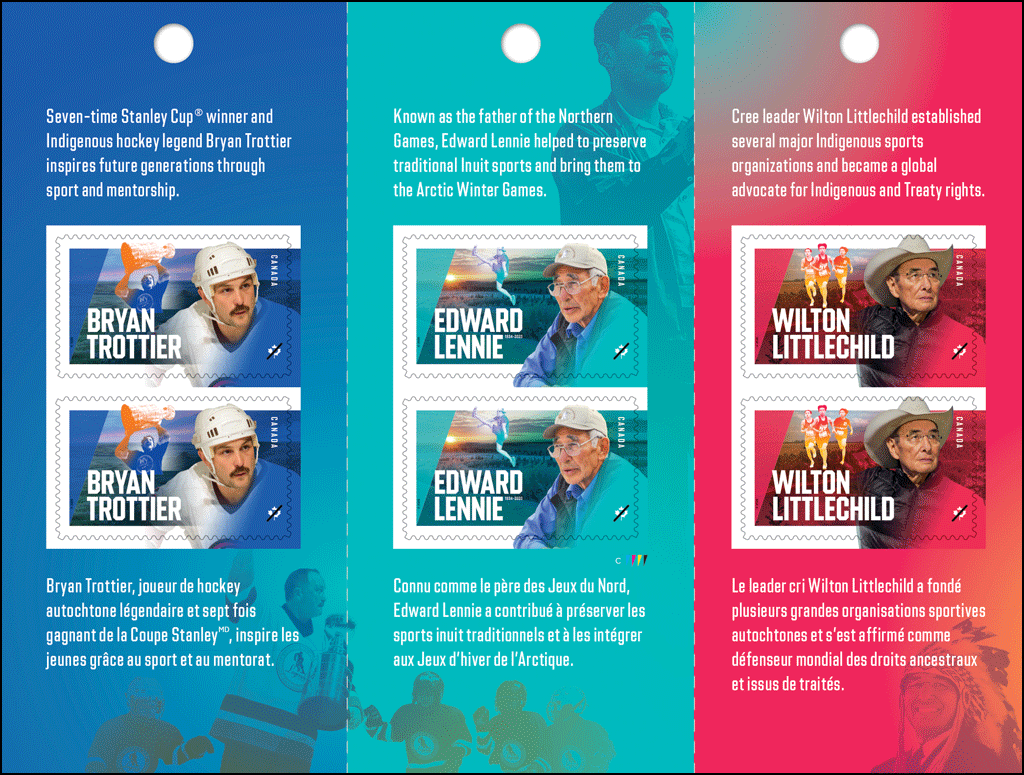
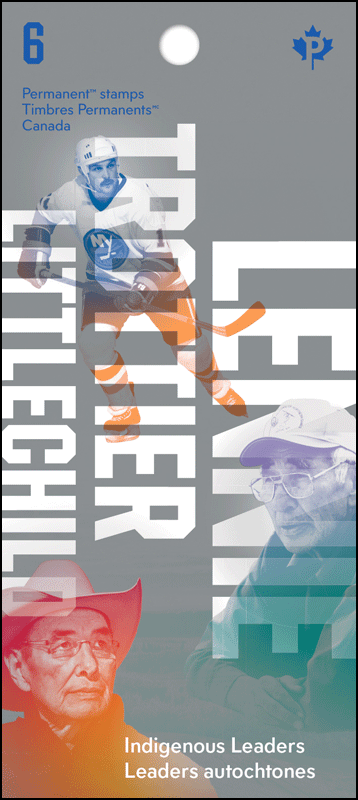
Bryan Trottier Six-time Stanley Cup® winner and member of Canada’s Sports Hall of Fame, Bryan Trottier (b. 1956 in Val Marie, Saskatchewan) is widely regarded as one of hockey’s greats. Drafted by the New York Islanders® in 1974, Trottier won five major National Hockey League® honours, including league and playoffs Most Valuable Player, and remains the Islanders’ all-time leader in points and assists. Trottier – who is Cree, Métis, Chippewa and Irish – co-founded the Aboriginal Alumni Hockey Team and has visited communities across Canada, offering clinics and mentorship to young people.
Edward Lennie Known as the Father of the Northern Games, Charles Edward Inglangasak Lennie (1934-2020) dedicated his life to promoting and preserving Arctic sports. He helped found the Northern Games and successfully advocated for Arctic sports to be showcased at the inaugural Arctic Winter Games. Lennie coached athletes in eight traditional events, including the kneel jump, the two-foot high kick and the arm pull.
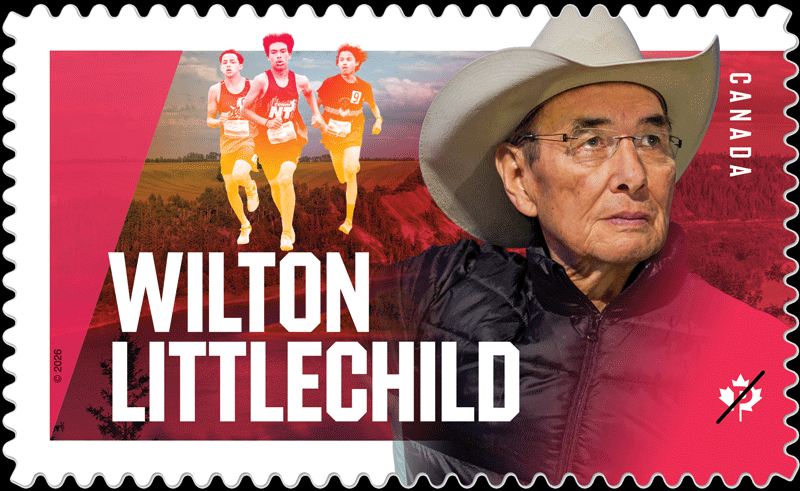
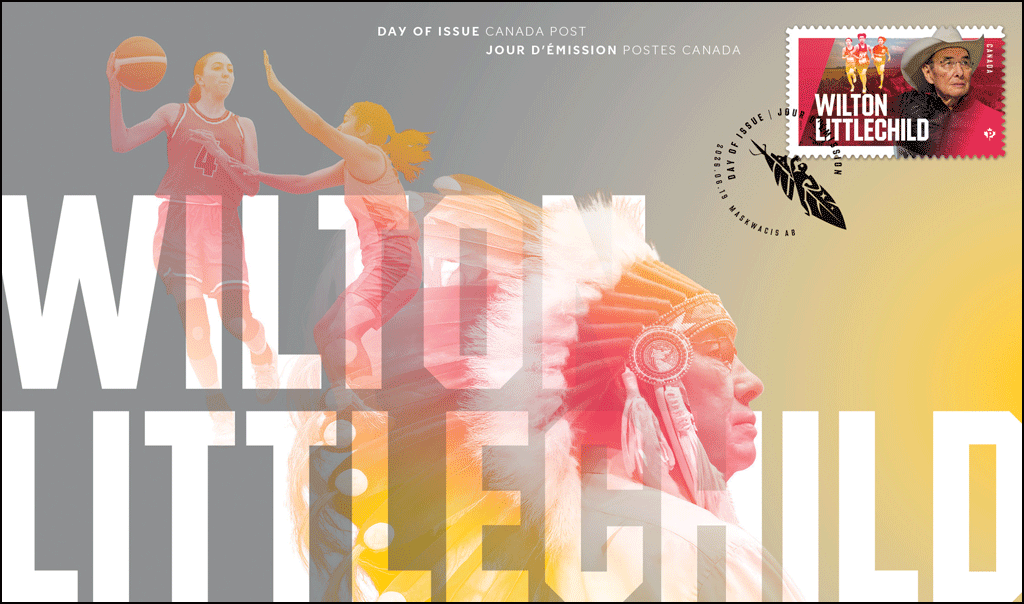
Chief Wilton Littlechild A former member of Parliament and commissioner of the Truth and Reconciliation Commission of Canada, Jacob Wilton “Willie” Littlechild, c.c. (b. 1944 in Hobbema [Maskwacis], Alberta) helped draft the United Nations Declaration on the Rights of Indigenous Peoples and the American Declaration on the Rights of Indigenous Peoples, and to secure Indigenous rights, including treaty rights, in Canada’s constitution. Inducted into several sports halls of fame, he worked to establish the National Indian Athletic Association, the North American Indigenous Games and the World Indigenous Nations Games.
About the stamp series
Launched in 2022, the series highlights the contributions of modern-day First Nations, Inuit and Métis leaders who have dedicated their lives to preserving their culture and improving the quality of life of Indigenous Peoples in Canada.
Honourees represent First Nations, Métis and Inuit communities from different regions of the country and are chosen in consultation with the Assembly of First Nations, the Métis National Council and Inuit Tapiriit Kanatami.
About the stamps The stamp designs pair powerful portraiture with evocative landscapes and imagery tied to each honouree’s life: Trottier’s focused gaze contrasts with a photo of him proudly lifting the Stanley Cup®, framed by a prairie landscape that anchors his success to his Saskatchewan roots; Lennie’s dignified portrait is paired with an image of the one-foot high kick set against a sweeping Arctic landscape, reflecting his heritage and the traditions he championed; Chief Littlechild appears in his signature cowboy hat beside young athletes with Alberta’s rolling hills behind him, highlighting both his homeland and impact on future generations.
The stamps are designed by Tétro, featuring photography by: Bruce Bennett | Getty Images and background imagery by Branimir Gjetvaj (Bryan Trottier); Inuvialuit Communications Society and the Lennie family with background imagery by C Cormier | Shutterstock.com (Edward Lennie); and Cole Burston | Getty Images and background imagery by Vadim Gouida | Adobe Stock (Chief Wilton Littlechild). They are printed by Colour Innovations. The issue includes a booklet of six Permanent™ stamps and three Official First Day Covers.
The cancellation sites are Val Marie, Saskatchewan (birthplace of Bryan Trottier), Inuvik, Northwest Territories (where Edward Lennie spent much of his life), and Maskwacis, Alberta (birthplace of Chief Wilton Littlechild).
The stamps and collectibles will be available at canadapost.ca and at select postal outlets across Canada beginning on June 19.
[en Francais pour les médias d’information] Postes Canada célèbre des leaders autochtones du domaine des sports avec une cinquième émission annuelle de timbres Bryan Trottier, Edward Lennie et le chef Wilton Littlechild reçoivent cet honneur pour leur excellence athlétique et leur contribution à la fierté culturelle autochtone.
CALGARY – Postes Canada est fière de rendre hommage à ces athlètes primés et défenseurs des sports autochtones dont l’héritage va bien au-delà des victoires et des médailles.
Lancée à l’occasion de la Journée nationale des peuples autochtones, cette émission de trois timbres est la cinquième de cette série annuelle. Les timbres ont été dévoilés 17 juin à la bibliothèque centrale de Calgary en présence du chef Wilton Littlechild, de Hans Lennie, fils d’Edward Lennie, et (par message vidéo) de Bryan Trottier.
Bryan Trottier Bryan Trottier (né en 1956 à Val Marie, en Saskatchewan), six fois gagnant de la coupe StanleyMD et membre du Panthéon des sports canadiens, est considéré comme l’un des plus grands de l’histoire du hockey. Recruté par les New York IslandersMD en 1974, Bryan Trottier remporte cinq grands honneurs de la Ligue nationale de hockeyMD (LNH), y compris les titres de joueur le plus utile de la ligue et de joueur le plus utile des séries éliminatoires, et il détient encore les records de points et d’aides des Islanders. D’origine crie, métisse, chippewa et irlandaise, Bryan Trottier cofonde l’équipe de hockey Aboriginal Alumni et visite des communautés partout au Canada, offrant des ateliers et du mentorat aux jeunes.
Edward Lennie Connu comme le père des Jeux du Nord, Charles Edward Inglangasak Lennie (1934-2020) consacre sa vie à la promotion et à la préservation des sports arctiques. Il aide à fonder les Jeux du Nord et réussit à faire présenter les sports arctiques aux premiers Jeux d’hiver de l’Arctique. Edward Lennie entraîne des athlètes dans huit épreuves traditionnelles, y compris le saut à genoux, le coup de pied double en hauteur et le bras de fer.
Chef Wilton Littlechild Ancien député à la Chambre des communes et commissaire de la Commission de vérité et réconciliation du Canada, Jacob Wilton « Willie » Littlechild, c.c. (né en 1944 à Hobbema [Maskwacis], en Alberta) aide à rédiger la Déclaration des Nations Unies sur les droits des peuples autochtones et la Déclaration américaine sur les droits des peuples autochtones, et à garantir l’inclusion des droits ancestraux et issus de traités dans la Constitution canadienne. Intronisé dans plusieurs temples de la renommée des sports, il aide à fonder la National Indian Athletic Association, les Jeux autochtones de l’Amérique du Nord et les Jeux mondiaux des nations autochtones.
À propos de la série de timbres Lancée en 2022, la série souligne les contributions de leaders inuit, métis et des Premières Nations modernes qui ont consacré leur vie à préserver leur culture et à améliorer la qualité de vie des peuples autochtones au Canada.
Les personnes honorées représentent les communautés des Premières Nations, métisses et inuit de différentes régions du pays et sont choisies en consultation avec l’Assemblée des Premières Nations, le Ralliement national des Métis et l’Inuit Tapiriit Kanatami.
À propos des timbres
Les timbres présentent des portraits des personnes honorées ainsi que des paysages et des images qui évoquent leur vie : le regard concentré de Bryan Trottier contraste avec une photo de lui soulevant fièrement la coupe StanleyMD, encadrée par un paysage des Prairies qui ancre le succès du hockeyeur dans ses racines saskatchewanaises; le portrait empreint de dignité d’Edward Lennie est accompagné d’une image de l’épreuve du coup de pied simple en hauteur, sur fond de paysage arctique majestueux, reflétant l’héritage et les traditions que M. Lennie a préservées; le chef Wilton Littlechild est représenté portant son incontournable chapeau de cowboy à côté d’images de jeunes athlètes sur fond de collines onduleuses de l’Alberta. Ce montage met en valeur sa terre natale et son influence sur les générations futures.
Les timbres sont conçus par Tétro et présentent des photographies de : Bruce Bennett | Getty Images et arrière-plan par Branimir Gjetvaj (Bryan Trottier); l’Inuvialuit Communications Society et la famille d’Edward Lennie avec arrière-plan par C Cormier | Shutterstock.com (Edward Lennie); et Cole Burston | Getty Images et arrière-plan par Vadim Gouida | Adobe Stock (chef Wilton Littlechild). Imprimée par Colour Innovations, l’émission comprend un carnet de six timbres PermanentsMC et trois plis Premier Jour officiels.
Les lieux d’oblitération sont Val Marie, en Saskatchewan (lieu de naissance de Bryan Trottier), Inuvik, dans les Territoires du Nord-Ouest (où Edward Lennie a passé la plus grande partie de sa vie), et Maskwacis, en Alberta (lieu de naissance du chef Wilton Littlechild).
Les timbres et les articles de collection seront en vente sur postescanada.ca et dans les comptoirs postaux partout au pays dès le 19 juin 2026.
[press release] [click on any of the pictures for larger versions] New stamps from Canada Post celebrate Quebec’s sugar shacks Rooted in Quebec’s history and identity, the sugaring-off season comes to life in an illustrated stamp issue.
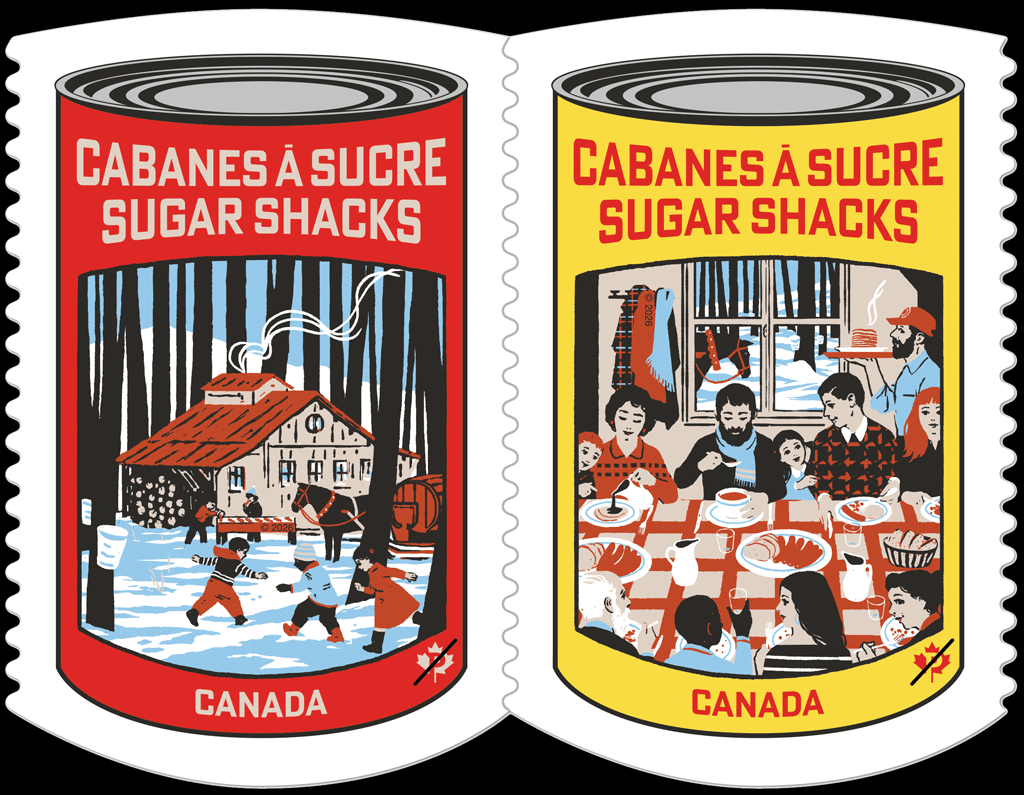
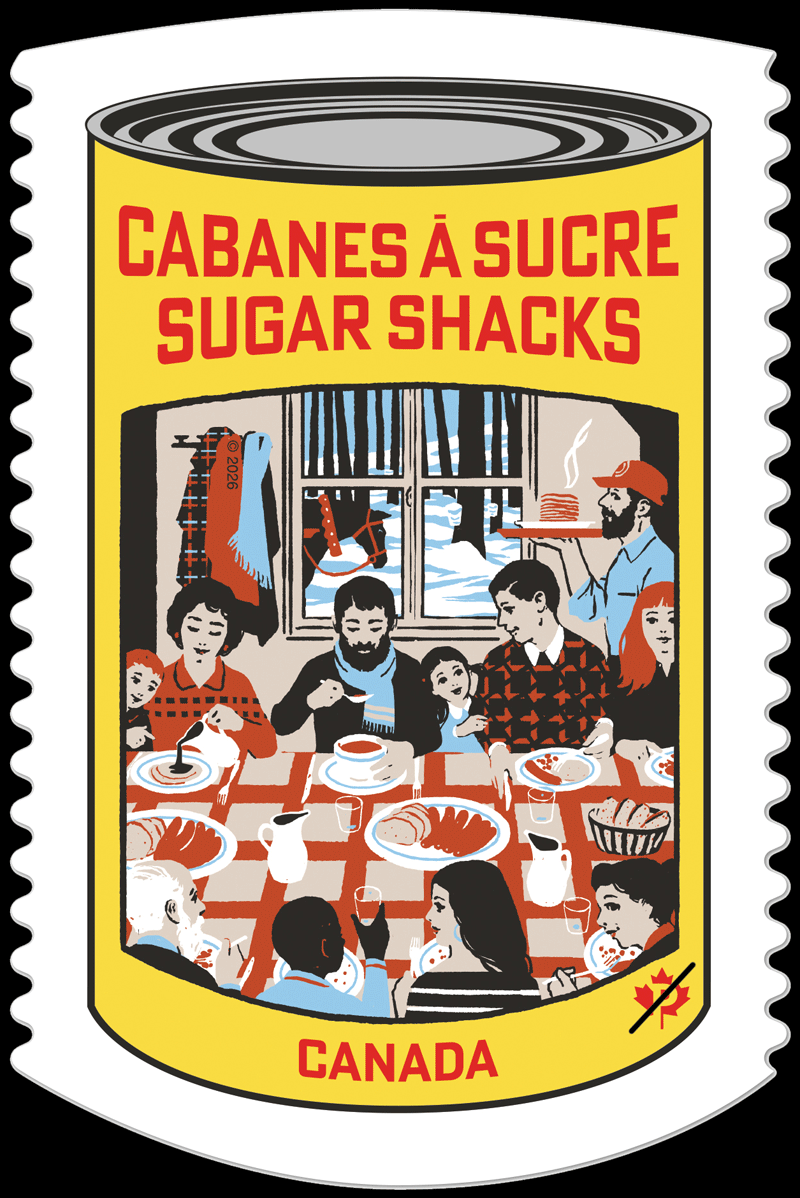
MONTRÉAL – Maple taffy in sticky little hands. The lively strains of a fiddle playing and spoons tapping. The comforting taste of hot pea soup. This spring, just as the scents, sounds and tastes of the season come to life at sugar shacks, Canada Post is issuing two stamps in the form of maple syrup cans. Unveiled today in Montréal at the Cabane Panache Festival, the stamps celebrate sugaring-off season and pay tribute to Quebec’s iconic sugar shacks.
Traditions that transcend generations
The traditions surrounding sugaring-off season are so important in Quebec that they are officially part of the province’s intangible heritage. Indigenous Peoples of the Eastern Woodlands, including the W8banakiak (Abenakis), the Anishinaabeg (Anishinabe), the Haudenosaunee (Iroquois) and the Mi’gmaq (Mi’kmaq) were producing maple products long before the arrival of European settlements. They shared their ancestral knowledge with early French colonists, who adapted their methods over time.
In the 1850s, the forerunners of modern sugar shacks began to appear – small shelters where maple sap was boiled, and that became social gathering places. A significant part of syrup production has been automated since then, and although sugar bushes have grown in size, artisanal techniques are still in practice.
Today, Quebec produces 90% of Canada’s maple syrup and over 70% of global production.
About the stamps
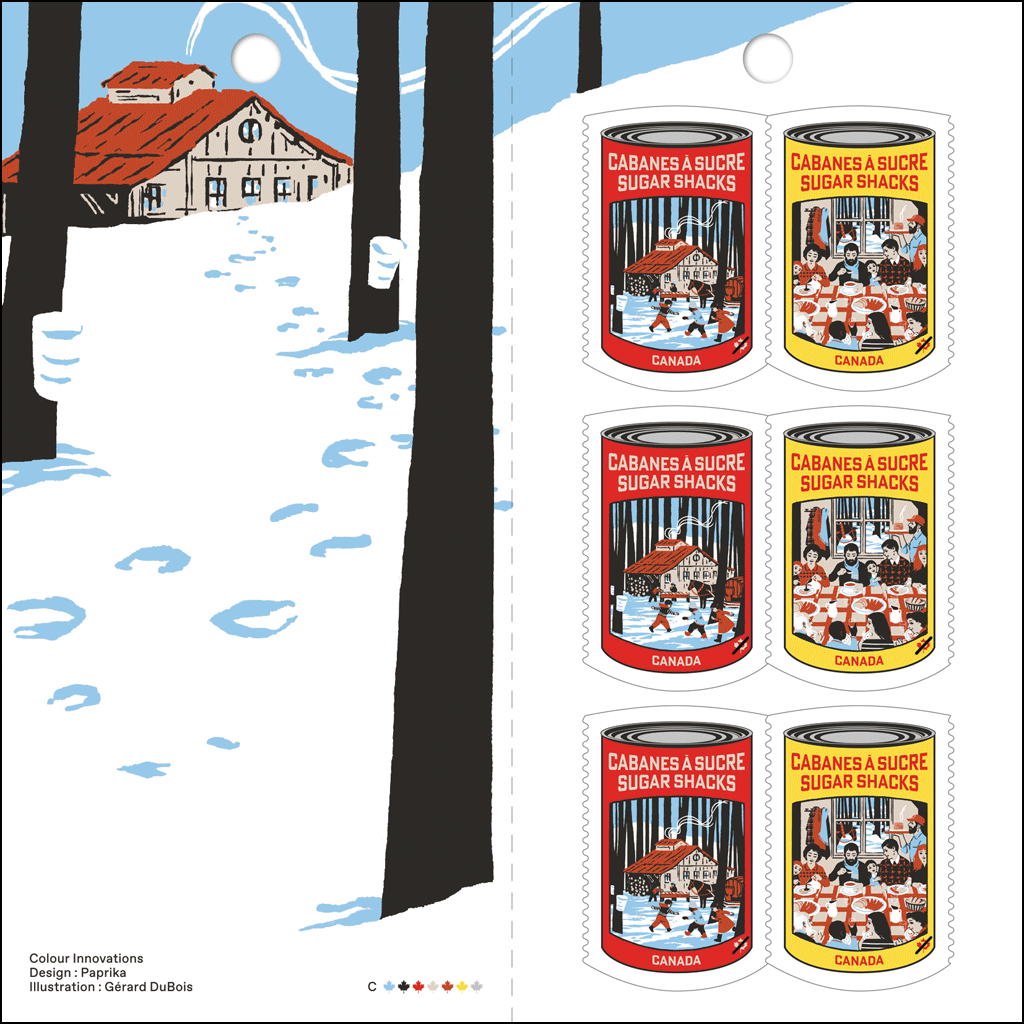
The stamps, booklet and Official First Day Cover (OFDC) are the work of illustrator Gérard DuBois and graphic design firm Paprika. Inspired by popular, commercial and advertising art from the 1940s and 1950s, the illustrations evoke colourful scenes of people enjoying shared meals and time outside. They portray the sugar shack as a place of gathering, enjoyment and tradition.
This stamp issue includes a booklet of six Permanent™ domestic rate stamps and an OFDC. Both are available at canadapost.ca and at retail outlets across the country. The OFDC bears a maple leaf cancellation in Saint-Georges, a Quebec city where the Festival beauceron de l’érable is held every year.
[press release] [click on any of the pictures for larger versions] New stamp issue marks Eid, celebrated by more than 1.5 million Muslims in Canada Canada Post is proud to mark Eid al-Fitr and Eid al-Adha with uniquely Canadian Muslim design
VANCOUVER – Canada Post issued new stamps March 10th to mark two of the most important holidays in Islam: Eid al-Fitr and Eid al-Adha.
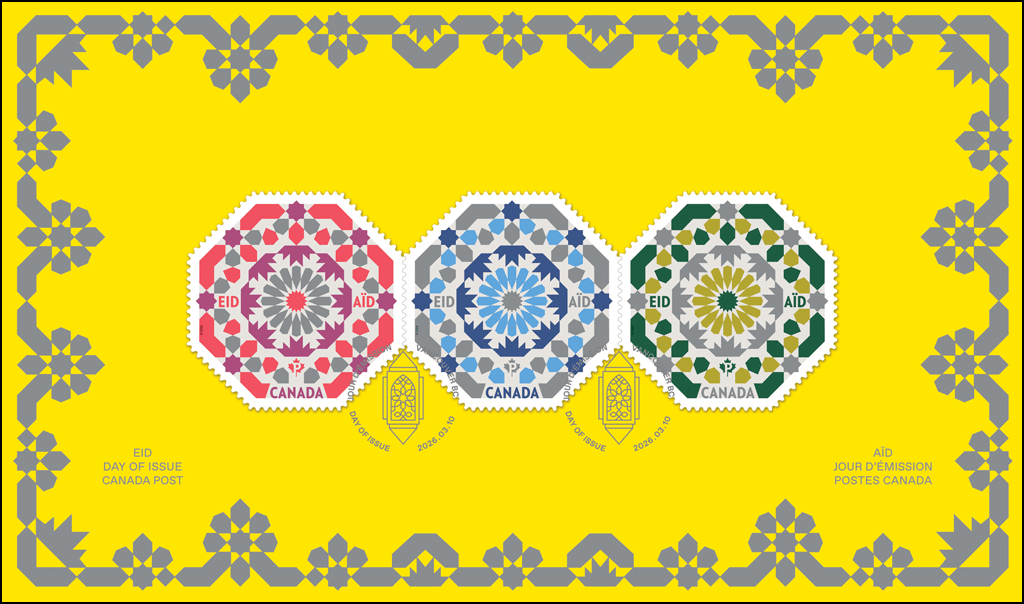
The three-stamp issue incorporates stylized maple leaves into a traditional Islamic pattern to reflect Canada’s cultural diversity and inclusivity. Featuring the same design in different colour palettes, the stamps honour the significance of Eid for Muslim communities across the country.
Patterns of beauty and symbolism Mesmerizing designs inspired by mathematics and nature are a hallmark of Islamic ornamentation. Infinitely expandable arrangements of interlacing circles and polygons are traditionally created with a compass and straightedge. Stylized floral and vegetal motifs are often weaved through these patterns, which vary across regions and eras.
The rhythm and symmetry of these patterns invite contemplation of the spiritual and natural worlds. The designs also add beauty and symbolism to Eid al-Fitr and Eid al-Adha, appearing as decorations in mosques and homes, and on lanterns and greeting cards.
Eid celebrations in March and May
Eid al-Fitr, or the Festival of Breaking the Fast, marks the end of Ramadan. The month of fasting, which is observed from sunrise to sunset, is one of the most distinctive practices in Islam. This year, Eid al-Fitr takes place in March.
Eid al-Adha, or the Festival of Sacrifice, marks the end of the Hajj pilgrimage, in which millions of Muslims journey to one of the holiest sites in Islam – the Kaaba in Mecca, Saudi Arabia. Also called Eid al-Kabir or the Greater of the Two Eids, the festival happens this year in May.
Celebrated by more than 1.5 million Muslims in Canada, both events can last several days and include communal prayers and feasts, visits with family, gift-giving and acts of charity.
The Eid issue is one of several stamps released by Canada Post each year to mark annual celebrations that are important to Canada’s culturally diverse population – others include Diwali, Hanukkah and Christmas.
About the stamps
This stamp issue was designed by Paprika and printed by Colour Innovations. It includes a booklet of six Permanent™ domestic rate stamps and an Official First Day Cover [below]cancelled in Vancouver, British Columbia, home to a large and diverse Muslim-Canadian population.
[press release] [click on any of the pictures for larger versions] Annual Flower Stamp Issue Features Delicate Blossoms of Ornamental Cherry Trees Bestselling issue often used for wedding stationery, popular among Canadian gardeners
VANCOUVER – A joyful sign of spring, cherry blossoms create spectacular canopies of colour during their blooming season. The fragrant flowers leave behind a delicate carpet of petals, symbolic of beauty and the transience of life. Cherry trees, both wild and cultivated, are found in many parts of the world, and many are native to the Northern Hemisphere.
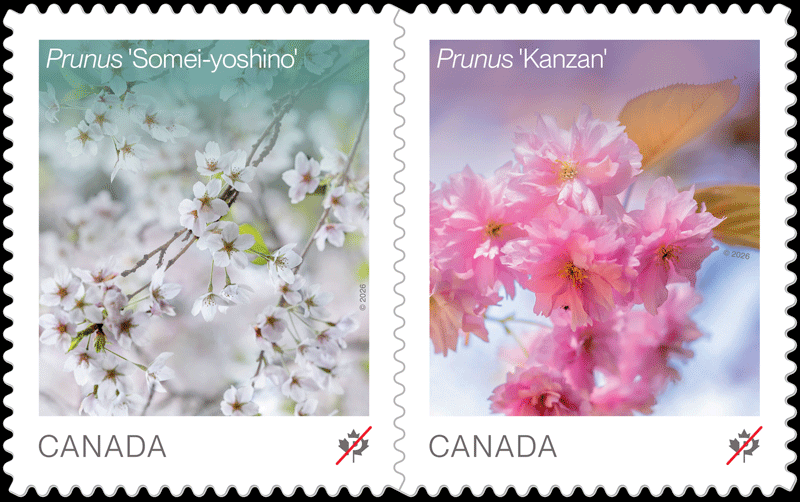
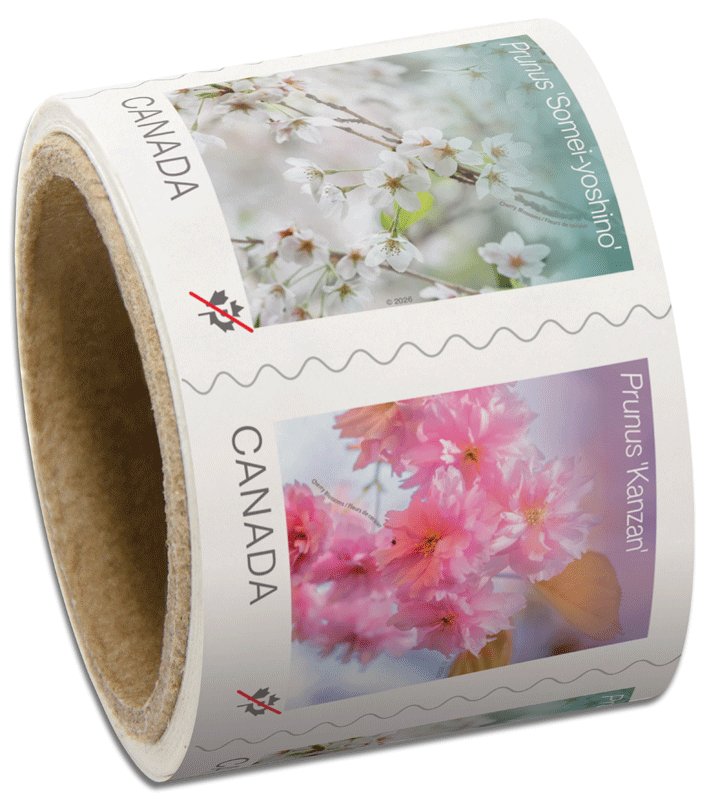
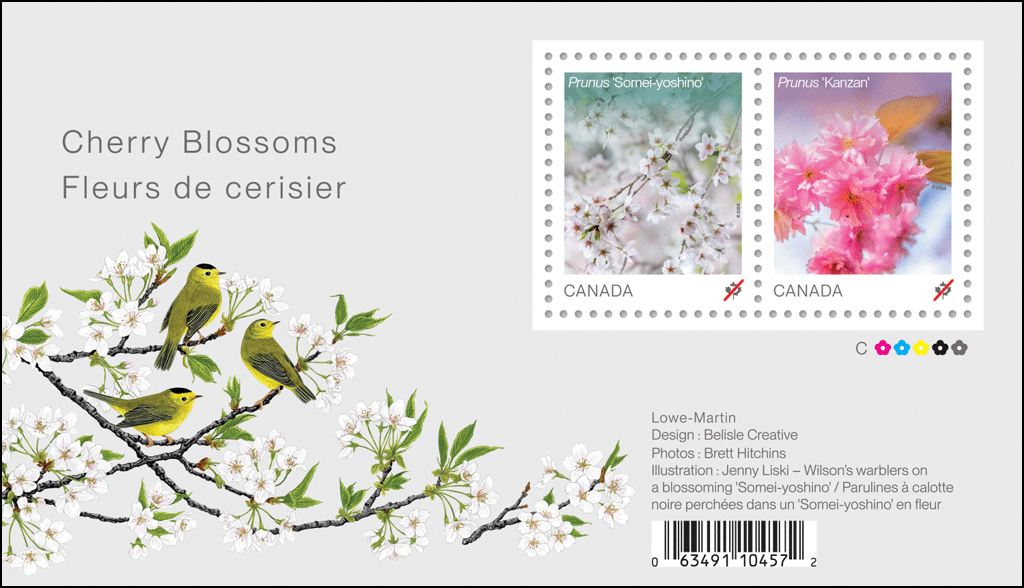
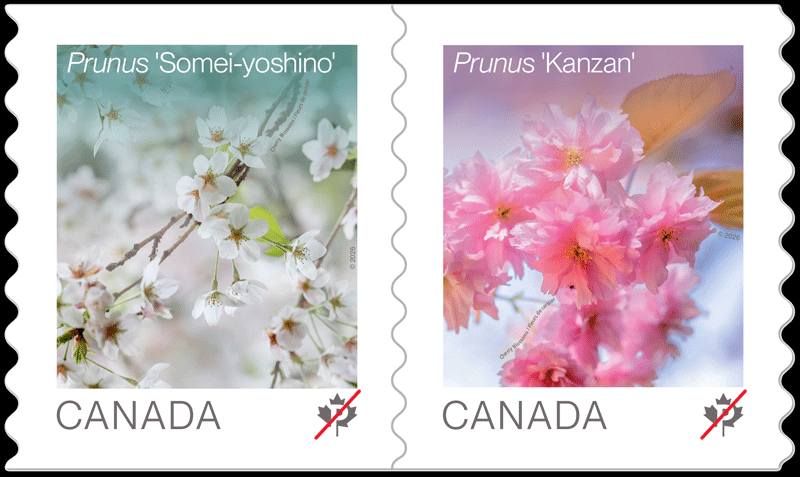
This stamp issue features two cherry blossom cultivars. Prunus ‘Kanzan’, cold-hardy and with large deep-pink double flowers, is one of the most popular Japanese cherry cultivars for blossom viewing in North America and Europe. Shrouded in clusters of white to pale-pink petals, the prolific?Prunus?‘Somei-yoshino’ is the focus of celebrations across Japan and other parts of East Asia.
In Japan, sakura (as cherry blossoms are called) are the inspiration for national celebrations. In Canada, dazzling displays can be found along city streets and in many parks and gardens across the country. Vancouver boasts thousands of specimens and hosts one of the country’s largest cherry blossom festivals.
About the stamp design
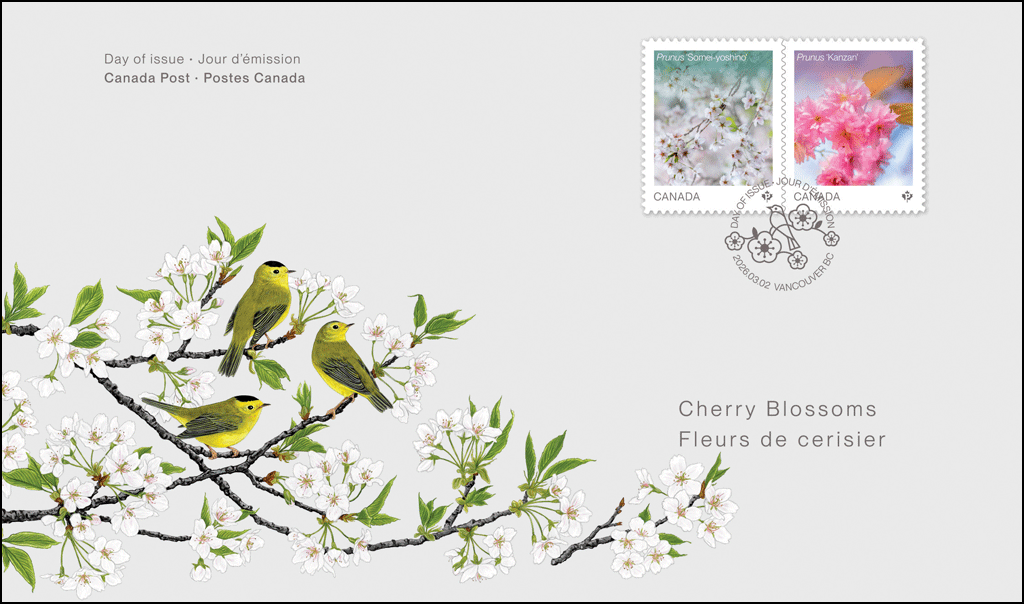
The two stamps feature original photographs of the cherry blossoms taken at the Nitobe Memorial Garden at the University of British Columbia in Vancouver. The stamps are designed by Belisle Creative, featuring photography by Brett Hitchins, and printed by Lowe-Martin. The issue includes a booklet of 10 Permanent™ stamps, a coil of 50 stamps, a souvenir sheet and an Official First Day Cover cancelled in Vancouver.
[en Francais pour les médias d’information] Les timbres floraux de cette année mettent en vedette les délicates fleurs de cerisiers ornementaux L’émission annuelle sur les fleurs est toujours très prisée pour les faire-part de mariage, en plus d’être appréciée des adeptes de jardinage.
VANCOUVER – Signes du printemps, les fleurs de cerisier forment des canopées colorées spectaculaires. Ces fleurs parfumées, qui laissent derrière elles un délicat tapis de pétales, symbolisent la beauté et le caractère éphémère de la vie. On trouve une grande variété d’espèces sauvages et cultivées de cerisiers dans de nombreuses régions du monde, et plusieurs sont indigènes de l’hémisphère Nord.
Cette émission met en vedette deux cultivars de cerisiers. Résistant au froid et prisé en raison de ses grandes fleurs doubles rose foncé, le Prunus ?Kanzan? est l’un des cultivars japonais les plus populaires en Amérique du Nord et en Europe. Couvert de grappes de fleurs blanches ou rose pâle, le prolifique Prunus ?Somei-yoshino? est la vedette de célébrations au Japon et ailleurs en Asie de l’Est.
Appelées sakura au Japon, les fleurs de cerisier inspirent des célébrations nationales. Au Canada, on peut admirer le spectacle en bordure de rues et dans bon nombre de parcs et de jardins. Vancouver abrite des milliers de spécimens et tient l’un des plus grands festivals de cerisiers en fleurs du pays.
À propos des timbres
Les deux timbres sont ornés de photos originales de fleurs de cerisier prises au Nitobe Memorial Garden de l’Université de la Colombie-Britannique à Vancouver. Imprimés par Lowe-Martin, ils sont conçus par Belisle Creative et présentent des photographies de Brett Hitchins. L’émission comprend un carnet de 10 timbres PermanentsMC, un rouleau de 50 timbres, un bloc-feuillet et un pli Premier Jour officiel oblitéré à Vancouver.
[press release] [click on any of the pictures for larger versions] New stamp set pays tribute to hip-hop trailblazers Maestro Fresh Wes, Michie Mee and Muzion This year’s Black History Month stamps celebrate early hip-hop in Canada
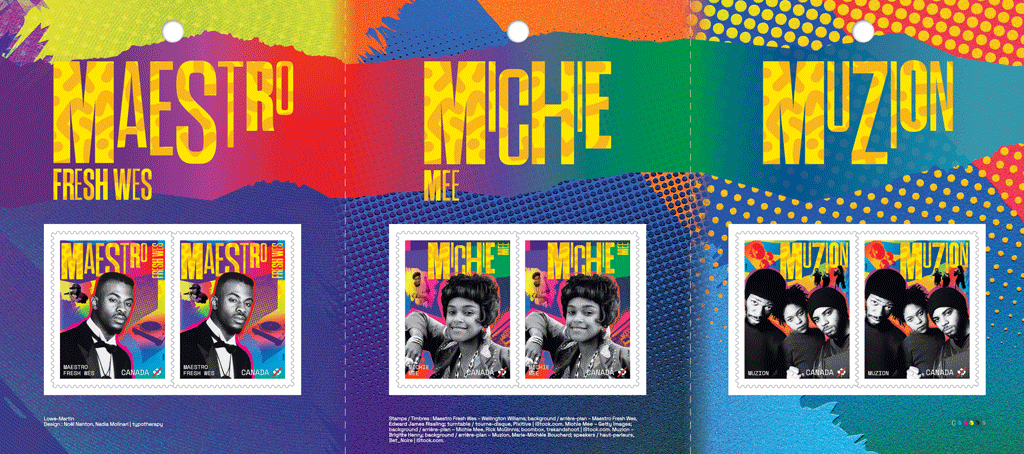
TORONTO – On January 28, 2026, Canada Post unveiled a new Black History Month stamp set celebrating the vibrant roots of hip-hop in Canada. The stamps pay tribute to three of the country’s most dynamic hip-hop trailblazers – Maestro Fresh Wes, Michie Mee and Muzion. Each of the artists is recognized for helping to shape the genre in Canada, while infusing the music with a uniquely Canadian sound.
Maestro Fresh Wes With his 1989 debut album Symphony in Effect, Maestro Fresh Wes (b. Wesley Williams, 1968) became the first Canadian MC to break into the mainstream. The album’s monster hit single “Let Your Backbone Slide” was the first Canadian rap song to go gold, while the album itself went platinum. In 1991, the JUNO Awards introduced a new category, Best Rap Recording – Symphony in Effect took the win. Over his career, Maestro released nine studio albums and became an author, actor and motivational speaker. In 2024, he was inducted into the Canadian Music Hall of Fame and received the Governor General’s Performing Arts Award for Lifetime Artistic Achievement.
Michie Mee Michie Mee (b. Michelle McCullock, 1970) was Canada’s first hip-hop superstar and built a reputation for continually pushing boundaries. The iconic MC exploded onto the scene in the late 1980s and was among the first to bring Jamaican Patois into her rhymes. In 1987, she released her debut single “Elements of Style,” which was an instant hit. A year later, she became the first Canadian MC to sign with a major U.S. label. In 1991, she released her first album, Jamaican Funk – Canadian Style, which combined rap with dancehall and reggae. Later that decade, she joined Raggadeath, a group known for fusing heavy metal and reggae.
Muzion Hailing from Montréal, Muzion brought a distinct sound to the world of hip-hop, layering French, English and Haitian Creole into their music. The group was formed in 1996 by MCs J.Kyll (Jenny Salgado), Imposs (Stanley Salgado), and Dramatik (Jocelyn Bruno). Their two albums Mentalité moune morne… (Ils n’ont pas compris) (1999) and J’rêvolutionne (2002) received multiple honours, including Félix Awards for Hip-Hop Album of the Year. Their hit single “La vi ti nèg” won a 2004 Canadian Urban Music Award. Muzion’s influence stretched into the wider culture. The trio, who were all born to Haitian parents, helped empower marginalized communities to see themselves as integral to the fabric of Quebec and Canada.
About the stamps
This stamp set is a shout-out to the vibrant roots of hip-hop in Canada. The titles are crafted using varied type sizes, echoing the rhythmic nature of hip-hop’s sound. Printed with fluorescent inks that glow under black light, metallic silver and black duotone portraits, and layered matte and gloss varnishes, these stamps evoke the bold, nostalgic aesthetic of the late 1980s and early 1990s.
The stamps were designed by Noël Nanton and Nadia Molinari of typotherapy. Various photographs were used in this set: Maestro Fresh Wes – Wellington Williams; background – Edward James Rissling. Michie Mee – Getty Images; background – Rick McGinnis. Muzion – Brigitte Henry; background – Marie-Michèle Bouchard.
The issue, which was printed by Lowe-Martin, includes six Permanent™ stamps and three Official First Day Covers. The cancel sites are Toronto for Maestro Fresh Wes and Michie Mee, and Montréal for Muzion.
Stamps and collectibles will be available at canadapost.ca and postal outlets across Canada beginning on January 28, 2026.
Technical Details:
Product: Hip-Hop in Canada (2026): booklet of 6 Permanent™ stamps
Article: 414308111
Quantity: 130,000 booklets of six Permanent™ stamps
Printing process: Lithography in 5 colours, Matte Aqueous & Gloss Varnish
Price: $7.44
Product: Hip-Hop in Canada (2026) – Maestro Fresh Wes: Official First Day Cover
Article: 414308131
Quantity: 6,000
Cancel: Toronto, Ontario
Price: $2.24
Product: Hip-Hop in Canada (2026) – Michie Mee: Official First Day Cover
Article: 414309131
Quantity: 6,000
Cancel: Toronto, Ontario
Price: $2.24
Product: Hip-Hop in Canada (2026) – Muzion: Official First Day Cover
Article: 414310131
Quantity: 6,000
Cancel: Montréal, Quebec
Price: $2.24
Design: Noël Nanton, Nadia Molinari | typotherapy
Printer: Lowe-Martin The Concert Hall in Toronto, Tuesday, January 27, 2026. Photo by Andrew Williamson Photography, provided by Canada Post.
The artists react to being commemorated on these stamps:
The artists talk about their music:
Maestro Fresh Wes, Michie Mee and Muzion talk about the early days of hip-hop in Canada:
[press release] [click on any of the pictures for larger versions] 2026 stamp lineup celebrates Canadian hip-hop, a sweet and timeless Quebec tradition, and much more Canada Post captures the spirit of Canada through the people, events and stories featured in upcoming stamp issues
OTTAWA – Today Canada Post announced its 2026 stamp lineup, which features several milestones, people and cultural events that have helped define Canadian identity.
Here are some highlights:
Next year’s annual Black History Month stamp dives into the careers and achievements of Canadian hip-hop pioneers.
Colourful scenes from the temps des sucres (sugaring-off season) and Quebec’s cabanes à sucre (sugar shacks) – traditions that are part of the intangible heritage of Quebec – grace these stamps.
The popular Places of Pride issue returns, remembering significant events and locations across Canada that 2SLGBTQIA+ people fought to make their own.
A new stamp commemorates the 100th anniversary of The Royal Canadian Legion, known for its National Poppy Campaign and roughly 1,350 branches that serve as community hubs across the country.
A fascinating look at four wolf species found across Canada.
In response to a growing demand for blood donations, a new stamp raises awareness and encourages Canadians to give.
A set of three eerie jack-o’-lanterns help kick off October’s spooky season.
The list of new stamps also includes the continuation of several popular annual series with a fresh take for 2026:
New Truth and Reconciliation stamps commemorate Orange Shirt Day.
The annual flower series showcases the delicate blooms of ornamental cherry blossoms.
A stamp raising funds for the Canada Post Community Foundation aims to deliver a brighter future for children and youth.
For Remembrance Day, a new design commemorates the service of Chinese Canadians sent on secret missions behind Japanese lines in Asia.
Unique stamps celebrate the holidays of Eid, Diwali, Hanukkah and Christmas.
Individually, the stamps tell their own rich stories. Collectively, they paint a bigger picture of what makes Canada special. The independent Stamp Advisory Committee recommends subjects for the annual program, and members rely on thoughtful input from groups and individuals to choose subjects that capture important themes and histories that reflect the shared values of Canadians nationwide.
[en Francais pour les médias d’information] Le programme des timbres-poste de 2026 célèbre le hip-hop canadien, une délicieuse tradition québécoise et plus encore Postes Canada saisit l’esprit du pays à travers les personnes, les événements et les histoires dont parlent ses prochaines émissions de timbres.
OTTAWA – Aujourd’hui, Postes Canada a dévoilé son programme de timbres-poste de 2026 qui inclura des personnes, des moments marquants et des événements culturels qui aident à définir l’identité canadienne.
En voici les points saillants :
Le timbre annuel du Mois de l’histoire des Noirs saluera la carrière et les réalisations de pionniers et pionnières du hip-hop canadien.
Des timbres illustreront par des scènes colorées le temps des sucres et la cabane à sucre, des traditions inscrites au patrimoine immatériel du Québec.
La très populaire émission de timbres sur les Lieux de la Fierté sera de retour, nous rappelant les événements et endroits importants au Canada pour lesquels la communauté 2ELGBTQIA+ s’est battue.
Un nouveau timbre commémoratif soulignera le 100e anniversaire de la Légion royale canadienne, connue pour sa Campagne nationale du Coquelicot et ses quelque 1 350 filiales qui servent de carrefours communautaires à l’échelle du pays.
Des timbres jetteront un regard fascinant sur quatre espèces de loups que l’on retrouve au Canada.
Un nouveau timbre sensibilisera la population canadienne à la demande croissante pour les dons de sang et l’encouragera à se retrousser les manches.
Un trio de citrouilles illuminées donnera le coup d’envoi à l’effrayante saison d’octobre.
La liste des nouveaux timbres comprend également la suite de plusieurs séries annuelles populaires, revampées pour 2026 :
De nouveaux timbres sur la vérité et la réconciliation en commémoration de la Journée du chandail orange.
Les délicates fleurs de cerisiers ornementaux pour la série annuelle sur les fleurs.
Un timbre philanthropique pour la Fondation communautaire de Postes Canada dont l’objectif est d’offrir un avenir meilleur aux enfants et aux jeunes du pays.
Pour le jour du Souvenir, un timbre commémoratif au sujet du service des Canadiens d’origine chinoise envoyés en mission secrète derrière les lignes japonaises en Asie.
Des vignettes uniques pour célébrer l’Aïd, Diwali, Hanoukka et Noël.
Individuellement, chaque timbre raconte une riche histoire. Ensemble, ils brossent le tableau de ce qui rend le Canada unique. Le Comité consultatif sur les timbres-poste, qui travaille de façon indépendante, recommande les sujets du programme annuel, en s’appuyant sur la contribution réfléchie de groupes et de particuliers pour choisir des histoires et des thèmes importants qui reflètent les valeurs de la population canadienne.

 major festival observed by Hindus, Sikhs, Buddhists, Jains and other communities in Canada and around the world.
 Canada’s culturally diverse population. Others include yearly stamps celebrating Eid, Hanukkah and Christmas. Canada Post has issued a new Diwali stamp each year since 2020.