
 Canada Post will issue a stamp or stamps to honor Hamilton on October 28th. (press release below)
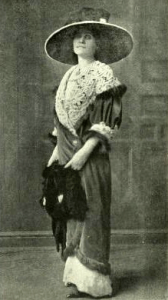
Called “Canada’s First Woman Artist,” Hamilton (1873-1954) recorded the aftermath of World War I by painting the battlefields in France and Belgium. She was born in Ontario, but grew up in Manitoba. She donated more than two hundred of her works to the Canadian Public Archives, and in 1988, War Amputations of Canada released No Man’s Land a documentary short focusing on Mary Riter Hamilton.
You can read more about her in Wikipedia, and the Library and Archives of Canada also has a page and podcast about her. 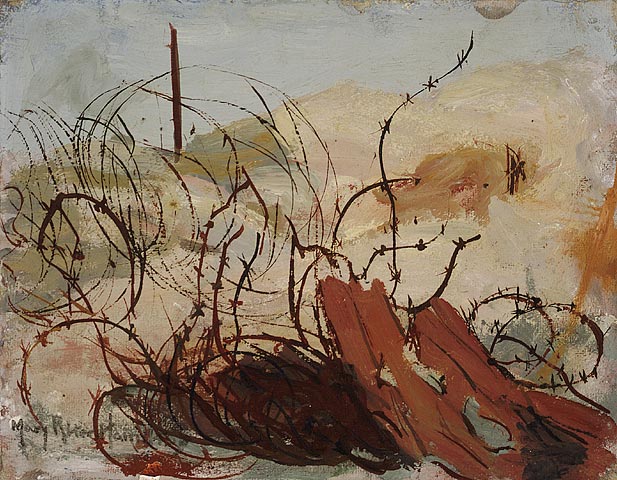 War Material, c. 1920
[press release]
Canada Post salutes country’s unofficial first woman battlefield artist
Remembrance Day stamp issue features the work of Mary Riter Hamilton
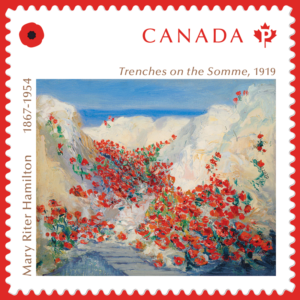 OTTAWA – Canada Post on October 28th released a new stamp issue featuring Mary Riter Hamilton’s Trenches on the Somme (1919) in honour of the painter, who was unofficially Canada’s first woman battlefield artist.
Born in Teeswater, Ontario, and widowed in her 20s, Riter Hamilton studied art in Toronto, Berlin and Paris, and received critical acclaim for her first cross-Canada exhibition in 1911-12. Living in Victoria and Vancouver during the First World War, she applied to the Canadian government to be sent to the frontlines to document Canada’s military efforts but was refused based on her gender. In 1919, she received a commission from the Amputation Club of British Columbia (now The War Amps) to paint the battlefields of France and Belgium for its veterans’ magazine, The Gold Stripe.
Arriving in Europe in March 1919, she travelled independently to the sites of Canadian battles such as Vimy Ridge, Ypres and the Somme. Over two and a half years, she produced more than 300 paintings, drawings and etchings, capturing the destruction and the reconstruction efforts. She often painted in the cold, travelled long distances on foot, and had inadequate shelter and little food or money.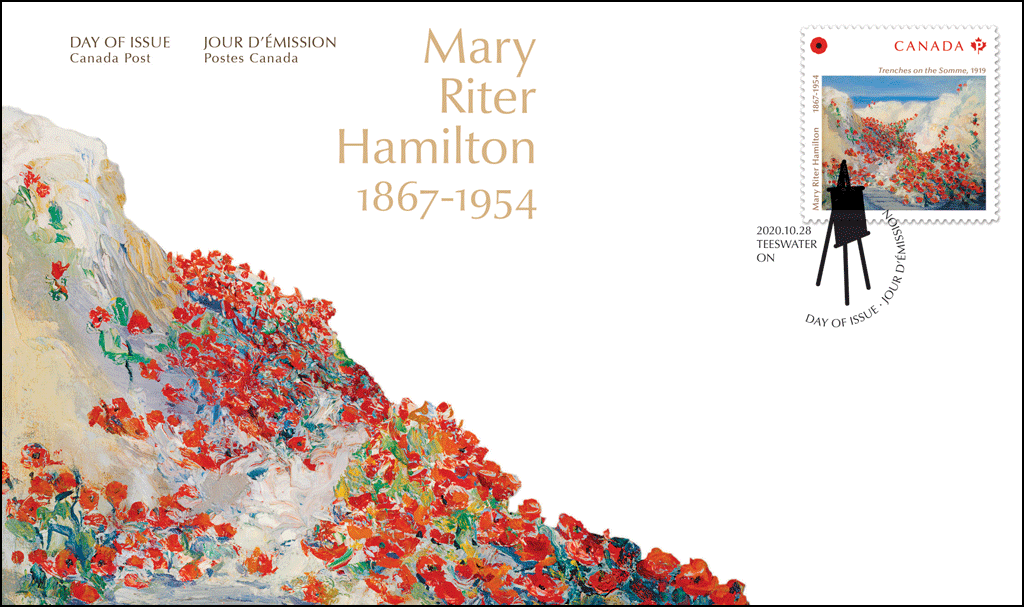
Commended for her talent and courage, she was awarded France’s Ordre des Palmes académiques in 1922. She remained in Europe, supporting herself by painting silk scarves, one of which won a gold medal at the Exposition internationale des arts décoratifs et industriels modernes in Paris in 1925. Returning to Canada that year, she found little interest in her paintings and donated most of her work to the Public Archives of Canada (now part of Library and Archives Canada).
In later years, her health suffered, due in part to her arduous living conditions on the battlefields. She died on April 5, 1954.
The booklet of 10 Permanent™ domestic rate stamps is the work of Montréal-based graphic designer Réjean Myette and was printed by Canadian Bank Note. An Official First Day Cover is also available.
Stamps and collectibles are available at canadapost.ca/shop.  [en Francais]
Postes Canada salue la première artiste de champs de bataille à titre officieux au pays
Le timbre émis à l’occasion du jour du Souvenir illustre une œuvre de Mary Riter Hamilton
OTTAWA – 28 Octobre, Postes Canada a émis un nouveau timbre qui illustre l’œuvre de Mary Riter Hamilton intitulée Trenches on the Somme (1919) en l’honneur de cette peintre qui est, à titre officieux, la première artiste canadienne de champs de bataille.
Née à Teeswater, en Ontario, et devenue veuve dans la vingtaine, elle étudie les arts à Toronto, à Berlin et à Paris. En 1911 et 1912 se tient sa première exposition pancanadienne, encensée par la critique. Mary Riter Hamilton, qui habite à Victoria et à Vancouver pendant la Première Guerre mondiale, propose au gouvernement canadien de l’envoyer au front pour témoigner des efforts militaires du Canada, mais sa demande est refusée en raison de son sexe. En 1919, l’Amputation Club of British Columbia (aujourd’hui Les Amputés de guerre) l’embauche pour peindre les champs de bataille en France et en Belgique pour son magazine The Gold Stripe destiné aux anciens combattants.
À son arrivée en Europe en mars 1919, elle se rend seule sur les champs de bataille où ont combattu des Canadiens, dont la crête de Vimy, Ypres et la Somme. Pendant plus de deux ans et demi, elle réalise plus de 300 peintures, dessins et esquisses qui témoignent de la destruction et des efforts de reconstruction. Elle peint souvent exposée au froid, parcourt de longues distances à pied et vit dans des abris de fortune avec peu de nourriture et d’argent.
En 1922, elle reçoit l’Ordre des Palmes académiques de France et elle est félicitée pour son talent et sa bravoure. Elle prolonge son séjour en Europe et y gagne sa vie en peignant des foulards en soie, dont un qui lui vaut une médaille d’or à l’Exposition internationale des arts décoratifs et industriels modernes à Paris en 1925. Après son retour au Canada cette année-là, ses créations suscitant peu d’intérêt, elle fait don de la plupart de ses œuvres à Archives publiques Canada (aujourd’hui Bibliothèque et Archives Canada).
Des années plus tard, sa santé se détériore, entre autres en raison des conditions difficiles dans lesquelles elle a vécu sur les champs de bataille. Elle décède le 5 avril 1954.
Le carnet de 10 timbres PermanentsMC au tarif du régime intérieur a été conçu par Réjean Myette, graphiste à Montréal, et imprimé par Canadian Bank Note. Un pli Premier Jour officiel est aussi offert.
Les timbres et les articles de collection sont disponibles en ligne à postescanada.ca/magasiner.
 Former APS executive director — but also a former member of the boards of the APS and American Topical Association, former Deputy Secretary of State and U.S. Ambassador — Robert E. Lamb received Ernest Kehr Award, which is bestowed annually helping to guarantee the future of the hobby.
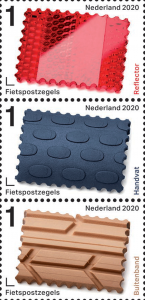
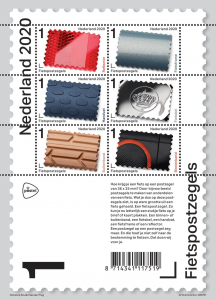 With 6 new stamps, PostNL pays tribute to the two-wheeler, in particular to its parts.
 37,000 kilometers of cycle paths. Local drivers from all over the world come to look at our cycling infrastructure, especially now that the bicycle is increasingly seen as a fast and healthy alternative to cars and public transport.
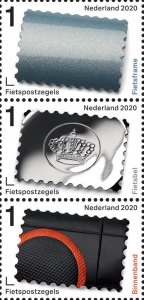 stamp. In this way, a fragment of a bicycle ends up on a bicycle stamp. “The entire stamp sheet also has the appearance of a stamp thanks to the perforation all around,” says Plug.
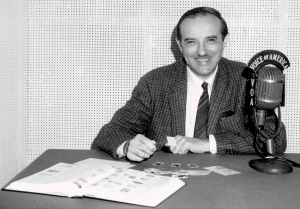 out. He was among those stamp collectors who, coming out of World War II, surveyed the value of U.S. new issues of the 1920s and 1930s, and thought “Hmmm…Mint U.S. commemorative stamps are popular, and the retail value seems to go up. So, I’ll buy a couple of sheets of every new issue, and when little Johnny gets to be college age, there is a little nest egg.”
 he bought only what he could afford, and what he could afford to lose; because when it came time to sell in the early 1960s, the market for sheets of U.S. commemoratives had tanked.
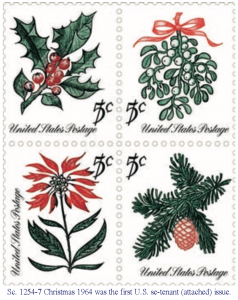 So, when all the little Johnnies and Janies got to college age in the late ‘50s and early ‘60s, the tens (if not hundreds) of thousands who had the same idea went to the well to collect on their investments, and found that there was far more supply than demand. If they could get 75% of face for routine stamps and full face for plate blocks, they were doing very well. Crank in the reduced purchasing power of the dollar, thanks to inflation, and even the realizations received were not nearly high enough to cover the initial outlay.
 printings that have topical value — such as Space-related, some sports heroes, the first stamps of a continuing series (such as Black Heritage) — still bring a modest premium. Also, some booklet panes, line pairs, plate number coils, and souvenir sheets. But for the vast majority of post WWII stamps, people selling them in quantity are now able to realize a mere 50-60% of face. And even some booth-holders at stamp shows who used to offer sheets of stamps to collectors for face value, are now forced to undercut their prior pricing in order to remain competitive.
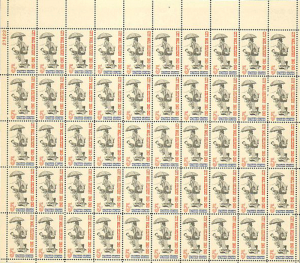 Now, don’t expect this dynamic to hold for single stamps being sold to collectors. Dealers who retail modern- era U.S. singles have to do more than buy and sell in large quantities. Even if they buy cheap, they have to break up sheets, put single stamps in glassines or make up year sets, advertise by individual Scott numbers, provide storage space for what is pending sale, and haul their wares to wherever they retail; or pay commissions if they are selling online using established websites. It all takes an investment of time and space, in addition to the investment of money. So you will pay more than face for single stamps to complete your album pages.
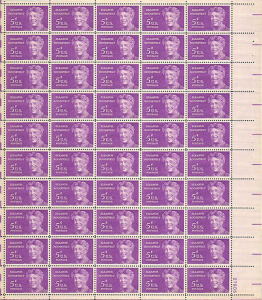 The holder of quantities of U.S. mint, often in my experience survivors of the original purchaser, rarely have a clue that what they have is not so much windfall as white elephant. I can’t count the number of times I’ve had to explain to the new owners the facts of philatelic life; that they have only a few alternatives:
 Kelsey was born September 3, 1949. He served as executive director of the AFDCS from 1991 until 2011, at which time the position was altered and named executive secretary. He also served many years on the society’s board of directors.
 president of the Machine Cancel Society, executive director of the Postal History Foundation, and secretary-treasurer of the Meter Stamp Society.
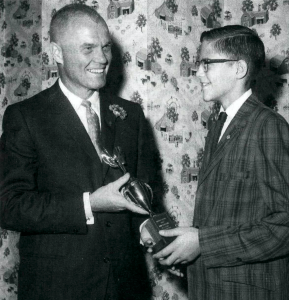 In the February 2002 issue of American Philatelist, Kelsey wrote about the 1962 Project Mercury first-day and his collection, and recounted how that collection’s display at the Ohio State Fair won him a chance to meet astronaut John Glenn, an Ohio native.
 The
The 
 The
The 
 And VSC member Joseph Goodwin is
 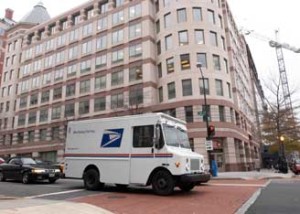 Postal agencies are rarely attention-getting issues in political races, but 2020 is a year like no other: The U.S. Postal Service is a lead item in the presidential election coverage.
 residence.
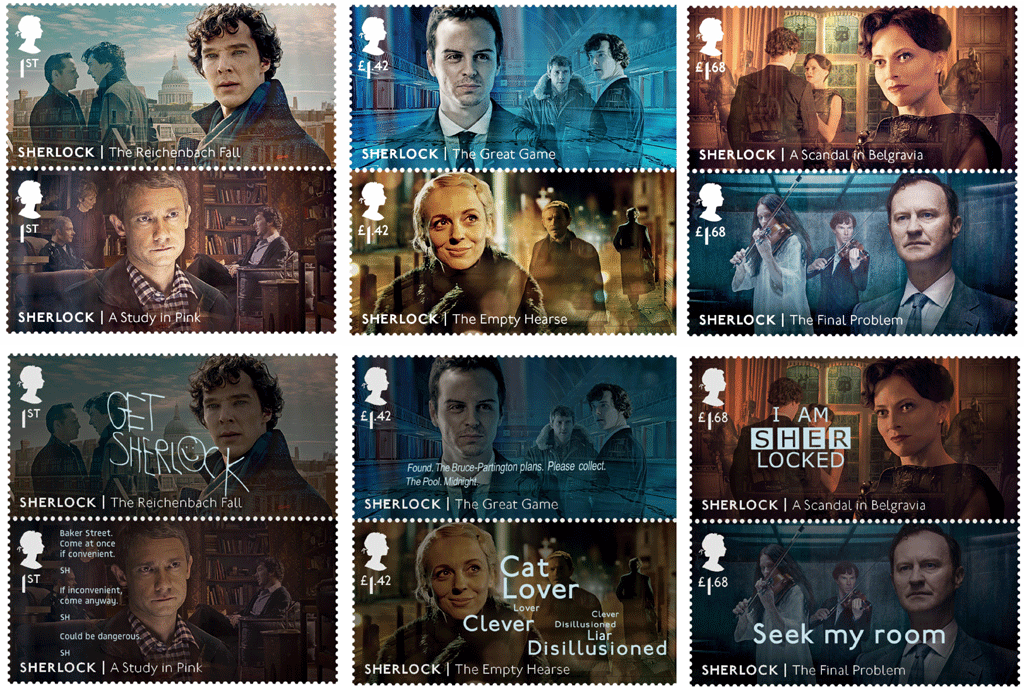

 Returning to London following a traumatic experience in the Afghanistan war, injured army medic Dr John Watson is on the hunt for a flatmate when he is introduced to Sherlock Holmes, a unique figure who describes himself as “the world’s only consulting detective”. The pair move into shared lodgings at 221B Baker Street, only for Watson to be drawn into an unexpected adventure when Sherlock begins investigating a series of bizarre ‘serial suicides’ that have left Scotland Yard baffled. Coming to the aid of Detective Inspector Greg Lestrade, Holmes soon discovers that each of these deaths is actually the work of the same sinister killer, who has the apparent ability to move undetected through the streets of London.
 and John Watson are drawn into a cat-and-mouse game with London’s most notorious criminal, the enigmatic James Moriarty. The challenge is simple: working against the clock, Sherlock must solve a series of crimes, each more fiendish and challenging than the last. Ranging from the seemingly natural death of a popular TV star to the theft of important government files, each case adds another piece to Moriarty’s sinister, unfolding puzzle. Having successfully completed all five tests – and survived a bruising encounter with a master assassin known only as The Golem – Holmes accepts Moriarty’s invitation to join him at a deserted swimming pool where the criminal mastermind finally reveals his true identity.
 photographs of a member of the Royal Family on her phone, and calls on Holmes and Watson to retrieve the device. When our heroes track the flirtatious Adler to her London flat she escapes, taking the phone with her. But Sherlock is unable to forget his encounter with this alluring woman, and when her dead body is found he is deeply affected. It later transpires that Adler – who has also been passing information to Moriarty and threatening to blackmail the government – faked her demise to evade a gang of terrorists, who plan to bomb a transatlantic flight. Only Sherlock has the knowledge necessary to stop them.
 question following another encounter with the devious Moriarty. Having carried out audacious attacks on the Bank of England, Pentonville Prison and the Tower of London, Moriarty is captured in possession of the Crown Jewels. He is swiftly brought to trial, only to be unexpectedly acquitted – because, as Sherlock discovers, the crime lord either threatened or bribed the jury. Having gained his freedom, Moriarty manipulates the public and the media into believing that Sherlock is a fraud who carried out crimes only to ‘solve’ them himself. Matters culminate in a face-to-face showdown between Sherlock and Moriarty on the roof of a hospital, from where Sherlock apparently plummets to his death.
 and eliminated the last vestiges of Moriarty’s criminal empire. He reintroduces himself to Dr Watson, only to be surprised when his old friend doesn’t welcome him with open arms. Watson, who is soon to be married to Mary Morstan, has spent the intervening years trying to come to terms with Sherlock’s death, and is understandably annoyed to discover that he has simply been in hiding. But the pair set aside their differences when Sherlock saves John from a kidnapping, and are soon on the case of a respected Lord who appears to have vanished on the London Underground. The case leads them to a bomb plot against the Houses of Parliament, and the revelation that there is a new master villain in town.
 second sibling – a sister, Eurus, described as a genius to rival Isaac Newton, but with a total absence of human empathy. Eurus is being held in a secret maximum-security prison situated on an island in the North Sea, a last-resort facility housing the country’s very worst criminals. Holmes and Watson travel to the prison to confront Eurus, only to find that she has used her extraordinary powers of persuasion to take over the facility, bending the staff and fellow prisoners to her will. To avert a horrific tragedy, Sherlock and John must undergo a series of psychological trials designed to test the bonds of friendship between them.
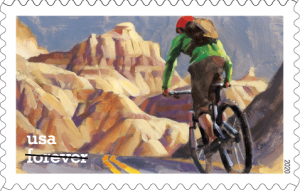 5475 (55¢) Enjoy the Great Outdoors – Child building sandcastle
 5480 (55¢) Hip Hop – MC with microphone rapping