Issued: March 2, 2020
[press release]
Canada Post cultivates thoughts of spring with dahlia stamps
Popular wedding flower is a favourite with Canadian gardeners 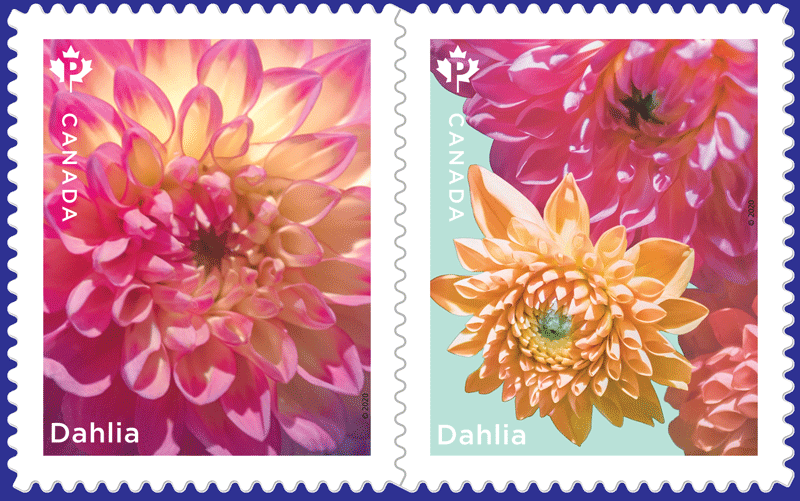 OTTAWA – Just in time to comfort the winter weary, Canada Post has released its annual flower stamp issue. This year’s offering features the colourful dahlia, a familiar standby for many Canadian gardeners.
Spikey, showy and uncomplicated, dahlias are part of the Asteraceae family, which includes sunflowers, daisies, chrysanthemums and zinnias. Single or double flowering, dahlias come in a rainbow of colours (except blue). Considered an annual in Canada, these robust plants will bloom in most parts of the country from mid-summer until the first frost. In the Victorian era, dahlias were exchanged by couples as a show of commitment. They are still widely used in weddings and are said to symbolize honesty, balance, inner strength, creativity, positive change and kindness. More recently, the dahlia has become symbol of diversity, given the seamless way each petal fits into the whole flower head.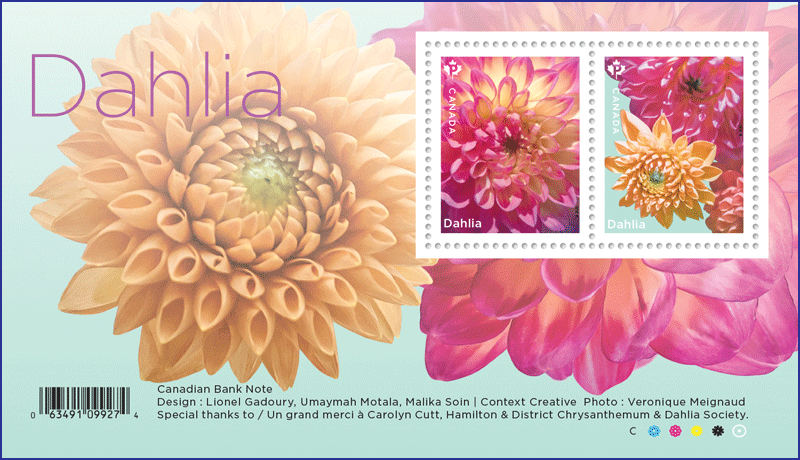
The stamps are available in booklets of 10 – five of each of the two designs – with matching envelope seals, as well as in convenient coils of 50, offering 25 of each design, for use on wedding invitations and stationery. A two-stamp souvenir sheet is available for collectors, along with strips of four and 10 stamps from the coil. An Official First Day Cover featuring both stamps is cancelled in Bloomfield, N.L. The stamp was designed by Lionel Gadoury, Umaymah Motala and Malika Soin of Context Creative, with photography by Veronique Meignaud. The booklet, souvenir sheet and Official First Day Cover were printed by Canadian Bank Note and the coil by Lowe-Martin.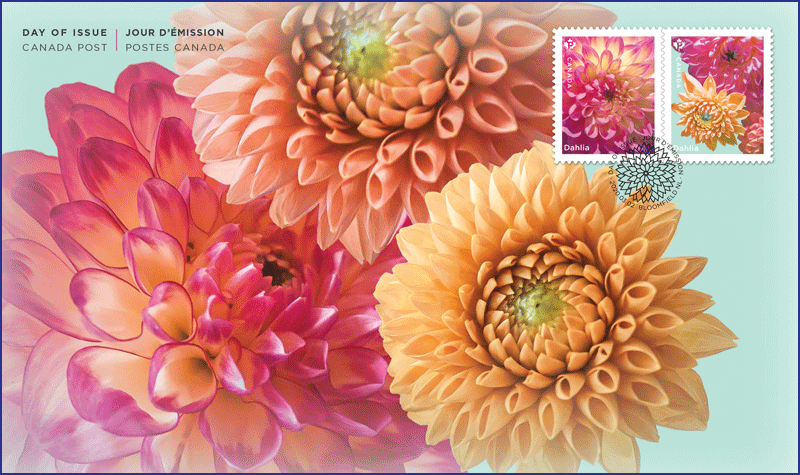
Stamps and collectibles are available at canadapost.ca and at postal outlets across Canada.
Postes Canada annonce l’arrivée du printemps avec ses timbres sur le dahlia
Cette fleur très prisée par les jardiniers canadiens est souvent utilisée à l’occasion de mariages
OTTAWA – Juste à temps pour nous soulager des rigueurs de l’hiver, Postes Canada a lancé son émission de timbres annuelle sur les fleurs. Les vignettes de cette année mettent en vedette le coloré dahlia, l’une des fleurs préférées des jardiniers canadiens.
À la fois spectaculaire et simple, tout petit ou imposant et garni de pétales pointus, le dahlia appartient à la famille des astéracées, qui comprend le tournesol, la marguerite, le chrysanthème et le zinnia. Que ce soit en fleurs simples ou doubles, le dahlia existe dans un nombre infini de couleurs, à l’exception du bleu. Cette plante robuste, considérée comme une annuelle au Canada, fleurit dans la plupart des régions du pays du milieu de l’été jusqu’au premier gel. À l’époque victorienne, les couples s’échangeaient un dahlia comme promesse d’engagement. Encore très utilisée à l’occasion de mariages, cette fleur symbolise traditionnellement l’honnêteté, l’équilibre, la force intérieure, la créativité, le changement positif et la bonté. De nos jours, elle représente la diversité, en raison de la façon harmonieuse dont ses nombreux pétales forment la corolle.
Les timbres, offerts en carnets de 10 (5 de chacun des deux motifs) avec les sceaux d’enveloppe assortis, de même qu’en rouleaux de 50 (25 de chaque motif), se prêtent bien aux invitations de mariage et au papier à lettres en général. Les collectionneurs peuvent se procurer un bloc-feuillet de 2 timbres ainsi que des bandes de 4 et de 10 timbres du rouleau. Un pli Premier Jour officiel est également proposé, orné des deux motifs et rehaussé d’un cachet d’oblitération portant la mention « BLOOMFIELD NL ». Lionel Gadoury, Umaymah Motala et Malika Soin, de la maison Context Creative, signent le design et Veronique Meignaud, la photographie. Le carnet, le bloc-feuillet et le pli Premier Jour officiel ont été imprimés par Canadian Bank Note et le rouleau par Lowe-Martin.
Les timbres et autres articles de collection sont en vente à postescanada.ca et dans les comptoirs postaux d’un bout à l’autre du pays.
From Canada Post’s Details magazine: 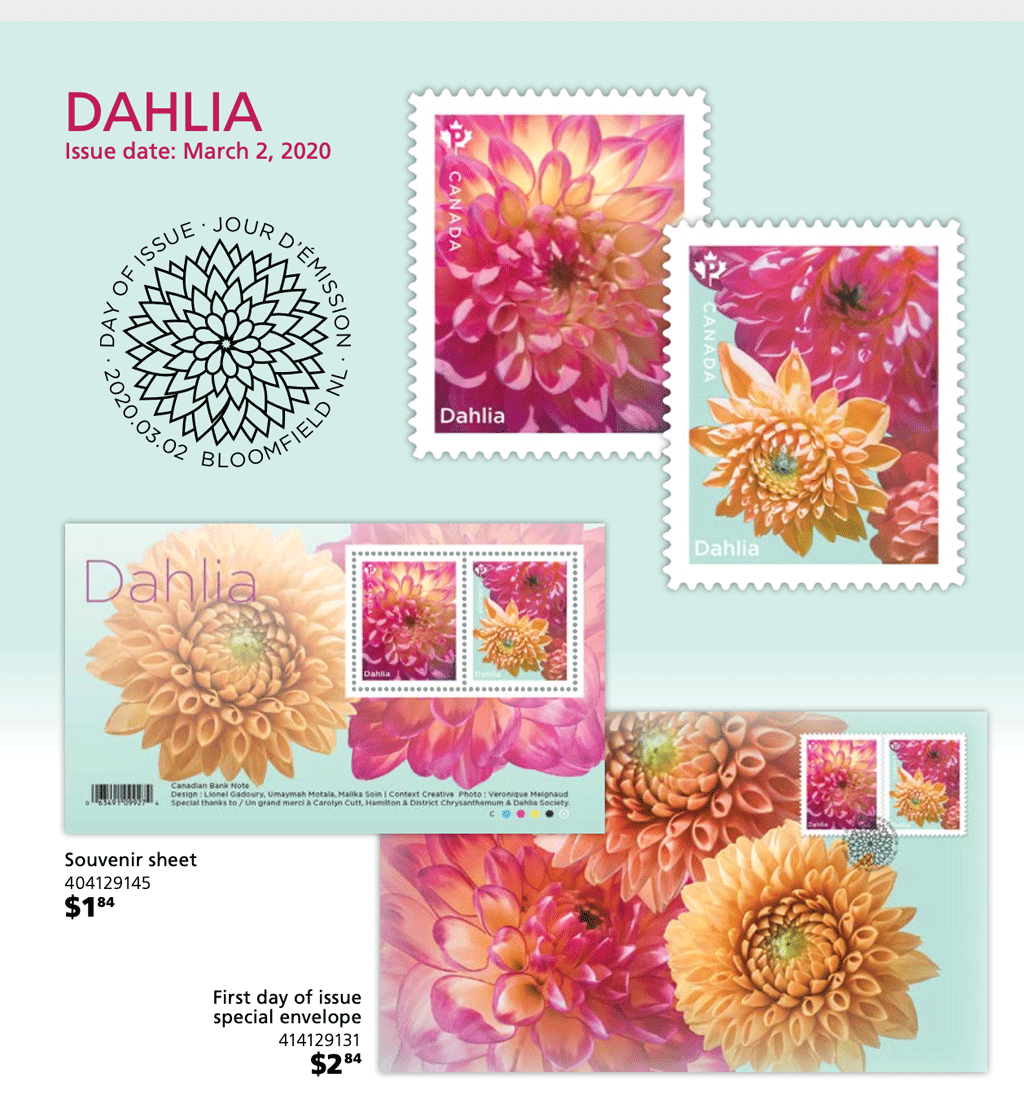 “In what has become a much-anticipated postal tradition, Canada Post welcomes spring with its annual flower issue – this year, featuring brightly coloured dahlias – just in time for the wedding season and other bloom-worthy celebrations.
“Dahlias can be found in almost every colour of the rainbow, except blue. Said to symbolize honesty, balance, inner strength, creativity, positive change and kindness, they have more recently come to be associated with diversity because of the seamless way their many petals form a single, dazzling blossom.
“According to Carolyn Cutt, President of the Hamilton & District Chrysanthemum & Dahlia Society, “Canadian gardeners enjoy dahlias for their long- blooming, show-stopping appeal, and because they provide a nectar source for pollinators until winter.”
“The fact that Victorian couples gave each other dahlias as a symbol of commitment may be a reason they’re still such a popular choice for wedding floral arrangements.” 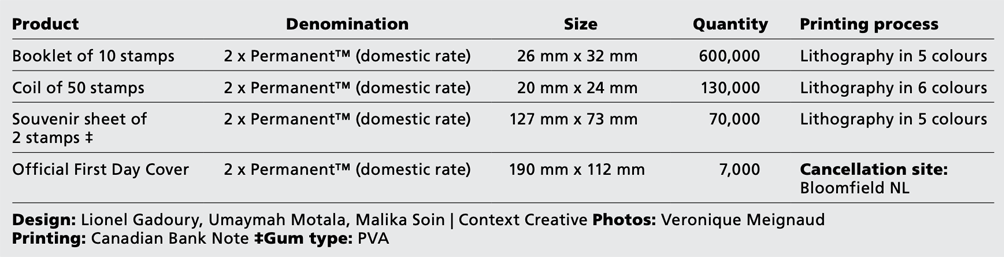
Additional information will appear below the line, with the most-recent at the top.
 Foreigners often find what is common for Dutch people very special. Those distinct aspects of our society are featured in the Typisch Nederlands [“Typically Dutch”] series by PostNL, of which the second stamp sheet has been released today. Typically Dutch is the successor of Mooi Nederland, a series that has been published for 15 years.
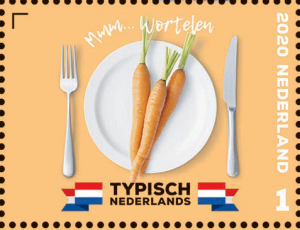 Design in Amsterdam. The photos are made by Scrambled Media, also from Amsterdam. Various formats and types of carrots were tested during the photo session. The medium-sized specimens proved to work best. Designer Van Praet: ìWe have placed them close together so that you can recognize a heart in it. With a little bit of green, because that is such a beautiful combination with orange. ”
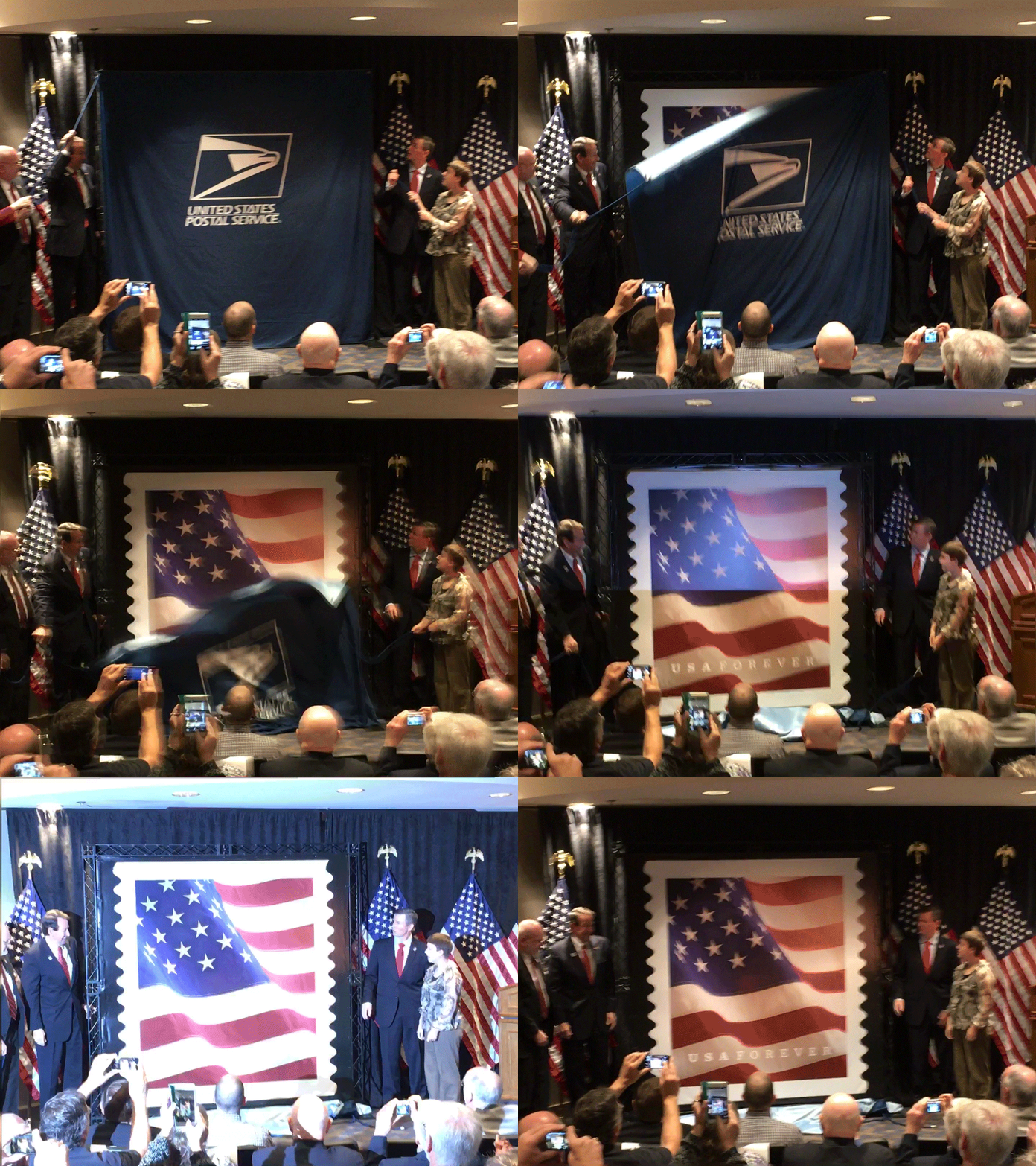 The listing of what happens at these events is the “program,” which is what we collect. However, we can do more than just accumulate these souvenirs. We can actually go to these events. (Shown above, the unveiling of the stamp design, launching the 2017 Flag stamp at Southeastern Stamp Expo near Atlanta.)
 If you begin as a collector of U.S. stamps, you eventually have to decide whether you will collect mint (with its unobstructed view of the design), used (which carries evidence in the form of the cancellation that the stamp has done the job it was created for), or both.
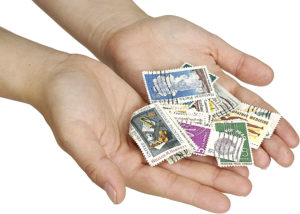 If you have enjoyed collecting current stamps, you may well decide to go backwards to get stamps previously issued by your country(ies) of interest. Or you may decide to broaden your collecting to other countries, or pursue a theme such as space travel on stamps, the story of tennis, or national costumes on stamps.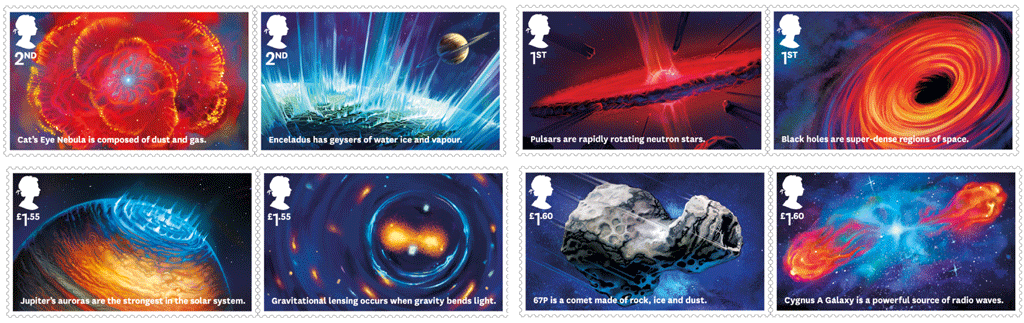
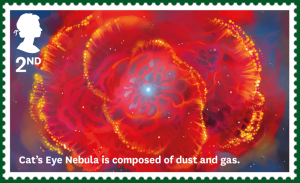 now expanding into space but was once inside a star, much like our own Sun. As the nuclear reactions that generate energy in its core were coming to an end, the uneven outflow of energy pushed the outer layers of the star off into space. The nebula was discovered by William Herschel ñ the first president of the RAS. In 1864, William Huggins used the pioneering technique of optical spectroscopy, in which light is split into an artificial rainbow and analysed, to prove that the Cat’s Eye Nebula was a tenuous gas, rather than a solid object. Huggins was awarded the prestigious Gold Medal of the Royal Astronomical Society in 1867.
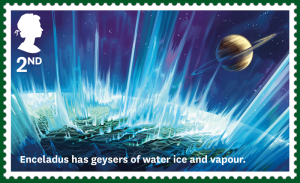 Enceladus is a small, icy moon of Saturn with a system of geysers that spray water and vapour into space. The geysers were found after the British-built magnetometer instrument on NASA’s Cassini spacecraft began sending back puzzling results indicating that Enceladus possessed a thin atmosphere. Michele Dougherty of Imperial College persuaded NASA to skim the space probe over the moon’s surface to take a closer look. In the process, the cameras revealed the geysers. Subsequent investigations have found that the geysers are fed by a subsurface ocean in which the water contains the molecular building blocks of life.
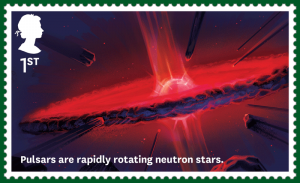 beam radiation across space like a lighthouse, sometimes many times a second. Every neutron star was once the energy-generating core of a massive star, but after exhausting its nuclear fuel supply it collapsed into an ultra-dense object, triggering the explosion of the star.
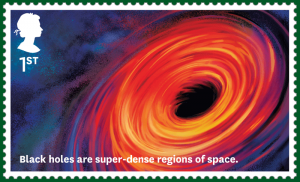 philosopher John Michell, and their behaviour was mathematically described in 1916 by the German physicist Karl Schwarzschild. Yet they seemed so unorthodox that astronomers were initially reluctant to believe they could truly exist. Only in the 1960s were black holes accepted, which led to a flurry of theoretical investigations.
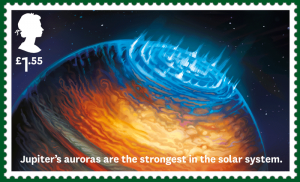 produced when charged particles accelerate into the atmosphere, giving off light as they collide with the gas atoms there. Earth’s auroras come in visible wavelengths of red and green, but at Jupiter they shine in the ultraviolet part of the spectrum and as X-rays. On Earth, powerful voltages in our magnetic field power the auroras, but this does not seem to be the case at Jupiter, where the source of power remains a mystery. A team of astronomers at the University of Leicester continues to study this phenomenon.
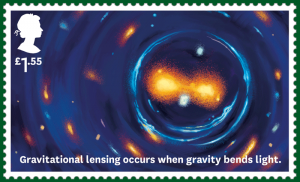 sources to form distorted and multiple images. The phenomenon was a prediction of Albert Einstein’s General Theory of Relativity. It was confirmed in 1979 when an Anglo-American team of astronomers that included Dennis Walsh and Bob Carswell discovered two distorted galaxies side by side that on closer inspection appeared to be identical. Astronomers can ‘weigh’ the amount of matter forming the gravitational lens by the appearance of the distorted images. This has shown that clusters of galaxies contain a lot more matter than can be seen. Astronomers call this invisible material ‘dark matter’.
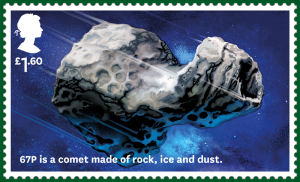 the European Space Agency’s Rosetta mission. UK industry and universities worked on the mission’s lander and instruments. We now know that 67P is an ancient object that formed before the planets, more than 4.5 billion years ago. Rosetta’s lander instruments revealed carbon-rich molecules in the ice. Such molecules could have been important in ‘seeding’ the early Earth and helping to get life started on our planet. Rosetta also showed that the comet’s two distinct lobes were once separate bodies that collided and stuck together.
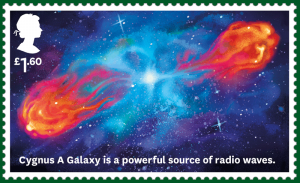 significant amount of energy within it. In the early 1950s, the Jodrell Bank radio observatory in Cheshire found that radio emission was not coming directly from Cygnus A but from a pair of radio lobes, one on either side of the visible galaxy. It is thought that energetic jets of particles are being accelerated away from the centre of the galaxy by strong magnetic fields. These particles collide with the extremely rarefied atoms in the space surrounding the galaxy, powering the radio lobes.

 The sixth Bond (Daniel Craig) joined the series in 2006 as the producers turn to Ian Fleming’s first novel to re-imagine a harder-edged 007. Having just earned his 00 status and his licence to kill, Bond foils ruthless Le Chiffre, who uses terror attacks to manipulate the stock market. A jaw-dropping finale ends with the tragic demise of, Vesper Lynd.
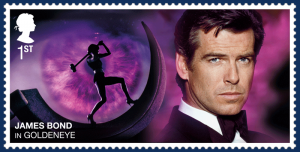 Although remaining involved, Cubby Broccoli passes on main producing responsibilities to his son and daughter, Michael G Wilson and Barbara Broccoli, who debuts in the producer’s chair. A new Bond (Pierce Brosnan) and a female M (Judi Dench) take the stage as a former agent, 006, threatens the world with a terrifying space weapon, GoldenEye.
 Timothy Dalton takes on the Bond mantle in this thrilling, lightning-paced adventure. The story draws inspiration from real-life East–West defections and Soviet-Afghan war in Afghanistan, as Bond defeats the ambitious Soviet General Georgi Koskov and a rogue US arms dealer called Whitaker.
 In Roger Moore’s first film as James Bond, 007 travels to Harlem, New Orleans and the Caribbean to investigate the mysterious Dr Kananga, known as Mr Big. Bond saves the day during a voodoo ritual and the stunt team sets a world record for a speedboat jump.
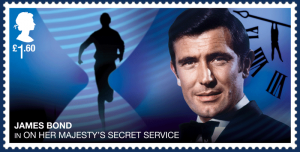 The film-makers unveil a new Bond (George Lazenby) and the adventurous Tracy Di Vicenzo (Diana Rigg) in a story that sees Bond marry. SPECTRE is bidding to blackmail world powers via biological warfare. Bond defeats Blofeld but is left devastated when his bride, Tracy, is gunned down on their wedding day.
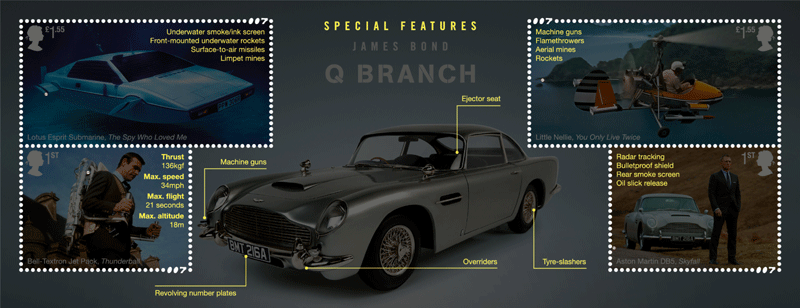
 The third film starring Sean Connery introduces the iconic Aston Martin DB5, which combines ingenious gadgetry with understated elegance. The story sees Bond track gold smuggler, Auric Goldfinger, dodging death in the form of Oddjob, as well as a terrifying laser beam. Bond, with the help of Pussy Galore, foils a bid to render Fort Knox worthless.
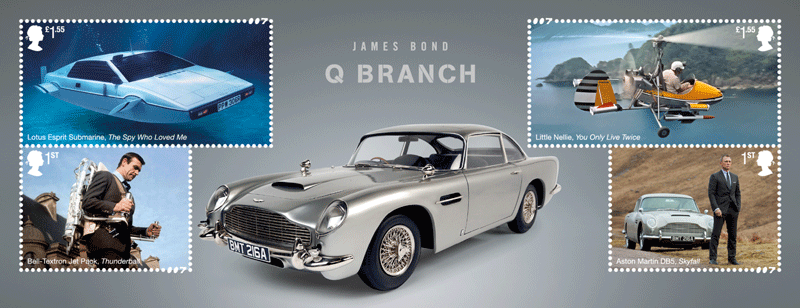
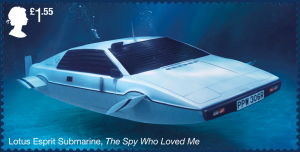 Lotus Esprit Submarine – The Spy Who Loved Me (1977)
 Little Nellie – You Only Live Twice (1967)
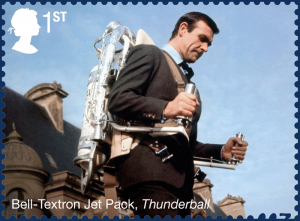 Bell-Textron Jet Pack – Thunderball (1965)
 Aston Martin DB5 – Skyfall (2012)
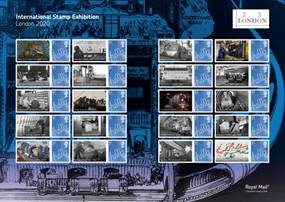 Royal Mail will celebrate London 2020 with a selection of special items that recall the worldís first adhesive postage stamps, the Penny Black, Twopenny Blue and Penny Red.
 Ahead of the exhibition opening, a retail stamp booklet will be issued on 10 March. Containing two each of the Penny Black, Twopenny Blue and Penny Red designs, the inside of the booklet includes the official London 2020 logo. The stamps in this booklet are self-adhesive.
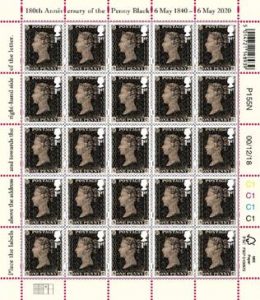 can be experienced as part of the attractions at The Postal Museum in London.
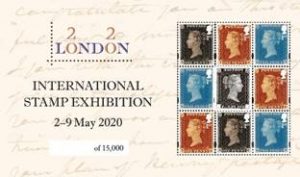 stamp design that appeared on the first postcard, while the sheet itself will carry an ëanniversaryí text. This sheet will be available in a numbered edition of 7,500.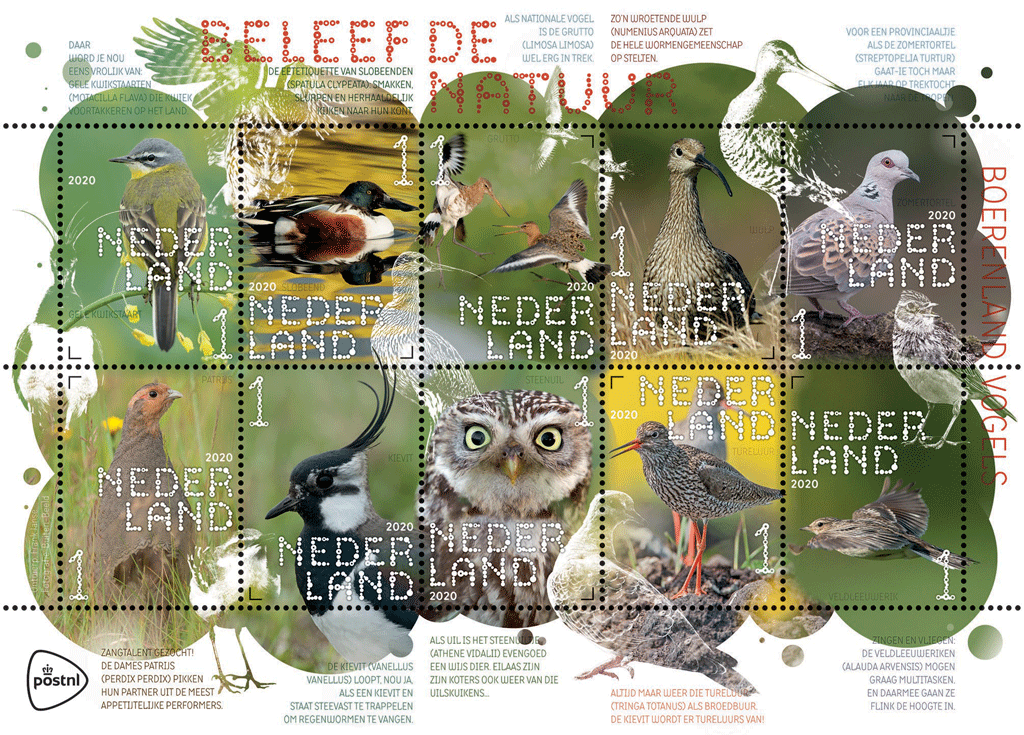
 The consequence of this for the farmland birds is far-reaching, says Resi Becker, director of Mail NL at PostNL. “In half a century, 60% of these birds have disappeared in our country. The Netherlands currently has around 70 species of farmland birds. We must handle this with care. That is why PostNL is supporting the efforts of Bird Protection Netherlands to protect all wild birds and their habitats as well as possible by issuing these stamps.”
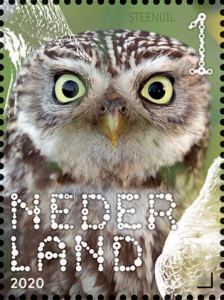
 partridge, lapwing, little owl, redshank and skylark. Of the 10 farmland birds on the stamps, only the 2 bellowing godwits and the skylark can be seen in the sky. The other birds are depicted standing, sitting or swimming. Janse: “That has to do with the fact that farmland birds are generally somewhat smaller and therefore more difficult to recognize when they fly. More importantly, I wanted to create a nice balance. With birds that takes different positions and look at different sides. ”
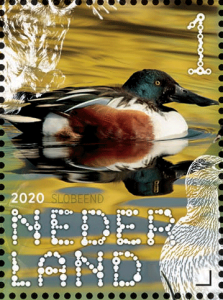
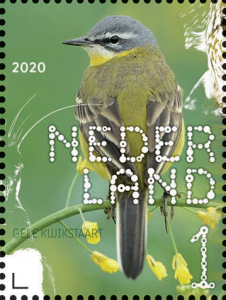 and orange. “The latter especially comes back nicely in the long legs of redshank, in the partridge’s part, the belly of the shoveler, and the necks of the two bald-tailed godwits. That was also a consideration to make the title orange this time. ”
 “
“