
Updated October 4th: Here are the Scott Catalogue numbers:
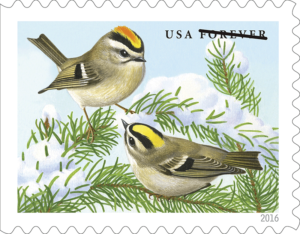
5126 Golden-crowned kinglets
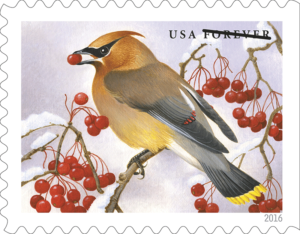
5127 Cedar waxwing
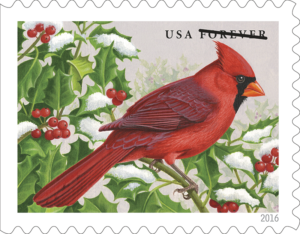
5128 Northern cardinal
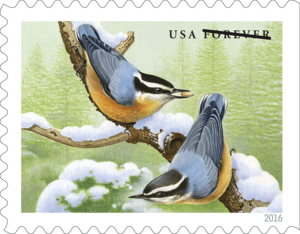
5129 Red-breasted nuthatches
a. Block of 4, #5126-5129
b. Convertible booklet pane of 20
Updated August 4th: The first day ceremony is at 1 p.m., not 11 a.m. as stated earlier.
Here is the Digital Color Postmark for this issue: 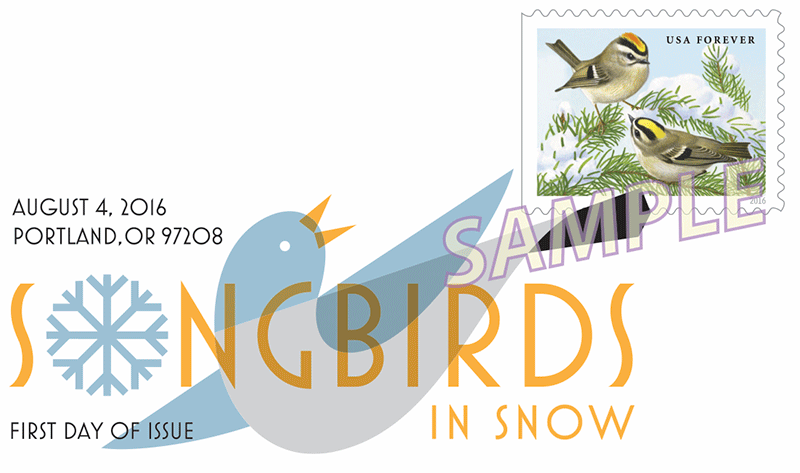 It measures 2.94” x 1.31”. The B&W postmark is the standard four-bar First Day of Issue.
Updated July 27th: The first day ceremony will be held at 1 pm in Rooms C123-124.
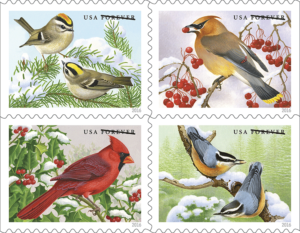 Updated July 22nd: On August 4, 2016, in Portland, OR, the U.S. Postal Service will issue the Songbirds in Snow stamps (Forever® priced at 47 cents) in four designs, in a pressure-sensitive adhesive (PSA) double-sided booklet of 20 stamps (Item 681100).
The stamps will go on sale nationwide August 4, 2016.
Each of these four new stamps celebrates a different songbird that brightens cold winter days. The birds featured in the stamp art are the golden-crowned kinglet, the cedar waxwing, the northern cardinal, and the red-breasted nuthatch. The illustrations, painted in acrylic on canvas boards, depict each bird perched on a snow-covered branch. The artist was Robert Giusti. Art director Derry Noyes designed the stamps.
Stamp Fulfillment Services will not make an automatic push distribution to Post Offices™. Post Offices may begin ordering stamps prior to the FDOI through SFS Web.
How to Order the First-Day-of-Issue Postmark:
 Customers have 60 days to obtain the first-day-of-issue postmark by mail. They may purchase new stamps at their local Post Office, at The Postal Store® website at http:⁄⁄www.usps.com⁄shop, or by calling 800-782-6724. They should affix the stamps to envelopes of their choice, address the envelopes (to themselves or others), and place them in a larger envelope addressed to:
Songbirds in Snow Stamps
United States Postal Service
Attn: Ruth Traynor
PO Box 2089
Portland, OR 97208-2089
After applying the first-day-of-issue postmark, the Postal Service™ will return the envelopes through the mail. There is no charge for the postmark up to a quantity of 50. There is a 5-cent charge for each additional postmark over 50. All orders must be postmarked by October 4, 2016.
There are ten philatelic products for this stamp issue:
 681106, Press Sheet with Die-cut, $75.20.
- 681110 Digital Color Postmark Keepsake (Set of 4), $15.95.
- 681116 First-Day Cover (Set of 4), $3.64.
- 681121 Digital Color Postmark (Set of 4), $6.48.
- 681124 Framed Art (Set of 4), $40.00.
- 681125 Framed Art (Golden-crowned Kinglet), $10.00.
- 681126 Framed Art (Northern Cardinal), $10.00.
- 681127 Framed Art (Cedar Waxuling), $10.00.
- 681128 Framed Art (Red-breasted Nuthatch), $10.00.
- 681130 Ceremony Program (random single), $6.95.
Technical Specifications:
 Issue: Songbirds in Snow Stamps
Item Number: 681100
Denomination & Type of Issue: First-Class Mail Forever
Format: Double-Sided Booklet of 20
Series: N⁄A
Issue Date & City: August 4, 2016, Portland, OR 97208
Art Director: Derry Noyes, Washington, DC
Designer: Derry Noyes, Washington, DC
Typographer: Derry Noyes, Washington, DC
Artist: Robert Giusti, Bridgewater, CT
Modeler: Joseph Sheeran
Manufacturing Process: Offset
Printer: Ashton Potter (USA) Ltd. (APU)
Printed at: Williamsville , NY
Press Type: Muller A76
Stamps per Booklet: 20
Print Quantity: 600,000,000 stamps
Paper Type: Nonphosphored Type III, Block Tag applied
Adhesive Type: Pressure-sensitive
 Processed at: Ashton Potter (USA) Ltd. (APU)
Stamp Orientation: Horizontal
Image Area (w x h): 1.05 x 0.77 in.⁄26.67 x 19.56 mm
Stamp Size (w x h): 1.19 x 0.91 in.⁄30.23 x 23.11 mm
Full Booklet Size (w x h): 2.38 x 5.76 in.⁄60.45 x 146.30 mm
Press Sheet Size (w x h): 4.76 x 23.29 in.⁄120.90 x 591.57 mm
Colors: Black, Cyan, Magenta, Yellow
Plate Size: 880 stamps per revolution
Plate Numbers: “P” followed by four (4) single digits
Marginal Markings: Header. “Songbirds in Snow” • Twenty First-Class Forever Stamps • Plate numbers in peel strip area • USPS LOGO • © 2016 USPS in peel strip area • Golden-crowned Kinglet • Cedar Waxwing • Northern Cardinal • Red-breasted Nuthatch • Promotional text in peel strip area
From the USPS, June 29th:
Commemorative Forever Stamps
First-Day-of-Issue Dedication Ceremony
Thursday, August 4, 2016
1:00 p.m.
American Philatelic Society: APS Stampshow 2016
Oregon Convention Center
Rooms C123-124
777 NE Martin Luther King Jr. Boulevard
Portland, OR 97232
Songbirds in Snow Forever Stamps
With Songbirds in Snow, the U.S. Postal Service celebrates four birds that brighten cold winter days.
The sight of birds sitting on a snowy tree branch and the sound of their songs and calls bring joy in the depth of winter. Though many birds migrate to warmer climes before the snow falls, some hardy birds have ways to cope with the cold and to find food year-round. The booklets of 20 stamps will available on usps.com/shop in early July for pre-order and will be delivered shortly after Aug. 4.
I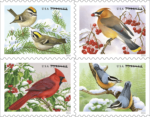 n winter, much of their day is spent looking for food; they consume large quantities to supply the energy to keep warm at night when temperatures plummet. Fluffing their feathers creates an insulating layer of air, and their winter plumage can contain up to 30 percent more feathers than in summer. Many birds are able to slow their metabolism, lower their body temperatures, or even reduce their heart rate to help them conserve energy. Some species gather in groups to search for food and to snuggle together at night to maintain body heat.
Winter birds will search for roosting places that provide protection from precipitation, wind, and predators. They generally choose the same kinds of habitats that they use for nesting, including cavities in trees, thickets, birdhouses, shrubs, or evergreen trees.
Four winter birds are celebrated here: the golden-crowned kinglet, the cedar waxwing, the northern cardinal, and the red-breasted nuthatch.
Even the smallest birds will thrive in the winter cold if they can find food. The golden-crowned kinglet (Regulus satrapa) is only a little larger than a hummingbird, yet it can survive nighttime temperatures of 40 degrees below zero. The tiny birds roost in evergreen forests and huddle together in small flocks high up in the branches to help them stay warm. Wary of taking food from a birdfeeder, its winter diet is made up mainly of dormant insects and their eggs as well as overwintering caterpillars.
The cedar waxwing (Bombycilla cedrorum) gets its name from its favorite winter food, cedar berries, and the red, waxy tips of some of its wing feathers. One of the few North American birds that thrives on a diet of mostly fruits, the cedar waxwing also consumes the winter fruits of the juniper, mistletoe, crabapple, and other plants. It generally inhabits open woodlands and hedgerows, but in winter it will join a flock around fruiting plants, including those in backyards and gardens, to feed.
A spot of bright red against the white of a snowy tree branch signals the presence of a northern cardinal (Cardinalis cardinalis), one of winter’s most colorful and beautiful birds. Found in thickets along the edge of forests or in shrubby, overgrown fields and hedgerows, as well as in backyards, cardinals usually appear in pairs but can gather in small flocks during the winter to forage for food. Their diet is mainly seeds and fruit, but they also eat insects. During the winter, cardinals are frequent visitors to birdfeeders; sunflower seeds are a favorite food.
The red-breasted nuthatch (Sitta canadensis), with its distinctive call like a tiny toy horn, prepares well for the season by caching conifer seeds, its preferred winter food. Stashed in cracks and openings in tree bark, the seeds are collected by the bird as it walks headfirst down the trunk. It lives mainly in coniferous forests, but the inquisitive little bird is attracted to birdfeeders, drawn particularly to sunflower seeds, peanuts, and suet.
Design Brief:
The Songbirds in Snow stamps feature four species: the golden-crowned kinglet (Regulus satrapa), the cedar waxwing (Bombycilla cedrorum), the northern cardinal (Cardinalis cardinalis), and the red-breasted nuthatch (Sitta canadensis). Illustrator Robert Giusti painted the original designs in acrylic on canvas board, depicting each bird perched on a snow-covered branch.
Booklet layout: 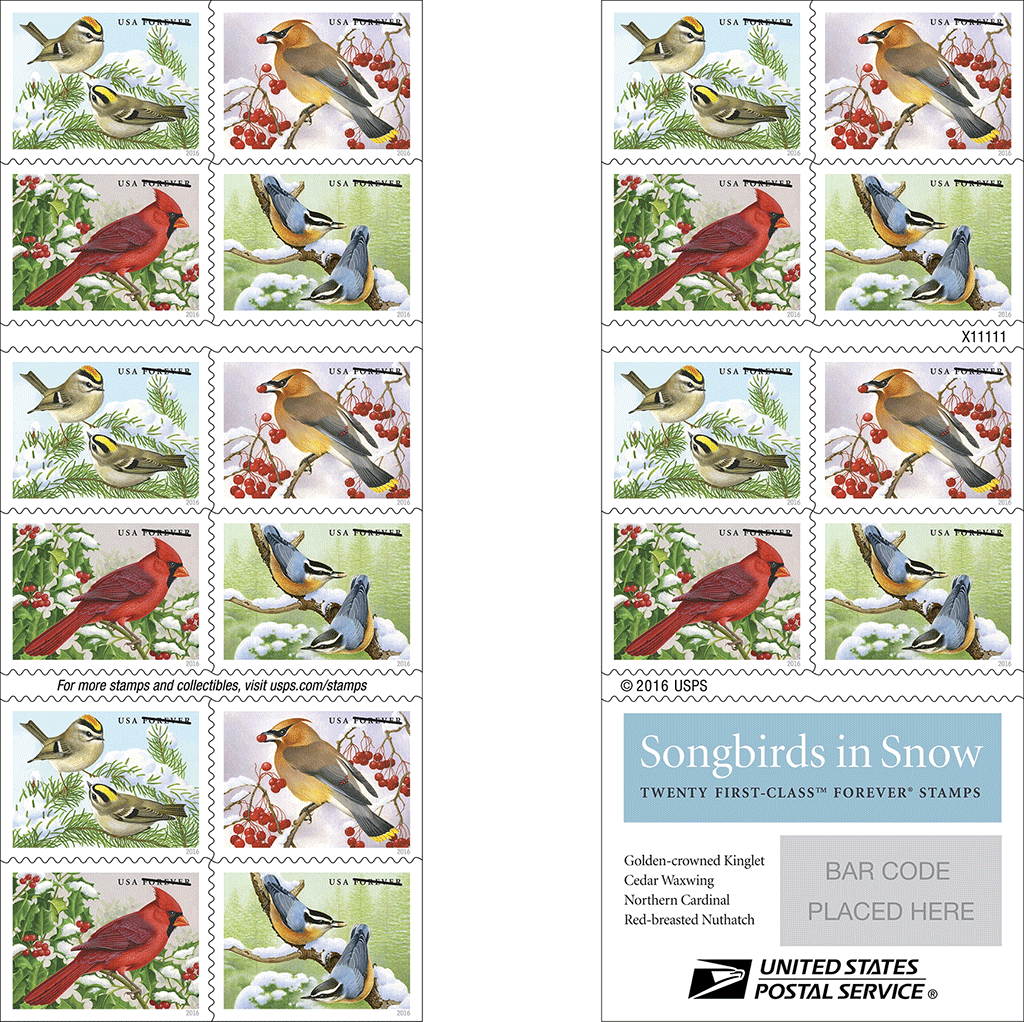
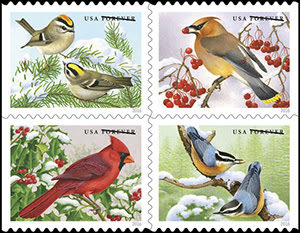 American Philatelic Society press release June 28th:
Four new Songbirds in Snow commemorative stamps will be issued August 4 during a stamp dedication ceremony at the American Philatelic Society’s annual summer StampShow in Portland, Oregon.
The four new stamps will be issued during a ceremony at 1 p.m. Thursday, August 4 in room C123-124 of the Oregon Convention Center, 777 N.E. Martin Luther King Jr. Blvd., Portland, Oregon.
“With the StampShow set among the natural wonders of Portland, the U.S. Postal Service will be issuing a great set of stamps,” said Scott English, Executive Director of the American Philatelic Society, “Not only are the stamps a fine addition to any collection, but they will make a wonderful gift to start a collection for someone new to the hobby.”
The stamps feature four birds in snowy scenes: the golden-crowned kinglet, the cedar waxwing, the northern cardinal, and the red-breasted nuthatch. The stamps feature acrylic-on-canvas board paintings by artist Robert Giusti.
The APS StampShow, the nation’s largest annual postage stamp show and exhibition, will take place August 4-7 in the Oregon Convention Center. Public hours are 11 a.m. to 6 p.m. Thursday, 10 a.m. to 6 p.m. Friday and Saturday, and 10 a.m. to 4 p.m. on Sunday. Admission is free and open to the public. Complete details are available on the show website: stamps.org/stampshow.
The American Philatelic Society and American Philatelic Research Library are located at the American Philatelic Center in Bellefonte, Centre County, Pennsylvania. The nonprofit organizations are dedicated to the hobby of stamp collecting and have a worldwide membership of about 30,000 members.
 Well, the big show is over and many of us who have been planning this extravaganza for more than decade are finally catching our breath. It gives us all a chance to reflect on what we planned and how it all turned out, with the goal of sharing that knowledge and experience with the Boston 2026 team preparing America’s next international philatelic exhibition.
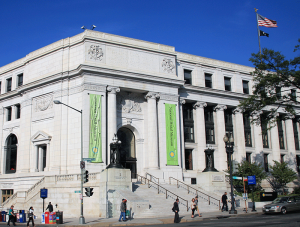 The Smithsonian’s National Postal Museum today announced the 2016 Smithsonian Philatelic Achievement Award recipients, Cheryl R. Ganz, William H. Gross and Richard H. Winter. They will be honored at a museum-hosted gala event in Washington, D.C., Oct. 22.
 Cheryl R. Ganz
 The National Postal Museum is devoted to presenting the colorful and engaging history of the nation’s mail service and showcasing one of the largest and most comprehensive collections of stamps and philatelic material in the world. It is located at 2 Massachusetts Ave. N.E., Washington, D.C., across from Union Station. The museum is open daily from 10 a.m. to 5:30 p.m. (closed Dec. 25). For more information about the Smithsonian, call (202) 633-1000 or visit the museum website at
  In one of the most contested American Philatelic Society elections in recent years — while maintaining an air of civility —
  Former president
  Even though the dust hasn’t settled yet on the 2016 U.S. international stamp show, work is under way on the next one, Boston 2026.
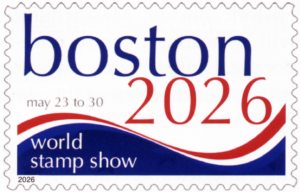 “We’re going to be taking up the entire convention center,” Clark told
 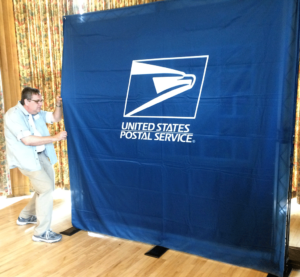 American First Day Cover Society Immediate Past President Chris Lazaroff is shown in this photo taking a sneak peak in Yellowstone National Park at what would become his 300th first-day ceremony in 50 states. That’s right: Chris has now attended at least one ceremony in every state, as well as a few territories and a District. I’ll have the story in an upcoming issue of Linn’s Stamp News.
 Sundman Also Decides To Extend Reward Offer
 Mystic Stamp Company president Donald Sundman in September 2014
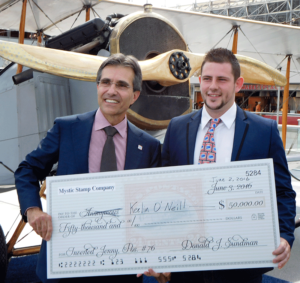
 Then, last month, Keelin O’Neil (right) of Belfast, Northern Ireland, brought the stamp in to the Spink USA auction house in New York, seeking to sell it. He had found it in his grandfather’s collection. Spink sent it to the Philatelic Foundation for an appraisal, and it was determined that it was one of the two missing stamps, although it had been altered to hide its identity.
 recognized that the stamp was stolen, they contacted the FBI, so he wasn’t getting the stamp back, once it went to the Foundation.”
 “This was good citizenship,” U.S. Attorney Preet Bharara. “They did the right thing and they ought to be commended for it.”
 “I told Roger [Brody, president of the APRL], ‘I’ve got to have a time limit on this, because I don’t want my grandkids to have to pay off this reward,” Sundman told
 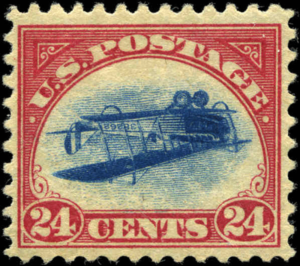 To mask the stamp’s identity, someone altered the left-side perforations and regummed the stamp, which removed the penciled number applied in 1918. However, because the two-color printing process in 1918 was so rudimentary, the centering of each stamp is different enough that the Philatelic Foundation was able to identify it anyway.