| Product Letters (1 oz.) Letters (metered 1 oz.) Additional Ounces Domestic Postcards International Postcards International Letter (1 oz.) |
Current Prices 78¢ 74¢ 29¢ 61¢ $1.70 $1.70 |
Current Basic U.S. Postal Rates
2

| Product Letters (1 oz.) Letters (metered 1 oz.) Additional Ounces Domestic Postcards International Postcards International Letter (1 oz.) |
Current Prices 78¢ 74¢ 29¢ 61¢ $1.70 $1.70 |
[press release] [click on any of the pictures for larger versions]
USPS Stamp Encore Voting Open Now
Vote for your favorite stamp to be reissued in 2026
WASHINGTON — The U.S. Postal Service is excited to announce the Stamp Encore Contest. To celebrate the organization’s 250th anniversary, and gear up to celebrate the  country’s 250th anniversary, the public is invited to select a stamp pane from the past for re-printing as part of the 2026 Stamp program.
The Postal Service chose 25 stamp panes from some of its bestselling and most popular stamp issuances of the recent past. Voting is open through Sept. 30, both online and by mail. You can view the official rules and vote online at stampsforever.com/vote, or print a paper ballot from the website and mail it in.
This is an open invitation — everyone is welcome, and you can vote as many times as you want.
The Postal Service plans to announce the winning stamp design in May 2026 at the Boston 2026 World Expo to coincide with America’s 250th anniversary celebrations.
Until then, the results will be a secret.
List of stamps:
| Art of Disney: Magic (2007) Bugs Bunny (1997) DC Comics Super Heroes (2006) Flag Act of 1818 (2018) Have a Ball! (2017) Mail a Smile (2015) Peanuts (2001) Star Wars: Droids (2021) Wonder Woman (2016 |
Batman (2015) Charles M. Schulz (2022) Disney Villains (2017) Frozen Treats (2018) Heritage Breeds (2021) Message Monsters (2021) Send a Hello (2011) Total Eclipse of the Sun (2017) |
Bioluminescent Life (2018) Classics Forever (2016) Emancipation Proclamation (2013) Happy Birthday (2021) Let’s Celebrate (2020) Mister Rogers (2018) Star Trek (2016) Transcontinental Railroad (2019) |
[press release]
Self-nominations are now open for the Board of Directors of the American First Day Cover Society, the largest not-for-profit FDC organization in the world. Each year, the membership of the AFDCS elects four people to serve on its board for three-year terms.
Those running for the board must be members in good standing and are expected to submit a statement of no more than 300 words and a photo. There is no other “qualifying process” for nominations: No 10-member petitions, minimum tenure in the AFDCS, nor the ability to recite cachet catalogue numbers from memory. Reasonable proficiency with email is expected.
Once elected, Directors are expected to attend the one in-person meeting a year (held at the convention) and ad hoc online meetings, participate in email discussions and vote electronically on matters that come before the board. The candidates are announced at Americover, the annual convention (held this year in conjunction with Great American Stamp Show) and the ballot and their statements are mailed to members in the fall. The terms begin on January 1.
Mark Gereb of New Jersey is chairing the AFDCS 2025 Nominating Committee, aided by Tris Fall of Pennsylvania and John Peterson of California. Those wish to run, or who would like more information, should contact Mark at rec.sec@afdcs.org.
The AFDCS Board of Directors consists of 12 elected members, plus three ex-officio members: the president, editor, and general counsel. (The Society’s complete bylaws are available at www.afdcs.net/bylaws). Directors are not compensated in any way for serving on the board, although they may receive reimbursement for expenses not related to serving on the board or attending meetings.
The American First Day Cover Society is a not-for-profit 501(c)(3) educational organization, established in 1955. It publishes the award-winning bimonthly journal First Days, as well as handbooks and catalogues, maintains a YouTube channel, and promotes the collecting of both modern and “classic” issues and cachets, as well as the exhibiting of FDCs.
For more information about the AFDCS, visit www.afdcs.org, e-mail afdcs@afdcs.org or write the AFDCS at Post Office Box 57, Somerset, WI 54025-0057.
6003 (73¢) Army 250th Anniv.
a. Imperforate
6004 (73¢) Navy 250th Anniv.
a. Imperforate
6005 (73¢) Marine Corps 250th Anniv.
a. Imperforate
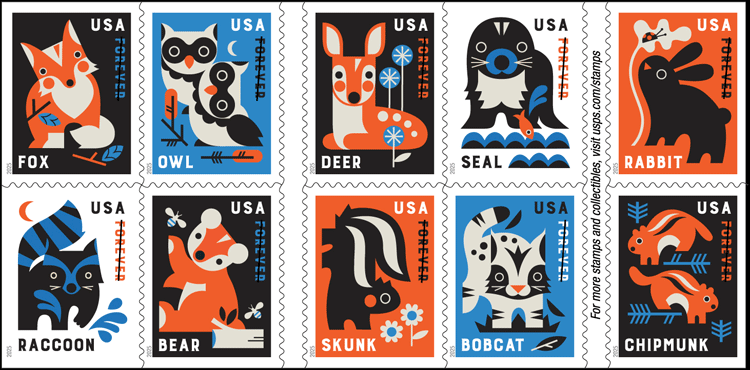 6006 (73¢) Baby Wild Animals – Fox
6007 (73¢) Baby Wild Animals – Owls
6008 (73¢) Baby Wild Animals – Deer
6009 (73¢) Baby Wild Animals – Seal
6010 (73¢) Baby Wild Animals – Rabbit
6011 (73¢) Baby Wild Animals – Raccoon
6012 (73¢) Baby Wild Animals – Bear
6013 (73¢) Baby Wild Animals – Skunk
6014 (73¢) Baby Wild Animals – Bobcat
6015 (73¢) Baby Wild Animals – Chipmunks
a. Block of 10, #6006-6015
b. Convertible booklet pane of 20, 2 each #6006-6015
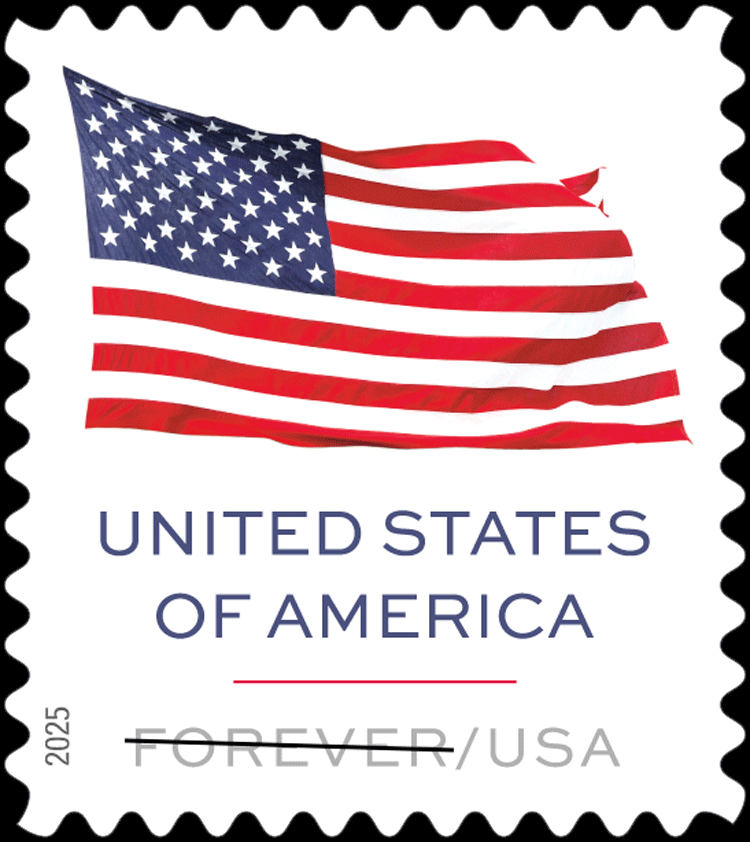 6016 (73¢) Flag, sheet stamp, serpentine die cut 11¼x11
6017 (73¢) Flag, coil stamp (Ashton-Potter), serpentine die cut 9½ vert., adjacent on roll
6018 (73¢) Flag, coil stamp (Ashton-Potter), serpentine die cut 10 vert., separated on roll
6019 (73¢) Flag, coil stamp (Banknote), serpentine die cut 11 vert.
6020 (73¢) Flag, booklet stamp (Ashton-Potter), serpentine die cut 11¼x11 on 2 or 3 sides, microprinted “USPS” at right of lower right corner of blue flag field
a. Convertible booklet pane of 20
6021 (73¢) Flag, booklet stamp (Banknote), serpentine die cut 11¼x11 on 2 or 3 sides, microprinted “USPS” near center of bottom flag stripe
 a. Convertible booklet pane of 20
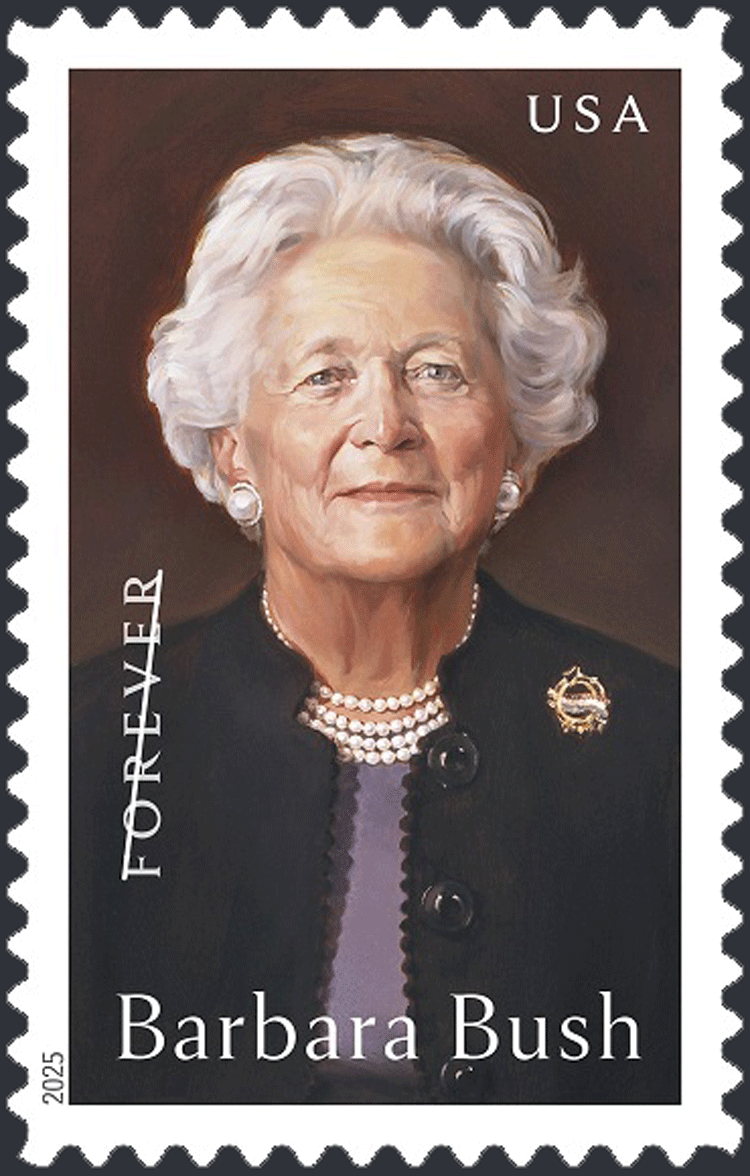
6022 (73¢) Barbara Bush
a. Imperforate
[press release] [click on any of the pictures for larger versions]
The Magic Of Mushrooms
Royal Mail has revealed images of 10 stamps that showcase the extraordinary diversity and ecological importance of mushrooms that can be found across the United Kingdom.
Mushrooms featured in the issue are: Chicken of the Woods; Clustered Bonnet; Scarlet Waxcap; Morel; Scarlet Elf Cap; Penny Bun; Amethyst Deceiver; Collared Earthstar; Fly Agaric; and Turkey Tail.
Royal Mail worked with mycologist Geoffrey Kibby, one of Britain’s foremost experts on identifying mushrooms in the field. Kibby has written numerous books, which he also illustrates. He also produces field guides on the larger fungi of both Europe and North America.
Fungi occupy every possible ecological niche and are a vital part of the world’s ecosystems, with many species forming symbiotic partnerships with trees, shrubs and other plants.
Mushrooms come in an amazing diversity of shapes, colours and textures. From the bizarre earthstars, which open to reveal a ball-like structure full of spores, to the sponge-like and very edible morels, there are over 4,000 mushroom varieties in the UK.
These range from edibles, such as the penny bun, to the toxic fly agaric, with its distinctive, white-spotted red cap. The often-startling colours of fungi can be surprising, for example the intense violet of the amethyst deceiver, a common species in autumn woodlands everywhere. Not all mushrooms have a cap and a stem.
Many form simple cups, of which arguably the most beautiful is the scarlet elf cup, while others are tough and bracket-shaped, such as the colourful turkey tails or the often large and striking chicken of the woods.
A common species on oak logs is the clustered bonnet, known for its unusual but difficult-to-define smell resembling that of paint, flour or cucumber. In undisturbed old meadows, you can find the beautiful scarlet waxcap. one of several species used by ecologists and nature agencies as indicators of nationally important grasslands. The variety of fungi is extensive, and we are only now learning of their importance in our world’s ecology.
David Gold, Director of External Affairs and Policy, Royal Mail, said: “Few people will be familiar with the breadth, variety and beauty of the fungi that are of such biological importance to our natural environment. Mushrooms play an essential role in the delicate balance of life around us, yet largely go unnoticed. In these stamps their contribution to the natural environment is duly recognised.”
Mycologist, Geoffrey Kibby said: “Fungi are finally getting the attention that they deserve in literature, education and on TV, and now their amazing diversity and importance to our ecology is being celebrated in this excellent set of Royal Mail stamps. The species illustrated show the wide variety of fungi to be found in the British countryside, emphasising their importance as a vital part of the fascinating biodiversity to be found in our islands.”
The stamps, and a range of collectible products, are available at www.royalmail.com/mushrooms and by telephone on 03457 641 641. A Presentation Pack including all 10 stamps is priced at £13.75
Stamp-by-stamp:
CHICKEN OF THE WOODS Laetiporus sulphureus The common name of this popular edible mushroom relates to its texture and taste when cooked. The very large, flattened brackets, up to 50cm across, are found on standing or fallen trees, especially oaks, chestnuts and other deciduous species. The yellow to orange colours and fleshy texture make it difficult to mistake for any other mushroom. The underside of each bracket has thousands of minute pores from which the spores are ejected. This mushroom appears in the early summer and continues throughout the autumn.
CLUSTERED BONNET Mycena inclinata Wherever you find fallen oak logs, you may see the clustered bonnet, one the most common and widespread British species of Mycena. The reddish brown stems, paler at the top, pale grey-brown caps and rather strong odour – sometimes likened to wet paint, cucumber or flour – are good identification characteristics. Several other species of Mycena grow in clumps on logs, but this is perhaps one of the easiest to identify.
SCARLET WAXCAP Hygrocybe coccinea This is one of the most beautiful mushrooms. Its scarlet cap can be found in late autumn in open, undisturbed, unfertilised meadows. The lamellae, or gills, on the underside of the cap and the fragile, waxy stem are both reddish-orange, with the stem being almost white at the base, while the thin reddish flesh is nearly odourless. The caps can reach up to 4cm across. There are several other red species of waxcap, differing in subtleties of colour, texture, size and smell, all best identified using a good field guide.
MOREL Morchella vulgaris Morels are found from March to May and are considered to be prized edibles. There are several very similar species, of which this is one of the more common; its sponge-like head is where its spores are formed in special cells, from which they are ejected in huge numbers in a smoke-like puff. The greyish-brown head can be up to 8cm tall. When cut in half, the body is hollow. This mushroom is widespread in the UK and found in mixed woods on rich soils.
SCARLET ELF CUP Sarcoscypha austriaca Found in the late winter through spring, this beautiful species can reach 5–6cm across and often occurs in groups along fallen, mossy branches in wet or humid deciduous woodlands. It is widespread and locally frequent in some parts of the UK. The outer surface of the cup is whitish and finely woolly, formed of microscopic curly hairs. If disturbed by tapping, it often fires clouds of spores up from the inner cup surface. It has an almost identical twin, Sarcoscypha coccinea, differing in microscopic features.
PENNY BUN Boletus edulis Also known as cep, this is one of the most famous edible mushroom species in Europe, celebrated in numerous cuisines. A robust species, it has caps that can reach 25cm across, varying from yellowish brown to dark chestnut. The fleshy stems have a fine white mesh or network on the surface, while the spongy pores on the underside of the caps are white, then yellowish. The flesh is thick, white and unchanging when cut. This fairly common mushroom can be found in the autumn in mixed woods throughout the UK.
AMETHYST DECEIVER Laccaria amethystina Small troops of amethyst deceivers may appear almost as soon as the autumn rains begin. They push up through the fallen leaf litter in forests across the UK. The amethyst deceiver’s small size and striking colour when fresh of bright amethyst violet on all its parts help make it one of the easier mushrooms to identify. However, when this mushroom is old, the colour fades to a dull greyish lilac or even buff. Theviolet gills may be dusted with the white spores it produces.
COLLARED EARTHSTAR Geastrum michelianum This mushroom starts growing closed up, rather like an onion, but then the outer tissues split and fold back into star-like arms, lifting the central ball up from the ground. Inside the ball are spores that puff out when the ball is struck by rain drops or falling debris. Earthstars are fairly common in the autumn in mixed woodlands and hedgerows and can reach up to 12cm across. This mushroom is also commonly called Geastrum triplex, but that is now known to be a different species from Southeast Asia.
FLY AGARIC Amanita muscaria This is the classic toadstool illustrated in children’s books of fairy tales around the world, but many people do not realise that it is a real fungus. Widespread over the whole of the UK from around August to December, it is most commonly found in birch woods, although it will grow with other trees too. The white spots are the remains of a veil that once covered the entire fungus when young. The fly agaric is one of several poisonous species in the genus Amanita, some of which are deadly.
TURKEY TAIL Trametes versicolor Bracket fungi, or polypores, produce bracketshaped bodies and usually grow on tree trunks or branches. One of the most common of the smaller bracket fungi found in deciduous woodlands throughout the UK, turkey tail is remarkably variable in the colour of the concentric zones, with purples, browns, greens and even bluish shades all being common. The fruiting bodies are tough but flexible, and the pale cream undersides have thousands of minute pores from which the spores are ejected.
[press release] [click on any of the pictures for larger versions]
New Patronage-Based Boston 2026 IREX Available
Boston 2026 philatelic and literature exhibitors should be aware that an update has taken place to the Boston 2026 IREX, the exhibition’s rules and regulations, which is now posted on the show’s web site. Applications continue to be accepted exclusively online.
The change was necessitated by the upgrade by the Fédération Internationale de Philatélie  (FIP) of the show to “Patronage” from “Recognition” status. A number of competitive exhibition classes have been added and are now fully welcomed to join those available earlier. FIP Consultant Reinaldo Macedo of Brazil has reviewed and approved the new guidelines.
Speaking about the transition, Boston 2026 President Yamil Kouri said, “Everything is now formally in place to fulfill the patronage changeover. It has been a while coming, but well worth the wait.”
Exhibitors who had previously applied for frames are not affected by the new IREX and are reminded that the selection of philatelic exhibits will not begin until the September 30 deadline has passed. Notification of acceptance will come through each country’s respective commissioner by mid-November. Literature applications, which include books, periodicals, catalogs, web sites, software and similar items will be accepted through January 31.
Boston 2026 World Expo takes place May 23-30, 2026, at the Boston Convention & Exhibition Center. Full show details may be found at Boston2026.org and on Twitter and Facebook. Sign up to be added to the Boston 2026 email list and receive updates when available.
[press release] [click on any of the pictures for larger versions]
APS Names Executive Director
Kirk Gillis to be Eighth Executive Director of the Society
The American Philatelic Society announced today the hiring of Kirk Gillis to be the eighth Executive Director of the Society. A seasoned leader with over two decades of experience  in strategic growth across the public, private, and nonprofit sectors, Kirk brings a dynamic track record of innovation and impact. Most recently, he served as Deputy Associate Director and Chief Sales and Marketing Officer for the U.S. Mint, where he led brand strategy, product development, e-commerce, and customer service for the numismatic and bullion programs. Under his leadership, the Mint’s numismatic business grew by 50 percent over four years.
Gillis will assume the leadership role on July 14, 2025. He replaces outgoing Executive Director Scott English, who announced his departure in November 2024, completing almost ten years in the role. The APS Board of Directors established a Search Committee in November 2024, with outgoing President Cheryl Ganz serving as Chair.
“Kirk’s joining the APS as Executive Director will further our mission to serve the philatelic community,” added incoming APS President Mark Banchik. “He brings skills and insights which will allow the APS to remain at the forefront of our hobby.” Banchik, who also served on the Search Committee, will take over as APS President at the Great American Stamp Show in August.
Kirk’s background also includes launching and scaling successful digital ventures in East  Africa, including ZoomTanzania and PinPoint Africa Media, which served major global brands. Earlier in his career, he helped establish the Recreational Boating and Fishing Foundation, directing a national outreach campaign to grow outdoor participation in the U.S. A Navy veteran with degrees from Texas A&M University and the University of Rhode Island, Kirk brings a global perspective and entrepreneurial spirit to lead the APS into its next chapter.
On taking the lead at the APS, Gillis added, “I hope to draw from these experiences as I engage the philatelic community in a collaborative strategic planning process that will grow membership and ensure a vibrant future for the APS and philately overall.”
English will remain at the APS through a transition period ending at the Great American Stamp Show in Schaumburg, Illinois.
About Kirk
Kirk Gillis is an entrepreneurial leader with over 20 years of experience in planning, executing, and optimizing highly integrated growth strategies for organizations across the private, nonprofit, and government sectors.
Most recently, Kirk served as Deputy Associate Director and Chief Sales and Marketing Officer for the United States Mint, where he was responsible for brand management, sales  and marketing strategy, product development, e-commerce operations, and customer service for the numismatic and bullion business lines. With a focus on customer acquisition and revenue growth, he oversaw a $80 million budget. He led a team of 60 employees, achieving an overall 50% growth in the Mint’s numismatic business over four years.
Before joining the Mint, Kirk successfully founded, scaled, and exited two digital businesses in East Africa. In 2008, he launched ZoomTanzania, an award-winning horizontal classifieds and e-commerce platform. In 2012, he opened the doors to PinPoint Africa Media, a full-service marketing agency that provided creative services, digital strategy, website development, and media planning to multinational brands operating in East Africa, including Tigo, Toyota, Barclays Bank, Coca-Cola, Samsung, Diageo, and others.
Before entering the business world, Kirk served as a founding member of the leadership team that launched the Recreational Boating and Fishing Foundation (RBFF), a 501(c)(3) organization funded through a cooperative agreement with the U.S. Fish and Wildlife Service. As the Marketing and Communications Director, Kirk led the development and execution of a national marketing and outreach strategy to increase participation in recreational fishing and boating in the United States.
Kirk earned his master’s degree from Texas A&M University and his undergraduate degree from the University of Rhode Island. He is also a proud veteran of the United States Navy.
Gillis’ LinkedIn profile is here.