
from Israel Post; this stamp will be issued February 7, 2017:
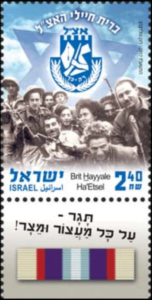 The National Military Organization in Eretz Israel (Etsel) broke away from the Haganah paramilitary organization in the spring of 1931. In the years before the establishment of the State of Israel in 1948, the organization operated clandestinely against Arab rioters during the revolt of 1936-1939 and took part in “Nonetheless” operations together with the Revisionist, Betar and HaTzohar groups to rescue European Jews before and during WWII. Members in Poland fought against the German enemy in the ghettos and took part in the Warsaw Ghetto uprising in 1943 as part of the Jewish Military Union, led by Pawel Frankel. Members in Eretz Israel were recruited to fight against Germany as volunteers in the British military. Etsel commander David Raziel was killed in the line of duty in Iraq on May 20, 1941. In February 1944 the Etsel, led by Menachem Begin, waged a campaign against the British authorities and government policy in Eretz Israel. Members were suppressed from within by the Haganah, but obeyed their leader’s decree never to take up arms against their brethren. Together with the Haganah-Palmach and Lehi, Etsel fighters, and especially those sentenced to death by hanging by the British Mandate courts, contributed to the establishment of the State of Israel. On July 13, 1980, the anniversary of the death of Etsel military leader Ze’ev Jabotinsky, Prime Minister Menachem Begin spoke at Mount Herzl in Jerusalem of those who fought both overtly and clandestinely: “Ö with their blood they sprouted the tree of freedom for their People, with their bodies they paved the way to the mountaintop”.
The Brit Hayyale Ha’Etsel organization (est. 1983) is committed to commemorating the memory of the fighters throughout the generations and to preserving their legacy.
Goals: to organize former Etsel members within a non-partisan social framework, encourage historical research, literary works and documentation to endow the legacy of the Etsel and its fighters. From the start, the organization has worked to achieve government recognition of the Etsel’s contribution to national liberation, defense of the Jewish Yishuv in Eretz Israel against Arab rioters and the struggle against the British authorities and against the Arab armies during the War of Independence. The Alliance (“Brit”) works to have the Etsel’s fallen, injured and missing declared as fallen IDF soldiers.
The organization worked to erect a memorial monument dedicated to the Acre prison escapees, to those who fell during the Altalena Affair and to those hanged on the gallows by the British. It has also established the Etsel Museum and the Etsel Museum 1948 named after Amichai Paglin (Gidi) in Tel Aviv-Jaffa in collaboration with the Ministry of Defense, as well as the Etsel Museum in Jabotinsky Shuni Park in Binyamina and the monument commemorating the 51 Etsel members who fell in the battle for Ramlah in 1948. The organization also conducts memorial services and holds services commemorating the fighters in the Etsel plots in cemeteries around Israel. The operations of the Brit, including documentation, publishing and film production, expose the public to the heroism of the Etsel fighters at the dawn of our independence.
— Yosef Kister
Jabotinsky Institute historical consultant and researcher
Description of the Stamp and First Day Cover
The stamp design is based on a photograph of Etsel combat soldiers who fought in the Menashia Battle in Jaffa (April 25-May 1, 1948).
The stamp tab features a quote from the Betar Song, written by Ze’ev Jabotinsky, and the Etsel Badge, which was presented by the Ministry of Defense to those who served in the Etsel.
The FDC features a photograph of the Etsel’s Jerusalem Regiment in formation, Jerusalem August 4, 1948.
From left to right: Mordechai Raanan and Menachem Begin.
The photographs and quote are courtesy of Jabotinsky Institute in Israel.
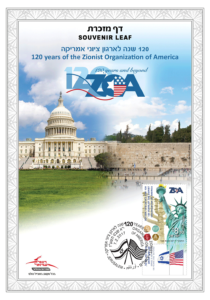 The ZOA, founded in 1897, is the oldest and one of the largest pro-Israel organizations in the United States. Its roster of distinguished presidents includes U.S. Supreme Court Justice Louis Brandeis, Rabbi Abba Hillel Silver who led the fight in America to reestablish the Jewish State, and currently, Morton A. Klein who was named one of the top five influential Jewish leaders by the Forward newspaper.
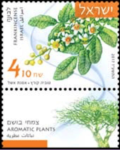 A genus (Boswellia) of the Burseraceae family that includes a number of tree and bush species from which the resin used for the incense called frankincense is derived. The resin is collected in containers after puncturing the bark of the young tree trunk.
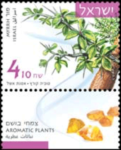 A genus (Commiphora) that also belongs to the Burseraceae family which includes species of bushes from which the resin used for the incense called myrrh is derived by slicing the bark of young branches. The species most commonly used is Commiphora mirrha.
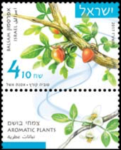 The balsam plant is mentioned in ancient writings and is consistent with the biblical Tzori plant which served as the source for producing high quality perfume. After some deliberation regarding the identification of the plant, there is now widespread agreement among researchers identifying it as one of the myrrh species of the Burseraceae family, Commiphora gileadensis, which still grows in the southern Arabian Peninsula. This plant was introduced to Israel and acclimatized in recent years and is now cultivated in the Ein Gedi and northern Dead Sea area.
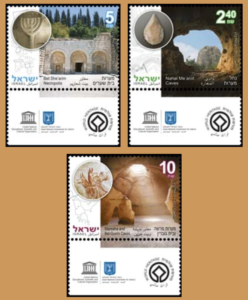 In 1972, the United Nations Educational, Scientific and Cultural Organization (UNESCO) approved an agreement to protect world heritage sites. The program included rules to assess natural and cultural sites and determine their significance to mankind’s common cultural heritage. Every country prepares a list of its sites and once a year the UNESCO World Heritage Center conducts a special meeting to choose which of the nominated sites shall be included in the list of United Nations World Heritage Sites.
 Four caves are carved into the mountain on the southern slope of Mount Carmel, at the entrance to the Nahal Me’arot Caves. Archeological excavations conducted at the site from 1928 to the present have discovered evidence of human existence near and inside the caves over hundreds of thousands of years. Among the many findings were remnants of houses, various stone tools, jewelry, bones of animals used for food and graves.
 Rabbi Yehudah Hanasi, leader of the Jewish people in the late 2nd century CE, was buried at his behest in the cemetery in the town of Bet She’arim in the western Jezreel Valley. Many others subsequently asked to be buried near the final resting place of the admired leader. Dozens of burial caves were carved into the hillsides and on the outskirts of the town. Jews were brought from all over Eretz Israel and even from faraway lands to be buried there. The hundreds of epitaphs found in the caves provide information about the Jewish lifestyle in the 3rd and 4th centuries CE.
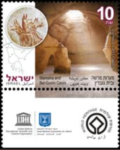 Residents of the city of Maresha, in the southern Judean plain, carved many spaces beneath their homes into the soft chalk bedrock upon which the city was built. These spaces served as water reservoirs, agricultural production facilities, storage rooms, pigeon raising, burial caves and more. After Maresha was destroyed in the 1st century BCE a new city called Bet-Guvrin was constructed nearby. In the Byzantine period, the townspeople carved bricks out of the chalk in deep, bell-shaped caves.
 Krav Maga is an Israeli martial art designed for self-defense, a method that allows anyone to defend him or herself against acts of violence. Krav Maga students learn how to protect themselves from arm and leg blows, strangulations, stabbing, bludgeoning and even how to deal with gun threats. Krav Maga is unique due to its simplicity and effectiveness in utilizing the attacker’s weak points. The technique was developed during the Yishuv period prior to the creation of the State of Israel, when the British Mandate government banned the bearing of arms following the 1936-39 Arab revolts. The Yishuv Council decreed that every Jewish boy and girl from the age of 13 and up must learn how to defend themselves in time of need. Krav Maga was also an inherent part of the training for members of the various underground defense organizations. The early Krav Maga was a combination of boxing and Japanese jujutsu. The jujutsu drills, however proved to be too difficult to master and therefore new, original drills, unique in their effectiveness and simplicity, were developed.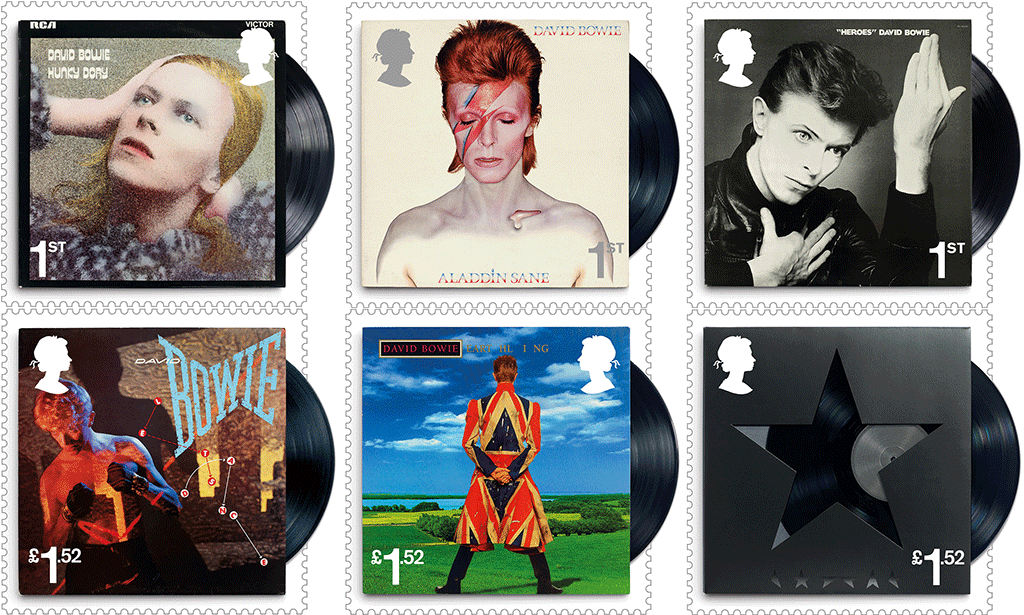
 Hunky Dory, Bowie’s fourth album and released in December 1971. Time magazine chose it as part of their “100 best albums of all time” list in January 2010.
 Aladdin Sane, his sixth album and released in April 1973. The album features the iconic photograph by Brian Duffy.
 Heroes, his twelfth studio album and released in October 1977. This was the second instalment of his “Berlin Trilogy” recorded with Brian Eno and Tony Visconti. The title track remains one of Bowie’s best known and acclaimed songs.
 Let’s Dance, his fifteenth studio album and released in April 1983. Co-produced by Nile Rodgers, and featuring three of his most successful singles Let’s Dance, Modern Love and China Girl. Let’s Dance is Bowie’s best-selling album.
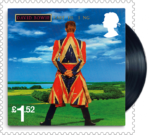 Earthling, his twentieth studio album and released in February 1997. The striking cover art features Bowie in an Alexander McQueen designed Union Flag coat.
 Bowie’s 28th and final studio album, released on his 69th birthday – 8 January 2016 – and charting at No.1 in more than 20 countries. Bowie died two days after the release of ★, the album reaffirming his legacy as modern music’s most unrelenting innovator and topping critics’ ‘Best of 2016’ lists.
 The Ziggy Stardust Tour, 1972. The tour promoted The Rise and Fall of Ziggy Stardust and the Spiders from Mars studio album and took in the UK, North America, and Japan.
 The Serious Moonlight Tour, 1983. The tour was designed to support the Let’s Dancealbum and was Bowie’s longest, largest and most successful concert tour.
 The Stage Tour, 1978. Also known as Isolar II – The 1978 World Tour and The Low / “Heroes” World Tour because it was staged to promote the Low and “Heroes” albums
 A Reality Tour, 2004. Staged to promote the Reality album this tour was to be Bowie’s last tour.
 The American Philatelic Society reports its Show Manager, Megan Orient, will be leaving following AmeriStamp Stamp Expo (March 3-5, Reno, Nevada) “to be closer to her family.” We understand that that is in Pittsburgh.
 February
 Dinosaur Provincial Park
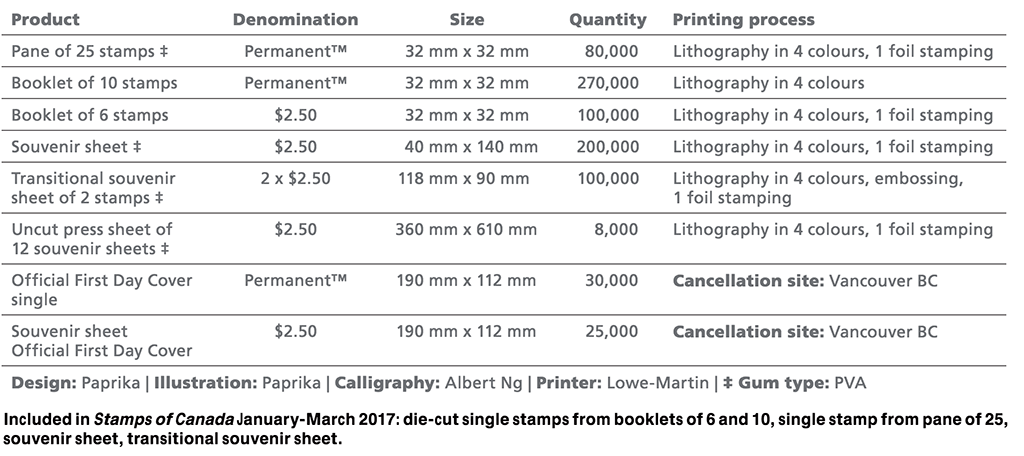
 Crafted by Lara Minja, of Lime Design, these definitive stamps showcase five places in Canada that have special status because of their importance to the common heritage of humanity. Mistaken Point (N.L.), the Historic District of Old Québec (Que.) and L’Anse aux Meadows National Historic Site (N.L.) make their debut in the series, while Dinosaur Provincial Park (Alta.) and Red Bay Basque Whaling Station (N.L.) enjoy an encore.
 Cancelled in a fishing community near Mistaken Point – Canada’s latest UNESCO site – the Official First Day Cover boasts a souvenir sheet with some hidden features in celebration of Canada’s sesqui- centennial. Use black light to explore our tribute to these captivating sites and you’ll find the official Canada 150 logo and text waiting to be discovered.
  [January 16th press release]
 CO World Heritage Sites.
 e than four centuries. Fortified with walls, gates and bastions, this is the only colonial city north of Mexico to have preserved its ramparts.
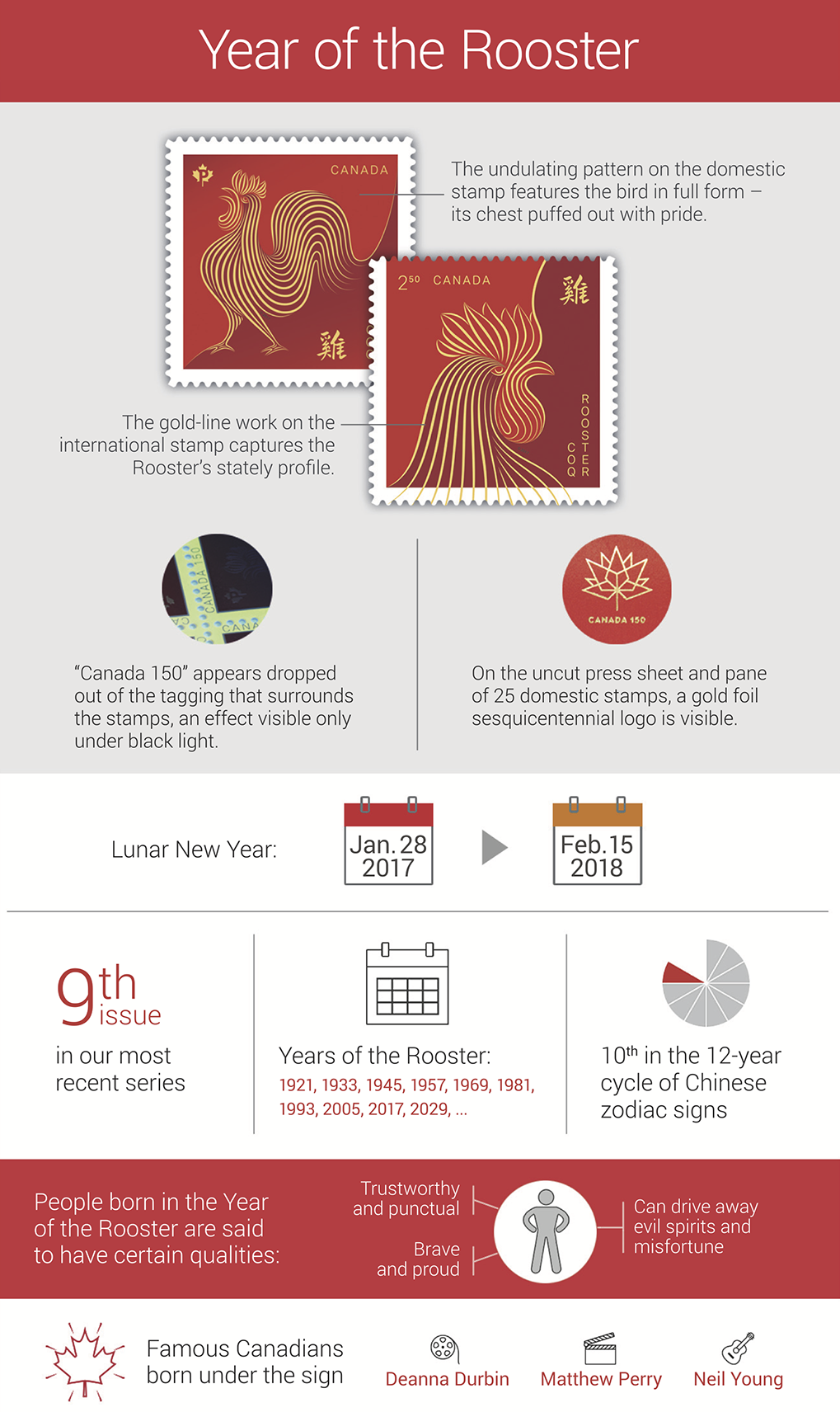
 OTTAWA – Canada Post will greet the Year of the Rooster with a two-stamp issue, the ninth in its most recent series honouring the Lunar New Year. A Permanent™ domestic-rate stamp featuring a rooster image, with its chest proudly puffed out, is paired with an international-rate stamp offering a close-cropped profile view of the rooster’s stately face. Both images are created from lines of gold foil.
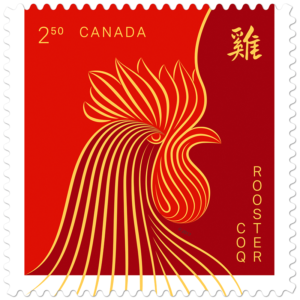 The Year of the Rooster arrives on January 28, 2017, and runs until February 15, 2018. Those born under this sign are honest, courageous and confident. Marked for success, they achieve their goals through a combination of wit, charm and hard work.
 [press release]