
Royal Mail Reveals Images Of New Marvel Super Heroes Special Stamps To Mark Celebration Of The UK’s Comics
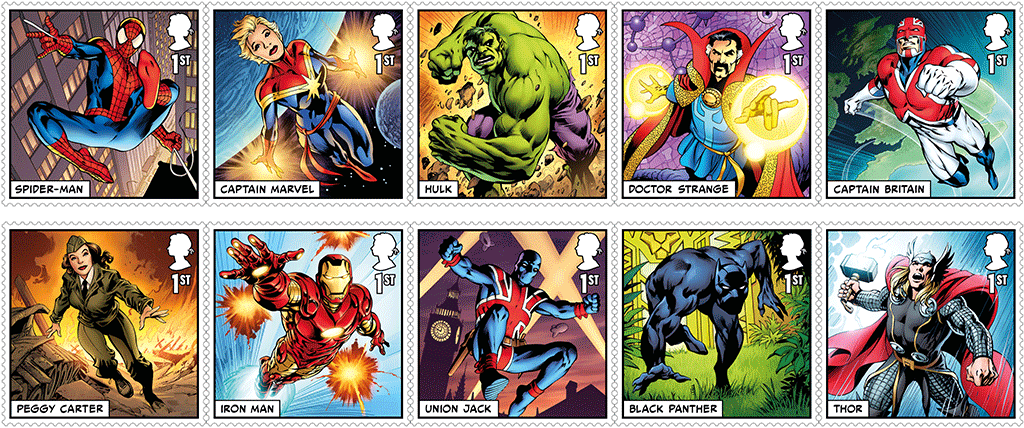
- 15 stamp set features some of the most popular and well-known Marvel characters
- Included in the set are: Spider-Man; Hulk; Thor; Iron Man; Doctor Strange; Captain Marvel; Peggy Carter; Black Panther, Captain Britain and Union Jack
- A further five stamps are presented in a miniature sheet in the form of a unique comic-strip entitled, Avengers UK
- The stamps are illustrated by renowned comic book artist Alan Davis, who has worked with Marvel since 1981
- Marvel is one of the world’s most prominent character-based entertainment companies with a catalogue of iconic Super Hero characters and marks its 80th anniversary in 2019
- The first Marvel Super Hero created for the UK was Captain Britain in 1976
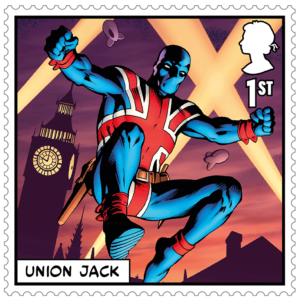
- That same year, Super Hero Union Jack made his first appearance in the classic Marvel series, Invaders
- The stamps and a range of collectible products are available now to pre-order from www.royalmail.com/marvel and go on general sale from Thursday 14 March by phone on 03457 641 641 and in 7,000 Post Offices throughout the UK
 Royal Mail has revealed the images of the Marvel Super Hero stamps issued to mark the UK’s celebration of Marvel’s iconic comic stories.
The 15-stamp set features some of the most popular Super Heroes from the comic books.
Ten stamps show: Spider-Man; Hulk; Thor; Iron Man; Doctor Strange; Captain Marvel; Peggy Carter; Black Panther; Captain Britain and Union Jack. A further five stamps are part of an exclusive short comic strip story contained in a miniature sheet.
The world-famous Marvel Comics grew out of Timely Comics, which in 1939 published its first comic book, Marvel Comics #1.
 Editor Stan Lee and artist Jack Kirby created a Super Hero revolution when they devised a new world of characters in the early 1960s, including Hulk and Thor.
In 1963, Lee and Steve Ditko hit upon a new idea for a hero; a teenager who accidentally takes on Super Hero abilities – and tested it out in a magazine that was about to be retired. However, the character caught the attention of the readers and Spider-Man was born.
In 1972, Marvel UK was formed, publishing weekly comics that repackaged the stories for a British audience. This changed in 1976 when Captain Britain Weekly was launched, featuring the adventures of the first Marvel Super Hero created for the UK.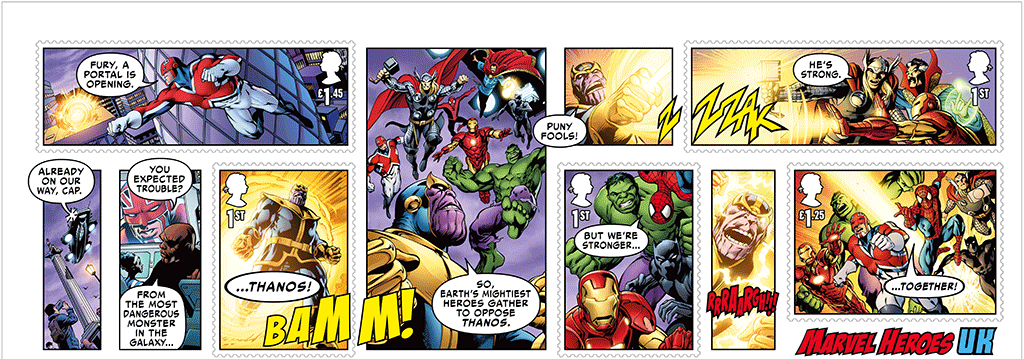 The 1980s, in particular, saw US comic publishers heavily recruiting British writers and illustrators, who increasingly worked on the American publications and began to inject darker storylines to widen the appeal of the characters. One such artist is Alan Davis, who
  designed the new Special Stamps, and has worked with Marvel since the early 1980s and first illustrated Captain Britain in 1985.
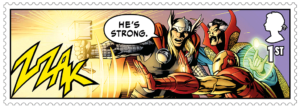
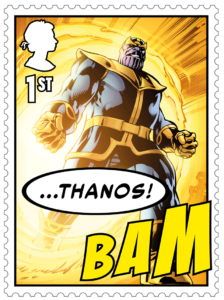
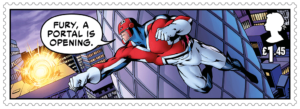
A specially-created story, also illustrated by Davis, features five further stamps printed in a miniature sheet. The story, entitled Avengers UK, sees Captain Britain rallying Super Heroes to face the arch villain Thanos.
 Stamp illustrator, artist, Alan Davis, said: “I really can’t take all the credit for producing these stamps. The speed of production required in US comics makes it necessary to separate the creative disciplines into four individual jobs. Writer, penciller, inker and colourist. My primary focus is writing and pencilling.
“My long-time collaborator Mark Farmer supplied the blackline inks for the stamps and Laura Martin added the colour.”
Philip Parker, Royal Mail, said: “Generations have grown up, spellbound by the adventures and the personalities of these Super Heroes. Our epic new stamps celebrate each in characteristic pose, emerging from the stamp frame.”
 The stamps and a range of collectible products are available now to pre-order from www.royalmail.com/marvel and go on general sale from Thursday 14 March by phone on 03457 641 641 and in 7,000 Post Offices throughout the UK.
Stamp-by-Stamp:
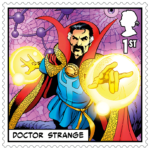 Doctor Strange – Once a brilliant yet vain neuro-surgeon, Stephen Strange sought out the help of the Ancient One when his hands were badly damaged in a car crash. Strange’s path led him to become a Master of the Mystic Arts and Earth’s Sorcerer Supreme, protecting the world from evil forces.
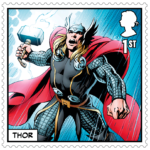 Thor – The mighty Thor is the Norse God of Thunder. Once cast out of Asgard for his pride, he was trapped on Earth as the injured doctor, Donald Blake. Thor’s banishment is long ended and now he protects both Earth and Asgard as an Avenger.
Captain Marvel – Carol Danvers was an Air Force officer when she 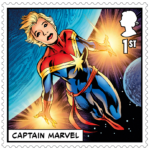 met Kree hero Captain Mar-vell. After her DNA mixed with his during an explosion, she gained super powers and took the name Ms Marvel. Following the original’s death, Carol took on the mantle of Captain Marvel to honour his legacy. Marvel Studios’ Captain Marvel is in cinemas from 8 March, 2019.
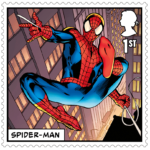 Spider-Man – Peter Parker is Spider-Man, New York’s amazing web-slinging hero. Bitten by a radioactive spider as a teenager, Peter Parker gained arachnid-like abilities and, after his Uncle Ben was murdered, swore to use his abilities to help others – having realised that with great power comes great responsibility.
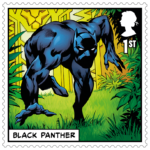 Black Panther – T’Challa is the Black Panther, ruler of the technologically advanced African nation of Wakanda and protector of its valuable vibranium supply. T’Challa first travelled to America to learn more about the country’s heroes and soon became a leading member of the Avengers.
Hulk – When mild-mannered scientist Bruce Bann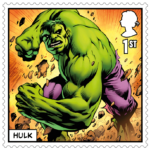 er was bombarded by radiation from a gamma bomb, he was transformed into the Incredible Hulk. The green-skinned behemoth is one of the planet’s most powerful and misunderstood heroes – feared by a world he has saved numerous times.
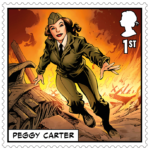 Peggy Carter – Peggy Carter was working for the French Resistance in the Second World War when she met and fell in love with Captain America. The two fought the Axis powers together before they were separated by the war. Peggy went on to become a leading agent of S.H.I.E.L.D. (Strategic Homeland Intervention, Enforcement and Logistics Division).
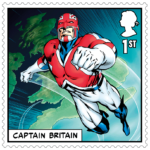
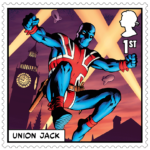 Union Jack – The original Union Jack was Lord James Falsworth, who fought in the First World War. When his descendant refused to take on the role, the mantle was passed to Joey Chapman, a working class hero from Manchester, who has gone on to fight alongside the Knights of Pendragon and the Invaders.
Captain Britain – Brian Braddock was chosen by Merlyn to be Britain’s greatest protector. Granted amazing powers, Brian became Captain Britain. He soon learned he was part of a multidimensional Captain Britain Corps and has fought alongside Excalibur and the Avengers to keep his country – and the world – safe from harm.
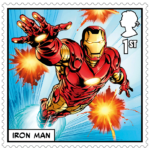 Iron Man – When terrorists captured billionaire inventor Tony Stark, they forced him to create weapons. With shrapnel near Stark’s heart endangering his life, Stark tricked the terrorists, building a suit of powered armour to defeat them. It was the birth of the armoured Avenger – the invincible Iron Man.
| Product name Stamps Miniature Sheet Stamp Pack Miniature Sheet Pack Presentation Pack First Day Cover Stamps First Day Cover Minisheet First Day Cover PSB pane Stamp Souvenir Cover Miniature Sheet Souvenir Cover First Day Envelope – Hulk First Day Envelope – Thor Prestige Stamp Book Collector Sheet (Generic Sheet) Retail Stamp Book Full Stamp Sheet 1 Full Stamp Sheet 2 Half Stamp Sheet 1 Half Stamp Sheet 2 Spider-man BU Medal Cover Spider-man Silver Medal Cover Hulk BU Medal Cover Hulk Silver Medal Cover Avengers BU Medal Cover Avengers Silver Medal Cover Stamp cards Classic Comics Stamp Souvenir Folde Stamp Artwork Collector Set Limited Edition PSB Press Sheet Framed Stamps & Minisheet Framed Collector Sheet Framed Gallery Prints Framed Stamps & Minisheet signed by Alan Davis Framed Stamps signed by Neil Edwards |
Code AS4355 MZ138 AS4355R MZ138A AP457 AF442 MF136 HF086 AW099 AW100 AE397 ME133 YB082 AT107 UB421 AS4355BFS AS4355CFS AS4355BHS AS4355CHS AM062 AM065 AM063 AM066 AM067 AM068 AQ274 AW104 AW110 YB083 PZ039 N3156 N3157 (various) N3165 N3166 |
Price £6.70 £4.71 £6.99 £4.99 £12.15 £8.60 £6.20 £6.00 £8.60 £6.20 £0.30 £0.30 £17.45 £7.70 £4.02 £33.50 £33.50 £16.75 £16.75 £24.99 £99.99 £24.99 £99.99 £24.99 £99.99 £7.20 £24.99 £34.99 £64.99 £93.25 £49.99 £39.99 £79.99 £195 £145 |
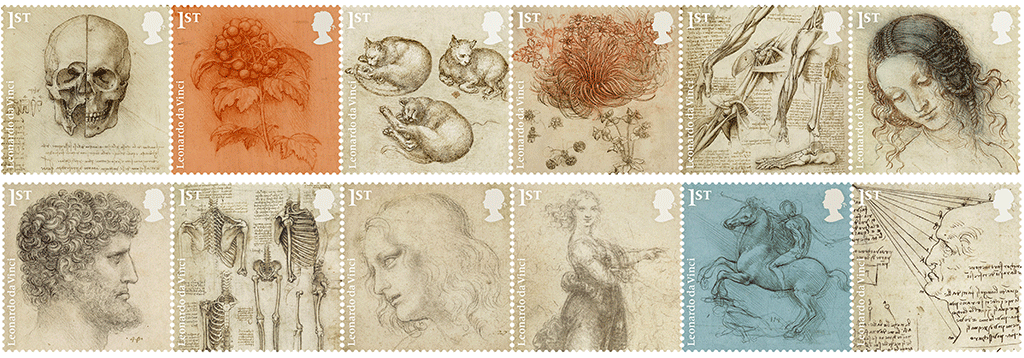
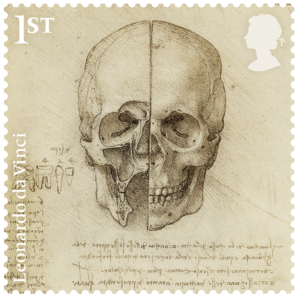 Leonardo had little access to human material when he first started to study anatomy. But in 1489, he obtained a skull, which he cut in a variety of sections to study its structure. In this drawing, he shows the skull sawn down the middle, then across the front of the right side. This beautifully lucid presentation, with the two halves juxtaposed, allows the viewer to locate the facial cavities in relation to the surface features. Leonardo wished to determine the proportions of the skull and the paths of the sensory nerves, believing that they must converge at the site of the soul.
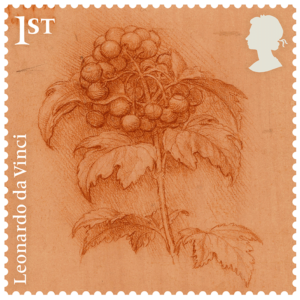 A beautifully rendered study of guelder-rose (Viburnum opulus) has been drawn in red chalk on paper rubbed all over with powdered red chalk. Although it may be connected with Leonardo’s Leda and the Swan, it is far more detailed than necessary as a study for a painting; indeed, it surpasses anything found in contemporary herbals. The leaves are shown curling and sagging, for Leonardo was interested not merely in their shape but also in their living form when subject to the natural forces of growth and gravity.
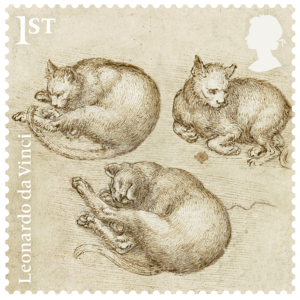 Leonardo’s studies of sleeping cats are among his most sensitively observed drawings and must have been done directly from life. His appreciation of the animals’ lithe forms had a scientific basis, for elsewhere on the sheet he wrote: “Of flexion and extension. The lion is the prince of this animal species, because of the flexibility of its spine.” This suggests that the drawings were made in connection with Leonardo’s proposed treatise on “the movements of animals with four feet, among which is man, who likewise in his infancy crawls on all fours”.
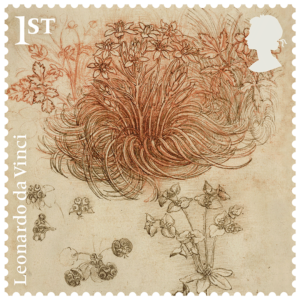 Leonardo drew plants and flowers as studies for decorative details in his paintings and probably also in the process of working towards a systematic treatise on the growth of plants and trees. His finest botanical drawings were executed for his painting Leda and the Swan, which was to have a foreground teeming with plants and flowers, thus echoing the fertility inherent in that myth. The focus of this drawing is a clump of star-of-Bethlehem (Ornithogalum umbellatum), whose swirling leaves are seen in studies for, and copies of, the lost painting.
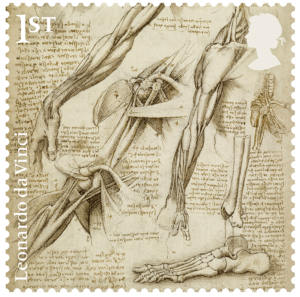 Leonardo was fascinated by the mechanism of the shoulder and by how the arrangement of muscles and bones allowed such a wide range of movement. Here he analyses the shoulder and arm in a series of drawings at progressive states of dissection. He begins at upper right with the muscles intact and then lifts away individual muscles, such as the deltoid and biceps, to reveal the structures below. At lower right, Leonardo demonstrates the articulation of the ankle with the tibia and fibula lifted away from the foot.
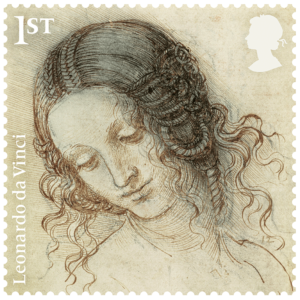 Over the last 15 years of his life, Leonardo worked on a painting of the myth of Leda, showing the queen of Sparta seduced by the god Jupiter in the guise of a swan. The painting was the highest valued item in Leonardo’s estate at his death; it later entered the French royal collection but was apparently destroyed around 1700. In this sketch, Leonardo expended little effort on Leda’s demure downward glance, devoting his attention instead to the most complicated of hairstyles – throughout his life he had a love of personal adornment in both hair and clothes.
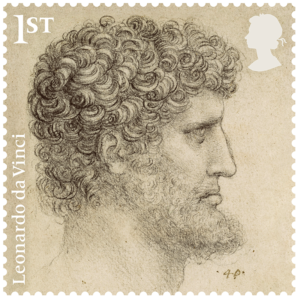 Leonardo was fascinated by the male profile, both the divinely beautiful and the hideously grotesque. Such heads are found throughout his work, from paintings such as The Last Supper to quick doodles in the margins of his drawings. Towards the end of his life, Leonardo made many carefully finished drawings of classical profiles, exercises in form and draughtsmanship simply for his own satisfaction. Their features – such as the dense mat of curly hair seen here – were inspired by ancient coins and medals of Roman emperors.
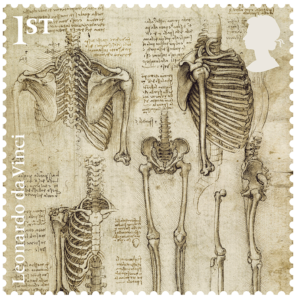 Leonardo’s most brilliant anatomical studies were conducted in the winter of 1510–11, when he was apparently working in the medical school of the university of Pavia, near Milan. He may have dissected up to 20 human bodies at that time, concentrating on the mechanisms of the bones and muscles. This is his most complete representation of a skeleton, seen from front, side and back in the manner of an architectural drawing. Leonardo aimed to compile an illustrated treatise on human anatomy, but his studies remained unpublished at his death.
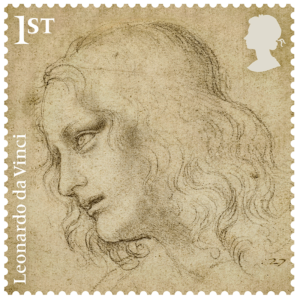 Leonardo’s greatest completed work was The Last Supper, painted in the refectory of the monastic church of Santa Maria delle Grazie in Milan and now in a ruined state. The mural shows the reaction of the disciples to Christ’s announcement of his imminent betrayal. Few drawings survive of the hundreds that must have been made. This study for the head of St Philip, leaning towards Christ in devotion and despair, was probably based on a live model, but Leonardo has idealised the features, taking them out of the real world and into the divine.
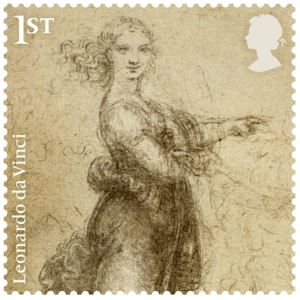 Two of Leonardo’s favourite devices – a mysterious smile and a pointing hand – are combined in this ethereal drawing. It shows a woman standing in a rocky, watery landscape, smiling at us while gesturing into the distance, her arms gathering her drapery to her breast. The most plausible explanation is that this is the maiden Matelda gathering flowers, as she appears to Dante on the far side of a stream in Purgatory, the second book of his Divine Comedy. However, the purpose of the drawing is unknown.
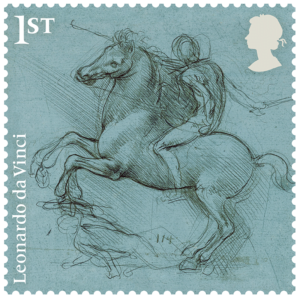 Ludovico Sforza, ruler of Milan, commissioned Leonardo to execute a bronze equestrian monument, well over life size, to his father, Francesco. Leonardo’s early studies show Francesco on a rearing horse over a fallen foe. Over the next five years, Leonardo built a full-sized clay model of the horse and prepared a mould for the casting – a huge technical challenge. But in 1494, Ludovico requisitioned the 75 tonnes of bronze for the cast to make cannon, and the monument was never finished. Invading French troops used the clay model for target practice, destroying it.
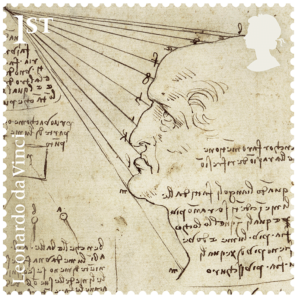 During the 1480s, Leonardo began to assemble material towards a treatise on the theory of painting. His own paintings, such as the Mona Lisa, were noted even in his own day for their sophisticated treatment of shadows, and here he sets out the geometrical principles of light and shade. The diagram and notes (in mirror writing) explain that where the light falls at right angles on the face, the face will be most strongly illuminated; where it falls at a shallow angle, the face will be less strongly lit; and where no light is received, under the nose and chin, the surface will be completely dark.
 February –
 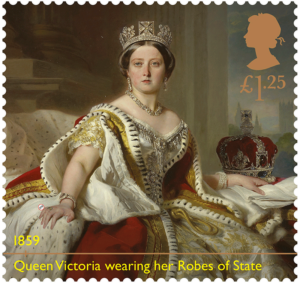 2019 marks the bicentenaries of the birth of both Queen Victoria and Prince Albert. She is the second longest reigning monarch in British history. Six stamps will chart her life in period paintings, from childhood and marriage to Prince Albert, to marking her long reign.