
Quick summary: Year of the Tiger, Pete Seeger, pioneering marine biologist Eugenia Clark, Washington Post publisher Katherine Graham, women’s rowing (four designs), Native American/African American sculptor Edmonia Lewis for the Black Heritage series, National Marine Sanctuaries (16 stamps), pony cars (Mustang, Challenger, Camaro, Cougar, Javelin), elephants (1 stamp), Native American modernist artist George Morrison (5 stamps), Mighty Mississippi (10 stamps),, Title IX (the civil rights law that prohibits discrimination on the basis of sex in any educational program or activity), cryptology, blackberries, and assorted flowers.
2022us_releaseScott Catalogue Update (November 2021)
5635 (58¢) Happy Birthday
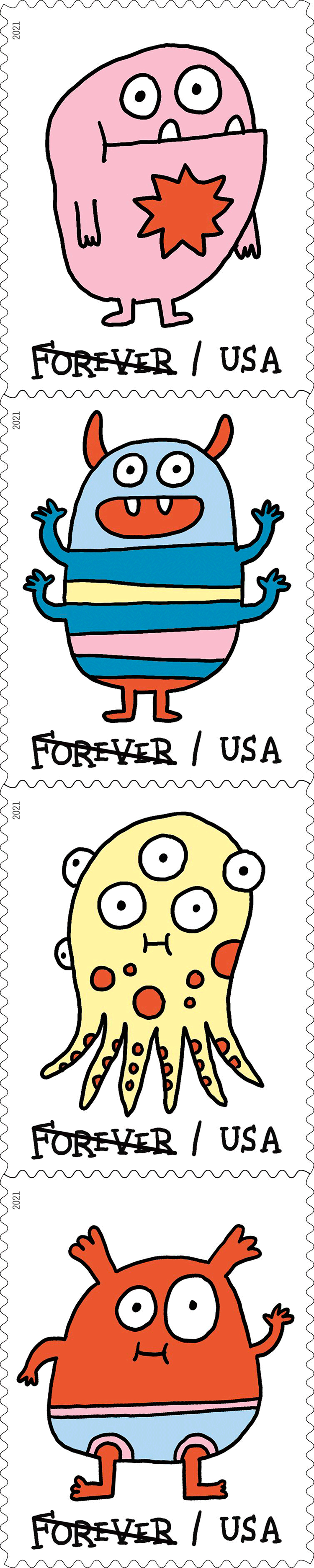 5636 (58¢) Message Monsters – Pink and Red Monster
a. Imperforate
5637 (58¢) Message Monsters – Four-armed Monster
a. Imperforate
5638 (58¢) Message Monsters – Tentacled Monster
a. Imperforate
5639 (58¢) Message Monsters – Red-headed Monster
a. Imperforate
b. Horiz. or vert. strip of 4, #5636-5639
c. Imperforate strip of 4, #5636a-5639a
5640 (58¢) Day of the Dead – Girl’s Skull with Bow
a. Imperforate
5641 (58¢) Day of the Dead – Man’s Skull with Hat
a. Imperforate
5642 (58¢) Day of the Dead – Woman’s Skull with Curled Hair
a. Imperforate
5643 (58¢) Day of the Dead – Boy’s Skull
a. Imperforate
b. Horiz. strip of 4, #5640-5643
c. Imperforate strip of 4, #5640a-5643a
Poppy (Canada 2021)
[press release]
Stamp marks 100 years of the poppy as symbol of remembrance
Release coincides with launch of the 2021 National Poppy Campaign
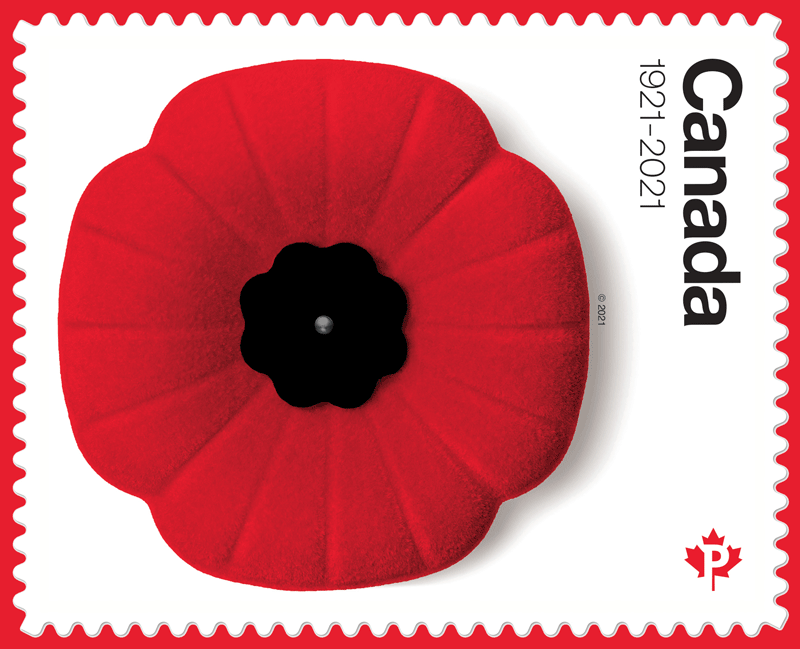 OTTAWA – Canada Post released today a poignant stamp to celebrate the 100th anniversary of the official adoption of the poppy as a symbol of remembrance in Canada. The release coincides with the launch of The Royal Canadian Legion’s 2021 National Poppy* Campaign, which begins the last Friday of October each year.
Canada Post has a long history of commemorating Remembrance Day and Canada’s military history through its stamp program. The Legion’s annual campaign is a highly visible way for Canadians to honour veterans and those who have fallen in Canada’s military.
The concept behind this special stamp was not only to immortalize the crimson flower, but also offer another way to remember the more than 117,000 Canadians who died for their country.
While the poppy is distributed freely, the Legion accepts donations to the Poppy Fund. Money raised helps to provide veterans and their families with financial assistance and other support. Millions of poppies are distributed in Canada every year, raising close to $20 million annually.
About the remembrance poppy
During the First World War, the appearance of the bright red flowers on the battlefields in 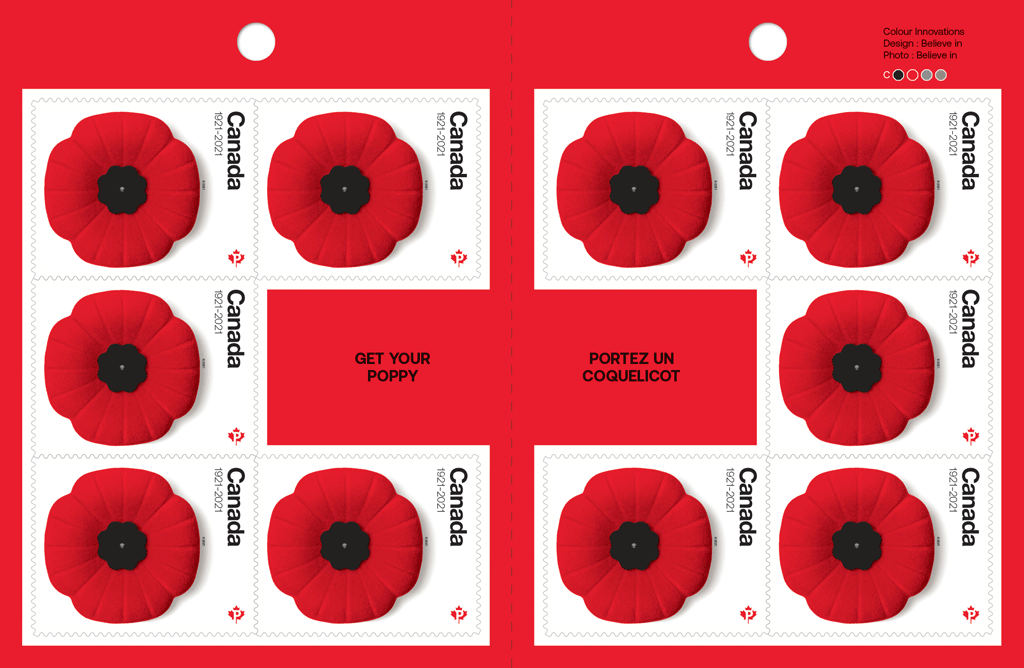 France and Belgium inspired Lieutenant-Colonel John McCrae of Guelph, Ontario, to pen the poem “In Flanders Fields” in May 1915, after he lost a friend in the Second Battle of Ypres. Moved by his words, a number of women and charities began to create poppies made of fabric as a memorial and to raise funds for veterans and families of the fallen. The Great War Veterans’ Association of Canada (the Legion’s predecessor) officially adopted the poppy as a symbol of remembrance on July 6, 1921. Canada’s first National Poppy Campaign launched later that year.
About the stamp issue
Blair Thomson of the Believe in studio designed the stamp, which was printed by Colour Innovations. The poppy’s red ink was created specially to match the crimson of the poppy, while metallic ink was used for the pinhead. A stark white background provided the contrast that makes the image pop. On the Official First Day Cover [below], the cancel features a stylized “100” to mark the poppy’s centennial as a symbol. The Remembrance Poppy issue includes a booklet of 10 Permanent™ domestic rate stamps and an Official First Day Cover. Both products are available here [direct link] and post offices across the country.
[en Francais pour les médias d’information]
Un timbre souligne le 100e anniversaire du coquelicot comme symbole du souvenir
Le lancement coïncide avec celui de la Campagne nationale du coquelicot de 2021
OTTAWA – Postes Canada a émis aujourd’hui un timbre émouvant pour souligner le 100e anniversaire de l’adoption officielle du coquelicot comme symbole du souvenir au Canada. L’émission coïncide avec le lancement de la Campagne nationale du coquelicot* de 2021 de la Légion royale canadienne, qui débute le dernier vendredi d’octobre de chaque année.
Postes Canada commémore depuis longtemps le jour du Souvenir et l’histoire militaire du Canada au moyen de son programme des timbres-poste. La campagne annuelle de la Légion est un moyen concret d’honorer les anciens combattants et les soldats qui sont tombés au combat.
Ce timbre spécial vise non seulement à immortaliser la fleur cramoisie, mais propose aussi une autre façon de se souvenir des plus de 117 000 Canadiens qui sont morts pour leur pays.
Bien que les coquelicots soient distribués gratuitement, la Légion accepte les dons au Fonds du coquelicot. L’argent ainsi recueilli est utilisé pour offrir une aide financière et d’autres formes de soutien aux anciens combattants et à leur famille. Des millions de coquelicots sont distribués chaque année au Canada, ce qui permet d’amasser près de 20 millions de dollars par an.
À propos du coquelicot, symbole du souvenir
Pendant la Première Guerre mondiale, le lieutenant-colonel John McCrae, originaire de Guelph, en Ontario, est interpellé par les fleurs rouges qu’il voit dans les champs de bataille de France et de Belgique. C’est cette vision qui lui inspire en mai 1915 l’écriture du poème Au champ d’honneur (adaptation française de Jean Pariseau), après la perte d’un ami durant la deuxième bataille d’Ypres. Touchées par ce poème, plusieurs femmes et organisations de bienfaisance commencent à confectionner des coquelicots commémoratifs en tissu et à les vendre afin de recueillir des fonds pour les anciens combattants et la famille des soldats morts au front. La Great War Veterans Association of Canada (maintenant la Légion royale canadienne) adopte officiellement le coquelicot comme symbole du jour du Souvenir le 6 juillet 1921. La première Campagne nationale du coquelicot est lancée plus tard la même année.
À propos de l’émission de timbre
Ce timbre a été conçu par Blair Thomson, du studio Believe in, et imprimé par Colour Innovations. L’encre rouge a été spécialement créée pour reproduire la couleur cramoisie du coquelicot et une encre métallique a été utilisée pour la tête d’épingle, tandis que l’image de coquelicot a été placée sur un fond blanc immaculé pour créer un effet de contraste. Sur le pli Premier Jour officiel [au dessous de], le cachet d’oblitération contient le nombre « 100 » stylisé en hommage au centenaire du coquelicot.L’émission Le coquelicot, symbole du souvenir – 100e anniversaire comprend un carnet de 10 timbres PermanentsMC au tarif du régime intérieur et un pli Premier Jour officiel. Les deux produits sont offerts ici [lien direct] et dans les bureaux de poste à l’échelle du pays.
2021’s Awards Season
No red carpets or glittering stars, but at Great American Stamp Show, the major stamp societies honored members who helped both the organizations and the hobby.
 The American Philatelic Society honored Darryl Ertzberger, Ron Lesher and Alberto Frohlich with the Luff Award, possibly the highest in philately. In a first, all three of the people named to the APS Hall of Fame were women, and a number of other individuals were also recognized for their service.
The American First Day Cover Society gave its Distinguished Service Award to a key figure in its first years, recognized other volunteers, and gave its writing award to a first-time winner. And The American Topical Association recognized a past president whose accomplishments included putting the ATA on a sound financial footing as its Distinguished Topical Philatelist.
 2020 was a challenging year, for first day cover collectors as well as the rest of us, but the year’s award-winning FDC cachets brought beauty and brightness in our lives. History was also made during the American First Day Cover Society’s annual contest. The story is here.
Hydrofoil Passenger Ship “Voshod” (Ukraine 2021)
 This stamp (No. 1958) was issued October 22, 2021. It covers the cost of mailing a letter of up to 50 grams within Ukraine. The size of the stamp 52×25 mm. The 9-stamp pane measures 186×106 mm. Valerii Rudenko designed the stamp, the first day cover and the maximum card.
You can purchase this and other Ukrainian stamps at http://pm.ukrposhta.ua/nishop.php and click on the tiny British flag near the top for an English translation. 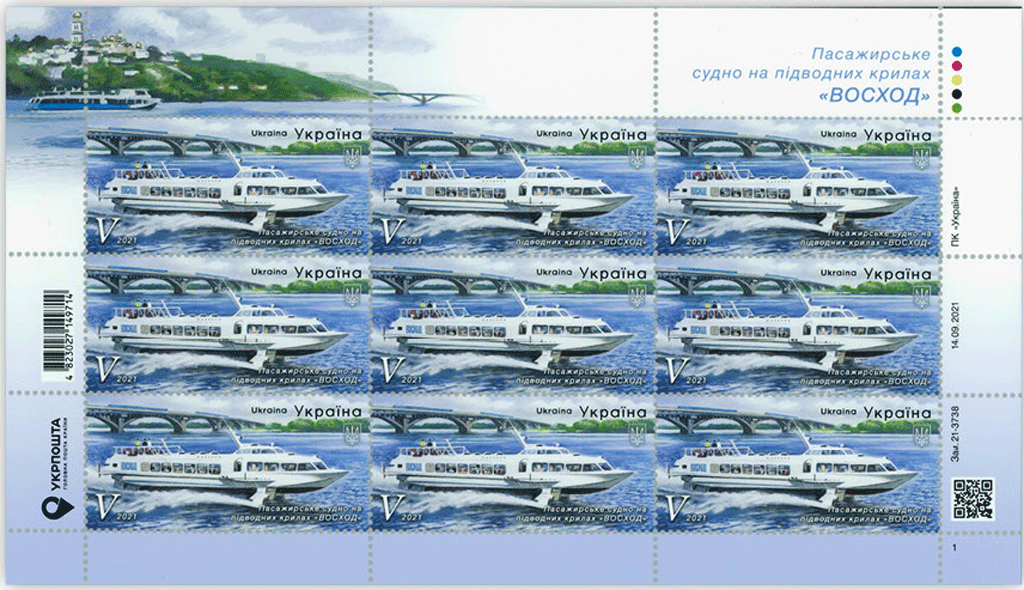 The pane of stamps is 94.50 UAH (Hryvnia, about US $3.54). The FDC with the special cancellation is 17.00 UAH (64¢) or without the cancellation, 15¢) and the same prices apply to the maximum card.

Digi Art (Netherlands 2021)
Appearance: Five different personal stamps marked ‘Nederland 1’, the denomination for post weighing up to 20g sent to an address within the Netherlands
Date of issue: 28 October 2021
Item number: 810060
Design: stamps Tim Ottens (Rijswijk), sheet edge Sandra Smulders (Gouda)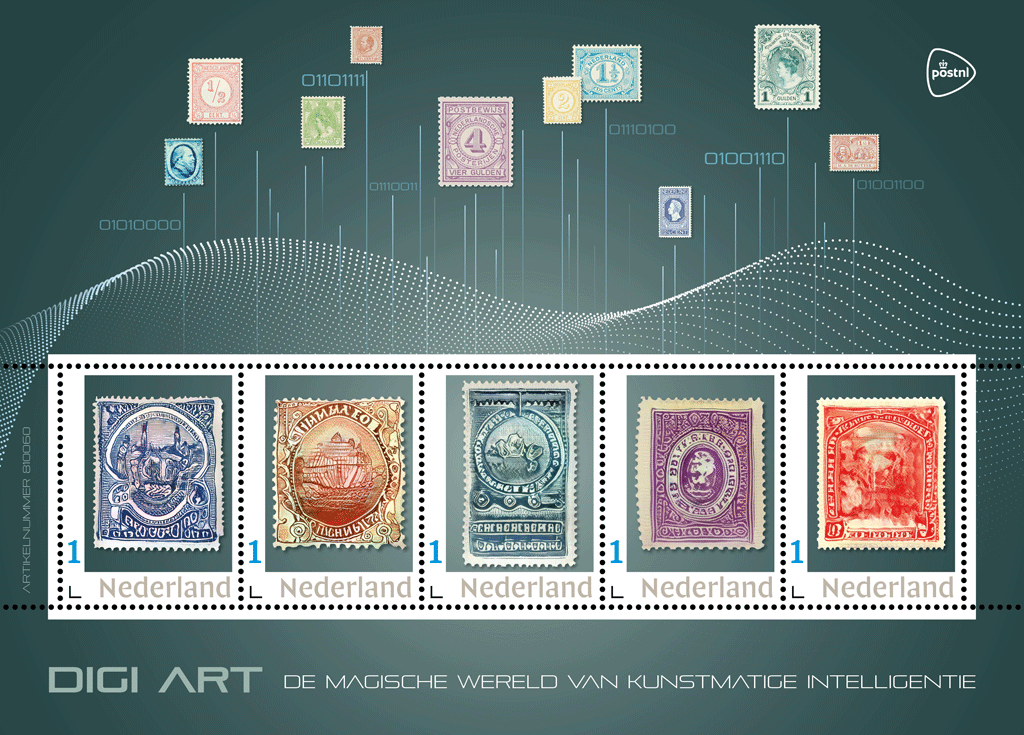 With the Digi Art issue, PostNL is the first postal company in the world to issue a stamp sheet with a design created by a computer algorithm. The Digi Art stamp sheet features five different personal stamps that were designed by an algorithm based on a collection of around 1500 stamps from the period from 1852 to 1920. The personal stamps are marked ‘Nederland 1’, the denomination for post weighing up to 20g sent to an address within the Netherlands.
Background:
Artificial intelligence (AI) refers to computer systems that mimic human intelligence. These AI systems are capable of extrapolating large amounts of data, making new decisions and choices, and coming up with new interpretations. To achieve this, the computer systems use algorithms – mathematical formulas that are able to make independent decisions based on data or indicators – and learn from them. The developments in artificial intelligence are coming thick and fast. It is used in numerous applications, from face recognition on smartphones and self-driving cars to smart thermostats and deep fakes – digitally manipulated images, sounds and texts. Within AI there is a separate discipline called generative art, which is when a computer algorithm creates an original work of art or design. And this is exactly what was used for PostNL’s Digi Art stamp issue.
Design:
The stamp Digi Art stamp sheet features five postage stamps in five different designs. The 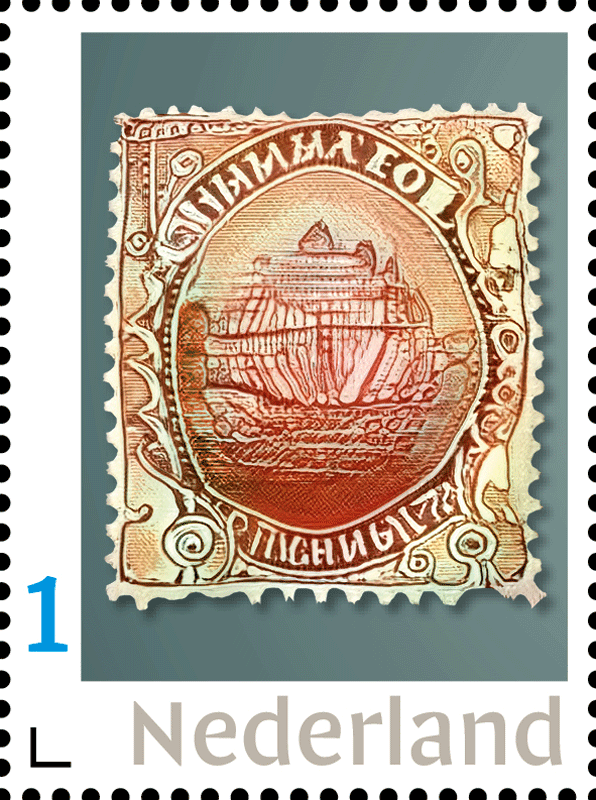 five stamps feature five unique computer-generated designs against a dark background. At first glance, the five stamps look as if they have been issued before, but appearances can be deceiving. They may look like classic stamps, but they are not. All the elements are familiar, such as a supporting picture in the centre with a frame around it, a strip at the bottom for text, decorations in the corners and a frame with perforations… and yet, they are different from the familiar stamps from the 1852-1920 period.
The sheet edge, which was designed by graphic designer Sandra Smulders, features ten old Dutch stamps. From left to right, these are: King Willem III 5 cents (1864), Numeral stamp ½ cent (1876), Queen Wilhelmina 20 cents (1899), King Willem III 7½ cents (1872), Postal order stamp 4 guilders (1884), Numeral 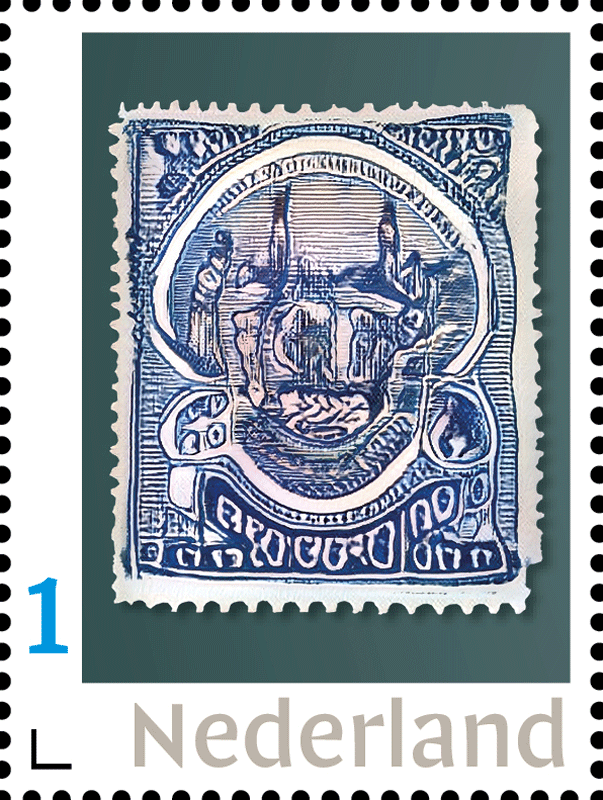 stamp 2 cents (1876), Numeral stamp 1½ cents (1899), Jubilee stamp 100 years of independence 12½ cents (1913), Coronation stamp Queen Wilhelmina 1 guilder(1898) and Michiel de Ruyter 1 cent (1907).
The 10 stamps are connected to the personal stamps with vertical lines via a horizontal elongated wave. The lines indicate the direction that the old stamps have travelled through the algorithm – represented by the wave – to form the new stamps. The background colour is derived from the personal stamp in the centre. The dark corners suggest depth. The gradient returns in the background of the stamps. In between the stamps, there are six individual letters in binary code (ones and zeros). The ones and zeros have different hues to symbolise the process of their creation.
Typography:
The font used for the denomination 1 and Nederland was designed in 2018 by font designer Martin Majoor from Arnhem. Pirulen Bold is used for the typography of the title, Pirulen Book for the binary code and Pirulen Light for the remaining text. All these fonts were designed in 2016 by Raymond Larabie of Typodermic Fonts in Nagoya, Japan.
Designer:
 The Digi Art personal stamps are the brainchild of Tim Ottens, data scientist with the Analytics & Decision Support team at PostNL. Ottens introduced the idea during a hack-time project: time he and his colleagues were allowed to spend on innovations not directly related to their own job. The result was so popular and the stamp colleagues at PostNL were so enthusiastic, that they decided to issue the Digi Art stamp sheet. During the creation process, Ottens worked together with Ying Yu, a data engineer at PostNL, to teach the computer algorithm to design new stamps.
Feedback
To explain how the algorithm works in practice, Ottens draws a comparison with the learning process of a real artist or designer. ‘Their designs are based on existing works of 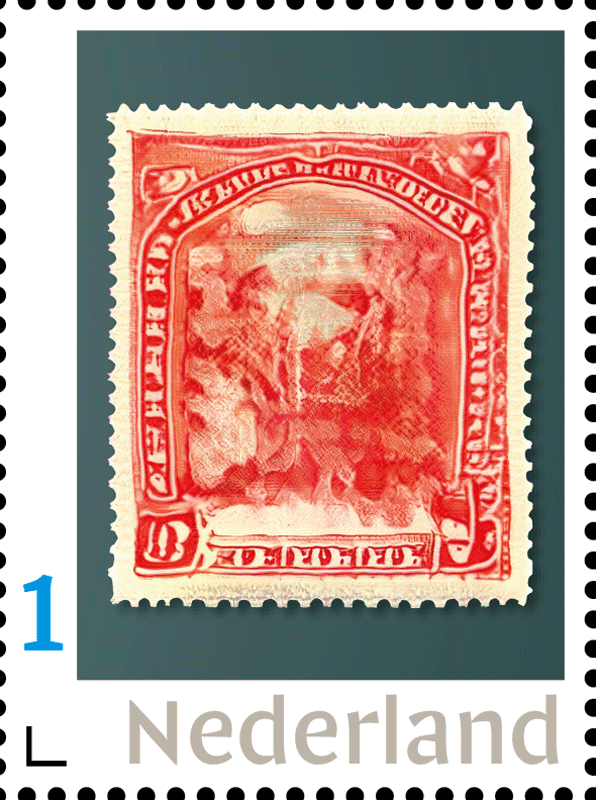 art, designs and impressions on the one hand and on feedback from others on the other. Generative art, so when an algorithm creates a design, works pretty much the same way. The algorithm also has to learn from existing works of art and designs plus feedback. To accomplish this, we need a considerable amount of data. In this case, we fed the algorithm a huge collection of images of old stamps. That’s what we call a dataset. When you have a good dataset, you get a balance between diversity and homogeneity. In other words, the stamps used as input for the algorithm must be different, but at the same time they should not be too different. That is why we focused on the more classic stamps from the period from 1852 to 1920.’
Marked stamps
Ottens started with a total dataset of 4500 different stamps from dozens of countries to feed the algorithm. This was whittled down to 1500 stamps over time. That is because the 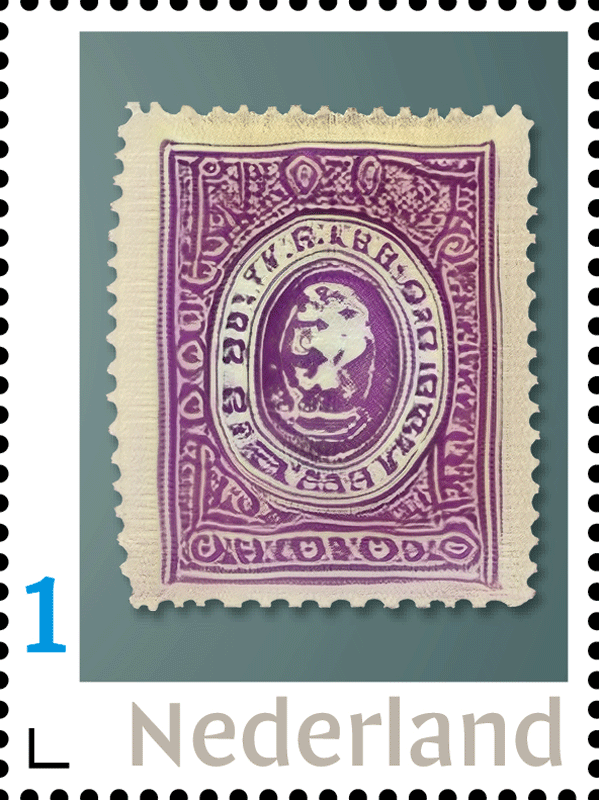 process ran across quite a number of obstacles. Ottens: ‘Images of marked stamps, for example. The algorithm doesn’t realise that it is a mark, so it teaches itself to create images with black splodges. So we removed all the marked stamps from the dataset.’
Noses
The next obstacle was the fact that many stamps feature faces. So when an algorithm creates new images based on these, you may end up with a face with two noses or no nose. ‘For an algorithm, this is only a small deviation, but we humans immediately notice that something is not right,’ says Ottens. ‘That is why we filtered all the stamps featuring faces from the dataset. And then there was the problem that the quality of some of the images just wasn’t adequate. We removed these by hand or adapted them to determine the final dataset. Sometimes, we offered the same stamps to the algorithm again, but in a different colour, or with a small piece cut off. Because the more variation you have in a dataset, the better the final result will be.’
Millions of evaluations
Ottens and Yu adapted open-source software to design the Digi Art stamps. This specific algorithm is able to learn unsupervised. This means that the algorithm discovers the 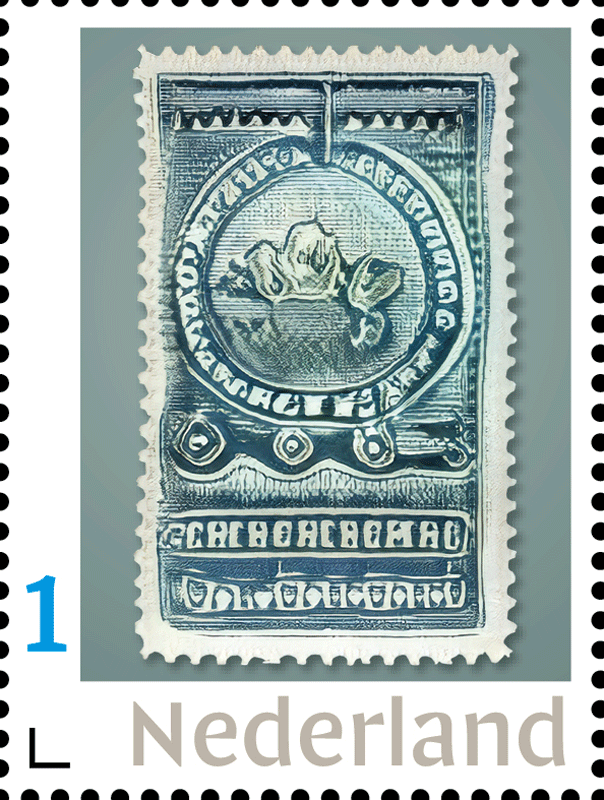 structure of the input itself and does not receive any commands relating to the desired output. In practice, there are two algorithms: the first is called the ‘generator’, the second the ‘discriminator’. Ottens: ‘The first algorithm functions as an artist who comes up with images from scratch. The second algorithm provides feedback by analysing the difference between the invented images and real stamps and passing this on to the other algorithm. By the way, the generator doesn’t just create a single image, it produces lots of them. That does take some computational time, the algorithms create and evaluate images millions of times.’
Human assessment
Ottens and Yu regularly checked a sample of the generated stamp designs. Ottens: ‘At first it didn’t look like anything, then slowly we saw outlines of stamps emerging. It started with the perforations and other recurring elements. During each assessment we tinkered with the program to give the algorithm a little push in the right direction. At some point we put together a longlist of the results and, together with our stamp colleagues, chose a number of designs. We didn’t adjust them any further, even the colours were picked by the algorithm. I am very happy with the final result, which far exceeded my expectations. Especially because sometimes unexpected details emerged. Like the double perforation on the centre stamp, for example. I couldn’t have come up with that myself.’
About the designers
Tim Ottens (Winterswijk, 1989) studied business economics, marketing intelligence and marketing management at the University of Groningen from 2010 to 2015. After graduating, he worked as a data-analyst at T-Mobile for four years. In 2019, he moved to PostNL, where he is now a senior data scientist responsible for projects related to predictive modelling and artificial intelligence. He applies his knowledge and experience to, for example, the personalisation of the PostNL app. He also develops models for the prediction of package volumes and the time lapsed between the pre-advice and the actual delivery of the packages.
Sandra Smulders (The Hague, 1974) studied advertising and presentation design at Nimeto Utrecht from 1991 to 1995, specialising in graphic design. She started the Vormgoed agency in Gouda in 2007 as a graphic designer and art director. Smulders specialises in designing logos and corporate styles and further developing the associated means of communication. For PostNL Smulders also designed the Stamp Day 2021 and 2020 stamp sheets, the Back to the 20th Century and Trains & Journeys (2019) stamp series, the 2018 Children’s Welfare Stamps, the stamp series celebrating 50 years of the Daily Fable (2018) and the 25 years of Fokke & Sukke (2018) stamp series.
The stamps are available while stocks last at www.postnl.nl/bijzondere-postzegels and can be ordered by telephone from the Collect Club customer service on telephone number +31 (0)88 868 99 00. The validity period is indefinite.
Value:
The denomination on these stamps is ‘1’, the denomination for items weighing up to 20 g destined for delivery in the Netherlands.
Technical Specifications:
Postage stamp dimensions: 30 x 40mm
Appearance: five different personal stamps marked ‘Nederland 1’, the : denomination for post weighing up to 20g sent to an address within the Netherlands
Print run: 8,000 per issue
Item number: 810060
Design: stamps Tim Ottens (Rijswijk), sheet edge Sandra Smulders (Gouda):
Copyright: © 2021 Koninklijke PostNL BV
Valour Road (Canada 2021)
[press release]
Canada Post honours the soldiers of Valour Road
Stamp pays tribute to three Victoria Cross recipients who lived on Winnipeg’s Pine Street
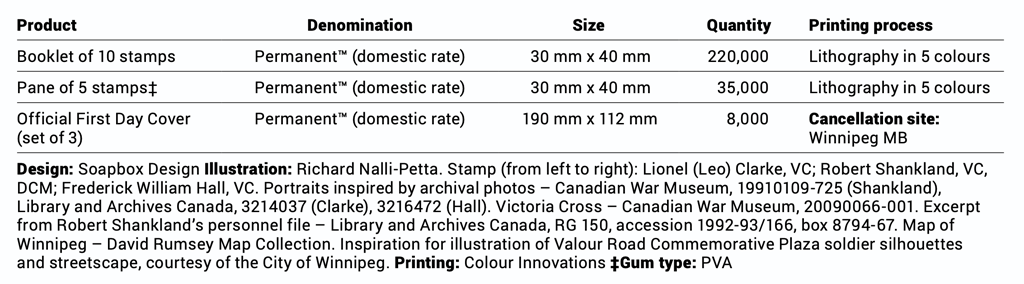
WINNIPEG – Canada Post issued a new stamp today in memory of three soldiers from Winnipeg’s Pine Street, all of whom were awarded the prestigious Victoria Cross for their 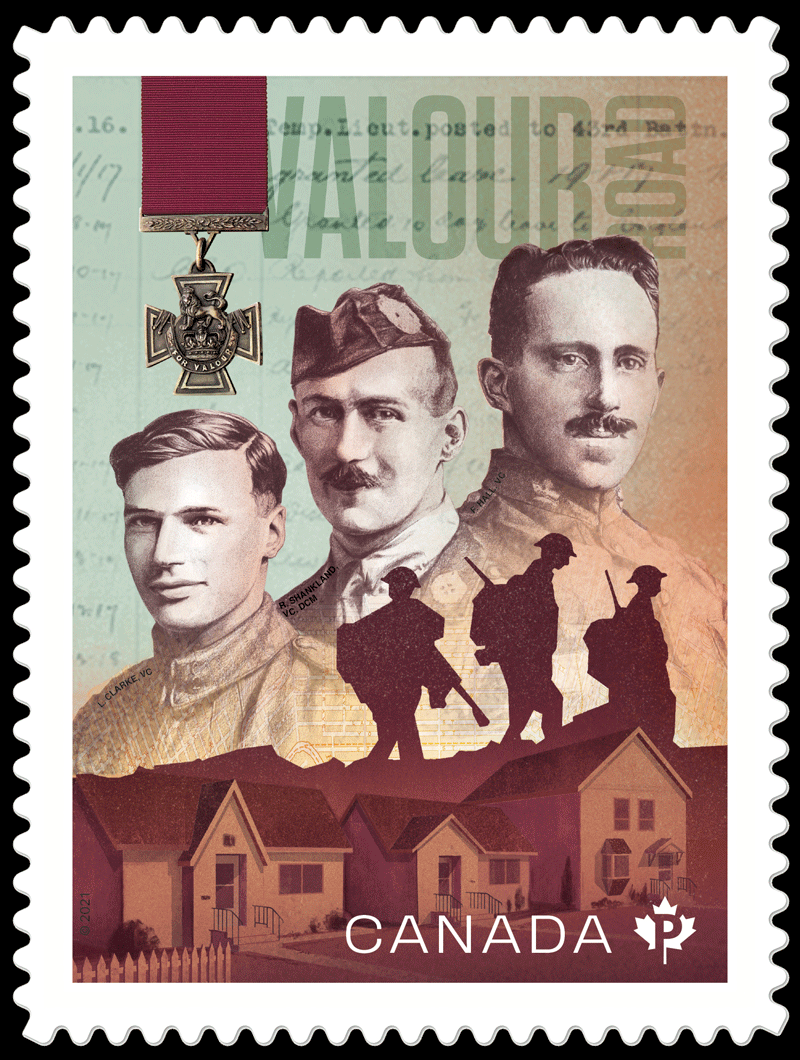 bravery and sacrifice in the First World War.
Bestowed on fewer than 100 Canadians since 1856, the Victoria Cross is the Commonwealth’s highest military decoration for bravery in combat. Pine Street, where these three men once lived, was renamed Valour Road in 1925, in dedication to their courage and sacrifices in the First World War.
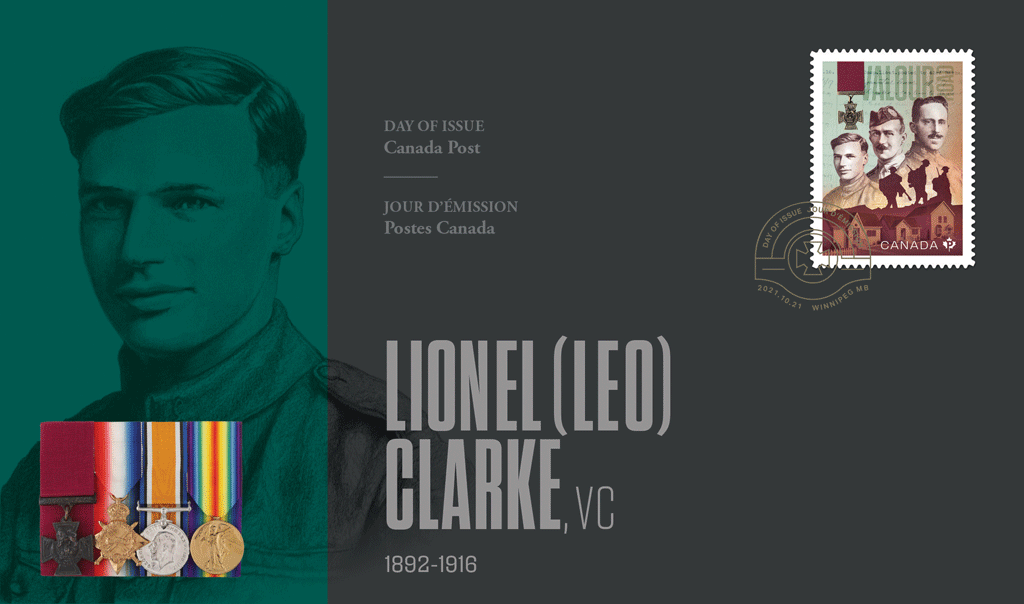
Corporal Lionel (Leo) Clarke, VC, and a small section of infantry were assigned to clear a German trench line near Pozières, France, during the Battle of the Somme. After every man but Clarke was killed or severely wounded in the operation, Clarke single-handedly held off a German counterattack, despite a bayonet wound to his leg.
Company Sergeant Major Frederick William Hall, VC, attempted to rescue a wounded soldier less than 15 metres outside a trench during the Second Battle of Ypres in 1915. Heavy machine-gun fire deterred his first attempt, but he tried again, reaching his comrade. As Hall started to carry him back to safety, both were killed.
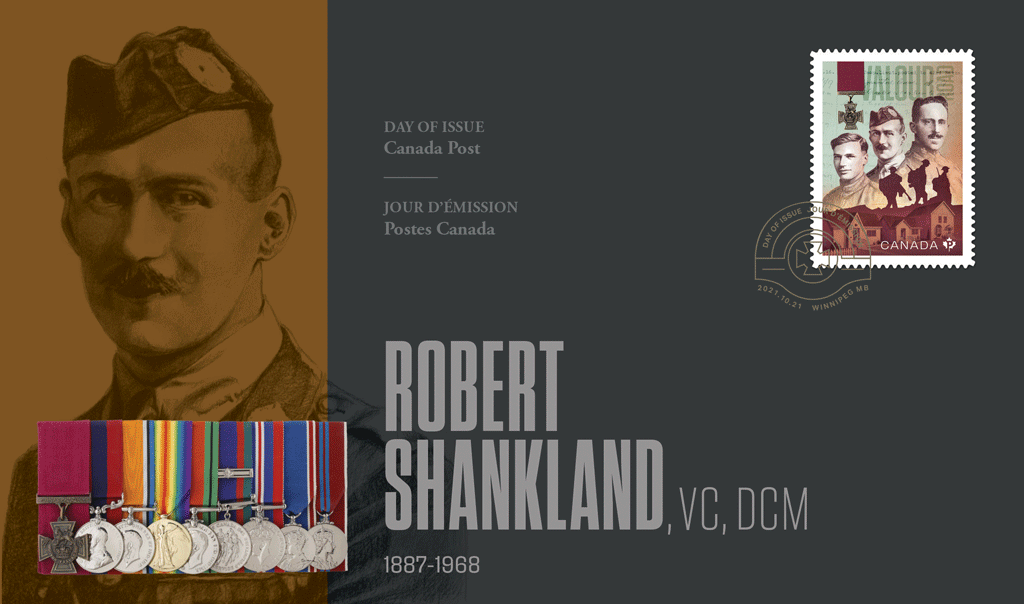
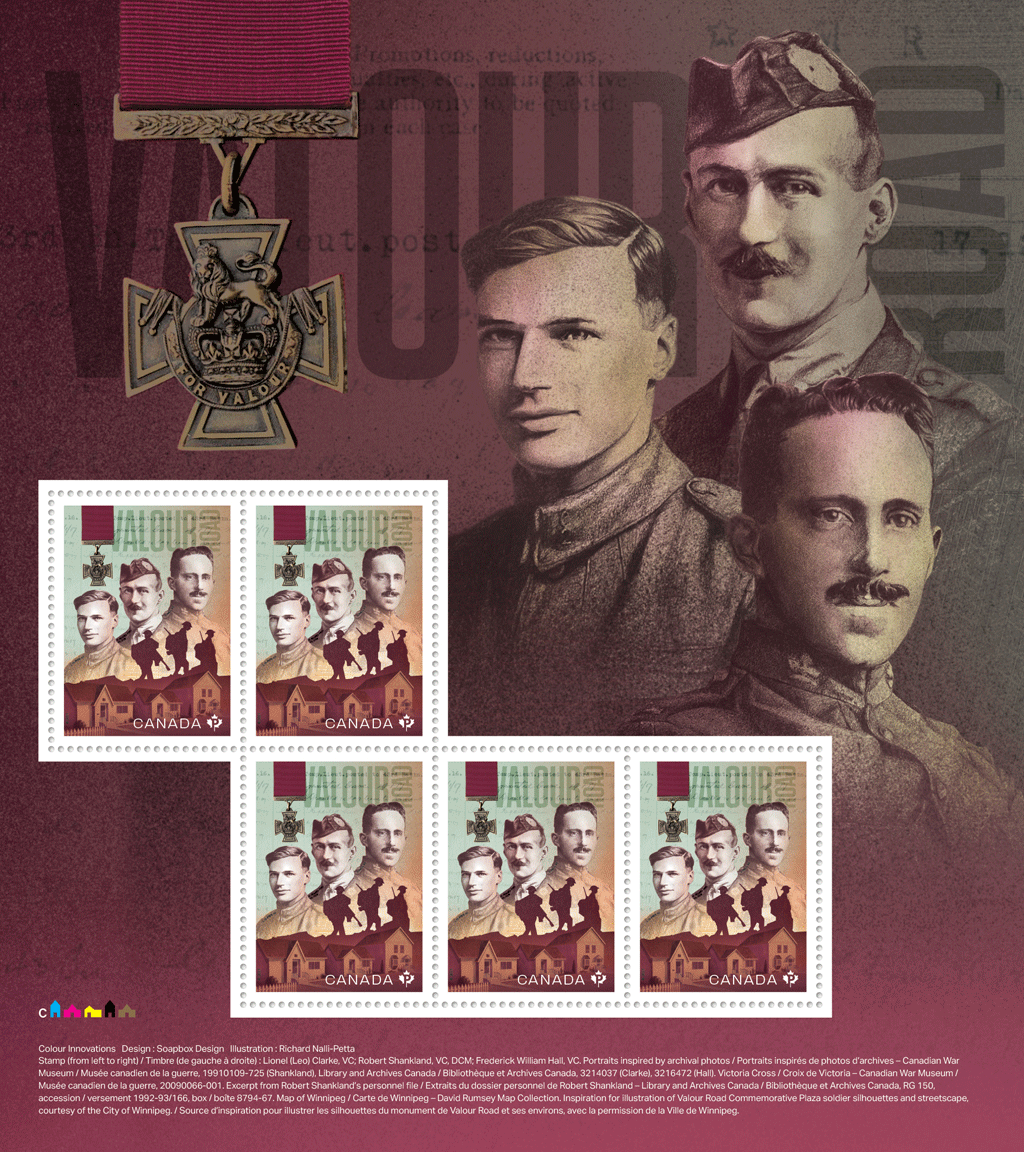 Lieutenant Robert Shankland, VC, DCM, won a strategic foothold on a ridge after his platoon and supporting soldiers were reduced to a remnant during the 1917 Battle of Passchendaele. Shankland led the surviving force against a fierce counterattack, then made his way through thick mud and shelling to the battalion headquarters to report on the enemy position.
The soldiers of Valour Road symbolize all those who served in the First World War – a horrific conflict that claimed roughly 61,000 Canadian lives – and the selflessness of all Canadian veterans and service members.
[Pictures of the three Official FDCs follow the French press release.]
[en Francais pour les médias d’information]
Postes Canada rend hommage aux soldats de Valour Road
Un timbre honore trois récipiendaires de la Croix de Victoria qui ont tous vécu sur la rue Pine à Winnipeg
WINNIPEG – Postes Canada a émis aujourd’hui un nouveau timbre en mémoire de trois soldats canadiens qui ont, à différentes époques, habité sur la rue Pine à Winnipeg. Véritables héros, ils ont été décorés de la prestigieuse Croix de Victoria pour leur courage et leur sacrifice durant la Première Guerre mondiale.
Décernée à moins de 100 Canadiens depuis 1856, la Croix de Victoria est la plus haute distinction britannique pour acte de bravoure au combat. En 1925, la rue Pine, où les trois hommes ont déjà vécu, a été renommée Valour Road (chemin de la bravoure) en leur honneur.
Au cours de la bataille de la Somme, le caporal Lionel (Leo) Clarke, V.C. , et une petite section d’infanterie doivent dégager une tranchée allemande près de la ville de Pozières, en France. Tous les hommes, sauf Leo Clarke, sont tués ou gravement blessés durant l’opération. Malgré une blessure à la jambe infligée par la baïonnette d’un ennemi, le soldat parvient seul à repousser les Allemands.
Le sergent-major de compagnie Frederick William Hall, V.C. , tente de secourir un soldat blessé à moins de 15 mètres d’une tranchée au cours de la deuxième bataille d’Ypres en 1915. Les tirs très intenses des Allemands le faisant d’abord reculer, il parvient à se rendre jusqu’à l’homme à la deuxième tentative, mais ils sont tous deux atteints mortellement alors que le sergent-major de compagnie soulève le soldat pour le ramener en lieu sûr.
Durant la bataille de Passchendaele en 1917, le lieutenant Robert Shankland, V.C., DCM, son peloton et d’autres soldats parviennent à gagner une partie de l’éperon de Bellevue, un endroit stratégique. Sa force largement réduite, il pousse les survivants à mener une contre-attaque intense, puis se fraye un chemin dans la boue jusqu’au quartier général du bataillon pour rapporter la position des Allemands.
Les soldats de Valour Road représentent le sacrifice consenti durant la Première Guerre mondiale – un conflit horrible qui a coûté la vie à environ 61 000 Canadiens – et le dévouem.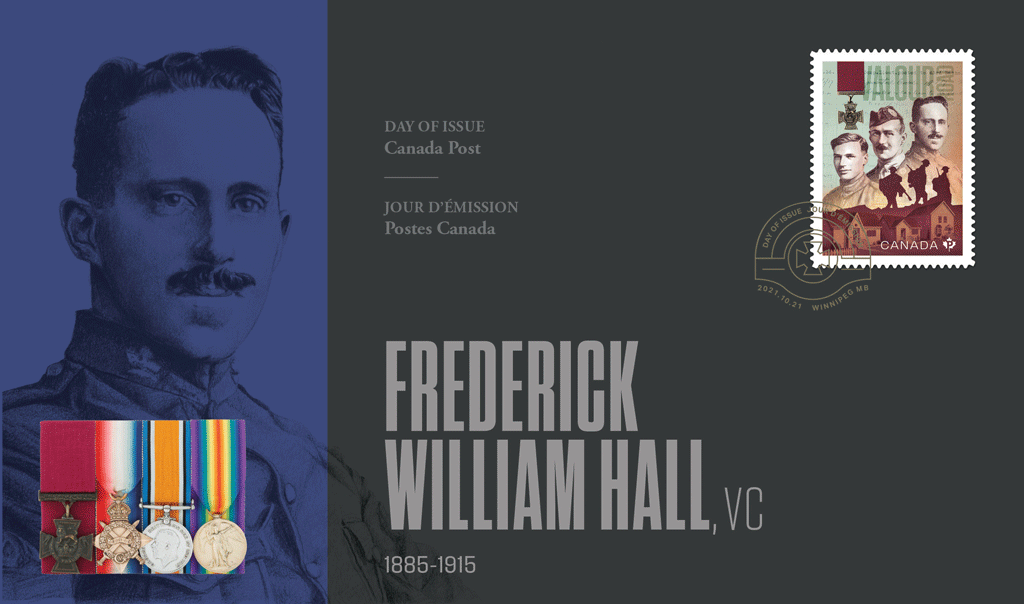
Canadian Horse Artillery envelope (Canada 2021)
From Details magazine:
“A” and “B” Batteries, 1st Regiment, Royal Canadian Horse Artillery envelope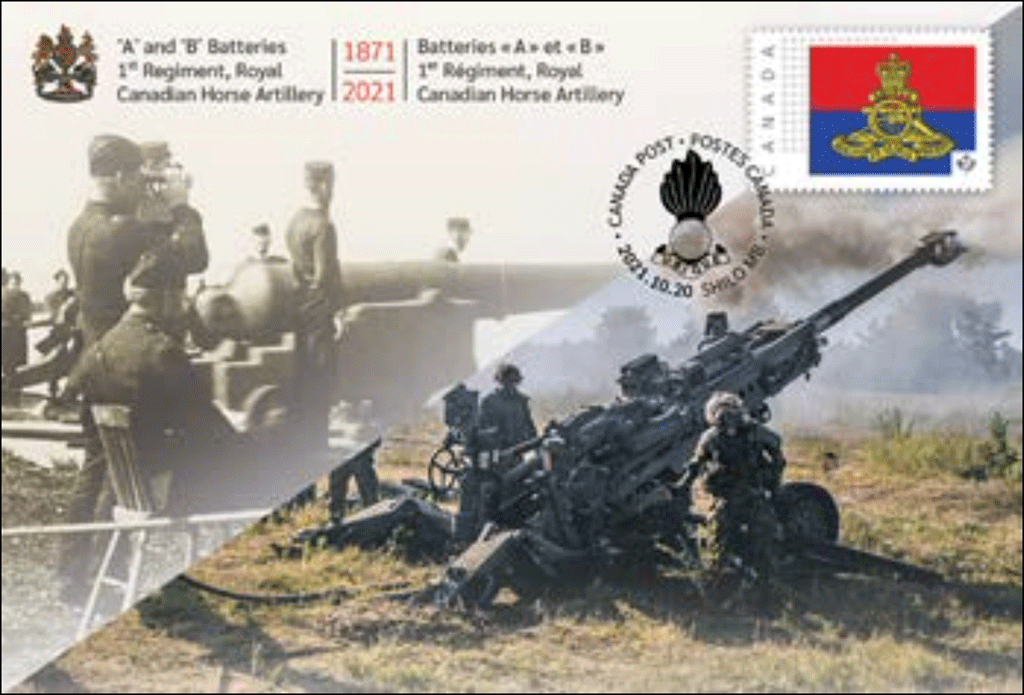
The formation of “A” and “B” Batteries as garrison artillery and schools of gunnery in Kingston and Quebec City in 1871 marked a watershed in Canadian military history. The first full-time or regular elements of the post-Confederation Canadian army, they continue to serve proudly as sub-units of 1st Regiment, Royal Canadian Horse Artillery – part of the Royal Regiment of Canadian Artillery.
Diwali (Canada 2021)
Issue date:19 October
Updated October 19th:
[press release]
Intricate pattern on new Diwali stamp welcomes good fortune
VANCOUVER – Today, Canada Post issued a new commemorative stamp to herald the arrival of Diwali – one of the largest and most widely celebrated festivals in India. Observed  by Hindus, Buddhists, Jains, Sikhs and others around the world, the five-day celebration falls on November 4 this year.
About the festival
A time to reflect, overcome negativity, and spread light and love, Diwali is associated with a number of traditions, many of them focused on the triumph of good over evil. Small clay oil lamps called diyas are often lit in rows in homes and temples or set adrift on rivers, fireworks illuminate the sky, and celebrants exchange gifts and donate to those in need.
Rangolis are also an important part of the festival. Drawn on floors in entranceways, living rooms and courtyards using flower petals, coloured sand and other materials, these intricate patterns are intended to invite Lakshmi, the goddess of good fortune, into celebrants’ homes.
About the stamp issue
Designer Seung Jai Paek layered the Rangoli pattern featured on this stamp with meaning. A lotus flower, symbolic of new beginnings, forms both the outline and inset; a ring of heart-shaped diyas expresses love and gratitude; and the Indian spice box (called a masala dabba) in the centre of the design alludes to the food shared during Diwali. Printed by Lowe-Martin, the stamp issue includes a booklet of 10 Permanent™ domestic rate stamps and an Official First Day Cover.
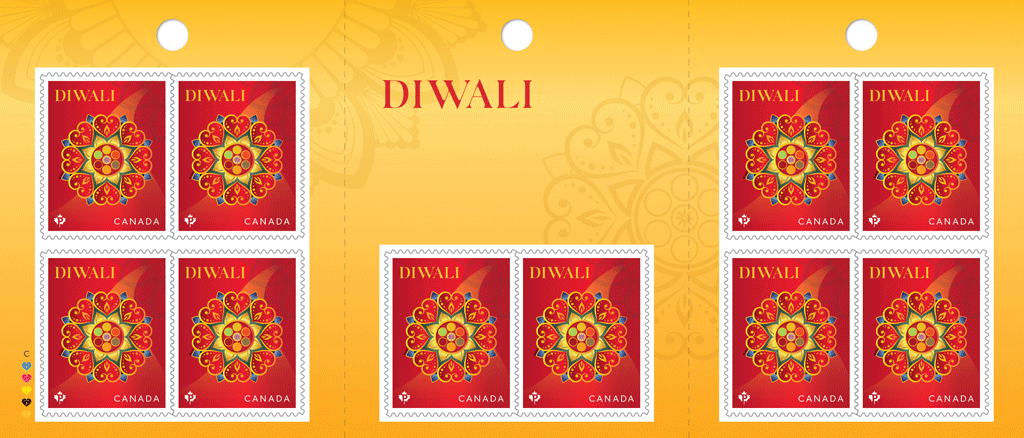
booklet pane
The Diwali stamps and collectibles are available at canadapost.ca and post offices across Canada starting today.

OFDC
en Francais:
Le motif élaboré du nouveau timbre célébrant Diwali invite à la bonne fortune
VANCOUVER – Aujourd’hui, Postes Canada a émis un nouveau timbre commémoratif pour souligner l’arrivée de Diwali, l’une des fêtes les plus importantes et les plus célébrées en Inde. Observée par les hindous, les bouddhistes, les jaïns, les sikhs et d’autres communautés dans le monde, la célébration de cinq jours commencera le 4 novembre cette année.
À propos de Diwali
Associée à bon nombre de traditions, dont plusieurs célèbrent le triomphe du bien sur le mal, Diwali est l’occasion de réfléchir, de surmonter la négativité et de remplir le monde de lumière et d’amour. De petites lampes à l’huile, appelées diyas, sont souvent allumées en rangées dans les maisons et les temples ou mises à la rivière, pendant que des feux d’artifice illuminent le ciel et que les gens échangent des cadeaux et font des dons aux personnes dans le besoin.
Les rangolis sont aussi un aspect important des célébrations. Tracés au sol dans les entrées, les salons et les cours à l’aide de pétales de fleurs, de sable coloré ou autre, ces motifs élaborés sont créés dans l’intention d’inviter Lakshmi, la déesse de la bonne fortune, dans les maisons des fidèles.
À propos du timbre
Le designer Seung Jai Paek a savamment superposé des motifs pour créer le rangoli illustré sur ce timbre. La fleur de lotus, qui symbolise les nouveaux débuts, forme le contour et l’intérieur; le cercle de diyas en forme de cœur représente l’amour et la gratitude; et la boîte à épices indiennes (appelée masala dabba), au centre du motif, rappelle le partage de nourriture lors des festins de Diwali. Imprimée par Lowe-Martin, cette émission comprend un carnet de 10 timbres PermanentsMC au tarif du régime intérieur et un pli Premier Jour officiel.
booklet pane
Le timbre et l’article de collection sur Diwali sont en vente dès aujourd’hui à postescanada.ca et dans les bureaux de poste partout au pays.
OFDC
From Details magazine:
Layers of symbolism are woven into the eye-catching Rangoli pattern on this stamp heralding the arrival of Diwali on November 4. A time to reflect, overcome negativity, and 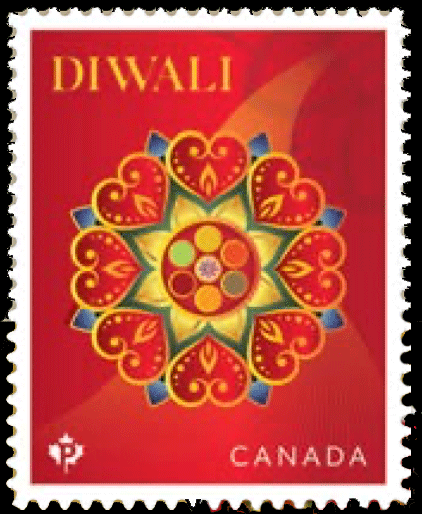 spread light and love, the five-day festival is observed by Hindus, Buddhists, Jains, Sikhs and others around the world.
Rangolis are an important part of the celebrations. Drawn on floors in entranceways, living rooms and courtyards using flower petals, coloured sand and other materials, these temporary works of art are traditionally created to invite Lakshmi, the goddess of good fortune, into celebrants’ homes.
Seung Jai Paek studied hundreds of Rangolis before devising this clever concept to convey the spirit of Diwali. A lotus flower, symbolic of new beginnings, forms both the outline and inset of the Rangoli. A ring of heart-shaped lamps or diyas, commonly lit during the festival, expresses love and gratitude. In the centre, an Indian spice box called a masala dabba alludes to the food shared during Diwali. The rich golds in the design evoke a sense of wealth, while the stream of light in the background represents the gods illuminating the path to peace and prosperity.
Specifications: 
Christopher Plummer (Canada 2021)
Date of Issue: 14 October
Note video further down. Click on any picture for a larger version.
Updated October 13th:
[press release]
Christopher Plummer honoured with new commemorative stamp
The legendary stage and screen actor played a leading role in selecting the stamp that celebrates his 70-year career
 TORONTO – Canada Post is proud to pay tribute to one of the world’s most distinguished actors, Christopher Plummer (1929-2021).
In a career that spanned seventy years, Plummer appeared in more than 200 films, television movies and mini-series, and performed on stages from Broadway to the Stratford Festival, where he captivated audiences in a long list of impressive leading roles including Henry V, Macbeth and Hamlet.
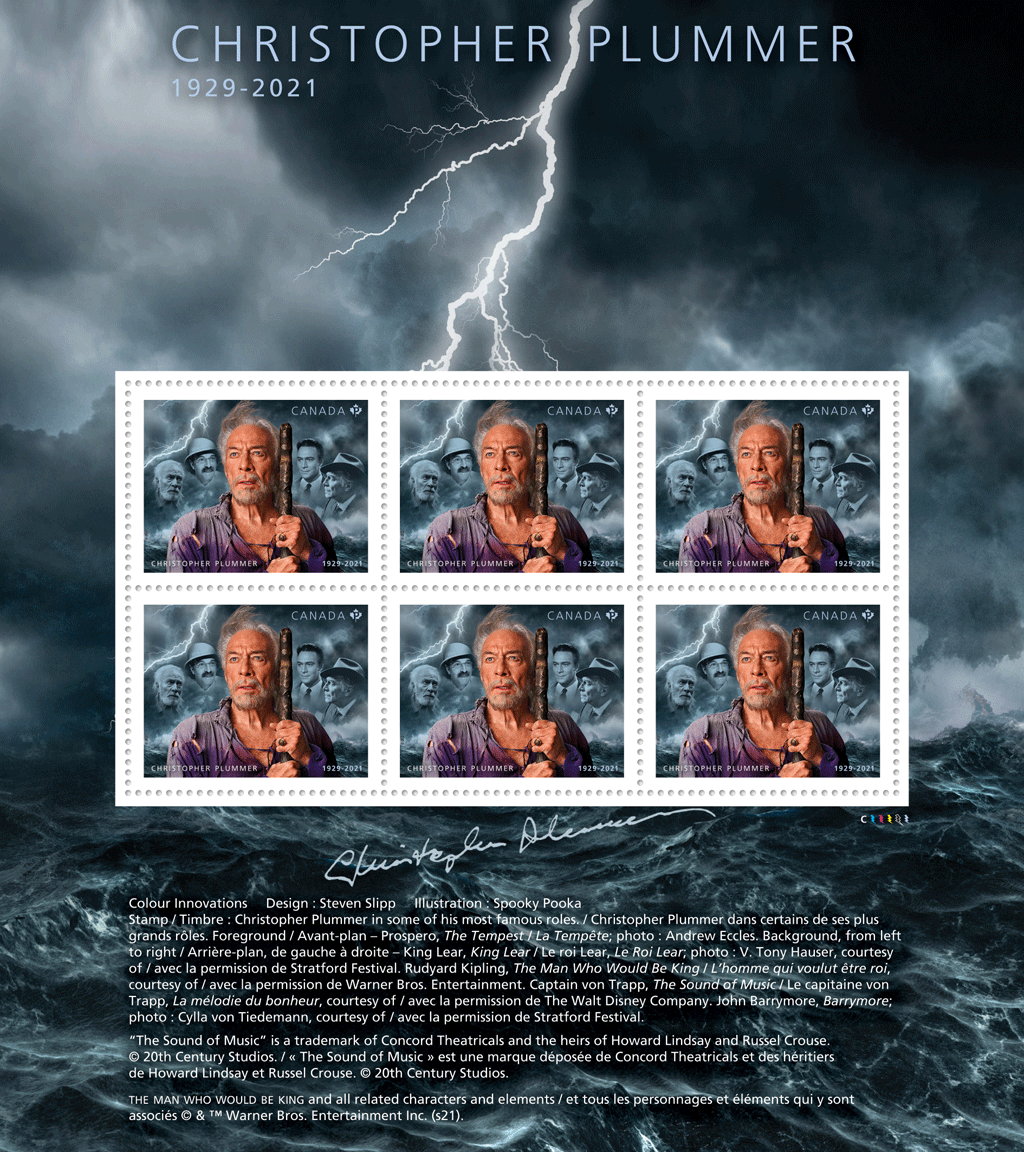
Pane of sheet stamps
While Plummer – who was born in Toronto and raised mostly in Montréal – distinguished himself among his peers as one of the most accomplished classical stage actors of his time, his film career was no less impressive.
From Stage Struck (1958), to The Insider (1999), to the movie that made him a household name,The Sound of Music (1965), Plummer appeared in an incredibly diverse range of films. He enjoyed playing unexpected roles, too – from voicing the obsessive villain Charles Muntz in the animated film Up (2009) to bringing panache to Star Trek VI: The Undiscovered Country (1991) as the Shakespeare-quoting Klingon, General Chang. His popularity grew as he embraced his golden years, winning praise for stand-out
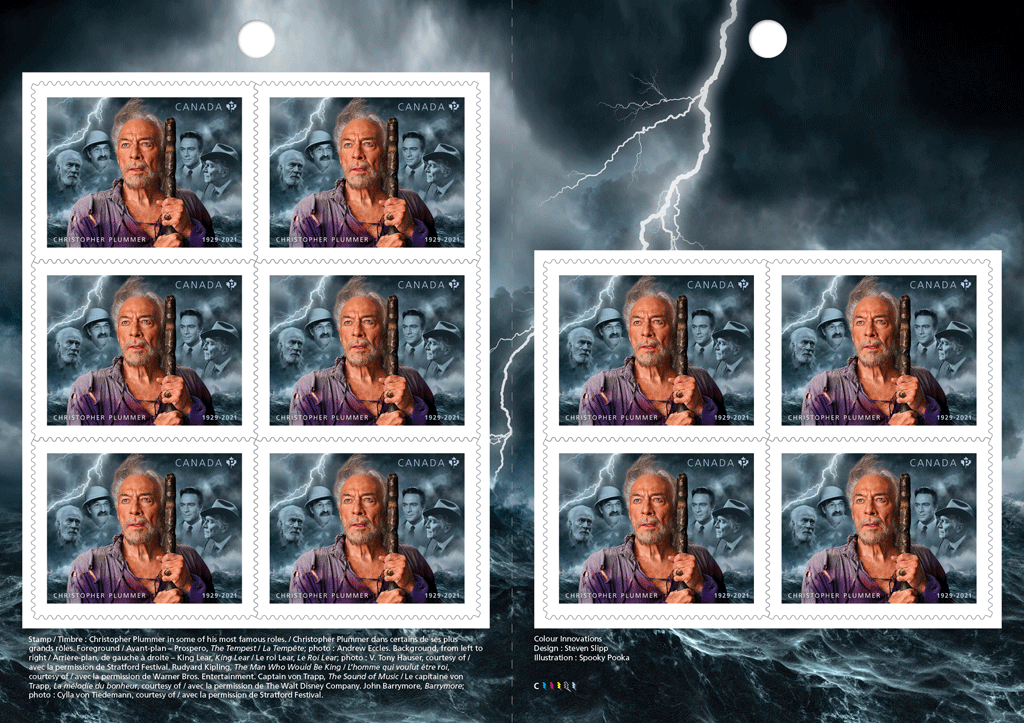
booklet pane
performances, including All the Money in the World (2017) and Knives Out (2019).
Plummer earned countless awards and honours for his work. He is among a select group – and the only Canadian – to achieve the triple crown of acting, in his case by taking home two Emmys, two Tonys and an Academy Award, which he won at age 82 for his supporting role in Beginners (2010). He was also appointed a Companion of the Order of Canada.
When Canada Post first approached Plummer in 2019, he was thrilled at the prospect of being featured on a Canadian stamp. He was consulted in the process from the very beginning and personally approved the stamp design.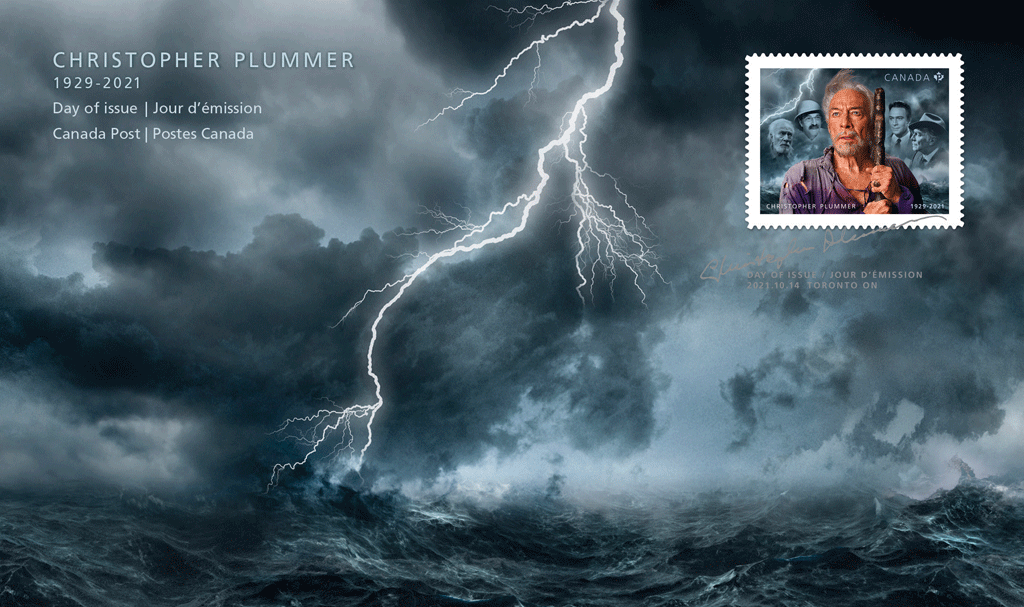 About the stamp issue
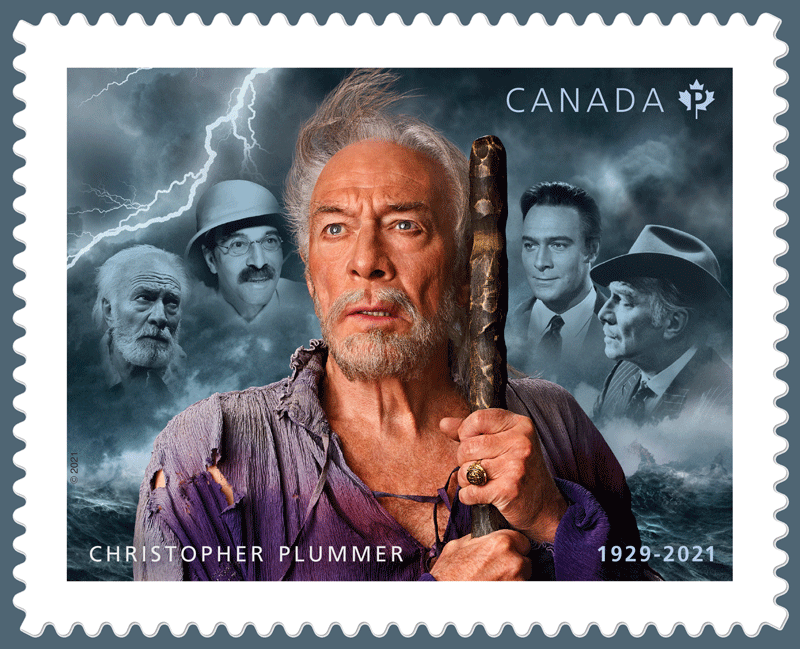
Designed by Stephen Slipp and printed by Colour Innovations, the stamp features illustrations by Spooky Pooka depicting the actor in several of his most celebrated roles, chosen by Plummer himself (from left to right):
- King Lear in King Lear
- Rudyard Kipling in The Man Who Would Be King
- Prospero in The Tempest (foreground)
- Captain von Trapp in The Sound of Music
- John Barrymore in Barrymore
The moody, tempestuous background of the stamp design is symbolic of the drama he brought to the stage and screen. The stamp issue includes a booklet of 10 Permanent™ domestic rate stamps, an Official First Day Cover (OFDC), a pane of six stamps and a limited edition framed pane.

reverse of the OFDC
Specifications: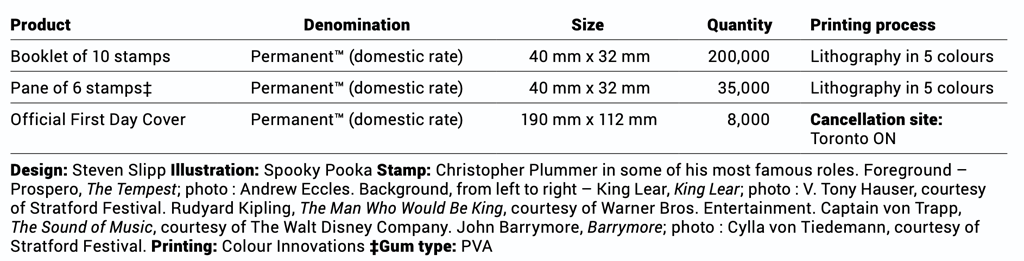
Canada Post video of Plummer talking about his work (in English):
[en Francais pour les médias d’information]
Un nouveau timbre commémoratif rend hommage à Christopher Plummer
L’acteur légendaire a participé à la sélection du timbre qui célèbre ses 70 ans de carrière
TORONTO – Postes Canada est fière de rendre hommage à l’un des plus célèbres acteurs au monde, Christopher Plummer (1929-2021).
Au cours de ses 70 ans de carrière, il joue dans plus de 200 films, téléfilms et miniséries, et il se produit sur scène, de Stratford à Broadway, où il enchante le public grâce à de nombreux rôles principaux dont Henry V, Macbeth et Hamlet.
Pane of sheet stamps
Christopher Plummer, qui est né à Toronto et a grandi principalement à Montréal, se distingue parmi ses pairs comme l’un des comédiens de théâtre les plus accomplis de son époque, mais sa carrière cinématographique n’en est pas moins impressionnante.
Du film Les Feux du théâtre (1958) à L’initié (1999), en passant par La mélodie du bonheur (1965) qui fait de lui une vedette, M. Plummer apparaît dans des œuvres très variées. Il aime aussi interpréter des rôles inattendus que ce soit en donnant sa voix au méchant Charles Muntz dans le film d’animation Là-haut (2009) ou en apportant du panache au personnage du général Chang qui cite du Shakespeare dans Star Trek 6 : La Conquête du nouveau monde (1991). Sa popularité ne décline pas avec l’âge, bien au contraire, et il remporte des éloges pour ses performances exceptionnelles, notamment dans Tout l’argent du monde (2017) et À couteaux tirés (2019).
booklet pane
Christopher Plummer reçoit de nombreux prix et honneurs pour son travail. Il est le seul Canadien à faire partie du groupe sélect d’artistes ayant remporté la triple couronne d’interprétation, c’est-à-dire deux prix Emmy, deux prix Tony et un Oscar, qu’il obtient à l’âge de 82 ans pour son rôle de soutien dans Les débutants (2010). Il est également nommé Compagnon de l’Ordre du Canada.
Lorsque Postes Canada a communiqué avec M. Plummer pour la première fois en 2019, l’acteur était ravi qu’un timbre canadien soit créé en son honneur. Il a participé au processus dès le début et a personnellement approuvé le motif.
À propos du timbre
Conçu par Stephen Slipp et imprimé par Colour Innovations, le timbre propose des illustrations de Spooky Pooka représentant l’acteur dans cinq de ses rôles les plus célèbres qu’il a lui-même sélectionnés (de gauche à droite):
- Le roi Lear dans Le Roi Lear
- Rudyard Kipling dans L’homme qui voulut être roi
- Prospero dans La Tempête (en avant-plan)
- Le capitaine von Trapp dans La mélodie du bonheur
- John Barrymore dans Barrymore
L’arrière-plan sombre et orageux du motif de timbre symbolise le sens dramatique de Christopher Plummer à l’écran comme sur scène. Cette émission comprend un carnet de 10 timbres PermanentsMC au tarif du régime intérieur, un pli Premier Jour officiel (PPJO), un feuillet de six timbres et un feuillet encadré à tirage limité.
reverse of the OFDC
Announced October 8th:
[press release]
Canada Post to pay tribute to acting legend Christopher Plummer with new stamp

in “The Sound Of Music”
TORONTO – Canada Post invites you to attend a special stamp event and tribute to legendary actor Christopher Plummer. Attendees will be able to watch the small, live event being broadcast from Toronto’s Elgin and Winter Garden Theatre Centre on Wednesday, October 13.
WHO: In attendance at the live event will be the following:
- Elaine Taylor Plummer, wife of Christopher Plummer
- Lou Pitt, manager and long-time friend
- Des McAnuff, director and long-time friend
- Peter Mansbridge, master of ceremonies
- Beth Hanna, CEO, Elgin and Winter Garden Theatre Centre
- Anthony Wilson-Smith, President and CEO, Historica Canada / Chair, Stamp Advisory Committee
- Franco Chirichella, Chief Digital Officer, Canada Post
WHERE: Live webcast access is available here.
Due to COVID-19 restrictions, the in-person live event is restricted to invited guests only. It will take place at the Elgin and Winter Garden Theatre Centre, 189 Yonge Street, in Toronto.
WHEN: Wednesday, October 13 at 11 am, Eastern Time
[en Francais pour les médias d’information]
Postes Canada rend hommage à l’acteur légendaire Christopher Plummer avec un nouveau timbre
TORONTO – Postes Canada vous invite à assister à un événement qui rendra hommage à l’acteur légendaire Christopher Plummer. Les invités pourront découvrir le timbre et assister à cet événement qui sera diffusé en direct du Centre des salles de théâtre Elgin et Winter Garden à Toronto, le mercredi 13 octobre.
QUI: Invités présents:
- Elaine Taylor Plummer, épouse de Christopher Plummer
- Lou Pitt, gérant et ami de longue date
- Des McAnuff, réalisateur et ami de longue date
- Peter Mansbridge, maître de cérémonie
- Beth Hanna, présidente-directrice générale, Centre des salles de théâtre Elgin et Winter Garden
- Anthony Wilson-Smith, président et chef de la direction, Historica Canada, et président du Comité consultatif sur les timbres-poste
- Franco Chirichella, chef de la stratégie numérique, Postes Canada
OÙ: Pour accéder à la diffusion en direct de la webémission, cliquez ici.
Compte tenu des restrictions liées à la COVID-19, seules les personnes qui ont reçu une invitation pourront se présenter à l’événement, qui aura lieu au Centre des salles de théâtre Elgin et Winter Garden, au 189 rue Yonge à Toronto.
QUAND: Le mercredi 13 octobre, à 11 h (HE)
Christopher Plummer on IMDb
Christopher Plummer on Wikipedia