U.S. Scott Catalogue Numbers (November 2015 Update)

5019 (49¢) Celebrate
5020 (49¢) Paul Newman
a. Imperforate

5021 (49¢) Christmas – Charlie Brown Carrying Christmas Tree
5022 (49¢) Christmas – Charlie Brown, Pigpen and Dirty Snowman
5023 (49¢) Christmas – Snoopy, Lucy, Violet, Sally and Schroeder Skating
5024 (49¢) Christmas – Characters, Dog House and Christmas Tree
5025 (49¢) Christmas – Linus and Christmas Tree
5026 (49¢) Christmas – Charlie Brown Looking in Mailbox
5027 (49¢) Christmas – Charlie Brown and Linus Behind Brick Wall
5028 (49¢) Christmas – Charlie Brown, Linus and Christmas Tree
5029 (49¢) Christmas – Charlie Brown Screaming, Snoopy Decorating Dog House
5030 (49¢) Christmas – Charlie Brown Hanging Ornament on Christmas Tree
a. Block of 10, #5021-5030
b. Convertible booklet pane of 20, 2 each #5021-5030
c. As “a,” imperforate
d. As “b,” imperforate

Christmas (Britain, 2015)

Christmas 2015
Issue Date: 03.11.15
Reason & Inspiration
uk_xmas5Royal Mail has issued Christmas stamps since 1966. From 2005 it introduced a policy of alternating secular with religious designs each year, and 2015 is a religious year. The stamps tell the traditional Nativity story in an impressionistic style, from the Annunciation, through to the Nativity and journey of the Magi.

As is usual, separate stamps at 1st and 2nd class rate of the Madonna and Child will also be available from Post Offices.

Experts
uk_xmas6David Holmes (Illustrator)
David Cecil Holmes was born in Chelsea, London. He attended the Ealing College of Art and The Central School of Art, and he began his career in advertising. After working in several top London agencies, he became co-founder and Creative Director of the award-winning Holmes Knight Ritchie Ltd., later TBWA Holmes Knight Ritchie. He works as a painter and illustrator, but he is also well known as an art director and designer.

Studio David Hillman (Stamp designers)
uk_xmas2Educated at the London School of Printing, David Hillman started as a designer on The Sunday Times Magazine. In 1968, he joined Nova magazine as art director and in 1975 he set up his own design practice, with a commission to design a new French daily newspaper, Le Matin de Paris. After joining Pentagram in 1978, he continued his work in editorial design, identity, signage and packaging. In 2007, he left Pentagram to set up Studio David Hillman.

David has won numerous awards and his work has been exhibited worldwide. He is a Fellow of the Chartered Society of Designers and a member of the Alliance Graphique Internationale (AGI). In 1997, he uk_xmas1was made a Royal Designer for Industry, and between 2001 and 2003 he served as International President of the AGI. In 2004, he was made a Senior Fellow of the Royal College of Art.

The most recent job David Hillman has undertaken for Royal Mail prior to the Christmas 2015 stamp issue was the 30 stamps celebrating the sports of the Olympic and Paralympic Games form 2009 to 2011. He also worked on 2007’s The Queen’s Diamond Wedding stamps and products and on the Millennium stamps.

uk_xmas3Mint Stamps In Detail
Stamp Set Price: £8.96
Stamp Set Code: AS46B

The Christmas 2015 stamps feature scenes from the Biblical story of the Nativity, painted by artist David Holmes, with art direction and design by Studio David Hillman.

The images are as follows:

2nd Class and 2nd Class Large: The journey to Bethlehem
uk_xmas81st Class and 1st Class Large: The Nativity
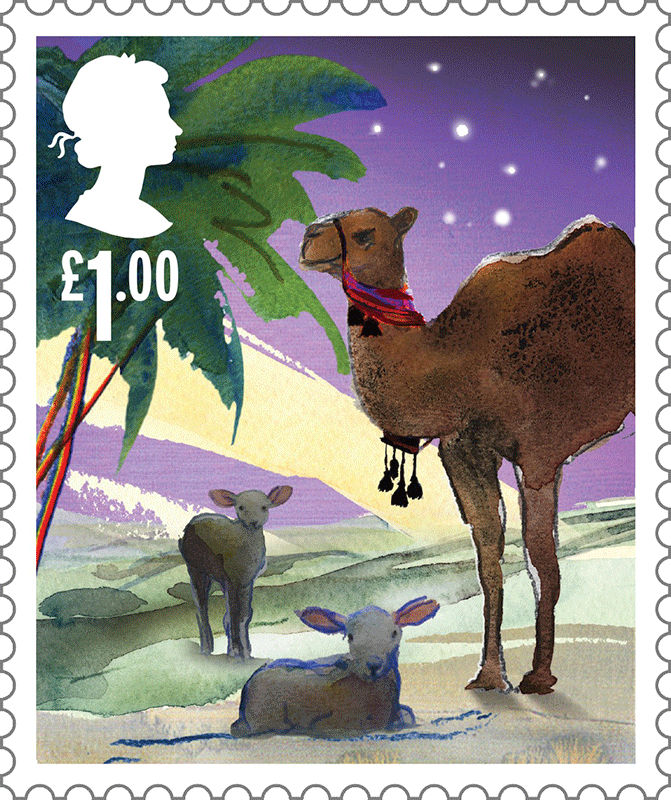
£1.00: The animals of the Nativity
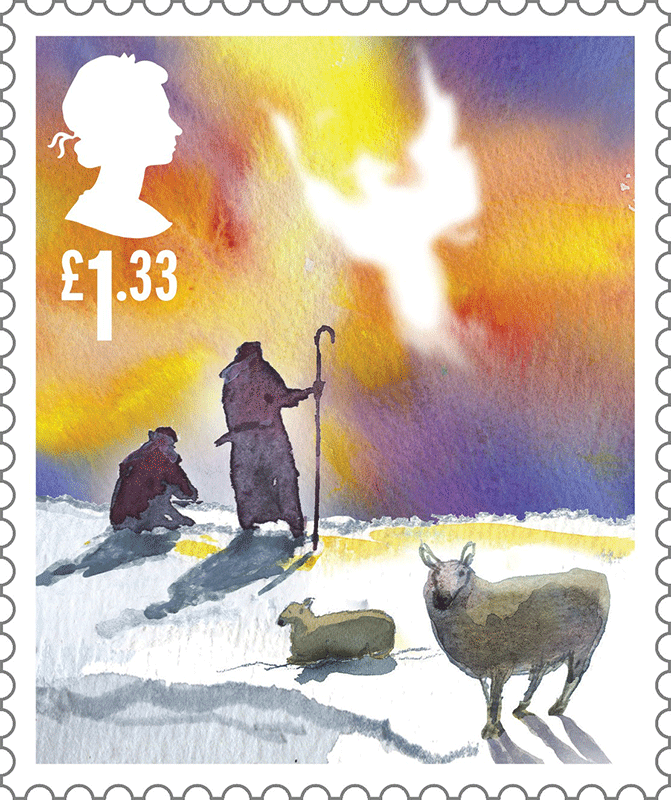
£1.33: The shepherds
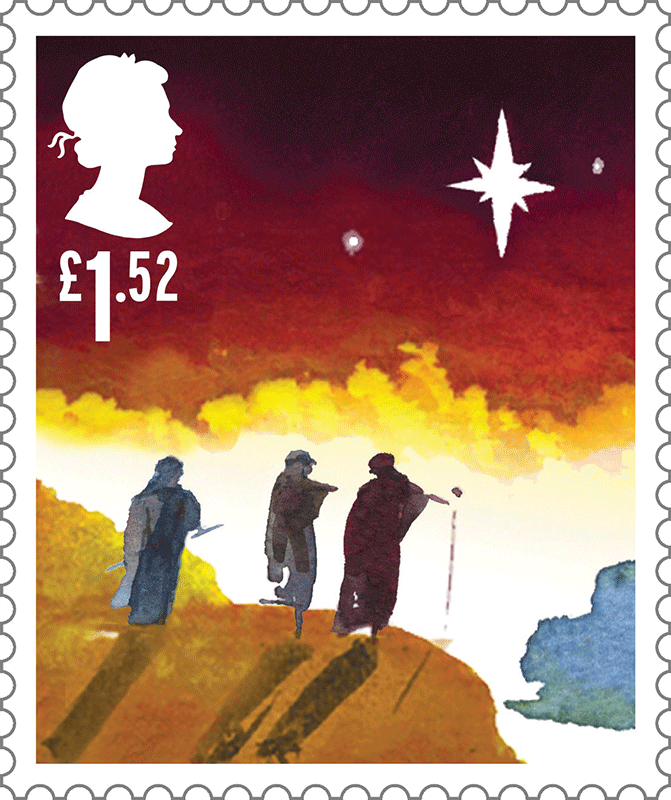
£1.52: The three wise men
£2.25: The Annunciation

Miniature Sheet In Detail
Price: £8.96
Code: MZ112

uk-xmas-miniThe Miniature Sheet has been designed by Studio David Hillman and illustrated by David Holmes.

Technical Details:

uk_xmas4Number of stamps: Eight
Design: Studio David Hillman
Acknowledgements: Illustrations by David Holmes
Stamp Format (Standard): Portrait
Stamp Format (Large): Landscape
Stamp Size (Standard): 24mm x 28mm
Stamp Size (Large): 34mm x 28mm
Sheet size: Sheet Stamps: 165mm x 323mm
Miniature Sheet: 179mm x 74mm
Number per Sheet: Stamps: 50
Miniature Sheet: 8
Printer: Sheet Stamps: De La Rue
uk_xmas7Miniature Sheet: De La Rue
Retail Books: International Security Printers
Print Process: Gravure
Perforations: 14.5 x 15
Phosphor: Bars as appropriate
Gum:Stamps: Self – adhesive
Miniature Sheet: PVA

Winter Fur & Feathers (Britain, 2015)

Winter Fur & Feathers
Issue Date: Tuesday, 16th November 2015
uk_furfeathersReason & Inspiration
During the winter months, the UK countryside can lose some of its natural colour, as leaves fall and trees become covered in snow. Yet among the seasonal changes linger some spectacular animals, often hard to see but occasionally revealing themselves with a flash of an underwing or shiny pelt. The robin, for example, is at its most dramatic during the British winter, its colourful red breast standing out from its surroundings, while other creatures, like the mountain hare, stoat and weasel, become completely transformed by their winter ermine.

Some birds and mammals visit British shores only in winter, including species such as the edwing. During this time of year, the UK becomes a migration hotspot, with millions of animals passing through or taking up temporary residence for a few weeks or months. So, while many animals hibernate and sit out the British winter, the rest of the countryside plays host to some wonderful sights and sounds, making it well worth keeping one’s eyes and ears open during a bracing wintry walk.

Stamp Specifications

Post & Go Stamps: Winter Fur & Feathers
Number of stamps: Four
Date of issue: 16th November 2015
Design: Osborne Ross
Acknowledgements: Illustrations by Robert Gillmor; photography © Royal Mail Card design © Royal Mail Group Ltd 2015
Printer: International Security Printers
Process: Gravure
Format: Landscape
Size: 56mm x 25mm
Perforations: Die-cut simulated
Phosphor: Bars as appropriate
Gum: Self-adhesive

uk_hareAs overprinted by Post & Go machine: Mountain Hare A true alpine mammal, the mountain hare inhabits upland areas with a height of more than 500 metres. From October onwards, it undergoes a series of remarkable moults, transforming from brown to pure white. During average British winters, this makes the hare virtually invisible.

uk_redwingAs overprinted by Post & Go machine: Redwing The smallest member of the thrush family, the redwing is a winter migrant in the UK, first appearing in late September. Easy to identify with its distinctive red flanks, in harsher winters it can be seen in gardens, foraging for berries and other food.

uk_redfoxAs overprinted by Post & Go machine: Red Fox One of the UK’s most abundant wild animals, the red fox is at home in a wide range of habitats – in both rural and urban areas – and its numbers are on the increase in towns and cities. With its sleek coat and bushy tail, it is an instantly recognisable and iconic sight.

uk_redsquirrelAs overprinted by Post & Go machine: Red Squirrel Most known for its red fur, tufted ears and bushy tail, the red squirrel is one of the UK’s favourite native mammals, although increasingly rare to spot. It is most at home in the coniferous woodlands of Scotland, but also survives in isolated spots in England.

Philatelic Foundation Receives Grant

[press release]
The Philatelic Foundation, the leading authority in the United States for the expertizing and certification of stamps and covers, is pleased to announce that it is the recipient of a substantial grant from the David T. Beals III Charitable Trust. Mr. Beals, who passed away in 1987, was a prominent philatelist and collector of Western covers, his family having been early settlers in Kansas City, Missouri.

Previous generous grants from the Trust provided for the PF’s acquisition of the VSC6000 and Bruckner Spectrometer, two pieces of high-tech equipment that have brought added assurance and confidence to its expertizing process and the development of its widely acclaimed PF Search data base that permits on-line review of the PF’s library of certificates.

The new grant will further advance the application of digital age technology to the PF’s remarkable collection of research material. This grant will permit the digital conversion of the PF’s collection of Stanley Ashbrook’s 16 notebooks of correspondence, 38 file drawers of index cards, and over 1000 color slides into a word-searchable database that will be posted on the PF’s website. Additional enhancements to the PF Search program, including certificates dating back to the PF’s beginnings in 1945, will be digitized and posted on its website, as well as studies of interesting current submissions made to the PF for certification. In all, nine different projects are to be funded and the cumulative result will be to convert the accumulation of PF research and information into a visual and searchable database.

Special thanks to the David T, Beals, III, Charitable Trust for making this all possible.

The Philatelic Foundation is a Section 501(c)(3) not-for-profit educational organization chartered by the State of New York.

Zais Declares for APS President

Candidate Statement: Mick Zais Declares Candidacy for American Philatelic Society President

Dear APS Members,

Mick-ZaisI’m announcing my candidacy for President of the American Philatelic Society in the coming 2016 election. I’m running because I believe the APS, while facing challenges, has significant opportunities to grow membership and expand member services. To this task, I’ll bring 45 years of diverse leadership and financial management experience.

For the past four years, I served as South Carolina’s State Superintendent of Education, overseeing policy for 1,250 schools, 51,000 teachers, and 720,000 students, while managing a budget of $4.0 billion.

For ten years, I served as President of Newberry College in South Carolina, a liberal arts, residential, undergraduate institution founded in 1856, with an annual budget in excess of $20 million. During my tenure the College almost doubled enrollment, constructed new facilities, and more than doubled its endowment. During the last three years of my tenure, the College was nationally recognized by U.S. News & World Report as one of “America’s Best Colleges.”

For 31 years, I led organizations of increasing size and complexity in the U.S. Army, culminating in promotion to Brigadier General. My assignments included Commanding General of all U.S. and Allied Forces in Kuwait and as Commanding General of Operation Provide Refuge which brought 4,000 Kosovo refugees out of Macedonia for settlement in the U.S. I was also the Pentagon’s Chief of War Plans.

My entire professional life has been dedicated to leadership through service to others.

Since the age of eight, I have collected stamps from around the world. Over the past 15 years, my focus has been on stamps and postal history related to the U.S. Military Academy at West Point as well as the U.S. Army stamps of 1936-37. Next year will mark forty years of continuous APS membership. In 2013, I was elected to the APS Board of Directors as a Vice President. Most recently, I served as Chairman of the search committee that found and hired the APS’s new Executive Director.

As your President, I will be a force for change. This means I will work to reverse declining membership by building new outlets for growing our membership and reaching out to more diverse groups. I’ll work to strengthen the partnership between the APS and the 30 World Series of Philately regional shows, our 195 specialty societies, and the hundreds of local chapters across the U.S. I’ll also work to enhance relations with philatelic organizations in other countries and to grow the number of international members.

Most importantly, I’ll work with our new Executive Director, the dedicated staff, the APS and APRL Boards, and the leaderships of many other philatelic organizations, large and small, to build a stronger hobby. Working together, I’m confident we can improve the business operations of the APS while enhancing services to our members: including our StampStore, sales circuits, expertizing, education programs and fundraising to complete the world’s premiere philatelic library.

The success of the APS depends upon the health of our hobby; and the health of our hobby depends upon dealers who find and provide material to collectors. As President, I will dedicate myself to strengthening the partnership between the APS and the professional philatelic community.

In the months ahead, I look forward to meeting more of you, learning about your experiences, and hearing your ideas about how we can work together to build an APS that will last for generations. To this end, I would welcome your ideas for the future of the Society at the addresses below. It would be an enormous honor for me to serve as your President. I respectfully ask for your vote in next year’s election.

Mick Zais
1642 Tanglewood Road – Columbia, SC 29204-3308
mickzais@gmail.com

U.S. Scott Catalogue Numbers, October 2015 Update

5010 (49¢) 2016 World Stamp Show – red vignette
5011 (49¢) 2016 World Stamp Show – blue vignette
a. Pair, #5010-5011
b. As “a,” imperforate
5012 (49¢) Ingrid Bergman
a. Imperforate
5013 (25¢) Eagle coil – green behind “USA”, litho., serpentine die cut 10¼ vert.
5014 (25¢) Eagle coil – blue green behind “USA”, litho., serpentine die cut 10¼ vert.
5015 (25¢) Eagle coil – blue behind “USA”, litho., serpentine die cut 10¼ vert.
5016 (25¢) Eagle coil – red violet behind “USA”, litho., serpentine die cut 10¼ vert.
5017 (25¢) Eagle coil – brown orange behind “USA”, litho., serpentine die cut 10¼ vert.
5018 (25¢) Eagle coil – yellow orange behind “USA”, litho., serpentine die cut 10¼ vert.
a. Strip of 6, #5013-5018

U.S. Post Offices Push Cancer Stamp

breastcancerrschOctober is National Breast Cancer Awareness Month, when post offices make a special effort to sell the postage stamp that raises funds for research.

The stamp currently sells for 60 cents. The additional 11 cents over the first-class postal rate helps fund breast cancer research at the National Institutes of Health and the Medical Research Program at the Department of Defense. The stamp has raised $80.9 million for breast cancer research since its creation in 1998.

In September, the Senate called for the stamp to continue on sale through 2019. However, the House version of the bill appears stalled in committee.

The Carl Junction, Missouri, post office hopes to retain its crown as the top seller of the Breast Cancer Research semi-postal stamp. Last year, “CJ” sold more than $49,000 worth of BRC stamps.

The Nevada, Missouri, post office is taking the challenge. Postmaster Julie Mader says she used to work with Carl postmaster Sharon Clark in another town. Mader says it’s more than just a fun competition, because everyone knows someone who has had breast cancer — such as Clark.

At the Gulfport, Mississippi, post office, employees are wearing pink and handing out pink cupcakes, cookies and candy to boost BRC stamp sales.

According to WLOX-TV, Mississippi has been tops in BRC stamp sales for the past three years.

“It’s our opportunity to give back to something that everyone has been impacted by,” Gulfport Postmaster Larry Delahunt told the station. “I don’t think there’s anyone you know that hasn’t been impacted by someone with breast cancer, so it’s personal and dear to almost everyone, including here at the post office.”

Great Goalies (Canada 2015)

[press release]

NHL Great Canadian Goalies stamps celebrate six innovators, influencers
Legendary goalies immortalized in multi-year NHL stamp collection
413992111-4TORONTO, Oct. 1, 2015 /CNW Telbec/ – Less than a week before the puck drops to start the 2015-16 NHL season, Canada Post lifted the veil today on a new stamp issue that celebrates six goaltending greats who transformed hockey.

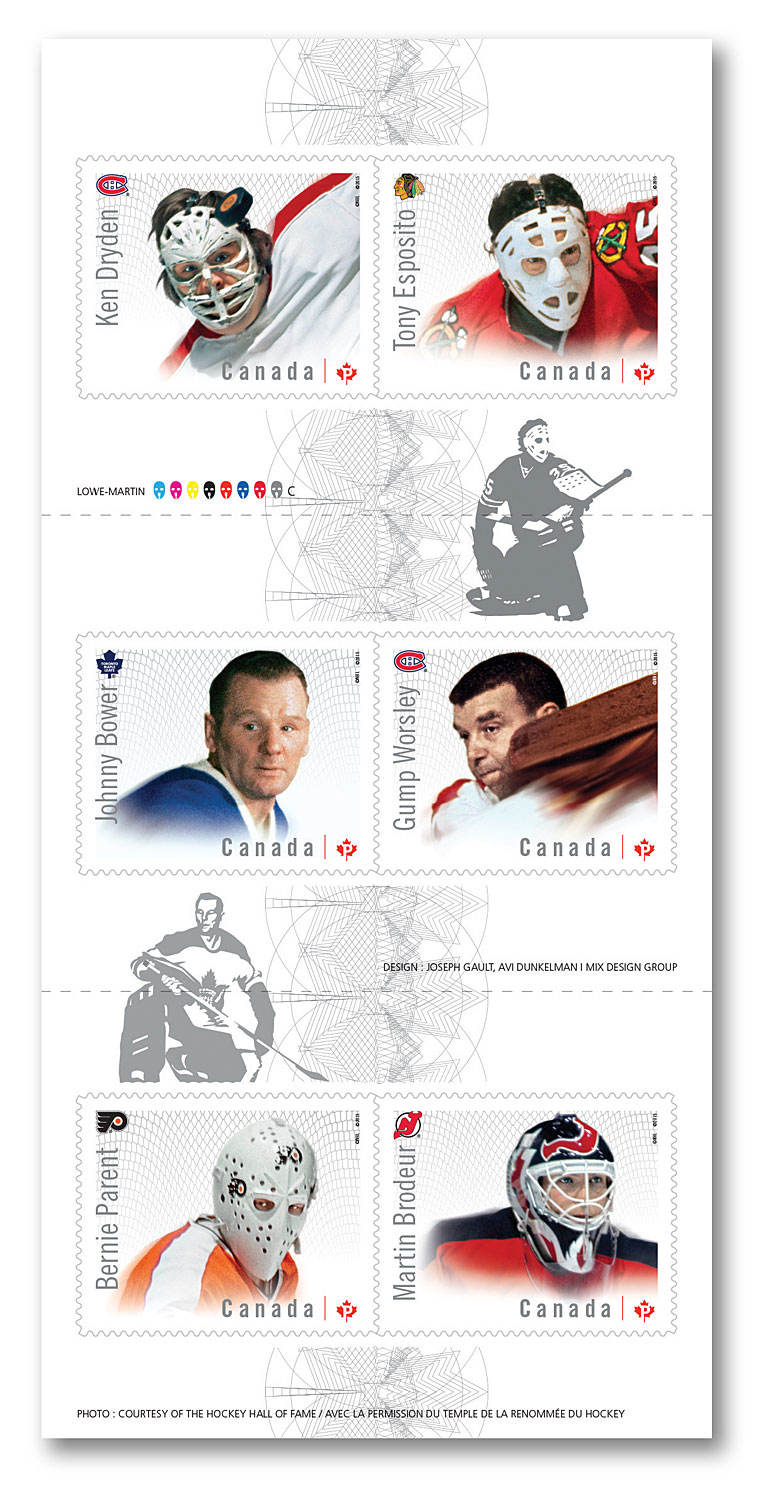
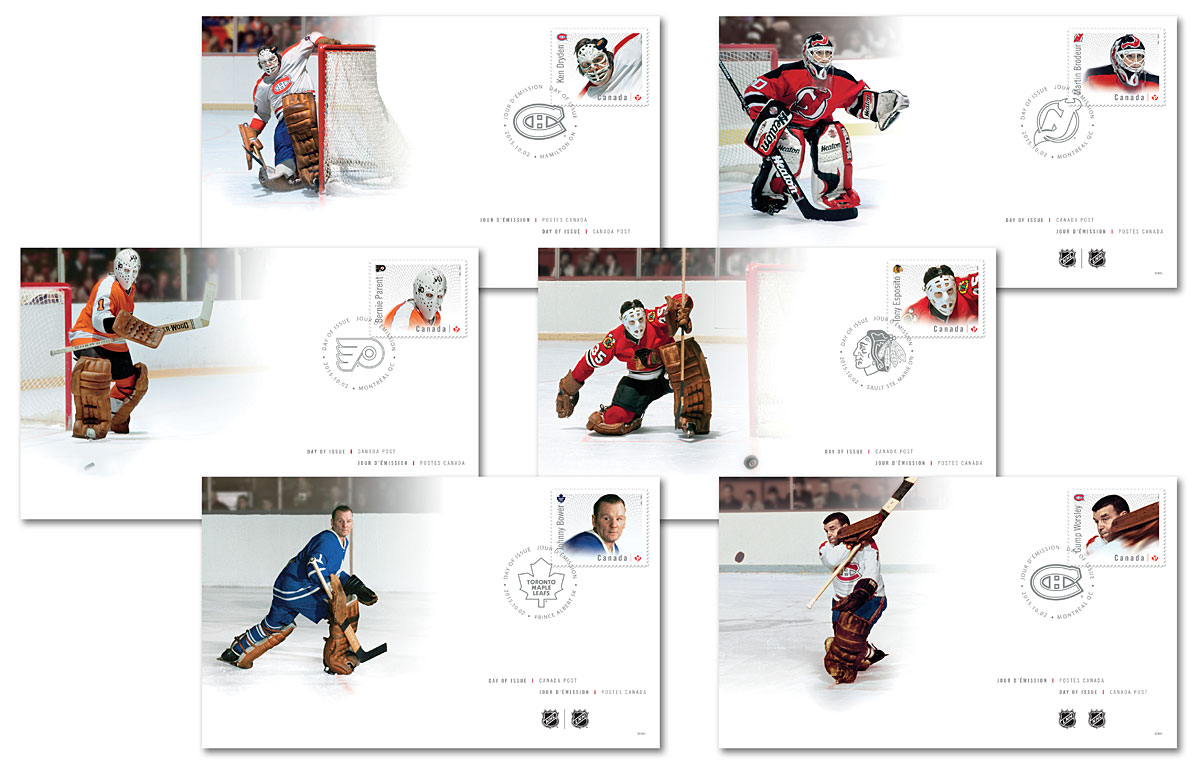
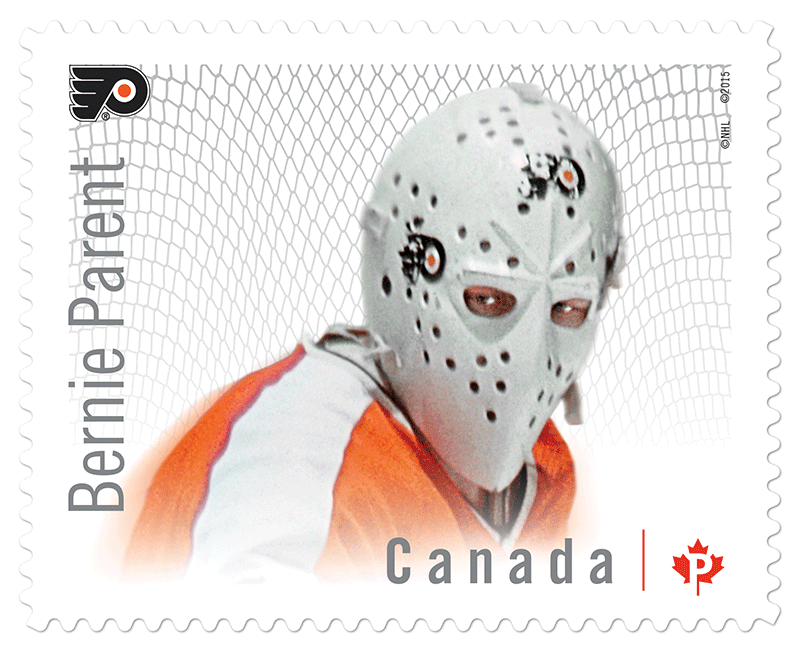
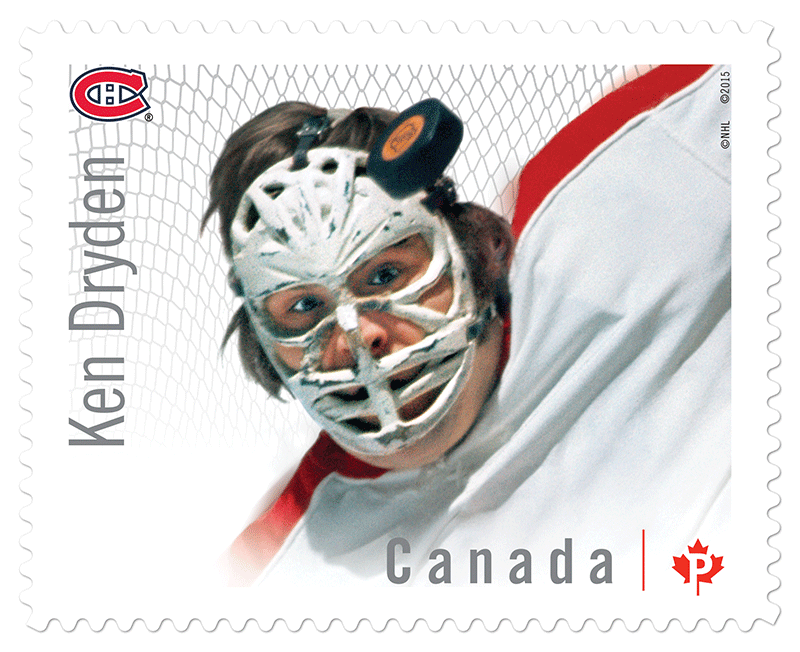
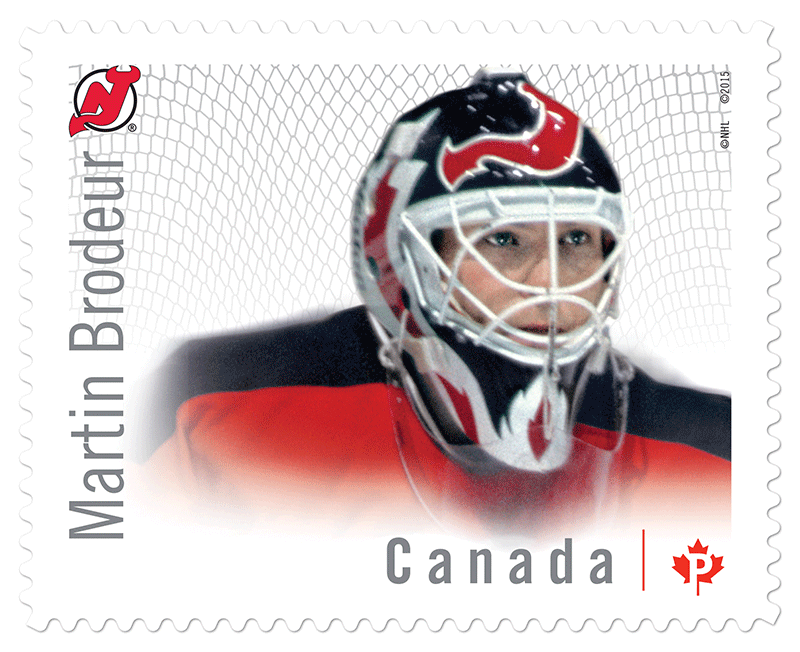
The 2015 NHL Great Canadian Goalies set highlights some of the finest goalies to play in the NHL between 1952 and 2015: Lorne “Gump” Worsley (Montreal Canadiens), Johnny Bower (Toronto Maple Leafs), Tony Esposito (Chicago Blackhawks), Bernie Parent (Philadelphia Flyers), Ken Dryden (Montreal Canadiens) and Martin Brodeur (New Jersey Devils).

All won the most coveted of prizes – the Stanley Cup Championship and the Vezina Trophy, recognizing the NHL’s best goalkeeper. All changed the way the game was played or perceived, making them larger-than-life figures.

can_goaliesbkltcan_goaliesfdc“These six goalies will forever remain relevant and real in a country that embraces its stars,” says Canada Post President and CEO Deepak Chopra. “They wore their hearts on their sleeves while they played, and captured ours in the process. Their on-ice brilliance left an indelible impression on a nation. They are an important part of our country’s rich history, and we are proud to immortalize these players on our stamps.”

“Many people dream of playing in the NHL, but only a distinguished number of players achieve it; and an even smaller, esteemed group leave a timeless impression,” says Bill Daly, NHL Deputy Commissioner. “Having some of the greatest NHL goalies immortalized on these stamps is remarkable; a true testament to their impact on hockey fans around the world. We’re proud to share this momentous occasion with the players, their loved ones, and the fans.”

Four of the five living hockey legends attended the unveiling ceremony in the Esso Great Hall, home of the Stanley Cup at the Hockey Hall of Fame in Toronto. Martin Brodeur, St. Louis Blues Assistant General Manager, was represented by his nephew, Philippe Gendron. Doreen Worsley, Gump Worsley’s widow, represented her husband at the event attended by hundreds of other dignitaries and fans.

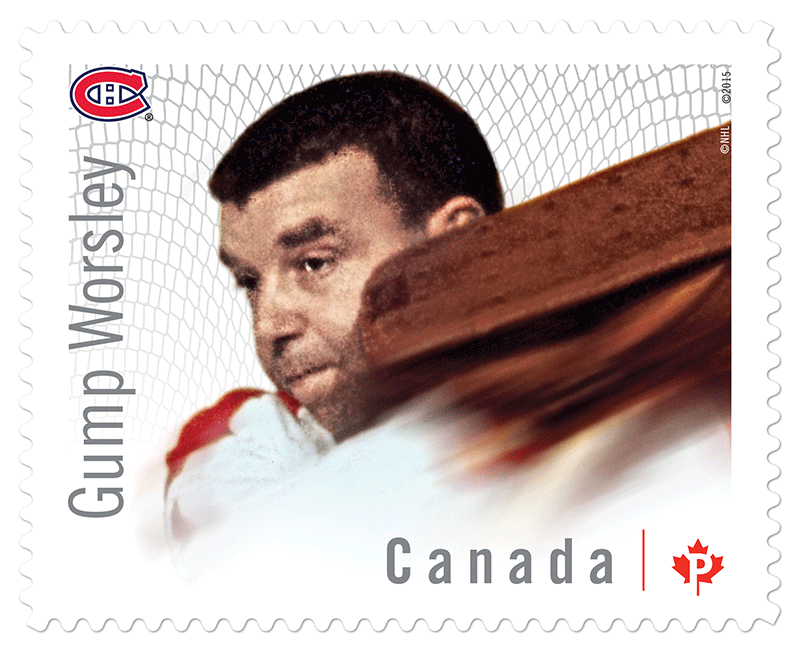
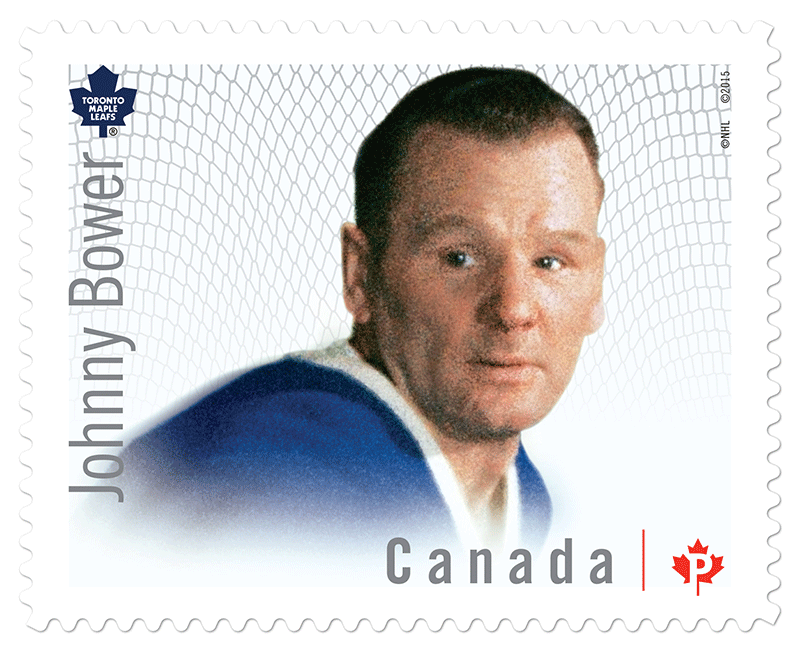
Avi Dunkelman and Joe Gault of Mix Design in Toronto designed the six-stamp Canadian issue, which features head-and-shoulder images of the players in uniform. The players are portrayed the way fans remember them. Four of the six are in masks. Two – Worsley and Bower – are without.

Oversize rate souvenir sheets resembling hockey cards and featuring full images of the players in game action are also offered. The back of the souvenir sheets complete the hockey-card experience, offering career statistics that tell part of the players’ professional story. They are available in packs of six, like hockey cards.

The lineup:

can_worsleyLorne “Gump” Worsley: New York Rangers (1952-53, 1954-55 to 1962-63), Montreal Canadiens (1963-64 to 1969-70), Minnesota North Stars (1969-70 to 1973-74). Born May 14, 1929, Montréal, Que. Worsley’s innovative style of lying on his side and making a wall of his pads became known as “Stacking the Gumpers.” The jokester who once said his face was his mask won the Calder Memorial Trophy as rookie of the year for the Rangers in 1953. With the Canadiens, he won the Stanley Cup Championship four times and the Vezina Trophy twice as the NHL’s best goalie between 1965 and 1969. He was inducted into the Hockey Hall of Fame in 1980.

can_bowerJohnny Bower: New York Rangers (1953-54, 1954-55, 1956-57), Toronto Maple Leafs (1958-59 to 1969-70). Born November 8, 1924, Prince Albert, Sask.Bower was a pioneer of the goalie poke check – diving headfirst into an attacking player to dislodge the puck from his stick. This he did without the protection of a mask. A member of Toronto’s last Stanley Cup championship team, Bower captured four Cup Championships in his career (1962, 1963, 1964 and 1967). He also won the Vezina Trophy twice (1961 and 1965). He retired at age 45 and was inducted into the Hockey Hall of Fame in 1976.

can_espositoTony Esposito: Montreal Canadiens (1968-69), Chicago Blackhawks (1969-70 to 1983-84). Born April 23, 1943, Sault Ste. Marie, Ont. The man fans called “Tony O” was a pioneer of the now-popular butterfly style. He started his NHL career making 13 regular season appearances for the Montreal Canadiens in 1968-69. A year later, he won the Calder Memorial Trophy as rookie of the year as a member of the Blackhawks. He would win the Vezina Trophy as best goalkeeper in 1970, 1972 and 1974 and play in the 1972 Summit Series against the Soviet Union. He was inducted into the Hockey Hall of Fame in 1988.

can_parentBernie Parent: Boston Bruins (1965-66 to 1966-67), Philadelphia Flyers (1967-68 to 1970-71, 1973-74 to 1978-79), Toronto Maple Leafs (1970-71 to 1971-72). Born April 3, 1945, Montréal, Que. Considered by many as the last great standup goalkeeper, Parent won the Stanley Cup, Vezina Trophy and Conn Smythe Trophy as most valuable player to his team in the playoffs in 1974 and 1975. His white Fiberglass mask with Flyers logos at each temple became iconic, making the cover of Time magazine in 1975. His mask decorations preceded the grandiose works of art that are modern-day masks. He was wearing his mask a night inFebruary 1979 when a stick accidentally poked through its right eye hole, causing permanent damage to Parent’s vision and ending a magnificent career at age 34, while he was still in his athletic prime. Parent was inducted into the Hockey Hall of Fame in 1984.

can_drydenKen Dryden: Montreal Canadiens (1970-71 to 1972-73, 1974-75 to 1978-79). Born August 8, 1947, Hamilton, Ont. Dryden not only shone on the ice, but influenced the way we perceived our national winter sport through his writing and teaching. The Game, one of several books authored by Dryden, was published in 1983 and described by one journalist as an intriguing “meditation on hockey’s special place in Canadian culture.” Dryden won the Stanley Cup Championship six times, his first before playing a full season in the NHL. He remains the only NHL player to ever win the Conn Smythe Trophy as playoff MVP before winning the Calder Memorial Trophy as rookie of the year. In just more than seven full seasons, Dryden won the Vezina Trophy an amazing five times. He also played for Team Canada in the 1972 Summit Series against the Soviet national team. He was inducted into the Hockey Hall of Fame in 1983, his first year of eligibility.

can_brodeurMartin Brodeur: New Jersey Devils (1991-92 to 2013-14), St. Louis Blues (2014-15). Born May 6, 1972, Montréal, Que. Brodeur made hockey history with puck-handling prowess so remarkable that lead to “The Brodeur Rule” in 2005-’06, limiting where goalkeepers can handle the puck outside the crease. He won the Calder Memorial Trophy in 1993-94, his first full year as the Devils’ starter, and the Stanley Cup Championship three times over his career. He is a four-time Vezina Trophy winner, and five-time winner of the William M. Jennings Trophy for the fewest goals against. Brodeur also won two Olympic gold medals with Team Canada in the 2002 and 2010 Winter Olympic Games, and is the only goalie in NHL history with eight 40-win seasons. He is also one of only two goalies to have scored a goal in both the regular season and the Stanley Cup Playoffs.

The 2015 NHL Great Canadian Goalies set is the third of a five-year collection of NHL stamps leading up to the NHL’s 100th anniversary in 2017. The issue builds on the NHL Team jerseys stamps released in 2013 and the Original Six™ defensemen issue released last year. Canada Post has produced more than 50 NHL-themed stamps since 1992.

The NHL goalkeepers’ stamps and all related products are available online at canadapost.ca/NHL.

About the 2015 NHL Great Canadian Goalies Stamps
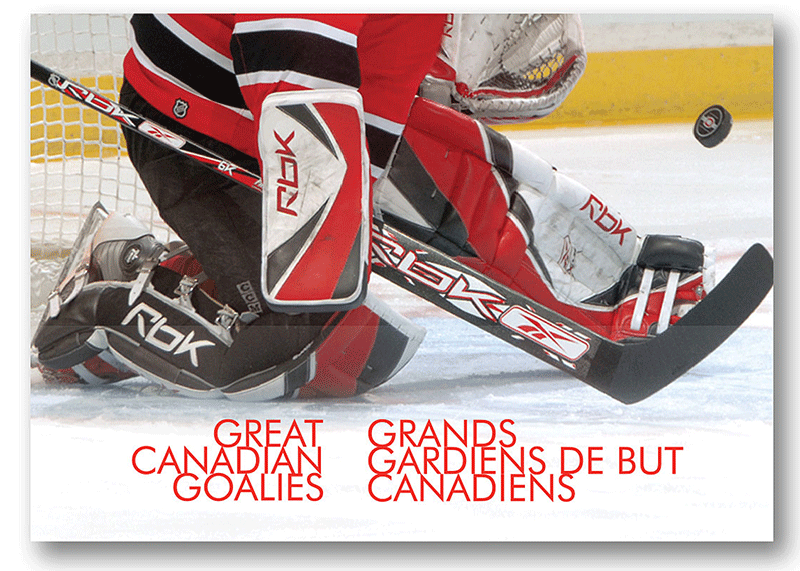
Available in a mixed booklet of six, one for each player, the stamps measure 40 mm x 32 mm with simulated perforations, and are printed by Lowe-Martin onTullis Russell paper with seven-colour lithography. The booklet front features a photograph of Martin Brodeur, taken by his father, Denis Brodeur, while the inside cover features a Hockey Hall of Fame archival photograph of Gump Worsley and Johnny Bower shaking hands after a playoff game in 1962. Oversize rate hockey-card-size souvenir sheets are available in a pack of six, as well. Each includes a chance to win: one in 40 packs has a signed and authenticated souvenir sheet. Related products: A gummed mini-pane collectors’ item featuring all six players. The mini-pane features embossed, foiled logos of the team each player was best known for and an embossed image of Jacques Plante’s first game-worn mask. The Official First Day Covers – one for each player – will be cancelled in the birthplaces of the players: Montréal, QC (Worsley, Parent and Brodeur); Prince Albert, SK (Bower); Sault Ste. Marie, ON (Esposito); and Hamilton, ON(Dryden). Limited edition numbered framed prints are available for each player. Bower, Brodeur, Esposito and Parent have signed prints.

Butterline Runs for APS Secretary

Dear Fellow APS Members,

ButterlineMy name is Mark Butterline and I am announcing my candidacy for the position of Secretary on the APS Board of Directors.

My main goal in running is to bring more people into our great hobby, and more collectors into the American Philatelic Society. In other words, maximum philatelic fun to the greatest number of people! There are many people out there for whom philately would bring them much joy. But they just don’t know it, yet.

This is the biggest challenge facing the philatelic community and the APS is the organization best equipped to do something about it. This task squarely falls upon the shoulders of the new Executive Director and the APS Board. They need to carefully analyze the current philatelic environment, identify our objectives and associated strategies, and then develop and execute plans to achieve those objectives. And they need to work with the whole APS community, collectors and dealers, while they do this. Our main challenges are about long-term strategy and communication (internal and external).

So who am I, and why should I be on the APS Board? Over the past 12 years, I have helped guide various philatelic organizations, large and small, while holding different leadership roles. I am the current President of the Northeastern Federation of Stamp Clubs. The Federation provides support services to 35 New England stamp clubs and their stamp shows, in addition to staging Philatelic Show, the annual WSP show in Boxborough, MA. I am a past President and Treasurer of the Pitcairn Islands Study Group and past Treasurer of the Waltham Stamp Club. Currently I am the Executive Director of the Boston 2026 World Stamp Show (the next international philatelic exhibition in the United States after New York 2016 – yes, there will be another big international show in America after New York). Much of my work in organized philately has been about analyzing organizational health and effectiveness, and developing and executing plans to improve that health and effectiveness.

As for my philatelic background, I discovered stamps at the age of four. My first acquisition was a large used multiple of the 1963 Sciences commemorative (Scott 1237). After soaking and drying, I affixed it to a piece of orange construction paper with thick white paste and exhibited it on my family’s refrigerator door. Since then my collecting techniques have improved. My current interests include stamps and covers of the Falklands, Pitcairn, United Nations, Germany, Bhutan and Expo67 postcards. I’ve been a proud member of the APS since 2003 and work on my collections almost everyday.

Professionally, I am a consultant that addresses both technical (IT) and business issues for companies ranging in size from 100 employees to multinationals. I am also an author of various articles, both professional and philatelic, as well as a book on software engineering. I am a graduate of Rutgers (1981 – B.S. Computer Science) and Cornell (1995 – M.B.A.). I am married, with a son, and live near Boston. If you have a questions or comments, please feel free to email me at mbutterli@gmail.com or call me at 1-978-407-9644.

Thank you for considering my candidacy for APS Secretary. I respectfully ask for your vote in next year’s Society election.

Mark Butterline

Hotchner: Roots

The Evolving of a Stamp Collection
by John M. Hotchner

hotchner If I ever began a column with a subject and little idea what I would say about it, this is it. I’m prompted to think about it by a realization that my journey in the hobby has come a long way from the days when my father gave me as an 11-year-old a packet of 1,000 worldwide stamps, and said, in essence, “Have fun!” He did know that I would, as I had pressed him to let me get started as early as age 5.

So I began what I now consider my apprenticeship as a worldwide collector with no date limitations. And I assumed that would be my approach forever. In 1954, this was not an unreasonable approach. Today, what I see happening is that this is not the way that most who come to the hobby begin. Rather they start as topical collectors based on another interest they may have; be it trains, space, cats, Princess Diana, Chinese New Year, or anything else that might tickle a mind engaged in today’s events or other aspects of their lives.

I believe this trend is equally true whether the new collector is young or an adult, though I think that the urge to collect one’s own country of origin or citizenship is probably more an adult way to approach the hobby than the topical approach.

Worldwiders are a vanishing species, and where I see it continuing to be a presence is in the realm of collecting time periods. The early trend was to collect the first century, 1840-1940, because it limited the challenge. And to hear it discussed, the stamps of this period were if not more colorful and attractive, then they at least represented the time when stamps were actually issued to be used, and the quality of production resulted in aesthetically beautiful engraved designs.

Today, there seem to be more worldwiders who prefer later time periods, or worldwide stamps from the year of their birth, or stamps that are blue, or stamps that feature in their designs a particular type of subject. Yes, we are back to topicalists, who are indeed a species of worldwide collector!

What I have learned is that however our collecting interests end up, they are likely to have become something very different from where we began. There are many reasons. Regardless of how generally we begin, or with what subject, as we play with our stamps, and acquire more, it is only natural that we are attracted to some stamps more than others. For the true worldwider, that may be because of the attractiveness of the stamps, the content of the designs, a connection to family origin or history (to include service in an area under military occupation or in combat), and for other reasons.

For the country collector, usually a particular issue (The Prexies, The Liberties, Washington-Franklins, may stand out; or you may be attracted especially to the Columbian issues, or Revenues.

So long as the bank account holds out and you can buy anything you wish, collecting broadly is no problem. You can add to your collections what you find. But for those of us, in fact most of us, who have limited funds to spend on our hobby, there usually comes a time when we have to decide to focus on one or more particular areas of interest, and to stop spending our scarce resources on things that do not give as much pleasure.

For me there was another pressure to retreat from worldwide collecting. At age 12, I began going with my father to the New Delhi, India Stamp Club. At a particular meeting, the club was holding its members-only auction. I had just gotten my 5 Rupees allowance, and flush with cash decided to bid on a lot of inexpensive India official overprints. Trouble was that in my enthusiasm to win the lot, I did not realize that I was bidding against my Dad. He won the lot, but not until he had been bid up to a level beyond my 5 Rupees. He was not, in today’s jargon, a Happy Camper.

This led us, once he started speaking to me again, to dividing up the world into his countries and my countries. In the course of that division of labor, I was also forced to consider what my slim resources could support, and I ended up with about 15 countries that I really liked. He ended up with about the same number, but countries that stamp-for-stamp cost a lot more. We agreed that we would each pursue our own USA collections — only his would be mint and mine would be used. We, mostly me, also agreed that we would not bid against each other any more.

I ultimately dropped a couple of the countries I had chosen, and again, ultimately, inherited his collections. I have continued most of his countries along with mine; a combined total of 22 countries plus a few that I have picked up along the way like Italy (my wife’s heritage) and Peru because a nephew married into a Peruvian family.

The countries I have kept up have been for a variety of reasons. For example, Poland (heritage), China (interesting complexity of the overprints), France (attractiveness of the stamps), Russia and Soviet Union (academic interest; especially in the period up to 1925), the early stamps of Great Britain (the fascinating number cancellations), and India, Pakistan, Nepal, and Bangladesh (because of the history they represent and the fact that I lived in the region as a teenager).

For true worldwide collecting, my early collection of stamps honoring every aspect of United Nations involvement got cut down to what I could afford, including World Refugee Year, and World United Against Malaria. And my early interest in number and letter cancellations has evolved into a collection of stamps costing no more than 10¢ with a clear number and/or letter cancel. In my U.S. collecting, I fairly rapidly reached a point where I had everything I could reasonably afford — as a teenager, everything that cost under $2! But I discovered a wide range of specialized material that cost next to nothing at the time, but found interesting. And based on the prices, apparently this material had not been discovered by the mass of collectors.

Among these were the “F” category of Errors, Freaks and Oddities. I could not afford the Errors. But I could and did seek out misperforations, color varieties, paper folds and creases, and anything else from the production process that was defective and classed by most collectors as damaged stamps.

Also of interest and added to my U.S. collecting were in depth interests in plate singles of the Liberty issue, all Bureau precancels, non-Bureau precancels of the Washington-Franklin issue, and Christmas seals — which eventually evolved into specialized collections of the 1934 and 1935 seals.

But along the way, I was also bitten by the U.S. postal history bug, which never interested Dad. Specifically, I found fascinating the wide range of reasons that mail might be delayed through the fault of the mailer, the fault of the postal system, or how blind luck might intervene, such as with a plane crash, hurricane, or pranksters throwing firecrackers into a mail collection box.

While retaining my interest in stamps, the lure of covers has pushed me in new directions: for examples rates paid by the stamps used, covers rerouted because of the exigencies of war, and covers that were used to comply with the social practices surrounding the mourning of relatives, friends and high profile leaders.

Bottom line (a truly appropriate term), my trek through the by ways of stamp collecting has been influenced by financial resources, family and professional considerations, the aspects of specific countries that I have found interesting, and blind luck — the specialties I have been introduced to by other collectors.

The result of how my collecting has evolved is that I went from a worldwide collector to a collector of several of the world’s countries, and in many cases, have delved into one or more aspects of the philately of the countries I enjoy.

Along the way I have made peace with the fact that I will never own the great rarities of the countries I enjoy but in just about all cases I have collections that are over 90% complete, and there is enough variety of things to work on and update that I am never bored. Nor do I come close to breaking the bank in order to maintain my interests.

Who could ask for more?!


Should you wish to comment on this editorial, or have questions or ideas you would like to have explored in a future column, please write to John Hotchner, VSC Contributor, P.O. Box 1125, Falls Church, VA 22041-0125, or email, putting “VSC” in the subject line.

Or comment right here.