
[press release]
Royal Mail Issues New Stamps on the 250th Anniversary of the Birth Of William Wordsworth
- Wordsworth is regarded as having been at the forefront of the Romantic movement of British poetry
- The stamps also celebrate other notable Romantic poets from the period: William Blake; John Keats; Lord Byron; Samuel Taylor Coleridge; Mary Robinson; Percy Bysshe Shelley; Walter Scott; John Clare; and Letitia Elizabeth Landon
- Each stamp uses an extract from one of their most popular and enduring works, along with a specially-commissioned illustration by the artist, Linda Farquharson
- Royal Mail worked with the award-winning biographer, Jonathan Bate on the stamp; issue
- A full set of all 10 stamps, available in a Presentation Pack, retails at £8.50
- The stamps and a range of collectible products are available now at www.royalmail.com/romanticpoets and by phone on 03457 641 641
- The stamps will be available on general sale from today (7 April)
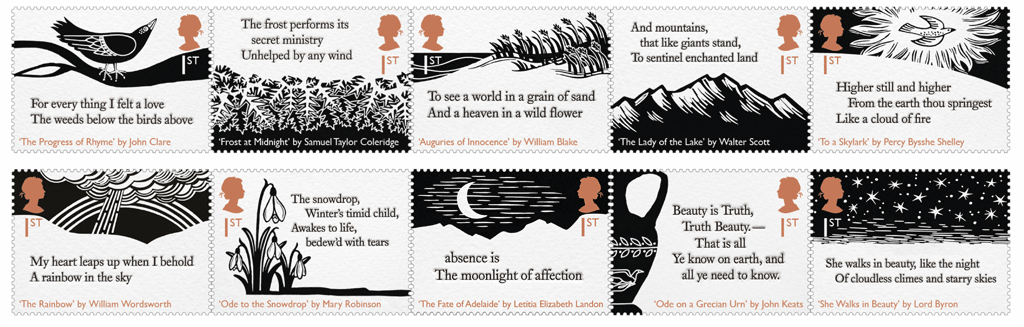 Royal Mail has announced the launch of 10 new Special Stamps on the 250th anniversary of the birth of William Wordsworth, the renowned Romantic poet, born on 7th April 1770.
 The stamps also celebrate other major Romantic poets: William Blake; John Keats; Lord Byron; Samuel Taylor Coleridge; Mary Robinson; Percy Bysshe Shelley; Walter Scott; John Clare; and Letitia Elizabeth Landon.
Each stamp uses an extract from one of their most popular and enduring works, along with a specially-commissioned, monochrome design that reflects the theme of the poem.
 The Romantic poets made poetry more passionate and more personal than ever before, and they embraced romantic landscapes and the natural world with vigour. Some became international household names. Lord Byron (1788–1824) was the original celebrity author and Sir Walter Scott (1771–1832) became famous as the inventor of the historical novel. By contrast, the genius of some others, notably William Blake (1757–1827) and John Clare (1793– 1864), was recognised only after their deaths.
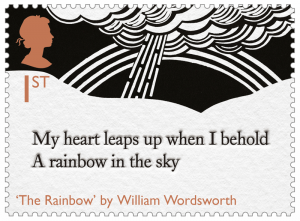 The poet who came to be seen as the primary voice of the Romantic movement, was William Wordsworth (1770–1850). Wordsworth’s early work was initially neglected. Lyrical Ballads (written with his friend and contemporary, Samuel Taylor Coleridge) and published anonymously, was often derided, but leading Victorian thinkers would come to regard him as the greatest English poet since Shakespeare.
In 1843, Queen Victoria made Wordsworth her Poet Laureate. 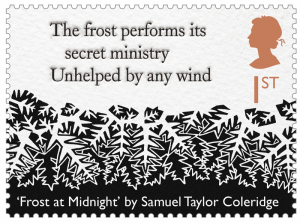 When he died seven years later, his influence was immense, and his poetry genuinely changed the world.
Coleridge (1772– 1834) wrote some of his best work around the turn of the century – penning the mysterious ‘Kubla Khan’ as well as his beautiful poem ‘Frost at Midnight’, addressed to his sleeping baby son Hartley.
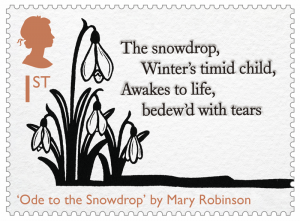
An admired female poet of the era was Mary Robinson (1757–1800) [stamp illustrated above]. In her mid-twenties, Mary was crippled by rheumatic fever and lost the use of her legs. She remade herself as a bestselling novelist, an author of a book arguing for women’s rights and a prolific lyric poet.
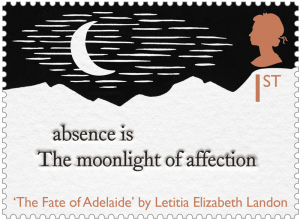 Many other women poets were celebrated during this period, including Letitia Elizabeth Landon (1802–38), who published under the initials LEL, and became known as ‘the female Byron’. Her life was beset by scandal, but her poetry – most of it published in the early 19th-century – was greatly admired for its intelligence and imagination.
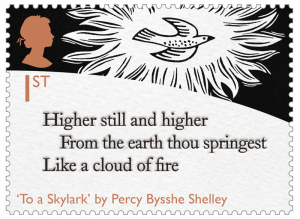
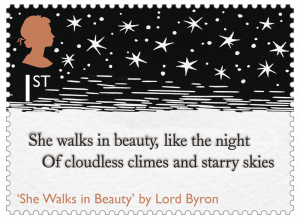 Technically, Lord Byron was a master of every poetic form, as adept in satire and wit as in the lyric of love or the evocation of Mediterranean landscapes. In exile on the Continent following a scandalous divorce, he befriended Percy Bysshe Shelley (1792–1822) [stamp design above]. Shelley was both a romantic idealist and a political radical: he was at his best in his glorious odes addressed to the skylark and to the west wind. He died, tragically, just before his 30th birthday, when out sailing in a storm off the Italian coast.
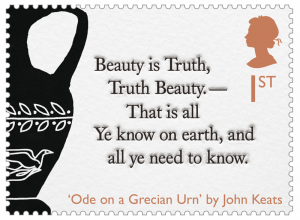 Another early death was that of John Keats (1795–1821), who succumbed to tuberculosis in Rome, aged just 25. Keats was the epitome of the Romantic poet: impoverished but idealistic, full of vitality in everything he wrote but always conscious of mortality. As with Shelley, his most anthologised poems are his odes, lyrical works addressed to a particular subject – in Keats’s case, a nightingale or the season of autumn or a beautiful urn that has survived since ancient Greece, with its depictions of sensuous scenes and its message that truth is beauty and beauty truth.
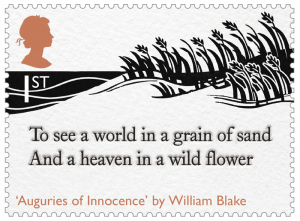
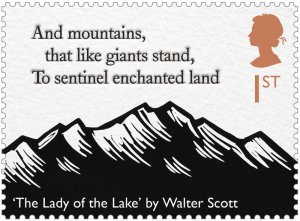 Some of the Romantics were highly respectable figures, such as Sir Walter Scott, whose poem, The Lady of the Lake,inspired generations of tourists to visit the Scottish Highlands; others were marginal, isolated figures. William Blake [stamp design below] published his own works in tiny, illustrated, hand-engraved editions. Though his ‘Jerusalem’ is now known by everyone, and his Songs of Innocence and of Experience are much loved, not many read his poems while he was
 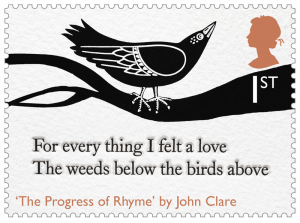 alive. John Clare, meanwhile, achieved brief fame as ‘the Northamptonshire Peasant Poet’ – he suffered from poverty, neglect and mental illness, spending the last 25 years of his life in a lunatic asylum.
Royal Mail spokesperson Philip Parker said: “The Romantic poets composed some of the most loved poetry of all time, and our striking new stamps celebrate the genius of their imaginations.”
 Royal Mail worked with the award-winning biographer, Jonathan Bate, on the stamp issue. The images are lino-cut illustrations by the artist, Linda Farquharson.
The full range of stamps, and other collectible products are available now at www.royalmail.com/romanticpoets and by phone on 03457 641 641.
The full set of 10 stamps, available in a Presentation Pack, retails at £8.50.
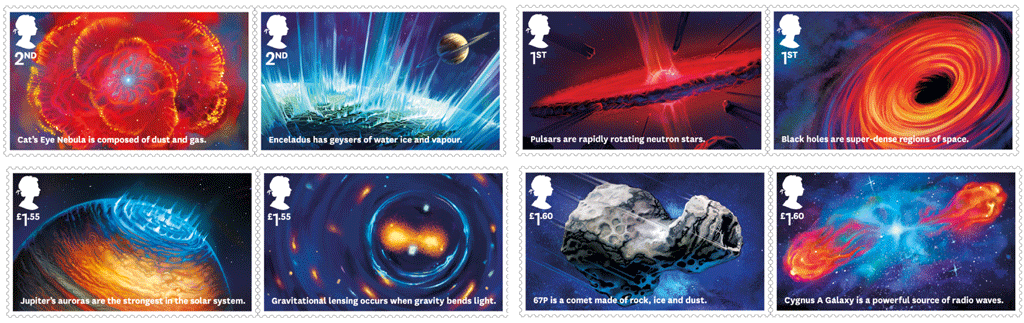
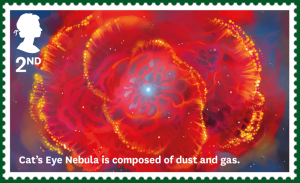 now expanding into space but was once inside a star, much like our own Sun. As the nuclear reactions that generate energy in its core were coming to an end, the uneven outflow of energy pushed the outer layers of the star off into space. The nebula was discovered by William Herschel ñ the first president of the RAS. In 1864, William Huggins used the pioneering technique of optical spectroscopy, in which light is split into an artificial rainbow and analysed, to prove that the Cat’s Eye Nebula was a tenuous gas, rather than a solid object. Huggins was awarded the prestigious Gold Medal of the Royal Astronomical Society in 1867.
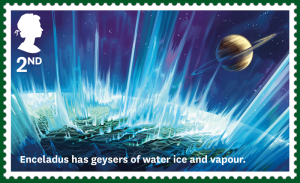 Enceladus is a small, icy moon of Saturn with a system of geysers that spray water and vapour into space. The geysers were found after the British-built magnetometer instrument on NASA’s Cassini spacecraft began sending back puzzling results indicating that Enceladus possessed a thin atmosphere. Michele Dougherty of Imperial College persuaded NASA to skim the space probe over the moon’s surface to take a closer look. In the process, the cameras revealed the geysers. Subsequent investigations have found that the geysers are fed by a subsurface ocean in which the water contains the molecular building blocks of life.
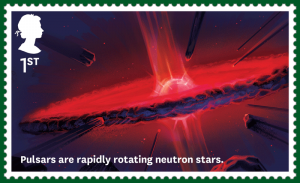 beam radiation across space like a lighthouse, sometimes many times a second. Every neutron star was once the energy-generating core of a massive star, but after exhausting its nuclear fuel supply it collapsed into an ultra-dense object, triggering the explosion of the star.
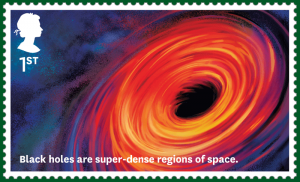 philosopher John Michell, and their behaviour was mathematically described in 1916 by the German physicist Karl Schwarzschild. Yet they seemed so unorthodox that astronomers were initially reluctant to believe they could truly exist. Only in the 1960s were black holes accepted, which led to a flurry of theoretical investigations.
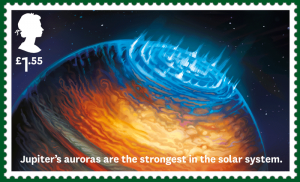 produced when charged particles accelerate into the atmosphere, giving off light as they collide with the gas atoms there. Earth’s auroras come in visible wavelengths of red and green, but at Jupiter they shine in the ultraviolet part of the spectrum and as X-rays. On Earth, powerful voltages in our magnetic field power the auroras, but this does not seem to be the case at Jupiter, where the source of power remains a mystery. A team of astronomers at the University of Leicester continues to study this phenomenon.
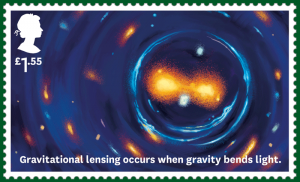 sources to form distorted and multiple images. The phenomenon was a prediction of Albert Einstein’s General Theory of Relativity. It was confirmed in 1979 when an Anglo-American team of astronomers that included Dennis Walsh and Bob Carswell discovered two distorted galaxies side by side that on closer inspection appeared to be identical. Astronomers can ‘weigh’ the amount of matter forming the gravitational lens by the appearance of the distorted images. This has shown that clusters of galaxies contain a lot more matter than can be seen. Astronomers call this invisible material ‘dark matter’.
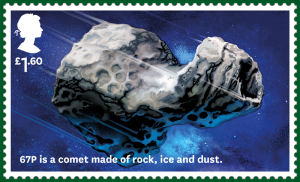 the European Space Agency’s Rosetta mission. UK industry and universities worked on the mission’s lander and instruments. We now know that 67P is an ancient object that formed before the planets, more than 4.5 billion years ago. Rosetta’s lander instruments revealed carbon-rich molecules in the ice. Such molecules could have been important in ‘seeding’ the early Earth and helping to get life started on our planet. Rosetta also showed that the comet’s two distinct lobes were once separate bodies that collided and stuck together.
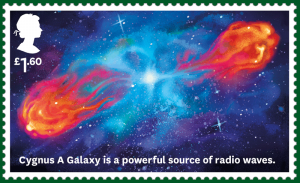 significant amount of energy within it. In the early 1950s, the Jodrell Bank radio observatory in Cheshire found that radio emission was not coming directly from Cygnus A but from a pair of radio lobes, one on either side of the visible galaxy. It is thought that energetic jets of particles are being accelerated away from the centre of the galaxy by strong magnetic fields. These particles collide with the extremely rarefied atoms in the space surrounding the galaxy, powering the radio lobes.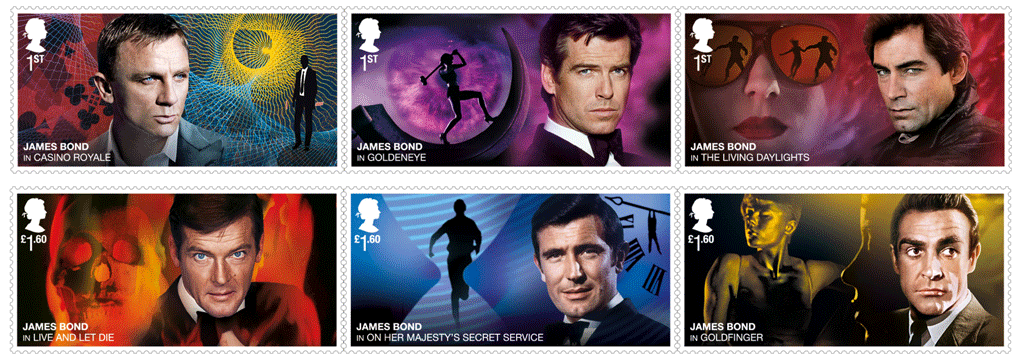

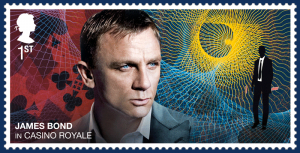 The sixth Bond (Daniel Craig) joined the series in 2006 as the producers turn to Ian Fleming’s first novel to re-imagine a harder-edged 007. Having just earned his 00 status and his licence to kill, Bond foils ruthless Le Chiffre, who uses terror attacks to manipulate the stock market. A jaw-dropping finale ends with the tragic demise of, Vesper Lynd.
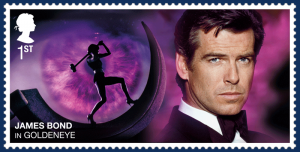 Although remaining involved, Cubby Broccoli passes on main producing responsibilities to his son and daughter, Michael G Wilson and Barbara Broccoli, who debuts in the producer’s chair. A new Bond (Pierce Brosnan) and a female M (Judi Dench) take the stage as a former agent, 006, threatens the world with a terrifying space weapon, GoldenEye.
 Timothy Dalton takes on the Bond mantle in this thrilling, lightning-paced adventure. The story draws inspiration from real-life East–West defections and Soviet-Afghan war in Afghanistan, as Bond defeats the ambitious Soviet General Georgi Koskov and a rogue US arms dealer called Whitaker.
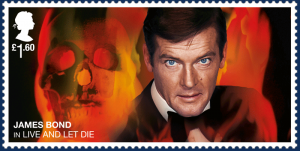 In Roger Moore’s first film as James Bond, 007 travels to Harlem, New Orleans and the Caribbean to investigate the mysterious Dr Kananga, known as Mr Big. Bond saves the day during a voodoo ritual and the stunt team sets a world record for a speedboat jump.
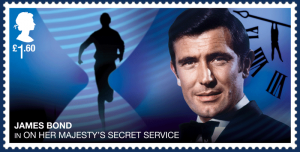 The film-makers unveil a new Bond (George Lazenby) and the adventurous Tracy Di Vicenzo (Diana Rigg) in a story that sees Bond marry. SPECTRE is bidding to blackmail world powers via biological warfare. Bond defeats Blofeld but is left devastated when his bride, Tracy, is gunned down on their wedding day.
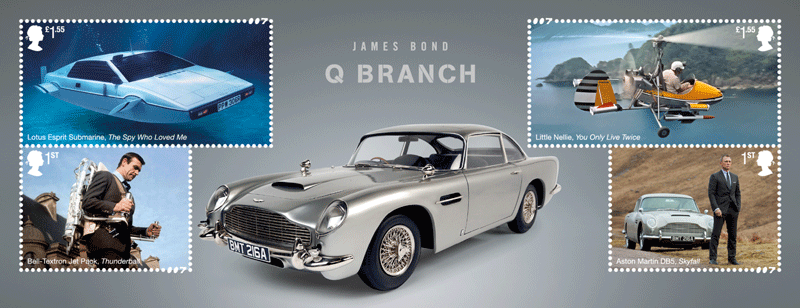
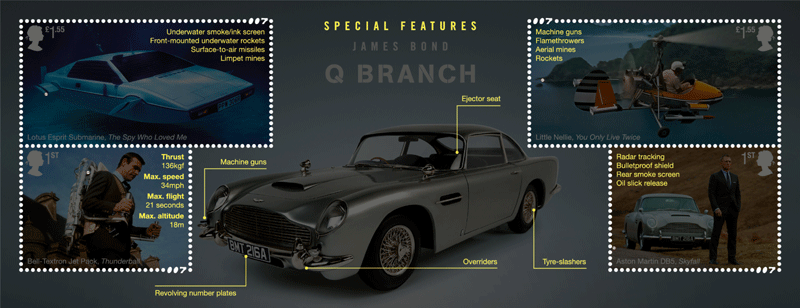
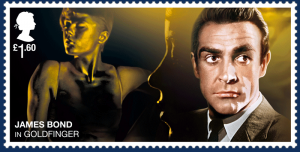 The third film starring Sean Connery introduces the iconic Aston Martin DB5, which combines ingenious gadgetry with understated elegance. The story sees Bond track gold smuggler, Auric Goldfinger, dodging death in the form of Oddjob, as well as a terrifying laser beam. Bond, with the help of Pussy Galore, foils a bid to render Fort Knox worthless.
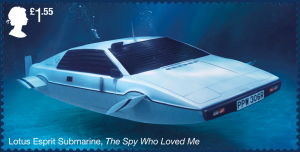 Lotus Esprit Submarine – The Spy Who Loved Me (1977)
 Little Nellie – You Only Live Twice (1967)
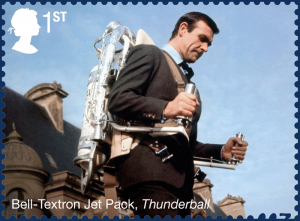 Bell-Textron Jet Pack – Thunderball (1965)
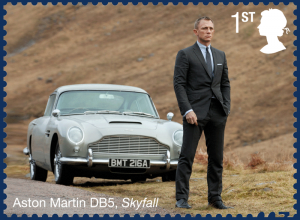 Aston Martin DB5 – Skyfall (2012)
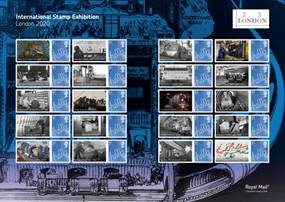 Royal Mail will celebrate London 2020 with a selection of special items that recall the worldís first adhesive postage stamps, the Penny Black, Twopenny Blue and Penny Red.
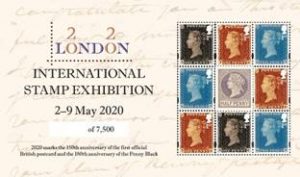 Ahead of the exhibition opening, a retail stamp booklet will be issued on 10 March. Containing two each of the Penny Black, Twopenny Blue and Penny Red designs, the inside of the booklet includes the official London 2020 logo. The stamps in this booklet are self-adhesive.
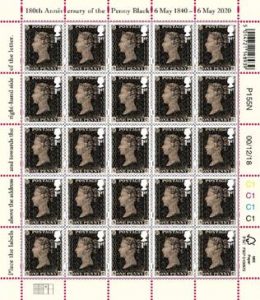 can be experienced as part of the attractions at The Postal Museum in London.
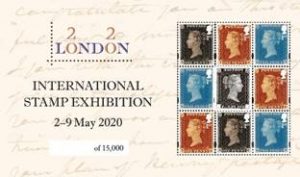 stamp design that appeared on the first postcard, while the sheet itself will carry an ëanniversaryí text. This sheet will be available in a numbered edition of 7,500.
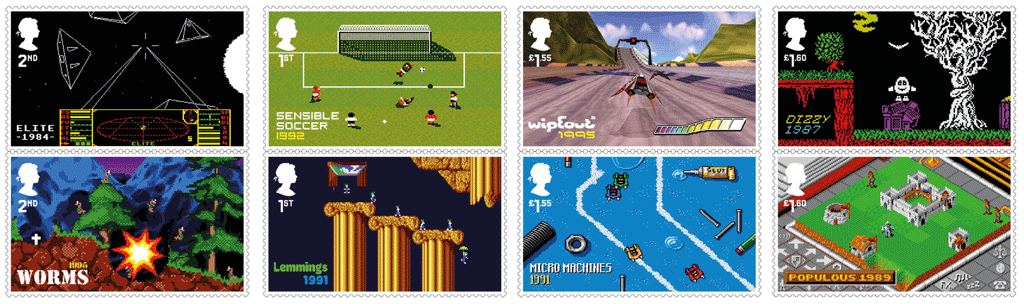

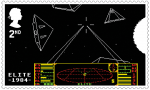 Elite (1984)
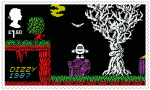 Codemasters. It went on to become one of the most successful British game franchises of the era. Originally created for the Amstrad CPC, it quickly converted to ZX Spectrum, Commodore 64 and other computers and consoles. The game’s main character is an adventuring egg that runs and tumbles around a fantasy world solving puzzles by collecting interesting objects.
 Populous (1989)
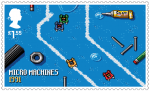 Micro Machines (1991)
 Sensible Soccer (1992)
 WipeOut (1995)
 Worms (1995)