
 Date of Issue: 01 May 2019
Size of stamp: W: 35 mm H: 50 mm
Face Value: NIS 11.80
Plate Block No. 1115
Designer: Tal Hoover
Printing Method: Offset
Printer: Cartor Security Printing, France
Sheet Type: Regular- Mini Sheet
Stamps per sheet: 10
Tabs: 5
No. of FDCs: 1
Price of FDCs: NIS 13
Place of cancellation: Jerusalem
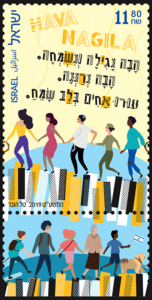
Hava Nagila is one of the most famous Hebrew songs in the world, arguably the most recognized of all Hebrew melodies. The lyrics were apparently written by composer Zvi Idelsohn and his students at the Lemel School. Idelsohn was the first professional Jewish composer in Jerusalem and in all of Eretz Israel. He was also a vocal and music teacher, musical arranger, choir conductor, cantor and mentor to young cantors. In addition, he researched Jewish music, meticulously collecting and compiling thousands of Jewish melodies from all of the Jewish ethnic groups and tribes and was the first to record music in Eretz Israel.
The song was composed when 400 years of oppressive Turkish rule in Eretz Israel came to an end and the Jews of Jerusalem were enthusiastic and joyful after the British troops led by General Edmond Allenby entered the city on the first day of Hanukkah, 1917. During such moments of joy the Hallel prayer of praise is recited in synagogue: “This is the day that the Lord has made; let us exult and rejoice on it”.
Idelsohn decided to compose a song in honor of this great event and arranged the melody based on a Hasidic tune that he heard in the Hasidic court of the Sadigura Rebbe. The ancient melody stems from the courts of the Chernobyl Hasidic dynasty and was heard in most Hasidic courts.
The song was first performed in 1918. It was later performed by many different artists, Jews and non-Jews alike. The melody was played at a dance in Jerusalem that same year, to great success. The words of the chorus are: “Let us rejoice and be glad, let us be happy, awaken brethren with a cheerful heart”.
The song was recorded in the 1920’s and spread among the Jewish communities of Europe and America. It reached New York, a center for Jews and also the music world, and quickly gained popularity. The catchy, rhythmic tune and the simple Hebrew lyrics made it a hit among the Jewish population and it became the core of Jewish celebrations, sung at weddings, bar and bat mitzvahs, etc.
Non-Jewish singers also embraced and performed the song, thus expanding its popularity in the United States and later throughout the world, and it eventually became a musical standard. Although lyrics have been written in other languages, most renditions of the song feature all of the Hebrew lyrics and it is probably the most recognized Hebrew song in the world.
The First Day Cover features part of the musical score to Hava Nagila.
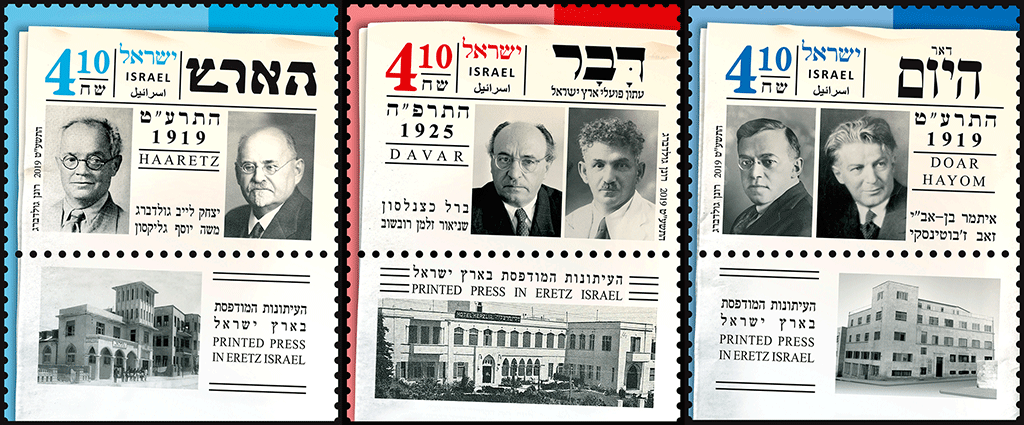
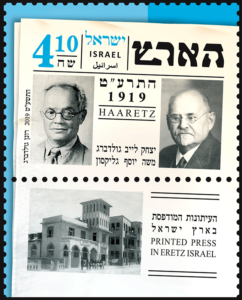 News of Haaretz was the civilian version of the British military weekly in Hebrew The Palestine News which was published for just one year (April 1918 – April 1919). When the British put it up for sale the Zionist Organization could not fund the purchase and called upon Isaac Leib Goldberg, a wealthy man and passionate Zionist from Eastern Europe, who acquired the newspaper and served as its first publisher.
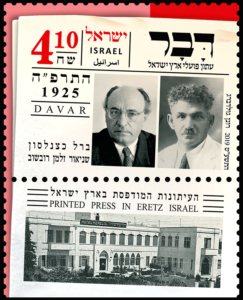 David Ben Gurion. The decision to publish a daily newspaper was made at the Histadrut’s founding convention in 1920, but its implementation was delayed by internal struggles within the organization. Berl Katznelson, the ideologist of the Labor Movement in Eretz Israel, founded Davar and served as its first editor. Shneur Zalman Rubashov (Shazar), later the third President of Israel, was his head assistant. Shazar succeeded Katznelson as the newspaper’s editor upon his death in 1944.
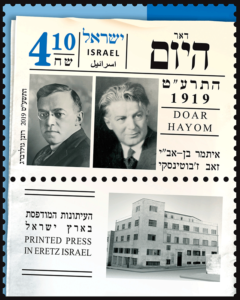 newspaper. Editor Itamar Ben-Avi derived the name of the Jerusalem-based newspaper from London’s Daily Mail. The right-wing Doar Hayom represented the veteran members of the Jewish Yishuv in Eretz Israel, the Sephardim and the farmers as opposed to the mid-left wing Haaretz and tended to publish more “scoops”, amusing stories from around the world and personal attacks on the heads of the Zionist movement and the Yishuv. Ben-Avi loathed Haaretz and used to say mockingly: “Haaretz may be a decent newspaper – but it isn’t a newspaper; Doar Hayom may not be decent, but it is a newspaper”.
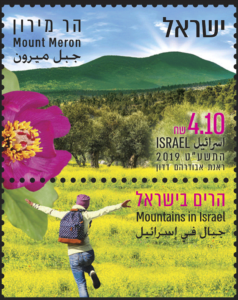 tz Israel west of the Jordan River and is one of the rainiest areas in Israel, and even has occasional snowfall during the winter months. These conditions allow plants such as the Wild Peony featured on the stamp, which are typical of the mountains in Turkey and Lebanon, to grow on Mount Meron, the southernmost point of their dispersion. Hiking trails are marked around the summit and along the slopes, leading visitors among the mountain’s many delightful natural and archeological treasures. Important prayer sites lie at the foot of the Mount Meron range, the most significant of which are the grave of Rabbi Shimon bar Yochai which is sacred to the Jews and the grave of Nabi Sablan, a sacred prophet of the Druze people.
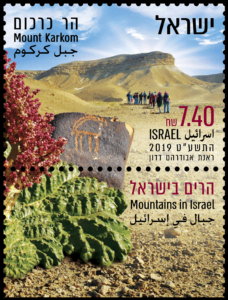 Negev Desert as well as the Sinai Desert. More than 40,000 rock drawings have been discovered on Mount Karkom and in the immediate area. These were carved by humans and include figures such as the Long Horned Deer that appears on the stamp. Many of the rock drawings show humans with their arms outstretched toward the heavens as if in prayer. The aridness of the area surrounding the mountain (which does not allow permanent inhabitance) along with the existence of the many rock drawings have led researchers to conclude that Mount Karkom served as a sacred place of worship and prayer, visited by caravans of merchants passing through the area and groups of believers who travelled there from distant lands. Prof. Emmanuel Anati, who devoted many years to researching the site, identified Mount Karkom as the Mount Sinai noted in the Bible, however this opinion is not accepted by most researchers in the field.
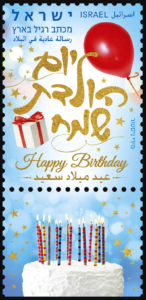 The Happy Birthday stamp joins the definitive Greetings stamps, which are also issued in the My Own Stamp sheet format.
 Science-Oriented Youth is an enrichment program operated in universities and other academic institutions in Israel with the support of the Ministry of Education. The program began offering expanded knowledge of science to Israeli youth at the Weizmann Institute of Science in 1964 and at Tel Aviv University in 1969 and currently operates in a number of additional institutions and units throughout Israel.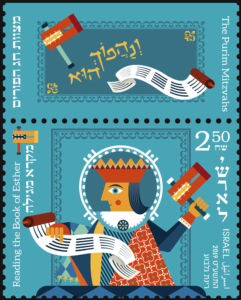
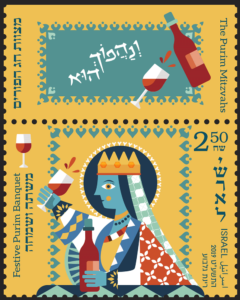 The lavish banquets hosted by King Ahasuerus and Queen Esther are well documented in the Book of Esther. The events that led to the Jews being saved occurred during these banquets. The Jewish wise men emphasized the importance of drinking wine during the Purim celebration and the Amora Rava even asserted that people must get drunk on Purim. This mitzvah is represented on the stamp by Queen Esther. The feast to which Esther invited Ahasuerus and Haman brought about the downfall of the Jews’ enemy.
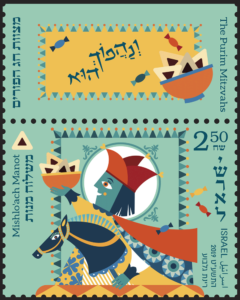 The Jewish wise men learned from the words “sending gifts (plural) to one another (singular) that everyone must send two types of food. A bowl of oznei haman, one of the symbolic foods of Purim, is shown in the hands of one of King Ahasuerus’ horseman, whose role was to deliver the King’s decrees throughout the kingdom.
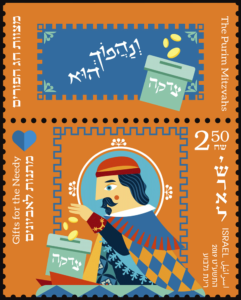 emphasized that “it is preferable for one to give numerous gifts to the needy than to expand his feast or increase his gifts to peers”. This important mitzvah is represented on the stamp by Mordecai who, according to the Book of Esther “was highly regarded by the Jews” (10:3).