
[press release]
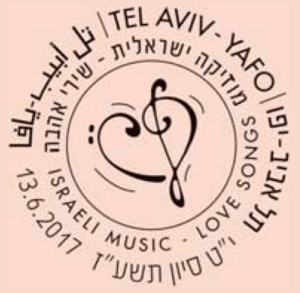
Israeli Music – Love Songs
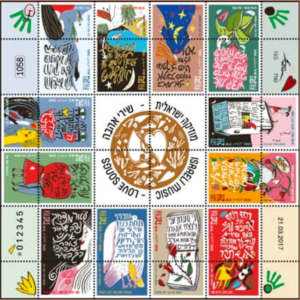 The people of Israel love to sing songs of love: love for God, love for their homeland, love for the world, love between a man and a woman. Some of the most beautiful poetic verses about love are found in the biblical Song of Songs. The Levites sang songs of love for God in the Temple. Through good and bad, throughout the world, during the Holocaust and the subsequent revival of the Jews, in war and in peace, the Jewish people have never stopped singing love songs.
The Israel Philatelic Service has selected 12 romantic love songs from a wide range of genres and times, songs that remind everyone of wonderful moments.
Atur Mitzchech Zahav Shachor (Your Forehead is Decorated in Gold & Black)
Lyrics: Avraham Chalfi, Melody: Yoni Rechter
Written in the 1950’s and set to music by Yoni Rechter in 1977. This very popular song was performed by Arik Einstein, accompanied by young singers Yehudit Ravitz and Corinne Allal.
Brit Olam (Universal Covenant)
Lyrics: Ehud Manor, Melody: Matti Caspi
Ehud Manor dedicated this song to his wife, singer Ofra Fuchs. He later gave it to his friend, composer and singer Matti Caspi, who added the words to the soundtrack he was composing for the film Hagiga BaSnuker (1975). Thus this magical love song was born. Matti named his firstborn daughter Brit.
 Lechol Echad Yesh (Everyone Has)
Lyrics and Melody: Uzi Chitman
One of the last hits by late songwriter Uzi Chitman, who wrote this love song in 2000 for his wife Aya when their son Yoav was drafted into an IDF combat unit. It expresses life and partnership coming full circle. Some interpret the song as one of love for Eretz Israel. It was performed as a duet by Shlomi Shabat and Lior Narkis and has become a popular wedding song.
Zemer Nogeh (Melancholy Song)
Lyrics: Rachel, Melody: Mordechai Zaira, Shmuel Kraus, Zohar Levy, Yosef Moustaki
This poem was written by poetess Rachel in the late 1920’s. It was set to music several different times, but became especially well known when Rona Ramon sent it to her husband Ilan Ramon, the first Israeli astronaut, who died in the Columbia space shuttle.
Hayu Leilot (There were Nights)
Lyrics: Yaakov Orland, Melody: Mordechai Zeira
This song was commissioned by the Kol Haruchot Theater in 1939. The songwriters met in the “Waiters Club” in Tel Aviv and completed it in the wee hours of the night, when it was first performed by the club’s waiters. Since then, the song has been sung by many singers, but it was the first song performed by Esther Ofarim as a soloist and from there she went on to be a star.
Slichot (Forgiveness)
Lyrics: Leah Goldberg, Melody: Oded Lerer
This poem appeared in Leah Goldberg’s book Shibolet Yeroket Ha’Ayin (Green-eyed Spike) in 1938. It was set to music by Oded Lerer in 1977 and sung by Yehudit Ravitz at the annual Song Festival.
Haperach Begani (The Flower in my Garden)
Lyrics and Melody: Avihu Medina
This song, which is considered to be a milestone in Eastern music, was written by Avihu Medina based on an experience of unrequited love in his youth. The song was written for the Eastern music festival “Lamenatze’ach Shir Mizmor” in 1982, where it was performed by Zohar Argov.
Kshe’or Dolek Bechalonech (When the Light is on in your Window)
Lyrics: Amos Ettinger, Melody: Alexander Argov
This song was written in 1964 for the Gesher Hayarkon trio. Ettinger wrote: “I love fairytales and the ones I don’t know, I make up… As long as I continue to believe that the light is on so that you can write your letters to me – I will keep waiting…”.
Tapuchim Ut’marim (Apples and Dates)
Lyrics: Eitan Glass, Melody: Rami Kleinstein
According to the lyricist: “In 1994, I was driving and listening to the tune from the film “Never on Sunday” and it reminded me of the bright light of Athens reflecting the colors from Mt. Lycabettus into the sea… the lyrics and the story for the song came to me in an instant, matched with a melody by Greek composer Hatzidakis. I pulled over and wrote down the lyrics. Later on, Rami Kleinstein set them to music”.
Rosa Rosa
Lyrics: Haim Hefer, Melody: Dubi Seltzer
Haim Hefer wrote this song for Yehoram Gaon, star of the 1973 film Kazablan, directed by Menahem Golan. The play Kazablan, written by Yigal Mossinson, was first performed in 1954 by the Cameri Theater, starring Yosef Yadin and Haya Hararit. In 1966 the play was turned into a musical starring Yehoram Gaon.
Pgisha Le’Ein Ketz (A Meeting to Eternity)
Lyrics: Natan Alterman, Melody: Naomi Shemer
This poem was published in Alterman’s book “Kochavim Bachutz” in 1938. Naomi Shemer set it to music and gave it to the “Shlosharim” trio in 1969. Since then it has been performed by many talented singers.
Hachnisini Tachat Knafech (Take Me Under Your Wing)
Lyrics: H.N. Bialik, Melody: Alexander Krane, Shmuel Alman, Paul Ben Haim, Menachen Avidom, Nurit Hirsch, Miki Gavrielov, folk tune
This poem was written by poet H.N. Bialik in 1905 in Odessa, for his beloved Ira Jan or for his wife Mania, or possibly for both… The words were set to music by numerous composers, including Paul Ben Haim, Nurit Hirsch, Miki Gavrielov and more, and it has been performed by many singers.
Nava Bodek Achiron, Series Editor
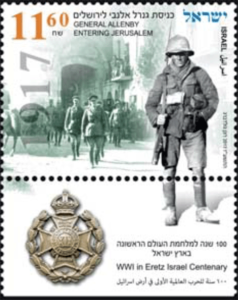 When WWI broke out in August 1914, the Ottoman Empire joined the Central Powers (Germany and Austria) against the Allied Countries (Britain, France and Russia). The Great War, as it was called at the time, lasted for more than four years and fundamentally changed world history, including the status of Eretz Israel.
 In late October 1917, the British surprised the Turkish forces by attacking the city of Beer Sheba and succeeded in breaking through the front line. British forces pressed on quickly, fighting intensely against the retreating Turks as they tried to establish numerous new lines of defense. By early December the southern coast had been conquered and the British reached the gates of Jerusalem.
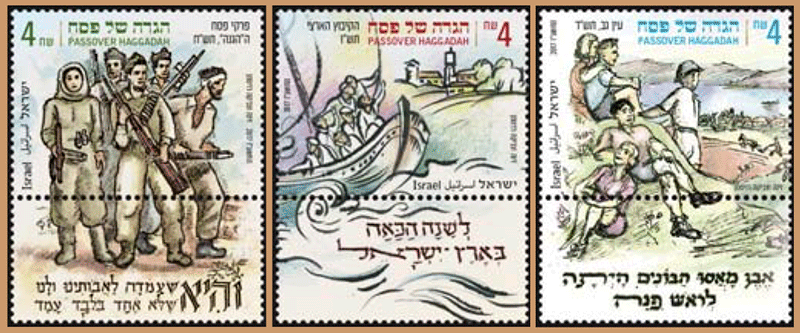 Issue date April 4, 2017
 The Kibbutz Artzi Federation, 1944 (Aliyah)
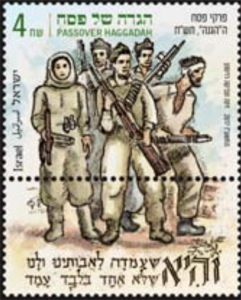
 Pirkei Pesach (Passover Chapters), Haganah, 1948 (security)
 Kibbutz Ein Gev, 1944 (settlement)
 Issue date April 4, 2017
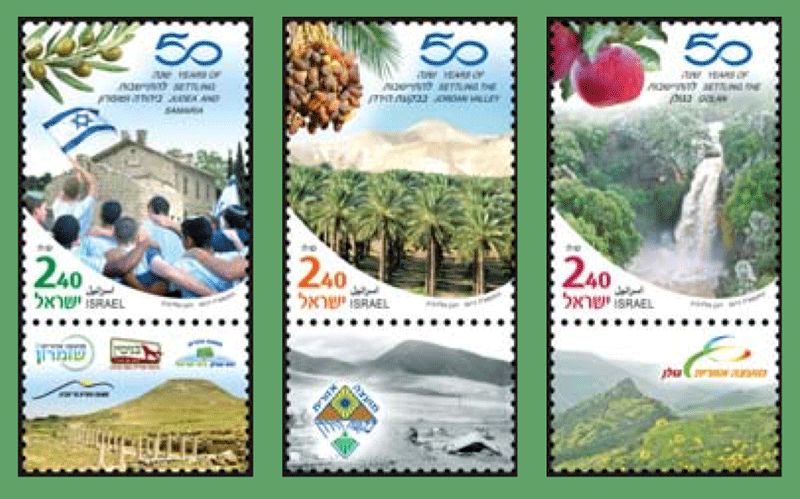
 Day War, the Israeli government led by Prime Minister Levi Eshkol adopted a plan to establish towns in the Golan Heights and the Jordan Valley, and within a decade dozens of new communities were established in these areas. The momentum of establishing new settlements in Judea and Samaria grew in the mid-1970’s, and increased significantly from 1977 after the new government headed by Prime Minister Menachem Begin took office.
 Remnants of ancient Jewish towns have been unearthed in archeological excavations near many of the new communities in the Golan Heights, Jordan Valley and Judea and Samaria. These communities renew and strengthen the historical bond between the Jewish people and its historic homeland.
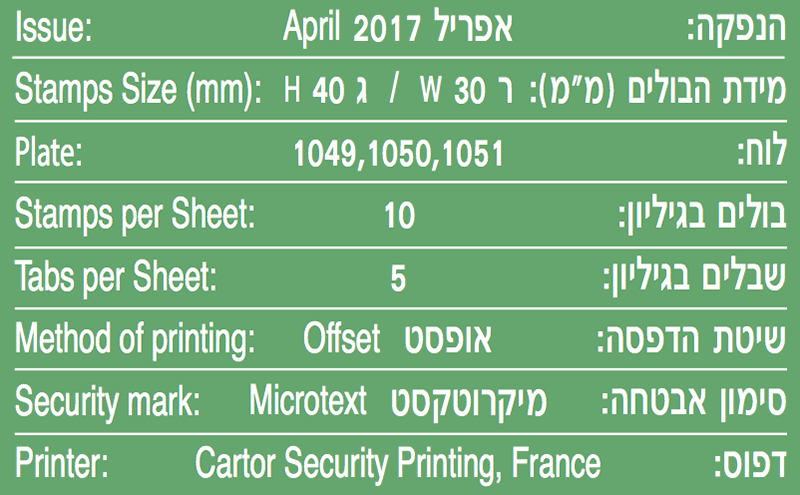
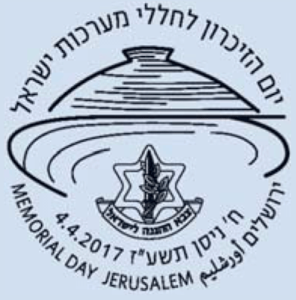
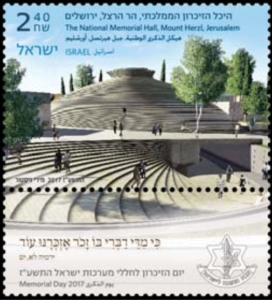 The letter card, cover and stamp – all of which are special and unique to Memorial Day – constitute the basis of a sensitive, original and extraordinary tradition that came into being following the War of Independence.
 The Memorial Hall’s location at Mount Herzl – the pantheon of Israeli heroism, constitutes a continuation of the Zionist vision of revival and realization.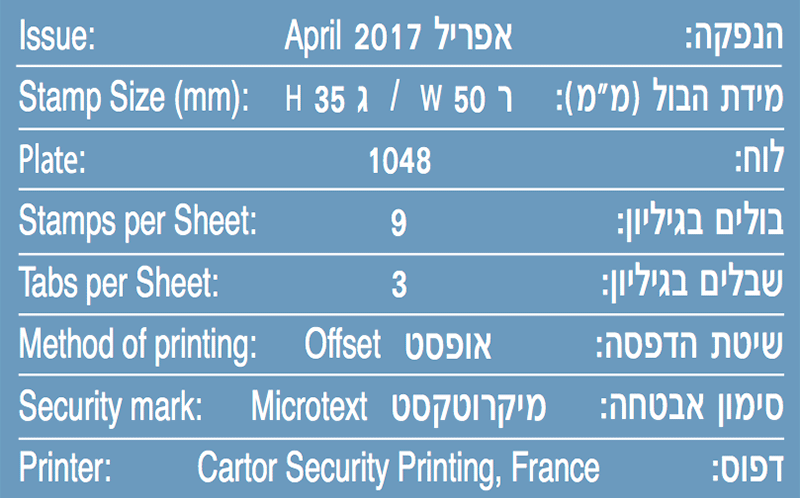
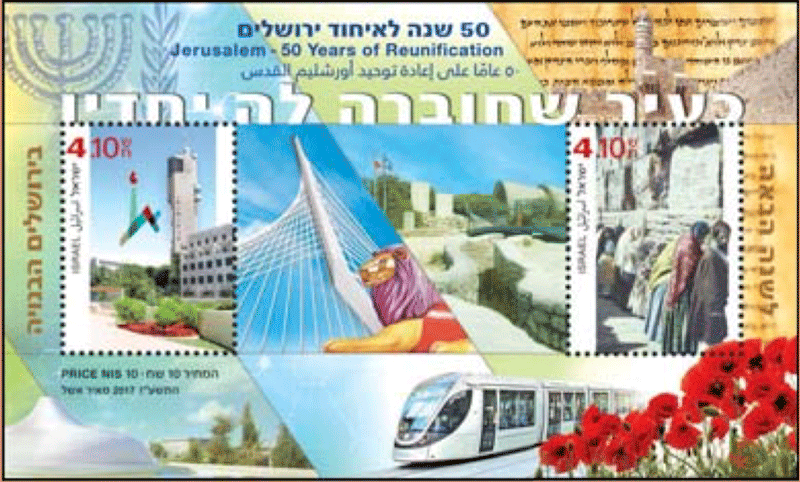
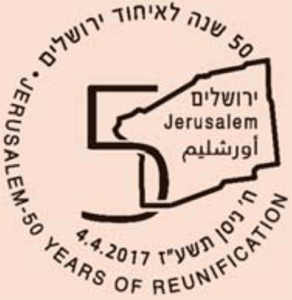 On the 50th anniversary of the unification of Jerusalem, the State of Israel is marking the historic event that took place in June 1967 with a series of events in Israel and abroad.
 Description of the Souvenir Sheet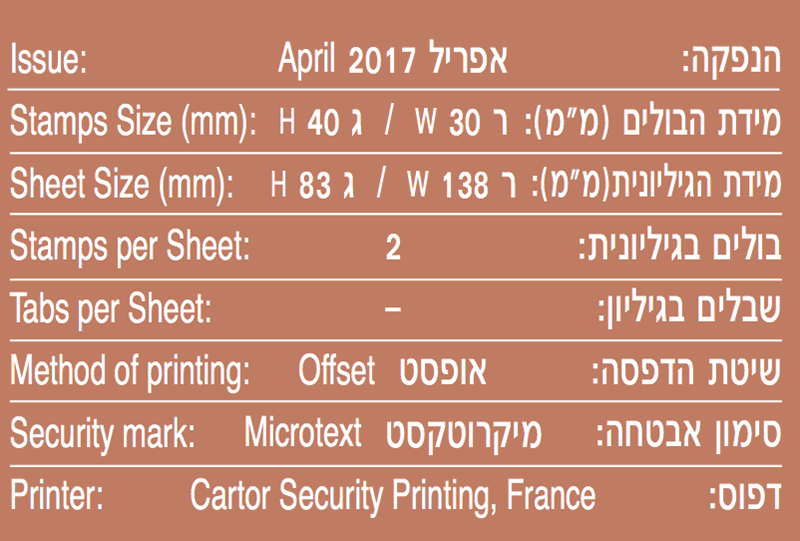
 The diplomatic relations between Israel and the Portuguese Republic developed in stages. An Israeli consulate was first opened in Lisbon in the late 1950’s. After the Carnation Revolution in Portugal in April 1974, this was upgraded to a general consulate and in 1977 to an embassy, the highest indication of full diplomatic relations. Since then the two countries have benefitted from friendly and collaborative relations in many fields.
 During WWII, many Jews passed through Portugal, mostly immigrating to other countries and later also to Israel.
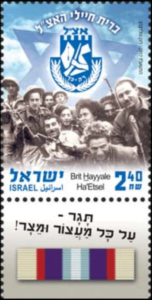 The National Military Organization in Eretz Israel (Etsel) broke away from the Haganah paramilitary organization in the spring of 1931. In the years before the establishment of the State of Israel in 1948, the organization operated clandestinely against Arab rioters during the revolt of 1936-1939 and took part in “Nonetheless” operations together with the Revisionist, Betar and HaTzohar groups to rescue European Jews before and during WWII. Members in Poland fought against the German enemy in the ghettos and took part in the Warsaw Ghetto uprising in 1943 as part of the Jewish Military Union, led by Pawel Frankel. Members in Eretz Israel were recruited to fight against Germany as volunteers in the British military. Etsel commander David Raziel was killed in the line of duty in Iraq on May 20, 1941. In February 1944 the Etsel, led by Menachem Begin, waged a campaign against the British authorities and government policy in Eretz Israel. Members were suppressed from within by the Haganah, but obeyed their leader’s decree never to take up arms against their brethren. Together with the Haganah-Palmach and Lehi, Etsel fighters, and especially those sentenced to death by hanging by the British Mandate courts, contributed to the establishment of the State of Israel. On July 13, 1980, the anniversary of the death of Etsel military leader Ze’ev Jabotinsky, Prime Minister Menachem Begin spoke at Mount Herzl in Jerusalem of those who fought both overtly and clandestinely: “Ö with their blood they sprouted the tree of freedom for their People, with their bodies they paved the way to the mountaintop”.
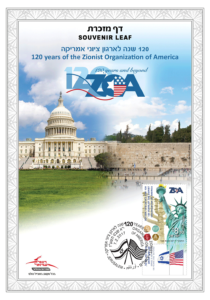 The ZOA, founded in 1897, is the oldest and one of the largest pro-Israel organizations in the United States. Its roster of distinguished presidents includes U.S. Supreme Court Justice Louis Brandeis, Rabbi Abba Hillel Silver who led the fight in America to reestablish the Jewish State, and currently, Morton A. Klein who was named one of the top five influential Jewish leaders by the Forward newspaper.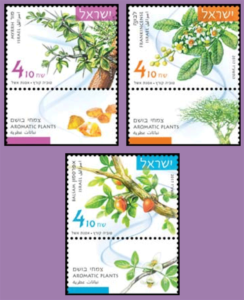
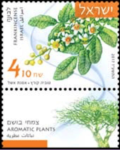 A genus (Boswellia) of the Burseraceae family that includes a number of tree and bush species from which the resin used for the incense called frankincense is derived. The resin is collected in containers after puncturing the bark of the young tree trunk.
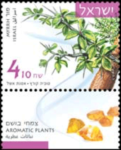 A genus (Commiphora) that also belongs to the Burseraceae family which includes species of bushes from which the resin used for the incense called myrrh is derived by slicing the bark of young branches. The species most commonly used is Commiphora mirrha.
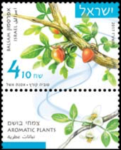 The balsam plant is mentioned in ancient writings and is consistent with the biblical Tzori plant which served as the source for producing high quality perfume. After some deliberation regarding the identification of the plant, there is now widespread agreement among researchers identifying it as one of the myrrh species of the Burseraceae family, Commiphora gileadensis, which still grows in the southern Arabian Peninsula. This plant was introduced to Israel and acclimatized in recent years and is now cultivated in the Ein Gedi and northern Dead Sea area.