
Author Archives: VSC
Wild Coasts (UK 2021)
[press release]
Wild Coasts
Issue Date: 22nd July 2021 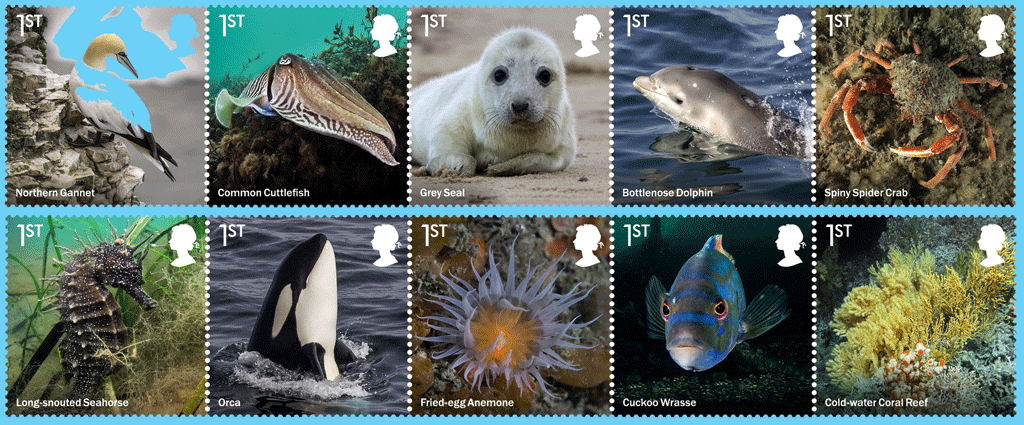 Product Range Summary
Set AS7400 £8.50 4
 Sheet MZ165 £5.10 5
First Day Envelope AE430 / ME157 £0.30 11
Presentation Pack AP493 £14.50 1
First Day Cover – Stamps AF475 £10.85 7
First Day Cover – Stamp Sheet MF161 £6.80 8
Press Sheet PZ055 £78.55 12
Collector’s Sheet AT128 £9.70 3
Souvenir AW191 £10.85 13
Stamp Sheet Souvenir AW192 £6.80 15
1st Class Stamp Book UB445 £5.10 6
Framed Stamps N3259 £29.99 2
Framed Collectors Sheet N3261 £29.99 9
Postcards AQ309 £6.75 10
 Full Sheet (x50) -NG AS7400AFS £42.50 14
Half Sheet (x25) – NG AS7400AHS £21.25 17
Full Sheet (x50) – TLSS AS7400BFS £42.50 16
Half Sheet (x25) – TLSS AS7400BHS £21.25 18
Reason and Inspiration
Nowhere in the UK is more than 70 miles from the coast, and our waters team with incredible marine life. This stamp issue celebrates the beautiful and surprising animals of our coastal seas and shores, with the UK waters and British Isles providing unique habitats for a multitude of species.
 Stamps
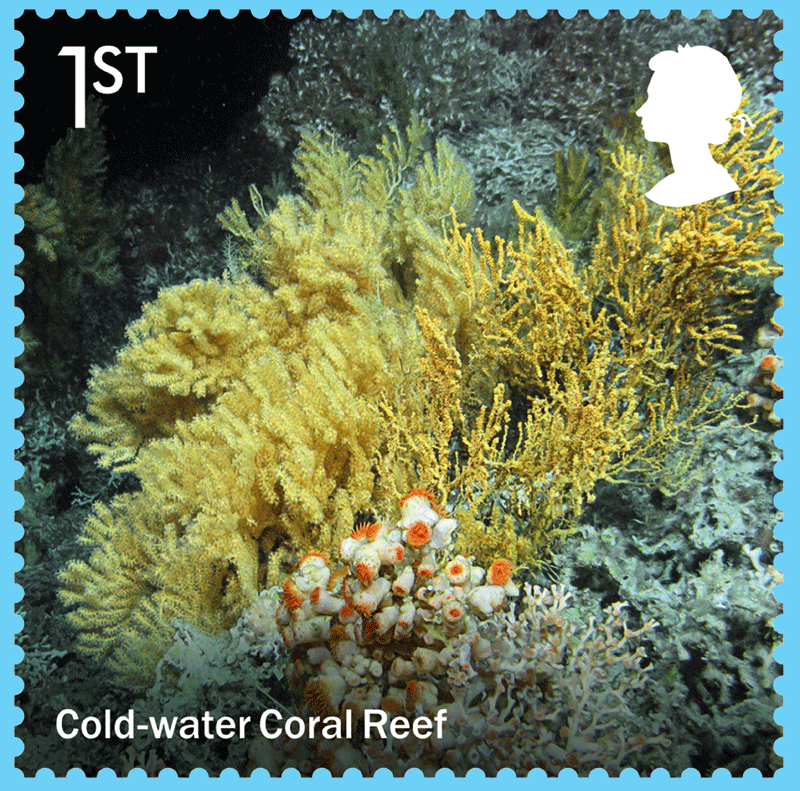
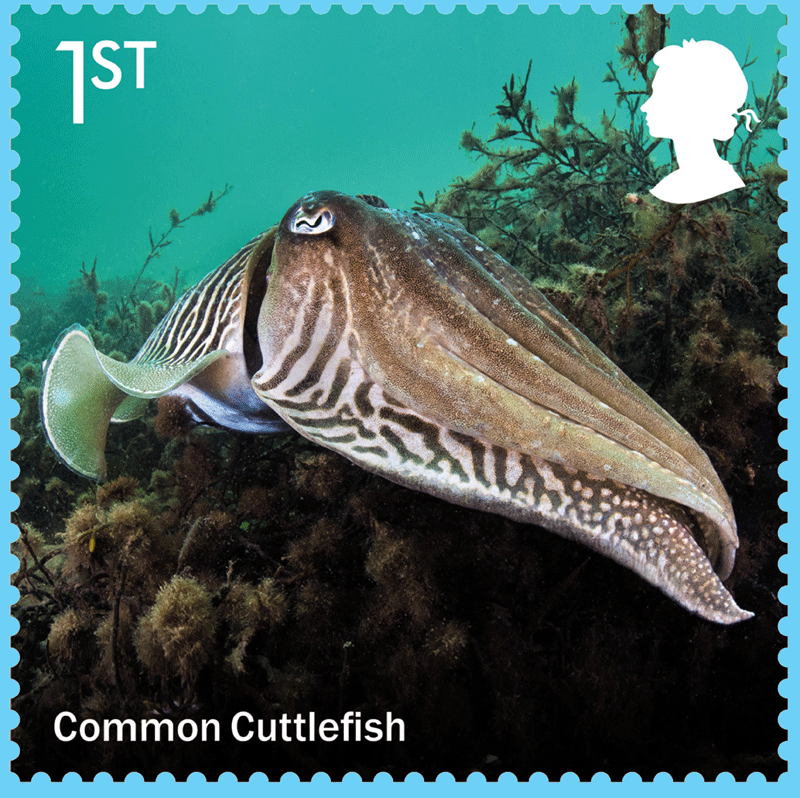
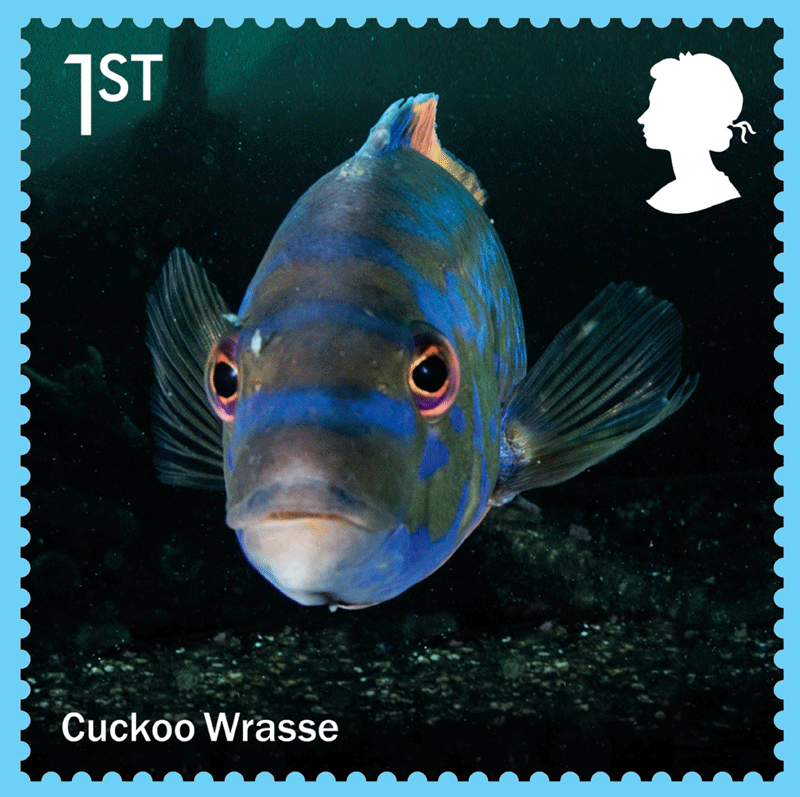
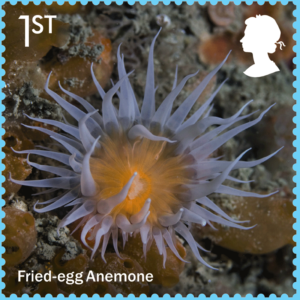
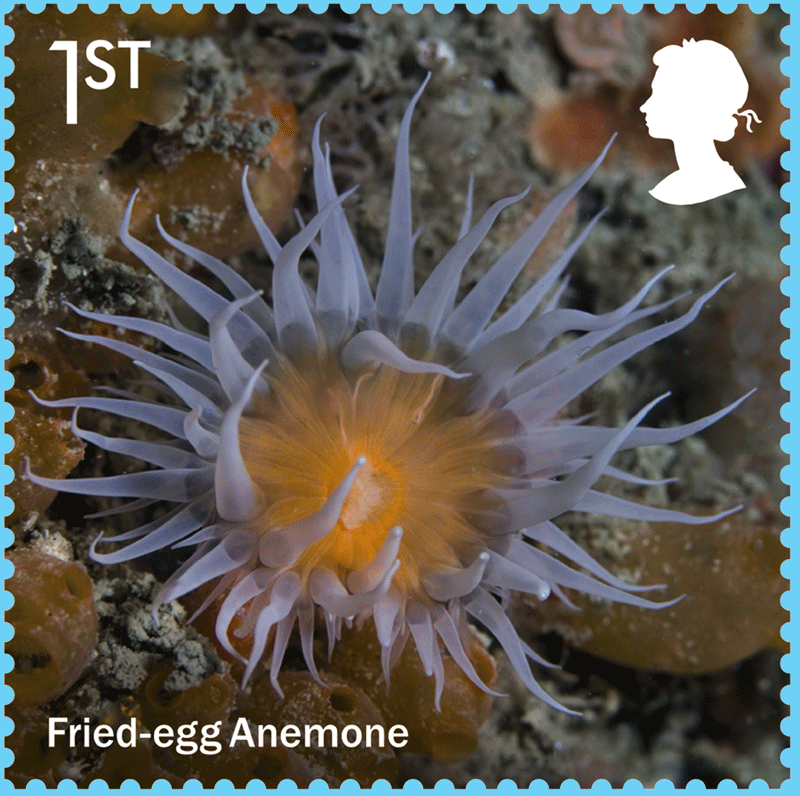
A ten-stamp stamp set showcasing wildlife across the UK’s coastlines; from mammals (Grey Seal, Bottlenose Dolphin, Orca), to fish (Long-snouted Seahorse, Cuckoo Wrasse), anemones (Fried-egg Anemone), crustaceans (Spiny Spider Crab), birds (Northern Gannet), molluscs (Common Cuttlefish) and Cold-water Coral Reef.
All 1st class stamps
- Northern Gannet
- Common Cuttlefish
- Grey Seal
- Bottlenose Dolphin
 Spiny Spider Crab
- Long-snouted Seahorse
- Orca
- Fried-egg Anemone
- Cuckoo Wrasse
- Cold-water Coral Reef
Technical details – stamps
Number of stamps: Ten
Value of Stamps: 1st class
Design: Steers McGillan Eves
Acknowledgements: Northern Gannet © Tim Slater/Alamy Stock Photo; Common Cuttlefish © Alex Mustard/2020VISION/ naturepl.com; Grey Seal © Robin Chittenden/naturepl.com; Bottlenose Dolphin © Graham Eaton/naturepl.com; Spiny Spider Crab © Sue Daly/naturepl.com; Long-snouted Seahorse © Alex Mustard/naturepl.com; Orca © Hugh Harrop; Fried-egg Anemone © Sue 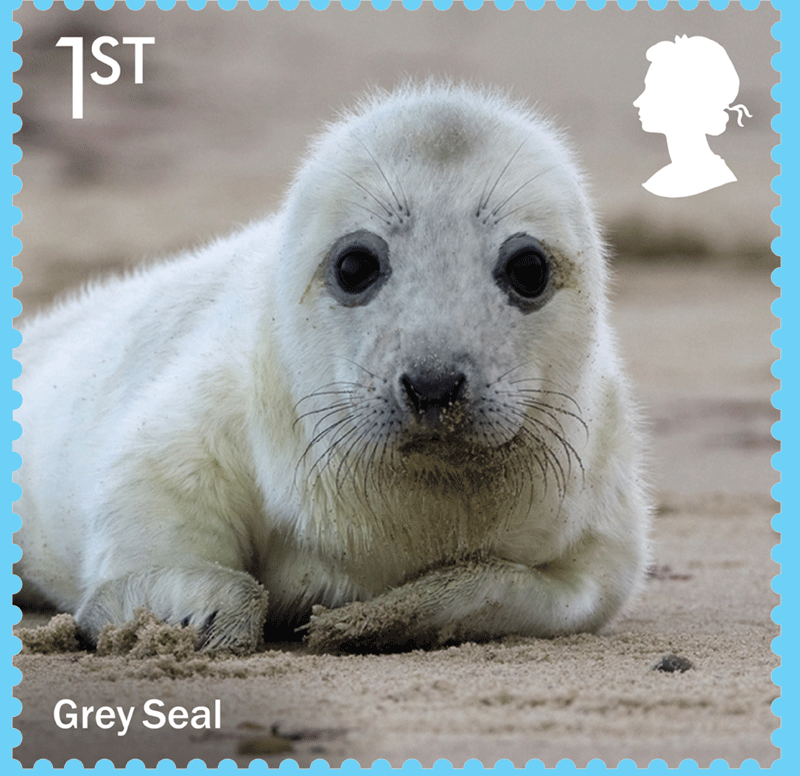 Daly/naturepl.com; Cuckoo Wrasse © Scotland: The Big Picture/naturepl.com; Cold-water Coral Reef © Prof J Murray Roberts, University of Edinburgh
Stamp Format: square
Number per sheet: 25/50
Stamp Size: 35mm x 35mm
Printer: International Security Printers
Print Process: lithography
Perforations: 14.5 x 14.5
Phosphor: bars as appropriate
Gum: PVA
Miniature Sheet
A four-stamp miniature sheet showcasing the Marine food chain; the transfer of energy from algae to top predator, beginning at Level 1; Photoautotrophs (e.g. Phytoplankton) to Level 4; Secondary Carnivores (Harbour Porpoise).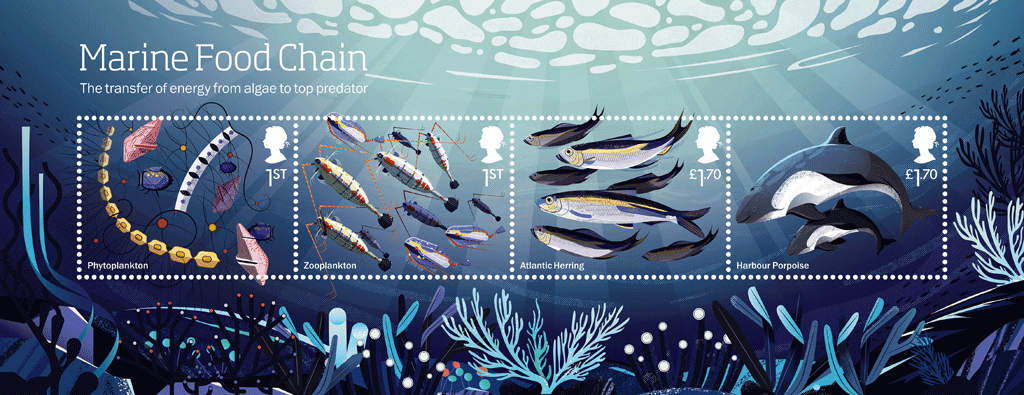
- 1st class Phytoplankton
- 1st class Zooplankton
- £1.70 Atlantic Herring
- £1.70 Harbour Porpoise
 Number of stamps: Four
Value of Stamps: 2 x 1st, 2 x £1.70
Illustrations: Maïté Franchi
Stamp designs: © Royal Mail Group Ltd 2021
Sheet Size: 192mm x 74mm
Format: landscape
Size: 41mm x 30mm
Perforations: 14.5 x1 4
Printer: International Security Printers
Print Process: lithography
Format: landscape
Phosphor bars: as appropriate
Gum: PVA
First Day Cover – Stamps
The First Day Cover is a unique time-limited and personalised collectible which includes the Wild Coasts stamp set postmarked on its first day of issue – 22nd July 2021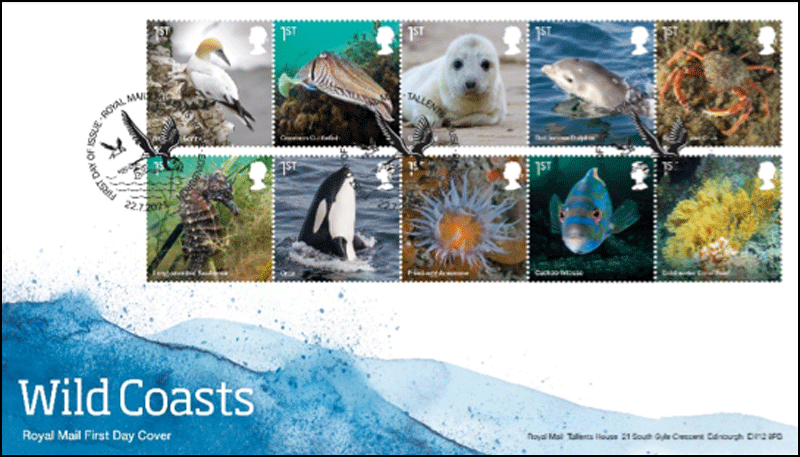
The envelope can be personalised with a name & address of the customer’s choice.
- Includes the ten-stamp set
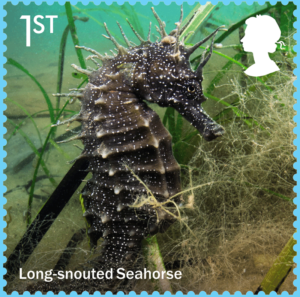 Postmarked on the stamp set’s first day of issue
- Personalised with name and address of customer’s choice
- Choice of 2 postmark designs; Coast, Achnasheen or Talents House, Edinburgh
- Includes an information card that includes brief insight into the coastal and marine wildlife found in the UK, key facts and the impact of human behaviour of marine life.
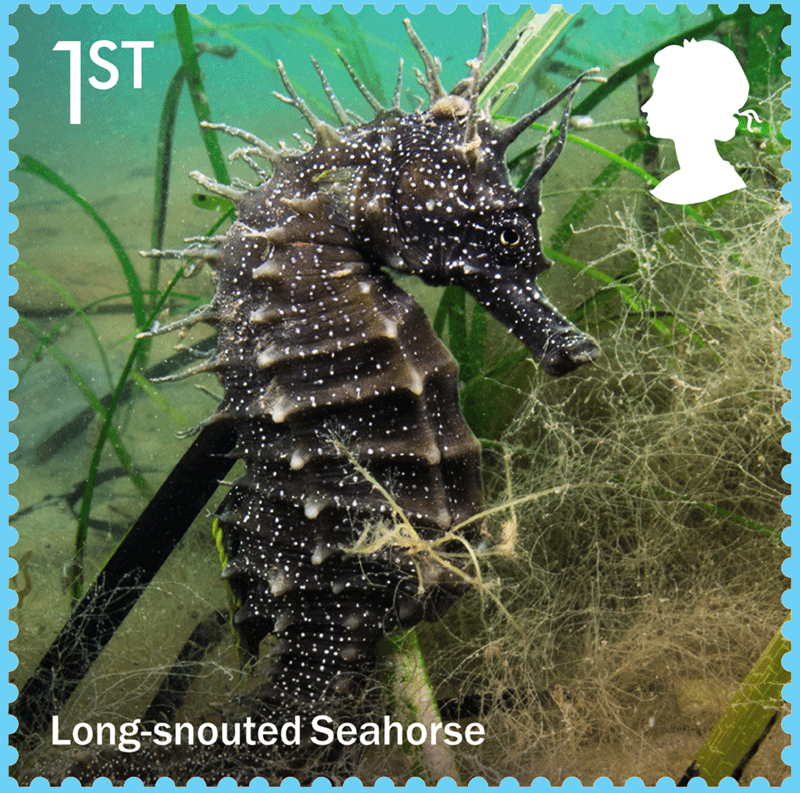
First Day Cover extension: Royal Mail is extending the First Day Cover deadline for this issue due to the uncertainty and restrictions on movement arising from COVID-19. This applies until further notice to First Day Covers ordered directly from Royal Mail as well as to those submitted from Post Office® branches for cancellation at a Special Handstamp Centre.
First Day Cover – Miniature Sheet
The First Day Cover is a unique time-limited and personalised collectible which includes the Wild Coasts miniature sheet postmarked on its first day of issue – 22nd July 2021 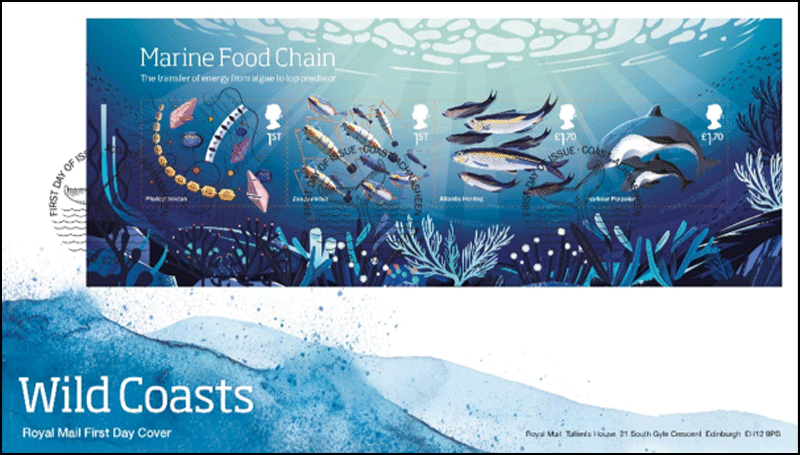 The envelope can be personalised with a name & address of the customer’s choice.
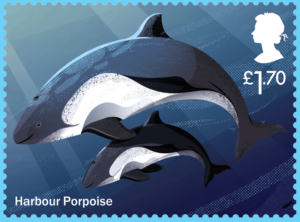 Includes the four-stamp miniature sheet
- Postmarked on the miniature sheet’s first day of issue
- Personalised with name and address of customer’s choice
- Choice of 2 postmark designs; Coast, Achnasheen or Talents House, Edinburgh
- Includes special edition envelope for the issue
- Includes an information card that includes brief insight into the coastal and marine wildlife found in the UK, key facts and the impact of human behaviour of marine life.
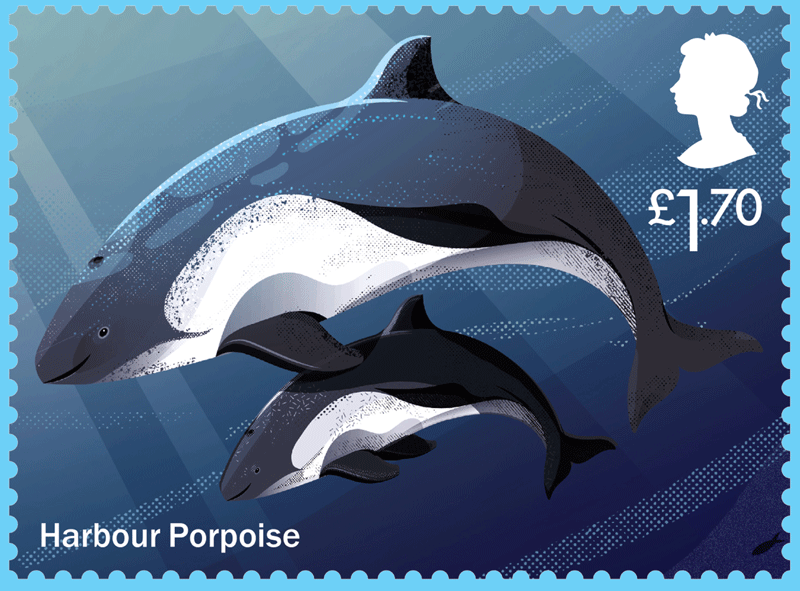
First Day Cover extension: Royal Mail is extending the First Day Cover deadline for this issue due to the uncertainty and restrictions on movement arising from COVID-19. This applies until further notice to First Day Covers ordered directly from Royal Mail as well as to those submitted from Post Office® branches for cancellation at a Special Handstamp Centre.
Presentation Pack
The double-sided presentation pack dives into the wild coasts of British waters. With the UK fringed by a patchwork of unique and beautiful marine habitats, the pack explores the places that support the incredible diversity of wildlife, as well as some of the species that interact in complex and often fascinating ways.
The pack expands on the wildlife chosen for the ten stamps, with a special carrier card for the miniature sheet that details the four levels of Marine food chain; from Photoautotrophs to Secondary Carnivores.
The pack includes both Wild Coasts stamp set & miniature sheet on a separate carrier.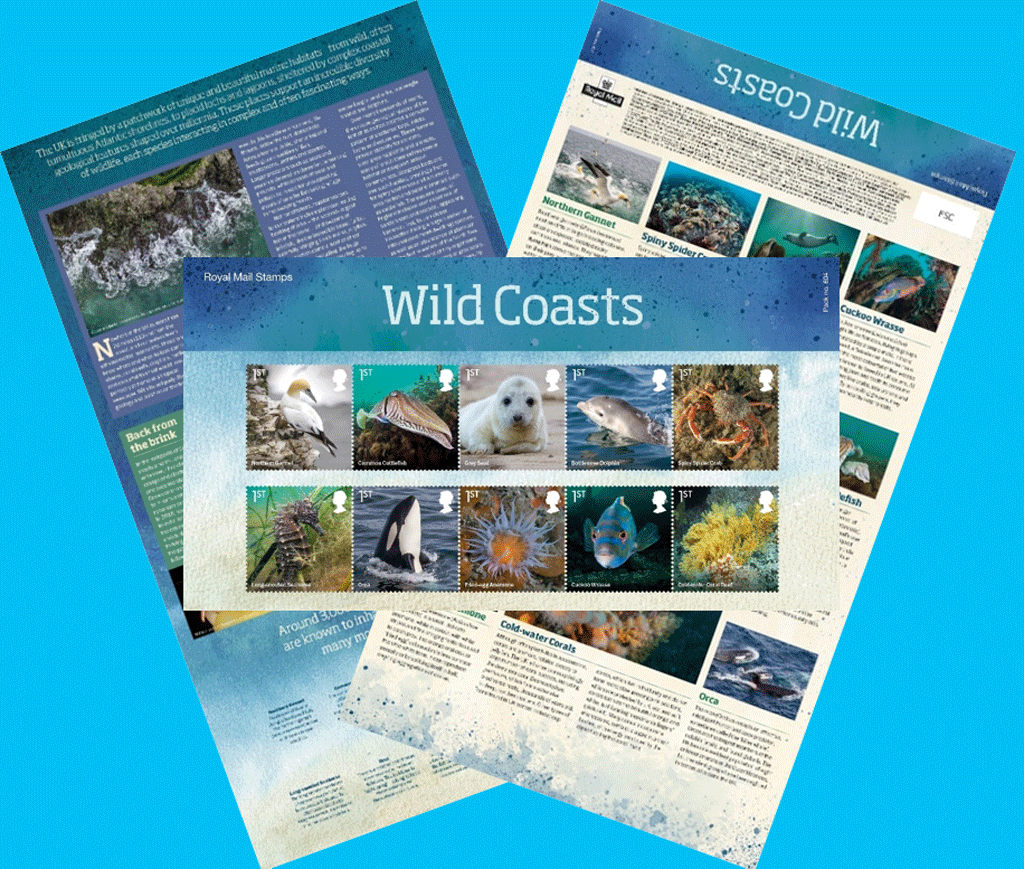
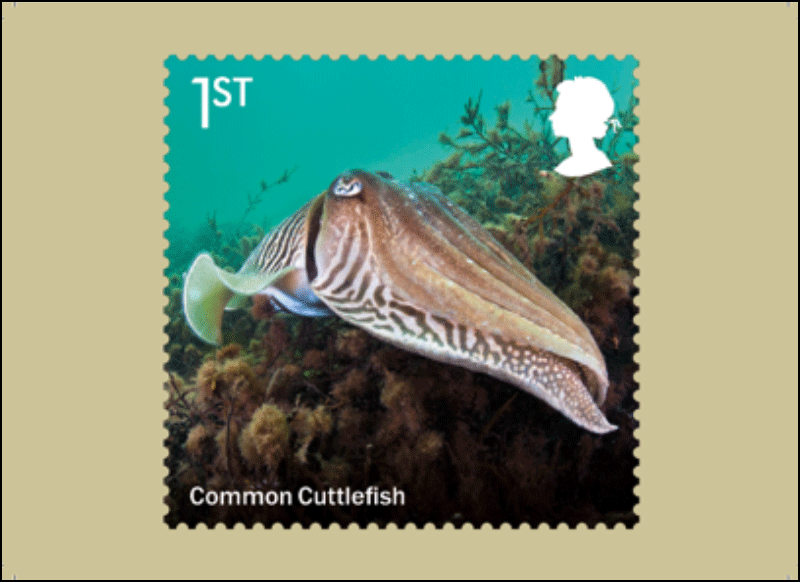 Postcards
A set of 15 postcards featuring enlargements of each of the stamps in the collection, including one of the composite miniature sheet (1 of the 15 images is shown here).
Scott Catalogue Update (July 2021)
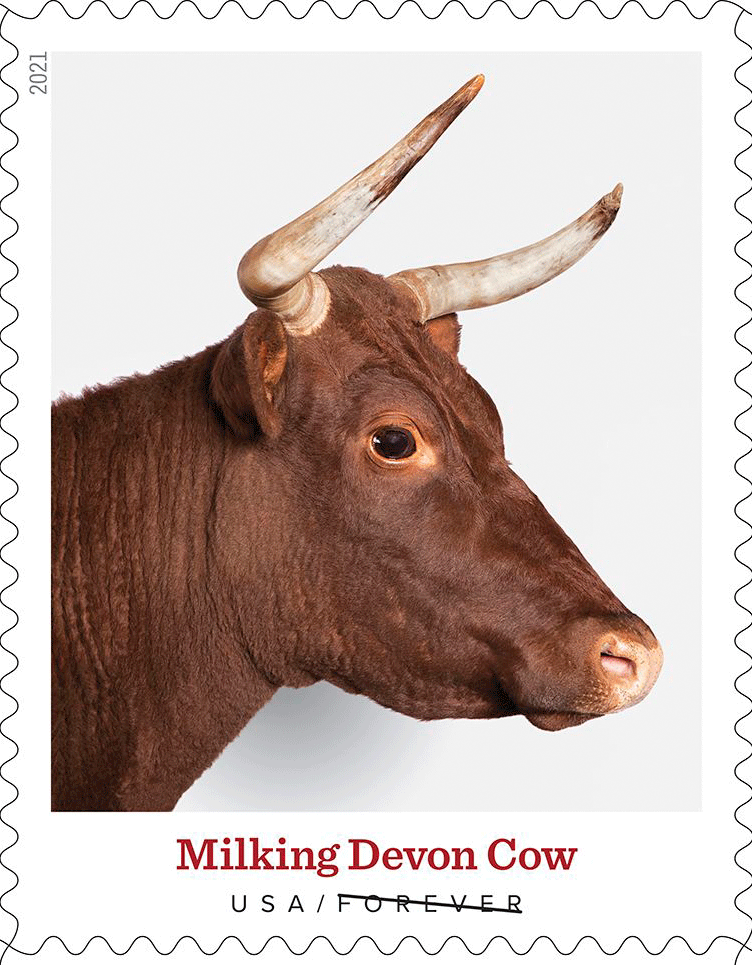 5583 (55¢) Heritage Breeds – Mulefoot hog
a. Imperforate
5584 (55¢) Heritage Breeds – Wyandotte chicken
a. Imperforate
5585 (55¢) Heritage Breeds – Milking Devon cow
a. Imperforate
5586 (55¢) Heritage Breeds – Narragansett turkey
a. Imperforate
5587 (55¢) Heritage Breeds – American Mammoth Jackstock donkey
a. Imperforate
5588 (55¢) Heritage Breeds – Cotton Patch goose
a. Imperforate
5589 (55¢) Heritage Breeds – San Clemente Island goat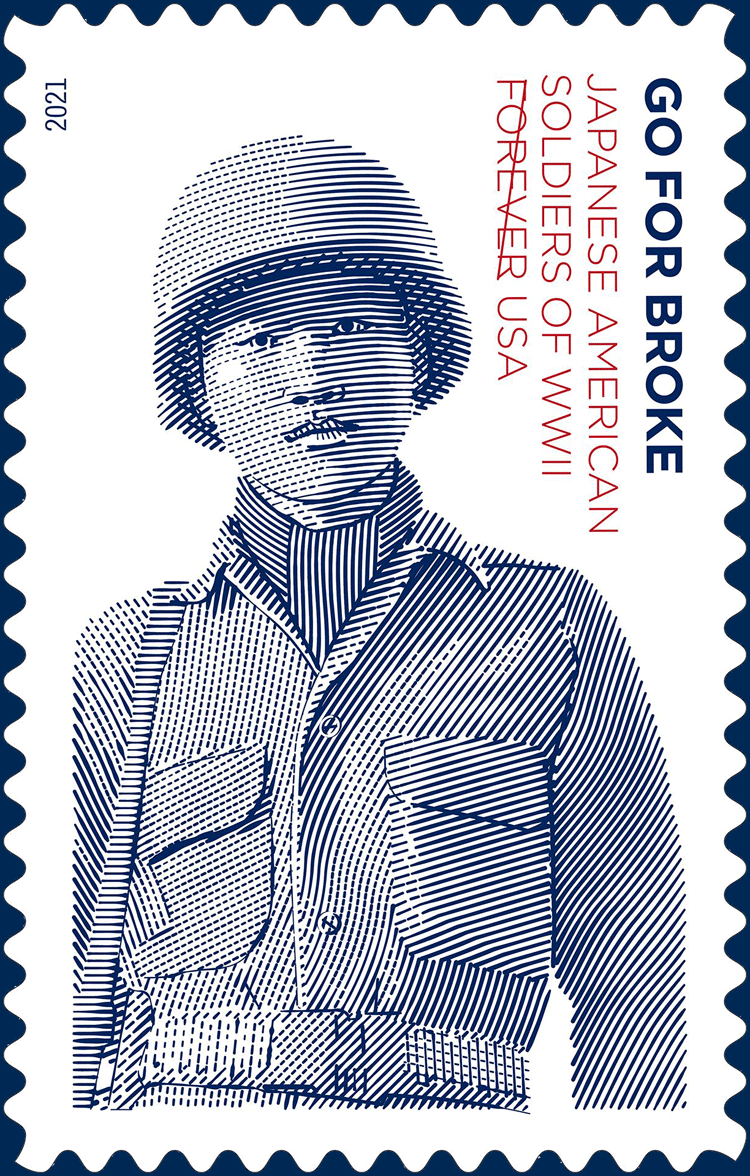
a. Imperforate
5590 (55¢) Heritage Breeds – American Cream draft horse
a. Imperforate
5591 (55¢) Heritage Breeds – Cayuga duck
a. Imperforate
5592 (55¢) Heritage Breeds – Barbados Blackbelly sheep
a. Imperforate
b. Block of 10, #5583-5592
c. Imperforate block of 10, #5583a-5592a
5593 (55¢) Go For Broke
a. Imperforate
 5594 (55¢) Paintings by Emilio Sanchez – Los Toldos
a. Imperforate
5595 (55¢) Paintings by Emilio Sanchez – Ty’s Place
a. Imperforate
5596 (55¢) Paintings by Emilio Sanchez – En el Souk
a. Imperforate
5597 (55¢) Paintings by Emilio Sanchez – Untitled (Ventanita Entreabierta)
a. Imperforate
 b. Horiz. or vert. strip of 4, #5594-5597
c. Imperforate horiz. or vert. strip of 4, #5594a-5597a
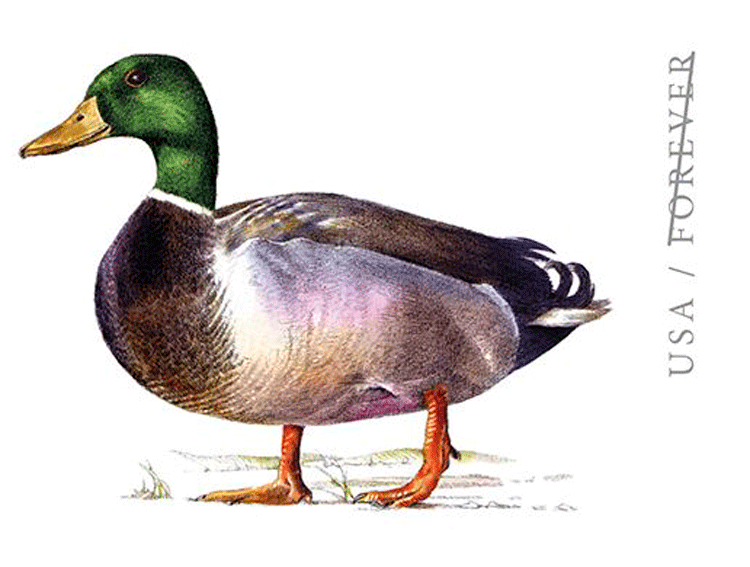
UX648 (36¢) Mallard Duck postal card
UY55 (36¢+36¢) Mallard Duck paid reply postal card
Celebrating Dennis Comic Strip’s 70th (UK 2021)
[press release]
Royal Mail Marks the 70th Anniversary of Beano’s Dennis with a Set of 10 Special Stamps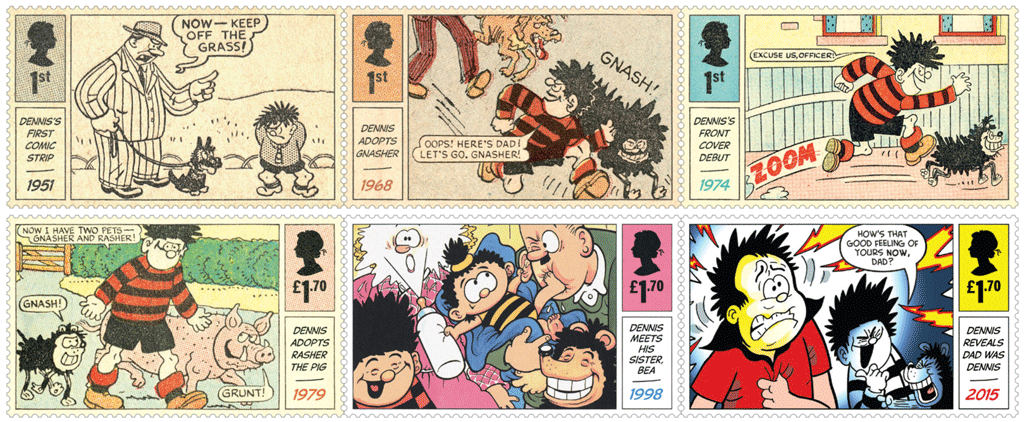
Issue date: July 1
- Six stamps depict key moments in the life of popular Beano comic character Dennis from 1951 to the present, marking his 70th anniversary
- The six stamps are based on original illustrations that appeared in the actual comics of the time
- A further four stamps, presented in a miniature sheet, have been illustrated exclusively for Royal Mail by the current Dennis artist Nigel Parkinson, and wish Dennis a Happy Birthday!
- Also celebrated in the stamp issue is Dennis’s canine pranking partner, Gnasher. Dennis first met the stray Abyssinian wire-haired tripe hound in 1968
- Dennis – ‘the world’s wildest boy’ – was first brought to life in a pencil sketch in January 1951
- He made his debut in Beano issue no. 452, dated 17 March 1951
- Royal Mail collaborated with Beano on the stamp issue
- The full set of 10 stamps, available in a Presentation Pack, retails at £13.65. The stamps and a range of collectible products are available from today at www.royalmail.com/dennisandgnasher
Royal Mail today announced the launch of a new set of stamps celebrating 70 years of the British comic character Dennis.
Six stamps look back at Dennis through the ages; from his first ever black-and-white comic strip in 1951, to important events in his life, including meeting his baby sister, Bea, adopting Gnasher, and even finding out that his dad is a grown-up version of Dennis from the 1980s. These stamps are based on original strips from Beano comics of the time.
A further four stamps, exclusively illustrated by the current Dennis artist, Nigel Parkinson, show the culmination of an exclusive comic strip. The strip, written especially for Royal Mail is featured in the Presentation Pack. The story focuses on Dennis’s birthday celebrations and includes a brief ‘history of Menaces’. The light-hearted episodes end with a birthday surprise, with the final comic strip frame revealing the four new stamps.
Natasha Ayivor, Royal Mail said: ”For seven decades Dennis has been entertaining children by getting into all manner of mischief and mayhem. Generations have experienced the excitement and anticipation of reading about Dennis’s latest prank. Royal Mail is delighted to be honouring Dennis and Gnasher with a set of stamps as the ultimate birthday present.”
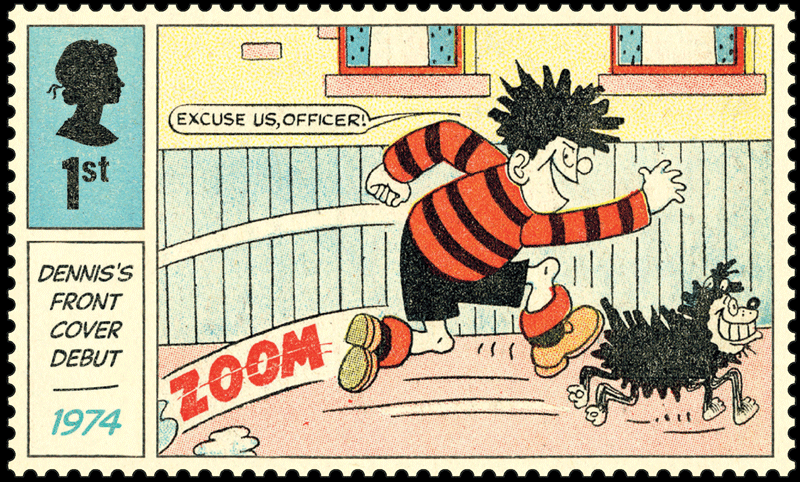 Mike Stirling, Editorial Director of Beano Studios said: “Dennis has stamped his personality across first class laughs and mischief for generations of children. We believe everyone has a little bit of the Dennis spirit within them, so can’t wait for fans big and small to take delivery of this amazing piece of Dennis history. This incredible stamp collection really pushes the envelope of philately flattery for our hero.”
Royal Mail collaborated with Beano Studios on selecting all the stamps and associated imagery featured in the issue.
Dennis through the years:
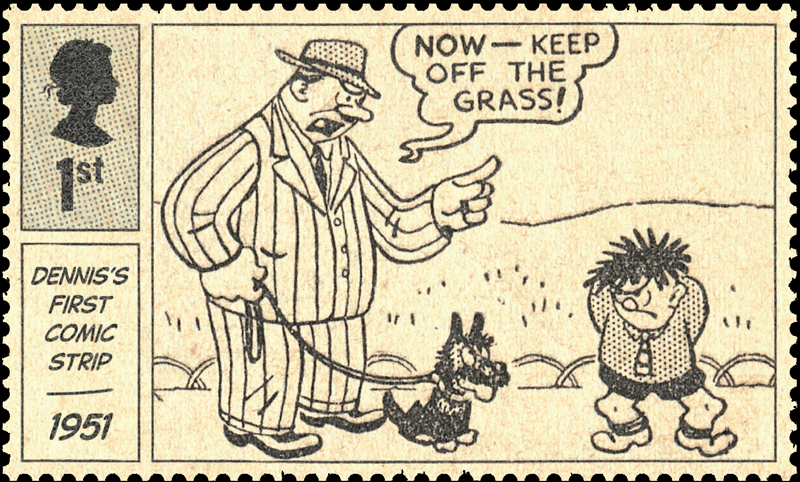 Dennis – ‘the world’s wildest boy’ – was first brought to life in a pencil sketch on the back of a cigarette packet in January 1951. Seventy years later, his mischievous pranks and cheeky grin have not only earned him a place in the hearts of readers of all ages but also ensured that he remains one of Beano’s most famous creations.
Dennis made his first appeared in issue no. 452 of Beano, dated 17 March 1951. It would be another few weeks before he donned his legendary red and black striped jumper, but in this half-page strip, illustrated by artist David Law, readers were offered their first glimpse of the cheeky schoolboy in action as he ignored signs to ‘keep off the grass’ at a local park with hilarious results.
 Prior to 1954, Dennis’s strip appeared either in black and white – as per his very first appearance – or supplemented with red, but in February of that year, ‘the world’s wildest boy’ went on his first full-colour adventure on Beano’s back page. Of course, full colour only heightened the mischief, and as Dennis embarked on a day of trainspotting, he not only tricked the train station staff to get onto the platform but ultimately found himself driving the train.
In August 1968, Dennis’s life changed forever when he met a stray Abyssinian wire-haired tripe hound whom he decided to name Gnasher. In the first story featuring the now infamous duo, Gnasher proved that he was just as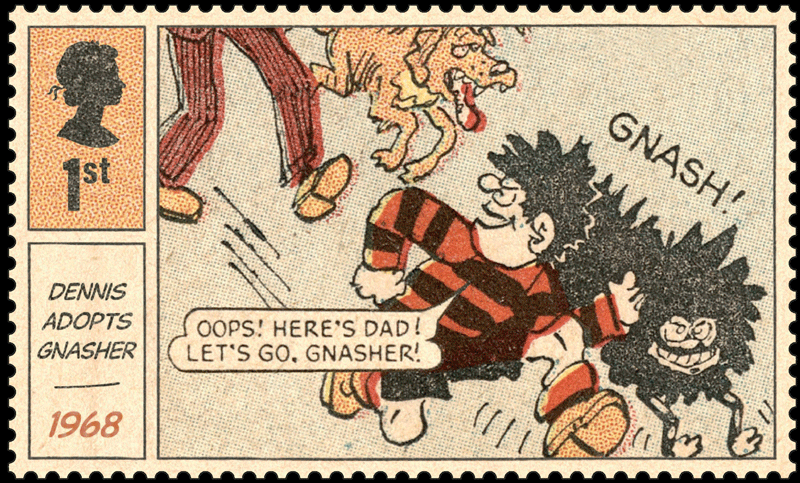 much of a prankster as his human pal when he swiped a bone from one of the ‘pampered pooches’ at a local dog show – and a fight ensued. Gnasher would go on to star in his own strip from 1977.
After 26 years on the cover of Beano, Biffo the Bear was finally ousted from the front page by Dennis in September 1974. It was a change that had been hinted at two years previously, when Dennis announced his desire to star on the front cover while featuring in a Biffo strip, and it is one that, over the years, has proved incredibly successful – Dennis has appeared on the front cover of almost every issue of the Beano since.
 Dennis first met his porcine chum Rasher in May 1979, when he spotted the ‘fine porker’ jumping on his trough at Wurzle Farm. After Dennis agreed to take Rasher off the farmer’s hands, the pig further endeared himself to Dennis when they ran into Walter Brown and he pushed over Dennis’s arch-nemesis, breaking his piggy bank. In 1984, thanks to his popularity with readers, Rasher was given his own strip, which ran regularly in Beano until 1988.
 Shortly after Beano celebrated its 60th anniversary in 1998, Dennis’s mum and dad had a big surprise in store for Dennis: his mum was pregnant! In the 19 September issue, Dennis’s little sister – Bea – arrived. Although Dennis was initially hesitant at the prospect of having a girl in the family, it turned out that Bea was not unlike her big brother when it came to causing mischief.
 In May 2015, Dennis fans were left gobsmacked when Beano revealed that Dennis’s dad was in fact Dennis 30 years earlier. In the strip, footage was unearthed of Dennis Senior as a boy in which the youngster – dressed as Dennis from older editions of the comic – could be seen engaging in a variety of pranks that, in the present, suitably impressed his young son.
The full set of 10 stamps, available in a Presentation Pack, retails at £13.65. [There are also several different first day covers (one of which is shown below), unserviced cacheted envelopes, a presentation pack, picture postcards and a press sheet. —VSC]  The stamps and range of collectible products are available today (1 July) from www.royalmail.com/dennisandgnasher.
US Postal Service Celebrates 50 Years
[press release]
A Half-Century of Operating Independently While Continuing to Bind the Nation Together
WASHINGTON — The U.S. Postal Service marks its 50th anniversary as an independent agency today.
 On July 1, 1971, the U.S. Post Office Department became the U.S. Postal Service, a transformation made possible by the Postal Reorganization Act of 1970. This law transformed the Post Office Department from a cabinet level agency to an independent establishment of the executive branch called the United States Postal Service (USPS).
 “In the more than two centuries since Benjamin Franklin was appointed our first Postmaster General in 1775, the Postal Service has grown and changed with America, boldly embracing new technologies to better serve a growing population,” said Postmaster General and Chief Executive Officer Louis DeJoy. “We stand ready, willing and able to deliver for America into the next half-century and beyond.”
The first day of USPS operations in 1971 was commemorated at Post Offices nationwide with a new postage stamp and a free souvenir envelope. Official ceremonies, open houses, facility tours, refreshments, entertainment and other festivities also marked the day.
The organization’s achievements during the past half-century include the introduction of ZIP+4 Codes (1983), its first website (1994), Forever stamps (2007) and new products and services like Every Door Direct Mail (2011) and Informed Delivery (2017).
This spirit of innovation continues with Delivering for America, the organization’s new 10-year plan, which focuses on restoring service excellence and financial stability to the Postal 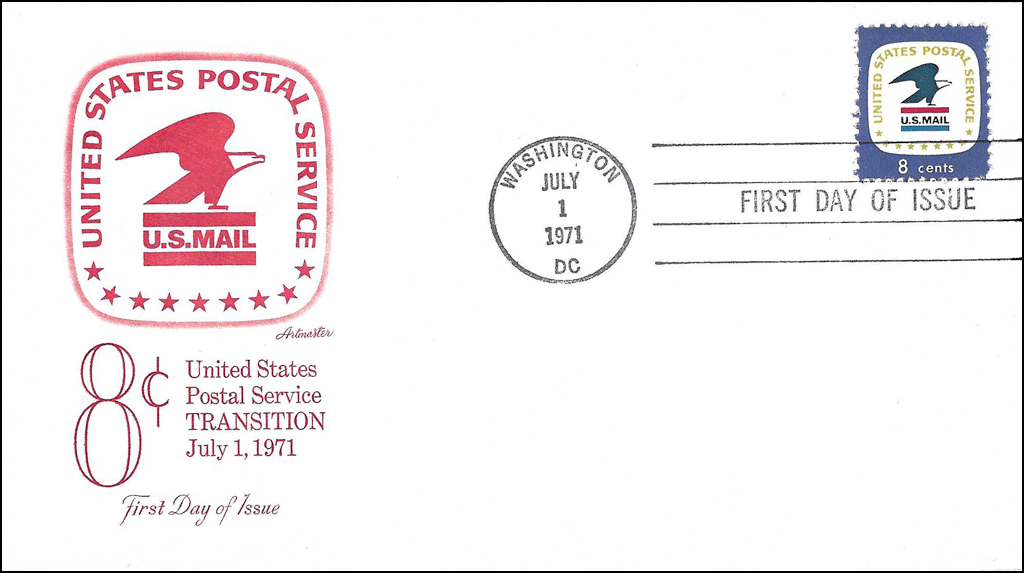 Service through new efficiencies, products and services, and investments in people, technology and infrastructure.
To mark its 50th anniversary, the Postal Service has published an oral history of its first 50 years with 25 employees who were part of the organization’s transition from the Post Office Department, as well as a retrospective of National Postal Service Day in 1971. Explore additional information about the Postal Service’s history at about.usps.com/who-we-are/postal-history/welcome.htm
The Postal Service generally receives no tax dollars for operating expenses and relies on the sale of postage, products and services to fund its operations.
Boston 2026: Less Than 5 Years To Go
[press release]
Under Five Years and Counting
 Planning continues for America’s next international philatelic exhibition, Boston 2026 World Expo, taking place May 23-30 at the Boston Convention and Exposition Center.
The show’s corporate officers and organizing committee members have been active in several areas this past year:
- An initial show layout was prepared and included in an RFP (request for proposal) sent to prospective decorator firms now under consideration.
- Prospective dealers are encouraged to contact Bourse Chair Mark Reasoner (Mark.Reasoner@Boston2026.org) to be added to an informational email list for news when available.
- Discussions are underway with mints to produce show medals.
- An outline for the Boston 2026 membership drive is being reviewed with specifics to be announced in the upcoming months.
- A newly revised web site is expected to go live by mid-August.
And activity in the Boston environs:
- The Boston Convention and Exposition Center reopened for events as of May 29 when pandemic restrictions in Massachusetts and Boston were lifted.
- A contract has been signed with the housing company onPeak to negotiate show rates with hotels in the Seaport/convention center area, as well as manage attendees’ hotel reservations.
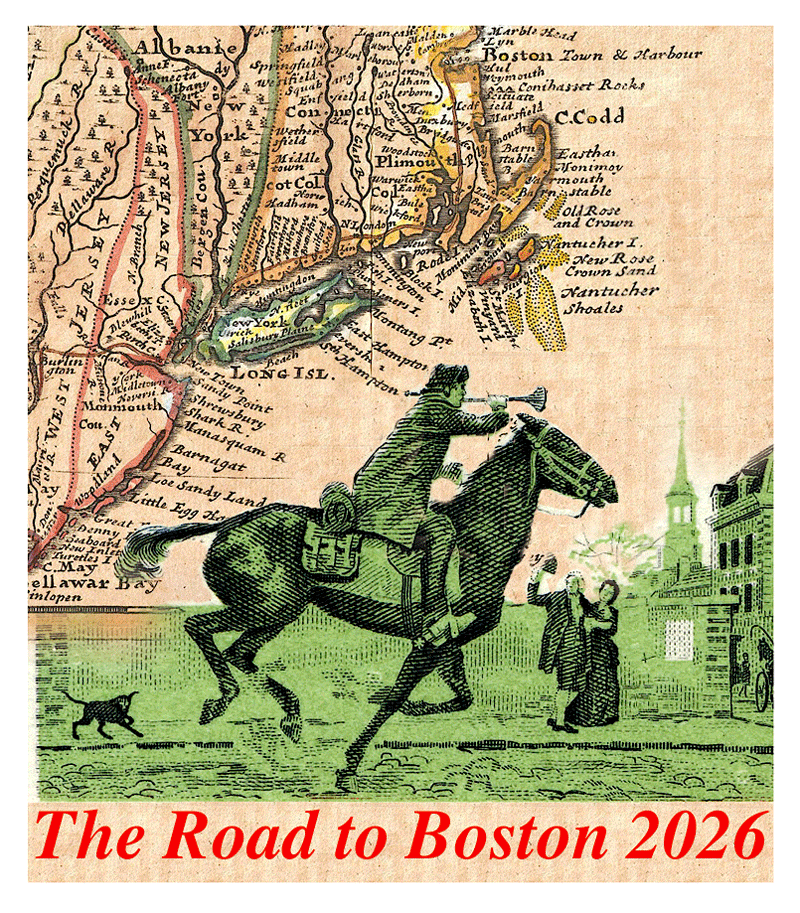 Join Boston 2026 World Expo representatives for an hour-long open meeting at the Great American Stamp Show in Chicago on Thursday, August 12 at 2 PM (room to be announced) with a presentation on progress to date followed by a question and answer session. The gathering will feature an unveiling ceremony for the first in a series of limited-edition show promotional labels [shown on left] created by stamp designer Chris Calle.
Find out additional information online at www.boston2026.org and on Facebook, Twitter and Instagram.
Stan Rogers (Canada 2021)
Issue date: July 21, 2021
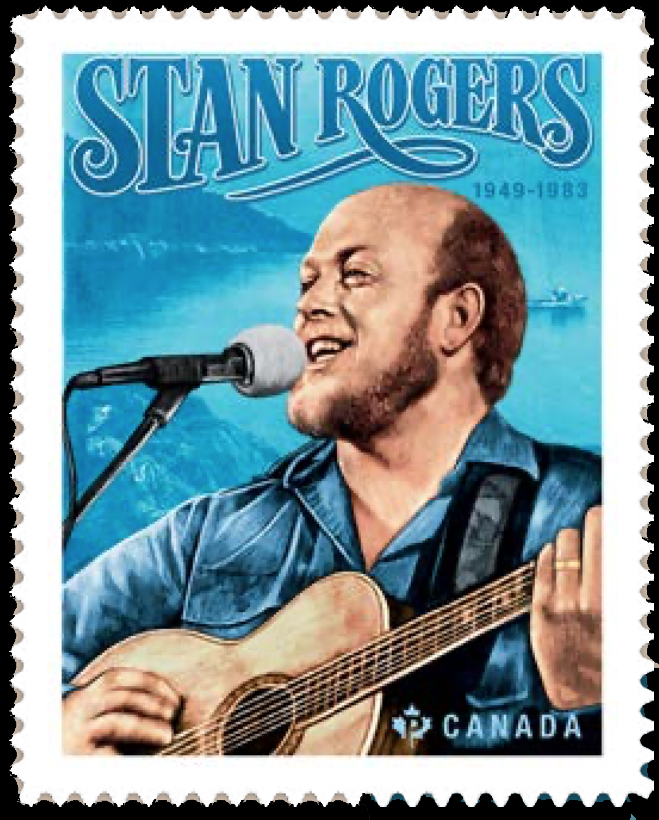 From the June-July issue of Canada Post’s Details magazine:
When Stan Rogers (1949-1983) took the stage, guitar in hand, his presence was electric. Standing six foot four, with a deep, rumbling voice that rose and fell like waves on a Nova Scotia shore, he poured his heart and soul into every word he sang. Poetry set to music, his ballads laid bare the lives of the sailors, ranchers, miners and others whose stories had captured his imagination.
“Stan said things about people that were true. He loved talking and listening to people because he was interested in what they did and wanted to tell their story,” says his widow, Ariel Rogers. “He had an incredible gift for taking that life experience and turning it almost like a prism, so you saw the essence of the person rather than just a reflection.”
Born in Hamilton, Ontario, on November 29, 1949, Rogers spent many summers in Nova Scotia, visiting his mother’s hometown of Canso. It was there that he found his passion in traditional Maritime music. A skilful storyteller, Rogers sang about subjects that were both deeply personal and universally relatable. He took tales from the past and made them moving and meaningful in the present – from the raucous sea shanty “Barrett’s Privateers,” on his first album Fogarty’s Cove (1976), to the emotional anthem “Northwest Passage” (1981), the title track of the last release before his death.
Rogers was only 33 – with his career on the rise – when his life was cut tragically short in an airplane fire on June 2, 1983. Likened to such greats as Bob Dylan and Woody Guthrie, he left a legacy of 11 albums, most released posthumously, that have kept his music vibrant and alive for nearly 40 years. “It was never about him. It was the music that mattered,” says Ariel. “He always said, ‘I don’t care if I’m a star, but I wouldn’t mind being a comet.’ And that’s exactly what he was.” Further details will be posted on the day of issue. Canada Post will also offer a framed souvenir for this issue:
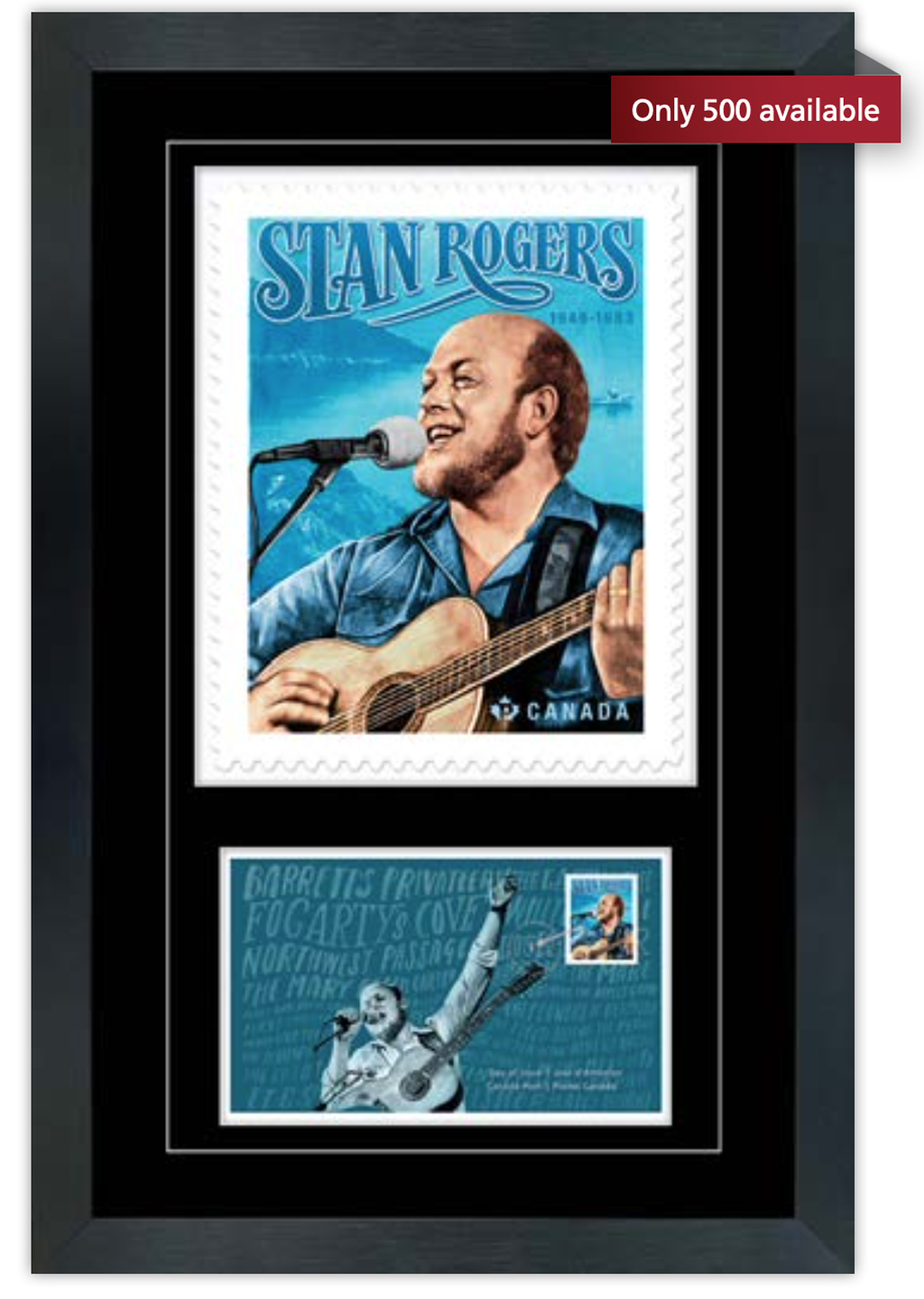 It measures 16 in. x 22 in. / 406 mm x 559 mm and will cost $99.95.
[day-of-issue press release]
Canada Post celebrates legendary folksinger Stan Rogers
Stamp pays homage to artist’s musical legacy and love of the Maritimes
OTTAWA – Canada Post has released a stamp celebrating one of Canada’s most beloved and influential artists, folksinger Stan Rogers.
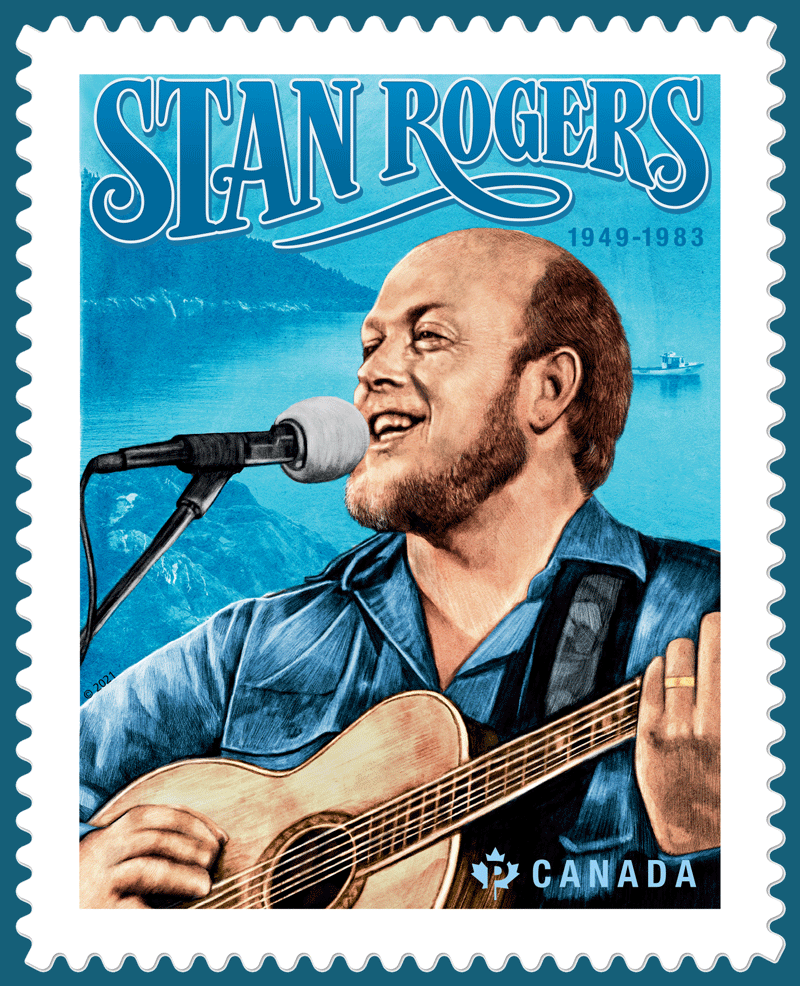 Born November 29, 1949, in Hamilton, Ontario, Rogers grew up in a musical family and taught himself how to play guitar at age five. As a boy, he spent his summers in Nova Scotia – mainly in the seaside community of Canso, where his mother grew up. His time there inspired his love of maritime life and music.
Known for his lively stage performances and rich baritone voice, Rogers’ songs were deeply personal, recounting the experiences, joys and sorrows of ordinary Canadians. He attracted a growing following with the 1976 release of his first album, Fogarty’s Cove, and the raucous sea shanty, “Barrett’s Privateers.” The title track from Northwest Passage, released in 1981, is considered one of the best songs ever produced in Canada and has become an unofficial anthem.
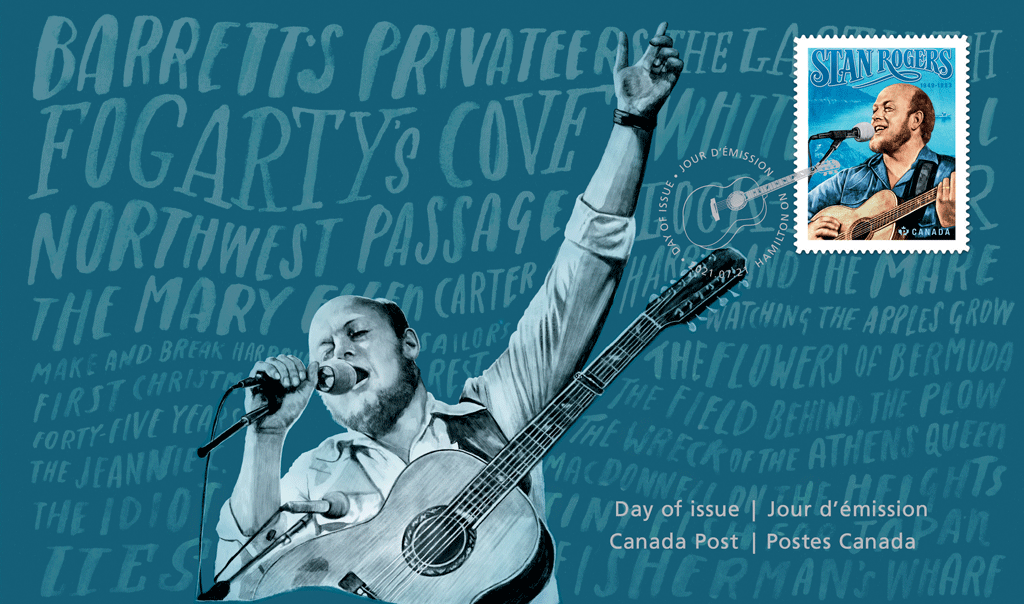
OFDC
Rogers has been likened to Bob Dylan and Woody Guthrie and described as one of the most talented singer-songwriters in North America by some of folk music’s biggest stars. He released four albums before his tragic death in an airplane fire in Kentucky on June 2, 1983, at the age of 33. Another seven albums were released posthumously.
About the stamp
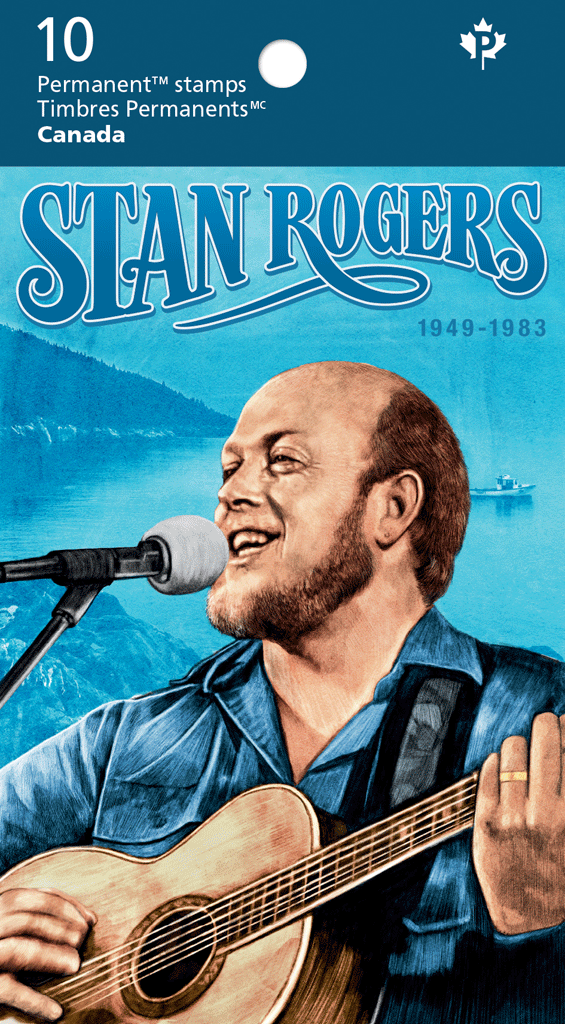 The issue includes a booklet of 10 Permanent™ domestic rate stamps, an Official First Day Cover (OFDC) and a limited edition framed stamp enlargement and OFDC. Designed by Steven Slipp and printed by Lowe-Martin, the stamp features an illustration by Peter Strain, who worked from two photographs: one by Paul Coates of Rogers performing at the Calgary Folk Festival in the early 1980s (foreground); and another by Darren Calabrese of Fogarty’s Cove, Nova Scotia – the name of Rogers’ debut album (background). The illustration on the front of the OFDC shows Rogers performing at the Dalhousie Arts Centre in Halifax in the early 1980s and was based on the cover of Rogers’ album, From Coffee House to Concert Hall (1999). The Official First Day Cover is cancelled in Hamilton in July, the month in which the annual Stan Rogers Folk Festival is held in Canso, Nova Scotia.
Stamps and collectibles are available at canadapost.ca and postal outlets across Canada.
Full-length video from Canada Post:
Shorter video:
[More videos after the French press release]
[en Francais pour les médias d’information]
Postes Canada salue le légendaire chanteur folk Stan Rogers
Le timbre rend hommage à l’héritage musical de l’artiste et à son amour pour les Maritimes
OTTAWA – Postes Canada a émis un timbre célébrant l’un des artistes les plus aimés et influents du Canada, le chanteur folk Stan Rogers.
Né le 29 novembre 1949 à Hamilton, en Ontario, M. Rogers fait partie d’une famille de musiciens et apprend tout seul à jouer de la guitare dès l’âge de cinq ans. Enfant, il passe ses étés en Nouvelle-Écosse, surtout dans la communauté côtière de Canso, ville où sa mère a grandi. Son temps là-bas inspire son amour pour la vie et la musique maritimes.
Reconnu pour ses prestations entraînantes et sa riche voix de baryton, Stan Rogers écrit des chansons profondément personnelles qui racontent les expériences, les joies et les peines des Canadiens ordinaires. Il attire de plus en plus de spectateurs après la sortie de son premier album, Fogarty’s Cove, en 1976, qui comprend le chant de marins « Barrett’s Privateers ». La chanson titre de l’album Northwest Passage (1981) est considérée comme l’une des plus belles chansons canadiennes et devient un hymne non officiel du pays.
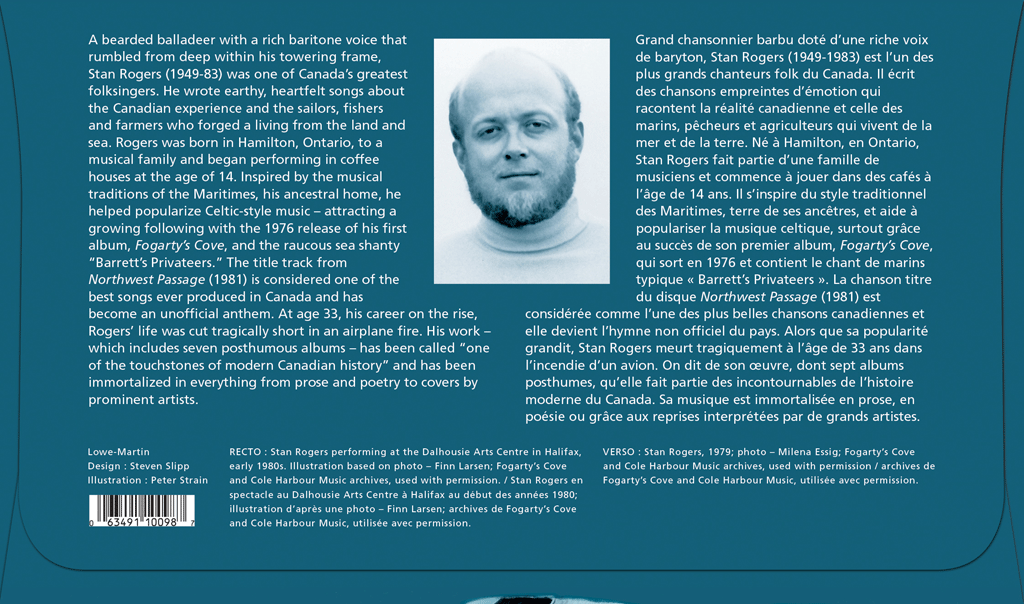
OFDC reverse
Certaines des plus grandes vedettes de la musique folk comparent Stan Rogers à Bob Dylan et Woody Guthrie. Elles le décrivent même comme étant l’un des chanteurs-compositeurs les plus talentueux en Amérique du Nord. Stan Rogers lance quatre albums avant sa mort tragique dans un incendie d’avion au Kentucky, le 2 juin 1983, à l’âge de 33 ans. Sept autres albums sont lancés à titre posthume.
À propos du timbre
Cette émission comprend un carnet de 10 timbres PermanentsMC au tarif du régime intérieur, un pli Premier Jour officiel (PPJO), ainsi qu’un agrandissement de timbres encadrés à tirage limité avec un PPJO. Conçu par Steven Slipp et imprimé par Lowe-Martin, le timbre met en vedette une illustration réalisée par Peter Strain. L’avant-plan est inspiré d’une photo prise par Paul Coates au Calgary Folk Festival au début des années 1980 et l’arrière-plan, d’un cliché réalisé par Darren Calabrese de Fogarty’s Cove, en Nouvelle-Écosse, la ville éponyme du premier album de Stan Rogers. La couverture du PPJO présente une illustration Stan Rogers en concert au Dalhousie Arts Centre, à Halifax, au début des années 1980; elle s’inspire de la couverture de son album From Coffee House to Concert Hall (1999). Le pli Premier Jour officiel est oblitéré à Hamilton en juillet, le mois où se tient le Stan Rogers Folk Festival à Canso.
Le timbre et les articles de collection sont en vente sur le site postescanada.ca et dans les comptoirs postaux partout au pays.
Video tribute by Ariel Rogers:
Video tribute by Jim Cuddy:
Video tribute by Natalie MacMaster:
Video tribute by Tom Cochrane:
Video tribute by Heather Rankin:
Canada Previews 2022 Stamp Programme
From the June-July issue of Canada Post’s Details magazine. The Virtual Stamp Club’s quick-list is at the end, along with the press release issued December 20, 2021.
 It’s that time of year when we’re ready (and excited!) to share what the future holds for the stamp program. Here’s a sneak peek at some of the topics you can expect in 2022.
We’ll kick off the year with a Black History Month issue featuring trailblazer Eleanor Collins – Canada’s first lady of jazz and a living legend at the age of 101.
Our flower issue, the annual reminder that spring is near, will feature graceful callas, commonly called calla lilies, even though they aren’t members of the lily family. Also marching to the fore is a special commemorative envelope celebrating the centennial of the Governor General’s Foot Guards, Canada’s senior reserve infantry regiment.
Then we’ll land a second set of five stamps from our Canadians in Flight series, encourage Canadians to help save lives with a stamp on organ and tissue donation, and pay tribute to three Indigenous leaders devoted to protecting the rights and cultures of their people.
We’ll dive to the depths of the ocean to learn about endangered whales – then take you for a whirl on some colourful, whimsical vintage carousels.
 Since we’re all itching to roam, we’ll issue stamps showcasing five vintage travel posters, along with other collectibles and a special souvenir sheet just in time for CAPEX 22 (an international stamp show and exhibition being held in Toronto next June). And we’ll honour award-winning jazz, blues and R&B singer Salome Bey, who inspired generations of young Black performers.
We’ll celebrate in ice hockey the 50th anniversary of the 1972 Canada-USSR Summit Series and near Remembrance Day, issue a stamp to honour Tommy Prince, Canada’s most-decorated Indigenous war veteran and one of its most decorated non- commissioned officers.
Then count on us to mark some special days of the year with stamps celebrating Eid, Diwali, Hanukkah and Christmas, including a three-stamp holiday issue that’s, quite frankly, for the birds!
- Black History: jazz artist Eleanor Collins
- Flowers: Callas
- Governor General’s Foot Guards (envelope)
- Canadians in Flight (second set)
- Organ and Tissue Donation
- Indigenous Leaders (3)
- Endangered Whales
- Vintage Carousels
- Vintage Travel Posters (CAPEX)
- Singer Salome Bey
- 1972 Canada-USSR Summit Hockey Series
- Remembrance Day: Tommy Prince
- Eid
- Diwali
- Hanukkah
- Christmas
- Holidays (birds)
The press release issued December 20:
[press release] [click on any of the pictures for larger versions]
Indigenous leaders, legendary singers, and vintage travel posters and carousels among subjects in Canada’s 2022 stamp program
Other stamps will shine a spotlight on the National Day for Truth and Reconciliation, organ and tissue donation and endangered whales
OTTAWA – The 2022 Canadian stamp program will celebrate some of the country’s most accomplished individuals, historic milestones, holidays, and creatures that share our planet.
The line-up includes the following subjects, among others:
- Two legendary jazz and blues singers
- Life-saving organ and tissue donation
- Vintage travel posters, which will be launched at the CAPEX 22 international philatelic exhibition in Toronto
- Three eminent Indigenous leaders
- The plight of endangered whales in Canadian waters
- Vintage carousels that are the pride of five Canadian communities
- The National Day for Truth and Reconciliation, which honours the lost children and survivors of the residential school system and their families and communities
- Canadians in Flight, part II, a return trip showcasing more examples of aeronautical prowess.
The following popular series will also return:
- Our annual Flower stamps will bloom with elegant callas.
- The Canada Post Community Foundation issue will once again encourage Canadians to support children and youth.
- New Eid, Diwali and Hanukkah stamps will honour the spirit of these cultural celebrations.
- Annual Christmas and holiday stamp issues will feature a modern take on the Nativity and messages of good cheer from three beautiful birds.
Canada Post is proud of its role as one of Canada’s storytellers. The independent Stamp Advisory Committee recommends the subjects for the annual stamp program and relies on thoughtful input from groups and individuals to ensure that those chosen are meaningful to all Canadians.
[en Francais pour les médias d’information]
Dirigeants autochtones, chanteuses légendaires, et affiches touristiques et carrousels d’époque parmi les sujets choisis pour le programme des timbres-poste du Canada de 2022
D’autres timbres porteront sur la Journée nationale de la vérité et de la réconciliation, le don d’organes et de tissus ainsi que les baleines en voie de disparition
OTTAWA – Le programme des timbres-poste du Canada de 2022 comptera parmi ses sujets variés des Canadiens accomplis, des moments marquants de l’histoire, des fêtes et des créatures avec lesquelles nous partageons notre planète.
Voici quelques-uns des sujets au programme:
- Deux chanteuses légendaires de jazz et de blues.
- Dons d’organes et de tissus qui sauvent des vies.
- Affiches touristiques d’époque, dont le lancement aura lieu à l’exposition philatélique internationale CAPEX 22 à Toronto.
- Trois éminents dirigeants autochtones.
- Le sort des baleines en voie de disparition dans les eaux canadiennes.
- Carrousels d’époque qui font la fierté de cinq communautés canadiennes.
- La Journée nationale de la vérité et de la réconciliation, qui rend hommage aux survivants du système des pensionnats et aux enfants qui ne sont jamais rentrés chez eux, ainsi qu’à leurs familles et leurs communautés.
- Exploits de l’aviation canadienne, partie II, un nouveau volet qui met en vedette d’autres prouesses aéronautiques
Les séries populaires suivantes seront aussi de retour:
- Notre série annuelle de timbres sur les fleurs qui seront ornés d’élégantes callas.
- Le timbre de la Fondation communautaire de Postes Canada qui invitera encore une fois les Canadiens à soutenir les enfants et les jeunes.
- De nouveaux timbres consacrés à l’Aïd, à Diwali et à Hanoukka qui rendront hommage à l’esprit de ces fêtes culturelles.
- Les timbres annuels de Noël et des Fêtes présentant un regard moderne sur la Nativité ainsi que trois superbes oiseaux porteurs de messages de gaieté.
Postes Canada est fière de faire partie des conteurs du Canada. Le Comité consultatif sur les timbres-poste, qui travaille de façon indépendante, recommande les sujets du programme annuel des timbres en s’appuyant sur la contribution réfléchie de groupes et de particuliers pour s’assurer que les sujets choisis sont significatifs pour tous les Canadiens.
Chicago Club Book on Polish Airmail History
[press release]
CCC Publishing Poland and Contiguous European Pioneer Aerophilately Handbook
The Collectors Club of Chicago is pleased to announce the upcoming publication of the CCC’s 36th handbook chronicling specialized philatelic subjects: The History of Airmail in  Poland and Its Contribution to Airmail Services of Europe ( 1914-1939), by Dr. Jerzy W. Kupiec-Węgliński. A Synopsis and Table of Contents in the Polish and German languages accompany this English edition.
The monograph, prefaced by Oxford-based Nobel Prize nominated historian Norman Davies, focuses on the development and operations of airmail services on the Polish territories throughout 25 years of turbulent European history during the 20th century. It begins with events originating in WWI, during October 1914-March 1915, in a remote area of the former Austro-Hungarian Empire’s Galicia Province, in the small town of Przemyśl. It concludes with the German invasion of Poland in September 1939, and the outbreak of WWII. It is an in-depth encyclopedic history of the development of air post not only in Poland, but also in all of Europe and beyond.
The substantive material is presented in 12 chapters. The first chapter highlights the 1914-1915 airmail effort by the Austrian Army from the besieged by Russian forces city of Przemyśl. The following chapter includes comprehensive descriptions and illustrations of the airmail postal route in 1918 from Vienna to Kiev, via Kraków and Lviv.
Further chapters detail the development of domestic airmail operations, as well as joint services by Polish and foreign carriers to other countries and continents, air rallies, “crash” (interrupted) mail, and the Zeppelin mail from mainland Poland and the Free City of Danzig to Americas.
The handbook is hardbound in an 8½”x11″ format, and includes 424 pages containing over 700 illustrations. The book is available from the CCC website ( www.collectorsclubchicago.org/handbooks-available-for-purchase for $US79.50 postpaid to U.S. and A.P.O. addresses (Europe for €65 plus Shipping & Handling), with PayPal being accepted for payment. Shipping to other destinations will be serviced on a per order basis.
 About the Collectors Club of Chicago:
Founded in 1928 and reestablished in 1944, the Collectors Club of Chicago is a group of award-winning philatelists focused on increasing knowledge and education of stamp collecting and postal history. The club owns and operates a philatelic library and clubhouse in downtown Chicago and has hosted monthly speakers from around the United States.
Bluenose sailing ship Centennial (Canada 2021)
Updated June 29th:
A Canada Post spokeswoman tells The Virtual Stamp Club that only 40,000 of the souvenir sheets with the CAPEX22 overprint will be produced, and the only “OFDC” (official first day cover) for the issue is the one for the un-overprinted souvenir sheet.
[press release] [Picture of uncut press sheet at end of French version]
New stamps celebrate the 100th anniversary of Bluenose
Queen of the North Atlantic undefeated over 17 years of racing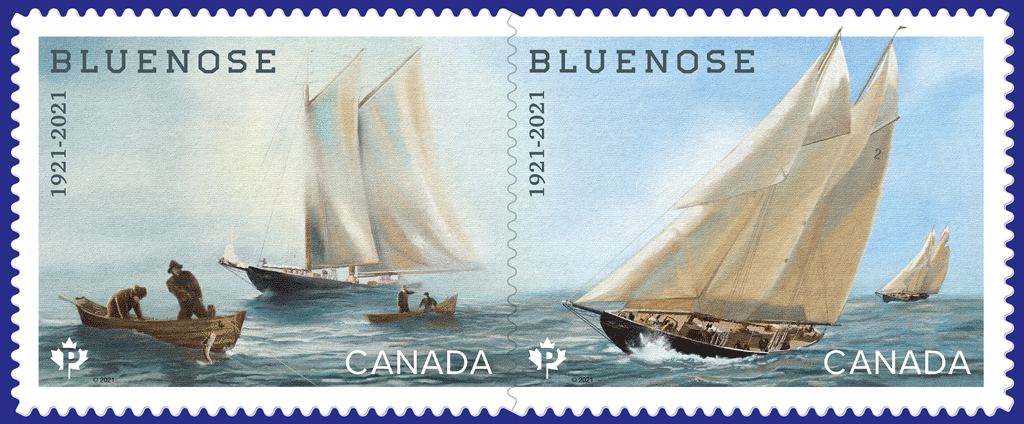
LUNENBURG, N.S. – Canada Post is celebrating the 100th anniversary of the launch of Bluenose, the Nova Scotian schooner known as the Queen of the North Atlantic, with two new stamps.
Canada’s most recognized sailing vessel excelled at fishing and racing in the 1920s and 1930s. The schooner was born of a seafaring rivalry between two fishing communities: Lunenburg, Nova Scotia, and Gloucester, Massachusetts. Competition over whose fishing vessels were the fastest led to the creation of the International Fishermen’s Trophy series in 1920.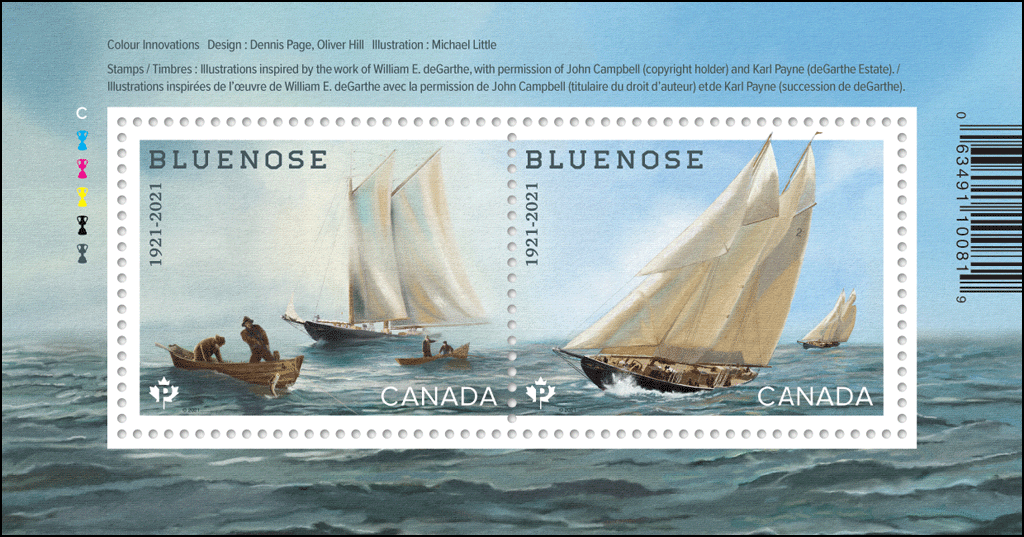
Designed by naval architect William J. Roué of Dartmouth, N.S. and launched from Lunenburg’s Smith & Rhuland Shipyard on March 26, 1921, Bluenose was built to challenge the Americans, who had won the inaugural competition.
With Captain Angus J. Walters at the helm, Bluenose handily won the International Fishermen’s Trophy in 1921 and remained undefeated in four subsequent trophy series: 1922, 1923, 1931 and 1938.
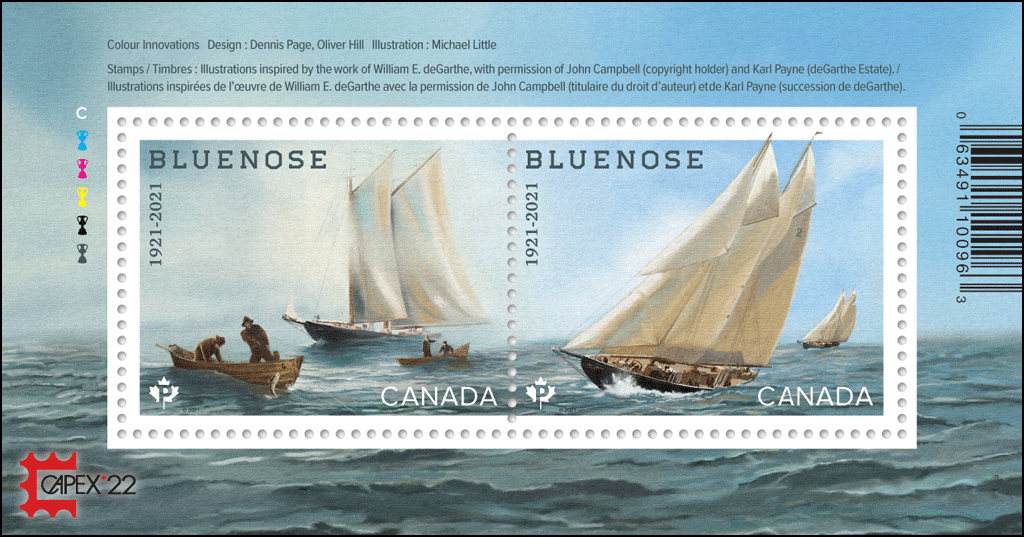
CAPEX souvenir sheet
Featured on Canada’s 10-cent coin, adorning Nova Scotia’s current licence plate and immortalized in song by folk music legend Stan Rogers, Bluenose has appeared in four previous Canadian stamp issues (1929, 1982, 1988 and 1998). Generations of collectors consider the 1929 stamp one of the most beautiful ever issued in Canada.
”Bluenose” comes from a nickname for Nova Scotians dating back to the late 18th century.
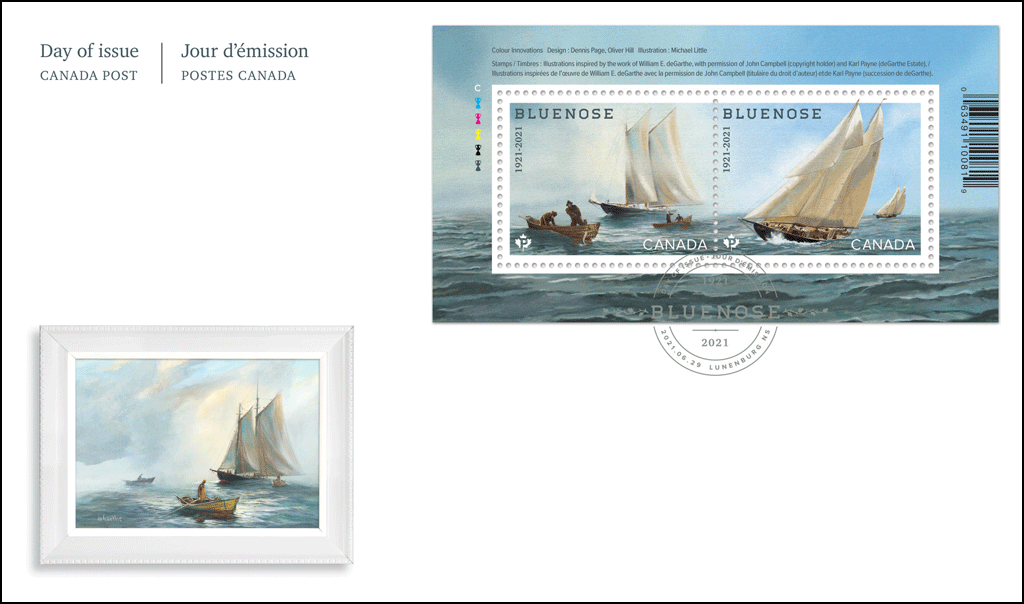
Souvenir Sheet OFDC
About the stamps
The stamps by Halifax designers Dennis Page and Oliver Hill feature illustrations by Michael Little, who was inspired by the work of East Coast marine artist William E. deGarthe (1907-83). They feature two new designs: one portraying Bluenose fishing; the other competing in its first race in 1921. Printed by Colour Innovations, these Permanent™ domestic rate stamps are available in a booklet of 10, two souvenir sheets, a souvenir sheet Official First Day Cover and an uncut press sheet.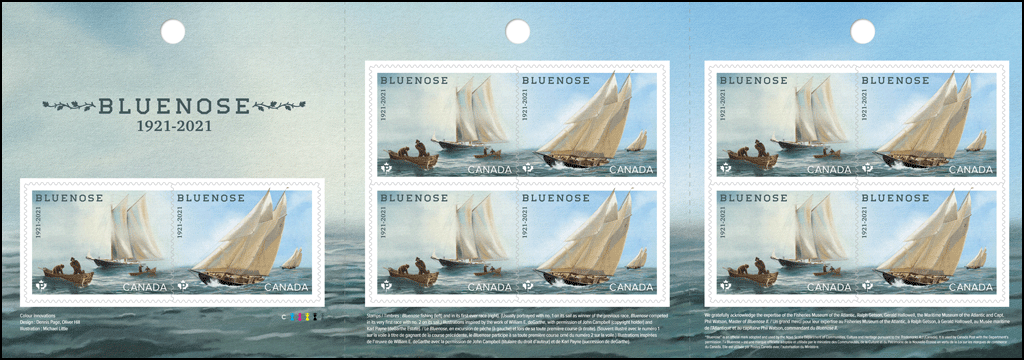
Stamps and collectibles are available at canadapost.ca [direct link] and postal outlets across Canada.
Canada Post video in English:
[en Francais pour les médias d’information]
De nouveaux timbres soulignent le centenaire du Bluenose
La Reine de l’Atlantique Nord reste invaincue sur 17 ans de course
LUNENBURG, N.-É. – Postes Canada célèbre le centenaire de la mise à la mer du Bluenose, la goélette néo-écossaise surnommée la Reine de l’Atlantique Nord, avec le lancement de deux nouveaux timbres.
Navire le plus célèbre du Canada, le Bluenose, qui fascine le monde par ses prouesses dans les années 1920 et 1930, naît d’une rivalité en mer entre les communautés de pêcheurs de Lunenburg, en Nouvelle-Écosse, et de Gloucester, au Massachusetts. Cet esprit de compétition mène alors à la création de la série de courses de l’International Fishermen’s Trophy en 1920.
Conçu par l’architecte naval William J. Roué de Dartmouth, en Nouvelle-Écosse, et mis à la mer depuis le chantier naval Smith & Rhuland de Lunenburg le 26 mars 1921, le Bluenose voit le jour pour devancer les Américains, qui décrochent la victoire lors de la première édition du concours.
Avec le capitaine Angus J. Walters à la barre, la goélette remporte avec brio son premier trophée en 1921 et au cours des 17 années suivantes, elle reste invaincue quatre fois de suite, soit en 1922, en 1923, en 1931 et en 1938.
CAPEX souvenir sheet
Le Bluenose orne la pièce canadienne de 10 cents, figure sur la plaque d’immatriculation actuelle de la Nouvelle-Écosse et est immortalisé en chanson par la légende de la musique folk Stan Rogers; il est aussi en vedette sur quatre anciennes émissions de timbres de Postes Canada (1929, 1982, 1988 et 1998). Des générations de collectionneurs considèrent la vignette de 1929 comme l’une des plus belles émises au pays.
L’appellation « Bluenose » vient d’un surnom donné aux Néo-Écossais à la fin du XVIIIe siècle.
Souvenir Sheet OFDC
À propos des timbres
Les timbres par les designers haligoniens Dennis Page et Oliver Hill présentent des illustrations de Michael Little inspirées de peintures de William E. deGarthe (1907-1983), un artiste de la côte Est. Les deux nouveaux motifs montrent le Bluenose en expédition de pêche et lors de sa première course en 1921. Imprimés par Colour Innovations, ces timbres PermanentsMC au tarif du régime intérieur sont offerts en carnet de 10, sur deux blocs-feuillets, sur un pli Premier Jour officiel du bloc-feuillet et sur une planche non coupée.
Les vignettes et les articles de collection sont en vente sur le site postescanada.ca [direct] et dans les comptoirs postaux partout au pays.
Video du Canada Post en Francaise:
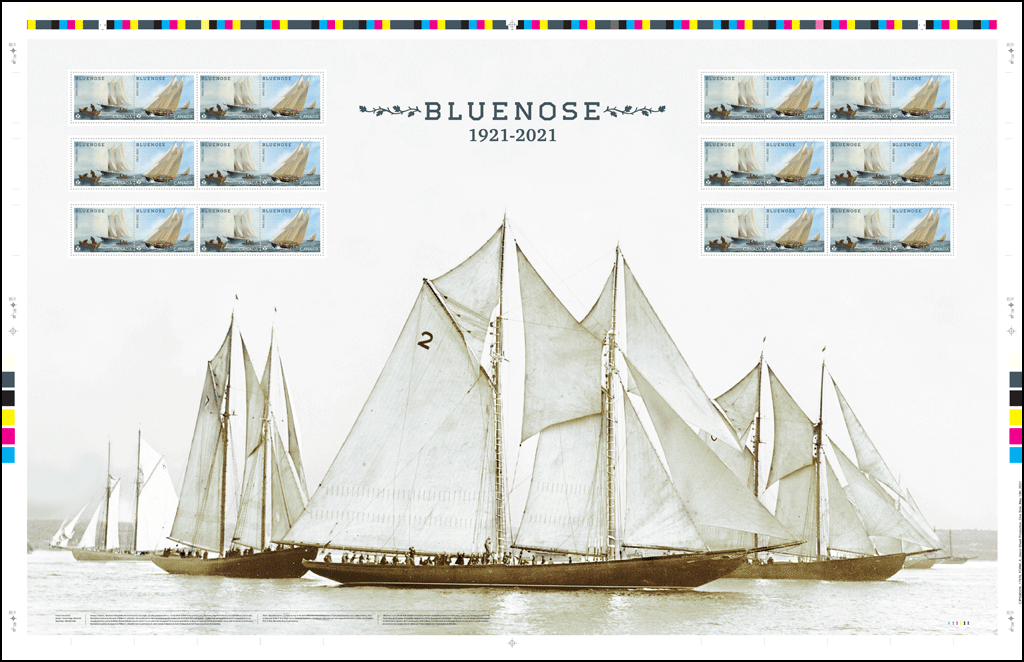
Uncut Press Sheet
[press release – June 26th]
Canada Post to celebrate the 100th anniversary of Bluenose with new stamps
OTTAWA – Canada Post invites you to attend a virtual unveiling of new stamps to mark 100 years since the launch of Bluenose, Canada’s most recognized sailing vessel.  Launched from the Smith & Rhuland Shipyard in Lunenburg, Nova Scotia, in 1921, Bluenose excelled as a fishing and racing schooner. Today, Canadians continue to recognize Bluenose for its profile on Canada’s 10-cent coin. Join Canada Post’s webcast (link below) for the stamp unveiling on Tuesday, June 29 at 11 am, Atlantic Time (10 am, Eastern Time). Speakers will be in Ottawa and Lunenburg. Canada’s iconic stamp program shares stories that connect, unite and make Canadians proud.
WHAT: Unveiling of the Bluenose 100th anniversary stamps
WHO: Interview opportunities will be available with Alan Creaser, chair of the Bluenose 100 Committee, and Canada Post representatives.
WHERE: Speakers will be in Ottawa and Lunenburg.
Set a reminder for the webcast here.
WHEN: Tuesday, June 29 at 11 am, Atlantic Time (10 am, Eastern Time)
[en Francais pour les médias d’information]
Postes Canada souligne le centenaire du Bluenose avec l’émission de nouveaux timbres
OTTAWA – Postes Canada vous invite à assister au dévoilement virtuel des nouveaux timbres marquant le centenaire de la mise à la mer du Bluenose, le navire le plus célèbre du Canada. Le Bluenose est inauguré en 1921 au chantier naval Smith & Rhuland à Lunenburg, en Nouvelle-Écosse. La goélette excelle dans la pêche et la course. De nos jours, les Canadiens peuvent toujours admirer le Bluenose sur leurs pièces de 10 cents. Assistez au dévoilement des timbres en webdiffusion (lien ci-dessous) le mardi 29 juin à 11 h, heure de l’Atlantique (10 h, heure de l’Est). Des présentations auront lieu depuis Ottawa et Lunenburg. Le programme des timbres-poste canadien raconte les histoires d’ici qui relient et unissent les Canadiens et les rendent fiers.
QUOI: Dévoilement des timbres du centenaire du Bluenose
QUI: Il sera possible de réaliser des entrevues avec Alan Creaser, président du Bluenose 100 Committee, ainsi qu’avec des représentants de Postes Canada.
OÙ: Les présentateurs se trouveront à Ottawa et à Lunenburg.
Programmez un rappel pour la webdiffusion ici.
QUAND: Mardi 29 juin à 11 h, heure de l’Atlantique (10 h, heure de l’Est)