Updated October 8th:
[press release]
Canada Post stamp honours editorial cartoonist Bruce MacKinnon
One of five cartoonists being recognized with a stamp, his vast body of work displays wide range from impish cheek to deep empathy
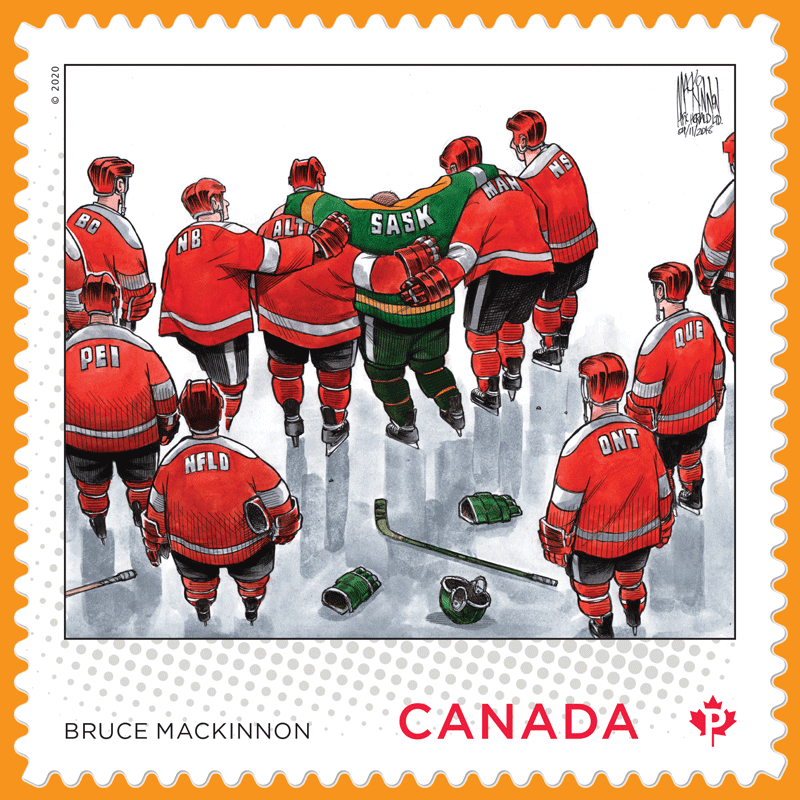
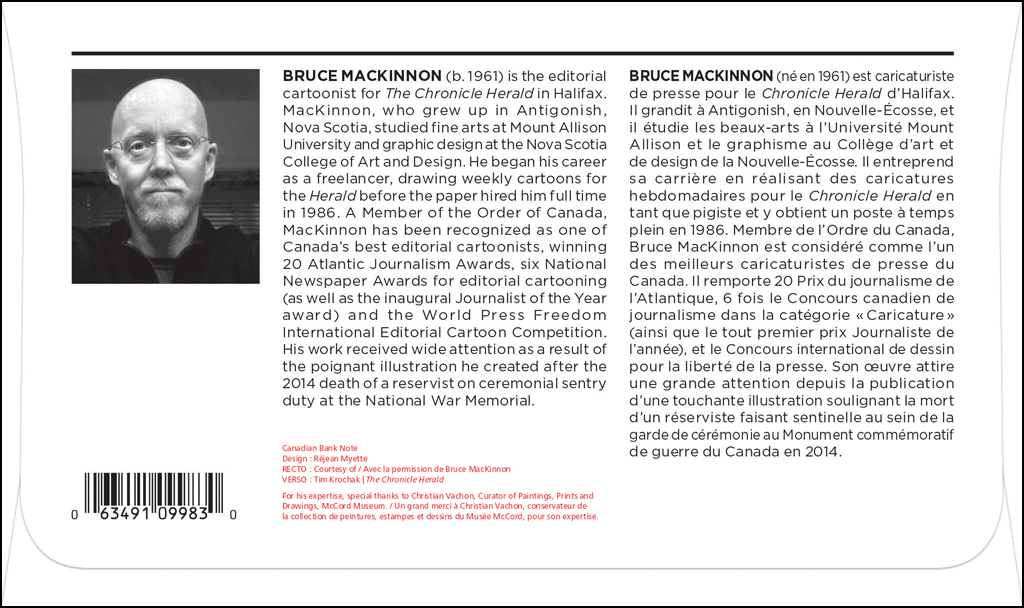
HALIFAX – Canada Post today unveiled a stamp paying tribute to Bruce MacKinnon of The Chronicle Herald (Halifax), one of the country’s most thoughtful, talented and respected 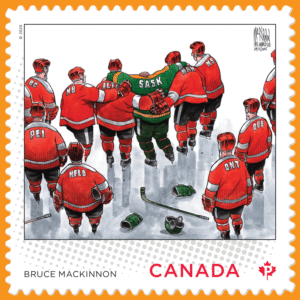 editorial cartoonists.
MacKinnon had his first editorial cartoon published in his hometown weekly paper in Antigonish, Nova Scotia, when he was just 14. After he drew weekly cartoons for the Herald, the paper hired him full time in 1986. Since then, he has drawn roughly 8,000 cartoons – but it is their quality that has won him numerous accolades.
His deeply touching tribute to a reservist killed at the National War Memorial was shared around the country and the world, as was his cartoon following the Humboldt Broncos bus crash in 2018. On such dark days, he reflects the gravity of the situation in a way that he calls “subtle and nuanced.”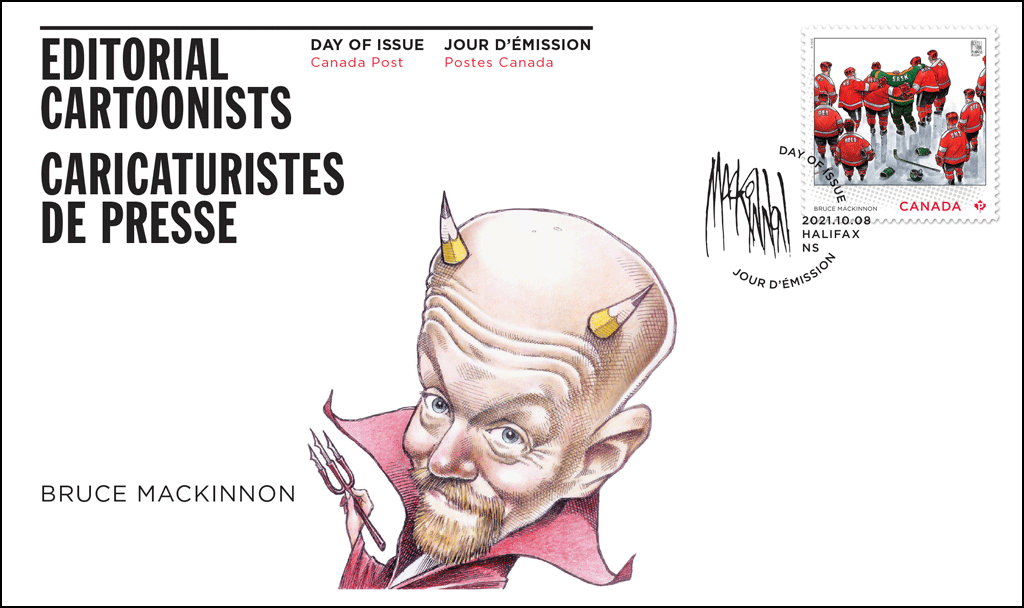
MacKinnon has won 21 Atlantic Journalism Awards, six National Newspaper Awards for 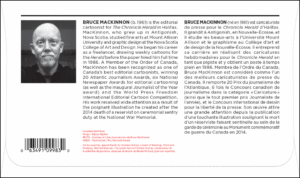 editorial cartooning (and a seventh, the inaugural Journalist of the Year award) and the World Press Freedom International Editorial Cartoon Competition. The citation for his appointment as a Member of the Order of Canada in 2016 describes him as “one of Canada’s most skilled, empathetic and provocative editorial cartoonists.”
More here
[en Francais pour les médias d’information]
Un timbre de Postes Canada rend hommage au caricaturiste de presse Bruce MacKinnon
L’un des cinq caricaturistes à l’honneur dans cette émission, ses œuvres commentent l’actualité avec humour et aussi avec une grande empathie
HALIFAX – Postes Canada a dévoilé aujourd’hui un timbre rendant hommage à Bruce MacKinnon. Caricaturiste de presse pour leChronicle Herald d’Halifax, il est reconnu comme l’un des plus réfléchis, talentueux et respectés au pays.
Bruce MacKinnon n’a que 14 ans lorsqu’il publie sa première caricature dans l’hebdomadaire de sa ville natale d’Antigonish, en Nouvelle-Écosse. Après qu’il ait réalisé des caricatures hebdomadaires pour le Herald, le quotidien l’embauche à temps plein en 1986. Depuis, il a produit environ 8 000 illustrations. Au delà de la quantité, c’est la qualité de ses œuvres qui lui rapporte de nombreuses distinctions.
Son hommage profondément touchant à un réserviste tué au Monument commémoratif de guerre du Canada a fait le tour du monde, tout comme son illustration à la suite de l’accident impliquant un autobus des Broncos de Humboldt en 2018. Durant ces moments difficiles, il souligne l’importance d’illustrer le sérieux d’une situation « avec sensibilité et sobriété ».
Au fil de sa brillante carrière, le caricaturiste remporte sept fois le Concours canadien de journalisme (dont le premier prix Journaliste de l’année), 21 Prix du journalisme de l’Atlantique et le Concours international de dessin pour la liberté de la presse. On le nomme membre de l’Ordre du Canada en 2016. La citation le décrit comme « l’un des caricaturistes de presse les plus compétents, empathiques et provocateurs du Canada ».
Lire la suite ici
Updated October 7th:
[press release]
Canada Post stamp honours editorial cartoonist Duncan Macpherson
Macpherson, the first editorial cartoonist invested into the Order of Canada, is one of five cartoonists being recognized for their contributions to Canadian journalism, humour and art
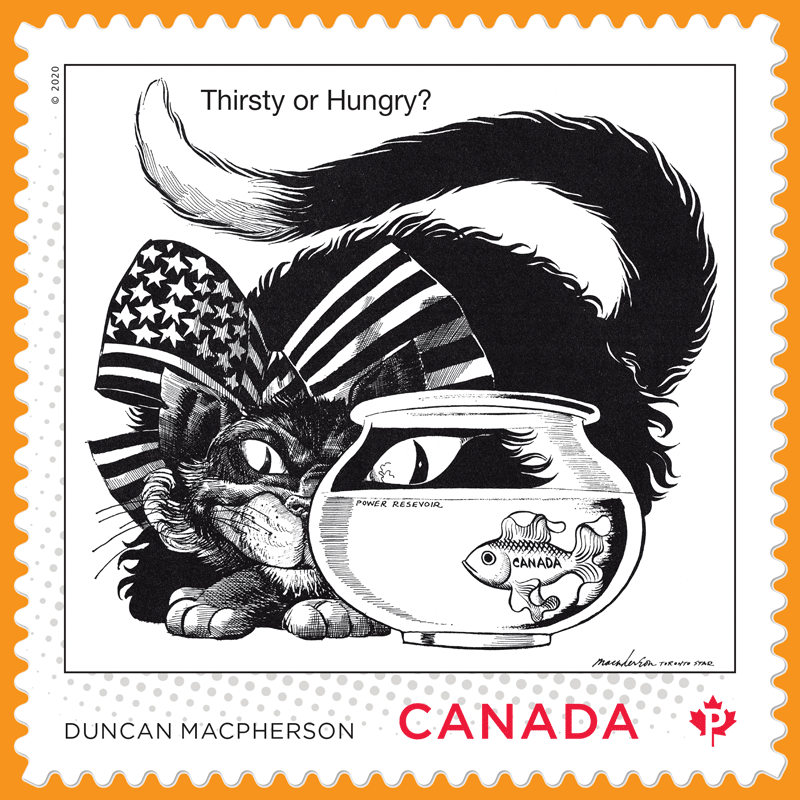
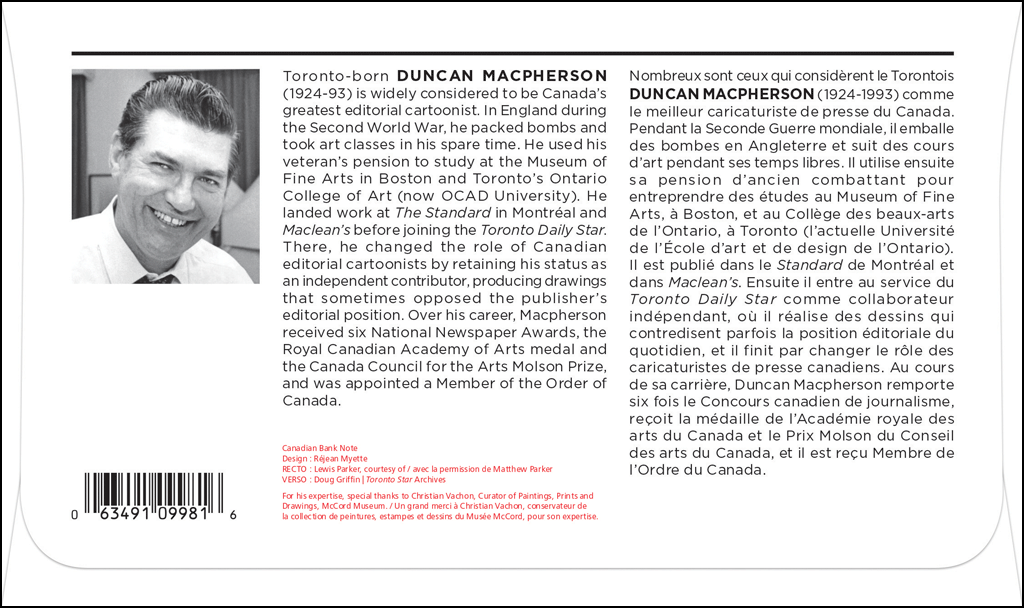
TORONTO – Canada Post today unveiled a stamp paying tribute to Duncan Macpherson (1924-93), who is widely considered one of the most influential cartoonists in Canada.
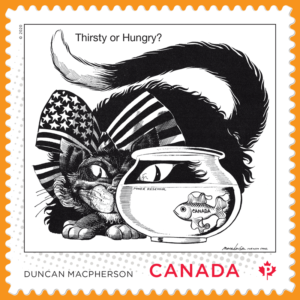 An editorial cartoonist for the Toronto Star for more than three decades, Duncan Macpherson drew witty cartoons that challenged what he called “wrongness” on behalf of everyday Canadians. Macpherson also helped reshape the profession for a generation of cartoonists by being the first to hire an agent to negotiate his salary and by pushing for editorial independence. Sometimes, his cartoons opposed the editorial stance of his own newspaper.
“Having dad honoured in this way revives his memory and his name. I’m so proud of his achievements,” says his son, Ian Macpherson. “For me personally, this rediscovery of my dad’s work and its influence has been a terrific experience.”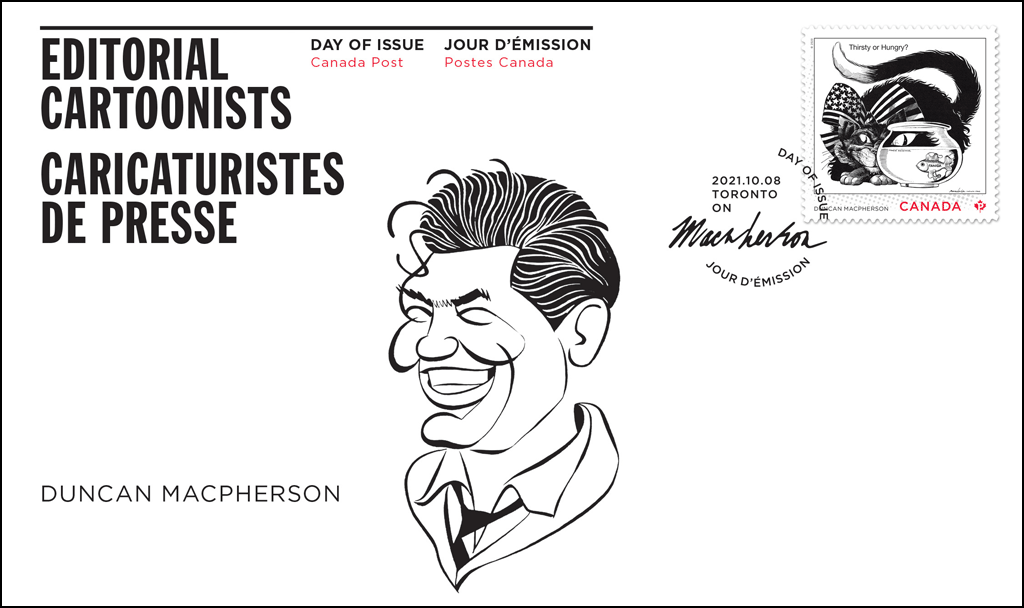
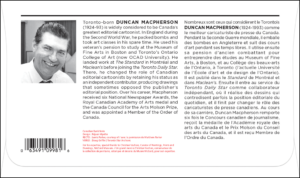 The first editorial cartoonist to be invested into the Order of Canada, Macpherson received six National Newspaper Awards, the Royal Canadian Academy of Arts medal and the Canada Council for the Arts Molson Prize. He died in 1993 at age 68.
More here
[en Francais pour les médias d’information]
Un timbre de Postes Canada rend hommage au caricaturiste de presse Duncan Macpherson
Duncan Macpherson, le premier caricaturiste à être décoré de l’Ordre du Canada en 1988, est l’un des cinq caricaturistes honorés pour leur contribution au journalisme, à l’humour et à l’art au pays
TORONTO, le 7 oct. 2021 /CNW/ – Postes Canada a dévoilé aujourd’hui un timbre rendant hommage à Duncan Macpherson (1924-1993), considéré comme l’un des caricaturistes les plus influents au Canada.
Caricaturiste de presse pour le Toronto Star pendant plus de trois décennies, il dessine des caricatures pleines d’esprit, remettant en question ce qu’il appelle « l’injustice » au nom des Canadiens ordinaires. L’artiste ouvre également la voie à une nouvelle génération en étant le premier caricaturiste canadien à négocier son salaire en passant par un agent. Parfois, ses dessins contredisent la position de son propre journal.
« Le fait que mon père soit honoré de cette façon ravive sa mémoire et son nom, affirme son fils Ian Macpherson. Je suis très fier de ses réalisations. Pour moi, cette redécouverte du travail et de l’influence de mon père a été une expérience formidable. »
Premier caricaturiste à être admis à l’Ordre du Canada, Duncan Macpherson remporte six fois le Concours canadien de journalisme, en plus de recevoir la médaille de l’Académie royale des arts du Canada et le Prix Molson du Conseil des arts du Canada. Il décède en 1993, à l’âge de 68 ans.
Lire la suite ici
Updated October 6th:
[press release]
Canada Post stamp honours editorial cartoonist Terry Mosher
One of five editorial cartoonists being honoured with a stamp, “Aislin” is commemorated for 50 years of thought-provoking work
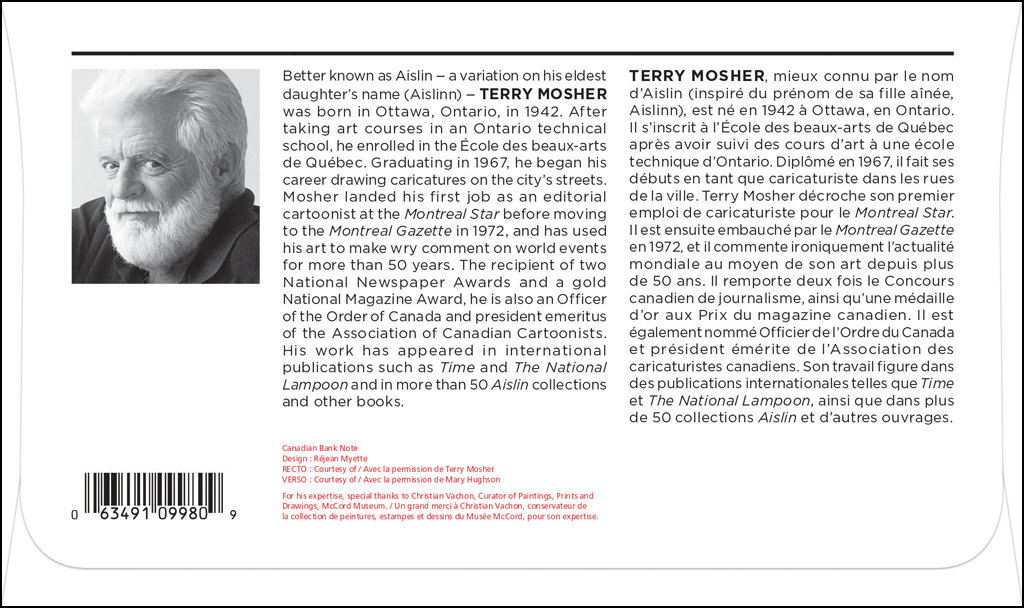
MONTRÉAL – Canada Post today released a stamp paying tribute to Terry Mosher, the long-time editorial cartoonist for the Montreal Gazette, known as Aislin. It is the third in a  five-stamp set honouring editorial cartoonists in Canada.
Mosher began his career drawing portraits and caricatures of tourists in the 1960s and was one of the founders of Artists’ Alley, an open-air gallery on Rue du Trésor in Québec – still a popular attraction.
He freelanced editorial cartoons to the Montreal Star before being hired there full-time in 1967. Five years later, he moved to the Montreal Gazette, where he is still drawing two cartoons a week. His 52nd book – Aislin’s Favourite COVID Cartoons from Around the World – was just released in September.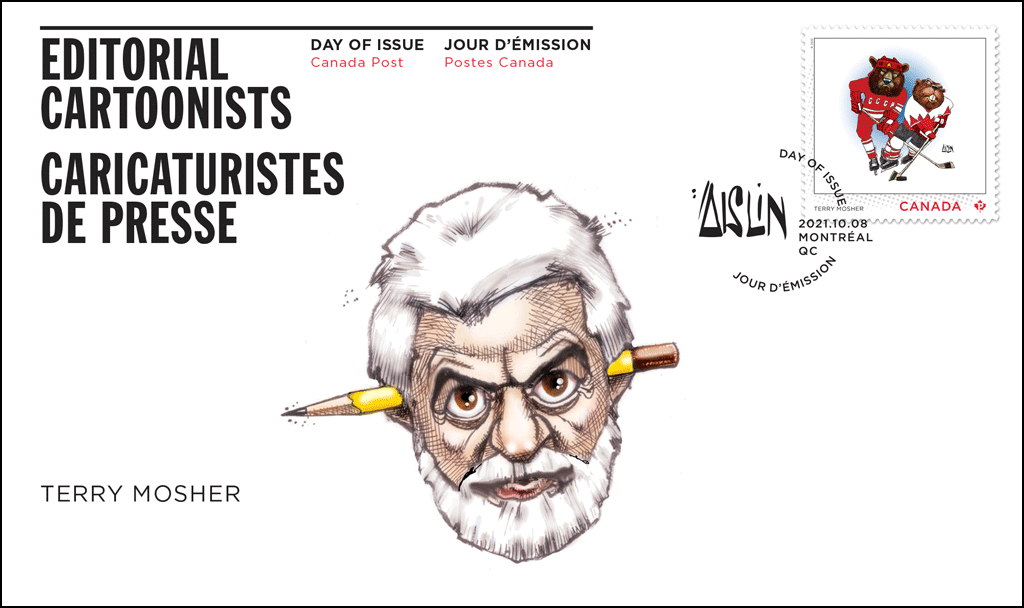 Believing that “no person or no thing is ever perfect,” Mosher upholds cartoonists’ satirical role, despite the controversies and criticism cartoons can provoke. “We all have faults and weaknesses,” he once said. “Can we admit as much by laughing at our frailties?”
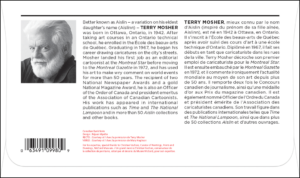 Mosher has drawn more than 14,000 cartoons; some have appeared in Time, The Atlantic Monthly, the New York Times International Edition, Punch and National Lampoon. He also earned two National Newspaper Awards, a gold National Magazine Award and was the youngest person to be inducted into the Canadian News Hall of Fame at age 43. He was also inducted into the Canadian Cartoonists Hall of Fame, is President Emeritus of the Association of Canadian Cartoonists and was appointed an Officer of the Order of Canada (2002).
More here
[en Francais pour les médias d’information]
Un timbre de Postes Canada rend hommage au caricaturiste de presse Terry Mosher
Aislin, qui dessine des caricatures mordantes depuis 50 ans, est l’un des cinq caricaturistes à être mis en vedette sur un timbre
MONTRÉAL, le 6 oct. 2021 /CNW/ – Postes Canada a émis aujourd’hui un timbre rendant hommage au caricaturiste de longue date du Montreal Gazette Terry Mosher, mieux connu sous le nom d’Aislin. Il s’agit du troisième timbre d’un jeu de cinq consacré aux caricaturistes canadiens.
Terry Mosher commence sa carrière dans les années 1960 en dessinant des portraits et des caricatures de touristes. Il est l’un des fondateurs d’Artists’ Alley, la galerie en plein air sur la rue du Trésor à Québec.
Il décroche un emploi de caricaturiste pigiste pour le Montreal Star avant d’être embauché à temps plein en 1967. Cinq ans plus tard, il se joint à la Gazette de Montréal, journal pour lequel il dessine deux caricatures par semaine, ce qu’il fait toujours aujourd’hui. Son52e livre, intitulé Aislin’s Favourite COVID Cartoons from Around the World, a été publié en septembre 2021.Croyant que « rien ni personne n’est parfait », Terry Mosher soutient le rôle satirique des caricaturistes, malgré les critiques qu’ils essuient parfois et les controverses que leurs dessins peuvent causer. « Nous avons tous des qualités et des défauts, souligne-t-il. Pouvons-nous l’admettre en riant de nos faiblesses? »
Au cours de sa carrière, l’artiste produit plus de 14 000 caricatures, dont certaines sont publiées dans Time, The Atlantic Monthly, le New York Times International Edition, Punch ou encore le National Lampoon. Aislin remporte deux fois le Concours canadien de journalisme, ainsi qu’une médaille d’or aux Prix du magazine canadien. À 43 ans, il devient le plus jeune membre du Temple de la renommée du journalisme canadien. Il est également intronisé au Temple de la renommée des caricaturistes canadiens, et il est aujourd’hui Officier de l’Ordre du Canada et président émérite de l’Association des caricaturistes canadiens.
Lire la suite ici
Updated October 5th:
[press release] (identical text to previous press releasea not included)
Canada Post stamp honours editorial cartoonist Brian Gable
One of five editorial cartoonists being recognized with a stamp, Gable is a legend of his profession who uses wit, humour to connect with readers
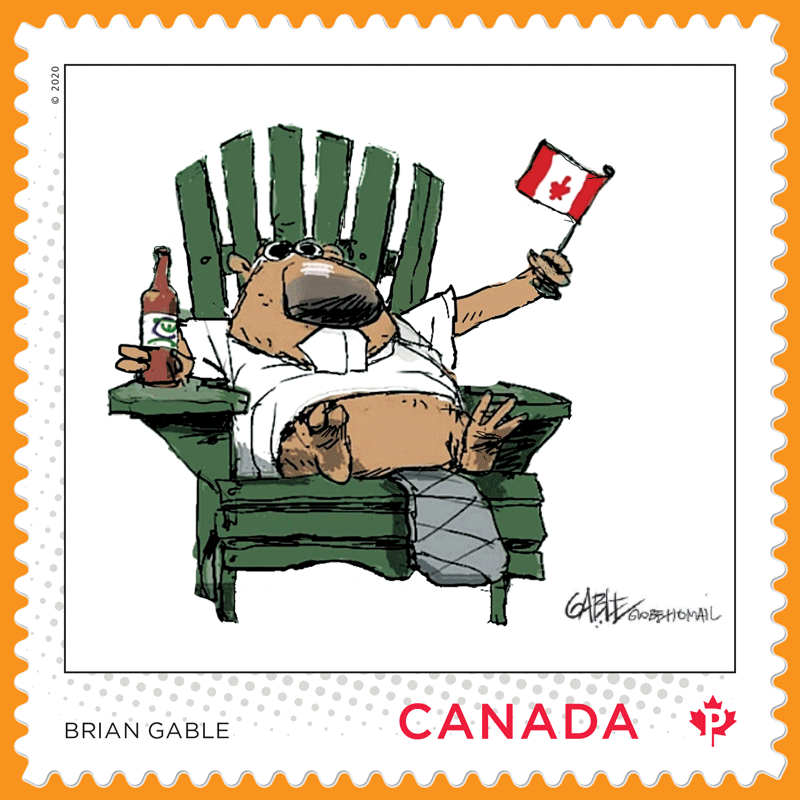
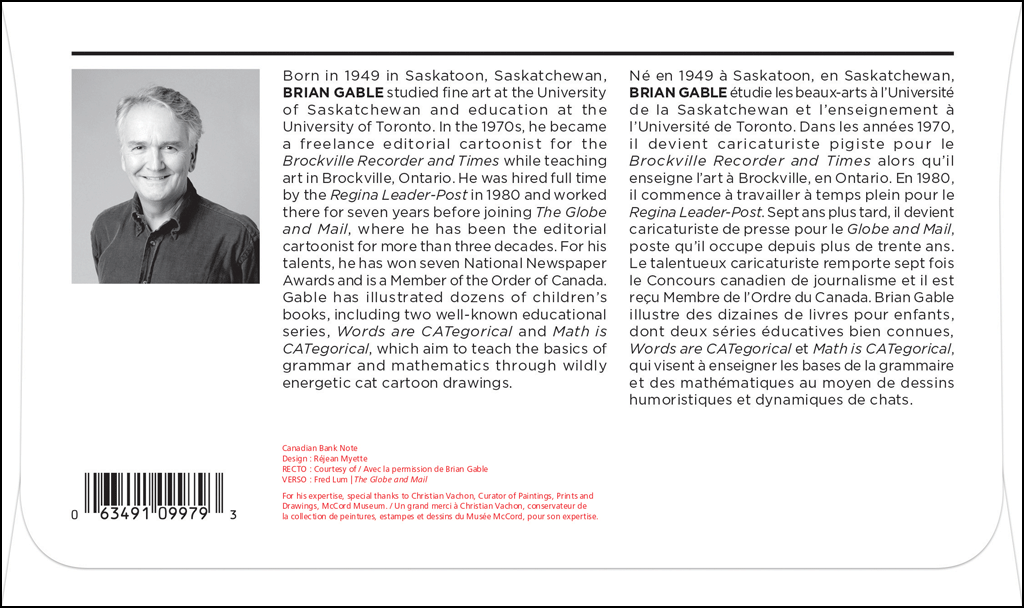
TORONTO – Canada Post unveiled a stamp today celebrating award-winning editorial cartoonist Brian Gable, whose work over several decades is widely lauded for making 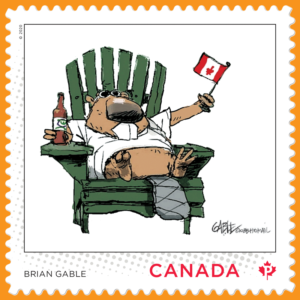 Canadians laugh and reflect.
Gable has been drawing his witty cartoons for daily newspapers for more than 40 years, including more than three decades as the editorial cartoonist for The Globe and Mail. He earned degrees in fine art and in education and penned his first published editorial cartoon for a student newspaper while in university. In 1977, he began freelancing editorial cartoons once a week for the Brockville Recorder and Times while teaching high school art in Brockville, Ontario. In 1980, he became an editorial cartoonist for the Regina Leader-Post, where he worked for seven years before joining The Globe and Mail in 1987.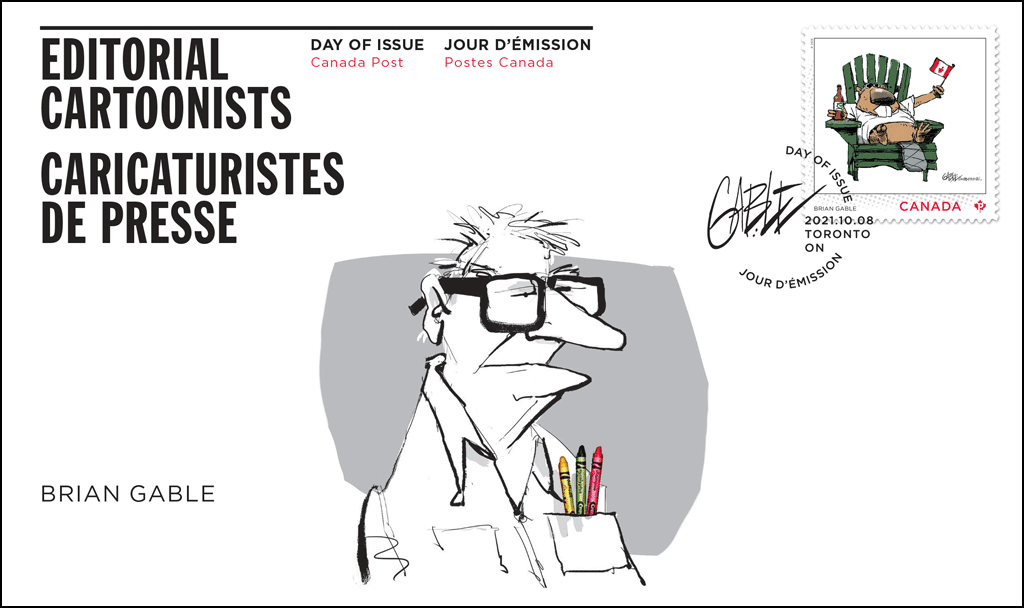
Gable captures the voices of average citizens in his cartoons and how they see decisions 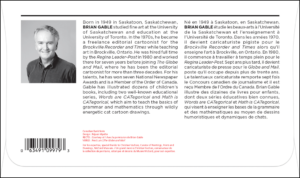 made by the powers that be. He regularly uses satire and sarcasm to highlight important issues facing our country and the world. He has won seven National Newspaper Awards for editorial cartooning. In 2018, he was invested as a Member of the Order of Canada. His citation said he’s “a legend within the editorial cartooning community” and that his work “embodies our national sense of humour, namely our ability to laugh at ourselves and our institutions.”
More here
[en Francais pour les médias d’information]
Un timbre de Postes Canada rend hommage au caricaturiste de presse Brian Gable
L’un des cinq caricaturistes à l’honneur dans cette émission, Brian Gable est une légende de sa profession, reconnu pour son brillant humour
TORONTO – Postes Canada a dévoilé aujourd’hui un timbre en hommage au caricaturiste de presse primé Brian Gable, dont les œuvres font rire et réfléchir les Canadiens.
Brian Gable nous présente ses caricatures de presse pleines d’esprit tous les jours depuis plus de 40 ans, la majorité ayant été publiées dans le Globe and Mail. Titulaire de diplômes en beaux-arts et en éducation, il réalise sa première caricature éditoriale pour un journal étudiant durant ses études universitaires. En 1977, il commence à faire des caricatures une fois par semaine pour le Brockville Recorder and Times tout en enseignant l’art à l’école secondaire de Brockville, en Ontario. En 1980, il devient caricaturiste de presse pour le Regina Leader-Post. Il y travaille pendant sept ans puis entre au Globe and Mail en 1987.
Dans ses caricatures, l’artiste représente les gens ordinaires et la façon dont ils perçoivent décisions prises par les grands dirigeants de ce monde. Il utilise régulièrement la satire et l’ironie pour mettre en évidence les enjeux importants auxquels notre pays et le monde sont confrontés. Durant sa carrière, il remporte sept fois le Concours canadien de journalisme pour la caricature éditoriale. En 2018, il est investi à titre de Membre de l’Ordre du Canada. Sa citation le décrit comme « une légende au sein de la communauté des caricaturistes de presse » et souligne que son travail « incarne notre sens de l’humour national, à savoir notre capacité à rire de nous-mêmes et de nos institutions ».
Lire la suite ici
Updated October 4th:
[press release]
Canada Post pays tribute to editorial cartoonist Serge Chapleau
One of five newspaper cartoonists whose work is featured on a stamp, Chapleau is honoured for his unique take on 50 years of news
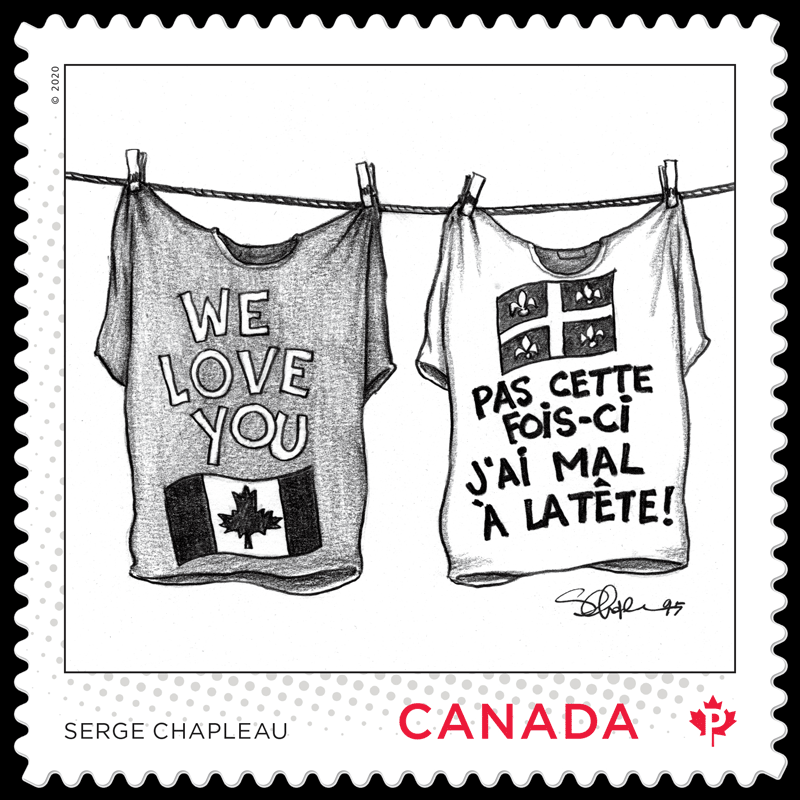
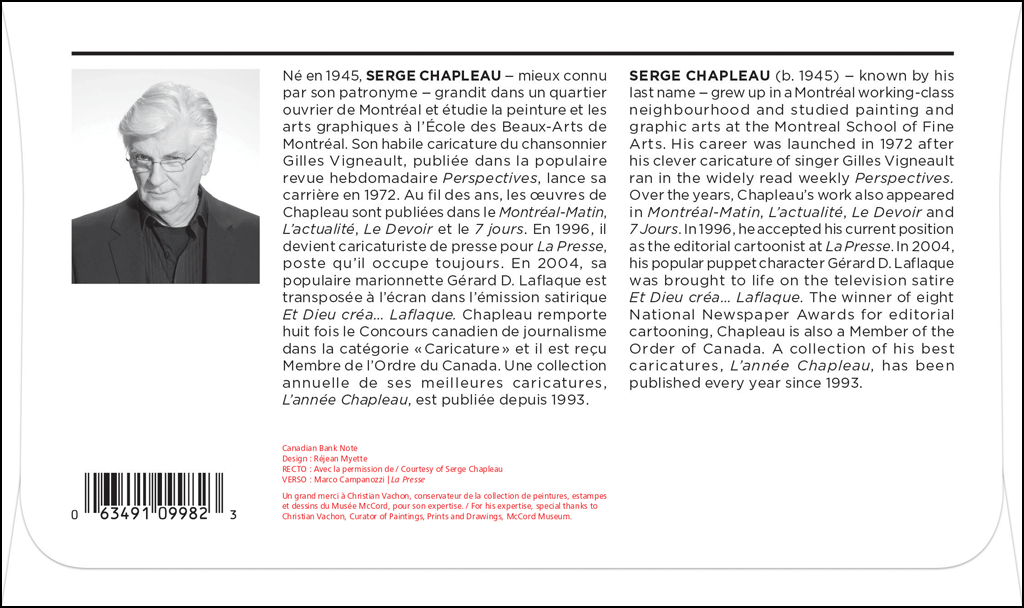
MONTRÉAL – Canada Post unveiled today a stamp honouring Serge Chapleau, the editorial cartoonist at La Presse and a true pioneer of his profession.
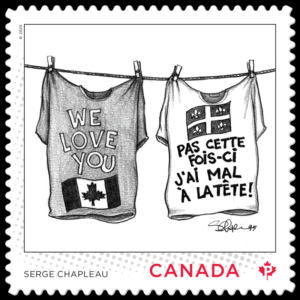 Serge Chapleau has drawn inspiration from the biggest European cartoonists and is known for his unique style and high-precision work. From his very first drawing, a portrait of singer Gilles Vigneault published in Perspectives magazine in March 1972, Chapleau became an overnight sensation and quickly established himself as one of the top cartoonists in the Montréal press. After working for various publications, including Le Devoir, L’actualité and 7 jours, he became staff cartoonist for daily newspaper La Presse in 1996, a position he holds to this day.
Through more than 7,000 drawings over the past 50 years, Chapleau has made people laugh and think by conveying the zeitgeist in a single image. In 1982, as a true pioneer of his profession, he became the first cartoonist to bring his characters to life on television. First with rubber puppets, then graphic animations, his famous character Gérard D. Laflaque captivated audiences, and nearly 500 episodes of shows Et Dieu créa… Laflaque and then ICI Laflaque were aired on Radio-Canada.
Winner of a record eight National Newspaper Awards (Editorial Cartooning category), Chapleau has published L’année Chapleau, a yearly collection of his best press drawings,  since 1993. When he was named a Member of the Order of Canada in 2015, he was recognized as “one of Canada’s most innovative and respected cartoonists,” and also a pioneer, having created animated cartoons for television.
Canada Post unveils five stamps
Canada Post’s other stamps in this set pay tribute to Brian Gable (The Globe and Mail, to be unveiled October 5), Terry Mosher (Montreal Gazette, October 6), Duncan Macpherson (Toronto Star, October 7) and Bruce MacKinnon (The Chronicle Herald, October 8). A live panel discussion with the cartoonists and Ian Macpherson, Duncan’s son, will be held online on October 8 at 11 am, ET. Register for the webcast here.
About the stamp issue
Canada Post’s newest stamp issue celebrates five of Canada’s greatest editorial cartoonists, whose thought-provoking and seminal work has helped shape our national fabric over the last half-century. The five award-winning cartoonists, each honoured with their own stamp, are some of our country’s best journalists and storytellers. Their
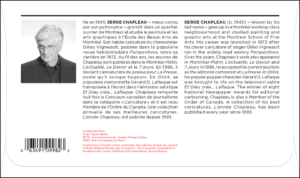
OFDC reverse
powerful drawings have been important fixtures in some of Canada’s most prominent and influential newspapers for decades.
Armed with pencils, ink and razor-sharp wit, these editorial cartoonists have boiled down complex issues into a single image – providing pointed commentary on important domestic and world events. Challenging the status quo and tackling controversial subjects head-on, their work has transcended politics and played an important role in upholding Canadian democratic freedoms.
These talented Canadian artists have made us laugh, reflect and cry with cartoons that tap into the emotions of a country. Their combination of humour and art has enlightened and entertained us, contributed to national debate, and brought attention to unfairness and injustice. Canada Post is proud to honour their enormous contributions to Canadian media and society.
[en Francais pour les médias d’information]
Postes Canada rend hommage au caricaturiste Serge Chapleau
L’un des cinq caricaturistes de presse à être mis en vedette sur un timbre, Chapleau est honoré pour son regard unique sur 50 ans d’actualité
MONTRÉAL – Postes Canada a dévoilé aujourd’hui un timbre-poste rendant hommage à Serge Chapleau, caricaturiste au journal La Presse et véritable pionnier de la profession.
S’inspirant des plus célèbres bédéistes européens, Serge Chapleau est reconnu pour son style unique et ses portraits d’une grande précision. Dès son premier dessin publié, un portrait du chanteur Gilles Vigneault dans le magazine Perspectives en mars 1972, Chapleau a fait sensation et est rapidement devenu l’un des caricaturistes incontournables de la presse montréalaise. Après diverses collaborations fructueuses, notamment dans le journal Le Devoir et les magazines L’actualité et 7 jours, il est devenu le caricaturiste attitré du quotidien La Presse en 1996, un poste qu’il occupe encore aujourd’hui.
Grâce à plus de 7 000 dessins réalisés depuis 50 ans, Chapleau fait rire et réfléchir en racontant en une image ce qui agite et ébranle la société. Véritable pionnier de la profession, il est devenu en 1982 le premier caricaturiste à donner vie à ses personnages au petit écran. D’abord avec des marionnettes en caoutchouc, qui deviendront plus tard des animations graphiques, son personnage Gérard D. Laflaque a séduit l’auditoire et près de 500 épisodes des émissions Et Dieu créa… Laflaque puis ICI Laflaque ont été diffusés par Radio-Canada.
Récipiendaire de huit prix du Concours canadien de journalisme dans la catégorie Caricature, un record, Chapleau publie depuis 1993 L’année Chapleau, un recueil annuel de ses meilleurs dessins de presse. Lorsqu’il est reçu Membre de l’Ordre du Canada en 2015, on le présente comme « l’un des caricaturistes les plus innovateurs et respectés au pays », en précisant qu’il « a aussi fait figure de pionnier grâce à sa caricature animée ».
Postes Canada dévoile cinq timbres
Les autres timbres de cette émission de Postes Canada rendent hommage à Brian Gable (The Globe and Mail, dévoilement le 5 octobre), Terry Mosher (Montreal Gazette, 6 octobre), Duncan Macpherson (Toronto Star, 7 octobre) et Bruce MacKinnon (The Chronicle Herald, 8 octobre). Une discussion en direct avec les caricaturistes et Ian Macpherson, fils de Duncan Macpherson, aura lieu en ligne le 8 octobre à 11 h (HE). Inscrivez-vous à la webémission.
À propos de l’émission de timbres
La plus récente émission de timbres de Postes Canada rend hommage à cinq des plus grands caricaturistes éditoriaux du pays, dont les œuvres inspirantes et marquantes
OFDC reverse
contribuent à la création du tissu social canadien depuis 50 ans. Ces cinq caricaturistes primés, chacun honoré par son propre timbre, comptent parmi les meilleurs journalistes et raconteurs de notre pays. Leurs dessins percutants ont été des éléments importants dans certains des journaux les plus lus et les plus influents du Canada pendant des décennies.
Armés de crayons, d’encre et d’un esprit aiguisé, ces caricaturistes de presse ont illustré des problèmes complexes en une seule image et commenté avec une grande pertinence d’importants événements sur la scène nationale et internationale. Contestant le statu quo et abordant de front des sujets controversés, leur travail a transcendé la politique et joué un rôle important dans la défense des libertés démocratiques canadiennes.
En dessinant des caricatures qui puisent dans les émotions des Canadiens, ces talentueux artistes nous ont fait rire, réfléchir et pleurer. Alliant humour et art, ils nous informent et nous divertissent, en plus d’alimenter la conversation nationale et de lever le voile sur les inégalités et les injustices. Postes Canada est fière de souligner les contributions importantes de ces caricaturistes aux médias d’ici et à la société canadienne.
Updated October 1st:
[press release]
Canada Post to pay tribute to five legendary editorial cartoonists next week through a special stamp issue
Each day a new stamp will be unveiled, honouring these individuals for their brilliant, funny and provocative images, ending with an online roundtable discussion with the artists
OTTAWA – Over the next week, Canada Post will unveil five stamps that celebrate five of Canada’s greatest editorial cartoonists, whose thought-provoking and seminal work has  helped shape our national fabric over the last half-century. Videos and stories will be shared with each unveiling, with a special online roundtable discussion with the artists planned for Friday, October 8.
The five award-winning cartoonists, each honoured with their own stamp, are some of our country’s best journalists and storytellers. Their powerful drawings have been important fixtures in some of Canada’s most prominent and influential newspapers for decades.
Armed with pencils, ink and razor-sharp wit, these editorial cartoonists have boiled down complex issues into a single image – providing pointed commentary on important domestic and world events. Challenging the status quo and tackling controversial subjects head-on, their work has transcended politics and played an important role in upholding Canadian democratic freedoms.
These talented Canadian artists have made us laugh, reflect and cry with cartoons that tap into the emotions of a country. Their combination of humour and art have enlightened and entertained us, contributed to national debate, and brought attention to unfairness and injustice.
Canada Post is proud to honour the enormous contributions to Canadian media and society of these editorial cartoonists:
Monday, October 4: Serge Chapleau of La Presse, winner of eight National Newspaper Awards and a Member of the Order of Canada. An annual collection of his best caricatures has been published every year since 1993. In 2004, his popular puppet character Gérard D. Laflaque was brought to life on the television satire Et Dieu créa…Laflaque.
Tuesday, October 5: Brian Gable of The Globe and Mail, winner of seven National Newspaper Awards and a Member of the Order of Canada, whose citation said his work “embodies our national sense of humour, namely our ability to laugh at ourselves and our institutions.”
Wednesday, October 6: Terry Mosher of the Montreal Gazette, best known by his pen name, Aislin. Over the last half-century, Mosher has drawn more than 14,000 cartoons, which have appeared around the world. He is an Officer of the Order of Canada and has won two National Newspaper Awards and a gold National Magazine Award. At 78, he is both a historian and an elder statesman of the craft in Canada; one of Mosher’s more than 50 books is about Duncan Macpherson’s career and influence.
Thursday, October 7: Duncan Macpherson (1924-93), of the Toronto Star, one of the most influential cartoonists in Canada. The first editorial cartoonist to be invested into the  Order of Canada, and winner of six National Newspaper Awards, he drew witty cartoons for three decades, challenging what he called “wrongness” on behalf of everyday Canadians. He also successfully pushed for independence from the editorial stance of his own newspaper, thereby changing the role for the editorial cartoonists who followed.
Friday, October 8: Bruce MacKinnon of The Chronicle Herald (Halifax), who has won 21 Atlantic Journalism Awards, six National Newspaper Awards for editorial cartooning (and a seventh, the inaugural Journalist of the Year award) and the World Press Freedom International Editorial Cartoon Competition. His citation as a Member of the Order of Canada called him “one of Canada’s most skilled, empathetic and provocative editorial cartoonists.
The live panel discussion with the cartoonists and Ian Macpherson, Duncan’s son, will be held online on October 8 at 11 am, ET. Register for the webcast here. It will be moderated by Anthony Wilson-Smith, President and CEO of Historica Canada and Chair of the Canada Post Stamp Advisory Committee.
[en Francais pour les médias d’information]
Cinq grands caricaturistes de presse seront à l’honneur dans une émission de timbres la semaine prochaine
Postes Canada dévoilera un timbre par jour, chacun soulignant l’intelligence, l’humour et l’irrévérence des œuvres, et présentera une table ronde en ligne avec les artistes
OTTAWA – Au cours de la prochaine semaine, Postes Canada dévoilera cinq timbres qui rendent hommage à cinq des plus grands caricaturistes éditoriaux du pays, dont les œuvres inspirantes et marquantes contribuent à la création du tissu social canadien depuis 50 ans. Des vidéos et des entrevues seront présentées lors de chaque dévoilement, et la semaine se terminera avec une table ronde en ligne spéciale avec les artistes le vendredi 8 octobre.
Ces cinq caricaturistes primés, chacun honoré par son propre timbre, comptent parmi les meilleurs journalistes et raconteurs de notre pays. Leurs dessins percutants ont été des éléments importants dans certains des journaux les plus lus et les plus influents du Canada pendant des décennies.
Armés de crayons, d’encre et d’un esprit aiguisé, ces caricaturistes de presse ont illustré des problèmes complexes en une seule image et commenté avec une grande pertinence d’importants événements sur la scène nationale et internationale. Contestant le statu quo et abordant de front des sujets controversés, leur travail a transcendé la politique et joué un rôle important dans la défense des libertés démocratiques canadiennes.
En dessinant des caricatures qui puisent dans les émotions des Canadiens, ces talentueux artistes nous ont fait rire, réfléchir et pleurer. Alliant humour et art, ils nous informent et nous divertissent, en plus d’alimenter la conversation nationale et de lever le voile sur les inégalités et les injustices.
Postes Canada est fière de souligner les contributions importantes de ces caricaturistes éditoriaux aux médias d’ici et à la société canadienne.
Lundi 4 octobre : Serge Chapleau de La Presse, huit fois gagnant du Concours canadien de journalisme et membre de l’Ordre du Canada. Une collection annuelle de ses meilleures caricatures est publiée depuis 1993. En 2004, sa populaire marionnette Gérard D. Laflaque est transposée à l’écran dans l’émission satirique Et Dieu créa… Laflaque.
Mardi 5 octobre : Brian Gable du Globe and Mail, huit fois gagnant du Concours canadien de journalisme et membre de l’Ordre du Canada. Sa citation à l’Ordre du Canada souligne que son travail « incarne notre sens de l’humour national, à savoir notre capacité à rire de nous-mêmes et de nos institutions ».
Mercredi 6 octobre : Terry Mosher du Montreal Gazette, mieux connu sous le nom Aislin. Au cours des 50 dernières années, il a réalisé plus de 14 000 caricatures qui ont fait le tour du monde. Officier de l’Ordre du Canada, il remporte deux fois le Concours canadien de journalisme, ainsi qu’une médaille d’or aux Prix du magazine canadien. À 78 ans, il est historien et le doyen du métier au Canada. Il est auteur de plus de 50 livres, dont l’un porte sur la carrière et l’influence de Duncan Macpherson.
Jeudi 7 octobre : Duncan Macpherson (1924-1993), du Toronto Star, est l’un des caricaturistes les plus influents au Canada. Premier caricaturiste de presse à être reçu membre de l’Ordre du Canada et gagnant du Concours canadien de journalisme à six reprises, il a réalisé des caricatures pleines d’esprit pendant trois décennies, remettant en question ce qu’il appelait « l’injustice » au nom des Canadiens ordinaires. Il a également milité pour l’indépendance éditoriale auprès de son employeur, ce qui a changé le rôle des nouvelles générations de caricaturistes de presse.
Vendredi 8 octobre : Bruce MacKinnon du Chronicle Herald d’Halifax, gagnant du Prix du journalisme de l’Atlantique à 21 reprises, du Concours canadien de journalisme (dont le premier prix Journaliste de l’année) à sept reprises et du Concours international de dessin pour la liberté de la presse. Sa citation de membre de l’Ordre du Canada le qualifie de « l’un des caricaturistes de presse les plus compétents, empathiques et provocateurs du Canada ».
Une discussion en direct avec les caricaturistes et Ian Macpherson, fils de Duncan Macpherson, aura lieu en ligne le 8 octobre à 11 h (HE). Inscrivez-vous à la webémission. La discussion sera animée par Anthony Wilson-Smith, président et chef de la direction d’Historica Canada et président du Comité consultatif sur les timbres-poste de Postes Canada.
Posted September 27th:
From Canada Post:
On October 8, the postal service will issue a new set of stamps that highlight the works of five of the nation’s most renowned editorial cartoonists.
We invite you to join us for a unique opportunity to hear directly from these highly acclaimed talents, as they recount tales of covering the news and societal trends, while expressing their opinions and perspectives through their art.
Moderator: Anthony Wilson-Smith, President and CEO, Historica Institute, and Chair, Stamp Advisory Committee
In conversation with
- Serge Chapleau, La Presse
- Brian Gable, The Globe and Mail
- Bruce MacKinnon, The Chronicle Herald
- Terry Mosher (Aislin), Montreal Gazette
- Ian Macpherson, representing his father Duncan Macpherson, Toronto Star
Sign up to watch a webcast and the opportunity to submit questions. It begins at 11:00 a.m. and will last for about 60 minutes.

 by Hindus, Buddhists, Jains, Sikhs and others around the world, the five-day celebration falls on November 4 this year.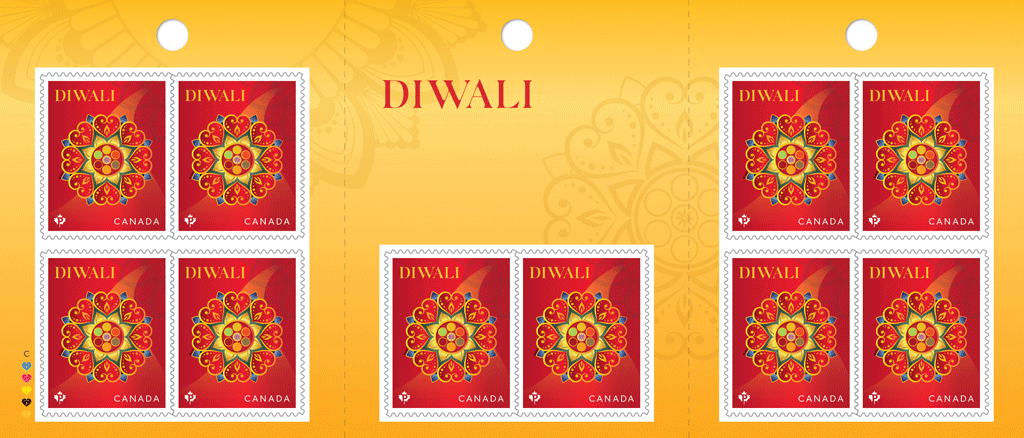

 spread light and love, the five-day festival is observed by Hindus, Buddhists, Jains, Sikhs and others around the world.