
[press release]
Canadian astronaut Jeremy Hansen unveils Canadarm stamp at Toronto school
Stamp is third in a set of 10 that captures unforgettable moments of the last 50 years as country celebrates Canada 150
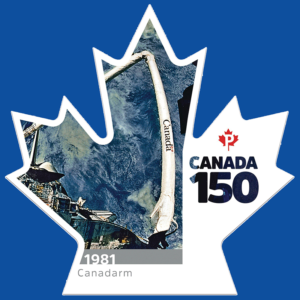 TORONTO, May 4, 2017 – Canadian Space Agency astronaut Jeremy Hansen was at a Toronto school to unveil a stamp with an image of Canada’s most famous robotics accomplishment – the Canadarm. The stamp commemorates Canada’s achievements in space, science, technology and innovation.
Hansen was on-site at Glen Ames Senior Public School on April 28 to unveil the stamp and meet with Grade 7 and 8 students from the school’s robotics club as they prepare to travel to California to compete in an international robotics competition. Students competing were tasked to design, build and program a robot made entirely of Lego to solve a real-world problem. The team came up with the PetPortion – a robot that manages a pet’s weight by automatically giving it the proper amount of food based on its weight and level of daily exercise.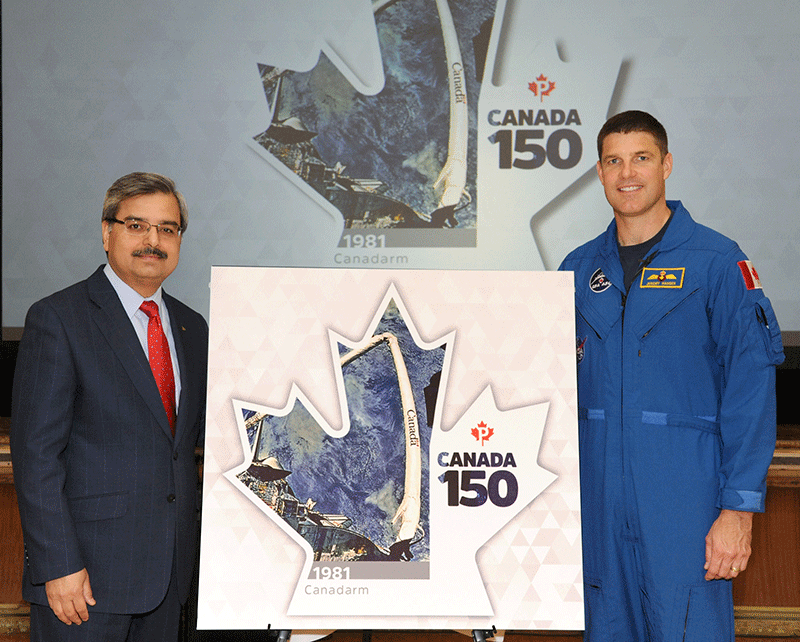
Hansen also addressed the entire school and encouraged the next generation of Canadian innovators to pursue education in the fields of science, technology, engineering and mathematics.
Hansen features in video, unveils third stamp for Canada 150
The Canadarm stamp is the third in a set of 10 to be issued which mark Canada 150. Each stamp celebrates a significant and unforgettable moment in the life of this country since its centennial in 1967.
The 10 moments and achievements, which have become pillars of Canada’s collective memory, were selected by Canada Post’s stamp advisory committee, which includes historians, archivists, graphic designers and philatelists. A video featuring Hansen and a magazine article about the Canadarm are on canadapost.ca/canada150.
Canadarm showcased Canada’s expertise in space and robotics
The Canadarm’s first mission was aboard the Space Shuttle Columbia on November 13, 1981. It manoeuvred astronauts, satellites and cargo over 30 years before it retired when the Space Shuttle program ended in 2011. The Canadarm launched Canada’s close partnership with NASA on human space flight. Eight Canadian astronauts have flown in space, participating in 16 missions aboard either a space shuttle or on the International Space Station: Roberta Bondar, Marc Garneau, Chris Hadfield, Steve MacLean, Julie Payette, Robert Thirsk, Bjarni Tryggvason and Dave Williams.
Currently Canada has two active astronauts: David Saint-Jacques and Jeremy Hansen, and two additional astronauts are expected to be announced this summer.
The Canadarm was instrumental in establishing Canada’s reputation for robotics innovation and led to a new generation of Canadian robotics on the International Space Station (ISS). It will inspire future generations of Canadian scientists and engineers as they develop new technologies that make the world a better, easier and safer place.
Each stamp in the set has been unveiled by a distinguished Canadian individual or group related to the moment being celebrated. The setting for each stamp launch also directly relates to the moment being commemorated. The stamp that celebrates Expo 67 was unveiled in Montréal by Habitat 67 architect Moshe Safdie on April 27 and the stamp about the Constitution and the Canadian Charter of Rights and Freedoms was unveiled on Parliament Hill on May 3. The next stamp in the Canada 150 set will be revealed in Toronto on Tuesday, May 9. The others will be unveiled individually at cities across the country, the last of them on June 1.
About the stamp
Each of the 10 maple-leaf shaped die-cut Permanent domestic-rate stamps measures 40 mm X 40 mm and is printed in 6 colours plus tagging. The self-adhesive stamps are available in a booklet of 10 (4 million stamps). A gummed pane of 10 stamps, with circle perforations 4.5 cm in diameter, is also available (80,000 panes). Official First Day Covers, one for each stamp design and each cancelled in OTTAWA ON, are available in a pack of 10 (10,000 packs). The stamp issue was designed by Roy White and Liz Wurzinger of Subplot Design Inc. in Vancouver, B.C., and printed by the Lowe-Martin Group.
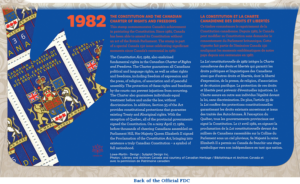
 OTTAWA, May 3, 2017 – Only a peaceful nation achieves full independence with the stroke of a pen, thousands of citizens erupting in cheers and a band striking up a fanfare – which is how Canada brought its Constitution home.
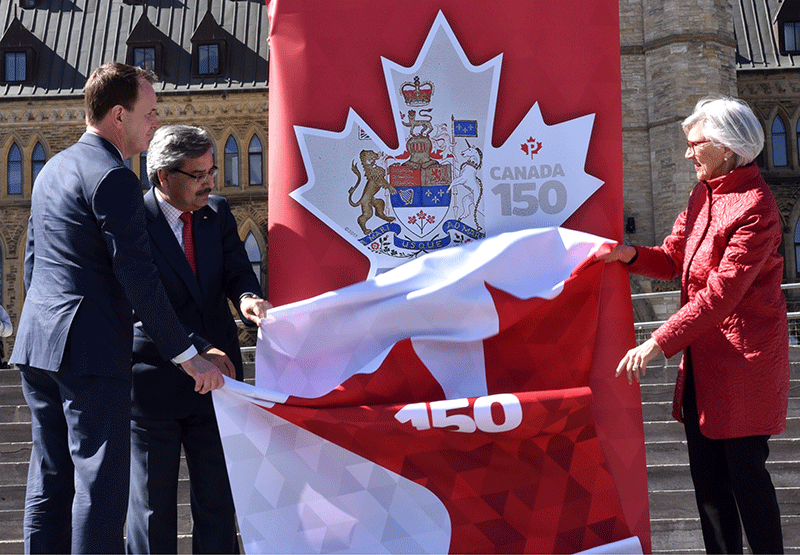 [Photo, left to right: Steven MacKinnon, Member of Parliament for Gatineau, Parliamentary Secretary to the Minister of Public Services & Procurement; Deepak Chopra, President and Chief Executive Officer, Canada Post; The Right Honourable Beverley McLachlin, P.C., Chief Justice of Canada. Photo by Canada Post/Denis Drever.]
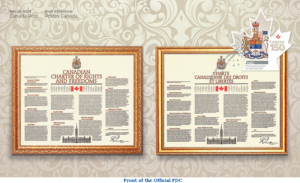 Under the Charter, Canadians have the right to freedom of speech, religion, thought and expression, as well as freedom of the press, of mobility, of association and of assembly, among others. The Charter also enshrines citizens’ rights to vote, to run for office, to a fair trial, to security and privacy, as well as important linguistic rights. The Charter also confers equality upon every individual in Canada – regardless of race, religion, national or ethnic origin, colour, sex, age or physical or mental disability. Governments must not discriminate on these grounds in laws or programs.
 A
A 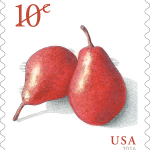 5178 10¢ Red Pears, serpentine die cut 11¼x11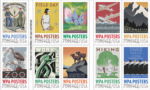
 a. Block of 10, #5180-5189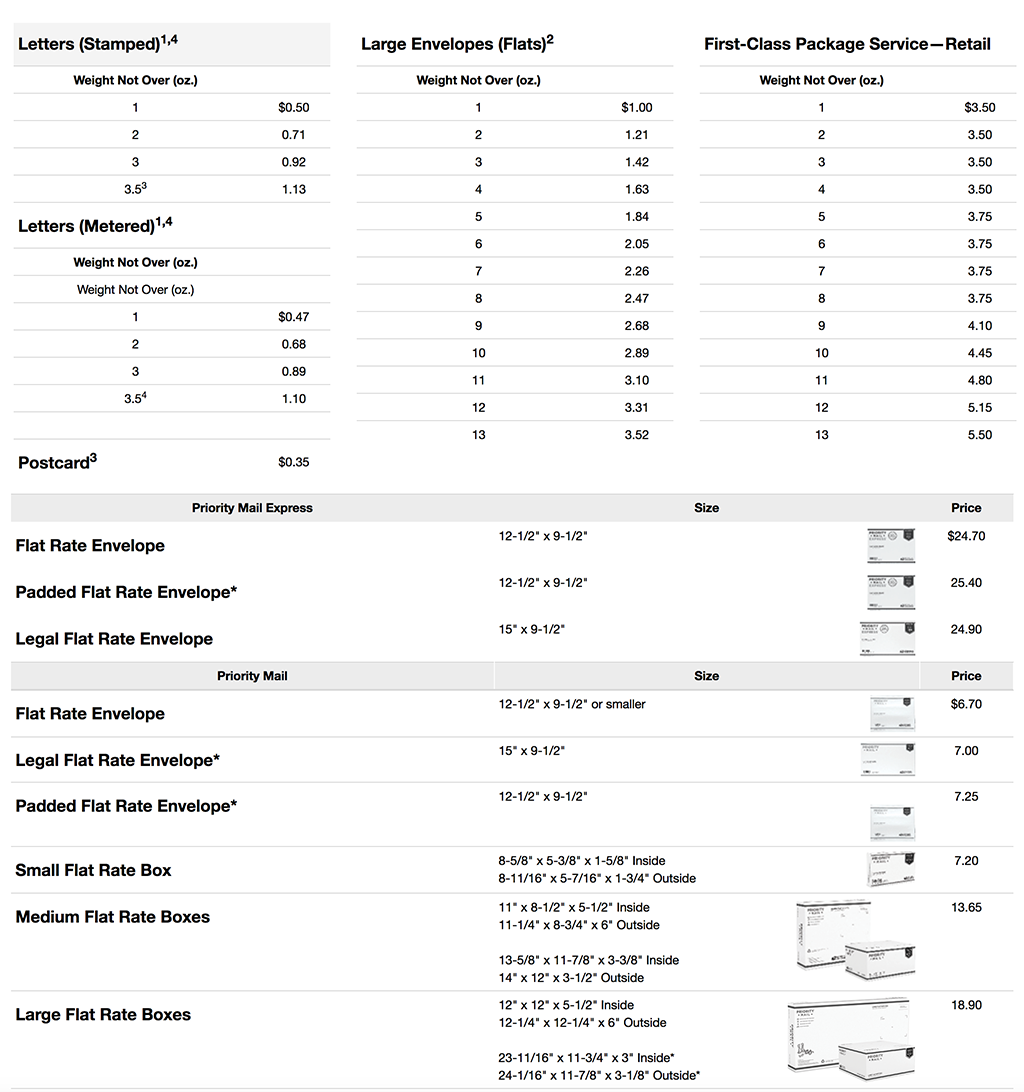
 Hardly any stamp collector is happy with the Postal Service’s practice, begun in earnest in 2007, of producing increasing numbers of self-stick issues that when used, can’t be floated free of the envelope paper.
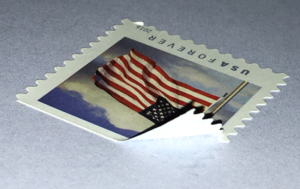 But are the changes really fatal, or do they simply force changes in collecting with which we are unhappy? Are we over-reacting to what we see as high handedness on the part of the USPS? Personally, I feel it, and there can be little doubt that there is some of this in the reaction of collectors. As confirmation, we saw it in letters to the editor in the philatelic press as the USPS went to unwashable self-sticks, and then decreed that all issues would be self-sticks.
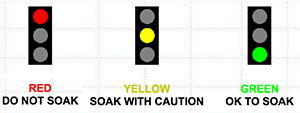 were soakable, through the hard work of volunteer John Cropper. Then he had to move on, and no one else was able to undertake this task. But the “Soaking Stoplight” information is still online here for
 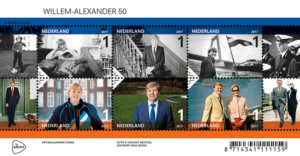 The Hague, 24 April 2017 – PostNL is issuing a special stamp sheetlet honouring King Willem-Alexander’s fiftieth birthday. The ten pictures show the various periods in the life of the king. The images are featured on six stamps and on four tabs to the left and right of the stamps.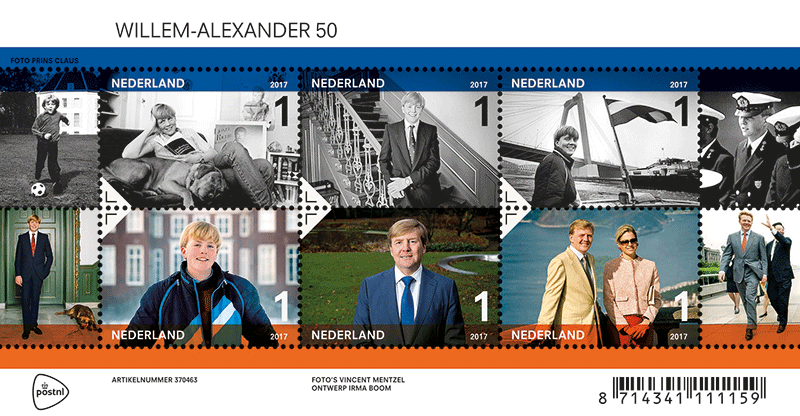
 The Hague, 25 April 2017 – PostNL is issuing a new stamp sheetlet to mark the occasion of the Year of the Botanical Gardens in 2017. The stamps feature ten special plants and trees. These crown jewels are all from botanical gardens in the Netherlands.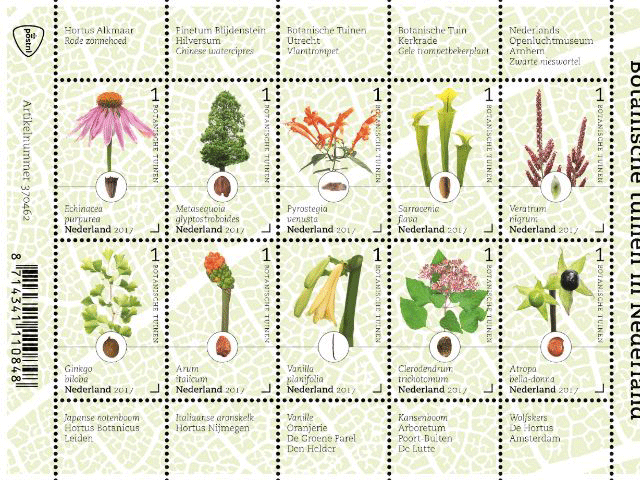
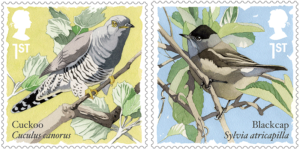 MINT STAMPS IN DETAIL
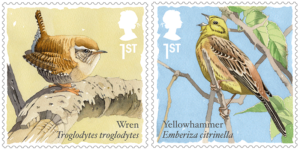 Stamp Format: Square
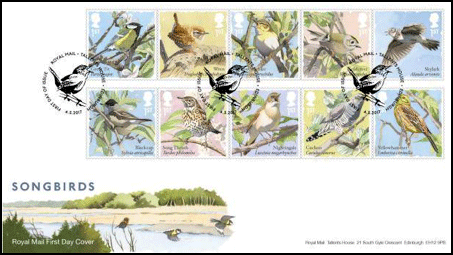 The First Day Covers (above) Feature All 10 Mint Stamps and a special First Day of Issue postmark.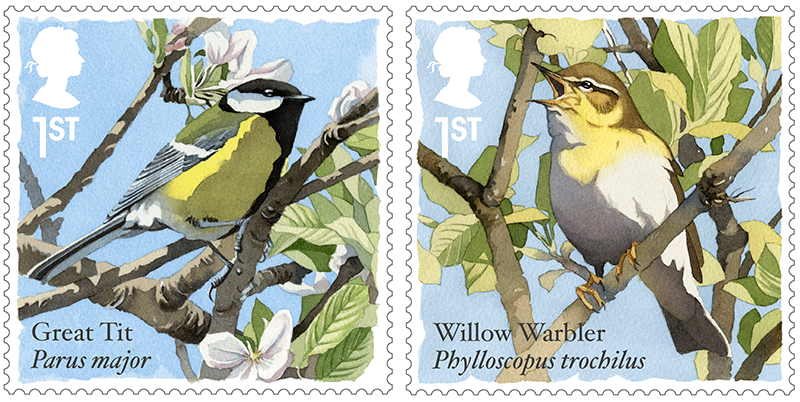
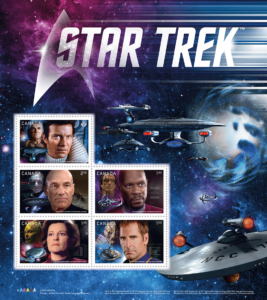
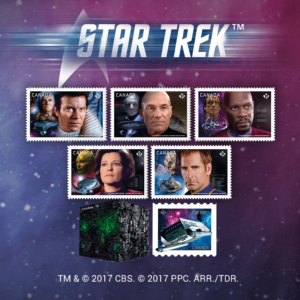 OTTAWA, April 28, 2017 /CNW/ – Canada Post today issued a set of seven Star Trek stamps that celebrate each of Starfleet’s finest leaders, dramatically depicting them with the most cunning of the adversaries they confronted on their voyages.
 Admiral James T. Kirk with Khan Noonien Singh (Star Trek II: The Wrath of Khan™, 1982)
 shuttlecraft stamp, measuring 24 mm by 20 mm, is available as a coil of 50 stamps. All seven stamps, including the uniquely-shaped Borg cube, which measures 67 mm by 62 mm and is enhanced with holographic foil and embossing, are available ready-to-mail in a prestige booklet. The Official First Day Covers – all cancelled in Vulcan, Alberta, except Kirk’s, which is cancelled in Montréal, Quebec – are available only as a set of seven.
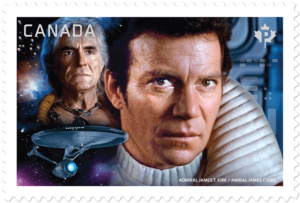 After completing his original five-year mission and earning a promotion, Admiral James T. Kirk set an unassailable standard for every Starfleet captain. But being stuck behind a desk at Starfleet Command made the aging admiral restless. Kirk rejoined the U.S.S. Enterprise, the first step toward a final show- down with his most cunning and deadly adversary: Khan. Set on revenge, the genetically enhanced superhuman cost Kirk the life of his closest companion.
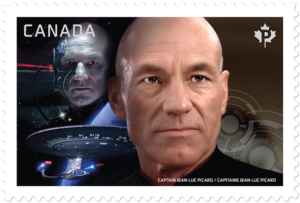 More “by the book” than Kirk, Captain Jean-Luc Picard led his crew with stern professionalism. When Borg drones invaded the U.S.S. Enterprise-D, they captured and assimilated Picard into the Borg Collective. Renamed Locutus and forced to be the Borg’s spokesperson, Picard was eventually rescued by his crew, though not before he was the Borg’s unwilling agent of destruction. Haunted, Picard finally overcame his demons in a final showdown with the Borg Queen.
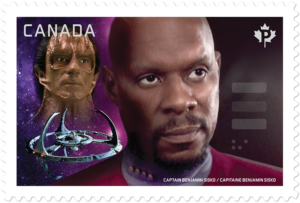 Posted to the space station Deep Space 9, near the planet Bajor, Captain Benjamin Sisko took to heart his mission to help the Bajorans recover from the Cardassian occupation. Dukat, the dangerous former prefect of the station, considered Sisko’s new role as a personal affront – and wanted revenge. This animosity led to escalating tensions between the Federation and a new, powerful enemy known as the Dominion, and placed Captain Sisko at the centre of a battle between good and evil.
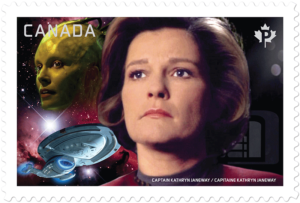 Sent to pursue renegades known as the Maquis, Captain Kathryn Janeway and the crew of the U.S.S. Voyager thought they’d be home in no time. Unexpectedly, Voyager and a Maquis vessel were transported to the other side of the galaxy. Far from home, the two crews united and began a decades- long journey back to the Federation. In the end, Janeway faced off against the enigmatic Borg Queen and used the Collective’s advanced technology to speed Voyager’s return home.
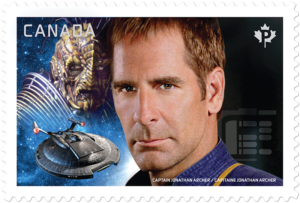 One of Starfleet’s earliest pioneers, Captain Jonathan Archer represented United Earth before the founding of the Federation. In 2153, Archer and the Enterprise NX-01 responded when the mysterious Xindi suddenly attacked Earth. The Enterprise trailed the Xindi to a dangerous region of space known as the Delphic Expanse, where Archer confronted Commander Dolim, a genocidal Xindi-Reptilian convinced that the destruction of humanity would ensure the survival of his people.
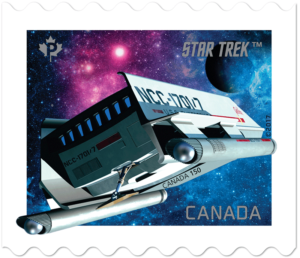 The U.S.S. Enterprise carried a fleet of shuttlecraft designed for short-range space exploration, planetary landings, and (often) dangerous missions. The first of these shuttles – named Galileo (NCC-1701⁄7) – met an explosive fate in orbit around Taurus II, seconds after its crew was beamed safely to the Enterprise. In honour of the spunky little craft, its name was passed on to future models, making it the most famous of the Enterprise sidekicks.
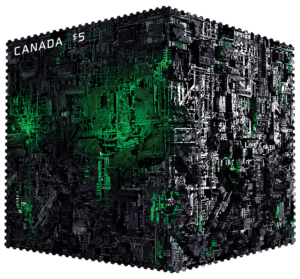 The cybernetic Borg had no interest in diplomacy; they sought only to achieve perfection by assimilating different species. Those assimilated lost all sense of individual identity and became merely an extension of the Borg Collective – a fate many considered worse than death. The appearance of a Borg cube – the Collective’s formidable spaceship – often meant the destruction of a civilization. Resistance, as the Borg said, was futile.
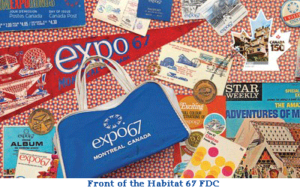
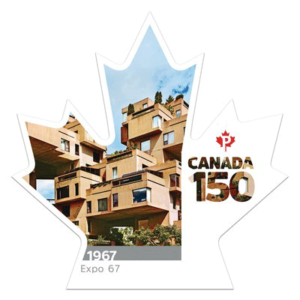 MONTRÉAL, April 27, 2017 /CNW/ – Canada Post and Moshe Safdie, whose revolutionary Habitat 67 modular housing complex earned global accolades as an icon of urban living, today unveiled a stamp with an image of his futuristic structure representing the event for which it was built: Expo 67.
 Safdie unveiled the stamp in the very building that forever placed his signature on his adopted city. With Habitat 67, Safdie – a bold, brash and brilliant young architect on the verge of launching a significant global career – captured an era of optimism, energy and progress. This project also launched his incredible career that has had him design prestigious buildings around the world, including the National Gallery of Canada, the Quebec Museum of Civilization, Marina Bay Sands in Singapore and the United States Institute of Peace in Washington, D.C.
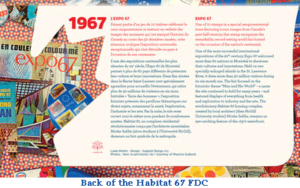 Those six months became a landmark moment for Canada – socially, culturally and politically. Several generations of Canadians have since pointed to it as the signature event of our centennial year. It featured pavilions from 62 countries, as well as Canada’s provinces and territories. It was an opportunity for Canadians to get better acquainted with Quebec culture. It attracted many notable figures of the time, including Queen Elizabeth II, U.S. President Lyndon B. Johnson, Princess Grace of Monaco, Jacqueline Kennedy and Robert F. Kennedy, and Bing Crosby. The Ed Sullivan Show was broadcast live from Expo 67 twice that May. Many Canadians associate Bobby Gimby’s popular centennial tune Ca-na-da with Expo 67.