
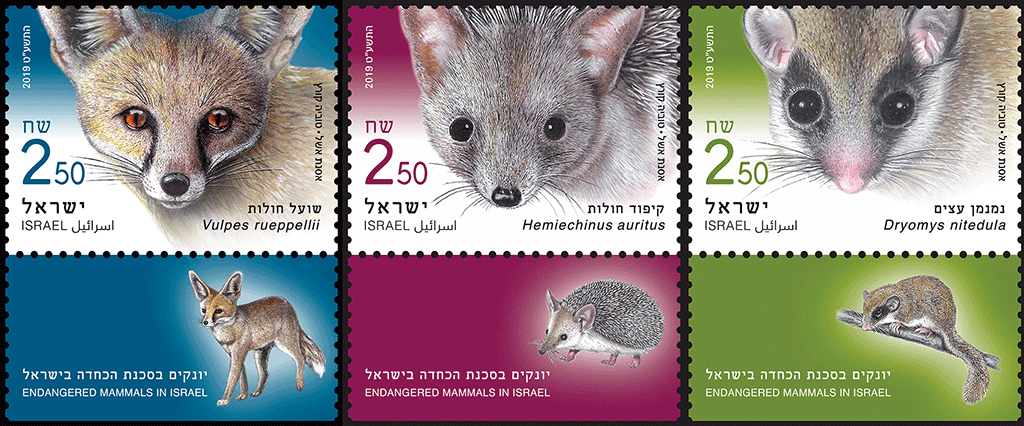
 Three stamps: Vulpes rueppellii, Hemiechinus auritus, Dryomys nitedula
Date of Issue: 01 May 2019
Denominations: NIS 2.50,2.50,2.50
Size of Stamps: W: 40 mm H: 30 mm
Plate nos.: 1119
Designers: Tuvia Kurtz, Osnat Eshel
Printers: Cartor Security Printing, France
Printing method: Offset
Sheet type: Mini Special Sheet
No. of stamps in sheet: 9 (3 tabs)
Place of cancellation: Be’er Sheva
No. of FDCs: 1
Price of FDCs: NIS 8.70
From Israeli Post:
Three special mammal species in Israel have something in common – although each lives 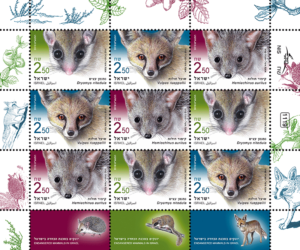 in a different area and habitat. All of these habitats are disappearing, be it loess covered areas, desert sands in the Negev or Mediterranean forests. The destruction of natural habitats is the most severe problem plaguing our world’s wildlife, and Israel is no exception.
Wide open spaces that existed just 200 years ago have been populated. Fallow fields have become few and planted. The “wilderness” has been tamed by concrete and cement and crisscrossed by roads. All of these factors have contributed to the decrease and segmentation of natural habitats, making it difficult for wild animals in Israel to sustain their populations.
These three species are all nocturnal, thus they are seldom seen by humans, who may admire their beauty only for brief moments. They will cease to exist if we fail to make a 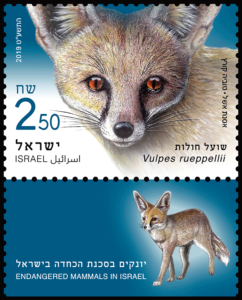 special effort to preserve them and their habitats.
Rueppell’s Fox — Vulpes rueppellii
The Rueppell’s Fox is a small, beautiful species. It has a grey stripe running from the corner of its eye to its mouth and paws that are covered in fur as an adaptation to its sandy habitat. The Negev Desert is the northernmost distribution area of this species. In the 1980’s the population gradually disappeared from the sands of the Negev and Arava, due to the destruction from its displacement of its habitat by red foxes and wolves.
Forest Doormouse — Dryomys nitedula
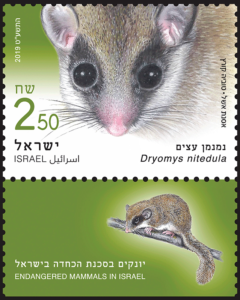 The Forest Doormouse is a small, stealth rodent that is active at night and few ever see it. It has a black “mask” on its face and a long, bushy tail. This species builds round nests in treetops, and spends its days sleeping there. At night it searches for acorns from oak trees and fruit in its
wooded Mediterranean habitat, using birds’ nests like tables. The Forest Doormouse may be found in the Galilee and was recently also seen in Jojoba groves in the northern Negev Desert. It is prevalent in the Balkans and southward to Israel, through Syria and Lebanon. Israel is the southernmost edge of its distribution.
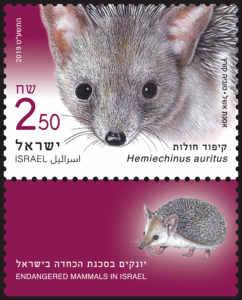 Long-eared Hedgehog — Hemiechinus auritus
The Long-eared Hedgehog is the smallest hedgehog species in Israel. It has a light colored face, a pointed nose, large furless ears and no fur. It lives on the coastal plain as far as Caesarea in the north, in areas of loess sediment. There is an isolated population in the Golan Heights as well. The Long-eared Hedgehog may also be found in towns in the central of Israel, where it shares the urban habitat with Southern White-breasted Hedgehog.
—Keren Or
Zoologist, Zoological Center, Ramat Gan
 Date of Issue: 01 May 2019
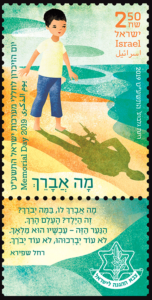 Date of Issue: 01: May: 2019
 Date of Issue: 01 May 2019
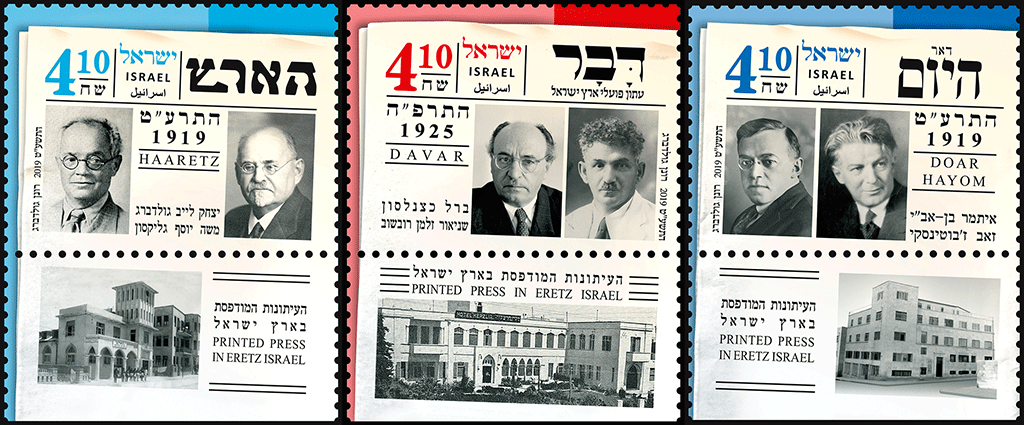
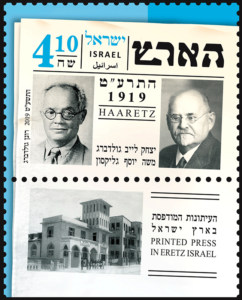 News of Haaretz was the civilian version of the British military weekly in Hebrew The Palestine News which was published for just one year (April 1918 – April 1919). When the British put it up for sale the Zionist Organization could not fund the purchase and called upon Isaac Leib Goldberg, a wealthy man and passionate Zionist from Eastern Europe, who acquired the newspaper and served as its first publisher.
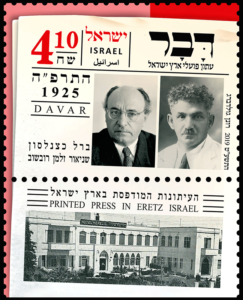 David Ben Gurion. The decision to publish a daily newspaper was made at the Histadrut’s founding convention in 1920, but its implementation was delayed by internal struggles within the organization. Berl Katznelson, the ideologist of the Labor Movement in Eretz Israel, founded Davar and served as its first editor. Shneur Zalman Rubashov (Shazar), later the third President of Israel, was his head assistant. Shazar succeeded Katznelson as the newspaper’s editor upon his death in 1944.
 newspaper. Editor Itamar Ben-Avi derived the name of the Jerusalem-based newspaper from London’s Daily Mail. The right-wing Doar Hayom represented the veteran members of the Jewish Yishuv in Eretz Israel, the Sephardim and the farmers as opposed to the mid-left wing Haaretz and tended to publish more “scoops”, amusing stories from around the world and personal attacks on the heads of the Zionist movement and the Yishuv. Ben-Avi loathed Haaretz and used to say mockingly: “Haaretz may be a decent newspaper – but it isn’t a newspaper; Doar Hayom may not be decent, but it is a newspaper”.
 5350 (55¢) Cactus Flowers – Opuntia engelmannii

 In the design of the Beautiful Netherlands 2019: Terschelling island shape plays the leading role. This is reflected in the map of Terschelling, who placed the designers in miniature on the stamps and wholesale on the stamp. The stamps are recognizable images of the island: the Brandaris as the oldest lighthouse in the Netherlands, a monumental tombstone in Strieperkerkhof, the clubhouse of the diving team Ecuador, a row of colorful buoys on the town wharf and a spoon with cranberries. The design turns the typical shape of the island is also back in other ways. For example, the font of the labels is a so-called letter box, composed of elements that are separate from each other.
 of the 2018 Grand with ” Frank Lloyd Wright-First Days and Usage of the Two Cent Issue,” will represent Americover this summer in Omaha, Nebraska.

 A First World War pilot, William George Barker, VC, who remains the most decorated member of the military in the history of Canada and the British Empire. Barker flew more than 900 combat hours between 1916 and 1918 and is credited with 50 victories over enemy aircraft.
 Aviation pioneer and bush pilot C.H. “Punch” Dickins, who logged more than 1.6 million kilometres flying over northern Canada. The First World War flying ace and Distinguished Flying Cross recipient made the first reconnaissance flight across the unmapped Barren Lands of the Northwest Territories.
 Elizabeth “Elsie” MacGill, who was the first woman in Canada to receive a degree in electrical engineering, and first in the world to hold a master’s degree in aeronautical engineering and to work as a professional aircraft designer. She was dubbed “Queen of the Hurricanes” in a wartime comic book for her work in overseeing design refinements and production of Hawker Hurricanes. The fighter plane was a stalwart workhorse in the Second World War, and especially the Battle of Britain.
 The Lazair, a family of twin-engine, high-wing ultralight monoplanes designed by Dale Kramer of Port Colborne, Ontario. Manufactured as kits in Canada between 1979 and 1985, the Lazair is still considered one of the best light aircraft ever made. Kramer received the Roméo Vachon Award in 1983 for outstanding contribution to the development of aeronautics in Canada.
 The twin-engine, supersonic Avro CF-105 Arrow interceptor, which could fly at more than twice the speed of sound. It is considered one of the greatest technological achievements in Canadian aviation history. Some of its innovative technologies are still in use today.

 Christina Tessier, President and CEO of

 The Hague, 14 March 2019. In 2019 it was 100 years ago that the Royal Dutch Airlines (KLM) and the Netherlands Aerospace Centre (NLR) were founded. In that year Fokker built the first aeroplanes on Dutch soil. PostNL honours this special centenary celebration with the issuance of the 100 Years of Aviation postage stamp sheet.