
from Israel Post; these stamps will be issued February 7, 2017:
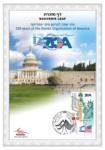
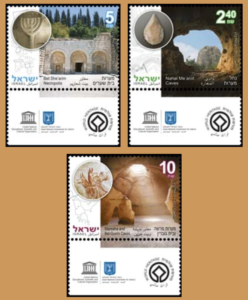 In 1972, the United Nations Educational, Scientific and Cultural Organization (UNESCO) approved an agreement to protect world heritage sites. The program included rules to assess natural and cultural sites and determine their significance to mankind’s common cultural heritage. Every country prepares a list of its sites and once a year the UNESCO World Heritage Center conducts a special meeting to choose which of the nominated sites shall be included in the list of United Nations World Heritage Sites.
In 1999, Israel joined the agreement and submitted sites for consideration, and since 2001 a number of Israeli sites have been added to the list: Old City of Acre (2001), Masada (2001), White City of Tel Aviv (2003), Biblical Tels ñ Megiddo, Hazor, Beer Sheba (2005), Incense Route ñ Desert Cities in the Negev (Avdat, Mamshit, Haluza and Shivta) (2005), Baha’i Holy Places (2008), Nahal Me’arot Caves (2012), Maresha and Bet-Guvrin Caves (2014), Bet She’arim Necropolis (2015).
Nahal Me’arot Caves
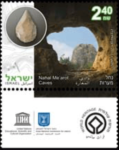 Four caves are carved into the mountain on the southern slope of Mount Carmel, at the entrance to the Nahal Me’arot Caves. Archeological excavations conducted at the site from 1928 to the present have discovered evidence of human existence near and inside the caves over hundreds of thousands of years. Among the many findings were remnants of houses, various stone tools, jewelry, bones of animals used for food and graves.
Bet She’arim Necropolis
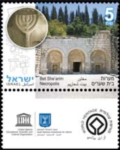 Rabbi Yehudah Hanasi, leader of the Jewish people in the late 2nd century CE, was buried at his behest in the cemetery in the town of Bet She’arim in the western Jezreel Valley. Many others subsequently asked to be buried near the final resting place of the admired leader. Dozens of burial caves were carved into the hillsides and on the outskirts of the town. Jews were brought from all over Eretz Israel and even from faraway lands to be buried there. The hundreds of epitaphs found in the caves provide information about the Jewish lifestyle in the 3rd and 4th centuries CE.
Maresha and Bet-Guvrin Caves
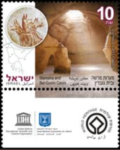 Residents of the city of Maresha, in the southern Judean plain, carved many spaces beneath their homes into the soft chalk bedrock upon which the city was built. These spaces served as water reservoirs, agricultural production facilities, storage rooms, pigeon raising, burial caves and more. After Maresha was destroyed in the 1st century BCE a new city called Bet-Guvrin was constructed nearby. In the Byzantine period, the townspeople carved bricks out of the chalk in deep, bell-shaped caves.
In June 2007, Acre, Tel Aviv and Masada stamps were issued as part of the World Heritage Site stamp series and in August 2007 the Biblical Tels and Incense Route stamps were added.
Description of the Stamps
Nahal Me’arot Caves The view from inside the cave toward the Nahal Me’arot Caves landscape (photo by Ronen Goldberg).
Carved flint hand axe from the Lower Paleolithic period found in the Tabun Cave. (photo: Midad Sokolovski; courtesy of the Israel Antiquities Authority).
Topographic map of Nahal Me’arot Caves (based on an Israel Antiquities Authority map).
Bet She’arim Necropolis
FaÁade of the Sarcophagi Cave, cave number 20 (courtesy of the Nature and Parks Authority, photo: Tsvika Tsuk).
Plaster relief in the shape of a menorah in the Sarcophagi Cave (photo: Shutterstock).
Partial diagram of the caves (based on a sketch in a Nature and Parks Authority pamphlet).
Maresha and Bet-Guvrin Caves
Bell cave in Bet-Guvrin (photo: Shutterstock).
Cave drawing of Cerberus, mythological hound that guards the gates of the underworld, from the Sidon Burial Cave (courtesy of the Nature and Parks Authority, photo: Jonny Limonik).
Partial diagram of the caves in the Maresha and Bet-Guvrin area (based on a sketch in a Nature and Parks Authority pamphlet).
 Krav Maga is an Israeli martial art designed for self-defense, a method that allows anyone to defend him or herself against acts of violence. Krav Maga students learn how to protect themselves from arm and leg blows, strangulations, stabbing, bludgeoning and even how to deal with gun threats. Krav Maga is unique due to its simplicity and effectiveness in utilizing the attacker’s weak points. The technique was developed during the Yishuv period prior to the creation of the State of Israel, when the British Mandate government banned the bearing of arms following the 1936-39 Arab revolts. The Yishuv Council decreed that every Jewish boy and girl from the age of 13 and up must learn how to defend themselves in time of need. Krav Maga was also an inherent part of the training for members of the various underground defense organizations. The early Krav Maga was a combination of boxing and Japanese jujutsu. The jujutsu drills, however proved to be too difficult to master and therefore new, original drills, unique in their effectiveness and simplicity, were developed.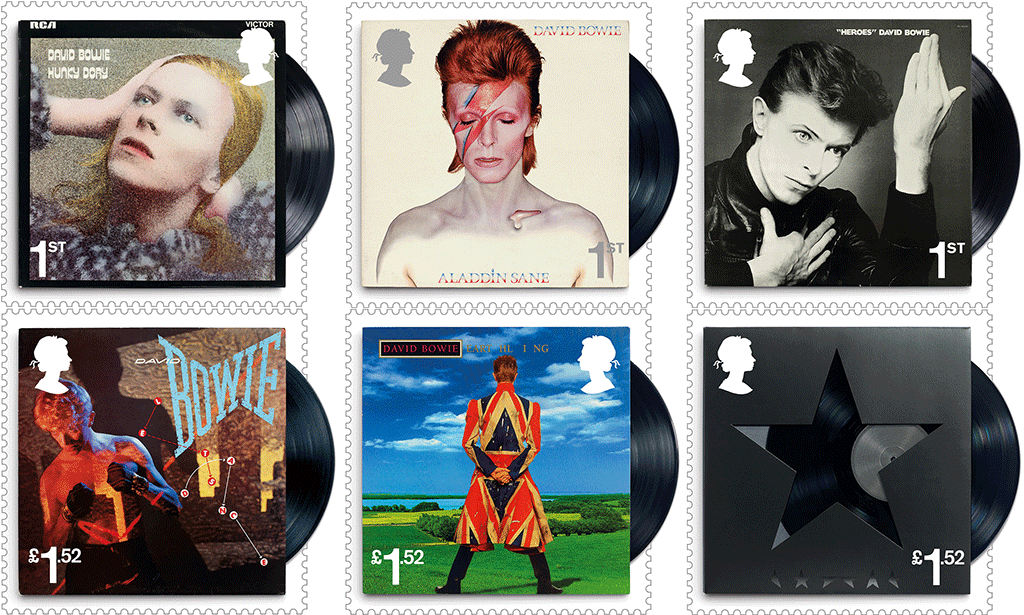
 Hunky Dory, Bowie’s fourth album and released in December 1971. Time magazine chose it as part of their “100 best albums of all time” list in January 2010.
 Aladdin Sane, his sixth album and released in April 1973. The album features the iconic photograph by Brian Duffy.
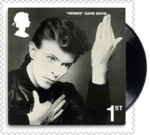 Heroes, his twelfth studio album and released in October 1977. This was the second instalment of his “Berlin Trilogy” recorded with Brian Eno and Tony Visconti. The title track remains one of Bowie’s best known and acclaimed songs.
 Let’s Dance, his fifteenth studio album and released in April 1983. Co-produced by Nile Rodgers, and featuring three of his most successful singles Let’s Dance, Modern Love and China Girl. Let’s Dance is Bowie’s best-selling album.
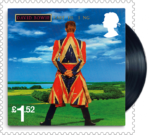 Earthling, his twentieth studio album and released in February 1997. The striking cover art features Bowie in an Alexander McQueen designed Union Flag coat.
 Bowie’s 28th and final studio album, released on his 69th birthday – 8 January 2016 – and charting at No.1 in more than 20 countries. Bowie died two days after the release of ★, the album reaffirming his legacy as modern music’s most unrelenting innovator and topping critics’ ‘Best of 2016’ lists.
 The Ziggy Stardust Tour, 1972. The tour promoted The Rise and Fall of Ziggy Stardust and the Spiders from Mars studio album and took in the UK, North America, and Japan.
 The Serious Moonlight Tour, 1983. The tour was designed to support the Let’s Dancealbum and was Bowie’s longest, largest and most successful concert tour.
 The Stage Tour, 1978. Also known as Isolar II – The 1978 World Tour and The Low / “Heroes” World Tour because it was staged to promote the Low and “Heroes” albums
 A Reality Tour, 2004. Staged to promote the Reality album this tour was to be Bowie’s last tour.
 The American Philatelic Society reports its Show Manager, Megan Orient, will be leaving following AmeriStamp Stamp Expo (March 3-5, Reno, Nevada) “to be closer to her family.” We understand that that is in Pittsburgh.
 February
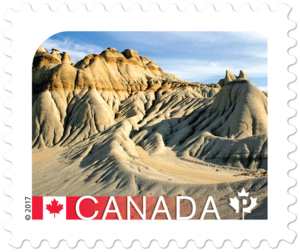 Dinosaur Provincial Park
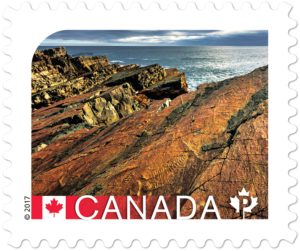
 Crafted by Lara Minja, of Lime Design, these definitive stamps showcase five places in Canada that have special status because of their importance to the common heritage of humanity. Mistaken Point (N.L.), the Historic District of Old Québec (Que.) and L’Anse aux Meadows National Historic Site (N.L.) make their debut in the series, while Dinosaur Provincial Park (Alta.) and Red Bay Basque Whaling Station (N.L.) enjoy an encore.
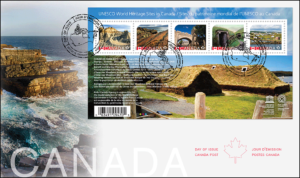 Cancelled in a fishing community near Mistaken Point – Canada’s latest UNESCO site – the Official First Day Cover boasts a souvenir sheet with some hidden features in celebration of Canada’s sesqui- centennial. Use black light to explore our tribute to these captivating sites and you’ll find the official Canada 150 logo and text waiting to be discovered.
 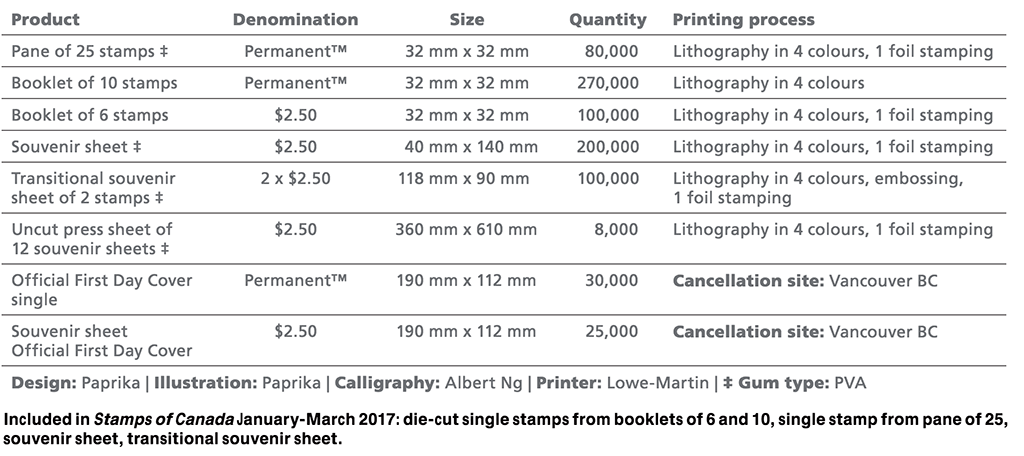 [January 16th press release]
 CO World Heritage Sites.
 e than four centuries. Fortified with walls, gates and bastions, this is the only colonial city north of Mexico to have preserved its ramparts.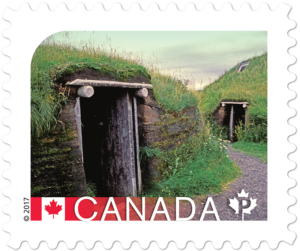
 OTTAWA – Canada Post will greet the Year of the Rooster with a two-stamp issue, the ninth in its most recent series honouring the Lunar New Year. A Permanent™ domestic-rate stamp featuring a rooster image, with its chest proudly puffed out, is paired with an international-rate stamp offering a close-cropped profile view of the rooster’s stately face. Both images are created from lines of gold foil.
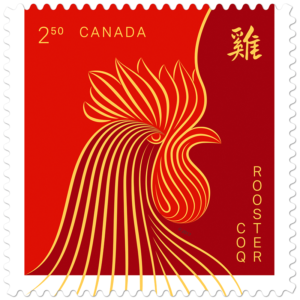 The Year of the Rooster arrives on January 28, 2017, and runs until February 15, 2018. Those born under this sign are honest, courageous and confident. Marked for success, they achieve their goals through a combination of wit, charm and hard work.
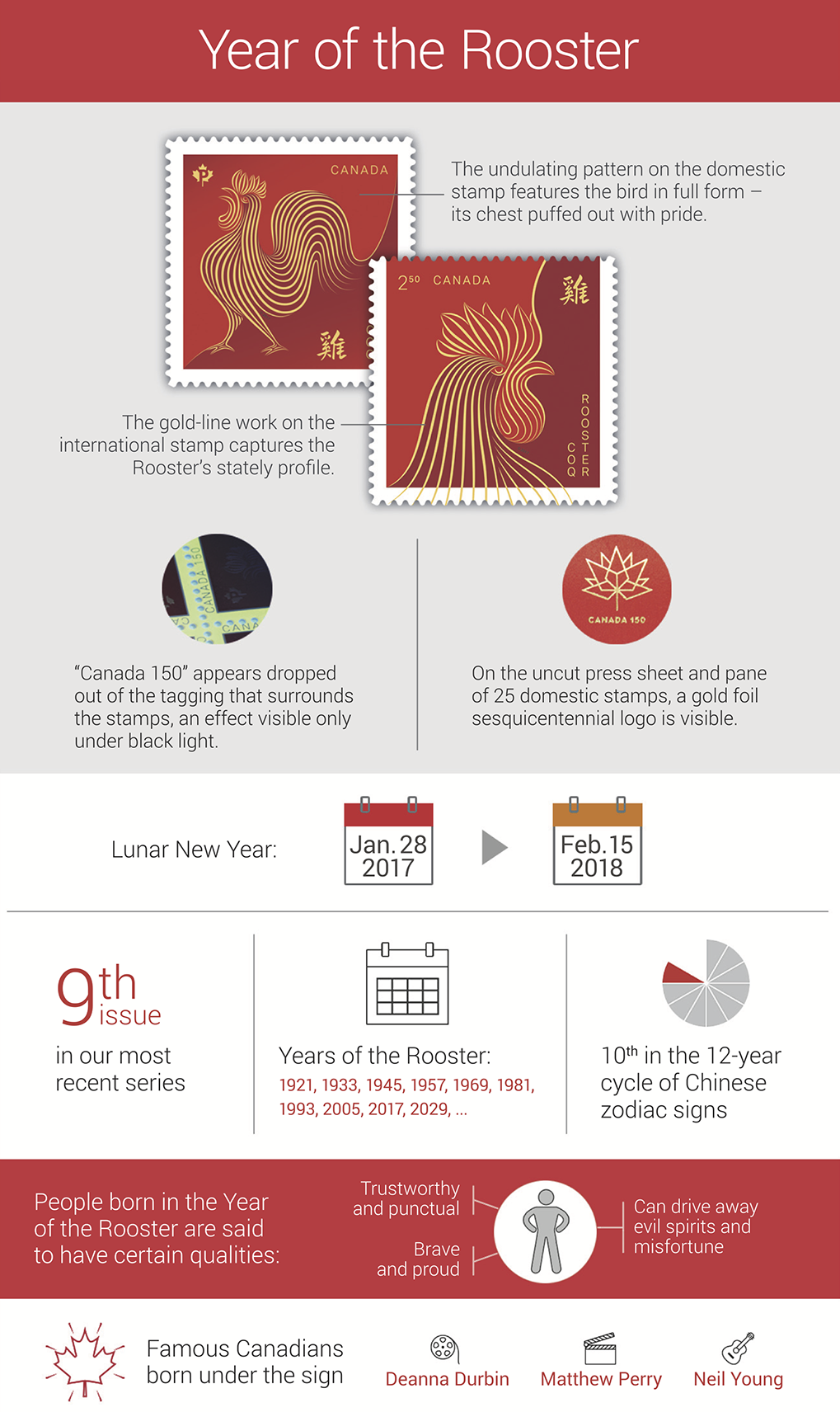 [press release]
 The major differences are no name of the issue, “Pillar 210” rather than “Suite 300;” and the ZIP extension.
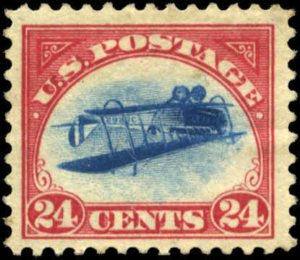 A representative of an auction firm recently brought a Jenny Invert to the Philatelic Foundation’s New York offices for authentication on behalf of a consignor. The Philatelic Foundation is widely regarded in the hobby of stamp collecting for its expertise in authenticating this iconic United States air mail rarity. Over the last 70 years, the PF has issued Certificates of Authenticity for 85 of the 100 stamps from the original error sheet of the “upside down airplane stamp,” including all six of the existing blocks of four.
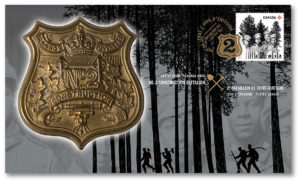 Although Canada Post produces its own cachets, such as the one shown on the right, it is possible for individuals to submit their own covers.
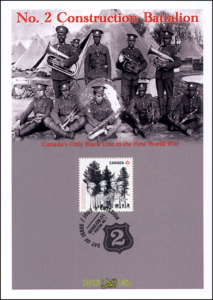 On the left is shown a Dragon Card produced by me for the same issue and submitted to Canada Post for servicing.
 Canada Post will not cancel covers that “bear foreign postage or previous cancellations.” That means no combination FDCs with another country’s stamps, such as the 1999 U.S. Star Trek stamp (Sc. 3188e). Earlier Canadian stamps are acceptable for combos.
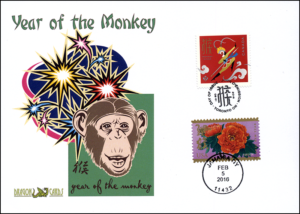 Canada strongly prefers that its stamps be in the traditional upper right corner, but is flexible.
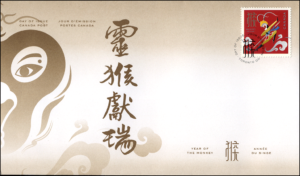 Post.
Post.