
[from PostNL material] [click on any of the pictures for larger versions]
PostNL brings birds from Saba to life on new stamp sheet
Issue: Experience Nature — Birds of Saba
Issue date: 5 January 2026
Format: sheet of 10 stamps in 10 different designs, denomination 1 for items up to 20 grams destined for addresses within the Netherlands
Item number: 460161
Design: Frank Janse, Gouda
Photography: Dreamstime, Shutterstock and Wikimedia Commons (Korall, lwolfartist, Mykola Swarnyk)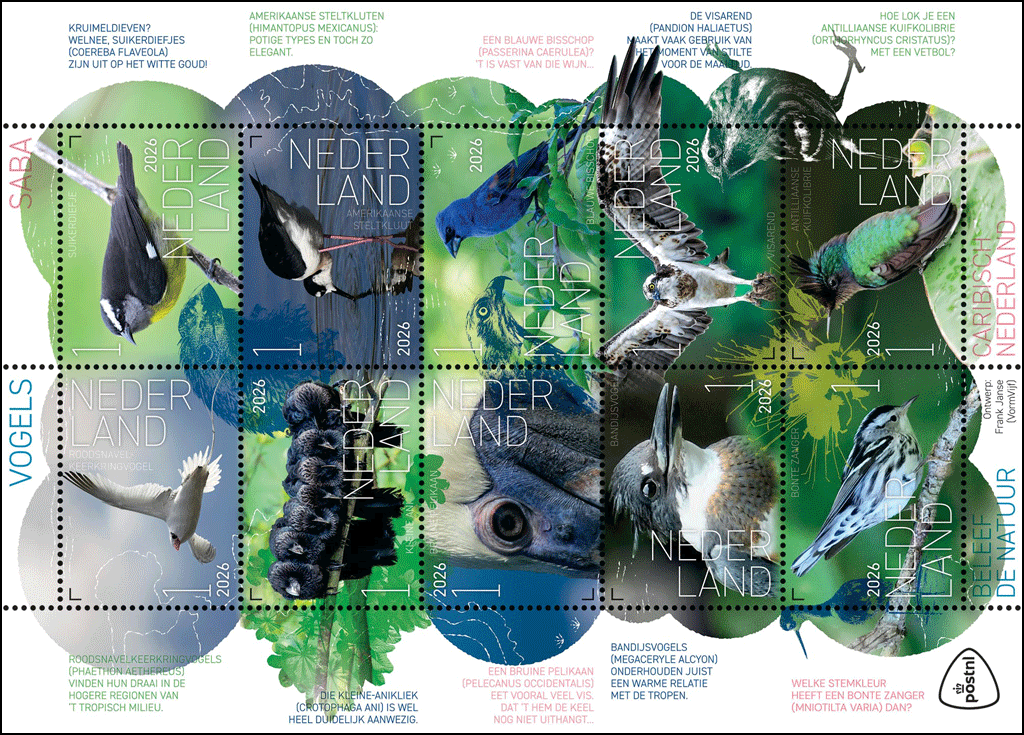
PostNL is issuing the “Experience Nature – Birds of Saba” stamp sheetlet. The sheetlet consists of ten different stamps featuring birds found on the Caribbean island of Saba. With this issue, PostNL continues its multi-year “Experience Nature” stamp series, which focuses on the nature of the Caribbean Netherlands.
These islands boast an extraordinary biodiversity by Dutch standards, with thousands of plant and animal species. In 2026, the focus will successively be on birds, butterflies, underwater life and flora of the windward island of Saba.
Biodiversity of the Caribbean Netherlands
The stamp sheetlet features images of the red-billed tropicbird, bananaquit, smooth-billed ani, black-necked stilt, brown pelican, blue grosbeak, belted kingfisher, osprey, black-and-white warbler and Antillean crested hummingbird. The birds are depicted in their natural habitat and demonstrate Saba’s high biodiversity. Despite its small size, the island boasts 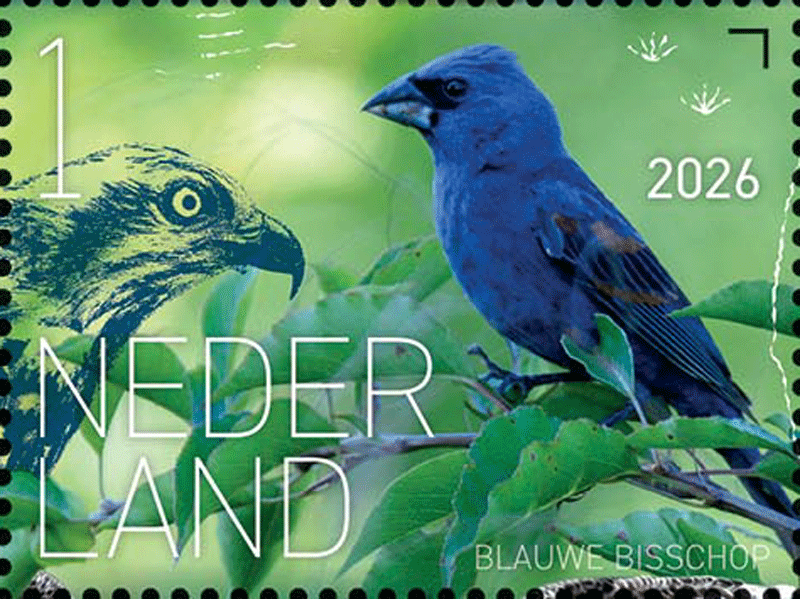 a remarkably rich bird life.
“Experience Nature – Birds of Saba” is part of a series dedicated to the Caribbean Netherlands from 2024 to 2026. In 2026, Saba will be the focus, with stamp sheets featuring not only birds but also butterflies, underwater life, and the island’s flora.
The island of Saba, like Bonaire and Sint Eustatius, has a special status within the Netherlands. Collectively, these three islands are known as the Caribbean Netherlands. Together with Aruba, Curaçao and Sint Maarten, they form the Caribbean 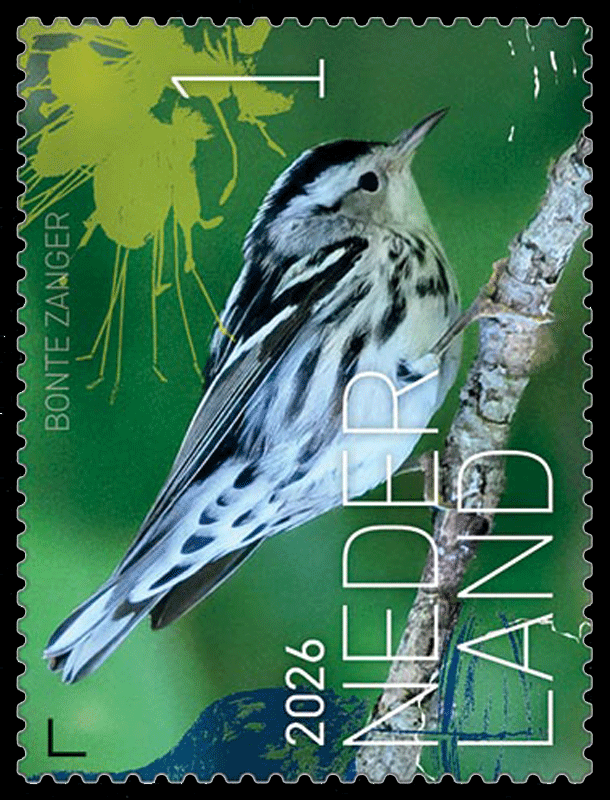 part of the Kingdom of the Netherlands. Roughly circular, the island measures about 4.5 kilometres across (about 2.8 miles) and covers an area of 13 square kilometres (5 square miles). Geologically, Saba is a dormant volcano with four lava domes. Its slopes descend steeply to the sea, and its coastline is rocky. At 870 metres, Mount Scenery is the highest point in the Netherlands. The climate is humid tropical, and the island is covered with secondary rainforest.
Birds are a popular subjects for stamps. “I think it’s mainly the freedom of birds that appeals to people,” said designer Frank Janse. “For a graphic designer, bird photos are rewarding images to work with. Birds are easily recognisable thanks to their iconic shapes, whether circling in the sky or perched on a branch.”
Design
The stamp sheet was designed by graphic designer Frank Janse from Gouda. Through the use of continuous images, circular shapes, and transparent layers, the ten stamps form a cohesive whole, emphasizing the interconnectedness of nature.
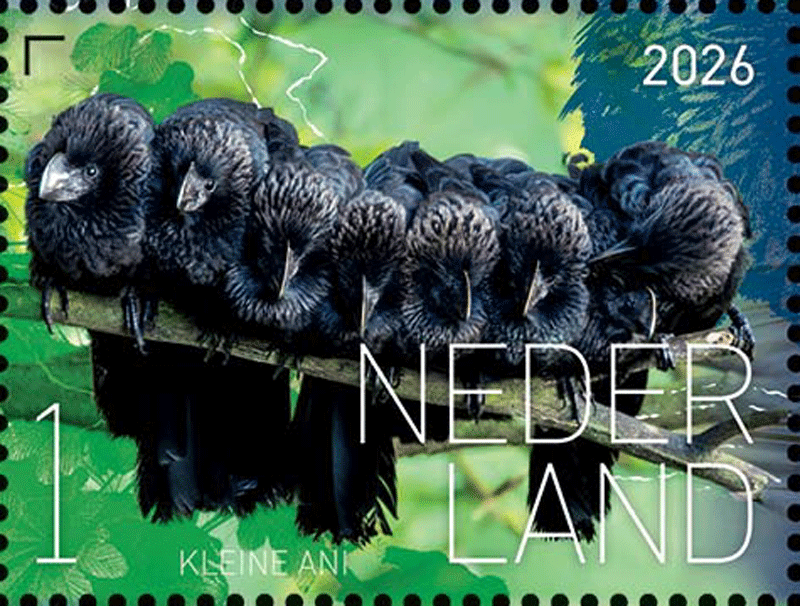 When selecting bird species for these stamps, Janse aimed for maximum variety. “Large and small species, forest, water and coastal birds – and of course, with the osprey, a bird of prey. Based on this distribution, I looked for striking photos I could crop for more variation.” Groups of birds usually don’t work well on stamps because of the small format. “Still, I made an exception for the amusing photo of the smooth-billed anis,” Janse said [above right]. “It looks like a cartoon scene, with them chatting on a twig. The photo’s colours help, with deep black against a light green background.”
Availability
The stamp sheet is available, while supplies last, at PostNL sales points, through the post office in Bruna stores, and online via the PostNL website. The ten stamps have a denomination of “1” for mail up to 20 grams destined for mail within the Netherlands.
Technical Specifications:
 Stamp size: 40 x 30 mm
Sheet size: 122 x 170 mm
Paper: normal with phosphor coating
Gumming: self-adhesive
Printing technique: offset
Colours: cyan, magenta, yellow and black
Print run: 275,000 sheets
Format: sheet of 10 stamps in 10 different designs
Denomination: 1 for items up to 20 grams destined for addresses within the Netherlands
Design: Frank Janse, Gouda
Photography: Dreamstime, Shutterstock and Wikimedia Commons (Korall, lwolfartist, Mykola Swarnyk)
Printer: Koninklijke Joh. Enschedé B.V., Haarlem
Item number: 460161
The Species:
Red-billed tropicbird (Phaethon aethereus)
A seabird from the tropicbird family, found over tropical oceans and breeding on islands in the tropics. Adults are almost entirely white, with a red bill – hence the name – and a wingspan of about one metre. Both sexes have similar plumage. Body length is 91 to 107 cm, including the distinctive elongated tail feather of 46 to 56 cm. This migratory bird is not a strong swimmer and is often seen far out at sea, sometimes hundreds of kilometres from land. It feeds on flying fish and squid, caught by plunge-diving from considerable heights.
Bananaquit (Coereba flaveola)
A songbird from the tanager family, found in northern and eastern South America and the Caribbean. Both sexes have a black crown, a white eyebrow stripe and a bright yellow breast and belly. The chin is light grey and the upperparts blackish-grey. The bananaquit grows up to 11 cm long. Usually solitary, it gathers in groups only where food is abundant. It feeds mainly on nectar, sometimes on fruit. To reach nectar, it pierces the flower base, avoiding pollination – hence its name ‘little thief’.
Smooth-billed ani (Crotophaga ani)
A member of the cuckoo family, found in Florida, Central and South America and the Galápagos Islands. This black bird, also called gladsnavelani in Dutch, has a long tail, short wings and a large, distinctive bill. Both sexes have similar plumage. It measures up to 35 cm and weighs about 125 grams. It nests low in dense shrubs during the warm season and is always seen in noisy groups. It forages mainly on the ground, eating grasshoppers and other insects, and follows livestock to snatch disturbed insects. It even perches on animals to remove ticks.
Black-necked stilt (Himantopus mexicanus)
A wader with very long legs from the stilt family, found as a resident in much of South and Central America, including the Caribbean. This black-and-white bird has long pink legs that extend well beyond the tail in flight. A continuous black area runs from the back along the nape to the head, forming a cap that covers the entire top of the head down to just below eye level, except for a small white patch around the bill and above the eye. It grows to about 35 cm. It forages mainly in mudflats and lake shores, and in very shallow coastal waters, feeding on invertebrates such as shrimp, worms, flies, molluscs, small fish and tadpoles.
Brown pelican (Pelecanus occidentalis)
A waterbird from the pelican family, found along the coasts of North and Central America, the Caribbean and northern South America. Mostly silver-grey and brown, with a white or whitish-yellow head and a chestnut-brown neck. The greenish bare facial skin and throat pouch become more colourful during breeding. Both sexes have similar plumage. It measures 100 to 150 cm and weighs over 3.5 kg. This bird uses its throat pouch as a fishing net. Unlike other pelicans that hunt cooperatively, brown pelicans plunge-dive from height to catch fish.
Blue grosbeak (Passerina caerulea)
A songbird from the cardinal family, found from the southern United States to Costa Rica. This migratory species breeds in northern Mexico and the southern US and winters in Central America. The male is 13 to 20 cm long, with reddish-brown wing bars and stripes on its back, brown eyes, rounded wings and a deep blue bill. The female is similar in size but mostly brown with a hint of blue. Naturally shy, they nest in low trees or shrubs 1 to 2.5 metres above ground, often at the edge of open areas for quick access to food. Summer offers the best chance to spot them as they forage for seeds in fields.
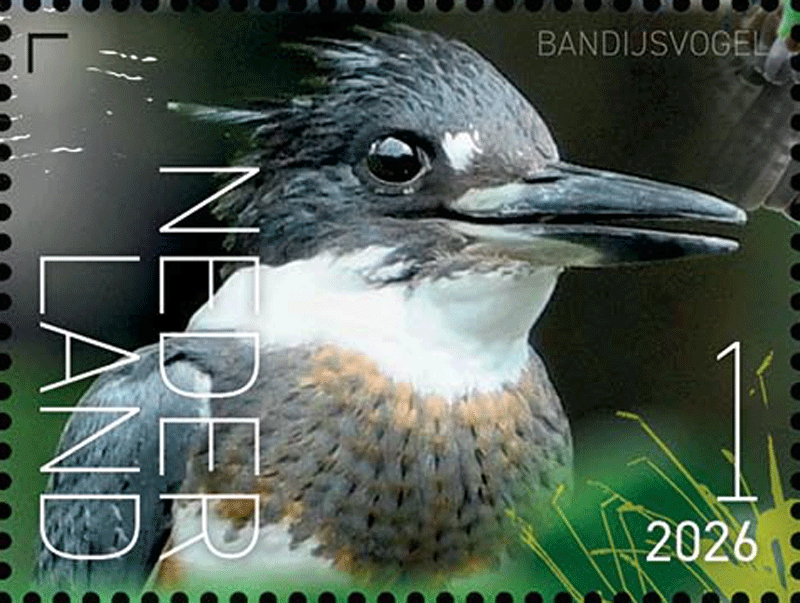
Belted kingfisher (Megaceryle alcyon)
A kingfisher species migrating from Canada and Alaska southwards to Mexico, Central America and the South American and Caribbean coasts. It has a dark head with a broad white collar around the neck. A dark, often iridescent band crosses the chest, giving the bird its name. The rest of the underparts are white, while most of the plumage is grey, with females showing reddish patches along the breast and belly under the wings. It measures 28 to 33 cm and weighs 113 to 178 grams. The nest is in an underground chamber at the end of a tunnel, usually dug into
Osprey (Pandion haliaetus)
The osprey is the only species in the osprey family. With the exception of Antarctica, it is found across all continents. In flight, it is easily recognised by its entirely white underside, chocolate-brown upperparts and slightly ‘angled’ wings. A dark stripe runs through the eye. Both sexes share the same plumage.
It is a relatively small eagle that likes to hover motionless above water before diving for a fish just below the surface with outstretched talons. When it spots a fish, the osprey plunges headfirst and, at the last moment, throws its legs forward to seize its prey. Its talons are razor-sharp, and its feet are equipped with small spines to grip the slippery catch more securely.
Black-and-white warbler (Mniotilta varia)
The black-and-white warbler is a songbird from the American warbler family. It breeds in Canada and the eastern United States and winters further south, as far as northern South America. This bird has a long bill and striking black-and-white plumage, which explains its English name. Its call is a high-pitched whistle, and its body length ranges from 11.5 to 14 cm.
Unlike most American warblers that forage among leaves, the black-and-white warbler climbs and creeps along trunks and thick branches, searching for food such as insects, larvae and spiders, which it extracts from bark crevices with its long bill. The nest is usually built low to the ground in a shrub or at the base of a tree, well hidden. Only the female incubates the eggs, but the male helps feed the chicks.
Antillean crested hummingbird (Orthorhyncus cristatus)
The Antillean crested hummingbird belongs to the hummingbird family. It occurs on Puerto Rico and the windward islands of the Caribbean. The male has an iridescent green plumage on its upperparts that, depending on the light, can appear yellowish or even coppery. Only the flight feathers are dark grey with a purple sheen. The bill is black, slender and straight. The male also sports an upright, shimmering cyan-green crest. The female is less colourful and lacks the crest. This tiny bird measures 8 to 9 cm and weighs between 3½ and 4 grams. It inhabits mangroves, wet and dry tropical lowland forests, thickets and gardens. It feeds mainly on nectar, which it extracts while hovering in front of flowers like a miniature helicopter. The female catches up to 2,000 insects and spiders per day to meet the protein needs of her growing chicks.
 Note: PostNL does not sell directly to collectors in North America. Its website refers to a company called Nordfirm, which says it sells Dutch new issues at face value. The Virtual Stamp Club has no connection to this company.
 Collectors may also wish to contact the U.S. firm Bombay Stamps, which can also obtain first day covers upon request, with lower shipping fees. The email is sales@bombaystamps.com Again, The Virtual Stamp Club has no connection to this company.